AIUEO JLPT Grammar
Meaning
「〜かねない」expresses that there is a possibility for a certain action or result to happen, often used to indicate that a bad result might occur.
How to use it
動詞ます形+かねない
Explanation · 日本語
「〜かねない」は、ある行動や結果が起こる可能性があることを示し、特に悪い結果が起こりうる場合に使われます。
In context 5 examples
このままでは事故がまた起きかねない。
If things continued like this, another accident might happen.
この説明では誤解を招きかねません。
This explanation could be misleading.
彼なら悪事をはたらきかねない、と思った。
I thought to myself that he might be up to something bad.
このままだと、会社は倒産しかねない。
At this rate, the company might go bankrupt.
この情報が漏れると、大きな問題になりかねません。
If this information leaks, it could lead to a serious problem.
文法
Meaning
〜してしまうかもしれない / 〜という悪い結果になる可能性がある
ある原因から悪い結果になる可能性がある。
How to use it
V(ます形)ます + かねない
In context 13 examples
こんなに暑いと熱中症になりかねないよ。
この状況が続くようであれば、会社は倒産しかねませんよ。
そんな運転の仕方では、事故を起こしかねないよ。
最近のマスコミの過剰な報道は、無関係な人を傷つけかねない。
健康的な生活を送らないと、体調を崩しかねません。
あいつは信用できないから、秘密を漏らしかねない。
誤解を招きかねない表現だから、まだ教えるのはよそう。
普通の人ならやらないだろうけど、あの人ならやりかねない。
このまま放置しておくと、大問題に発展しかねない。
そんな状態で運転するなんて、大きな事故につながりかねないよ。
毎日ファストフードばっかり食べてると、病気になりかねないよ。
プログラミングの勉強のためにスクールに通うのはいいけど、通う前に基本的なことを本で学習しておかないと挫折しかねないよ。
最近の若者は、忍耐力がなさすぎる。ちょっと怒っただけで「もう会社辞めます」と言い出しかねないし、どう接していいのかわからない。
Bunpro Grammar Reference
Meaning
Might, Could be, Capable of, Possible
How to use it
Verb[stem]+ かねない
Noun + に + かねない
Verb[stem]+ かねません
Noun + に + かねません
Nuance
A grammar point highlighting that some negative situation might or could be possible due to the logic behind it not being spread too thin.
Explanation
The negative form of the る-Verb 兼ねる 'to spread across' (usually 2 different activities or thought processes) is a grammar pattern that indicates a possibility of (A) happening, especially when it is something that the speaker themselves cannot control. 兼ねない is often translated as 'might (A)', 'capable of (A)', or '(A) is a possibility'.
This structure will be seen connected to the ます-stem of verbs, or after nouns followed by に. Both the kanji and non-kanji forms may be used.
それは命を落としかねない感染症らしい。
Apparently that is an infectious disease that could lead to death.
地震の後には津波が起こりかねないので、出来るだけ早く避難しましょう。
A tsunami might follow an earthquake so try to evacuate as soon as possible.
ベッドでの喫煙は火災になりかねないのでご遠慮ください。
Please refrain from smoking on the bed as it might cause a fire.
仕事のやりすぎは、鬱の原因になりかねない。
Working too much could be a cause of depression.
It is quite common to see 兼ねない come after conditional phrases that include と, ば, たら, でも, and similar structures. This indicates that 'if (A) were to happen, (B) may also occur'.
操作を間違えれば怪我人が出かねない。
If you operate it wrong, it could cause injuries.
どんなに注意をしていても、事故は起こりかねない。
No matter how careful you are, accidents might happen.
Caution
While this grammar structure is most often used to highlight negative outcomes, it may also be used to indicate or desire or wish sarcastically.
ちゃんと毎日勉強すれば、来週のテストは合格できかねない。
If I study everyday, I might do well on the test next week.
Fun-fact
As 兼ねる means 'to spread across', in the negative, this expression can be thought of as similar to 'to not be a stretch' in English. It just indicates the action of (A) would not be a stretch of the ability or capacity of whoever or whatever is being discussed.
彼女はどんな病気でも治しかねない。
It wouldn't be a stretch to say that she can cure any disease.
Nuance · 日本語
その論理が広がりすぎていないため何か悪いことが起こる可能性が高まるということを強調する時に使われる文法。
Explanation · 日本語
一段動詞「兼ねる」の否定形「兼ねない」は、話し手自身がコントロールできない状況で (A) が起こる可能性があることを示す文型です。これは「(A) かもしれない」や「(A) という可能性がある」のような意味で使われます。
この文型は動詞のマス形や「に」を伴う名詞の後に置かれます。表記は漢字のこともひらがなのこともあります。
それは命を落としかねない感染症らしい。
Apparently that is an infectious disease that could lead to death.
地震の後には津波が起こりかねないので、出来るだけ早く避難しましょう。
A tsunami might follow an earthquake so try to evacuate as soon as possible.
ベッドでの喫煙は火災になりかねないのでご遠慮ください。
Please refrain from smoking on the bed as it might cause a fire.
仕事のやりすぎは、鬱の原因になりかねない。
Working too much could be a cause of depression.
「兼ねない」は「と」「ば」「たら」「で」などの条件を表す文型とよく一緒に使われ、「もし (A) が起こったら、(B) も起こるかもしれない」という意味を表します。
操作を間違えれば怪我人が出かねない。
If you operate it wrong, it could cause injuries.
どんなに注意をしていても、事故は起こりかねない。
No matter how careful you are, accidents might happen.
注意点
この文型は悪い結果を強調するために使われるのがふつうですが、希望や願いについて皮肉として使われることもあります。
ちゃんと毎日勉強すれば、来週のテストは合格できかねない。
If I study everyday, I might do well on the test next week.
豆知識
「兼ねる」の「一つで二つ以上の役割を果たすこと」という意味は「広げる」や「伸ばす」とニュアンスにも通じています。「兼ねる」が (A) という行動が、話し手が対応できる範囲を超えて、広がってしまっている、伸びてしまっているようにイメージできるのに対し、「兼ねない」はその範囲を超えていないことを示します。
彼女はどんな病気でも治しかねない。
It wouldn't be a stretch to say that she can cure any disease.
In context 20 examples
- この事をそのままにしていたら、摩擦を生み兼ねない。
If you leave it at that, it might cause conflict.
- それは命を落としかねない感染症らしい。
Apparently that is an infectious disease that could lead to death.
- どんなに注意をしていても、事故は起こりかねない。
No matter how careful you are, accidents might happen.
- 地震の後には津波が起こりかねないので、出来るだけ早く避難しましょう。
A tsunami might follow an earthquake so try to evacuate as soon as possible.
- ベッドでの喫煙は火災になりかねないのでご遠慮ください。
Please refrain from smoking on the bed as it might cause a fire.
- 仕事のやりすぎは、鬱の原因になりかねない。
Working too much could be a cause of depression.
- 操作を間違えれば怪我人が出かねない。
If you operate it wrong, it could cause injuries.
- 危険な運転をすれば、事故が起こり兼ねない。
If you drive dangerously, an accident might occur.
- この犬に噛まれたら、大怪我をしかねない。
If this dog bites you, it is capable of causing serious injury.
- この程度の怪我でも、ウイルスに感染し兼ねない。
Even with this degree of injury, you might get a viral infection.
- 灯油の保管をちゃんとしないと、火事になり兼ねない。
If you don't properly store kerosene, a fire is possible.
- この書類を開示されてはスキャンダルが起き兼ねないから、処分する必要があります。
If those documents are disclosed, it might cause a scandal, so it is necessary to get rid of them.
- このままでは以前と同じパターンになり兼ねないから、もっと工夫してください。
Continuing like this, we could end up with the same pattern as before, so please think of a better idea.
- 彼は問題を増やし兼ねないから、誰かちゃんとアドバイスしてください。
Since it is possible he may end up increasing the problems, someone please give him some proper advice.
- この暑さでマラソン大会を行なったら、死者も出兼ねない。
If we hold a marathon in this heat, it is possible someone might die.
- 賞味期限切れの食品は、下痢の原因になり兼ねない。
Expired food could be a cause of diarrhea.
- あの財閥は、目的を達するためなら他人などかまわず何でもやり兼ねない。
That firm is quite capable of doing anything to reach their goals without any regard to other people.
- あの様子だとまた家出し兼ねない。そうならないように、話を聞いてあげてください。
It looks like they might run away from home again. Please listen to them so that doesn't happen.
- ちゃんと毎日勉強すれば、来週のテストは合格できかねない。
If I study everyday, I might do well on the test next week.
- 彼女はどんな病気でも治しかねない。
It wouldn't be a stretch to say that she can cure any disease.
絵でわかる日本語
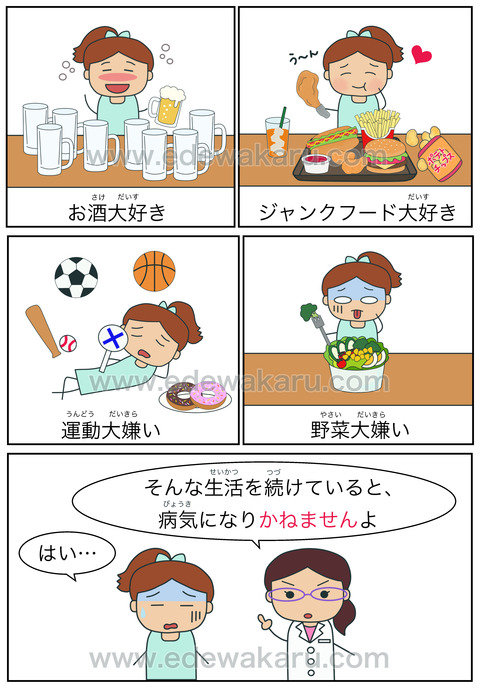
Meaning
(悪いことが起きる)かもしれない
(悪い結果になる)可能性がある
How to use it
動詞[ます形]+かねない
Explanation
「〜かねない」は「悪いことが起きるかもしれない」「悪い結果になる可能性がある」という意味を表す文型です。 この文型は
「悪いこと」や「悪い結果」にしか使うことができません
ので、いいことに使う場合は「〜かもしれない」を使うようにしましょう😊
(復習:〜ようにする)
[例]
❌病気が治り
かねない
⭕️病気が治る
かもしれない
「〜かねない」はかたい言い方ですので
【書き言葉】
として使われます。また、漢字で書くと
「〜兼ねない」
になると覚えておきましょう😀
(復習:〜として)
In context 5 examples
そんな生活を続けていると、病気になりかねませんよ
→病気になる可能性がありますよ遅刻してばかりいると首になりかねないよ
→首になるかもしれないよ(復習:〜てばかりいる・〜てばかりだ)(復習:首にする・首になる)彼は100点を取るためだったら、カンニングをしかねない
→カンニングをするかもしれない(復習:〜ために(目的))(復習:カンニング)歩きスマホをしていたら、事故に遭いかねないよ
→事故に遭う可能性があるよ(復習:歩きスマホ)山田くんは口が軽いので、秘密を言ってしまいかねない
→秘密を言ってしまう可能性がある(復習:口が軽い)(復習:〜てしまう)
日本語文型辞典
Meaning
基本情報R-かねない説明その可能性・危険性がある、という意味。「かもしれない」「ないとは言えない」などと近いが、この「かねない」は、話し手がマイナスの評価をあたえるものにしか使えない。例文① 風邪だからといってほうっておくと、大きい病気になりかねない。② 君は、彼がそんなことをするはずがないと言っているそうだが、ぼくはあいつならやりかねないと思うけどね。③ 政府の今回の決定はいくつかの問題点をはらんでおり、近隣諸国の反発をまねきかねない。④ 今回の土砂崩れは二次災害を引き起こしかねないものであり、対策を急がねばならない。例文(誤) 私のこどものこの病気はなおりかねない。例文(正) 私のこどものこの病気はなおるかもしれない。説明書きことば的。
日本語文型辞典 英語版
Meaning
【かねない】[R-かねない]
Means there is a possibility or a danger of something. Similar to かもしれない and ないとはいえない, but かねない can only be used for something the speaker evaluates negatively.
(×)私のこどものこの病気はなおりかねない。
This disease of my child’s may be cured.
(○)私のこどものこの病気はなおるかもしれない。
This disease of my child’s may be cured.
A formal expression often used in written language.
In context 4 examples
風邪だからといってほうっておくと、大きい病気になりかねない。
If you just think it’s a cold and let it go, it may turn into a serious illness.
君は、彼がそんなことをするはずがないと言っているそうだが、ぼくはあいつならやりかねないと思うけどね。
I hear you’re saying you’d never expect him to do such a thing, but I wouldn’t put it past him to do it.
政府の今回の決定はいくつかの問題点をはらんでおり、近隣諸国の反発をまねきかねない。
This decision by the government entails some problems and may invite some resistance from neighboring countries.
今回の土砂崩れは二次災害を引き起こしかねないものであり、対策を急がねばならない。
This landslide may lead to a secondary disaster, so countermeasures have to be taken quickly.
くらべてわかる日本語表現文型辞典
Meaning
Aという事態にならないとはいえないというあいまいな表現。自分のことには使わないが、自身でコントロールできないことには使える。
How to use it
Aかねない
[動詞-ます形]かねない
Notes
【注意1】
・Aの事態は話し手が好ましくないと思っている場合に使うことが多いが、望んでいる事態に皮肉・ユーモアを込めて使うこともある。
○このままの勢いでいけば、今年は阪神が優勝しかねないぞ。
・意味1のような「これから起こる可能性」だけでなく、過去の事実に対して可能性が大いにあると納得する場合にも使う。
○「昨日のパーティーで田中さんったら、殴り合いの喧嘩をしたのよ。」
「あいつなら、やりかねないなあ。」(するだろうな)
In context 4 examples
無責任な彼のことだから、約束していても忘れかねないよ。
あのビルを早く撤去しなければ、倒壊しかねない。
コンセント付近はまめに掃除しておかないと、火災を起こしかねない。
俺は短気だから、カッとなったら辞表を出しかねないぞ。
日本語NET JLPT文法解説まとめ
Meaning
"〜してしまうかもしれない / 〜という悪い結果になる可能性がある"
ある原因から悪い結果になる可能性がある。
How to use it
V(ます形)ます + かねない
Explanation
"It could end up doing ~ / There's a possibility of a bad outcome such as ~"
Indicates the possibility of a certain cause leading to an unfavorable effect.
In context 13 examples
こんなに暑いと熱中症になりかねないよ。
この状況が続くようであれば、会社は倒産しかねませんよ。
そんな運転の仕方では、事故を起こしかねないよ。
最近のマスコミの過剰な報道は、無関係な人を傷つけかねない。
健康的な生活を送らないと、体調を崩しかねません。
あいつは信用できないから、秘密を漏らしかねない。
誤解を招きかねない表現だから、まだ教えるのはよそう。
普通の人ならやらないだろうけど、あの人ならやりかねない。
このまま放置しておくと、大問題に発展しかねない。
そんな状態で運転するなんて、大きな事故につながりかねないよ。
毎日ファストフードばっかり食べてると、病気になりかねないよ。
プログラミングの勉強のためにスクールに通うのはいいけど、通う前に基本的なことを本で学習しておかないと挫折しかねないよ。
最近の若者は、忍耐力がなさすぎる。ちょっと怒っただけで「もう会社辞めます」と言い出しかねないし、どう接していいのかわからない。
IMABI
Potential IV
Read this IMABI lesson ↗Explanation
Potential IV: ~かねる・かねない VS ~きれる・きれない VS ~える/うる・~えない
Now that you have learned more Japanese, it is now time to delve into differences with phrases related to “can” or “can’t” that are more advanced and somewhat difficult to get straight. Be careful with the role of ~ない in this lesson.
Certainly, when a student realizes that 理解しきれない, 理解しえない, and 理解しかねる are possible on top of 理解できない, to the student, it seems at first glance that they must be interchangeable because they all translate as “can’t understand”. However, as with any similar phrases in Japanese, there will always be differences. Let’s get started at figuring out what these differences are.
Although there are clear nuance differences and writing style differences between them, as the example with 理解する demonstrates, ~きれない, ~えない, and ~かねる have the basic meaning of “can’t”. It’s now time to look at them individually and then compare.
~かねる・かねない
The 一段 verb かねる means “to serve/combine two or more functions or roles simultaneously”. Other verbs that could be used instead for this include 組み合わせる and 兼ね備える.
1. 彼は教師と教育理事長を兼ねています。
He is both a teacher and the education chair.
2. 彼はその二つの部の部長を兼ねています。
He is in charge of the two departments.
3. 総理が外相を兼ねた。
The Prime Minister concurrently held the Foreign Minister position.
4. 朝ごはんと昼ごはんをかねて遅めに食べることが多い。
I eat breakfast with lunch late a lot.
5. 応接間と書斎しょさいを兼ねた部屋です。
This is a room that serves as a parlor and a library.
6. 趣味を兼ねた仕事
Job combined with hobbies
7. 観光と取材をかねて旅行していた。
We were traveling to both sight-see and cover an event.
Meaning Note: News’ crews go places all the time not to just cover the story, but also to enjoy the place they’re at.
~かねる shows that something is impossible. This is more so impossibility of doing something in a certain situation. Say you really hate someone, and you are asked if you’re going to agree with him, you might say “I can’t agree with such a person”. So, it expresses the inability, reluctance, or refusal to do something. It can be translated as “cannot” or “(am) not able.”
8. 彼は、「表明には承服しょうふくしかねる」と怒りの面持おももちで言ったそうだ。
I hear that he said that he could not consent with the assertion with an angry face.
9. そんな悪徳あくとく業者には賛成しかねる。
I cannot agree with such an unscrupulous businessman.
10. そんな方法には賛成しかねる。
I can’t approve of such methods.
11. 動機を図りかねる。
To not be able to fathom the motive.
12. この場では決めかねますので、また別途べっと会議を設けましょう。
Since it is impossible to decide at this place, let’s set up a separate meeting again.
13. 彼女は彼氏が来るのを待ちかねていた。
She couldn’t wait for her boyfriend to come.
14. 申しかねますが。
I hesitate to say but…
~かねない is the negative form of -かねる. Since -かねる shows the impossibility, -かねない shows that something very well “can” happen. This ending is especially used when the situation is bad. So, it means that there is a danger/possibility that the bad thing might occur.
15. 彼は嘘をつきかねない男だ。
He is a man capable of telling a lie.
16. 彼なら嘘をつきかねないと思う。
I wouldn’t put it past him to lie.
17. このまま進めば、人間の絶滅をも引き起こしかねない。
If it continues at this rate, it may lead to human extinction.
18. このままでは、個人情報が漏洩ろうえいしかねない。
At this rate, personal information might be leaked.
19. このレフェリーは規則にうるさいので試合を台無しにしかねない。
This referee is fussy about the rules, so he could ruin the match.
20. 彼はせっかくのチャンスを棒ぼうに振ってしまいかねない。
He might end up making a complete waste of an opportune moment.
~きれる・きれない
This is the potential form of ~切る. It is used to show that you can completely do something, of which a lot is to be done. So, it’s negative form, ~きれない shows that you can’t do this.
So, as for 理解しきれない, you can still understand somewhat, but you can’t understand entirely. It is often used with expressions that show quantity and degree. It is often written in 漢字 as ~切れない.
21. 学校でいくら注意しても子供を守りきれないんだよ。
No matter how much we warn them at school, we cannot completely protect the kids.
22. 彼の行為こういは言葉で褒ほめ切れないほど立派ですよ。
His actions are beyond praise.
23. 言い切れます。
I can completely say (that…).
24. 1日で食べきれないほどのバナナを買いました。
I bought more bananas than can be eaten all in a day.
25. 待ちきれなかった。
We couldn’t wait (completely).
~える・うる/~えない
Though this has already been taught in Potential II, remember that this pattern is old-fashioned and used in the written language. It doesn’t show that something is literally impossible, but that since the conditions don’t match up, the possibility is slim to none. With non-volitional verbs the interpretation changes slightly to more of “it shouldn’t/can’t be that…”.
26. 期待しえないことだ。
It’s something that you can’t anticipate.
27. 忘れ得ぬ日
A day I can never forget
28. 過酷事故かこくじこは原理上げんりじょう起こりえない。
Severe accidents in theory can’t occur.
Compare and Contrast
All of these endings show impossibility in the forms ~かねる, ~きれない, and ~えない, but let’s see how well they can be used in a situation of stating one’s actual abilities.
29.
A: 韓国に来てどのくらいですか。
B: 半年です。
A: 韓国語はどの程度話せますか。
B: まだ十分話{〇 せません・△ しきれません・X しえません・X しかねます}。
A: How long has it been since you came to Korea?
B: It’s been half a year.
A: How much Korean can you speak?
B: I still can’t speak well enough.
From this data we can see that these endings cannot simply be used to show capacity.
The situation is not saying that you can’t speak a certain quantity of something completely. The situation is asking for your competency of the language itself. So, ~きれない is not correct.
Now, consider the following.
30. 田中が犯人だと断定できましたか。
Could you conclude that Tanaka is the criminal?
31.
Response 1: いえ、彼が犯人だとは断定できません。
Response 2: いえ、彼が犯人だとは断定しきれません。
Response 3: いえ、彼が犯人だとは断定しえません。
Response 4: いえ、彼が犯人だとは断定しかねます。
Translation: No, I cannot conclude that he is the criminal.
In this case, all four responses are correct, but they are all slightly different. In the first response, you are objective stating that it is impossible to decide. In the second situation, you state that you can’t 100% call him the criminal because there is still some doubt. In the third response, you can’t say that he is the criminal given the surrounding circumstances. It is also very uncommon to use this in 話し言葉. The fourth response implies that you refrain from stating definitively that he is the criminal.
With the last comment, you can see how ~かねる can be used in polite contexts in denying/rejecting things.
32. いろいろ考慮しましたが、お引き受けしかねます。
I’ve thought hard on this, but I cannot undertake it.
So, even in situations where all are possible, there will be differences as defined thus far. They are all used in showing that one can’t decide one way or another, as demonstrated by the criminal example.
33. 生徒が本当に分かっているのかどうか判断し{きれない・えない・かねる}。
I can’t determine whether or not the students really understand.
They can also be used in situations where because of a certain reason or cause, you can’t do something or it is extremely difficult to do something. The fine details, of course, are predicated on the pattern you choose.
34. 大きすぎて、把握はあくし{きれない・えない ・かねる}問題だ。
It’s a problem too big that I cannot fully grasp.
Remember that ~かねる implies that the speaker has a feeling of reluctance, which is part of the reason why they “can’t”. Again, as for ~えない, a consensus of the various circumstances can’t be made. So, in this example that means that the speaker can’t grasp certain parts due to conflicting issues.
Words Used
It is now time to examine what kinds of words these items are frequently used with to even further distinguish them.
X~きれない: Used with verbs concerning with degree, quantity. It is also used with volitional verbs in regards to recognition and decision. Ex. 数える, 押さえる, 対処する, 理解する, 等.
35. 彼のアリバイ説明で納得しきれないところがあります。
There are parts I’m not completely convinced in his alibi’s explanation.
X~えない: Used with volitional verbs in concern with recognition, progress, and remarking. It is not used with simple action verbs like 見る, 食べる, 飲む, 等. Verbs it is used with include 予期する, 期待する, 達成する, 等. It can also be used with non-volitional verbs such as ある, 存在する, 起こる, 等.
36. そんなことはありえないでしょう。
Isn’t something like that impossible?
37. 理解し得ない感情
Feelings that one cannot understand
38. 金にならないものは評価され得ない。
Something that won’t make money is cannot be assessed.
39. 客観的中立メディアなど存在し得ない。
An objective, neutral media cannot exist.
X~かねる: It too is used with volitional verbs of decision but also agreement, and it is also used in a lot of other expressions given its sense of reluctance. Ex. 理解する、決める, 耐える, 等.
40. すぐには決めかねます。
I can’t decide immediately.
41. 激痛げきつうに耐たえかねて呻うめく。
To not be able to bear the great pain and moan.
42. 先週、夫の虐待ぎゃくたいに耐えかねて、花子は実家に帰った。
Last week, unable to stand her husband’s abuse, Hanako returned to her parent’s house.
In context 40 examples
彼は教師と教育理事長を兼ねています。
He is both a teacher and the education chair.
彼はその二つの部の部長を兼ねています。
He is in charge of the two departments.
総理が外相を兼ねた。
The Prime Minister concurrently held the Foreign Minister position.
朝ごはんと昼ごはんをかねて遅めに食べることが多い。
I eat breakfast with lunch late a lot.
応接間と書斎しょさいを兼ねた部屋です。
This is a room that serves as a parlor and a library.
趣味を兼ねた仕事
Job combined with hobbies
観光と取材をかねて旅行していた。
We were traveling to both sight-see and cover an event.
彼は、「表明には承服しょうふくしかねる」と怒りの面持おももちで言ったそうだ。
I hear that he said that he could not consent with the assertion with an angry face.
そんな悪徳あくとく業者には賛成しかねる。
I cannot agree with such an unscrupulous businessman.
そんな方法には賛成しかねる。
I can’t approve of such methods.
動機を図りかねる。
To not be able to fathom the motive.
この場では決めかねますので、また別途べっと会議を設けましょう。
Since it is impossible to decide at this place, let’s set up a separate meeting again.
彼女は彼氏が来るのを待ちかねていた。
She couldn’t wait for her boyfriend to come.
申しかねますが。
I hesitate to say but…
彼は嘘をつきかねない男だ。
He is a man capable of telling a lie.
彼なら嘘をつきかねないと思う。
I wouldn’t put it past him to lie.
このまま進めば、人間の絶滅をも引き起こしかねない。
If it continues at this rate, it may lead to human extinction.
このままでは、個人情報が漏洩ろうえいしかねない。
At this rate, personal information might be leaked.
このレフェリーは規則にうるさいので試合を台無しにしかねない。
This referee is fussy about the rules, so he could ruin the match.
彼はせっかくのチャンスを棒ぼうに振ってしまいかねない。
He might end up making a complete waste of an opportune moment.
学校でいくら注意しても子供を守りきれないんだよ。
No matter how much we warn them at school, we cannot completely protect the kids.
彼の行為こういは言葉で褒ほめ切れないほど立派ですよ。
His actions are beyond praise.
言い切れます。
I can completely say (that…).
1日で食べきれないほどのバナナを買いました。
I bought more bananas than can be eaten all in a day.
待ちきれなかった。
We couldn’t wait (completely).
期待しえないことだ。
It’s something that you can’t anticipate.
忘れ得ぬ日
A day I can never forget
過酷事故かこくじこは原理上げんりじょう起こりえない。
Severe accidents in theory can’t occur.
田中が犯人だと断定できましたか。
Could you conclude that Tanaka is the criminal?
いろいろ考慮しましたが、お引き受けしかねます。
I’ve thought hard on this, but I cannot undertake it.
生徒が本当に分かっているのかどうか判断し{きれない・えない・かねる}。
I can’t determine whether or not the students really understand.
大きすぎて、把握はあくし{きれない・えない ・かねる}問題だ。
It’s a problem too big that I cannot fully grasp.
彼のアリバイ説明で納得しきれないところがあります。
There are parts I’m not completely convinced in his alibi’s explanation.
そんなことはありえないでしょう。
Isn’t something like that impossible?
理解し得ない感情
Feelings that one cannot understand
金にならないものは評価され得ない。
Something that won’t make money is cannot be assessed.
客観的中立メディアなど存在し得ない。
An objective, neutral media cannot exist.
すぐには決めかねます。
I can’t decide immediately.
激痛げきつうに耐たえかねて呻うめく。
To not be able to bear the great pain and moan.
先週、夫の虐待ぎゃくたいに耐えかねて、花子は実家に帰った。
Last week, unable to stand her husband’s abuse, Hanako returned to her parent’s house.
どんなときどう使う 日本語表現文型辞典
Meaning
could
How to use it
Vます+かねない
Explanation
~かもしれない
話者が結果や成り行きを危惧して、「~という悪い結果になる可能性がある」と言いたいときに使う。
Speaker apprehends result or course of events as having potential of being adverse.
In context 3 examples
そんな乱暴な運転をしたら事故を起こしかねないよ。
食事と睡眠だけはきちんと取らないと、体を壊すことになりかねません。
最近のマスコミの過剰な報道は、無関係な人を傷つけることにもなりかねない。
毎日のんびり日本語教師
How to use it
動ます形+兼ねない
Explanation
良くない可能性や危険性があることを表します。
話者の物事に対する負の評価として使います。
Notes
関連文法「【N2文法】~兼ねる(かねる)」
In context 16 examples
彼女は信用できないので秘密を漏らしかねない。
こんなにも暑いと熱中症になりかねないから、ちゃんと水分補給しよう。
この手の曖昧な表現は混乱を招きかねない。
まさかとは思うが、あいつならやりかねない。
肥満は様々な病気の原因にも繋がりかねない。(肥胖可能会导致各种各样的疾病。)
これは一歩間違えれば死傷者が出かねない事態です。
センター試験は人生を左右しかねない大切なものだ。
ギターは間違った方法で練習すると挫折しかねない。
マスクしながらの運動だから余計に暑く、水分補給しないと脱水症状になりかねないです。
守秘義務を違反すれば裁判沙汰になりかねない。
爆発的な感染拡大により医療崩壊を招きかねない状態となっている。
食べ過ぎてしまうと、お腹を下してしまう原因になり兼ねないので気をつけましょう。
トンネル内は一度火災が起これば大惨事に発展し兼ねない。
留年はその後の進路や人生を左右しかねない。
遺書がないと自分の死後トラブルに発展しかねないのでちゃんと書いておきましょう。
公園にはガラスの破片など、怪我をし兼ねないようなものが落ちていました。