DoJG 日本語文法辞典(全集)
Meaning
Seem; look like; apparently; I heard
How to use it
(i) {V/Adjective い} informal | らしい | |
| {話す /話した} らしい | It seems that someone (will) talk/talked |
| {高い /高かった} らしい | It seems that something is/was expensive |
(ii) {Adjective な stem/ Noun} | {Ø/だった} らしい | |
| {静か /静かだった} らしい | It seems that something is/was quiet |
| {先生 /先生だった} らしい | It seemst aht someone is/was a teacher |
Explanation
An auxiliary adjective which indicates that the preceding sentence is the speaker’s conjecture based on what he has heard, read or seen.
In context 6 examples
松田さんはアメリカへ行くらしい・らしいです。
It seems that Mr. Matsuda is going to America.
杉本さんはもう帰ったらしいです。
Mr. Sugimoto seems to have gone home already.
あの学校の入学試験は難しいらしい。
That school's entrance exam seems difficult.
この辺りはとても静からしいです。
This neighbourhood seems very quiet.
その話は本当らしい。
That story seems true.
ここは学校らしい。
This place seems to be a school.
日本語文型辞典
Meaning
a. NらしいN
同じ名詞を繰り返してその名詞の表すものの中の典型的なものを表す。
b. Nらしい
名詞に付き、そのものの典型的な性質がよく表れていることを表す。
文末に付いて、話し手がその内容をかなり確実度の高いことがらであると思っていることを表す。その判断の根拠は外部からの情報や観察可能なことがらなど客観的なものであり、単なる想像ではない。例えば、①は、「雨らしい」と判断したのは、天気予報という情報によるものだということ。⑤は、「試験がうまくいかなかったらしい」と判断したのは「帰ってくるなり部屋に閉じ込もってしまった」という状況からだということ。「みたいだ」「そうだ」との違いについては「みたいだ2」を参照。
How to use it
Nらしい
…らしい
N/Na/A/V らしい
In context 15 examples
最近は子供らしい子供が少なくなった。
男らしい男ってどんな人のことですか。
あの人は本当に先生らしい先生ですね。
このところ雨らしい雨も降っていない。
今日は春らしい天気だ。
弱音を吐くなんて君らしくないね。
彼はいかにも芸術家らしく奇抜なかっこうで現れた。
彼女が選んだ花束はいかにも彼女らしいやさしい色合いだった。
天気予報によると明日は雨らしい。
新しく出たビデオカメラはとても便利らしい。
みんなの噂では、あの人は国では翻訳家としてかなり有名らしい。
彼はどうやら今の会社を辞めて、自分で会社を作るらしい。
兄はどうも試験がうまくいかなかったらしく、帰ってくるなり部屋に閉じ込もってしまった。
その映画は予想以上におもしろかったらしく、彼は何度もパンフレツトを読み返していた。
料理はいかにも即席で用意したらしく、インスタントのものがそのまま並んでいた。
絵でわかる日本語
Usage 1
Read this source entry ↗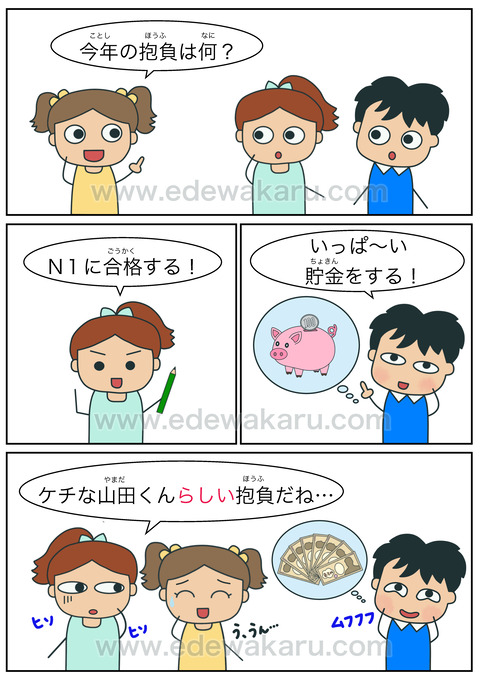
Meaning
〜が持っている性質・性格を十分に表している
〜の性質が十分に表れている
〜と呼ぶのにふさわしい
How to use it
名詞[辞書形]+らしい
Explanation
「Aらしい」は「A」の典型的な性質を表す文型で、「Aの性質が十分に表れている」「Aと呼ぶのにふさわしい」という意味を表します。
[例]
①A:山田くん
らしい
抱負だね…
→山田くんの性格がよく表れている抱負だね
②今日は暖かくて、春
らしい
天気だね
→春と呼ぶのにふさわしい天気だね
③私の彼氏は男
らしくて、すごくステキなのよ
→私の彼氏は男と呼ぶのにふさわしい、すごくステキな人なのよ
④バイトばっかりしていないで、学生
らしく
しっかり勉強をしなさい
→学生と呼ぶのにふさわしく、しっかり勉強をしなさい
⑤B:あきらめるなんて、君
らしく
ないよ
→あきらめるなんて、いつもの君とはすごく違うね
「〜らしい」には【推量】を表す用法もありますので、復習しておきましょう。
In context 5 examples
A:今年の抱負は?山田:100万円貯金する!A:山田くんらしい抱負だね…
今日は暖かくて、春らしい天気だね
私の彼氏は男らしくて、すごくステキなのよ
バイトしてばかりいないで、学生らしくしっかり勉強をしなさい
A:また不合格だった…もうあきらめようかな…B:あきらめるなんて、君らしくないよ
Usage 2
Read this source entry ↗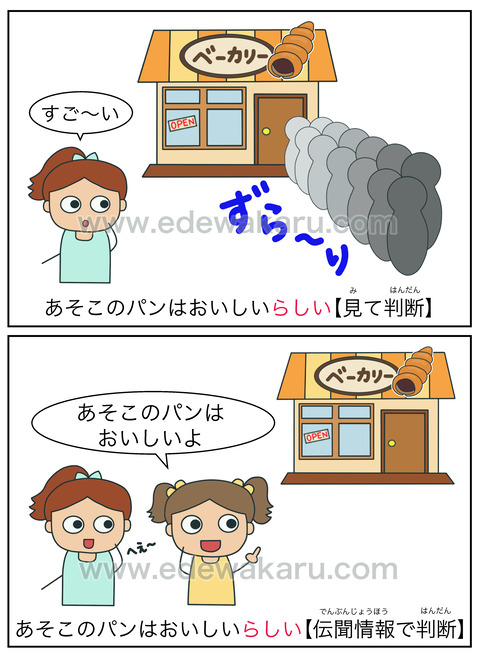
Meaning
たぶん〜と思う
〜だそうだから、〜と思う
How to use it
動詞[普通形]+らしい
形容詞[普通形]+らしい
名詞[普通形]+らしい
Explanation
「〜らしい」は[推量]を表す文型で「たぶん〜と思う」「〜だそうだから〜と思う」という意味を表します。「〜らしい」は
何かを見たり聞いたりして判断した時
や、
誰かに聞いて得た伝聞情報で判断する時
に使用されます😊
使い方や場面によっては【見たり聞いたりして推量】【伝聞情報で推量】両方の意味と考えられる場合もあります
😮
(復習:〜によって(区別))
[例]
①あそこのパンはおいしい
らしい
【見る・聞く】たくさんの人が並んでいるのを
見て
「おいしい」と判断
【伝聞情報】友達に
聞いた
情報
(復習:〜ている(結果の状態))
②雨が降った
らしい
【見る・聞く】道や車が濡れているのを
見て
判断
【伝聞情報】お母さんに
聞いた
情報
③彼女はもうすぐ結婚する
らしい
【見る・聞く】彼女が「婚約指輪(こんやくゆびわ)」をしているのを
見た
【伝聞情報】友達に
聞いた
情報
(復習:〜をする(装身))
また、例文⑤のように伝聞情報で推量する場合は
「〜によると」
と一緒に使われることもあります。
(復習:〜によると・〜によれば)
(復習:〜ことがある)
[推量]を表す「〜らしい」は【見たり聞いたりして判断する】場合は「〜ようだ(五感推量)」にとても似ています。また【伝聞情報で判断する】場合は「〜そうだ(伝聞)」の使い方に似ていて混乱しがちです😨これらは全部初級の文型ですが、とても複雑ですのでしっかりと復習しておきましょう😀また、「〜らしい」には【典型】を表す用法もありますので、一緒に覚えておきましょう。
【関連文型】
In context 5 examples
あそこのパンはおいしいらしい
雨が降ったらしい
彼女はもうすぐ結婚するらしい
山田くんは首になるらしい(復習:首にする・首になる)
ニュースによると、今年の夏も暑いらしい
どんなときどう使う 日本語表現文型辞典
Usage 1
Meaning
seems that
How to use it
〔普通形〕(ナA/N)+らしい
Explanation
らしい〈推量〉
1)話す人が見たり聞いたりしたことから、現時点で判断したことを言いたいときに使う。直感でそう思ったのではなく、そのように推測した客観的な根拠が何かある場合に使うことが多い。自分の主観だけで言うときに使うと不自然である。
◆ × (わたしの)目の中にごみが入ったらしいです。
2) ❹ のように人から聞いたことを伝える場合にも使う。
3)話す人の意志的な行為の予測には使わない。
4)イ形容詞と同じように活用するが、現在の推量を表す言い方なので普通、過去形や否定形では使わない。
◆ × (わたしの)目の中にごみが入ったらしいです。
4)Conjugates like イ-adjectives, and since expresses cur-rent conjecture, usually not found in past tense or negative.
1)Speaker makes judgment based on what was seen or heard at that moment. Often used when there is some objective basis for judgment rather than just intuition. Unnatural to use simply based on speaker's subjectivity.
2)Also used to convey something heard from someone, as in sentence ❹ .
3)Not used for predicting speaker's volitional actions.
In context 5 examples
みんながホールのテレビの前に集まっていますよ。何か事故があったらしいですよ。
あの子はにんじんがきらいらしいね。いつもにんじんだけ残すよ。
ヤンさんは今日本にはいないらしいです。メールを送ったけど返事が来ません。
天気予報では、今日は雨が降るらしいですよ。台風が近づいているらしいです。
野球の試合が終わったらしく、おおぜいの人が野球場から出てきました。
Usage 2
Meaning
the epitome of
How to use it
N+らしい
Explanation
らしい〈典型〉
1)「そのものの典型的な性質をもっている」と言いたいときの表現。
◆ 今日は夏らしい日でしたね。(今日は夏のある日)/今日は夏のような日でしたね。(今は夏ではない)
2) ❹ ❺ は「らしい」の前後に同じ名詞を置き、その典型的な性質をもつものを表す表現。
3)イ形容詞と同じように活用する。
◆ 今日は夏らしい日でしたね。(今日は夏のある日)/今日は夏のような日でしたね。(今は夏ではない)
2)In sentences ❹ and ❺ , same nouns are written before and after らしい to express representative essence of nouns.
3)Conjugates same way as イ-adjectives.
1)Something has representative essence of something.
In context 5 examples
ケンはいつも元気で、本当に若者らしいです。
ことしの夏は涼しくて、あまり夏らしくないですね。
久しぶりに会った明子さんは、ほんとうに母親らしくなって、やさしい声で子どもに話していました。
このごろ雨らしい雨が降っていません。
子どものときから、わたしは病気らしい病気をしたことがない。
日本語NET JLPT文法解説まとめ
Usage 1
Read this source entry ↗Meaning
たぶん〜だ / 〜だそうだ
見たり聞いたりした情報から判断して「たぶん〜だ」と述べる推量表現。
How to use it
V(普通形)+らしい
イA(普通形)+らしい
ナA(普通形)+らしい ※ナAだ + らしい
N(普通形)+ らしい ※Nだ + らしい
Explanation
”It seems that”
An expression of speculation based on information seen or heard, typically phrased as "probably."
In context 10 examples
あのレストランのハンバーグはとっても美味しいらしいよ。
キムさんによると、トムさんは最近、日本人の彼女ができたらしい。
トムさんは大学を卒業したら、国へ帰るらしいよ。
木村さん、来月で会社を辞めるらしいよ。やっぱり仕事が辛かったのかな。
来月、RADWIMPSの新曲が出るらしいよ。
日本には他の国では見られない、少し変わった祭りがあるらしい。
最近、仕事大変らしいね。大丈夫?
新しい先生は英語、中国語、韓国語がペラペラらしいよ。
週末、学校でパーティーがあるらしいけど、キムさんは参加するの?
A:どうしてあそこに人が集まっているんだろう。
Usage 2
Read this source entry ↗Meaning
「そのものの典型的な性質を持っている」ということを表す表現。
How to use it
N + らしい
N + らしく
Explanation
Acts just like~ is / typical of ~ / an epitome of
An expression that denotes "having the typical characteristics of that thing.
In context 11 examples
子供は子供らしく、外で遊んだいいがいい。
今日は夏らしい日だ。
今日は少し暖かく、春らしい天気となるでしょう。
私は今まで、病気らしい病気をしたことがありません。
田中さんは本当に男らしいですね。
この絵はいかにも鈴木さんらしい絵ですね。
だんだん秋らしい景色になってきましたね。
遊んでばかりいないで、もっと学生らしく勉強しなさい。
この会社にいても自分らしく働くことは難しいから、自分の会社を作ろうを思っている。
彼はまだ入社1年目なのに、毎日、新入社員らしくない格好で会社へ来ている。
約束の時間の5分前には着いてるなんて、日本人らしいね。僕の国だったら、たいてい30分は遅れるよ。
毎日のんびり日本語教師
How to use it
動詞普通形+らしい
い形容詞普通形+らしい
な形容詞語幹+らしい
名詞+らしい
Explanation
2つの意味があります。
①伝聞/推測
他人から聞いた情報や、状況から推測した客観的な情報を述べるときに用います。背景にはある程度信頼できる根拠があるので、可能性は比較的高いです。
②典型的な性質を持っている
名詞に接続して接尾辞的に用い、その物事が持つ典型的な性質を持っていることを表します。
「らしい」はイ形容詞の活用と同じです。
Notes
特になし
In context 8 examples
Aさんは明日誕生日らしいよ。(明天好像是A先生的生日。)
弘前公園の桜は5月初旬が見頃らしい。(弘前公园的樱花5月上旬正是观赏时节。)
天気予報によると、明日は快晴らしい。
今日の満月は今年最も地球に接近していてとても明るいらしい。
実家に帰り、やっと人間らしい食事ができた。
子供は子供らしく遊べばいい。(孩子可以像孩子一样玩。)
まだ4月だが、暑くて夏らしい天気だ。
いつもはそうではないのに、時折男らしい行動を見せるところが彼の魅力だ。
日本語文型辞典 英語版
Meaning
Repeating the same noun, conveys the model of the thing denoted by it.
b. Nらしい
Attaches to a noun, and expresses that the typical properties of that thing are very apparent.
Attached to the end of a sentence, expresses the speaker’s thinking that the content of the sentence is quite certain to be so. The basis of this judgement stems from external information or observable objective things and not simply the speaker’s impression. For example, the judgement 雨らしい in example
(1)
is made according to the weather forecast. The judgement made in
(5)
, 試験がうまくいかなかったらしい (that the exam did not go well), is based on the fact that the brother shut himself in his room immediately after returning home.
For the differences between this and みたいだ and そうだ, please refer to Usage 2 in みたいだ.
How to use it
1. Nらしいa. NらしいN
2. ...らしい[N/Na/A/V らしい]
In context 15 examples
最近は子供らしい子供が少なくなった。
Recently there seem to be fewer truly childlike children.
男らしい男ってどんな人のことですか。
What kind of person is a manly man?
あの人は本当に先生らしい先生ですね。
That person is very much a teacher’s teacher.
このところ雨らしい雨も降っていない。
There really hasn’t been any measurable rain recently.
今日は春らしい天気だ。
Today the weather is like spring.
弱音を吐くなんて君らしくないね。
It’s not like you to be so negative.
彼はいかにも芸術家らしく奇抜なかっこうで現れた。
He turned up in a striking outfit you would expect an artist to wear.
彼女が選んだ花束はいかにも彼女らしいやさしい色合いだった。
The bouquet (of flowers) she chose had gentle hues, just like her.
天気予報によると明日は雨らしい。
According to the weather forecast, it looks like rain tomorrow.
新しく出たビデオカメラはとても便利らしい。
The video camera that has just been launched is said to be very handy.
みんなの噂では、あの人は国では翻訳家としてかなり有名らしい。
According to what everyone’s saying, that woman is quite famous as a translator in her country.
彼はどうやら今の会社を辞めて、自分で会社を作るらしい。
It seems that he’s going to quit the company he’s at now and start his own.
兄はどうも試験がうまくいかなかったらしく、帰ってくるなり部屋に閉じ込もってしまった。
It seems that my older brother’s exam didn’t go well. As soon as he came home he shut himself in his room.
その映画は予想以上におもしろかったらしく、彼は何度もパンフレットを読み返していた。
That movie must have been more interesting than expected; he reread the flier many times.
料理はいかにも即席で用意したらしく、インスタントのものがそのまま並んでいた。
It looked as though the dishes were prepared very quickly; many instant food items were lined up as they were.
AIUEO JLPT Grammar
Usage 1
Meaning
This sentence pattern expresses speculation or hearsay based on information or rumors from others, often including the speaker’s subjective assumptions.
How to use it
普通文+らしい
Explanation · 日本語
この文型は、他人から聞いた情報や噂を基にした推測や伝聞を表す表現で、話し手の主観的な推測を含むことが多いです。
In context 5 examples
あのレストランは美味しいらしいよ。
It seems that restaurant is delicious.
この本は勉強に役立つらしいです。
It seems that this book is useful for studying.
明日は雪が降るらしいね。
It seems that it will snow tomorrow.
その映画はとても感動的らしいです。
It seems that the movie is very touching.
新しい契約が結ばれるらしいです。
It seems that a new contract will be signed.
Usage 2
Meaning
This sentence pattern is used to express that an object has a typical characteristic or feature.
How to use it
名詞+らしい
Explanation · 日本語
この文型は、ある対象がその典型的な特徴を持っていることを表す表現です。
In context 5 examples
今日は春らしい天気だ。
Today’s weather is really spring-like.
このデザインは本当に日本らしいですね。
This design is really typical of Japan, isn’t it?
彼の行動は非常に男らしいです。
His behaviour is very manly.
その発言は彼らしい。
That remark is very characteristic of him.
彼は本当に子供らしい。
He is really like a typical child.
Usage 3
Meaning
This sentence pattern is used to express a guess or inference based on information or observations.
How to use it
動詞+らしい形容詞+らしい形容動詞+らしい名詞+らしい
Explanation · 日本語
この文型は、見聞きした情報や状況からの推測を表す表現です。
In context 5 examples
彼は新しい車を買ったらしい。
It seems that he bought a new car.
お母さんはもう退院したらしいです。
It seems that your mother has already been discharged from the hospital.
その計画は中止されたらしいです。
It seems that the plan has been canceled.
彼はどこかで迷子になったらしい。
It seems that he got lost somewhere.
雨が降るらしいので、傘を持って行ってください。
It seems that it will rain, so please take an umbrella.
文法
Usage 1
Meaning
たぶん〜だ / 〜だそうだ
見たり聞いたりした情報から判断して「たぶん〜だ」と述べる推量表現。
How to use it
V(普通形)+らしい
イA(普通形)+らしい
ナA(普通形)+らしい ※ナAだ + らしい
N(普通形)+ らしい ※Nだ + らしい
In context 10 examples
あのレストランのハンバーグはとっても美味しいらしいよ。
キムさんによると、トムさんは最近、日本人の彼女ができたらしい。
トムさんは大学を卒業したら、国へ帰るらしいよ。
木村さん、来月で会社を辞めるらしいよ。やっぱり仕事が辛かったのかな。
来月、RADWIMPSの新曲が出るらしいよ。
日本には他の国では見られない、少し変わった祭りがあるらしい。
最近、仕事大変らしいね。大丈夫?
新しい先生は英語、中国語、韓国語がペラペラらしいよ。
週末、学校でパーティーがあるらしいけど、キムさんは参加するの?
A:どうしてあそこに人が集まっているんだろう。
B:どうやらバイクと車の事故があったらしいですよ。
Usage 2
Meaning
「そのものの典型的な性質を持っている」ということを表す表現。
How to use it
N + らしい
N + らしく
In context 11 examples
子供は子供らしく、外で遊んだいいがいい。
今日は夏らしい日だ。
今日は少し暖かく、春らしい天気となるでしょう。
私は今まで、病気らしい病気をしたことがありません。
田中さんは本当に男らしいですね。
この絵はいかにも鈴木さんらしい絵ですね。
だんだん秋らしい景色になってきましたね。
遊んでばかりいないで、もっと学生らしく勉強しなさい。
この会社にいても自分らしく働くことは難しいから、自分の会社を作ろうを思っている。
彼はまだ入社1年目なのに、毎日、新入社員らしくない格好で会社へ来ている。
約束の時間の5分前には着いてるなんて、日本人らしいね。僕の国だったら、たいてい30分は遅れるよ。
Yokubi — The Common Grammar Guide (https://yoku.bi)
Explanation
There are many ways in Japanese to say "X resembles Y" or "X looks like Y".
One of them, is the な adjective suffix みたい. It looks like the たい form of 見る \-\> 見たい, however in modern Japanese this is considered a completely separate thing and should not be confused.
みたい (it is **always** written in kana and should **never** be written as 見たい) is a な-adjective and conjugates like one. It means "seems".
While みたい is for all intents and purposes a な adjective, when used adverbially it sometimes conjugates like an い adjective. This is seen as casual/slang, but you'll see it often enough in Japanese media that it is good to be aware of it.
Both of these examples are valid, but the former is more proper.
らしい is an auxiliary adjective that attaches to nouns or verbs/adjectives and says that something factually "seems so" based on circumstance. らしい is appropriate for things that would translate to "seems X", rather than "Xish".
You might also see らしい used to mean "I heard that", used to convey hearsay or information obtained from third parties.
ぽい/っぽい is a suffix い adjective that says that something subjectively "seems so" based on appearance or stereotypical properties. It translates well as "Xish" or "X-like". It sounds casual.
There are two separate constructions of the auxiliary suffix そう.
The first one attaches to the masu stem of a verb or adjective, and it means "seems like". It is used to describe things from a subjective impression or perspective, often from physical appearances. そう turns whatever it attaches to into a な adjective.
The other そう attaches to the complete form of the word before it, so for な adjectives and nouns it becomes だそう. This usage means "I heard that" and it is similar to the hearsay usage of らしい we saw earlier. It feels a bit more formal.
In context 2 examples
日本人らしい名前。
A name that seems Japanese.
出発は明日の昼頃になるらしい。
I heard that the departure will be tomorrow at around noon.
NINJAL 日本語文型データベース
Usage 1
Meaning
~の典型的な特徴や性質がよく表れていることを表します。
How to use it
Nらしい
Notes
「〜らしくない・〜らしかった・〜らしくて」などのように、イ形容詞と同じ形に変化します。
In context 6 examples
今日の美香さんの服はきれいな桜色で、とても春らしいですね。
私は山歩きが好きです。中でも、山らしい山ではなく、小高い丘のようなところをよく歩きます。
もう諦めてしまうなんて、田中さんらしくないですよ。
彼がこの映画のためにデザインした衣装の色使いは、とても彼らしかった。
バスの車窓から見える雄大な景色は、いかにも北海道らしくて、素晴らしかった。
今の仕事は自分に向いていないという思いが強くなるばかりだ。もっと自分らしくいられる仕事を探すことにしよう。
Usage 2
Meaning
[1] ある事柄について、話し手が見たり聞いたり調べたりした根拠から判断・推量したことを言いたいときに使います。
[2] 聞いたり読んだりして得た情報を伝える伝聞の言い方です。情報源や情報の内容を正確に言う必要がないときや、正確に言うことを避けるときに使います。
How to use it
V普通形+らしい
i-A普通形+らしい
na-A普通形+らしい(ただし、「na-Aだ」→「na-A+らしい」)
N普通形+らしい(ただし「Nだ」→「Nらしい」)
na-A普通形+らしい(ただし、「na-Aだ」→「na-A+らしい」)
N普通形+らしい(ただし、「Nだ」→「N+らしい」)
Notes
[1] 話し手自身の意志的行為の判断・推量には使いません。
「〜らしく・〜らしくて」のように、イ形容詞と同じ形に変化します。
ふつう、過去形や否定形にはしません。
[2] 「〜らしく・〜らしくて」のように、イ形容詞と同じ形に変化します。
ふつう、過去形や否定形にはしません。
In context 39 examples
今日は店内の様子がいつもと違う。何かイベントがあるらしい。
「お祭りは予定通りには始められないらしいですね」「うん、台風の被害が大きかったからね」
どうやら夜中に雨が降ったらしい。道が濡れている。
校長先生の話は子どもたちにはよくわからなかったらしく、話の途中で遊び始める子もいた。
隣の部屋で行われている役員会は、誰が責任を取るかでもめているらしく、なかなか閉会にならないようだ。
新しくできた小児科の医院は評判がいいらしい。
以前、中山さんと沢田さんはとても親しかったらしいが、今はどうかな。
今日うちの犬は散歩に行きたくないらしいから、庭で遊ばせよう。
タケシはまだ眠いらしくて、部屋から出てこない。
渡辺さんは今とても忙しいらしく、いつ電話しても不在だし、メールを送ってもなかなか返信がありません。
母は体の不調で不安らしいです。明日一緒に病院へ行きます。
松本さんは試験の結果がよほど心配らしくて、合格発表の今日は、朝からどうも落ち着かない様子だ。
この作家はこの国ではあまり有名ではないらしい。誰に聞いても知らないと言う。
田中さんは若いころからスポーツが得意だったらしい。今でも若い人に負けていない。
この資格試験はそう簡単ではないらしく、問題集や対策本がよく売れている。
みんな大きいエビが入ったスープを注文している。どうやらこれがこの店の人気メニューらしい。
横山さんはSNSのフォロワーが10万人もいる。どうもネットの世界ではかなりの有名人らしい。
松島さんは子どもの頃、童謡歌手だったらしい。母が名前を知っていた。
トマトはりょうちゃんの大好物らしく、あっという間に全部食べてしまった。
来週、超大型の台風が来るらしい。インターネットのニュースで見た。
「よくかんで食べるほうが太らないらしいよ。」
「昨日聞きましたが、宮本さんのお母さん、退院されたらしいですね」
由美さんによると、あの店は閉店したらしいですよ。
「今聞いたんだけど、東名高速道路で事故があったらしい」
ニュースで言ってたけれど、インフルエンザのワクチンが不足しているらしい。
バスツアーの参加希望者は少ないらしいです。先月の台風が影響しているのかもしれません。
中川先生の講演はとてもよかったらしい。行けばよかったなあ。
バレー部に入った。先輩の話では、練習はそんなに厳しくないらしいから。
子どもが入学試験から帰ってきました。それほど難しくはなかったらしく、私もほっとしています。
「初めて日本に来ましたが、暑いので驚きました。でも、今年の夏の暑さは特別らしいですね」
人から聞いた話だけど、あの新入社員はかなりわがままらしい。
「田中さんの話では、あの会場を借りるには3か月前の予約が必要らしいよ。今からでは無理だよ」
先輩によると、このアルバイトは給料はいいけど、仕事は楽じゃないらしい。
三井さんの家庭は昔、あまり裕福ではなかったらしい。生活は大変だったと言っていた。
社長の都合で今日の会議は来週に延期らしいです。
「え、さゆりちゃん、けがしたの?」「うん、でもひどいけがではないらしい」
「斎藤さんは今日休み?」「うん、風邪らしいね」
「ねえ、聞いた? あの先生は昔プロのサッカー選手だったらしいよ」
「これは秘密なんですが、佐藤さんが昨日休んだ理由は、本当は風邪じゃなかったらしいですよ。見合いだったらしいです」
IMABI
The Auxiliary ~らしい
Read this IMABI lesson ↗Explanation
The Auxiliary ~らしい
The auxiliary ~らしい is most known for its role in marking supposition (推量), which are statements made that one believes to be true but without 100% certainty. ~らしい also happens to be a suffix that denotes stereotypical traits, and it turns out that these two grammatical roles are related to each other.
The Meanings of ~らしい
~らしい is a supposition marker which represents firm speculation based on credible information. Meaning, there is good reason/objective evidence to back up what the speaker is saying.
1.(天気予報によると)台風が関東地方に接近しているらしく、どうやら明日昼頃に東京都に直撃するらしい。
(According to the weather report), a typhoon is apparently approaching the Kanto Region, and it will apparently directly hit Tokyo Prefecture around noon tomorrow.
~らしい is very similar to ~ようだ, but because statements made with ~らしい are based on information gathered from an outside source, the self-perceived certainty behind the statement is higher, and a common source utilized is hearsay. To an English speaker, describing a supposition as hearsay may ironically lessen the credibility, but this is not the case with ~らしい. Compare the following:
2. 列車はすぐにも出発するらしい。
The train is apparently going to depart at any moment.
3. 列車はすぐにも出発するようだ。
It looks like the train is going to depart at any moment.
Whereas Ex. 2 indicates that the speaker must have acquired some external information about the train’s departure that makes it seem all that more likely, Ex. 3 only indicates the speaker’s own conjecture about what appears to be happening, but of course, what if that person is just wrong? For that reason, the certainty behind Ex. 3 is less than Ex. 2.
Because ~らしい is characterized by suppositions based on hearsay of the overall scene at hand, it should not be used in contexts concerning people’s situations out of the picture.
4a. テイラー君は今頃は飯でも食っているだろう。〇
4b. テイラー君は今頃は飯でも食っているらしい。X
Taylor is probably eating right about now.
As for how ~らしい contrasts with ~そうだ, which also marks hearsay, consider the following:
5a. テイラー君は、酸っぱいものを食べたいらしいです。
Taylor apparently wants to eat something sour.
5b. テイラー君は、酸っぱいものを食べたいそうです。
I hear Taylor wants to eat something sour.
As opposed to 終止形+~そうだ, the speaker may be seen as indifferent to the validity of the statement when using ~らしい. If it turns out the assertion is wrong, the speaker would be blamed for being distant to the situation, and in turn, not as reliable as once felt. Whereas with 終止形+~そうだ, since it is implied that the speaker is more psychologically/emotionally involved with procuring and spreading the information in question, ending up wrong would indicate another problem: what went wrong?
At best, ~らしい is a self-perceived confident claim whose source is entirely undisclosed, but the speaker is still implying a rather objective reasoning of some sort behind their statement.
These two sentences also beg the question as to how they are any different than the following:
5c. テイラー君は、酸っぱいものを食べたいようです。
It looks like Taylor wants to eat sour food.
5d. テイラー君は、酸っぱいものを食べたいみたいです。
It looks like Taylor wants to eat sour food.
Both 5c and 5d indicate that the speaker got the impression that Taylor wants to eat sour food, with 5d implying a more visual impression than anything. Because ~みたいだ is a relatively new ending in terms of Japanese grammar – having originated from ~見たようだ – it is still deemed to be less formal than ~ようだ.
~らしい may also express typicality, as in, striking similarity.
6. この絵画は本物(である)らしい。
This painting is apparently the real one.
7. この絵画は本物よりも本物らしい。
This painting is more worthy of being the real one than the actual real one.
Notice how in Ex. 6, ~らしい feels more like an auxiliary because of how it marks supposition, whereas in Ex. 7 ~らしい instead acts as an adjectival suffix marking likeness. This is because we are indeed looking at two rather distinct yet very closely tied meanings.
The auxiliary ~らしい may attach to non-past and past tense of conjugatable parts of speech, pairing well with an array of conjugations – negative, passive, causative, desire (w. ~たい), etc. Rather than showing a conjugation chart of the various conjugation combinations possible, here are example sentences that do the same job but with meaningful context.
8. ハワイの物価は高いらしい(です)。
Cost-of-living in Hawaii seems to be high.
9. その家に幽霊が出るらしい(です)。
The house seems to be haunted.
10. 蟻は餌を見つけると、仲間に知らせるらしい(です)。
When ants find food, they apparently let their fellow ants know.
11. 面接で親の職業を聞かれるらしい(です)。
You’re apparently asked in the interview what your parents’ occupations are.
12. 日本以外の地域では視聴できないらしい(です)。
You apparently cannot watch it in regions outside of Japan.
13. 最近、企業が高卒を取りたがっているらしい(です)。
Recently, corporations are apparently wanting to grab high-school graduates.
14. いまびさんがDiscordフォロワーを増やしたいらしい(です)。
Imabi-san apparently wants to increase his Discord following.
15. トムは日本へ行かなかったらしい(です)。
Tom apparently didn’t go to Japan.
16. あいつは、身の程を知らぬらしい(です △)
That guy doesn’t seem to forget who he is.
Grammar Note: Idiomatic expressions tend to have set grammar. Because the phrase 身の程知らず (not knowing one’s social position) incorporates the older negative auxiliary ~ず, its presence prevents です from sounding natural with it. Note, though, that ~ぬらしい itself is not problematic.
The auxiliary ~らしい may even follow certain particles such as ~から and ~ばかり, and even nominal phrases (including those made with the particle の) and adjectival nouns. In these situations, imagine the verbal element being the copula but unspoken (although using である is possible – see below).
17. 武志が、携帯の連絡先を家族以外消し、自分一人で何でもする様になったのはそれかららしい。
It was apparently after that point when Takeshi got rid of his phone contacts aside from his family and would do everything on his own.
18. 先月日本に来たばっかりらしいですね!日本の生活はどうですか?
You apparently just arrived to Japan last month! How do you like living in Japan?
19. 土日ということで、あの店は賑やからしいです。
With it being the weekend and all, it seems that that restaurant/store is bustling.
20. それが原因らしい(です)。
That is apparently the cause.
21. その時計は齋藤さんのらしいです。
That watch seems to be Saito-san’s.
~らしい may only be after the copula if it is in the form である, but it is most common to see it directly attach to the noun forming the predicate. More importantly, if the tone is not formal enough, である itself would feel even more out of place.
22. 国境の山々はまだ冬の姿であるらしい。
The mountains on the border are still seemingly unchanged from winter.
Conversely, the adjectival suffix only attaches to nouns or the stems of adjectives/adjectival nouns. In doing so, ~らしい becomes a part of the word. There are two closely related nuances that can be gleamed from it.
①When used with nouns, Noun X – the one being modified – is worthy of/stereotypical of Noun X or Noun Y (another entity likened to it).
②When used with nouns, the stems of adjectives/adjectival nouns, and a select number of adverbs, it denotes a feeling that is brought about.
23. 男らしい男と付き合いたい。
I want to a date a real/manly man.
24. 海外で生活すればするほど、日本人らしい生活を送りたいと考えるようになってきた。
The longer I lived abroad, the more I starting wanting to live life more like a Japanese person would.
25. あんな、いやらしい本は全部捨てといたわよ!
I threw away all those filthy books of yours!
Word Note: いやらしい is a combination of 嫌だ (unpleasant) and ~らしい, and the resultant adjective means “to be lewd/obscene/nasty.”
To get an even deeper understanding of how ~らしい is used overall, we will delve into its history and also inspect its conjugations which have not been shown yet.
Origin & CONJUGATIONS OF ~らしい
When delving into the past, one will find that Old Japanese also had an auxiliary verb for marking supposition: ~らし. This ancient ending is thought to ultimately derive from the existential verb あり, but exactly how it came into fruition is still a bit of a mystery1.
This auxiliary followed the 終止形 of most verbs but irregularly followed the 連体形 of anything said to have had a ラ変型 conjugation2. It also, quite uniquely, had access to only three conjugational bases, which were as follows:
未然形連用形終止形連体形已然形命令形
〇〇らしらし(き)3らし〇
26. 春過ぎて夏来たるらし
It definitely appears that spring has passed and summer has arrived.
Grammar Note: As is evident from the translation, this older ~らし was closer in nuance to the modern phrase ~に違いない.
Conversely, the adjectival suffix ~らしい also happened to exist in the form of ~らし, but it only attached to nouns or the stems of adjectives/adjectival nouns, and it conjugated like a typical adjective of the time. Its bases were as follows:
未然形連用形終止形連体形已然形命令形
らしかららしかり
らしくらしらしかる
らしきらしけれ〇
27. 上はなんとない様で内心が毒らしゅうて人を傷害するぞ。
Though he (upper official) acts like it is of no offense to him, he is actually quite hurt inside.
From the 史記抄
The going theory is that by Early Modern Japanese, ~らしい emerged from the adjectival suffix that had long been used, incidentally centuries after the Classical Japanese auxiliary verb ~らし had disappeared from the spoken language; however, once it reappeared as an auxiliary by the late 1800s, its role quickly expanded beyond the confines of both once separate endings.
The bases of the modern ~らしい are as follows, but as is evident from the chart, its auxiliary and adjectival suffix meanings do act separately in the sense that its newer auxiliary role’s specific purpose conflicts semantically with all the conjugations that would otherwise be bestowed to a full-fledged adjective.
~らしい未然形連用形終止形連体形仮定形命令形
Auxiliary〇らしかっ
らしくらしいらしい
らしき(らしけれ)〇
Suffixらしかららしかっ
らしくらしいらしい
らしきらしけれ〇
Even so, when compared to the older auxiliary ~らし, the new-and-improved auxiliary ~らしい is used in a wider range of grammatical circumstances.
①Traditionally, the older auxiliary could not be used with supposedly true events of the future, but this tense restriction is not true of the modern ending.
②The degree of certainty and source of confidence that the speaker has when saying ~らしい also does not match the older auxiliary, being not quite the 100% the older auxiliary once bolstered.
③Thanks to not being restricted with tense like the older auxiliary was, this means that the 仮定形 to indicate future, hypothetical situations ought to be logical. Indeed, らしけれ does exist, but it is overshadowed by other options (see below).
Next, we will inspect the existing forms of ~らしい to bring more context as to how its bases function and how the ending functions overall.
Use of the 未然形: ~らしからぬ
The form ~らしからぬ utilizes the 未然形 of the adjectival suffix rending of ~らしい, which in turn features ~ぬ, an older negation auxiliary verb. It is the classical rendition of ~らしくない, indicating something that is uncharacteristic/unbefitting.
28.「まさか」と細君が小さい声を出すと、「本当ですか」と寒月君が本当らしからぬ様子で聞く。
“Surely not,” murmurs the Mrs. “Are you being for real?” asks Mr. Kangetsu in a tone of voice suggesting he cannot take [the statement] as being for real.
From 『吾輩は猫である』 by 夏目漱石.
29. 不正な戦術やスポーツマンらしからぬ行為などは断じて許されません。
Any illegitimate (sports) tactics or unsportsmanlike acts will absolutely not be tolerated.
30. 病院らしからぬ外観だ。
The exterior is unbefitting of a hospital.
You may also encounter the form ~らしからざる, which is identical in meaning to ~らしからぬ. The ~ざる is an alternative 連体形 of the old negative auxiliary ~ず but with あり incorporated into the root. It arose as kari-type conjugations began to proliferate in the language before a general consensus formed as to when they ought to be used. Confusingly, ~ざる is most commonly seen in texts which derive from Japanized renditions of 漢文 (Classical Chinese written by Japanese people of antiquity) as well as grammar points which derived from this practice. As for its modern use in relation to ~らしい, it is restricted heavily to purposefully constructed renditions of said speech style.
31. その最極端なる一例は、所謂、朝寝坊が起こさるる時にして、数回に亘る呼声に応答しつつ、又も熟睡に陥り、日三竿に及びて蹶起して、今日は唯一回の呼声にて覚醒したりなぞ主張する事珍しからざるは、世人の周知せる事例なり。(文語4)
As a most extreme example, take a so-called late-riser who, when woken up, having responded to several calls yet each time full back into deep sleep, finally jumps to their feet in the middle of the day, and claims to have woken up from just that one call: such a claim being far from rare shows just how well-known this case is to the public.
Word Note: 珍しい is actually believed to be a combination of the root /mezu-5/ + the adjectival suffix ~らしい.
Use of the 連用形: らしく・らしかっ
There are several usages of the 連用形 of ~らしい, but now that we know the auxiliary and adjectival meanings of ~らしい are still syntactically distinct, we can look at the forms created here without making the mistake of giving them one-size-fits-all interpretations.
■How to Use ~らしく
This form is seen in ~らしく(て) , which can be used in either the auxiliary or the adjectival suffix sense. Note that the dropping of て is indicative of formal speech, but also be aware that the range of て’s exact nuances are still subject to context.
32. 海南カレーには、醤油味が加わっているらしく(て)、それが日本人の口に合う味なのかもしれない。(Auxiliary ~らしい)
There seems to be soy sauce flavor put into the Hainan curry, and that might be what would make it match the tastes of Japanese people.
33. 男らしくて何が悪い?(Adjectival Suffix ~らしい)
What’s so wrong about being manly?
34. 友達に親が大学教授らしくて、そいつは「俺の親は大学教授だから、俺はコネで大学教授になれるから将来安泰だ」と言っているんですが、そんな簡単に大学教授になんてなれませんよね?(Auxiliary ~らしい)
I have this friend who has a parent who is apparently a college professor, and this guy is always like, “Since my parent is a college professor, I’ll be able to come one through connections, so I’ll be set for my future,” but you can’t just become a college professor that easily, right?
A usage of ~らしく only possible if it is the adjectival suffix is being used as an adverb.
35. 小さい頃を振り返ると、両親から「もっと子供らしくしなさい」と言われるような少年だった。
When I look back to when I was young, I was that lad who would get told by my parents, “you need to act more like a kid.”
36. 赤ちゃんが外からの刺激に反応し、抱っこを求めるように腕を広げる動作を可愛らしく思う人も多いのではないでしょうか。
I would say there are a lot of people who think how babies react to external stimulus by spreading out their arms as if they were seeking a hug is cute.
Speaking of its adverbial use, this is technically how the negative form ~らしくない is created grammatically, and this form is, just as the case with ~らしからぬ, only possible as an adjectival suffix.
37. ここ最近の自分は、全然自分らしくない。
I, as of late, haven’t been myself at all.
38. うちの猫は頼んでもいないのにメンチ切る6し、猫らしくない座り方をします。
My cat mad stares at me even when he isn’t even asking for anything, and he doesn’t sit like a cat normally does.
There is, in fact, a variant of ~らしく which is only used in Modern Japanese when followed by honorific supplementary verbs such as ~ございます and ~存じます: ~らしゅう, which is the result of the /k/ inside the 連用形 dropping and the resulting /iu/ causing palatalization to occur. In older Japanese such as was seen in Ex. 27 and many Western Japanese dialects, ~らしゅう can fully replace ~らしく, but in Standard Japanese, it is limited to rather old-fashioned, highly formal speech.
39. お姫様は大変可愛らしゅうございます。
Princess, you are incredibly pretty.
40. 私らしゅう生きるノート (Dialectal)
Notes on how to live like myself
■How to Use ~らしかっ
This kari-type 連用形 is only used with the auxiliary verb ~た in ~らしかった, but it might have already occurred to you that where ~た goes in relation to ~らしい is a valid question. What is the difference between ~たらしい and ~らしかった?
~たらしい indicates supposition regarding a past event/situation for which there is considerable reason to believe is a true statement, and the reasoning can, of course, be based on hearsay.
41. 亮介は学校へ行ったらしい。
It seems Ryosuke went to school.
~らしかった, if as an auxiliary, indicates a situation that, according to one’s valid reasoning, seemed so in a retrospective manner – not in terms of implying that it ultimately did not happen or was not the case. This specific nuancing is very common in narration but not so much in spoken speech. In this narrator voice, ~らしかった can be viewed as “having bore the likeness of said action,” a bridging context between its use as an auxiliary and an adjectival suffix.
42. しかし英子は自分の「決心」に感動しているらしかった。
From 『山の音』 by 川端康成.
Incidentally, it is also possible to see ~たらしかった, particularly in narration, when retrospectively retelling an account. As is the case with ~らしかった in general, it is more natural when most if not also sentences in the narration end in ~た, as it is this retrospective voice that the author is trying to creating.
43. 何にも知らないお嬢さんは私を見て驚いたらしかったのです。
From 『こころ』by 夏目漱石.
Likewise, if within the narration, there is a change in point of view for whatever reason, we may expect ~たらしい to impose itself as a way to mark that change.
44. そこで彼は気分が悪くなり、気を失った。雨にうたれて眼を開けた時は、まわりにほとんど人がいなかった。誰も彼のことに気をつかってくれなかったらしい。雨の中を、彼はふるえながら歩きだした。
From 『日本沈没』by 小松左京.
Outside retrospective narration, however, ~らしかった is rather unnatural.
45b. 亮介は学校へ行くらしかった。△
Intended Meaning: It seemed he was going to school.
If as an adjectival suffix, ~らしかった states how something bore an uncanny resemblance.
Use of the 終止形: ~らしい
Though it may seem unproductive to look at the 終止形, it is a good way to remind ourselves that ~らしい, like anything else that conjugates and is in sentence-final position, we can expect final particles to follow it. What’s more, this is also the base which です attaches to make it polite.
46. この都市の不動産は高いらしいです。
The real estate properties in this city seem to be expensive.
47. リンさんは熱心に日本語を勉強しているらしいですよ。
Rin-san seems to really be studying Japanese passionately.
It is perceivable that ~らしい in predicate position can either be interpreted as the auxiliary (due to the lack of the copula) or the adjectival suffix, and how one tells the difference is by paying close attention to context. Although the adjectival suffix is more likely intended if followed by a noun, the 終止形 can only be followed by final particles or です. This, though, is actually enough context.
48. この絵画って本当に本物らしい(です)ね。
This painting really is like the real one, huh?
49. この絵画って本当に本物らしい(です)よ?
It really seems this painting is the real one, you know?
Use of the 連体形: ~らしい・らしき
Whether as an auxiliary or as an adjectival suffix, the 連体形 may be used when modifying a nominal phrase. In actuality, it is not always so easy to tell the difference between the two. Consider the following:
50. 犯人らしき男を発見!
I’ve spotted a man who matches the criminal.
In this sentence, we find ~らしき attached to a noun, making it seem like the adjectival suffix, but the phrase 犯人らしき is not simply describing the noun 男 as being worthy of being called a criminal. Instead, there is information out there which is leading the speaker to believe that he has found the criminal in question. This is in line with how the auxiliary ~らしい is used, as there is a relationship between an X and a Y entity based on evidence/hearsay.
Consider this next example:
51. まだ周囲に鬼らしき姿は見えないが、この空間に何かしらが現れるような気がする。
Although I have yet to see anything resembling a demon [as I’ve come to expect], I do get the sense that something of the sort will show up in this space.
It turns out that ~らしき is usually found in this context, as opposed to demonstrating uncanny resemblance.
As for ~らしい, major overlap between its two usages – “judgment/supposition based on evidence/hearsay” and “stereotypical attribute” – is commonplace.
52. 新人らしい看護師が一生懸命に掃除(を)していました。
The [seemingly new/newbie-ish] nurse was painstakingly cleaning.
Did the speaker hear about the nurse being new, or is there something about the nurse’s behavior or appearance that makes them look like a newbie?
There are at least three other ways to distinguish the auxiliary ~らしい from the adjectival suffix ~らしい.
①Remember that even though there is overlap between the two when after nouns, the adjectival suffix ~らしい only follows nouns (and the stems of adjectives – see below).
②There is a difference in pitch accent between the two. When used as an auxiliary, its pitch accent is assigned as if it were still a standalone word, having a 中高型 pattern of LHL. When used as an adjectival suffix, its pitch is HHL.
③XらしいX, with X being the same noun, to exemplify X as being the perfect iteration of an X, is only possible with the adjectival suffix.
In conversation, ~らしい is still the dominant 連体形, as ~らしき is indicative of older Japanese.
53. 従業員と一緒にカウンターでお酒を飲む店長らしい老人を見た。
I saw an old man who seemed to be the store owner drinking alcohol together with the employees.
54. どうも嘘らしいことを申します。
What I’m about to say will certainly seem like a lie.
One aspect that we have not looked at too closely so far is how the adjectival suffix ~らしい attaches to the stems of adjectives/adjectival nouns, in which it truly becomes part of the word, with a meaning closer to ~と感じられる, which also serves as a bridging context for how the auxiliary ultimately came about.
55. 足の踏み場もないくらい汚らしい部屋になっていた。
The room had become so filthy that there was no stepping room.
Word Note: 汚い (dirty)+ ~らしい = 汚らしい (filthy/squalid)
56. 証拠もなにもないから裁判を起こすなんて馬鹿らしくて話にならないよ。
You have absolutely no evidence, so starting a lawsuit, would just be ridiculous and out of the question.
Word Note: 馬鹿 (stupid) + ~らしい = 馬鹿らしい (ridiculous)
57. 綾子はわざとらしい微笑をつくってみせた。
Ayako put on a forced smile.
Grammar Note: Ex. 57 is a rather rare instance of the adjectival suffix ~らしい following an adverb.
Use of the 仮定形: ~らしけれ
The 仮定形 of ~らしい is deemed moribund, meaning it is not being productively used by speakers. In Early Modern Japanese, it was still possible to see conjugations like ~らしけれど (→ らしいけれど in Modern Japanese) as well as in ~らしければ. As for ~らしければ, its use in today is limited to when it functions as an adjectival suffix, but it is practically only seen in the pattern ~ばいい.
58. 自分らしければそれでいい。
If you’re yourself, then you’re fine.
59. 外見は可愛くても、内面が男らしければいいと思います。
Even if you look cute on the outside, I think you’re fine if inside you’re manly.
60. 少なくとも此の浄土寺は洞窟に本尊を奉安したるらしければ7、窟上とは事実には猶仏殿と謂はむが如き意である。
At the very least, at this Jodo-sect temple, since they have the principal image enshrined in a cave, the cave, moreover, is in reality a temple building.
From 『史林・第二十四巻』
The Non-Existence of the 命令形
The 命令形 once existed for adjectival parts of speech, but even before entering the Modern Japanese period, that structure had essentially become broken apart, rendering itself as ~くあれ if it were to ever be used. In theory, thus, ~らしくあれ is a valid structure for when it behaves as an adjectival suffix, but this is overshadowed by ~らしくしろ, using the imperative of する instead of ある.
61a. 大人らしくしなさい。〇
61b. 大人らしくあれ。△
Act like an adult.
~らしい in Isolation
It is even possible nowadays to see ~らしい at the start of a sentence, which can be interpreted as dropping そう or the predicate that would otherwise be used. It can even be seen conjugated into other forms in this way.
62.「あれ、お母さん出かけたの?」「らしいね、朝からいない」
“Huh? Did mom go out?” “Seems like it; she hasn’t been here since morning.”
63. なんか(君)らしくないな。
Not really like ya.
~らしさ
Because the adjectival suffix ~らしい creates full-fledged adjectives, the resultant adjectives may be utilized to the fullest as any other adjective. This also includes being nominalized with ~さ.
64. 自分らしさって何だ?
What is “individuality”?
65. 自分の素晴らしさに気づいていますか?
Have you noticed what makes you amazing?
66. 人間らしさを重視する企業が成功するには、価値観に一貫性がなければならない。
For a company which emphasizes the human touch to succeed, they must be consistent in their values.
~らしげ
Interestingly, it is also possible to see adjectives made with ~らしい have the suffix ~げ(気)attached, usually to then be used adverbially in the form of ~らしげに. The purpose of ~げ is to indicate that something gives off a certain appearance, which is very similar to what the adjectival suffix ~らしい means.
67. 見知らぬ人から憎らしげに睨まれたことがあります。
I’ve been stared at hatefully by a stranger before.
68. 珍しげに眺めている子供たちに、「何ていう名前の生き物か知ってる?」と聞きました。
I asked the kids looking at it with curious eyes, “do you know what the name of this creature is?”
The auxiliary ~らし found in Old-Early Middle Japanese is possibly the adjectival rendition of ~あり, which would imply a possible etymological connection with the adjectival suffix ~らし, whereas some see it deriving from a shortening of あるらし・けるらし・なるらし. ↩︎
ラ変型活用 was represented by many auxiliaries like ~たり (predecessor of ~た), kari-type conjugations with adjectives, the verb あり (the predecessor of あり), etc. Anything demonstrating this conjugation class are etymologically tied with あり. ↩︎
Both the 連体形 and 已然形 of the auxiliary ~らし are believed to be らし-. However, when paired with the particle こそ, the form らしき would be used instead, which is the 連体形 of the adjectival suffix ~らし:
香具山は畝傍ををしと耳梨と相争ひき神代よりかくにあるらし古も然にあれこそうつせみも妻を争ふらしき
Kaguyama, wishing to make Unebiyama its wife, fought Miminashiyama over this, and it seems this has been so since the age of the gods, which is why they are still fighting over Unebiyama as they did in antiquity.
From Poem 13 of the 万葉集.
Because the 連体形 had already replaced the 已然形 with adjectives when used with こそ, that, at some level, ~らし had always been likened to adjectives, but as the auxiliary ~らし died out from speech in Middle Japanese, uses of らしき as its 連体形 look more like confusing it with the adjectival suffix ~らし as opposed to a merger, as it would be centuries later until the modern auxiliary ~らしい emerges. ↩︎
文語 refers to the written style of Japanese based on Heian-period Japanese, which had been the standard of writing up until World War II. ↩︎
/mezu-/ derives from the Classical Japanese verb 愛づ “to praise/adore.” ↩︎
メンチを切る is a dialectal phrase representative of Kansai Dialects. In East Japanese dialects, ガンを飛ばす・ガンを垂れる replace it. ↩︎
This usage of the particle ば indicates reason, and the expression ~たるらしければ, as a whole, would be replaced with ~たらしいので in Modern Japanese. ↩︎
In context 73 examples
(天気予報によると)台風が関東地方に接近しているらしく、どうやら明日昼頃に東京都に直撃するらしい。
(According to the weather report), a typhoon is apparently approaching the Kanto Region, and it will apparently directly hit Tokyo Prefecture around noon tomorrow.
列車はすぐにも出発するらしい。
The train is apparently going to depart at any moment.
列車はすぐにも出発するようだ。
It looks like the train is going to depart at any moment.
テイラー君は今頃は飯でも食っているだろう。〇
Taylor is probably eating right about now.
テイラー君は今頃は飯でも食っているらしい。X
Taylor is probably eating right about now.
テイラー君は、酸っぱいものを食べたいらしいです。
Taylor apparently wants to eat something sour.
テイラー君は、酸っぱいものを食べたいそうです。
I hear Taylor wants to eat something sour.
テイラー君は、酸っぱいものを食べたいようです。
It looks like Taylor wants to eat sour food.
テイラー君は、酸っぱいものを食べたいみたいです。
It looks like Taylor wants to eat sour food.
この絵画は本物(である)らしい。
This painting is apparently the real one.
この絵画は本物よりも本物らしい。
This painting is more worthy of being the real one than the actual real one.
ハワイの物価は高いらしい(です)。
Cost-of-living in Hawaii seems to be high.
その家に幽霊が出るらしい(です)。
The house seems to be haunted.
蟻は餌を見つけると、仲間に知らせるらしい(です)。
When ants find food, they apparently let their fellow ants know.
面接で親の職業を聞かれるらしい(です)。
You’re apparently asked in the interview what your parents’ occupations are.
日本以外の地域では視聴できないらしい(です)。
You apparently cannot watch it in regions outside of Japan.
最近、企業が高卒を取りたがっているらしい(です)。
Recently, corporations are apparently wanting to grab high-school graduates.
いまびさんがDiscordフォロワーを増やしたいらしい(です)。
Imabi-san apparently wants to increase his Discord following.
トムは日本へ行かなかったらしい(です)。
Tom apparently didn’t go to Japan.
あいつは、身の程を知らぬらしい(です △)
That guy doesn’t seem to forget who he is.
武志が、携帯の連絡先を家族以外消し、自分一人で何でもする様になったのはそれかららしい。
It was apparently after that point when Takeshi got rid of his phone contacts aside from his family and would do everything on his own.
先月日本に来たばっかりらしいですね!日本の生活はどうですか?
You apparently just arrived to Japan last month! How do you like living in Japan?
土日ということで、あの店は賑やからしいです。
With it being the weekend and all, it seems that that restaurant/store is bustling.
それが原因らしい(です)。
That is apparently the cause.
その時計は齋藤さんのらしいです。
That watch seems to be Saito-san’s.
国境の山々はまだ冬の姿であるらしい。
The mountains on the border are still seemingly unchanged from winter.
男らしい男と付き合いたい。
I want to a date a real/manly man.
海外で生活すればするほど、日本人らしい生活を送りたいと考えるようになってきた。
The longer I lived abroad, the more I starting wanting to live life more like a Japanese person would.
あんな、いやらしい本は全部捨てといたわよ!
I threw away all those filthy books of yours!
春過ぎて夏来たるらし
It definitely appears that spring has passed and summer has arrived.
上はなんとない様で内心が毒らしゅうて人を傷害するぞ。
Though he (upper official) acts like it is of no offense to him, he is actually quite hurt inside.
「まさか」と細君が小さい声を出すと、「本当ですか」と寒月君が本当らしからぬ様子で聞く。
“Surely not,” murmurs the Mrs. “Are you being for real?” asks Mr. Kangetsu in a tone of voice suggesting he cannot take [the statement] as being for real.
不正な戦術やスポーツマンらしからぬ行為などは断じて許されません。
Any illegitimate (sports) tactics or unsportsmanlike acts will absolutely not be tolerated.
病院らしからぬ外観だ。
The exterior is unbefitting of a hospital.
その最極端なる一例は、所謂、朝寝坊が起こさるる時にして、数回に亘る呼声に応答しつつ、又も熟睡に陥り、日三竿に及びて蹶起して、今日は唯一回の呼声にて覚醒したりなぞ主張する事珍しからざるは、世人の周知せる事例なり。(文語4)
As a most extreme example, take a so-called late-riser who, when woken up, having responded to several calls yet each time full back into deep sleep, finally jumps to their feet in the middle of the day, and claims to have woken up from just that one call: such a claim being far from rare shows just how well-known this case is to the public.
海南カレーには、醤油味が加わっているらしく(て)、それが日本人の口に合う味なのかもしれない。(Auxiliary ~らしい)
There seems to be soy sauce flavor put into the Hainan curry, and that might be what would make it match the tastes of Japanese people.
男らしくて何が悪い?(Adjectival Suffix ~らしい)
What’s so wrong about being manly?
友達に親が大学教授らしくて、そいつは「俺の親は大学教授だから、俺はコネで大学教授になれるから将来安泰だ」と言っているんですが、そんな簡単に大学教授になんてなれませんよね?(Auxiliary ~らしい)
I have this friend who has a parent who is apparently a college professor, and this guy is always like, “Since my parent is a college professor, I’ll be able to come one through connections, so I’ll be set for my future,” but you can’t just become a college professor that easily, right?
小さい頃を振り返ると、両親から「もっと子供らしくしなさい」と言われるような少年だった。
When I look back to when I was young, I was that lad who would get told by my parents, “you need to act more like a kid.”
赤ちゃんが外からの刺激に反応し、抱っこを求めるように腕を広げる動作を可愛らしく思う人も多いのではないでしょうか。
I would say there are a lot of people who think how babies react to external stimulus by spreading out their arms as if they were seeking a hug is cute.
ここ最近の自分は、全然自分らしくない。
I, as of late, haven’t been myself at all.
うちの猫は頼んでもいないのにメンチ切る6し、猫らしくない座り方をします。
My cat mad stares at me even when he isn’t even asking for anything, and he doesn’t sit like a cat normally does.
お姫様は大変可愛らしゅうございます。
Princess, you are incredibly pretty.
私らしゅう生きるノート (Dialectal)
Notes on how to live like myself
亮介は学校へ行ったらしい。
It seems Ryosuke went to school.
しかし英子は自分の「決心」に感動しているらしかった。
何にも知らないお嬢さんは私を見て驚いたらしかったのです。
そこで彼は気分が悪くなり、気を失った。雨にうたれて眼を開けた時は、まわりにほとんど人がいなかった。誰も彼のことに気をつかってくれなかったらしい。雨の中を、彼はふるえながら歩きだした。
亮介は学校へ行くらしかった。△
Intended Meaning: It seemed he was going to school.
この都市の不動産は高いらしいです。
The real estate properties in this city seem to be expensive.
リンさんは熱心に日本語を勉強しているらしいですよ。
Rin-san seems to really be studying Japanese passionately.
この絵画って本当に本物らしい(です)ね。
This painting really is like the real one, huh?
この絵画って本当に本物らしい(です)よ?
It really seems this painting is the real one, you know?
犯人らしき男を発見!
I’ve spotted a man who matches the criminal.
まだ周囲に鬼らしき姿は見えないが、この空間に何かしらが現れるような気がする。
Although I have yet to see anything resembling a demon [as I’ve come to expect], I do get the sense that something of the sort will show up in this space.
新人らしい看護師が一生懸命に掃除(を)していました。
The [seemingly new/newbie-ish] nurse was painstakingly cleaning.
従業員と一緒にカウンターでお酒を飲む店長らしい老人を見た。
I saw an old man who seemed to be the store owner drinking alcohol together with the employees.
どうも嘘らしいことを申します。
What I’m about to say will certainly seem like a lie.
足の踏み場もないくらい汚らしい部屋になっていた。
The room had become so filthy that there was no stepping room.
証拠もなにもないから裁判を起こすなんて馬鹿らしくて話にならないよ。
You have absolutely no evidence, so starting a lawsuit, would just be ridiculous and out of the question.
綾子はわざとらしい微笑をつくってみせた。
Ayako put on a forced smile.
自分らしければそれでいい。
If you’re yourself, then you’re fine.
外見は可愛くても、内面が男らしければいいと思います。
Even if you look cute on the outside, I think you’re fine if inside you’re manly.
少なくとも此の浄土寺は洞窟に本尊を奉安したるらしければ7、窟上とは事実には猶仏殿と謂はむが如き意である。
At the very least, at this Jodo-sect temple, since they have the principal image enshrined in a cave, the cave, moreover, is in reality a temple building.
大人らしくしなさい。〇
Act like an adult.
大人らしくあれ。△
Act like an adult.
「あれ、お母さん出かけたの?」「らしいね、朝からいない」
“Huh? Did mom go out?” “Seems like it; she hasn’t been here since morning.”
なんか(君)らしくないな。
Not really like ya.
自分らしさって何だ?
What is “individuality”?
自分の素晴らしさに気づいていますか?
Have you noticed what makes you amazing?
人間らしさを重視する企業が成功するには、価値観に一貫性がなければならない。
For a company which emphasizes the human touch to succeed, they must be consistent in their values.
見知らぬ人から憎らしげに睨まれたことがあります。
I’ve been stared at hatefully by a stranger before.
珍しげに眺めている子供たちに、「何ていう名前の生き物か知ってる?」と聞きました。
I asked the kids looking at it with curious eyes, “do you know what the name of this creature is?”
Bunpro Grammar Reference
Usage 1
Meaning
Seems like, Apparently, I heard
How to use it
Verb + らしい
[い]Adjective + らしい
[な]Adjective + らしい
Noun + らしい
Verb + らしい + です
[い]Adjective + らしい + です
[な]Adjective + らしい + です
Noun + らしい + です
Nuance
A structure that presents a presumption based on information about (A) having the appearance that one would expect of (A).
Explanation
The auxiliary verb らしい is very similar to the auxiliary verbs そうだ and ようだ, in that it expresses something that the speaker 'thinks' is true. This use is known as 推定 (presumption) in Japanese. However, despite being a presumption/assumption, らしい usually sounds relatively confident.
らしい is regularly translated as 'it seems like (A)', or 'I heard that (A)'.
To use らしい, attach it to end of any (non-polite) verb, adjective, or noun.
ねえ、聞いた?タケシ君がキヨミちゃんにプロポーズするらしいよ。
Hey, did you hear? It seems that Takeshi-kun is proposing to Kiyomi-chan.
カシキさんの彼氏はカッコいいらしいよ。
I heard that Kashiki-san's boyfriend is handsome.
タカギ先輩がさっき言っていた事は本当らしいですよ。
Apparently the thing that Takagi senpai was talking about earlier is true.
あの人はフランス人らしいよ。
I heard that person is French.
In these examples, らしい indicates that the speaker has some reason to believe that (A) is true. This could be that they heard, saw, or read something, but are still not 100% sure whether their understanding is correct or not. In this way, it sounds very similar to 'it appears as though (A)' in English.
今朝、新聞で読んだんだけど、明日から雪が降るらしいよ。
I read this in the newspaper this morning, but it appears as though it is going to start snowing tomorrow.
Caution
There are 2 main forms of らしい in Japanese. The auxiliary verb usage mentioned above, and the 形容詞の一部 (auxiliary adjective), a type of adjective that must be attached to another word for it to have any meaning usage. らしい has the meaning of something that is 'typical of (A)', when used as an auxiliary adjective.
あなたは本当に男らしいね。
You are really manly, aren't you. (You exhibit the typical qualities of a man)
やっと11月らしい天気になったね。
The weather is finally becoming November-like, don't you think? (Weather that is typical of November)
This い-Adjective use of らしい will be covered more in our second らしい lesson.
Nuance · 日本語
(A)についての情報に基づく推定を提示する文法で、(A)の在り方を示す文法。
In context 19 examples
- 彼はダイエットを続けるらしいです。
He seems likely to continue his diet.
- ねえ、聞いた?タケシ君がキヨミちゃんにプロポーズするらしいよ。
Hey, did you hear? It seems that Takeshi-kun is proposing to Kiyomi-chan.
- タカギ先輩がさっき言っていた事は本当らしいですよ。
Apparently the thing that Takagi senpai was talking about earlier is true.
- 今朝、新聞で読んだんだけど、明日から雪が降るらしいよ。
I read this in the newspaper this morning, but it appears as though it is going to start snowing tomorrow.
- カシキさんの彼氏はカッコいいらしいよ。
I heard that Kashiki-san's boyfriend is handsome.
- あの人はフランス人らしいよ。
I heard that person is French.
- 彼は姉のタイプじゃないらしい。
It appears that he is not my older sister's type.
- あなたの元彼女が婚約したらしいです。
I heard that your ex-girlfriend got engaged.
- あの人は会社の社長らしいよ。
I heard that he is a president of a company.
- 日本語を話せなくても、日本に行けるらしい。
I heard that you can go to Japan even if you cannot speak Japanese. (It seems like you can)
- 大統領がキューバに行くらしい。
I heard that the president is going to Cuba. (It appears that he is going)
- ブックオフに沢山の安い漫画があるらしい。
It seems like there are many cheap mangas at Bookoff.
- 明々後日退院出来るらしい。
It seems like he will be discharged (from hospital) in three days time. (It appears that he will be discharged)
- 魔王さまはしばらくマクロナルドで働いていたらしい。
I heard that the Demon King worked at McRonald for some time.
- また中東で戦争が起こるらしい。信じられない。
It seems like there is going to be another war in The Middle East. I can't believe it.
- O型(血液)は誰にでも使えるらしい。
I heard that the O bloodtype can be used by anyone.
- 台風が日本の西の方に向かうらしい。
It appears that the typhoon is going towards the western part of Japan.
- あなたは本当に男らしいね。
You are really manly, aren't you. (You exhibit the typical qualities of a man)
- やっと11月らしい天気になったね。
The weather is finally becoming November-like, don't you think? (Weather that is typical of November)
Usage 2
Meaning
typical of, -ish・like, appropriate for, becoming of, befitting
How to use it
Noun + らしい。
Noun + らしく + Phrase
Noun + らしい + Noun
Noun + らしい + です。
Noun + らしく + Phrase
Noun + らしい + Noun
Nuance
A word showing that (A) is expressing typical features that would usually be expected of itself, or typical of itself.
Explanation
In our first らしい lesson, we discussed the auxiliary verb use of らしい. In this lesson we will focus on the 形容詞の一部 (auxiliary adjective) usage. An auxiliary adjective is a type of adjective that must be attached to another word for it to have any meaning.
To use らしい in this way, it must be attached to the end of a noun, and will imply that something is 'typical of (A)', where (A) is the noun that comes before it. As this らしい behaves like an い-Adjective, it may also be conjugated to らしく, before a (B) phrase will explain more about 'what' is/was typical of (A).
トムは本当に男らしいね。
Tom, you are really manly.
タケル君はもうお兄ちゃんなので、お兄ちゃんらしくしなさい!
Takeru, you are already an older brother, so you should act like an older brother!
やっと10月らしい天気になったね。
It has finally become October-like weather, don't you think?
The primary use of this らしい is to express that (A) has some feature or trait that is expected of itself. It can be used for people, 'studying all night is so typical of Tanaka', or it can be used for things like seasons 'this heat is so typical of the Japanese Summer'. Other common translations are 'to be befitting of (A)', or 'to be appropriate for (A)'.
However, it may also be used negatively, to show that something is (often surprisingly) 'uncharacteristic of (A)'.
トムがこんなに勉強をしているのは見たことがない、トムらしくない。
I've never seen Tom study this much. It's very uncharacteristic of him.
今日は8月らしくないです。涼しいです。
Today is not typical of August. It's cool.
彼女は女らしくない人だ。
She is an unladylike person.
Fun Fact
When the noun that appears in (A) and (B) are the same, it will imply that (A) is the 'prime example of (B)', or 'the most (A), (B)'.
今年の8月は夏らしい夏だね。
August this year is the prime example of summer. (Literally, 'the most summery summer')
Nuance · 日本語
(A)が通常の特徴、または思った通りの特徴を表現しているということを表す時に使われる言葉。
In context 19 examples
- 「もっと大人らしくしなさいよ!」
'Behave more like an adult!' (befitting of)
- トムがこんなに勉強をしているのは見たことがない、トムらしくない。
I've never seen Tom study this much. It's very uncharacteristic of him.
- 今日は8月らしくないです。涼しいです。
Today is not typical of August. It's cool.
- 彼女は女らしくない人だ。
She is an unladylike person.
- トムは本当に男らしいね。
Tom, you are really manly.
- タケル君はもうお兄ちゃんなので、お兄ちゃんらしくしなさい!
Takeru, you are already an older brother, so you should act like an older brother!
- やっと10月らしい天気になったね。
It has finally become October-like weather, don't you think?
- 「やっと夏らしい日が来たよ!」
'At last, a day befitting of summer has come!'
- 「そんなことを言うのは、彼女らしい。」
'Saying something like that, (it is) typical of her.'
- 「カップルらしく映画を見に行こう!」
'Let's go to the movies like couples do!' (typical of)
- 「あなたの笑顔の愛らしさに気づいたばかりだわ。」
'I just noticed the loveliness of your smile.'
- 「テーマパークらしいテーマパークの方が好きだよ。ブラックジャックと....」
'I prefer theme park-like theme parks! With blackjack and…' (typical of)
- スコット:「これは一番だいこんらしいだいこんだよ!」
Scott: 'This is the most radish radish among radishes!' (very radish-like/typical of)
- トモちゃんは女の子だけど、女らしくない。
Tomo-chan is a girl, but she is unladylike. (lacks typical traits of a woman)
- 「今年の5月は5月らしくない日が多いじゃないか。」
This May will have many days that are not May-typical, right?
- 「いかにもめぐにんらしいね。最初に爆発して質問は後だよ。」
'Typical of Megunin. First explosions, then questions.'
- 父親:「学校に行きたくなくなることは子供らしい。オレもそうだったよ。」
Father: 'Not wanting to go to school is typical of children. I was also like that.'
- スーツの色で一番人気なのは黒だと思っている。一番サラリーマンらしいし、他の服にも合いやすいから。
I think that the most popular suit color is black. Because it is (the color) most typical of company employees and easily matches other clothes.
- 今年の8月は夏らしい夏だね。
August this year is the prime example of summer. (Literally, 'the most summery summer')