Bunpro Grammar Reference
Meaning
Not only... but also, Let alone, Of course
How to use it
Noun + はもとより + Phrase
Verb + こと(1) + はもとより + Phrase
(1) の
Nuance
An expression highlighting that from the obvious origin of (A), (B) too. Of course (A), which is a base fact, but (B) too.
Explanation
は元より, commonly seen purely in hiragana, is a grammar pattern that indicates 'not only (A), but also (B) ', or 'let alone (A), (B)'. This construction is just a combination of は, the noun 元 'origin', and より. In this way, it is just highlighting that 'even compared to the original fact of (A), (B)'. Often, (A) will be something that is considered obvious, or the most well known information in regard to the topic.
はもとより may appear after nouns, or verb phrases that have been nominalized with の or こと.
この商店街は地元の人はもとより、全国からの観光客で賑わっています。
This shopping street is crowded with not only locals, but also tourists from all over the country.
最近の車は自動運転はもとより、自動駐車もできるそうだ。
They say that modern cars can not only drive automatically, but also park automatically.
この学校では日本語が上手になることはもとより、日本でのマナーや文化を理解できる授業が行われています。
The school offers classes that not only help students become proficient in Japanese, but also give them an understanding of Japanese manners and culture.
Alternatively, はもとより may be used in structures where it is simply showing that (A) is the base from which (B) is also a fact. Although this may sound similar to the previous meaning, it translates closer to 'from the start, (A) is (B)', or 'by nature, (A) is (B)'. Which meaning is being used will usually be clear in the context of the overall sentence.
このテストはもとより、合格できるとは思っていなかった。
I did not think that I could pass this test from the start.
親は自分の子供を守るのはもとより、何不自由ない生活をしてほしいと思っている。
Parents want not only to protect their children, but also want them to live a comfortable life.
失敗はもとより、もっと酷くなることを覚悟していたから、そんなに悔しくない。
Let alone failure, because I was prepared for it to get even worse, I'm not that disappointed.
Nuance · 日本語
(A)という当たり前の始まりから見て、(B)でもあるということを強調する時に使う表現。(A)という基本的なことはもちろん、(B)も。
Explanation · 日本語
「は元より」は「(A) だけでなく (B)」や「(A) はもちろん (B) も」という意味を表す文型で、ひらがなで書かれることが多いです。これは「は」と名詞「元」、そして「より」から成り立っており、「もともとの (A) と比べても (B)」のような比較のニュアンスがあります。多くの場合、(A) にはその話題において明らかなことや、一般によく知られている情報が入ります。
「はもとより」は名詞の後、または「の」や「こと」で名詞化された動詞句の後に置かれます。
この商店街は地元の人はもとより、全国からの観光客で賑わっています。
This shopping street is crowded with not only locals, but also tourists from all over the country.
最近の車は自動運転はもとより、自動駐車もできるそうだ。
They say that modern cars can not only drive automatically, but also park automatically.
この学校では日本語が上手になることはもとより、日本でのマナーや文化を理解できる授業が行われています。
The school offers classes that not only help students become proficient in Japanese, but also give them an understanding of Japanese manners and culture.
また「はもとより」は、(A) が基準または出発点であり、そこからもちろん (B) が成り立つという意味を表すこともあります。これは前に述べた意味と似ているように見えますが、この場合の意味は「最初から (A) は (B) だ」や「もともと (A) は (B) だ」のようなものに近くなります。どちらの意味で使われているかは、たいてい文の流れから判断できます。
このテストはもとより、合格できるとは思っていなかった。
I did not think that I could pass this test from the start.
親は自分の子供を守るのはもとより、何不自由ない生活をしてほしいと思っている。
Parents want not only to protect their children, but also want them to live a comfortable life.
失敗はもとより、もっと酷くなることを覚悟していたから、そんなに悔しくない。
Let alone failure, because I was prepared for it to get even worse, I'm not that disappointed.
In context 18 examples
- 速く走るのは元より経済的でもある車を買いたい。
Not only a fast one, but I want to buy a car that's also economical.
- この商店街は地元の人はもとより、全国からの観光客で賑わっています。
This shopping street is crowded with not only locals, but also tourists from all over the country.
- この学校では日本語が上手になることはもとより、日本でのマナーや文化を理解できる授業が行われています。
The school offers classes that not only help students become proficient in Japanese, but also give them an understanding of Japanese manners and culture.
- このテストはもとより、合格できるとは思っていなかった。
I did not think that I could pass this test from the start.
- 親は自分の子供を守るのはもとより、何不自由ない生活をしてほしいと思っている。
Parents want not only to protect their children, but also want them to live a comfortable life.
- 失敗はもとより、もっと酷くなることを覚悟していたから、そんなに悔しくない。
Let alone failure, because I was prepared for it to get even worse, I'm not that disappointed.
- 最近の車は自動運転はもとより、自動駐車もできるそうだ。
They say that modern cars can not only drive automatically, but also park automatically.
- 最近ではコンピューターやスマホは元より、歯ブラシさえWIFIを備えている。
Recently, not only computers and smartphones, but even toothbrushes are equipped with wifi.
- 英語はイギリスやアメリカの母国語としては元より台湾でも使われている。
English is not only the native language of England and the US, but it is even used in Taiwan.
- 我が社が製造する棒茶は日本全国は元より、海外でもよく売られている。
The twig tea manufactured in our company is not only sold all over Japan, but also abroad.
- アニメや漫画は子供は元より大人や老人の関心も集める。
Anime and manga attract not only children, but also adults and the elderly.
- LINUXというオペレーティングシステムはサーバによく使われているのは元より、最近デスクトップのコンピュータの中で人気があるようだ。
The operating system known as Linux is not only often used on servers, but also seems to be popular on desktops.
- レオナルド・ダ・ヴィンチは偉大な画家であることは元より、一流の発明家の一人でもある。
Leonardo da Vinci is not only a great painter, but is also among one of the top inventors.
- インターネットでは世界中の人々とチャットができることは元よりたとえどこに住んでいようとも人間の知識にアクセスできる。
Not only can you chat with people all over the world with the internet, but no matter where you live, you can also access the knowledge of humans.
- 弔辞:「彼は一流の外科医であることは元より、何より偉大な友達でした。」
A eulogy: 'He was not only a world-class surgeon, but above all, a great friend.'
- 今日のスマホは、話したりゲームをしたりできるのは元より、音声コマンドに応じてレストランや整備工を勧めるということだ。
On smartphones these days you can not only do things like talking and playing games, but they can also recommend car mechanics and restaurants among others in response to voice command.
- 砂漠を横切る際、暑さや脱水は元より急な洪水が非常に危険です。ウィキペディアによれば、脱水より水難で死ぬ人の方が多いということです。
When crossing a desert, not only can extreme heat and dehydration be dangerous, but also sudden floods. According to Wikipedia, there are more people who die from drowning than dehydration.
- 健全な食生活は人間は元より動物にも有益に決まっている。
Healthy eating habits are definitely beneficial not only for humans, but also for animals.
どんなときどう使う 日本語表現文型辞典
Meaning
of course
How to use it
N(+助詞)は+もとよりFW
Explanation
~は当然として
1)「~は当然として、程度が重い(軽い)事柄も加わる」という意味。
2)「はもとより」は、「はもちろん」より書き言葉的な言い方。
2)More of written form than はもちろん.
1)One matter is taken for granted; in fact some other element of more or less import is also added.
In context 4 examples
日本はもとより、多くの国がこの大会の成果に期待している。
数学は、自然科学や社会科学はもとよりどんな方面に進む者にとっても重要だ。
体の弱いぼくが無事に学校を卒業できたのも両親はもとより、いろいろな方々の援助があったからです。
うちの父はパソコンはもとより、携帯電話さえ持とうとしない。
絵でわかる日本語
Meaning
〜だけでなく〜も
〜はもちろん〜も
How to use it
名詞[辞書形]+はもとより
Explanation
「AはもとよりB」は「AだけでなくB」「AはもちろんB」という意味を表す文型です。「Aは当然〜で、Bも同じように〜だ」と言いたい時に使います。また「〜はもとより」は書き言葉としてもよく使われます😊
(復習:〜として)
「〜はもとより」は「〜は元より」と漢字で書かれる場合もありますので、覚えておくといいと思います😊
In context 5 examples
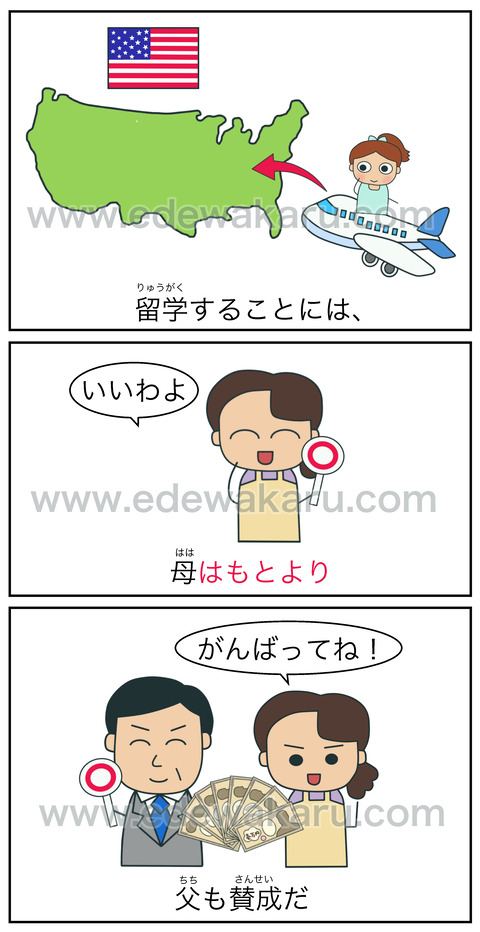
留学することには、母はもとより父も賛成だ
→留学することには、母だけでなく父も賛成だ彼女は勉強はもとよりスポーツもできる
→彼女は勉強はもちろんスポーツもできる彼は英語はもとより中国語も話せる
→彼は英語だけでなく中国語も話せるうちのおばあちゃんはスマホはもとよりパソコンも使ったことがない
→うちのおばあちゃんはスマホだけではなくパソコンも使ったことがない私は海外旅行(かいがいりょこう)はもとより、国内旅行(こくないりょこう)もしたことがありません
→私は海外旅行だけでなく、国内旅行もしたことがありません
くらべてわかる日本語表現文型辞典
Meaning
意味1:Aは言うまでもなくBも。AはもちろんBも。
意味2:Aはもともと、はじめからB。
How to use it
AはもとよりB
[名詞-∅]はもとより
Explanation
【対比1,2】
「AはもちろんBもC」(意味1 P.285)
In context 8 examples
公演中はテープ録音はもとより、携帯電話での撮影も禁止だ。
沖縄旅行は台風で、泳ぐことはもとより、買い物もできなかった。
地球温暖化防止のため、わが社ではエンジンの改良はもとより、燃費の低減を目指して研究開発を続けております。
本気でダイエットをするなら、カロリーコントロールはもとより、運動もしなければ、目に見えた成果は得られない。
失敗はもとより覚悟していた。
こういう問題はもとより校長の判断を仰がねばならないことだ。
責任はもとより私にあるのだ。
人間はもとより独りでは生きられない動物だ。
日本語NET JLPT文法解説まとめ
Meaning
〜はもちろん
How to use it
N + はもとより
Explanation
・「〜はもちろん」よりも硬い表現
In context 5 examples
うちは貧乏なので、車はもとより、バイクもありません。
仕事が忙しすぎて、彼女とデートする時間はもとより、ゆっくり寝る時間もない。
東京オリンピックには日本人はもとより多くの外国人が観戦に来ました。
インターネットがあれば、都会はもとより、田舎でも仕事ができる。
ラーメンは日本人はもとより、外国人にも人気がある日本料理だ。
毎日のんびり日本語教師
How to use it
名詞+はもとより
名詞+はもちろん
Explanation
前項で代表的な物事を挙げ、それは言うまでもなく自明であることを表します。
また、後項では前項と同程度の物事について触れ、それについても同様であることを表します。
「~はもちろん」は口語で、「~はもとより」は口語だけでなく書き言葉としても用いられます。
Notes
似ている文法「【N1文法】~言わずもがな」
似ている文法「【N1文法】~もさることながら」
In context 8 examples
この車はデザインはもとより、燃費もいい。
当店は、国内はもちろん、世界各地から美味しい食材を仕入れています。
試合観戦はもとより、コンサートにも行った事がない。
私の彼は、顔はもちろん性格も完璧。
彼女は英語はもちろん、中国語も堪能だ。
Aさんはもちろん、Bさんも行く予定です。
うちの旦那は掃除はもちろん、料理もしてくれる。
第一印象を良くするには、清潔さはもちろん、笑顔も重要だ。
NINJAL 日本語文型データベース
Meaning
基本である~は当然そうだが、それに加えて、さらに広い範囲のものも同じだと言いたいときに使います。
How to use it
Nはもとより
その他
Notes
「~」には、予想しやすい、基本となる事柄を表す言葉がきます。「~はもとより」の後には、「〜」より広い範囲を表す言葉、またはより広い範囲に含まれる別の事柄を表す言葉がきます。
別の事柄を表す言葉には「も」をつけることが多いです。より広い範囲を表す言葉にはつけません。
In context 6 examples
今季新発売のこのエアコンは、省エネ面はもとより、あらゆる面で従来のモデルに勝る製品です。
相互扶助の精神の大切さは、個人はもとより集団にも国家にも当てはまることではないだろうか。
在日期間中、保証人はもとより、多くのみなさまにお世話になりました。
災害復興は、当該地域はもとより、国全体で取り組まなければ実現しない。
みなさんは営業マンですから、職場ではもとより、職場以外の場でも丁寧な言葉遣いを心がけてください。
SNSの普及により、同じ国の人とはもとより、遠い国の人とも容易に知り合える時代になった。
IMABI
Addition
Read this IMABI lesson ↗Explanation
Addition: ~に加えて, ~にとどまらず, ~もさることながら, ~はおろか, ~はもちろん, ~はもとより, ~ともあれ
When a speaker feels obligated to mention yet another thing into the mix, that is usually done so with negative connotation, and it is this that will be the theme of this lesson.
~に加えて
The transitive verb 加える roughly translates to “to add,” but it may also be translated as “to count (someone) in,” “to deal (damage),” “or even “to gather (speed).”
1. 料理に胡椒こしょうは一つまみも加える必要はない。
There is no need to add a pinch of pepper to a dish.
2. お茶に砂糖を加える。
To mix sugar in the tea.
3. 圧力を加える。
To add pressure.
咥える should not, however, be confused with the homophonous transitive verb 咥える・銜える, which means “to put in one’s mouth,” although they are etymologically tied.
4. 子供は指を銜くわえる嫌いがある。
Children have the tendency to have their fingers in their mouth.
Perhaps the most important use of this verb is its appearance in the phrase ~に加えて meaning “in addition to.” It is used a lot in enumerating negative situations.
5. 彼女は日本語に加えて、英語もあまり分からないみたいだね。
In addition to Japanese, it looks like she barely understands English.
6. イギリスに加えて、フランスもドイツも多文化主義の非を鳴らしています。
In addition to England, France and Germany are also denouncing multiculturalism.
7. そのことに加えて、彼は自分の名前を忘れたよ!
In addition to that, he also forgot his own name!
8. 5日のニューヨーク株式市場かぶしきしじょうは、東京市場で株価が大幅おおはばに値下がりしたことに加えて、アメリカが景気を下支したざさえするために行っている量的緩和りょうてきかんわの縮小しゅくしょう時期など、アメリカの金融きんゆう政策に対する不安から幅広い銘柄めいがらに売り注文が広がりました。
As for the New York Stock Exchange on the fifth, selling orders have spread in a wide range of brands from worries towards American financial policies such as the quantitative easing curtailment period America is carrying out in order to backup the economy in addition to the large drop in prices due to the Tokyo Exchange.
From NHK.
~にとどまらず
The speech modal ~にとどまらず attaches to nouns which can be perceived as some sort of parameter/level/stage with which the following clause indicates an extension of said parameter.
10. マスメディアによる情報というものは、今や一国にとどまらず、世界中に伝わる。
Information by the media doesn’t stay in one country now; it travels the world.
11. 農作物は、台風に襲われた直後にとどまらず、一年中その影響を受ける。
Crops don’t just receive the effects directly after being hit by a typhoon; they feel the impact throughout the year.
12. 彼女は成功にとどまらず、社会貢献に尽力した。
She not only stopped at success, but she also labored as a contribution to society.
Though ~にとどまらず usually attaches itself to nouns, it can on occasion follow the 連体形 of verbs, but in doing so, it is not used with static verbs, as such verbs do not agree with the concept of extending parameters.
13. 一人の人間の明るさは、場を明るくするにとどまらず、周囲の人々に心身の活力をも与えるものである。
The brightness of a person not only brightens up the area, but also it gives energy to the hearts and minds of the surrounding people.
14. 更に執刀した岡山大学病院の大藤剛宏医師は手術後の記者会見で「中葉を使った移植は男の子1人を助けるにとどまらず、これまで助けることができなかった子どもたちに光が当たるという意義がある」と話しました。
In addition, Dc. Oto Takahiro of Okayama University Hospital who did the surgery in a press conference afterwards said that “the transplant using the middle lobe [of the lung] does not just save this one boy, but it gives light to other children that have not been able to be helped till now”.
From the NHK article 『生体肺移植の男児 容体安定』 on 2013年7月2日
When used with adjectives/adjectival noun predicates, the nature of the situation must be in some state of transition to account for an extension of the parameter being described to remain grammatical. So, although adjectival expressions may literally be static by definition, they can be implemented in dynamic circumstances.
As this pattern follows the 連体形, but because it is also generally restricted to rather stiff written language, we can expect it to follow the である-連体形 for adjectival nouns, but as for adjectives1, we find that the particle だけ (only) is placed in between the adjective (though still in the 連体形) and ~に留まらず.
15. あの法令は単に違憲であるにとどまらず、ネットのおかげで実効性も失われて久しい。
That ordinance is not only simply unconstitutional, but thanks to the Internet, it has lost its effectiveness for quite some time.
16. 健康に良いだけにとどまらず、シジミは旨味成分もたくさん含まれています。
Freshwater clams are not just good for your health, but they also contain lots of umami components.
Though not grammatically necessary and in some sense redundant, the particle だけ can generally be seen used with this pattern in general, resulting in ~だけにとどまらず.
17. 弊社は社会貢献だけにとどまらず、様々な活動を展開しております。
Our company is not limiting itself to just contributing to society but is expanding its reach into all sorts of activities.
Orthography Note: Though not typically written in Kanji, its Kanji spelled is ~に留まらず.
~もさることながら
The pattern ~もさることながら follows nouns deemed to obviously be of a certain quality (most often positive), and that the following clause adds to the worth/validity of said statement. This, in turn, is translated into English as “it goes without saying that…”
18. 中華料理ちゅうかりょうりは味あじもさることながら、健康けんこうにいいですよ。
It goes without saying that Chinese food is tasty, but it’s also good for you.
19. 彼女は人柄もさることながら、その頭の働きの良さで周囲の人をぐいぐいと引っ張っていくんですよ。
Her personality goes without saying, and her great mind pulls those around towards her.
Orthography Note: The full Kanji spelling of this pattern is 然る事乍ら.
Grammar Note: 然る is an old-fashioned 連体詞 derived from the Classical Japanese verb 然り, which has the meaning of “to be said/some thing” in a very vague sense, and if it were directly translated into something in Modern Japanese, it would be closest to そういう or とある, which results in it directly equating to “such.” Given how affirming the noun-predicate is, we see that the particle ながら attaches itself to state that the two clauses of the sentence are concurrently in agreeance to that effect.
~はもちろん・もとより・おろか
~はもちろん(のこと)is used when juxtaposing two predicates as being “as matter of fact.” The first clause which it attaches to must be a nominal(ized) phrase, but what follows after it is typically a verbal/adjectival which affirms the first predicate.
In the examples that follow, we can see how the literal meaning of もちろん, that being “of course,” can be taken literally here. To truly understand how this pattern works regarding nuance, though, let’s posit that the first clause is X and the second clause is Y. In the mind of the speaker, X is mentioned first as it has the highest relevance or the highest recognition of being obvious, whereas Y adds to what is obvious or fully expected given knowledge of the situation. Y may at times be far more impressive than Y, but the reason why X is mentioned first is because it has the most relevance.
Speech Style Note: While ~はもちろん is largely used in the written language, whenever it is utilized in the spoken language, it is often rendered as ~もちろんのこと, which grammatically allows for said dependent clause to more clearly function as a noun-predicate that is more parallel in structure to predicate Y.
20. 彼は英語はもちろん、スペイン語も韓国語もできます。
Not to mention English, he can also speak Spanish and Korean.
21 あの子は書くのはもちろん、読むこともできない。
That kid can’t even read, let alone write.
22. 彼は、母語はもちろん(のこと)、他にも7つの言語も話せますよ。
Not only his native language, but he can also speak seven other languages.
23. 彼は修士を得るのはもちろん、入学さえできない。
He can’t even enter college, let alone receive a master’s degree.
Now, whenever Y is not something that cannot be deemed obvious given the situation at hand, ~はもちろん becomes ungrammatical, and it would need to be replaced with something broader such as ~だけでなく.
24. この米には、もみ{だけでなく 〇・はもちろん X}、砂まで入ってるのよ。
Not only is there husks in this rice, there’s even sand in it.
While it may be intrinsically obvious that someone who excels in his main language does indeed have mastery in other languages like in Ex. 22, there is nothing intrinsic about rice being contaminated with all sorts of things.
~はもとより
The nuance spin that ~はもとより provides is that it quality X is “principally” so. Meaning, based on principle, X is that standard which is both most pertinent and obvious in nature, and then Y builds onto that execution of standard. Just as with ~はもちろん(のこと), X is a nominal(ized) phrase, while Y is usually a verbal/adjectival predicate which expands on that notion.
25. 彼女は料理はもとより食器も洗ってくれます。
She not only cooks, but she also washes the dishes.
26. 彼は英語はもとより、スペイン語も韓国語もできます。
Not to mention English, he can also speak Spanish and Korean.
27. 低賃金、劣悪な労働条件、一方的な首切りなどの経済・労働問題はもとより、各種の人道的問題までも引き起こしている。
They are not only suffering from low wages, cases of poor working condition, and economic and labor problems such as one-sided layoffs, they are also troubled to the extent of various forms of discrimination.
28. 地方ごとに、味はもとより、料理の仕方も違ってきますね。
With each region, not to mention flavor, but even cooking methods differ, don’t they?
~はおろか
The word おろか indicates that the noun in the dependent clause X is negligible in how bad Y is obviously true.
29. 一ドルはおろか一セントも持ってないよ。
I don’t have a cent, let alone a dollar!
30. 父はおろか、僕の犬でさえ反対したようだ。
Not to mention my father, even my dog seemed to object.
31. 僕はバイオリンはおろか、ギターも弾けないんだ。
I can’t even play the guitar, much less a violet.
32. あの子は話すのはおろか、足も動かせません。
That child can’t even move her legs, let alone speak.
漢字 Notes: The Kanji spellings of these phrases are as follows:
①おろか → 疎か
②もちろん → 勿論
③もとより →【元・固・素】より.
~ともあれ
~ともあれ is an adverbial phrase that means “never mind/putting aside.” It is also seen in 何はともあれ meaning “in any case.” Grammatically speaking, あれ is the 已然形 of the existential verb ある, which means that as a whole, this adverbial phrase pinpoints the noun in said dependent clause X is already obviously an established issue, but that Y is the ‘real’ problem at hand.
33. 中国語はともあれ、問題は日本語の勉強なんだぞ。
Never mind Chinese, the problem is my Japanese studies!
34. 何はともあれ、後でしよう。
In any case, let’s do (this) later.
In older language, the き-連体形 of adjectives does become valid with this grammar structure.
i. 良き素材で醸されたお酒は香味や余韻の良きにとどまらず、飲み手にはその格に相応しい陶酔感をもたらします。
Sake brewed with excellent ingredients not only has superb flavor and aftertaste, as it provides a level of intoxication befitting of its worth to the consumer. ↩︎
In context 32 examples
料理に胡椒こしょうは一つまみも加える必要はない。
There is no need to add a pinch of pepper to a dish.
お茶に砂糖を加える。
To mix sugar in the tea.
圧力を加える。
To add pressure.
子供は指を銜くわえる嫌いがある。
Children have the tendency to have their fingers in their mouth.
彼女は日本語に加えて、英語もあまり分からないみたいだね。
In addition to Japanese, it looks like she barely understands English.
イギリスに加えて、フランスもドイツも多文化主義の非を鳴らしています。
In addition to England, France and Germany are also denouncing multiculturalism.
そのことに加えて、彼は自分の名前を忘れたよ!
In addition to that, he also forgot his own name!
5日のニューヨーク株式市場かぶしきしじょうは、東京市場で株価が大幅おおはばに値下がりしたことに加えて、アメリカが景気を下支したざさえするために行っている量的緩和りょうてきかんわの縮小しゅくしょう時期など、アメリカの金融きんゆう政策に対する不安から幅広い銘柄めいがらに売り注文が広がりました。
As for the New York Stock Exchange on the fifth, selling orders have spread in a wide range of brands from worries towards American financial policies such as the quantitative easing curtailment period America is carrying out in order to backup the economy in addition to the large drop in prices due to the Tokyo Exchange.
マスメディアによる情報というものは、今や一国にとどまらず、世界中に伝わる。
Information by the media doesn’t stay in one country now; it travels the world.
農作物は、台風に襲われた直後にとどまらず、一年中その影響を受ける。
Crops don’t just receive the effects directly after being hit by a typhoon; they feel the impact throughout the year.
彼女は成功にとどまらず、社会貢献に尽力した。
She not only stopped at success, but she also labored as a contribution to society.
一人の人間の明るさは、場を明るくするにとどまらず、周囲の人々に心身の活力をも与えるものである。
The brightness of a person not only brightens up the area, but also it gives energy to the hearts and minds of the surrounding people.
更に執刀した岡山大学病院の大藤剛宏医師は手術後の記者会見で「中葉を使った移植は男の子1人を助けるにとどまらず、これまで助けることができなかった子どもたちに光が当たるという意義がある」と話しました。
In addition, Dc. Oto Takahiro of Okayama University Hospital who did the surgery in a press conference afterwards said that “the transplant using the middle lobe [of the lung] does not just save this one boy, but it gives light to other children that have not been able to be helped till now”.
あの法令は単に違憲であるにとどまらず、ネットのおかげで実効性も失われて久しい。
That ordinance is not only simply unconstitutional, but thanks to the Internet, it has lost its effectiveness for quite some time.
健康に良いだけにとどまらず、シジミは旨味成分もたくさん含まれています。
Freshwater clams are not just good for your health, but they also contain lots of umami components.
弊社は社会貢献だけにとどまらず、様々な活動を展開しております。
Our company is not limiting itself to just contributing to society but is expanding its reach into all sorts of activities.
中華料理ちゅうかりょうりは味あじもさることながら、健康けんこうにいいですよ。
It goes without saying that Chinese food is tasty, but it’s also good for you.
彼女は人柄もさることながら、その頭の働きの良さで周囲の人をぐいぐいと引っ張っていくんですよ。
Her personality goes without saying, and her great mind pulls those around towards her.
彼は英語はもちろん、スペイン語も韓国語もできます。
Not to mention English, he can also speak Spanish and Korean.
彼は、母語はもちろん(のこと)、他にも7つの言語も話せますよ。
Not only his native language, but he can also speak seven other languages.
彼は修士を得るのはもちろん、入学さえできない。
He can’t even enter college, let alone receive a master’s degree.
この米には、もみ{だけでなく 〇・はもちろん X}、砂まで入ってるのよ。
Not only is there husks in this rice, there’s even sand in it.
彼女は料理はもとより食器も洗ってくれます。
She not only cooks, but she also washes the dishes.
彼は英語はもとより、スペイン語も韓国語もできます。
Not to mention English, he can also speak Spanish and Korean.
低賃金、劣悪な労働条件、一方的な首切りなどの経済・労働問題はもとより、各種の人道的問題までも引き起こしている。
They are not only suffering from low wages, cases of poor working condition, and economic and labor problems such as one-sided layoffs, they are also troubled to the extent of various forms of discrimination.
地方ごとに、味はもとより、料理の仕方も違ってきますね。
With each region, not to mention flavor, but even cooking methods differ, don’t they?
一ドルはおろか一セントも持ってないよ。
I don’t have a cent, let alone a dollar!
父はおろか、僕の犬でさえ反対したようだ。
Not to mention my father, even my dog seemed to object.
僕はバイオリンはおろか、ギターも弾けないんだ。
I can’t even play the guitar, much less a violet.
あの子は話すのはおろか、足も動かせません。
That child can’t even move her legs, let alone speak.
中国語はともあれ、問題は日本語の勉強なんだぞ。
Never mind Chinese, the problem is my Japanese studies!
何はともあれ、後でしよう。
In any case, let’s do (this) later.
文法
Meaning
〜はもちろん
How to use it
N + はもとより
Notes
・「〜はもちろん」よりも硬い表現
In context 5 examples
うちは貧乏なので、車はもとより、バイクもありません。
仕事が忙しすぎて、彼女とデートする時間はもとより、ゆっくり寝る時間もない。
東京オリンピックには日本人はもとより多くの外国人が観戦に来るでしょう。
インターネットがあれば、都会はもとより、田舎でも仕事ができる。
ラーメンは日本人はもとより、外国人にも人気がある日本料理だ。