日本語文型辞典 英語版
Meaning
Means “things vary according to N or are influenced by N.” Example
(1)
means “it is for you to decide.”
Means “immediately after doing....” Expresses that as soon as one action or event is realized, the next action will be carried out. The first half of the sentence often describes an event that takes place as part of a natural progression. On the other hand, the second half of the sentence indicates an intentional action on the part of the speaker. It cannot refer to a spontaneously-occurring event or action.
(×)そのニュースが伝わり次第、暴動が起こるだろう。
As soon as the news spreads, a riot will probably happen.
In addition, R-しだい cannot be used to refer to past events.
(×)休みになりしだい、旅行に行った。
As soon as the vacation starts, they went on a trip.
Often used in TV news and the like, as in
(2)
.
Used to describe the course of events that has led to the present state of affairs, the reason(s) behind it, etc. In idiomatic expressions, adjectives are sometimes used.
(例)こんなことになってしまい、まったくお恥ずかしい次第です。
I feel thoroughly embarrassed that it should have come to this.
Used to preface a statement when the outcome of a course of events is uncertain or when something of importance is to be decided. An idiomatic expression.
How to use it
1. Nしだいだ
2. R-しだい
3. V-る/V-た しだいだ
4. こととしだいによって
In context 12 examples
するかしないかは、あなたしだいだ。
Whether you do it or not is up to you.
世の中は金しだいでどうにでもなる。
Money makes the world go round.
作物の出来具合いはこの夏の天気次第です。
The quality of the crops will depend on the weather this summer.
結婚した相手次第で人生が決ってしまうこともある。
Your life can be determined by the person you marry.
落し物が見つかりしだい、お知らせします。
We will let you know as soon as the lost item is found.
事件のくわしい経過がわかりしだい、番組のなかでお伝えします。
We will bring you further reports on this program, as the details of the incident become known.
資料が手に入り次第、すぐに公表するつもりだ。
As soon as we obtain the materials, we intend to make them public.
天候が回復し次第、出航します。
We will set sail as soon as the weather clears.
とりあえずお知らせした次第です。
The facts of the matter are as I have just told you.
《挨拶状》今後ともよろしくご指導くださいますようお願い申し上げる次第でございます。
《letter of greeting》Therefore I humbly request your continued guidance in the future.
ことと次第によって、計画を大幅に変更しなければならなくなるかもれない。
It all depends, but we may have to make drastic changes to the plan.
ことと次第によっては、事件の当事者だけでなく責任者も罰することになる。
Depending on what happens, not only the person involved in the incident but also the one in charge may be penalized.
IMABI
As soon as
Read this IMABI lesson ↗Explanation
As soon as: ~や(いなや), ~なり, ~途端(に), ~かと思うと, & ~次第
Though “as” itself is hard enough in Japanese, Japanese also has a lot of expressions that mean “as soon as”. This lesson will investigate how to use these expressions. Take close attention to what defines them as there are differences!
~や否や & ~や
Placed after the 終止形しゅうしけい of a verb in ~や or ~や否いなや, it means “as soon as”. With 否や, it is like the second action takes place before the first action can even be confirmed or done. The most used is や否や. In fact, や否や will be used 90% of the time.
1. 地震じしんが発生はっせいするやいなや、気象庁きしょうちょうは直ただちに津波警報つなみけいほうを出しました。
As soon as the earthquake happened, the Meteorological Agency issued a tsunami warning.
2. 姉の顔を見るやいなや、泣き出した。
I began weeping as soon as I saw my sister’s face.
3a. その選手はチャンスと見るや、一気に{攻め込んだ・攻撃をしかけた}。
3b. その選手はチャンスと見るやいなや、一気に{攻め込んだ・攻撃をしかけた}。 (あまり使わない言い方)
The player felt a chance open and attacked in one burst.
4. 出発しゅっぱつするやいなや雨が降ふり出した。
It started to rain as soon as I departed.
~やいなや cannot be used to show the speaker’s wants or intentions. Also, don’t use the past tense before ~やいなや. The action can be something that you can expect. It’s important to understand that the events of the second clause are actions/movements.
5. うちの猫は魚が大好きで、あげるやいなや、一気に全部食べてしまう。
My cat loves fish, and the instant you give it to it, it’s gone in an instant.
The Conjunctive Particle なり
After the 連体形 of a verb, ~なり shows that something is done as soon as something else is done. So right when someone does something, they do something next in sequence to the first action. The subject is normally third person, and the subject is the same in both clauses.
6a. 宿題を済ませるなり、彼らはインターネットを使った。
6b. 宿題を済ませるとすぐに、彼らはインターネットを使った。(More natural)
They used the Internet as soon as they finished their homework.
7. 彼は帰るなり、トイレに行った。
He went to the bathroom as soon as he got home.
8. 社長は入ってくるなり、大声で怒鳴りました。
As soon as the company president came in, he shouted in a big voice.
The word comes from the なり in words like 身なり (appearance). The event in the second clause is often one that describes an action/condition not wanted. Although it is used some in the spoken language, it is usually reserved to writing.
After the past tense, it shows a situation that is still in play as another action begins. It is unnatural when you move in any way to a different action.
9. 彼は靴を履いたなり、畳に上がってしまった。 △
彼は靴を履いたまま、畳に上がってしまった。 〇
He accidentally stepped onto the tatami mat with his shoes still.
10. 彼女は公園でベンチに座り込んだ{なり・まま}、眠ってしまった。
She fell asleep while sitting on a park bench.
~途端(に)
When students learn of 途端に, they immediately think of ~ときに, especially when they learn that this phrase is used after the past tense. Understandable, ~たとき(に)and ~たとたん(に) vaguely resemble each other, especially when not written in 漢字.
~た途端とたん(に) is, again, only used with the past tense. It marks the instant after one does something. This “something” that happens afterward is something that is unexpected and much of a surprise.
11. 彼がドアを開けた途端、車が爆発した。
The car exploded just as he opened the door.
12. 窓まどを開けた途端に、犬が飛び出していった。
As soon as I opened the window, the dog jumped out.
13. 立ち去さった途端に、その建物たてものが爆発ばくはつしたよ!
As soon as he left, the building exploded!
14. 動画どうがを観みた途端に、眠ねむくなってしまった。
I accidentally fell asleep as soon as I saw the video.
15. 余所見をした途端、転んだ。
I fell down as soon as I turned away.
16. 酒を飲むと、(その)途端に人が変わる。
Once a person drinks, that person changes instantly.
Grammar Note: 途端 may also be used in the sense of instantly and can be seen with such statements.
As seen in the example sentences, though, ~た途端(に)can’t be used when something volitional occurs. So, although a situation may be unexpected, you would need to use a phrase like ~たら、すぐに if you are using a verb of volition.
17. ベルが鳴ったら、すぐに外に出てください。
When the bell rings, immediately go outside.
~かと思うと
Perhaps because it is rarely treated separately in grammar discussions, students have a hard time knowing how to use this phrase. This describes something happening that causes a sense of surprise, similar to ~た途端(に), which follows after an event described in the first clause. Transitivity, though, is clearly different as ~た途端(に)is used with transitive expressions, but this phrase does not have that requirement.
You cannot use this phrase for yourself. At times it may be best to use ~かと思ったら instead. Sentences of command, negation, or will appear afterwards. For some people, when the event is not of the future or going back and forth in a way that means the first action may happen again in the “future”, then the use of ~かと思うと is somewhat unnatural and should be replaced with ~かと思ったら. So, for the sentences below regarding weather, you can paraphrase with the latter and have no problem.
Examples
18. 雨が降ってきたかと{思うと ?/〇・思ったら 〇}、もう止んだ。
Just when I thought it had started to rain, it stopped.
19. 空が曇ってきたと{思うと ?/〇・思ったら 〇}、突然大雨になった。
Just when I thought it got cloudy, it started to rain heavily.
20. 彼女はA君のことを好きだと言っていたかと思うと、次はB君が好きだと言い出し、何を考えているのかよく分からない。
Just as I had thought she said she liked A-kun, she then stated that she liked B-kun, and so I don’t know what she’s thinking.
22. うちの子供は帰ってきたかと{思うと ?/〇・思ったら 〇}、もう外に遊びに行った。
The kids had already gone to play outside just when I thought they had come home.
~次第
As a regular noun, 次第 means “course of events”. It is seen after nouns a lot, especially Sino-Japanese words, but also after the 連用形 of verbs.
When it attaches to other nouns, it often means “depending on”. As such, when after the 連用形 of a verb, it may show that something is dependent on an action in question.
23. 請求せいきゅうがあり次第だ。
It’s on demand.
24. 物事は状況次第。
Circumstances alter cases.
25. こういう次第だ。
This is how it stands.
26. 万事は君の(この)取り扱い方次第だ。
It depends on the way you handle it.
27. 天気の様子次第で行くかどうか決めるんだ。
I’m going to decide on whether to go or not depending on the weather condition.
28. 大統領が決心するかどうかはそれ次第だ。
The president’s resolution depends on this.
29. 豊作になるかどうかは天気次第です。
An abundant harvest is dependent on the weather.
30. 結果は君次第だ。
The results depend on you.
31. 昇進できるかどうかは能力次第だ。
Promotion is dependent on one’s ability.
連用形 + 次第
It may also be used with the 連用形 of a verb to show what happens “as soon as…”. This is in the sense that right after something realizes, one does the next action. Thus, the second clause following must be a verb of volition in regards to the speaker. This separates it quite well from the other “as soon as” phrases in this lesson.
32. 着き次第、被災地に援助します。
As soon as we arrive, we will aid in the disaster area.
33. 手当たり次第に食べ物を買い占しめる。
To buy up food as it is made available.
34. 満員になり次第締め切ろう。
Let’s close up as soon as we become a full house.
35. 我々は雪がやみ次第、作業を再び始めるつもりです。
We plan to resume operations as soon as it stops snowing.
Adverbial 次第に
Lastly, 次第に is an adverb meaning “gradually”, “finally”, or “in order”.
36. 機械は{次第にだんだんと}廃すたれていくだろう。
Machines will gradually go out of date.
37. 騒音そうおんが次第に消えてゆく。
Noise will gradually fade away.
In context 38 examples
地震じしんが発生はっせいするやいなや、気象庁きしょうちょうは直ただちに津波警報つなみけいほうを出しました。
As soon as the earthquake happened, the Meteorological Agency issued a tsunami warning.
姉の顔を見るやいなや、泣き出した。
I began weeping as soon as I saw my sister’s face.
その選手はチャンスと見るや、一気に{攻め込んだ・攻撃をしかけた}。
The player felt a chance open and attacked in one burst.
その選手はチャンスと見るやいなや、一気に{攻め込んだ・攻撃をしかけた}。 (あまり使わない言い方)
The player felt a chance open and attacked in one burst.
出発しゅっぱつするやいなや雨が降ふり出した。
It started to rain as soon as I departed.
うちの猫は魚が大好きで、あげるやいなや、一気に全部食べてしまう。
My cat loves fish, and the instant you give it to it, it’s gone in an instant.
宿題を済ませるなり、彼らはインターネットを使った。
They used the Internet as soon as they finished their homework.
宿題を済ませるとすぐに、彼らはインターネットを使った。(More natural)
They used the Internet as soon as they finished their homework.
彼は帰るなり、トイレに行った。
He went to the bathroom as soon as he got home.
社長は入ってくるなり、大声で怒鳴りました。
As soon as the company president came in, he shouted in a big voice.
彼は靴を履いたなり、畳に上がってしまった。 △
彼女は公園でベンチに座り込んだ{なり・まま}、眠ってしまった。
She fell asleep while sitting on a park bench.
彼がドアを開けた途端、車が爆発した。
The car exploded just as he opened the door.
窓まどを開けた途端に、犬が飛び出していった。
As soon as I opened the window, the dog jumped out.
立ち去さった途端に、その建物たてものが爆発ばくはつしたよ!
As soon as he left, the building exploded!
動画どうがを観みた途端に、眠ねむくなってしまった。
I accidentally fell asleep as soon as I saw the video.
余所見をした途端、転んだ。
I fell down as soon as I turned away.
酒を飲むと、(その)途端に人が変わる。
Once a person drinks, that person changes instantly.
ベルが鳴ったら、すぐに外に出てください。
When the bell rings, immediately go outside.
雨が降ってきたかと{思うと ?/〇・思ったら 〇}、もう止んだ。
Just when I thought it had started to rain, it stopped.
空が曇ってきたと{思うと ?/〇・思ったら 〇}、突然大雨になった。
Just when I thought it got cloudy, it started to rain heavily.
彼女はA君のことを好きだと言っていたかと思うと、次はB君が好きだと言い出し、何を考えているのかよく分からない。
Just as I had thought she said she liked A-kun, she then stated that she liked B-kun, and so I don’t know what she’s thinking.
うちの子供は帰ってきたかと{思うと ?/〇・思ったら 〇}、もう外に遊びに行った。
The kids had already gone to play outside just when I thought they had come home.
請求せいきゅうがあり次第だ。
It’s on demand.
物事は状況次第。
Circumstances alter cases.
こういう次第だ。
This is how it stands.
万事は君の(この)取り扱い方次第だ。
It depends on the way you handle it.
天気の様子次第で行くかどうか決めるんだ。
I’m going to decide on whether to go or not depending on the weather condition.
大統領が決心するかどうかはそれ次第だ。
The president’s resolution depends on this.
豊作になるかどうかは天気次第です。
An abundant harvest is dependent on the weather.
結果は君次第だ。
The results depend on you.
昇進できるかどうかは能力次第だ。
Promotion is dependent on one’s ability.
着き次第、被災地に援助します。
As soon as we arrive, we will aid in the disaster area.
手当たり次第に食べ物を買い占しめる。
To buy up food as it is made available.
満員になり次第締め切ろう。
Let’s close up as soon as we become a full house.
我々は雪がやみ次第、作業を再び始めるつもりです。
We plan to resume operations as soon as it stops snowing.
機械は{次第にだんだんと}廃すたれていくだろう。
Machines will gradually go out of date.
騒音そうおんが次第に消えてゆく。
Noise will gradually fade away.
DoJG 日本語文法辞典(全集)
Meaning
As soon as; depend on
How to use it
(i) Vます | 次第 | |
| 読み次第 | As soon as someone has read something |
| 帰り次第 | As soon as someone has returned |
Exception | いらっしゃり次第 | As soon as someone comes/goes there |
| おっしゃり次第 | As soon as someone says it |
| なさり次第 | As soon as someone does something |
(ii) VN | 次第 | |
| 帰国次第 | As soon as someone comes back to his/her country |
| 到着次第 | As soon as someone/something arrives |
(iii) (Xは)Noun | 次第だ/で | |
| (農業は)天気次第だ | Farming depends on the weather |
| 給料次第で | Depending on the salary |
Explanation
A conjunction/noun to express that an action indicated by a preceding verb or an action implied by a preceding noun is a prerequisite for another action.
In context 13 examples
大阪に着き次第、お電話を差し上げます。
As soon as I get to Osaka, I will call you.
原稿は完成次第お送り致します。
I will send my manuscripts as soon as they are completed.
世の中で成功するかしないかはあなたの努力次第ですよ。
Whether you succeed in the world or not depends on your efforts.
夫は仕事が終わり次第、毎日まっすぐ帰宅します。
My husband comes straight home every day, as soon as he has finished his work.
空港から電話があり次第、お迎えに参ります。
I will go to pick you up as soon as you call me from the airport.
山岸先生がいらっしゃり次第、会議を始めたいと思います。
As soon as Professor Yamagishi comes here I'd like to begin our meeting.
東大を卒業次第、京大の大学院に入学するつもりだ。
Upon graduation from the University of Tokyo, I intend to enter the Graduate School of Kyoto University.
お尋ねの件は、判明次第、ご連絡申し上げます。
On the matter you have inquired about, I will inform you as soon as I find out.
レセプションが終了次第、晩餐会を始めます。
As soon as the reception is finished we will start the dinner party.
就職はコネ次第ですよ。
Finding employment depends on connections.
「地獄の沙汰も金次第(だ)」ということわざを知っていますか。
Do you know the proverb "Even affairs in hell depend on money”?
ご注文次第で、どんな物でも料理致します。
Depending on your orders, I will cook you anything you like.
条件次第では、その仕事を引き受けたいと思います。
Depending on the employment terms I would like to accept that job.
どんなときどう使う 日本語表現文型辞典
Meaning
as soon as; the moment that
How to use it
Vます+次第
Explanation
~したらすぐ
「~次第…」の形で、「~」が起こったら、すぐ「…」をする、という意志を伝えたいときによく使う。
Often used to convey volition to do something as soon as something else happens.
In context 4 examples
スケジュールが決まり次第、すぐ知らせてください。
資料の準備ができ次第、会議室にお届けします。
向こうから連絡があり次第、出発しましょう。
会長が到着し次第、会を始めたいと思います。もうしばらくお待ちください。
絵でわかる日本語
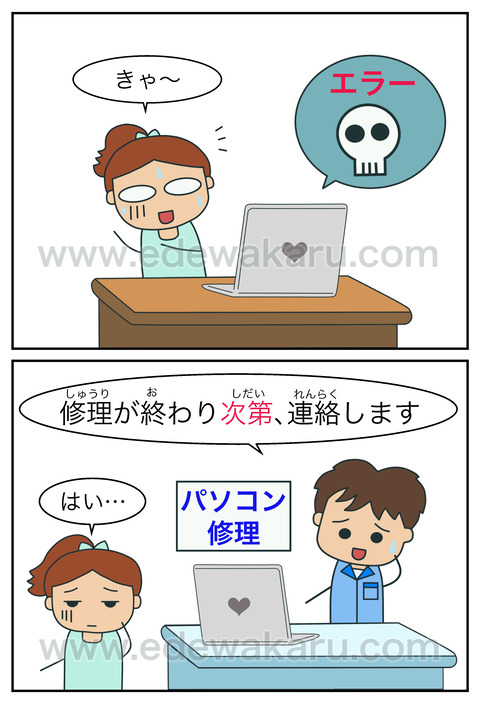
Meaning
〜たら、すぐ
How to use it
動詞[ます形]+次第
Explanation
「A次第B」は「Aたら、すぐにB」という意味を表す文型です。「A」した後、すぐに「B」をするという意味ですね😊
「B」には自然に起こることや過去のことは使えませんので気をつけましょう
😨
[例]
❌日本に着き
次第、雨が降るだろう【「B」に
自然に起こることはこない】
❌卒業し
次第、日本へ留学した【「B」に
過去はこない】
「〜次第」は「〜たらすぐに」の丁寧な言い方だと覚えておきましょう。
報告や連絡などをする時によく使われますよ😀またテレビやニュースなどでよく聞くと思いますので、覚えておきましょう😉
【関連文型】
In context 3 examples
修理が終わり次第、連絡します
→修理が終わったらすぐに連絡します準備ができ次第、出発しましょう
→準備ができたらすぐに出発しましょう予定が決まり次第、お知らせしますね
→予定が決まったらすぐにお知らせしますね
日本語文型辞典
Meaning
「Nによっていろいろに変わる、左右される」という意味。①は「あなたが決めることだ」の意味。
「…したらすぐに」の意味で、あることがらが実現したらすぐに、次の行為をすることを表す。前半の文は自然の経過で起こることを表す場合が多いが、後半の文は自然の経過で起こることには使えず、話し手の意志的な行為を表す文が続く。
また、過去のことには使えない。
②のようにテレビのニュースなどでよく使われる。
成行きからここに至った事情、わけなどを述べるのに使う。書きことば的。慣用的な言い方では形容詞が用いられることがある。
成行きでどうなるかわからない時、なにか重大なことを決める際の前置きとして使う。慣用的な表現。
How to use it
Nしだいだ
R-しだい
V-る/V-た しだいだ
こととしだいによって
In context 15 examples
するかしないかは、あなたしだいだ。
世の中は金しだいでどうにでもなる。
作物の出来具合いはこの夏の天気次第です。
結婚した相手次第で人生が決まってしまうこともある。
落し物が見つかりしだい、お知らせします。
事件のくわしい経過がわかりしだい、番組のなかでお伝えします。
資料が手に入り次第、すぐに公表するつもりだ。
天候が回復し次第、出航します。
(誤) そのニュースが伝わり次第、暴動が起こるだろう。
(誤) 休みになりしだい、旅行に行った。
とりあえずお知らせした次第です。
≪挨拶状≫今後ともよろしくご指導くださいますようお願い申し上げる次第でございます。
(例) こんなことになってしまい、まったくお恥ずかしい次第です。
ことと次第によって、計画を大幅に変更しなければならなくなるかもれない。
ことと次第によっては、事件の当事者だけでなく責任者も罰することになる。
くらべてわかる日本語表現文型辞典
Meaning
Aという状況になったら、すぐBをする。Aは近い将来の状況である。
How to use it
A次第B
[動詞-ます形]次第
Notes
【注意1】
・単にAとBが時間的に幅がないことを述べているのではなく、話し手がAという状況を待ち構えているときに使う。
×雨が降り次第、洗濯物を入れてください。
・「手当たり次第」は慣用的表現である。
○彼女は怒って、その辺にあるものを手当たり次第投げた。
In context 4 examples
現地に着き次第、連絡をくれ。
定員になり次第締め切ります。お早めにお申し込みください。
雨がやみ次第、出発します。
容体が落ち着き次第、手術にとりかかります。
日本語NET JLPT文法解説まとめ
Meaning
〜したらすぐに / 〜が終わったらすぐに
How to use it
Vます + 次第
Explanation
as soon as
In context 10 examples
定員になり次第、受付を終了いたします。
スケジュールが決まり次第、ご連絡いたします。
信号が変わり次第、発車いたします。
会議が終わり次第、すぐに向かいます。
落とし物が見つかり次第、ご連絡いたします。
状況が確認でき次第、お知らせいたします。
準備が整い次第、向かいます。
新しい情報が入り次第、番組内ででお伝えします。
わかり次第、すぐにご連絡いたします。
さぁ、みんな準備して。天候が回復し次第、出発するわよ。
毎日のんびり日本語教師
How to use it
名詞+次第だ
Explanation
「名詞+次第だ」の文型を取り、結果や状況の変化がそのものの性質や意向に委ねられていることを表します。
Notes
特になし
In context 10 examples
信じるか信じないかはあなた次第です。(信不信由你。)
お米は天候次第で収穫量が大きく影響される。(米的收成受天气的影响很大。)
努力次第で人生は変わる。(人生因努力而改变。)
全ては結局自分次第だ。
来年も旅してみようかなと思ってる。貯金次第ですが。
大雨で被災した方々、もうこれ以上被害が無ければいいんですが、こればかりはお天道様次第ですね。
他人を思いやれるような子供に育つかどうかは、ひとえに親次第である。
医者「食欲はありますか?」 患者「おかず次第です」
彼と結婚するかどうかは、体の相性次第です。
状況は自分の行動力次第でいくらでも変えられます。用法② 順接仮定条件(の継起表現)
NINJAL 日本語文型データベース
Meaning
〜が実現した後、すぐにある行動をとると言いたいときに使います。
How to use it
Notes
「〜」には、実現しそうなことを表す言葉がきます。「〜次第」の後には、話し手の意志的な行為を表す文や相手への働きかけの文がきます。
In context 5 examples
商品は代金の支払いが確認でき次第、発送致します。
園芸セミナーの申し込みは先着順です。定員になり次第、応募受け付けを終了いたします。
先ほど近畿地方で強い地震が発生しました。詳しい情報が入り次第、この番組でお伝えします。
今日は授業が終わり次第、すぐにアルバイト先に向かわなければならない。
宿泊者の人数は変更できます。正確な人数がわかり次第、ご連絡ください。