AIUEO JLPT Grammar
Meaning
This sentence pattern emphasizes the speaker’s emotions or feelings, highlighting certain emotions or events for emphasis.
How to use it
動詞た形+ことに形容詞辞書形+ことに形容動詞な+ことに
Explanation · 日本語
この文型は、話者の感情や感動、驚きなどの心情を強調する表現で、特定の感情や出来事を際立たせるために使われます。
In context 5 examples
驚いたことに、彼はその秘密を知っていた。
To my surprise, he knew the secret.
残念なことに、試験に不合格だった。
Unfortunately, I failed the exam.
嬉しいことに、彼女が私の提案を受け入れてくれた。
To my delight, she accepted my proposal.
不思議なことに、その鍵は自動的に開いた。
Incredibly, the lock opened by itself.
お恥ずかしいことに、ルールを知りませんでした。
Embarrassingly, I didn't know the rules.
文法
Meaning
とても〜で
How to use it
V(タ形)+ことに
イAい + ことに
ナAな + ことに
Notes
①話し手が感じたことを強調して言う時に使う。
②この文型と一緒に使われる言葉は限定される。
③後ろに意志を表す文はこない。現実のことや終わったことなどが来る。
[よく一緒に使われる言葉]
・驚いた
・悲しい
・おもしろい
・残念な
・悔しい
・困った
・嬉しい
・ありがたい
In context 7 examples
悔しいことに、1点差で試合に負けてしまった。
嬉しいことに、来年から夢だったアメリカで働けることになった。
ラッキーなことに、旅行中は一度も雨が降らなかった。
残念なことに、クラスでトムさんだけが、試験に落ちてしまった。
困ったことに、高速道路を走っているときに車が故障して動かなくなってしまった。
ワンさんは日本語の勉強を初めて、まだ1年なのに、驚いたことに、JLPT N1に合格してしまった。
悲しいことに、大切に育てていたペットが事故で死んでしまった。
Bunpro Grammar Reference
Meaning
Extremely, Especially, To my ...
How to use it
Verb + ことに
[い]Adjective + ことに
[な]Adjective + な + ことに
Nuance
A phrase that expresses the extremely or particularly high emotional response of (A), caused by something unexpected.
Explanation
When 事 'thing' is combined with the case-marking particle に following a statement, it highlights that something is of a 'great extent'. Common translations include 'particularly', 'especially', or 'to my (A)'. This grammar pattern almost always describes some kind of feeling or emotion.
ことに is regularly seen after verbs, い or な-Adjectives.
ビックリしたことに、久しぶりに小学生時代の友達から電話がかかってきた。
To my surprise, I got a phone call from a friend from elementary school after such a long time.
珍しいことに、彼がいいレストランに連れていってくれた。
In a particularly rare occurance, he took me to a good a restaurant.
残念なことに、その商品はもう販売中止になりました。
Unfortunately, that product is no longer being sold.
In most situations, '(A) ことに (B)' can be translated quite literally as 'to a particularly (A) extent, (B)'.
Fun Fact
A very common expression 幸いなことに uses this particular grammar structure as a set phrase, and is often translated simply as 'fortunately', or 'luckily'.
幸いなことに、近所の人が私の猫を見つけて家まで届けてくれた。
Fortunately, my neighbor found our cat for us, and brought her home.
Fun Fact
ことに may sometimes be seen before descriptions rather than following them. In these cases, it comes from the kanji 殊, and is being used adverbially in the same way as 特に to mean 'particularly' or 'especially'.
Nuance · 日本語
予想外の出来事が原因で、(A)の感情がいつもより、又はものすごく高まっているということを表すときに使われる表現。
Explanation · 日本語
「事」に格助詞の「に」が付いた「事に」は、話し手の感情や気持ちの程度が大きいことを表す表現です。「(A) ことに (B)」の形で、「とても (A) で、(B)」のような意味で使われます。
「ことに」は、主に動詞やイ形容詞、ナ形容詞のあとで使われます。
ビックリしたことに、久しぶりに小学生時代の友達から電話がかかってきた。
To my surprise, I got a phone call from a friend from elementary school after such a long time.
珍しいことに、彼がいいレストランに連れていってくれた。
In a particularly rare occurance, he took me to a good a restaurant.
残念なことに、その商品はもう販売中止になりました。
Unfortunately, that product is no longer being sold.
多くの場合、まず (A) でその文がどのような感情や気持ちに関するものかを示して、そのあと (B) でその感情や気持ちを抱くことになった出来事や状況が述べられます。
豆知識
「幸いなことに」は、この文法を含む定型表現です。「運が良くて」のような意味で、広く使われています。
幸いなことに、近所の人が私の猫を見つけて家まで届けてくれた。
Fortunately, my neighbor found our cat for us, and brought her home.
豆知識
「ことに」は、形容詞のあとではなく、前に置かれることもあります。この場合の「こと」は、「特に」と同じような意味の副詞です。漢字では「殊」と書かれます。
In context 16 examples
- 幸せな事に、来年結婚します。
I am extremely happy about getting married next year.
- 残念なことに、その商品はもう販売中止になりました。
Unfortunately, that product is no longer being sold.
- ビックリしたことに、久しぶりに小学生時代の友達から電話がかかってきた。
To my surprise, I got a phone call from a friend from elementary school after such a long time.
- 珍しいことに、彼がいいレストランに連れていってくれた。
In a particularly rare occurance, he took me to a good a restaurant.
- 不思議な事に、最近物事がすべてうまくいく。
By some extreme oddity, lately everything seems to be going well.
- 嬉しい事に、みんなが協力してくれるようになりました。
I am extremely happy that everyone started to cooperate with me.
- 嬉しい事に日本語能力試験に合格しました。
I am especially happy about passing the JLPT.
- 驚いた事に、六ヶ月で赤ちゃんが初めて歩いた。
To our extreme surprise, the six month old baby took its first steps.
- 不幸な事に、彼は奥さんがなくなり失意のあまり、辞職した。
Sadly, he was so heartbroken after his wife's death that he resigned.
- 不幸な事に、事故で何人もの人が亡くなってしまいました。
By some extreme misfortune, many people died in the accident.
- 喜ばしい事に、何年も前に書いた小説が賞を取りました。
To my extreme delight, the novel I wrote many years ago won the prize.
- おかしい事に、悪いことをしたのは僕ではないのにメンバーから外された。
What was especially strange was that they removed me as a member, even though I didn't do anything wrong.
- 腹立たしい事に、突然大雪が降って、渋滞になった。
To my extreme dismay, suddenly heavy snow started falling and caused a traffic jam.
- 驚くべき事に、彼は交通事故で怪我をしたあと、
怪我を克服してオリンピックで金メダルを手にしたんだ。To our extreme surprise, after he was injured in a traffic accident, he overcame his injury and won the gold medal at the olympics.
- 信じられない事に、毎日、彼は早起きして勉強している。
To my extreme disbelief, he wakes up early every day and studies!
- 幸いなことに、近所の人が私の猫を見つけて家まで届けてくれた。
Fortunately, my neighbor found our cat for us, and brought her home.
DoJG 日本語文法辞典(全集)
Meaning
It is ~ that; I am ~ that; we are ~ that; to my/our ~; ~ly
How to use it
(i) Adjectiveいinformal | ことに | |
| {悲しい/悲しかった}ことに | It is/was sad that; sadly |
(ii) Adjective な stem | {な/だった}ことに | |
| 幸い{な/だった}ことに | It is/was fortunate that; fortunately |
(iii) Vinformal | ことに | |
| 腹の{立つ/立った}ことに | I am/was mad that |
Explanation
A phrase that expresses the speaker’s/ writer’s emotion or subjective judgment.
In context 12 examples
嬉しいことに、今学期は祭日が3日もある。
I'm glad that there are (as many as) three holidays this term.
残念なことに、この本は絶版で、普通の本屋では手に入らない。
To my regret, this book is out of print and cannot be purchased at ordinary bookstores.
驚いたことに、村田さんはあんなに気に入っていた会社を半年で辞めてしまった。
I was surprised that Mr. Murata quit his job after six months- he seemed so excited about his work.
恥ずかしいことに、私は英文学専攻でありながら英語が話せない。
It's embarrassing, but I can't speak English despite the fact that I'm an English literature major.
面白いことに、ハワイの日系人の方が日本人より日本の古い伝統をよく守っているという。
Interestingly, they say that Japanese-Americans in Hawaii maintain old Japanese traditions better than (Japanese) people in Japan.
悪いことに、オーディションの前の日に風邪を引いてしまった。
Unfortunately, I caught a cold the day before my audition.
悔しいことに、私はロジャーに負けた。
I was frustrated by my loss to Roger.
吉岡さんのところの悦子ちゃんは、感心なことに、お母さんが仕事で遅くなる時は自分で晩ご飯を作るんだそうです。
I'm so impressed with Etsuko, Yoshioka's daughter; they say she fixes dinner herself when her mother is late because of work.
浄水器は濾過の過程で塩素をすべて取り去ってしまうため、濾過した瞬間から水は腐敗の危険にさらされる。さらに心配なことに、濾過材に残った水から大量に細菌が繁殖するといった問題が報道された。
Because water purifiers remove all the chlorine in the purification process, from the moment it's been purified, there's a risk the water will get contaminated (literally: rot). What's even more worrisome, bacteria can multiply in the water left in the (purification) fixtures, according to media reports.
厄介なことに、この種の詐欺は被害者が世間体のために警察に届けを出さないことが多く、これが犯人検挙を難しくしている。
The trouble is, this kind of fraud is seldom reported to the police because the victims want to save face, which makes it hard to arrest the culprits.
困ったことに、日本のDVDはアメリカのプレーヤーで見られないのです。
The problem is that Japanese DVDs cannot be viewed on American (DVD) players.
腹の立つことに、私のフライトは5時間も待たされたあげく、キャンセルされた。
It was maddening: After I was kept waiting for my flight for five full hours, in the end it was cancelled.
絵でわかる日本語
Meaning
とても〜
非常に〜
How to use it
動詞[た形]+ことに
い形容詞[ーい]+ことに
な形容詞[ーな]+ことに
Explanation
「〜ことに」は「とても〜が」「非常に〜が」という意味を表す文型です。この文型は
感情を表す動詞・形容詞
に使われ、話し手の感情を強調します😊使われる単語はほとんど決まっていますので、いくつか覚えておくといいと思います😉
[「〜ことに」とよく使う単語]
・驚いたことに
・びっくりしたことに
・困ったことに
・嬉しいことに
・ありがたいことに
・悲しいことに
・残念なことに
・悔しいことに
・不思議なことに
・おもしろいことに
・あきれたことに など
「〜ことに」は
書き言葉的
ですので、会話ではあまり使われませんが、N2の文型としてしっかりと覚えておきましょう😉
(復習:〜として)
【「こと」シリーズ】
〜こと(命令)
〜ことか
〜ことから
〜ことがある
〜ことができる(可能)
〜ことができる(能力)
〜ことこの上ない
〜ことだ・〜ないことだ
〜ことだから
〜ことだし
〜ことで(Nのことで)
〜こととて
〜ことなしに
〜ことなく
〜ことに
〜ことにしている
〜ことにする
〜ことになっている
〜ことになる・〜こととなる
〜ことには
〜ことは〜が①(形容詞・名詞)
〜ことは〜が②(動詞)
〜ことはない
〜ことはならない
〜たことがある(経験)
〜だこと!
(〜は)〜てのこと
〜ても〜すぎることはない
〜ということだ
〜とのことだ
〜ないこともない
〜ないことには
〜なかったことがある
In context 4 examples
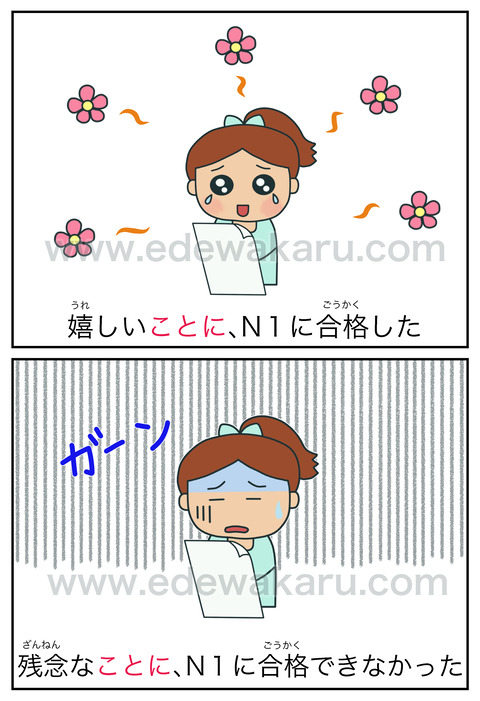
嬉しいことに、N1に合格した
→N1に合格してとても嬉しい残念なことに、N1に合格できなかった
→とても残念なのですが、N1に合格できなかった驚いたことに、彼女は満点でN1に合格した
→とても驚いたのですが、彼女は満点でN1に合格した悔しいことに、1点足りなかったので不合格だった
→とても悔しいが、1点足りなかったので、不合格だった
日本語文型辞典
Meaning
基本情報NaなことにA-いことにV一たことに説明感情を表す形容詞や動詞に付いて、これから述べようとしていることがらに対する話し手の気持ちを前もって表すのに用いる。書きことば的表現。例文① 残念なことに、私がたずねたときには、その人はもう引っ越したあとだった。② おもしろいことに、私がいま教えている学生は、私がむかしお世話になった先生のこどもさんだ。③ おどろいたことに、彼女はもうその話を知っていた。④ あきれたことに、その役所は知事の選挙資金のために裏金をプールしていた。
日本語文型辞典 英語版
Meaning
【ことに】[Na なことに][A-いことに][V-たことに]
Attached to an adjective or verb of emotion and used to indicate in advance the feeling or attitude of the speaker regarding the situation s/he is about to describe. Has the tone of written language.
In context 4 examples
残念なことに、私がたずねたときには、その人はもう引っ越したあとだった。
Unfortunately, when I visited, that person had already moved out.
おもしろいことに、私がいま教えている学生は、私がむかしお世話になった先生のこどもさんだ。
Interestingly, one of the students I’m teaching now is the child of a teacher who mentored me long ago.
おどろいたことに、彼女はもうその話を知っていた。
Surprisingly, she already knew that story.
あきれたことに、その役所は知事の選挙資金のために裏金をプールしていた。
It’s appalling, but that local government office was pooling money in a slush fund for the governor’s campaign expenses.
くらべてわかる日本語表現文型辞典
Meaning
意味1:現実に起こったBに対する話し手の感情をAで述べる。
意味2:「AべきことにB」の形で。Bという事実に対して、みんながAと感じるだろうと、相手に共感を求める表現。
意味3:「AことにはB」の形で。「~によると」という伝聞の情報源を表す。
How to use it
AことにB(AことにはB/AべきことにB)
接続1:
[動詞-た形]ことに
[動詞-可能の否定]ことに
(信じられない、考えられない、許せないなど)
[イ形-い]ことに
[ナ形-な]ことに
接続2:
[動詞-る形]べきことに
接続3:
[動詞-る形/た形]ことには
Notes
【注意1】
・Aには感情を表す言葉が来ることが多い。
【注意2】
・話し手はBの事実を述べたいのであり、Aは聞き手の注意をひくための言葉。Aは感情を表す動詞が多い。
【注意3】
・Aには「聞いた・言う・言った・話した」などが使われる。
In context 12 examples
残念なことに、きのう録画したはずの番組がとれていなかった。
うれしいことに、庭の桜の木が今年も花をつけた。
信じられないことに、たった1枚買った宝くじで1億円当たった。
驚いたことには、濡れた猫を乾かすために電子レンジに入れた人がいるらしい。
おそるべきことに、犯人はこのマンションに住んでいたのだ。
悲しむべきことに、時代を象徴する歌手が死んだ。
注目すべきことには、この薬を飲んで異常行動に走るのは10代の若者に限られていることだ。
喜ぶべきことに、オリンピックでかつてない数の金メダルを獲得した。
彼が言うことには、田中さんは再婚したそうだ。
私が聞いたことには、うちの会社は近々合併するらしい。
気象予報士が言うことには、今年は観測史上、一番の暖冬だそうだ。
社長が話したことには、2年で会社を倍の規模にするということだ。
日本語NET JLPT文法解説まとめ
Meaning
とても〜で
How to use it
V(タ形)+ことに
イAい + ことに
ナAな + ことに
Explanation
①話し手が感じたことを強調して言う時に使う。
②この文型と一緒に使われる言葉は限定される。
③後ろに意志を表す文はこない。現実のことや終わったことなどが来る。
In context 7 examples
悔しいことに、1点差で試合に負けてしまった。
嬉しいことに、来年から夢だったアメリカで働けることになった。
ラッキーなことに、旅行中は一度も雨が降らなかった。
残念なことに、クラスでトムさんだけが、試験に落ちてしまった。
困ったことに、高速道路を走っているときに車が故障して動かなくなってしまった。
ワンさんは日本語の勉強を初めて、まだ1年なのに、驚いたことに、JLPT N1に合格してしまった。
悲しいことに、大切に育てていたペットが事故で死んでしまった。
毎日のんびり日本語教師
How to use it
動た形+ことに
動ない形+ことに
イ形辞書形+ことに
ナ形語幹+なことに
Explanation
話し手の後件に対する評価を述べる文法です。
感情・感覚的な語につきます。
例文(8)のような文は倒置法です。
Notes
特になし
In context 9 examples
驚いたことに、あの人は実年齢45歳らしい。25歳くらいに見える。
不思議なことに、朝起きたら全裸だった。
びっくりしたことに、朝起きたら頭と足の位置が反対になっていた。
嬉しいことにみんなに綺麗になったねって褒められるようになった。
頼もしいことに、彼が協力してくれるようだ。
素晴らしいことに、昔から貯めてた貯金が100万超えていた。
恐ろしいことに、この映画はほぼ実話だそうだ。
彼氏は今いないんだよね。悲しいことに。
信じられないことに、人が見ている色はそれぞれ違うらしい。
IMABI
Adverbs for “Especially”
Read this IMABI lesson ↗Explanation
Adverbs for “Especially”: 殊に, 特に, 就中, とりわけ, 殊更, etc.
This lesson focuses on an array of interrelated adverbs which translate to “especially/particularly.” Although some words may already be very familiar to you, others will be crucial additions to your vocabulary in preparation for the higher levels of the JLPT.
殊に
The adverb 殊に derives from the adjectival noun 異なり meaning “to be different,” which you’ll recognize from the verb 異なる with the same meaning of “to be different.” In fact, 異なる is the verbalized form of 異なり.
It should come as no surprise, then, that 殊に means that something “especially/particularly” different. It is used to mark a higher degree of some quality in comparison to other things. This word is rather literary and is not heard too often in the spoken language.
1. 天文は殊に船乗りに必要だ。
Astronomy is especially important to sailors.
2. 先ほどから殊に目を惹いた一人の男性がいた。
There was one person from earlier who particularly drew my attention.
3. 雪崩の跡で道が殊に悪くなっていた。
The road had become especially worse by what the avalanche left behind.
In older language, 殊に could also mean “moreover.”
4. 殊にこの頃は西山、東山の花盛りにてあると申して
Moreover, (they) say that the Nishiyama and Higashiyama are in full bloom at this time.
From 『猿座頭』 by 虎清狂
特に & 特別(に)
The adverb 特に also means “especially/particularly” by indicating that something stands out as being different than the norm, but unlike 殊に it can also refer to “special/preferential” treatment.
5. 今日は【特に・特別(に)】暑い。
Today is particularly hot.
6. 発展途上国で雇用が特に悪化している。
Employment is particularly worsening in developing countries.
7. 「何か問題があった?」「特にないよ」
“Where there any problems?” “There weren’t any in particular.”
特別(に) can also be used as an adverb, indicating that the state or disposition of something surpasses other things. It also shares 特に’s meaning of referring to “special/preferential” treatment. You will also see 特別 used as an adjectival noun to mean “special/particular.” As an adjectival noun, it usually takes な, but it is also very common to find it in compound words.
8. 在留を特別に許可する。
To especially allow for (someone) residing.
9. 特別なものなんて要らない。
I don’t need anything special.
10. 漢検は自分には特別必要ないと思っている学生がいるかもしれません。
There may be students who think that the Kanken is not particularly important to themselves.
11. 特別料金で申込受付中!
Accepting subscriptions at a special (lower) rate!
格別(に)& 格段に
格別(に)is also very similar to 特別(に)in that it marks an exceptionally true quality. It can also have the nuance of being “especially selected/treated with exception.” The difference in nuance between it and 特別 is that it indicates that something is especially better.
Just like 特別, 格別 may also be used as an adjectival noun meaning “special/particular,” and as an adjectival noun, it usually takes the particle の.
12. 冬は鍋が格別に美味しい季節ですね!
Winter is the season when hot pot tastes especially delicious.
13. 雨の日は格別として、毎日ジムに行きなさい。
With exception to rainy days, go to the gym daily.
14. 平素は格別のお引き立てを賜り、厚く御礼申し上げます。
I wish to express my deep gratitude for the substantial support you always provide.
格段に is particularly closely related to the word 格別(に), but rather than indicating that something is far better than something else, its nuance indicates that the difference at hand is a “marked/noticeable” one at that. The difference is also usually a positive one. When it is used as an adjectival noun, it usually takes the particle の.
15. 一般の人と技量に格段の違いがある。
There is a substantial difference in skill between (him) and ordinary people.
16. 私から言わせると格段に上達していると感じております。
If you ask me, I feel that (he) has markedly improved.
If you want to say that something is at a wildly different level than something, you can also use the synonym 段違いに. As an adjectival noun, it can take な or の.
17. ファイターの強さも段違いだ。
The fighter’s strength is on another level.
18. ダンジョンで出現する他のモンスターより段違いに強いモンスターが出現する。
Monsters wildly stronger than other monsters that appear in dungeons will appear.
とりわけ(て)
Deriving from the te-form of the verb 取り分ける meaning “to distribute/divide,”とりわけ(て) means “especially,” but it is preferred in objective contexts and is not used in relation to actions that are done purposefully or willfully.
19. 今年はとりわけ雨が多い。
This year has especially had a lot of rain.
20. とりわけ政治界においては必ずと言っていいほど改革は挫折する。
Especially in the world of politics, it is safe to say that reformation will invariably fail.
21. 世界中があなたの物になっていても取り分けて本国をお愛しなさい。
Even if the whole world becomes yours, love thy home country above all.From 『ファウスト』by 森鷗外.
Variation Note: とりわけて is identical in meaning and usage to とりわけ, but it is usually only encountered in writing.
とりわけ can best be understood as pinpointing what is “especially so among others.” In this sense, it may be used to refer to personal opinion or the action of others, making it interchangeable with 特に, but it maintains its objective lens on the situation.
22.スポーツの中では【とりわけ・特に】サッカーが好きです。
Among sports, I especially like soccer.
23. とりわけボクシングを熱心にやっている。
(Among other things, he) is especially patient about boxing.
Orthography Note: The kanji spelling of とりわけ is 取り分け, but it is seldom used.
就中
なかんずく, also more traditionally spelled as なかんづく, is a contraction of なかにつく and means “especially… among other things” and is a more literary, fancy synonym to the second usage of とりわけ.
24. すべての学科に言えるが、なかんずく国語が重要である。
Though the same can be said for every subject, Japanese language instruction is especially important.
25. ただ道は最も奥で、山は就中深いが、栃木峠から中の河内は越せそうである。
The road is simply further deep with the mountains being especially deep, but Kawachi, in its interior, seems passable from Tochigi Pass.
From 『栃の実』by 泉鏡花.
別に & 別段
Although all these adverbs can be used in negative sentences, the two synonyms that can only be used in negative structures are 別に and 別段. Both words mean “not particularly/especially,” the latter form being more literary.
26. そこも別段変わった所もなかった。
There wasn’t anything particularly unusual there either.
27. 彼は別段、戦争に協力するような一行の煽動的な文章を書いてはいない。
He hasn’t particularly written any incendiary passage abetting war.
From『通俗と変貌と』by 坂口安吾.
28. 科学は別に特別な知識ではなくて、結局は知識そのものにすぎない。
Science isn’t especially particular knowledge but ultimately knowledge itself and nothing more.
From 『科学編』 by 戸坂潤.
殊更 VS わざと VS 故意に
殊更 has two meanings, one of which is meaning “particularly” as the emphatic version of 殊更.
29. 善とか悪とかいうことが何であるかは今殊更問題にしまい。
I will not particularly make issue of what exactly “good” and “evil” are now.
30. その種の笑い話は本集にも極めて多いが、殊更に多くを集めたのではない。
There is an extremely large amount of such funny stories in this compilation, but it isn’t that (we) have particularly collected lots of them.
From 『中国笑話集』 by 駒田信二.
The second meaning of 殊更 is indicating “intentional/deliberate” action. In negative contexts, it may give off the meaning of “not particularly necessary to” which could be viewed the same as saying “no need to go out of one’s way to.”
In positive contexts such as Ex. 26, you can actually see how the “intentional” meaning derives from its use to “particularly” be a certain way but in a transitive context.
Particle Note: For this second usage, you may also see the particle に with no change in meaning or nuance.
31. 筋肉は殊更(に)膨脹し、男らしさを強調する。
His muscles especially swelled up (on purpose), emphasizing his manliness.
32. 殊更(に)誰に聴かせようとして歌っていたものではない。
(I) wasn’t singing that to intentionally have someone listen to it.
A far more common way to say “deliberately/on purpose,” though, is わざと.
33. 喫茶室にラファエル君がいることには気づいていたが、わざと視線を合わせなかった。
Although I had noticed that Rafael was in the coffee room, I purposely made sure I eyes didn’t meet.
34. 人の前でわざとこんなことをして見せたがる女がいるなんて・・・
To think there’d be a woman who would purposely want to show off doing this sort of thing in front of people…
Orthography Note: The kanji spelling of わざと is 態と, but it is seldom used.
In technical speech, the adverb 故意に will also be seen.
35. たとえば他人がその櫛で頭を梳かしたことはなかったか。あるいは故意にA型の人の毛をそこに入れて裁判所に提出しなかったか。
For instance, are you sure another person didn’t use a comb on the person’s head? Are you sure no one deliberately placed hair of an A-type individual there and then presented that to the court?
From 『死体は語る』by 上野正彦.
36. 犯人は死体の遺棄を故意に腐食動物に任せた可能性が出てきたのである。
The strong possibility has arisen that the criminal abandoned the body and purposefully left it for scavengers.
From 『虫送り』 by 和田はつ子.
In context 36 examples
天文は殊に船乗りに必要だ。
Astronomy is especially important to sailors.
先ほどから殊に目を惹いた一人の男性がいた。
There was one person from earlier who particularly drew my attention.
雪崩の跡で道が殊に悪くなっていた。
The road had become especially worse by what the avalanche left behind.
殊にこの頃は西山、東山の花盛りにてあると申して
Moreover, (they) say that the Nishiyama and Higashiyama are in full bloom at this time.
今日は【特に・特別(に)】暑い。
Today is particularly hot.
発展途上国で雇用が特に悪化している。
Employment is particularly worsening in developing countries.
「何か問題があった?」「特にないよ」
“Where there any problems?” “There weren’t any in particular.”
在留を特別に許可する。
To especially allow for (someone) residing.
特別なものなんて要らない。
I don’t need anything special.
漢検は自分には特別必要ないと思っている学生がいるかもしれません。
There may be students who think that the Kanken is not particularly important to themselves.
特別料金で申込受付中!
Accepting subscriptions at a special (lower) rate!
冬は鍋が格別に美味しい季節ですね!
Winter is the season when hot pot tastes especially delicious.
雨の日は格別として、毎日ジムに行きなさい。
With exception to rainy days, go to the gym daily.
平素は格別のお引き立てを賜り、厚く御礼申し上げます。
I wish to express my deep gratitude for the substantial support you always provide.
一般の人と技量に格段の違いがある。
There is a substantial difference in skill between (him) and ordinary people.
私から言わせると格段に上達していると感じております。
If you ask me, I feel that (he) has markedly improved.
ファイターの強さも段違いだ。
The fighter’s strength is on another level.
ダンジョンで出現する他のモンスターより段違いに強いモンスターが出現する。
Monsters wildly stronger than other monsters that appear in dungeons will appear.
今年はとりわけ雨が多い。
This year has especially had a lot of rain.
とりわけ政治界においては必ずと言っていいほど改革は挫折する。
Especially in the world of politics, it is safe to say that reformation will invariably fail.
世界中があなたの物になっていても取り分けて本国をお愛しなさい。
スポーツの中では【とりわけ・特に】サッカーが好きです。
Among sports, I especially like soccer.
とりわけボクシングを熱心にやっている。
(Among other things, he) is especially patient about boxing.
すべての学科に言えるが、なかんずく国語が重要である。
Though the same can be said for every subject, Japanese language instruction is especially important.
ただ道は最も奥で、山は就中深いが、栃木峠から中の河内は越せそうである。
The road is simply further deep with the mountains being especially deep, but Kawachi, in its interior, seems passable from Tochigi Pass.
そこも別段変わった所もなかった。
There wasn’t anything particularly unusual there either.
彼は別段、戦争に協力するような一行の煽動的な文章を書いてはいない。
He hasn’t particularly written any incendiary passage abetting war.
科学は別に特別な知識ではなくて、結局は知識そのものにすぎない。
Science isn’t especially particular knowledge but ultimately knowledge itself and nothing more.
善とか悪とかいうことが何であるかは今殊更問題にしまい。
I will not particularly make issue of what exactly “good” and “evil” are now.
その種の笑い話は本集にも極めて多いが、殊更に多くを集めたのではない。
There is an extremely large amount of such funny stories in this compilation, but it isn’t that (we) have particularly collected lots of them.
筋肉は殊更(に)膨脹し、男らしさを強調する。
His muscles especially swelled up (on purpose), emphasizing his manliness.
殊更(に)誰に聴かせようとして歌っていたものではない。
(I) wasn’t singing that to intentionally have someone listen to it.
喫茶室にラファエル君がいることには気づいていたが、わざと視線を合わせなかった。
Although I had noticed that Rafael was in the coffee room, I purposely made sure I eyes didn’t meet.
人の前でわざとこんなことをして見せたがる女がいるなんて・・・
To think there’d be a woman who would purposely want to show off doing this sort of thing in front of people…
たとえば他人がその櫛で頭を梳かしたことはなかったか。あるいは故意にA型の人の毛をそこに入れて裁判所に提出しなかったか。
For instance, are you sure another person didn’t use a comb on the person’s head? Are you sure no one deliberately placed hair of an A-type individual there and then presented that to the court?
犯人は死体の遺棄を故意に腐食動物に任せた可能性が出てきたのである。
The strong possibility has arisen that the criminal abandoned the body and purposefully left it for scavengers.
Phrasal こと
Read this IMABI lesson ↗Explanation
Phrasal こと: ~ことに・~ことには・~AことはA~・Aことこの上ない・~ということだ
The grammatical patterns involving the nominalizer こと to be discussed in this lesson are as follows:
~ことに
~ことには
AことはA
Aことこの上ない
~ということだ
Solid understanding of the other pieces to these grammatical structures combined with understanding how nominalization works with こと is essentially all you need to master these patterns.
~ことに
Following verbal or adjectival/adjectival noun predicates, ~ことに can indicate a strong emotional response toward a situation that follows. This following main clause should not indicate volition. This grammar is largely limited to phrases of the same vein as those in the chart below.
悲しいことにsadly…不思議なことにstrangely enough…
驚いたことにsurprisingly…ありがたいことにthankfully…
残念なことにunfortunately…面白いことにinterestingly…
悔しいことにto my chagrin…幸いなことにfortunately…
困ったことにawkwardly…嬉しいことにto my delight…
恐ろしいことにhorribly…興味深いことにintriguingly…
Not only is it the case that volition is absent from either clause, the commentary itself ought not to include the listener’s circumstance. Meaning, it is limited to first and third person scenarios.
1. とても残念なことに、あともう少しだったのに、負けちまった。
Very unfortunately for me, I ended up losing despite how close I was.
2. ありがたいことに、全員が無事だった。
Thankfully, everyone was alright.
3. 住民の恐ろしいことに、洪水で数千頭の家畜が溺死し、一部は木のてっぺんにとどまりました。
To the horror of the residents, thousands of livestock drowned in the floodwaters, some remaining lodged in the treetops.
If additional emphasis is warranted for these phrases, you may also see it topicalized via the particle は.
4. 驚いたことには、欠席どころか、一度遅刻したこともなかったそうだ。
What was surprising was that, far from being absent, apparently, (he) had never even been late once.
5. あきれたことには、あんな人が店長に昇進したんだよ。
It’s dumbfounded how someone like that got promoted to store manager.
に is highly adverbial in nature in this pattern. Given the emphatic tone of ~ことに, it is comparable to sentence-final ~ことだ. Meaning, we are looking at the /ni-/ 連用形 of the copula. It is this adverbial property which then limits ~ことに to adjectival/adjectival noun predicates.
Given the adverbially nature of に and how it relates quite nicely with sentence-initial instances of “-ly” in English, it is important NOT to confuse ~ことに when に functions as an object marker, which would be obvious from the clausal structuring of the sentence.
6. 悲しいことにも、うれしいことにも、 起こってしまうどんなことにも、 そんなに驚かないで、慌てないでいられたらいいなって思う。
I hope that I can remain unsurprised and not panicked by anything happens, whether sad or happy.
As longwinded as Ex. 6 might be, in the case of both 悲しいことに and うれしいことに, they are objects of the verb 驚く that does indeed follow. In which case, the appropriate translation of に would be “at/by.”
~ことには
By Condition A being the case, Condition B is sure to follow.
7. その根源を解決しないことには、一時的に課題を解決しても、また同じ課題になやまされることになります。
Unless you address the root cause, even if you solve the problem for the time being, you will end up suffering from the same problem again.
8. 早く出発しないことには、大変なことになる。
By not departing early, it’ll become a huge ordeal.
As suggested by the translation of “by,” the particle に shown in this pattern relates to its cause marking function. When applied to predicates, it is Situation/Condition A, usually not happening that causes Situation/Condition B to happen.
~ないことには~ない
This pattern is the same as ~ことには but with both the dependent clause and main clause rendered in the negative, creating a conditional statement in which “by Condition A not being met, Condition B does not come about.”
9. まず、事実関係を確認しないことには、何とも言えません。
First of all, there is really nothing I can say about it without checking the facts.
10. 何事も経験してみないことには分からないでしょう。
You won’t know until you experience it, and that’s with anything.
11. 失敗の発生要因をきちんと見つけだして解決しないことには再発防止にはならないのである。
Unless the cause of the failure is properly identified and resolved, preventing recurrence will not be feasible.
12. 本物であるかは買ってみないことにはわかりません。
You won’t know if it’s real until you buy it.
言う(こと)には・・・
This pattern is used when the speaker wishes to pass along information they have directly obtained from Source A which may still be . It is possible to find 言う in the non-past or past tense, but oddly enough, こと is not required when this pattern is used in the non-past. In its absence, it is understood that には follows the 連体形1.
As for the nature of the particle に, it is used in its standard marker capacity.
13. 村民が言う(こと)には、腹を空かせた熊が、餌を探しに街に出没しているらしい。
Villagers say that hungry bears have been lurking in the town looking for food.
14. テイラー君が言う(こと)には、明日は開店日だそうだよ。
From what Taylor-kun is saying, tomorrow is opening day.
15. メアリーさんの言う(こと)には、今年のN1はかなり難しかったらしいよ。
From what Mary-san is saying, this year’s N1 seemed pretty difficult.
16. 今菊池さんが言ったことには、もしかしたら参考になるかもしれない。
Given what Kikuike-san just said, perhaps it might be of help (to you).
While it is not a requirement that 言う be used, the verb must still be an equivalent.
17. 「鳩さんが申します2には、このお嬢さんのおとしは十歳だそうです。お嬢さんあたりましたか」
“From what Hato-san is saying, you fine lady here are ten, is that right?”
From 『電気鳩』 by 海野十三.
18. 陛下が仰せになる(こと)には、それでよいとのことでした3。
From what His Majesty is saying, that will be fine.
It is worth noting that this utilization of ~ことには ought not be confused with the sentence structure is actually [~こと]+にはある or similar sentences.
19. 検察官の仰ることにはどう見ても首をかしげるような事実誤認の部分もありました。
No matter how you look at it, there were some factual errors in what the prosecutor(s) said that made me tilt my head.
AことはA…(が・けれど)
Juxtaposing a predicate pertaining to states – nominal, adjectival, or adjectival noun – with ITSELF, the speaker admits the validity of the truth statement made by said predicate, but the commentary (Situation B) that follows downplays the importance of it in some way. In a broad sense, it is one way of qualifying one’s statement, with a meaning similar to “it is the case that… but…”
By juxtaposing a predicate (Situation A) with itself, both iterations on each side of ことは must match either in predicate type and state of affirmation (positive or negative). As for politeness, it may be marked on Situation B or on the second utterance of Situation A4.
Now, because the 連体形 must be used before こと, you will still need to know when to use な・だ・である in relation to to nominal/adjectival noun predicates.
Predicate TypeExample
動詞食べることは食べるが
形容詞美味しいことは美味しいが
形容動詞便利{な・である}ことは便利だが
20. おいしいことはおいしいが、ちょっと高すぎる。
Sure, it’s delicious, but it’s a little too expensive.
21. それ以降もミステリーを書くことは書いたが、一般小説で脚光を浴びるようになって行った。
Although (I) continued to write mystery novels after that, (I) began to gain attention for my general fiction.
22. 先月開通した道は便利なことは便利だが、事故が多い。
The road that opened last month is convenient, sure, but there are a lot of accidents (on it).
23. 自分が学生の頃は授業に出ることは出たがあんまり熱心には受講していなかった。
When I myself was a student, I did attend classes, but I was not all that enthusiastic about taking them.
Tense is not restricted by this pattern aside from “past… ~ことは non-past…” being ungrammatical. Consider the following.
24. 見ての通り、キュワワー以外にもレア度の高いモンスターが出たことは出たが、出現率が高いとは言い難い。
As you can see, there were other super rare mons that spawned besides Comfey, but I can’t say that their spawn rate was high.
25. 全部分かったことは分かったけど、時間がなくなってしまった。
I know I understood it all, but I ran out of time.
26. 書いたことは書いたんだけど、捨てちゃったかも。
I wrote it, I know it, but I guess I threw it away.
27a. きのう、本屋へ行ったことは行ったが、店が閉まっていて買えなかった。
27b. きのう、本屋へ行くことは行ったが、店が閉まっていて買えなかった。
27a. I went to the bookstore yesterday, that I did, but the store was closed and I couldn’t buy (it).
27b. Yesterday, I did in fact go to the bookstore, but the store was closed and I couldn’t buy (it).
In Ex. 27a, the speaker is emphasizing that Situation A is a thing of the past. Meanwhile, in Ex. 27b, the use of the non-past tense first indicates how the speaker’s mind has rewound to that moment in time, placing the focus on [本屋へ行く] as opposed to the time setting of yesterday. With [行ったことは行った], the emphasis is on the action having occurred in a confirmatory tone.
28a. タイに行く前にタイ語を勉強することはしたのですが、たった2週間だけです。
28b. タイに行く前にタイ語を勉強したことはしたのですが、たった2週間だけです。
28a. I did in fact study Thai before going to Thailand, but only for two weeks.
28b. I studied Thai before going to Thailand, yes, but only for two weeks.
Ex. 28 also illustrates how ellipsis can occur for the root element of a する verb when it is repeated.
w/ Nominal Predicates
Due to nominal predicates already being representations of “X being Y,” which in this case, Y=X, using AことはA with such predicates is generally unnatural5 due to grammatical redundancy. The same can be said for the English equivalent.
i. 道路{である・な}ことは道路だ。X
What is being a road is a road. X
ii. 道路は道路だ。〇
A road is a road.
Aことこの上ない
Following all predicate types, ~ことこの上ない, this emphatic pattern indicates that there is no condition/state that better fits that description than what is being stated. This, though, could be used in a literal and sarcastic sense, so whether the statement is a good thing or not will be contextually based.
29. 発音が弱くて聞き取りにくかったのかもしれませんが、やる気満々の私には悔しいことこの上ありません。
Maybe my pronunciation was poor and it was hard for them to catch what I was saying, but it was the most vexing thing for me ever considering how determined I was.
30. 昨日は雪が大したことなくて良かったですね。しかしながら、寒いことこの上ないです。
I’m so glad the snow wasn’t too bad yesterday. Even so, it was still beyond cold.
31. 床には粉々に砕けたステンドグラスが散乱しており、見ていて危なっかしいことこの上なかった。
Shattered stained glass was scattered all over the floor, making for an extremely dangerous sight to see.
32. 食べにくいことこの上ございませんことよ6!
It is beyond difficult to eat!
When this pattern is being used to modify a noun, it manifests as この上ない~.
33. 皆様を弊社にお迎えでき、この上ない喜びです。
It is my greatest pleasure to welcome all of you to our company.
34. 大切な方やペットとの死別は、この上ない悲しみや苦しみに襲われる場合があり、どうしようもない悲嘆の感情にお困りの方もいらっしゃるでしょう。
The death of a loved one or a pet can cause extreme sadness and anguish, and some people may find themselves overwhelmed by grief that they cannot cope with.
This pattern may also be used adverbially as この上なく.
35. この上なくいい天気でした。
The weather couldn’t have been better.
~ということだ(伝聞)
Oftentimes, especially in formal speech such as reporting, indicating the “facts” of the matter as first stated or observed by others is indicated with ~ということだ.
36. ロケットが打ち上げられたということだ。
This means that a rocket was launched.
37. 駆除されたクマと、4年前に町内の70代の女性を死亡させたクマのDNAも一致したということです。
The DNA of the culled bear also matched that of a bear that killed a woman in her 70s who lived in the town four years ago.
From NHK 7/19/25.
38. この岩石の年代について、放射性元素を使った手法で詳しく分析したところ、太陽系誕生直後のおよそ45億6730万年前に形成されていたことがわかったということです。
Detailed analysis of the rock’s age using radioactive isotypes revealed that it was formed approximately 4.5673 billion years ago, shortly after the birth of our solar system.
From NHK 7/19/25.
In casual conversation, in addition to seeing it manifested as ~ってことだ, tonality heavily affects the implication behind the speaker relaying what they have heard as hearsay (伝聞). For instance, in the following examples, the speaker is not all too happy about the situation and is probing for more information.
39. その夜、ご主人はご帰宅なさらなかったということですが、おかしいじゃありませんか。どうしてなのですか。
I understand that your husband didn’t come home last night, but isn’t that strange? Why did he not?
40. うちの子が怪我したってことだが、いったいどうしてくれるんだ?
So, apparently my child got hurt. What are you going to do about it?
When the statement ~ということだ follows is not necessarily hearsay, the implication is that the speaker is trying to make a matter-of-fact statement, which would be corroborated by past experiences, common sense, or actually quoting someone.
41. 社長が朝礼で言ったのは、「心をひとつにして頑張ろう」ということだよ。
As for what the president was talking about in our morning meeting, he talked about “coming together and doing our best.”
In the spoken language, you may also encounter this use of ~ということだ further abbreviated to ~って. Now, as for whether what follows ~って happens to still be an ellipsed ことだ or some other plausible replacement such as 言う would be contextually based. In any event, the statement would still be backed up in some fashion beyond the speaker simply stating what they believe to be the case.
~とのことだ is largely equivalent to ~ということだ, albeit with a far calmer tone, making it inappropriate for Exs. 39-40 from earlier. It also would not fit well in Ex. 41, either, on the basis that ~とのことだ is not used to persuade the listener that the statement is true.
42. 今夜雨が降る{という・との}ことでした。
(They) were saying how it’s going to rain tonight.
In Ex. 42, while both という・との are possible, the use of という implies a degree of positive reinforcement on the part of the speaker to get the listener up to speed, with との thus being technically politer and unassuming.
~とのことだ shifts the focus to where the information is derived, making it clear that it is not derived (solely) from the speaker’s mind, which aids in the establishing its calm tone.
43. お出かけになるとのことでしたが、まだよろしいのですか。
I had heard about you heading out, but are you still fine (to head out)?
~とのことだ is heavily used in letters and writing, especially when congratulating, sending condolences, etc. Notice also how, in sentence-medial position, this pattern manifests as ~とのこと~.
44. ご子息様、合格なさった{とのこと 〇・ということ X}ですね。
I hear your son passed the exam.
45. お祖父様、ご逝去とのこと、心よりご冥福をお祈り申し上げます。
I would like to extend my heartfelt condolences to you on the passing of your grandfather.
参照
『日本語類義表現使い分け辞典』 by 泉原省二
Case particles could regularly attach to the 連体形 of verbs, and this property of the 連体形 is found fossilized in a handful of patterns such as this one. ↩︎
In uber-polite 敬語-style speech, the 連体形 of ~ます does become frequently utilized despite politeness markers generally not being used in such capacity. ↩︎
The use of ~た should be interpreted as being confirmatory in nature and not that the measure “was” alright in the past. ↩︎
Politeness marking cannot occur in 連体形 position under normal circumstances, which is why both sides may not match in this regard. ↩︎
This also coincides with how the scope marker ~のだ is similarly ungrammatical due to grammatical redundancy, as nominal predicates naturally designate “X = Y, ” unambiguously as the “focus” of defining. ↩︎
~ませんことよ is an example of てよ・だわ言葉. ↩︎
In context 47 examples
とても残念なことに、あともう少しだったのに、負けちまった。
Very unfortunately for me, I ended up losing despite how close I was.
ありがたいことに、全員が無事だった。
Thankfully, everyone was alright.
住民の恐ろしいことに、洪水で数千頭の家畜が溺死し、一部は木のてっぺんにとどまりました。
To the horror of the residents, thousands of livestock drowned in the floodwaters, some remaining lodged in the treetops.
驚いたことには、欠席どころか、一度遅刻したこともなかったそうだ。
What was surprising was that, far from being absent, apparently, (he) had never even been late once.
あきれたことには、あんな人が店長に昇進したんだよ。
It’s dumbfounded how someone like that got promoted to store manager.
悲しいことにも、うれしいことにも、 起こってしまうどんなことにも、 そんなに驚かないで、慌てないでいられたらいいなって思う。
I hope that I can remain unsurprised and not panicked by anything happens, whether sad or happy.
その根源を解決しないことには、一時的に課題を解決しても、また同じ課題になやまされることになります。
Unless you address the root cause, even if you solve the problem for the time being, you will end up suffering from the same problem again.
早く出発しないことには、大変なことになる。
By not departing early, it’ll become a huge ordeal.
まず、事実関係を確認しないことには、何とも言えません。
First of all, there is really nothing I can say about it without checking the facts.
何事も経験してみないことには分からないでしょう。
You won’t know until you experience it, and that’s with anything.
失敗の発生要因をきちんと見つけだして解決しないことには再発防止にはならないのである。
Unless the cause of the failure is properly identified and resolved, preventing recurrence will not be feasible.
本物であるかは買ってみないことにはわかりません。
You won’t know if it’s real until you buy it.
村民が言う(こと)には、腹を空かせた熊が、餌を探しに街に出没しているらしい。
Villagers say that hungry bears have been lurking in the town looking for food.
テイラー君が言う(こと)には、明日は開店日だそうだよ。
From what Taylor-kun is saying, tomorrow is opening day.
メアリーさんの言う(こと)には、今年のN1はかなり難しかったらしいよ。
From what Mary-san is saying, this year’s N1 seemed pretty difficult.
今菊池さんが言ったことには、もしかしたら参考になるかもしれない。
Given what Kikuike-san just said, perhaps it might be of help (to you).
「鳩さんが申します2には、このお嬢さんのおとしは十歳だそうです。お嬢さんあたりましたか」
“From what Hato-san is saying, you fine lady here are ten, is that right?”
陛下が仰せになる(こと)には、それでよいとのことでした3。
From what His Majesty is saying, that will be fine.
検察官の仰ることにはどう見ても首をかしげるような事実誤認の部分もありました。
No matter how you look at it, there were some factual errors in what the prosecutor(s) said that made me tilt my head.
おいしいことはおいしいが、ちょっと高すぎる。
Sure, it’s delicious, but it’s a little too expensive.
それ以降もミステリーを書くことは書いたが、一般小説で脚光を浴びるようになって行った。
Although (I) continued to write mystery novels after that, (I) began to gain attention for my general fiction.
先月開通した道は便利なことは便利だが、事故が多い。
The road that opened last month is convenient, sure, but there are a lot of accidents (on it).
自分が学生の頃は授業に出ることは出たがあんまり熱心には受講していなかった。
When I myself was a student, I did attend classes, but I was not all that enthusiastic about taking them.
見ての通り、キュワワー以外にもレア度の高いモンスターが出たことは出たが、出現率が高いとは言い難い。
As you can see, there were other super rare mons that spawned besides Comfey, but I can’t say that their spawn rate was high.
全部分かったことは分かったけど、時間がなくなってしまった。
I know I understood it all, but I ran out of time.
書いたことは書いたんだけど、捨てちゃったかも。
I wrote it, I know it, but I guess I threw it away.
きのう、本屋へ行ったことは行ったが、店が閉まっていて買えなかった。
27a. I went to the bookstore yesterday, that I did, but the store was closed and I couldn’t buy (it).
きのう、本屋へ行くことは行ったが、店が閉まっていて買えなかった。
27a. I went to the bookstore yesterday, that I did, but the store was closed and I couldn’t buy (it).
タイに行く前にタイ語を勉強することはしたのですが、たった2週間だけです。
28a. I did in fact study Thai before going to Thailand, but only for two weeks.
タイに行く前にタイ語を勉強したことはしたのですが、たった2週間だけです。
28a. I did in fact study Thai before going to Thailand, but only for two weeks.
発音が弱くて聞き取りにくかったのかもしれませんが、やる気満々の私には悔しいことこの上ありません。
Maybe my pronunciation was poor and it was hard for them to catch what I was saying, but it was the most vexing thing for me ever considering how determined I was.
昨日は雪が大したことなくて良かったですね。しかしながら、寒いことこの上ないです。
I’m so glad the snow wasn’t too bad yesterday. Even so, it was still beyond cold.
床には粉々に砕けたステンドグラスが散乱しており、見ていて危なっかしいことこの上なかった。
Shattered stained glass was scattered all over the floor, making for an extremely dangerous sight to see.
食べにくいことこの上ございませんことよ6!
It is beyond difficult to eat!
皆様を弊社にお迎えでき、この上ない喜びです。
It is my greatest pleasure to welcome all of you to our company.
大切な方やペットとの死別は、この上ない悲しみや苦しみに襲われる場合があり、どうしようもない悲嘆の感情にお困りの方もいらっしゃるでしょう。
The death of a loved one or a pet can cause extreme sadness and anguish, and some people may find themselves overwhelmed by grief that they cannot cope with.
この上なくいい天気でした。
The weather couldn’t have been better.
ロケットが打ち上げられたということだ。
This means that a rocket was launched.
駆除されたクマと、4年前に町内の70代の女性を死亡させたクマのDNAも一致したということです。
The DNA of the culled bear also matched that of a bear that killed a woman in her 70s who lived in the town four years ago.
この岩石の年代について、放射性元素を使った手法で詳しく分析したところ、太陽系誕生直後のおよそ45億6730万年前に形成されていたことがわかったということです。
Detailed analysis of the rock’s age using radioactive isotypes revealed that it was formed approximately 4.5673 billion years ago, shortly after the birth of our solar system.
その夜、ご主人はご帰宅なさらなかったということですが、おかしいじゃありませんか。どうしてなのですか。
I understand that your husband didn’t come home last night, but isn’t that strange? Why did he not?
うちの子が怪我したってことだが、いったいどうしてくれるんだ?
So, apparently my child got hurt. What are you going to do about it?
社長が朝礼で言ったのは、「心をひとつにして頑張ろう」ということだよ。
As for what the president was talking about in our morning meeting, he talked about “coming together and doing our best.”
今夜雨が降る{という・との}ことでした。
(They) were saying how it’s going to rain tonight.
お出かけになるとのことでしたが、まだよろしいのですか。
I had heard about you heading out, but are you still fine (to head out)?
ご子息様、合格なさった{とのこと 〇・ということ X}ですね。
I hear your son passed the exam.
お祖父様、ご逝去とのこと、心よりご冥福をお祈り申し上げます。
I would like to extend my heartfelt condolences to you on the passing of your grandfather.
どんなときどう使う 日本語表現文型辞典
Meaning
terribly; extremely
How to use it
Vた/イAい/ナAな+ことに(は)
Explanation
ことに(は)
非常に~ことだが
1)ある事柄について話者がどう感じたかを前もって「ことに」の前で言うことによってその感じを強調する言い方。
2)「ことに」の前には感情を表す言葉が入り、後には話者の意志を表す文は来ない。
◆ × うれしいことに、来年カナダに留学するつもりだ。
3)やや書き言葉的な表現。
1)Speaker's emotions are indicated before ことに, the inversion putting emphasis on speaker's feelings.
2)Words expressing emotions come before ことに; no expressions of speaker's intentions follow.
◆ × うれしいことに、来年カナダに留学するつもりだ。
3)Somewhat more common in written language.
In context 4 examples
驚いたことに、将棋の試合で小学生が大人に勝った。
不思議なことに、何年も実がならなかった柿の木に今年はたくさん実がなった。
悔しいことには、1点差でA校とのバスケットボールの試合に負けてしまった。
うれしいことに、来年カナダに留学できそうだ。