くらべてわかる日本語表現文型辞典
Meaning
意味1:断続的・機械的に繰り返されるAの時は、いつもB。どのAもみんなB。
意味2:Aを続けて/続いていくと、だんだんBの程度が強まる/弱まる。
意味3:Aを一つの固まりと考え、その固まりのどれもがB。
意味4:Aの数を区切りとして、Bが繰り返される。
How to use it
AごとにB
接続1:
[名詞-∅]ごとに
接続2:
[動詞-る形]ごとに
[名詞-∅]ごとに
接続3:
[名詞-∅]ごとに
接続4:
[数詞]+[動詞-る形]ごとに
[数詞]ごとに
Explanation
【対比1】
「AたびにB」(意味1 P.125)
【対比2】
「AたびにB」(意味2 P.125)
「AたびにB」は繰り返されるAの1回1回に視点があり、「AごとにB」は時間の流れとともに変化していく中でAを区切りとしてとらえている。
○あの先生に聞くたびにわからなくなる。
×あの先生に聞くごとにわからなくなる。
×雨が降るたびに暖かくなっていく。
○雨が降るごとに暖かくなっていく。
【対比4】
「AおきにB」(意味1 P.46)
「AあたりB」(意味1 P.28)
Notes
【注意3,4】
・「1分ごとに」、「1日ごとに」などは、普通「毎分・毎日…」と「毎」を使うことのほうが多い。
・意味3は、Aを一つのまとまりと考え、そのまとまりに対してBという考え方だが、意味4は全体を線上のものと考え、Aという区切りで切ってBという考え方である。
○3人ごとに旗を配る。(意味3)
○3人ごとに旗を持たせる。(意味4)
In context 16 examples
主人は日曜ごとにゴルフに行っています。
あの事件以来、夜ごとに夢を見るようになった。
季節ごとにショー・ウィンドーのディスプレーが変わる。
パーティー会場では、会う人ごとに名刺を配って歩いた。
彼は試合ごとに強くなっていく感じがする。
一雨ごとに暖かくなってまいりました。
ページをめくるごとに、物語は核心に迫っていく。
一口食べるごとに、うまさが増してくる。
クラスごとに集まって写真を撮る。
品詞ごとにノートにまとめておくと、便利だ。
文を書くときは、一段落ごとに1字下げて書く。
営業マンごとに担当地区が決められている。
この薬は6時間ごとに飲んでください。
オリンピックは4年ごとに開催されます。
このハイキングコースには4キロごとにトイレがある。
校内を500メートル走るごとにスタンプがもらえる。
DoJG 日本語文法辞典(全集)
Meaning
Every
Explanation
Something takes place regularly in succession after a certain temporal or spatial interval.
In context 6 examples
私は三時間ごとに薬を飲んだ・飲みました。
I took medicine every three hours.
正月は家ごとに門松を立てる・立てます。
They put up pine tree decorations at every house on New Year's Day.
一課ごとに試験がある。
There is a test after every lesson.
学期ごとに先生が変わる。
Every semester teachers change.
木村さんは会う人ごとに挨拶している。
Mr. Kimura greets everyone he meets.
三日ごとにテニスをしています。
I'm playing tennis every third day.
日本語文型辞典
Meaning
基本情報NごとにV-ることに説明①②③のように、そのたびに、そのつど、という意味を表す場合と、④のように、それぞれに、おのおのに、というような意味を表す場合とがある。②のように動詞に付く場合は「見るたびに」のように「たびに」を使うことの方が多い。また④は「人に会うたびに」や「会う人会う人に」と言いかえることもできる。例文① このめざまし時計は5分ごとに鳴る。② こどもというものは、見るごとに大きくなっていくものだなあ。③ この季節は、よくひと雨ごとにあたたかくなるという。④ 彼は、会う人ごとに、こんど獲てた家のことを自慢している。
絵でわかる日本語
Usage 1
Read this source entry ↗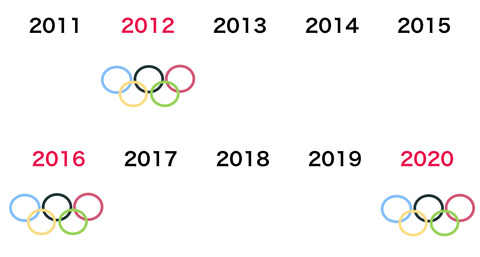
Meaning
〜に1回〜する
How to use it
数量詞+ごとに
Explanation
「〜ごとに」は「〜に1回〜する」と言いたい時に使われる文型です。
期間・時間・距離
を表す数量詞に使います😊ほとんどの場合ひらがなで「〜ごとに」と書きますが、漢字で書くと「〜毎に」と書きます。また、「〜ごと」は「毎〜」という意味になる場合も覚えておきましょう😉
[「〜ごと=毎〜」の場合]
・1日
ごと
=
毎
日
・1週間
ごと
=
毎
週
・1か月
ごと
=
毎
月
・1年
ごと
=
毎
年
「毎日・毎週・毎月・毎年」の方がよく使われますが、「必ず毎日」「必ず毎週」というように強調したい場合などに「1日ごと」「1週間ごと」が使われます😊
今回の「〜ごとに」は、以前紹介した「〜おきに」と混乱しがちですので同じ例文を使って説明してみました😀N3以上を受ける人は、違いをしっかりと復習しておいてください。
「〜ごとに」には、いくつか意味がありますので1つ1つ区別して覚えておきましょう。
In context 3 examples
オリンピックは4年ごとに開催される
→オリンピックは4年に1回開催される3か月ごとに授業料(じゅぎょうりょう)を払う
→3か月に1回授業料を払う2日ごとにゴミを出す
→2日に1回ゴミを出す
Usage 2
Read this source entry ↗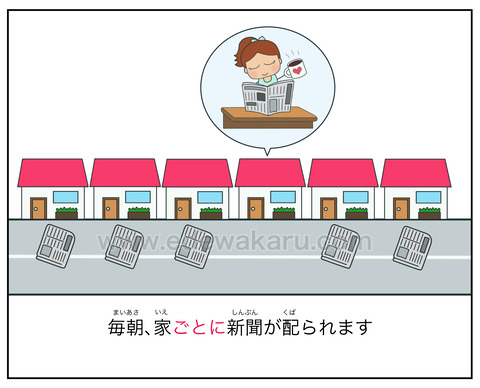
Meaning
〜それぞれに
〜それぞれ全部に
How to use it
名詞[辞書形]+ごとに
Explanation
「〜ごとに」は「〜それぞれ全部に」という意味を表す文型です。
「例外なくそれぞれ全てに〜」
と言いたい時に使います😊
[例]
①家
ごとに
新聞が配られます
→「家」1軒1軒それぞれ全部に
②会う人
ごとに
あいさつをする
→「会う人」1人1人それぞれみんなに
③近くを通る人
ごとに
ティッシュを渡す
→「近くを通る人」1人1人それぞれ全員に
④グループ
ごとに
リーダーを決めてください
→全部の「グループ」1つ1つそれぞれ
「〜ごとに」はいくつか意味があり、似ている文型もありますのでとても複雑です😨しっかりと区別をして覚えておくといいと思います😀
In context 4 examples
毎朝、家ごとに新聞が配られます
→毎朝、家それぞれ全部に新聞が配られます会う人ごとにあいさつをする
→会う人それぞれみんなにあいさつをする近くを通る人ごとにティッシュを渡す
→近くを通る人それぞれみんなにティッシュを渡すグループごとにリーダーを決めてください
→全部のグループそれぞれリーダーを決めてください
日本語NET JLPT文法解説まとめ
Meaning
〜たびに / 〜単位で / 〜周期で
How to use it
V(辞書形)+ ごとに
N + ごとに
Explanation
「〜ごとに」は漢字にすると「〜毎に」となる。
In context 6 examples
私が働くコンビニでは1時間ごとにおでんやフライドチキンなど、食べ物の品質をチェックしている。
私の会社では2年ごとにパソコンを新しいものに交換する。
オリンピックは4年ごとに開催される。
このシステムは半年ごとにアップデートされる。
人は失敗するごとに成長していくものだ。
それでは今からグループごとに発表してもらいます。
日本語文型辞典 英語版
Meaning
【ごとに】[Nごとに][V-るごとに]
Used to express the meaning of “each and every time,” as in
(1)
,
(2)
, and
(3)
, as well as the notion of “each person or individual,” as in
(4)
. With verbs (see
(2)), たびに is used more often, as in 見るたびに (every time I see (s.o./s.t.)). Also,
(4)
can be paraphrased as 人に会うたびに (every time he meets someone) or 会う人会う人に (every person he meets).
In context 4 examples
このめざまし時計は5分ごとに鳴る。
This alarm clock rings every five minutes.
こどもというものは、見るごとに大きくなっていくものだなあ。
Children get bigger every time we see them, don't they?
この季節は、よくひと雨ごとにあたたかくなるという。
In this season, it is often said that it gets warmer with each rainfall.
彼は、会う人ごとに、こんど建てた家のことを自慢している。
He brags to every person he meets about the house he’s just built.
AIUEO JLPT Grammar
Meaning
「〜ごとに」is used to indicate that something happens at regular intervals or frequency, or that different situations or actions occur in each unit of time or space.
How to use it
動詞辞書形+ごとに名詞+ごとに
Explanation · 日本語
「〜ごとに」は、一定の間隔や頻度で物事が繰り返されること、またはそれぞれの単位で異なる状況や動作が発生することを表す表現です。
In context 5 examples
この薬は、食事ごとに服用してください。
Please take this medicine with each meal.
彼は会うごとに新しい話題を提供してくれる。
He brings up a new topic every time we meet.
彼女は2年ごとに引っ越している。
She moves every two years.
この時計は、1時間ごとにチャイムが鳴る。
This clock chimes every hour.
大会は3年ごとに開催されます。
The tournament is held every three years.
文法
Meaning
〜たびに / 〜単位で / 〜周期で
How to use it
V(辞書形)+ ごとに
N + ごとに
Notes
「〜ごとに」は漢字にすると「〜毎に」となる。
In context 6 examples
私が働くコンビニでは1時間ごとにおでんやフライドチキンなど、食べ物の品質をチェックしている。
私の会社では2年ごとにパソコンを新しいものに交換する。
オリンピックは4年ごとに開催される。
このシステムは半年ごとにアップデートされる。
人は失敗するごとに成長していくものだ。
それでは今からグループごとに発表してもらいます。
Bunpro Grammar Reference
Meaning
Each, Every
How to use it
Verb + ごとに
Noun + ごとに
Nuance
A structure that highlights something occuring every (A), focusing on every individual interval.
Explanation
ごとに is a combination of the noun ごと, and the particle に. Together, they are used adverbially to express that something happens 'every (A)', or 'at intervals of (A)'. ごとに may be used after any verb (usually in non-past form), or noun.
失敗をする経験は無駄ではありません。失敗をするごとに上達します。
Failing is not a pointless experience. Every time you fail, you improve.
私は3時間ごとにお菓子を食べます。
I eat snacks every 3 hours.
Although ごとに may be used after verbs, the most common use is with nouns, or phrases that finish with nouns.
Caution
ごと is the 訓読み (Japanese reading) of the kanji 毎, which means 'every'. This fact will be important when trying to remember the difference between ごとに and おきに, a similar grammar point which can also mean 'every', but focuses more on 'interval' or 'gap' of a specific time or distance. Due to おきに focusing on the space between 'each (A)', there are sentences where おきに and ごとに will have different meanings.
私は一週間ごとに実家に帰ります。
I go to my parents' home every week. (Every single one)
私は一週間おきに実家に帰ります。
I go to my parents' home every other week. (With 'spaces' or 'gaps' of 1 week)
Here, we can see that ごとに will mean 'every week', while おきに will mean 'every second week', due to there being a 'one week interval' when おきに is used. To make things easier, these two expressions can be remembered in the following way.
(A) ごとに = During every (A), (B).
(A) おきに = After every space of (A), (B).Fun FactMany native speakers make mistakes with the difference between おきに and ごとに, so there are quite a large number of people (especially in the younger generation) that will consider them completely interchangeable.
Nuance · 日本語
ある区間に焦点を当て、(A)のたびに起こるということを強調するときに使われる文法。
In context 16 examples
- あのチームは、試合をする毎に強くなっている。
That team is getting stronger with every match.
- 失敗をする経験は無駄ではありません。失敗をするごとに上達します。
Failing is not a pointless experience. Every time you fail, you improve.
- 私は3時間ごとにお菓子を食べます。
I eat snacks every 3 hours.
- 夏毎にアメリカに帰ります。
Every summer I go back to America.
- 生徒毎に紙を渡した。
I gave a paper to every student. (Each)
- 二日毎に友達とサッカーをする。
I play soccer with my friend every two days. (at two day intervals)
- あの人は会う人毎に笑顔で握手します。
That person greets every person they meet with a smile and a handshake.
- 3時間毎に水一杯を飲んで下さい。
Please drink a glass of water every 3 hours.
- 先生毎にお土産をもらった。
I received a souvenir from each teacher.
- 5時間毎にこの不味い薬を飲まなくてはいけない。
I have to drink this awful medicine at five hour intervals.
- クリスマスは私の近所で家毎にイルミネーションをしている。
During Christmas, every house in my neighborhood hangs Christmas lights.
- 日本で日本語能力試験が1年毎に2回行われます。
The JLPT is held twice each year in Japan.
- 彼女は運転中、赤信号毎に、携帯を見る。
She looks at her phone at every red light while driving.
- 出来るだけ、1週毎に漢字を20字覚えたい。
If possible, I want to memorize 20 kanji each week.
- 私は一週間ごとに実家に帰ります。
I go to my parents' home every week. (Every single one)
- 私は一週間おきに実家に帰ります。
I go to my parents' home every other week. (With 'spaces' or 'gaps' of 1 week)
IMABI
毎~, ~ごとに, & ~おきに
Read this IMABI lesson ↗Explanation
毎~, ~毎に, & ~おきに
In this lesson, we will learn about three grammar points which roughly translate to “every/each…” in the context of repetition.
The Prefix 毎~
The prefix 毎~ denotes an ordinary repetition of time. While it is used in response to common, habitual actions, it is limited to idiomatic expressions and cannot generate new possible combinations:
毎朝まいあさevery morning毎晩every evening
毎日every day毎週every week
毎月まいつきevery month毎年まいとしevery year
毎春まいはるevery spring毎夏まいなつevery summer
毎秋まいあきevery autumn毎冬まいふゆevery winter
毎時(間)every hour毎分every minute
毎秒every second毎回every time
毎度always/often毎期every term
毎学期every semester毎号every issue
1. 毎朝散歩に出かけます。
I go out on a walk every morning.
2. 台風20号は毎時50キロメートルの速度で進んでいる。
Typhoon No. 20 is moving at a speed of 50 kilometers per hour.
3. 家の近くに野良猫が棲んでいて、1年くらい、ほぼ毎晩食事をあげています。
There is a stray cat that lives near my house, and I’ve been feeding it almost every evening for about a year.
4. 人間の意識的な思考速度は毎秒10ビット、一方で感覚器官の情報処理速度は毎秒約1ギガビット(10億ビット)に達することが判明しました。
It has been found that the speed of conscious thought for humans is 10 bits per second, while the processing speed for the sensory organs reaches approximately 1 gigabit (1 billion bits) per second.
5. 日本人は毎日三回食事まいにちさんかいしょくじをするのが普通ふつうだ。
It is typical for Japanese people to eat three meals every day.
6. 日本の首相は毎年のように替わる。
The Japanese prime minister changes practically every year.
7. 毎月のように熱を出すけど、変な病気ではない?
I get a fever like every month, but isn’t this some sort of strange illness?
8. 連載記事を毎号愛読してくださる方におすすめ!
Recommended for those who enjoy reading every issue of our serialized articles!
As is borne out in the chart above, 毎~ is primarily used with one-character words, but examples like 毎学期 (every semester) and 毎学年 (every academic year) are notable exceptions to this norm.
9. 毎学期楽しく過ごせています。
I’ve been able to enjoy every semester.
The most common lengthy utilization of 毎~ happens to be found when expressing “every [day of the week],” which is typically formed by using “毎週+ day of the week,” as opposed to “毎 + day of the week,” which is possible yet rather rare, particularly in the spoken language.
10. 毎週日曜日に教会に通うことにどのような意味があるのでしょうか。
What does it mean to go to church every Sunday.
In formal writing, more expressions utilizing 毎~ may be found, almost all of which relate to non-deictic time expressions. In this environment, it is also possible to find example words mentioned in the previous chart read solely with ON readings to heighten the literary tone.
毎朝まいちょうevery morning毎月まいげつevery month
毎年まいねんevery year毎夕まいゆう1every evening
毎夜まいよ2every night毎春まいしゅんevery spring
毎夏まいかevery summer毎秋まいしゅうevery autumn
毎冬まいとうevery winter毎季every season
In the spoken language, these formal expressions are switched out with their equivalents shown in the previous chart or replaced altogether with help from the next item of discussion in this lesson, ~ごとに.
~ごとに
~ごとに, written in kanji as ~毎に, is the native equivalent of 毎~, translating into English as “every/each…,” but its utility is far more versatile. Its usage can be summarized with the four following environments:
For every constant place, time period, person, etc., something is repeated, translating as “each/every.”
Something differs between instances of a given variable, translating as “from X to X…”
For every constant spatial or temporal interval, something is repeated, translating as “every/per.”
With each passing interval, a change progresses, translating as “with each…”
Each/Every…
Attaching after nouns, ~ごとに may translate as “each/every,” indicating the repetition of some action/event with each/every identified constant.”
11. 祝日ごとに、家族みんなでドライブに出かけることにしてますよ。
The whole family goes out on a drive every holiday.
12. 降りてくる人ごとに「あとどれぐらい?」と尋ねた。
With each person (I passed that was) descending, I would ask, “how much longer is there?”
From X to X…
Attaching after nouns, ~ごとに may translate as “each/from X to X” to indicate that some circumstance differs between each variable.
13. 会社ごとに、それぞれの社是しゃぜと社則しゃそくがあるから、よく注意してください。
[Each company/from company to company, each one] has its own policies and rules. So, please pay close attention.
14. カレーの味は地方ごとに異なります。
The way curry tastes differs from region to region.
15. 相続人ごとに考え方が異なり、「公平感」の違いから争いに発展することがあります。
Each heir has their own way of thinking, and differences in their sense of “fairness” can often lead to disputes.
Every/Each…
Paired with either spatial or temporal nouns, including counter phrases, ~ごとに may translate as “every/each” to indicate some repetition in constant intervals.
16. 4年ごとに閏年うるうどしになって、オリンピックが開かれるということは常識じょうしきだ。
It’s common sense that every four years is a leap year and that the Olympics are held.
17. 一時間ごとに手洗い消毒を行っています。
We disinfect or hands every hour.
18. 土曜日ごとに塾に通います。
I go to cram school every Saturday.
19. 昔は、3月から5月にかけて週末ごとに釣りに行っていました。
I used to go fishing every weekend from March to May back in the day.
20. 長さ100メートルの道に端から端まで5メートルごとに木が植えられています。
The 100 meter-long road has trees planted every 5 meters from one end to the other.
With Each…
At every stated constant interval, some effect becomes more pronounced.
21. 一雨ごとに、もっと暖かくなる。
With each rain, it gets warmer.
22. 年ごとに、地球温暖化が加速しているように思えます。
With each passing year, global warming seems to be accelerating.
For some non-deictic temporal nouns such as 年 and 月, duplicating the noun is a common, more prominent paraphrasing of ~ごとに. Meaning, 年々 = 年ごとに; 月々 = 月ごとに. While it may not be always the case that what is repeated has an accumulated effect (Usage 3), the interchangeability is maintained.
23. 家賃を{月々 ◎・月ごとに 〇}ちゃんと払っています。(Usage 3)
I properly pay my rent every month.
This is not to say that ~ごとに is entirely synonymous with 毎~ as it pertains to cyclical behavior. 毎~ simply denotes repetition, whereas ~ごとに, especially with Usage 4, implies accumulation, which the former can never express.
24. 毎年調査を行っていますが、年々店舗の意識も上がり、ほとんどの店舗できちんとした規制が行われていました。
(We) conduct surveys every year, and with each year, we find that awareness (of the matters at hand) at those stores is improving, with proper regulations being enforced at nearly all stores.
~ごとに = Objective
Expressions made with ~ごとに have a strong objective feel, and there is often a sense that whatever is happening repeats cyclically as the rule. In this light, it may follow verbal predicates, but this is quite rare, being inappropriate when describing personal, emotional anecdotes. However, if the repetition described is just an objective statement of fact, “Verb + ~ごとに” may be used naturally, although this is still quite uncommon and overshadowed by other grammar points.
25. 買い物するごとに、還元ポイントがもらえます。
Every time you shop, you received cash-back points.
In older language, “Verb + ~ごとに” could be seen more broadly to mean “whenever,” and in this greater capacity, it holds on in set phrases such as ことあるごとに (with every little thing/at every turn), albeit with a negative connotation.
26. オレの彼女だが、ことあるごとに浮気を疑ってくる。
My girlfriend suspects that I’m cheating on her at every turn.
Expressing “Every Time”
As you may have noticed, 毎~ may be used with the counters ~回 and ~度, and while it may seem like common sense that both would be synonymous to mean “every time,” they are not as interchangeable as one might expect.
While both 毎回 and 毎度 may translate as “every time/occurrence,” the literal sense of what is meant by “every time” is not nearly as felt with 毎度, allowing it to be used more idiomatically.
27. お客さんは毎回違う。
The patrons/guests are different each time.
28. 毎回このパターンだ・・・
Each time, it’s this same pattern (of behavior)…
29. 毎度ありがとうございます3。(Said often to customers)
Thank you as always.
30. 毎度のことだけれど、どこから手をつけていいか悩むわ。
As always, I’m not sure where to start.
31. 2人分の晩御飯が毎回毎回多すぎなのは知ってる。
I’m aware that dinner enough for two each and every time is too much.
~おきに
~おきに is equivalent to “every other,” and it can be used with temporal or spatial intervals. While it shows repetition within a given interval, the spacing out of said repetition is not the same as ~ごとに. To see how this manifests, compare the following:
32a. 2日おきに (●○○●○○●○○●)
Every other two days
32b. 2日ごとに (●○●○●○●)
Every two days
33a. 3メートルおきに (●○○○●○○○●)
Every other three meters
33b. 3メートルごとに (●○○●○○●)
Every three meters
34. きょうから一日いちにちおきに出勤です!
It’s going into work every other day starting today (for me)!
35. 部屋は5分おきに揺ゆれた。
The room shook every other five minutes.
When the interval of time or space is so small that the gap that ~おきに literally imposes is negligible, it essentially becomes synonymous with ~ごとに. Here are some scenarios to figure out the logic behind this:
Imagine you are planting trees 10 meters away from each other for 100 meters. If you measure so that the 10 meters goes from center to center, you can ensure that each interval is the same regardless of how thick each tree is (think ~ごとに). If, however, each interval of 10 meters begins at the edge of each tree, fewer trees will be planted the thicker the trees are (think ~おきに).
Imagine aftershocks are occurring in intervals of five minutes. Earthquakes typically only last for a few seconds. Here, the difference between ~ごとに and ~おきに is arguably negligible.
Though not heard in the spoken language, 毎夕 is generally read as まいゆう, with the reading まいせき giving off an even stronger literary tone. ↩︎
Though its traditional reading is まいや, it is generally read まいよ in modern speech. However, the word is normally replaced with 毎晩 in everyday speech. ↩︎
The Kansai Dialect iteration of this expression, 毎度大きに, is widely known. ↩︎
In context 37 examples
毎朝散歩に出かけます。
I go out on a walk every morning.
台風20号は毎時50キロメートルの速度で進んでいる。
Typhoon No. 20 is moving at a speed of 50 kilometers per hour.
家の近くに野良猫が棲んでいて、1年くらい、ほぼ毎晩食事をあげています。
There is a stray cat that lives near my house, and I’ve been feeding it almost every evening for about a year.
人間の意識的な思考速度は毎秒10ビット、一方で感覚器官の情報処理速度は毎秒約1ギガビット(10億ビット)に達することが判明しました。
It has been found that the speed of conscious thought for humans is 10 bits per second, while the processing speed for the sensory organs reaches approximately 1 gigabit (1 billion bits) per second.
日本人は毎日三回食事まいにちさんかいしょくじをするのが普通ふつうだ。
It is typical for Japanese people to eat three meals every day.
日本の首相は毎年のように替わる。
The Japanese prime minister changes practically every year.
毎月のように熱を出すけど、変な病気ではない?
I get a fever like every month, but isn’t this some sort of strange illness?
連載記事を毎号愛読してくださる方におすすめ!
Recommended for those who enjoy reading every issue of our serialized articles!
毎学期楽しく過ごせています。
I’ve been able to enjoy every semester.
毎週日曜日に教会に通うことにどのような意味があるのでしょうか。
What does it mean to go to church every Sunday.
祝日ごとに、家族みんなでドライブに出かけることにしてますよ。
The whole family goes out on a drive every holiday.
降りてくる人ごとに「あとどれぐらい?」と尋ねた。
With each person (I passed that was) descending, I would ask, “how much longer is there?”
会社ごとに、それぞれの社是しゃぜと社則しゃそくがあるから、よく注意してください。
[Each company/from company to company, each one] has its own policies and rules. So, please pay close attention.
カレーの味は地方ごとに異なります。
The way curry tastes differs from region to region.
相続人ごとに考え方が異なり、「公平感」の違いから争いに発展することがあります。
Each heir has their own way of thinking, and differences in their sense of “fairness” can often lead to disputes.
4年ごとに閏年うるうどしになって、オリンピックが開かれるということは常識じょうしきだ。
It’s common sense that every four years is a leap year and that the Olympics are held.
一時間ごとに手洗い消毒を行っています。
We disinfect or hands every hour.
土曜日ごとに塾に通います。
I go to cram school every Saturday.
昔は、3月から5月にかけて週末ごとに釣りに行っていました。
I used to go fishing every weekend from March to May back in the day.
長さ100メートルの道に端から端まで5メートルごとに木が植えられています。
The 100 meter-long road has trees planted every 5 meters from one end to the other.
一雨ごとに、もっと暖かくなる。
With each rain, it gets warmer.
年ごとに、地球温暖化が加速しているように思えます。
With each passing year, global warming seems to be accelerating.
家賃を{月々 ◎・月ごとに 〇}ちゃんと払っています。(Usage 3)
I properly pay my rent every month.
毎年調査を行っていますが、年々店舗の意識も上がり、ほとんどの店舗できちんとした規制が行われていました。
(We) conduct surveys every year, and with each year, we find that awareness (of the matters at hand) at those stores is improving, with proper regulations being enforced at nearly all stores.
買い物するごとに、還元ポイントがもらえます。
Every time you shop, you received cash-back points.
オレの彼女だが、ことあるごとに浮気を疑ってくる。
My girlfriend suspects that I’m cheating on her at every turn.
お客さんは毎回違う。
The patrons/guests are different each time.
毎回このパターンだ・・・
Each time, it’s this same pattern (of behavior)…
毎度ありがとうございます3。(Said often to customers)
Thank you as always.
毎度のことだけれど、どこから手をつけていいか悩むわ。
As always, I’m not sure where to start.
2人分の晩御飯が毎回毎回多すぎなのは知ってる。
I’m aware that dinner enough for two each and every time is too much.
2日おきに (●○○●○○●○○●)
Every other two days
2日ごとに (●○●○●○●)
Every two days
3メートルおきに (●○○○●○○○●)
Every other three meters
3メートルごとに (●○○●○○●)
Every three meters
きょうから一日いちにちおきに出勤です!
It’s going into work every other day starting today (for me)!
部屋は5分おきに揺ゆれた。
The room shook every other five minutes.
毎日のんびり日本語教師
Meaning
~度に
How to use it
名詞+毎に
動詞辞書形+毎に
Explanation
接続によって意味が2つに分かれます。
①動辞形の時は「~ときにいつも」
「~度に」と同じ用法です。
②数詞に接続する時は「そのいずれも~」
数詞とは1つ、2本、3台、4個、5日、6年などのことです。
例えば1日毎には毎日、1週間毎には毎週、1年毎には毎年と同じ意味になります。
「名詞+ごと+動詞」で、「~も一緒に~する」という意味を表すこともあります。
例文(5)参照。
Notes
「~おきに」と似ているので注意。
1日おきに:●〇●〇●〇●〇
1日ごとに:●●●●●●●●
2日おきに:●〇〇●〇〇●〇
2日ごとに:●〇●〇●〇●〇
ただし例外があって、秒・分・時間や距離の時はほぼ同じ意味になります。動作のタイミングが若干異なるだけです。
5秒おきに:5秒経った後に1回
5秒ごとに:5秒の中で1回
1kmおきに:1kmの後に1回
1kmごとに:1kmの中で1回
「10秒ごとに見る」と「10秒おきに見る」は10秒で1回見る点は同じと言えますが、その見るタイミングにわずかな違いがあります。
「10秒ごとに」は0秒~10秒の間いつ見るかは決まっていません。
「10秒おきに」は0~9秒では見ませんが、10秒経った後最後に見ます。より定期的です。
備考②
また、似た文型に「度に」があります。
動辞形に接続する時はお互いに言い換えることができます。
〇
経験を重ねる度に自信が得られる。
〇
経験を重ねる毎に自信が得られる。
「度に」は数詞には接続できませんが、動作性の名詞にはできます。
〇
運動の度に痩せていく
✕
運動毎に痩せていく。
✕
一日の度に痩せていく。
〇
1日毎に痩せていく。
「ごと」シリーズ
In context 5 examples
このシステムは一年毎に更新される。
一つ失敗するごとにまた一つ成長する。
山間部の天気は一時間ごとにでも一変する。
グループごとに意見を発表してください。
りんごを皮ごと食べる。(苹果带皮儿吃。)