AIUEO JLPT Grammar
Meaning
This sentence pattern expresses that an unexpected result occurred, differing from the expectation. It is used when something surprising or unexpected happens.
How to use it
普通文 (+か)+と+思いきや
Explanation · 日本語
この文型は、予想や期待と異なる結果が生じた時に使われる表現です。何かが起こると予想していたものの、意外にも違う結果が現れたことを強調します。驚きや意外性を伴う場面でよく使用されます。
In context 5 examples
今日は晴れるかと思いきや、突然雨が降り出した。
I thought it would be sunny today, but it suddenly started raining.
試験は簡単かと思いきや、予想以上に難しかった。
I thought the exam would be easy, but it was harder than expected.
新しいレストランは人気かと思いきや、店内はガラガラだった。
I thought the new restaurant would be popular, but it was almost empty.
仕事を終わらせたと思いきや、まだ半分しか終わっていなかった。
I thought I had finished the job, but it was only half done.
彼女は泣くと思いきや、笑い出した。
I thought she was going to cry, but she started laughing.
Bunpro Grammar Reference
Meaning
Thought...but, When...thought that...but, Despite having thought...
How to use it
Verb + (か)+ と思いきや + Phrase[た]
[い]Adjective + (か)+ と思いきや + Phrase[た]
[な]Adjective + (か(1))+ と思いきや + Phrase[た]
Noun + (か(1))+ と思いきや + Phrase[た]
(1)(だ)
Nuance
A strong expression, implying that just when (A) was thought, unexpectedly it was actually (B).
Explanation
と思いきや is an expression used in Japanese for indicating that something is not as one had thought, and will often be translated as 'despite having thought (A), (B)', or 'when I thought that (A), it was actually (B)'. と思いきや is a combination of the case marking particle と, the conjunctive form of the う-Verb 思う, 思い, the classical auxiliary verb き, which indicates past tense, and the classical binding (adverbial) particle や, which marks actual or rhetorical questions in the same way as か. Due to this, a more literal translation is 'I thought it had (A), but I guess (B)'.
Despite the origin of the phrase, in modern Japanese と思いきや is just thought of as an emphatic structure that highlights the speaker's surprise in relation to something not being as they had expected.
と思いきや may follow any word in its standard form.
今日も残業するかと思いきや、4時になったと同時に上司が「みんな、毎日お疲れさん、今日は早めに帰って、ゆっくりしてくれ」と言ってくれたから定時前に帰ることができた。
I thought I would have to work overtime again today, but as soon as it hit 4:00, my boss said, 'Hey guys, thanks for working hard every day, go home early today and relax,' so I was able to leave before the regular time.
木村くんのピアノの先生は優しいと思いきや、見学してみたらめちゃくちゃ怖くて厳しいということが分かった。
I thought that Kimura-kun's piano teacher was nice, but when I went to observe the class, I found out that she is very scary and strict.
家を建てるのは簡単かと思いきや、建てる前に色々土地の調査など測量などをしないといけなかったから思っていたより面倒だった。
I thought building a house would be easy, but it was more trouble than I expected because I had to do things such as survey and inspect the land before building.
彼女たちは姉妹だと思いきや、親子だった。
I thought that they were sisters, but they were mother and daughter.
The particle か may appear before と思いきや, but this just further emphasizes the same rhetorical question, as や itself has the same role.
Caution
A past tense phrase will always appear in (B), as it is considered to be the actual situation which has come about, or has been realized by the speaker.
彼は日本に10年も住んでいるもんだから日本語をペラペラに話せると思いきや、少しも話せない。
He had lived in Japan for 10 years, so I thought that he could speak Japanese fluently, but he can't speak a word of it. (Unnatural Japanese)
Nuance · 日本語
(A)ということを予想していたが、実際には(B)が起こったということを示す丁寧な表現。
Explanation · 日本語
「と思いきや」は「(A) と思ったら、実は (B) だった」といった意味で、何かが思っていたことと違っていたときに使われる表現です。これは、格助詞「と」、五段動詞「思う」の連用形「思い」、過去を表す古語の助動詞「き」、そして疑問を表す係助詞「や」の組み合わせです。
ただし、こうした成り立ちとは関係なく、現代では「と思いきや」は、話し手の予想に反する出来事や状況に対する驚きを強調する表現として使われています。
「と思いきや」は、普通形の語に続けて使われます。
今日も残業するかと思いきや、4時になったと同時に上司が「みんな、毎日お疲れさん、今日は早めに帰って、ゆっくりしてくれ」と言ってくれたから定時前に帰ることができた。
I thought I would have to work overtime again today, but as soon as it hit 4:00, my boss said, 'Hey guys, thanks for working hard every day, go home early today and relax,' so I was able to leave before the regular time.
木村くんのピアノの先生は優しいと思いきや、見学してみたらめちゃくちゃ怖くて厳しいということが分かった。
I thought that Kimura-kun's piano teacher was nice, but when I went to observe the class, I found out that she is very scary and strict.
家を建てるのは簡単かと思いきや、建てる前に色々土地の調査など測量などをしないといけなかったから思っていたより面倒だった。
I thought building a house would be easy, but it was more trouble than I expected because I had to do things such as survey and inspect the land before building.
彼女たちは姉妹だと思いきや、親子だった。
I thought that they were sisters, but they were mother and daughter.
「と思いきや」の前に助詞の「か」がつくこともあります。この場合は「や」が持つ修辞的な疑問のニュアンスがさらに強くなります。
注意点
「と思いきや」の文では、実際に起こったことや話し手が気づいた出来事が述べられるので、(B) の節は過去形になることがほとんどです。
彼は日本に10年も住んでいるもんだから日本語をペラペラに話せると思いきや、少しも話せない。
He had lived in Japan for 10 years, so I thought that he could speak Japanese fluently, but he can't speak a word of it. (Unnatural Japanese)
In context 17 examples
- いよいよ晴れるだろうと思いきや、たちまち雨が降り出してしまった。
I thought that the weather would finally clear up, but it suddenly started raining.
- 今日も残業するかと思いきや、4時になったと同時に上司が「みんな、毎日お疲れさん、今日は早めに帰って、ゆっくりしてくれ」と言ってくれたから定時前に帰ることができた。
I thought I would have to work overtime again today, but as soon as it hit 4:00, my boss said, 'Hey guys, thanks for working hard every day, go home early today and relax,' so I was able to leave before the regular time.
- 彼女たちは姉妹だと思いきや、親子だった。
I thought that they were sisters, but they were mother and daughter.
- 木村くんのピアノの先生は優しいと思いきや、見学してみたらめちゃくちゃ怖くて厳しいということが分かった。
I thought that Kimura-kun's piano teacher was nice, but when I went to observe the class, I found out that she is very scary and strict.
- 家を建てるのは簡単かと思いきや、建てる前に色々土地の調査など測量などをしないといけなかったから思っていたより面倒だった。
I thought building a house would be easy, but it was more trouble than I expected because I had to do things such as survey and inspect the land before building.
- 「やっぱり、今度も失敗したか...」と思いきや、見事合格だった。
Despite having thought, 'As expected, I failed again,' I passed with flying colors.
- うたげさんが小さいから同級生と思いきや、驚くことに先生だった。
Because she was small (like me), I thought Utage-san was (my) classmate, but, to my surprise, she was (my) teacher.
- 納豆はまずそうに見えるから、間違いなくまずいと思いきや、実際は、そうではなかった。
I thought for sure that natto would be gross since it looks unappetizing, but that was not the case.
- 娘は部屋がとても静かだからきっと寝ていると思いきや、意外にも勉強していた。
I thought that my daughter was sleeping because it was very quiet, but to my surprise she was studying.
- 今日は定時で帰れると思いきや、やはり定時の直前に新たな仕事を任されてしまった。
Despite having thought that I could return home at the regular time today, as expected, just before that I was requested to do some new work.
- 姉は二年も日本で留学したので日本語が話せるのかと思いきや、全く話せなかった。
I thought that my older sister would be able to speak Japanese due to her 2 year study abroad in Japan, but she couldn't speak at all.
- 十分も待った末にようやく電車が来たと思いきや、その電車はここで折り返すそうだ。
After waiting for a suitably long time, just as I thought that the train was finally going to come, but I heard that that train was turning back around from here.
- 確実にボールがゴールに入ったかと思いきや、背が高い相手チームにブロックされてしまった。
Despite having thought that the ball had definitely gone in the goal, it was blocked by the tall opposing team.
- 非常によく似ているので兄弟と思いきや、実際には、単なる友達と知って驚きました。
I thought they were brothers because they were remarkably similar, but I was shocked to learn that they were just friends.
- 今度の実習先の看護師達は怖いと思いきや、見た目とは裏腹に非常に優しい人達でした。
Just when I thought that the nurses here on placement would be scary, but contrary to their appearances, they were extraordinarily nice people.
- 時間に余裕を持って問題を全て解き終わったと思いきや、裏のページにもまだ沢山の問題が残っていました。
Having plenty of time, just when I thought that I had solved all of the problems, there were still lots of questions that remained on the reverse page.
- 彼は日本に10年も住んでいるもんだから日本語をペラペラに話せると思いきや、少しも話せない。
He had lived in Japan for 10 years, so I thought that he could speak Japanese fluently, but he can't speak a word of it. (Unnatural Japanese)
絵でわかる日本語
Meaning
〜だろうと思ったら、意外にも…だった
〜だろうと思ったら、意外にも…した
How to use it
動詞・形容詞・名詞[普通形]+と思いきや
*な形容詞・名詞の現在肯定形を使用する場合は「ーだと思いきや」になる
(例:元気だと思いきや 学生だと思いきや)
動詞・形容詞・名詞[普通形]+かと思いきや
*な形容詞・名詞の現在肯定形につく場合は「辞書形+かと思いきや」になる
(例:元気かと思いきや 学生かと思いきや)
Explanation
「〜と思いきや」「〜かと思いきや」は予想・予測していたことと反対の結果が起こった時に使用されます😌この文型は、すでに結果が現れていることに使われますので、使用するときのポイントは、「〜と思いきや…した」「〜と思いきや…だった」というように、
後ろには必ず「た形」がくることです
😀また、「〜と思いきや」の前に「か」を入れて「〜かと思いきや」という形もありますので一緒に覚えておいてください。
な形容詞の場合と名詞は接続が変わりますので、気をつけてください
😉
N1の文法は書き言葉的なものが多いですね…😮上級レベルの人は会話でよく使う文型と、書き言葉の文型をうまく使い分けられるようにがんばってくださいね😆
In context 5 examples
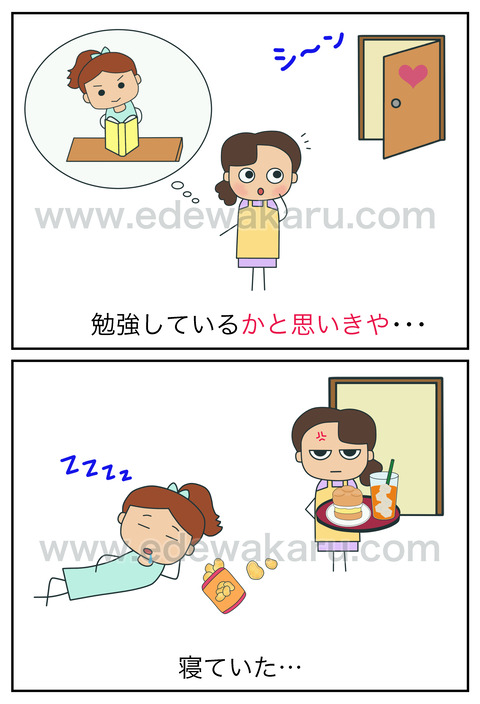
勉強しているかと思いきや、寝ていた
→勉強しているだろうと思ったら、実際は寝ていた今日はずっといい天気だと思いきや、急に雨が降ってきた
→今日はずっといい天気だろうと思っていたら、急に雨が降ってきた人気のパン屋さんだったのでおいしいかと思いきや、そうでもなかった
→人気のパン屋さんだったのでおいしいだろうと思ったら、そうでもなかった欲しがっていた(「〜欲しがっている」)指輪をあげたので喜ぶかと思いきや、なぜか怒りだした
→欲しがっていた指輪をあげたので、喜ぶだろうと思ったが、 なぜか怒りだした20点以上の差があったのでAチームが優勝すると思いきや、Bチームが逆転勝利した
→20点以上の差があったのでAチームが優勝すると思っていたら、Bチームが逆転勝利した
くらべてわかる日本語表現文型辞典
Meaning
意味1:Aだと思ったが、実際はB。話し手の驚き・意外・あきれ・落胆などの気持ちを表す。
意味2:困難な状況Aを脱したと思ったら、別の困難な状況Bになった。
How to use it
In context 8 examples
電車に間に合ったと思いきや、目の前でドアが閉められた。
試験は難しくてできないと思いきや、やってみると簡単だった。
静かに勉強していると思いきや、気持ちよさそうに寝ていた。
今日は雨だと思いきや、朝起きたらいい天気だった。
宿題が全部終わったと思いきやカバンの中にまだ残っていた。
ひどい風邪が何とか治ったと思いきやまた風邪を引いた。
洗濯物を片付けたと思いきや、子どもが泥だらけで帰ってきた。
うるさい顧客の機嫌がようやく直ったと思いきや、また部下が不始末をしでかした。
NINJAL 日本語文型データベース
Meaning
〜と予想したが、実際はそうではなかったと言いたいときに使います。話し手の驚きや意外感を伝える言い方です。
How to use it
V普通形+と思いきや
i-A普通形+と思いきや
na-A普通形+と思いきや(「na-Aだ」→「na-Aと思いきや」の形になることもある)
N普通形+と思いきや(「Nだ」→「N+と思いきや)」の形になることもある)
その他
Notes
「〜」は話し手の予想を表す文がきます。「~と思いきや」の後には事実を述べる文がきます。
In context 21 examples
パスポートはすぐに見つかると思いきや、しまってあるはずの引き出しの中になくて、焦ってしまった。
子どもはぐっすり寝ていると思いきや、いきなり目を開けたのでびっくりした。
開店前なのでまだ客はいないと思いきや、すでに何人もの人が並んでいた。さすが人気店だ。
大きな仕事が終わってやっと休みが取れたと思いきや、急ぎで別の仕事を頼まれてしまい、何もできませんでした。
乗ろうとしていた電車に間に合わなかったと思いきや、電車はまだホームにいて、ぎりぎりで乗れた。
店内は狭いと思いきや、奥のほうに広い部屋があって、意外とゆったりしていた。
バイオリンは難しいと思いきや、習ってみたらそうでもなかった。
引越しの荷物はそれほど多くないと思いきや、箱詰めしてみるとかなりの量になった。
公園の入り口近くの桜はまだつぼみで、見に来るのが少し早かったと思いきや、奥に進むと咲き始めている木もたくさんあった。
テストに書いた答えに○がついていたので、この答えは正しくなかったと思いきや、これは日本では正しいという意味なのだそうだ。私の国では○は正しくないという意味なのだけれど。
今日からデータ入力のアルバイトを始めた。仕事は簡単だと思いきや、意外と複雑で時間がかかった。
この店のカレーはマイルドと思いきや、食べた後からけっこうな辛さが舌にくる。
こうちゃんは魚はあまり好きじゃないと思いきや、今日の魚料理は意外と喜んで食べた。
読解の問題が難しかったので、JLPTの合格は今回も無理だったと思いきや、ぎりぎりで合格していた。
この辺りは昔からそれほどにぎやかではなかったと思いきや、かなり栄えていた時期もあったらしい。
普通の風邪と思いきや高熱が出て、病院に行くとインフルエンザと診断された。
朝の状況では今日は一日中雨だと思いきや、昼にはやんで雲ひとつない晴天になった。
病院の待合室にはたくさんの人がいるので、まだまだ私の順番ではないと思いきや、もう名前が呼ばれている。
久しぶりに同窓会で会った夏美と話が弾んだ。中学生のとき夏美が好きだったのは山本君だったと思いきや、なんと谷君だったのだそうだ。
はじめ聞いたことのないメロディーで、私の探していたのはこの曲ではなかったと思いきや、曲調が変わって、やっぱりこれだったとわかった。
短い間にたくさんの漢字を覚えるのはさぞ大変だっただろうと思いきや、漢字が大好きなトムさんは楽しくてしかたがなかったのだそうだ。