絵でわかる日本語
Usage 1
Read this source entry ↗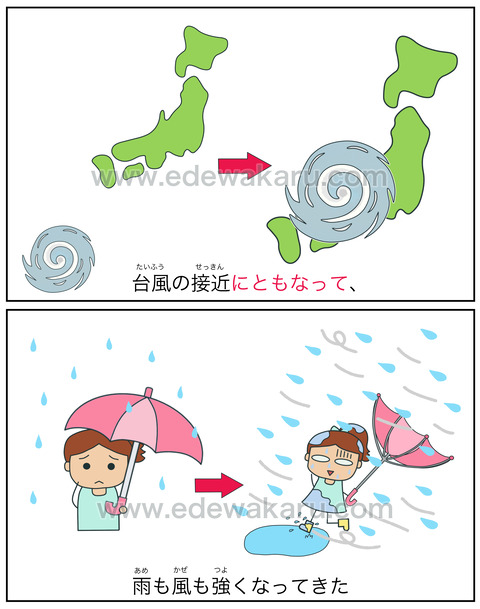
Meaning
〜が変化すると、〜も変化する
How to use it
動詞・名詞[辞書形]+にともなって・にともない
動詞・名詞[辞書形]+にともなう+名詞
Explanation
「AにともなってB」は「Aが変化すると、Bも変化する」という意味で、2つの変化を表す文型です。「A」にも「B」にも【変化】を表す言葉が入り、2つの変化が起こっていると言いたい時に使われます。この文型は多くの場合、社会的なことなど大きなことに使われます。「〜にともなって」より、さらにかたい言い方は「〜にともない」になります。
[例]
①スマホの普及
にともなって、いろんなことが便利になった
=スマホの普及
にともない、いろんなことが便利になった
②人口の増加
にともなって、いろんな問題が起こっている
=人口の増加
にともない、いろんな問題が起こっている
また後ろに名詞がくる場合は、「〜にともなう+名詞」という形になります。
[例]
人口の増加にともなう問題は、年々増えている
「〜にともなって・〜にともない・〜にともなう」は、かたい文で使われることが多いです。
漢字で書くと「〜に伴って」になります😊
「〜にともなって」には【付随】を表す用法もありますので、一緒に覚えておきましょう。
In context 5 examples
台風の接近にともなって、雨も風も強くなってきた
→台風が接近して、雨も風も強くなってきた人口の増加にともなって、いろんな問題が起こっている
→人口が増えて、いろんな問題が起こっているスマホの普及にともなって、ネットショッピングをする人が増えた
→スマホが普及して、ネットショッピングをする人が増えた医学の進歩にともなって、平均寿命(へいきんじゅみょう)がのびた
→医学が進歩して、平均寿命がのびた少子化が進むにともなって、学校の数も減ってきている
→少子化が進んで、学校の数も減ってきている
Usage 2
Read this source entry ↗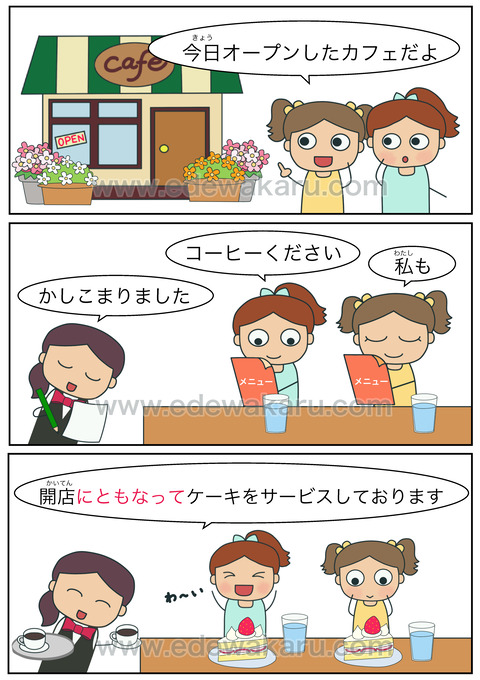
Meaning
〜と一緒に〜が起こる
〜が起こると、続いて〜も起こる
How to use it
動詞・名詞[辞書形]+にともなって・にともない
動詞・名詞[辞書形]+にともなう+名詞
Explanation
「AにともなってB」は「Aと一緒にBが起こる」「Aが起こると、続いてBも起こる」という意味を表す文型です。この文型は[付随]を表すもので「A」が原因・理由になって「B」が起こると言いたい時に使われます。【付随】を表す「〜にともなって」は「〜につれて」にチェンジできません。「〜にともなって」より、さらにかたい言い方は「〜にともない」になります。
[例]
開店
にともなって、ケーキを1つサービスしております
=開店
にともない、ケーキを1つサービスしております
「〜にともなって」には「Aが変化するとBも変化する」という文型もありますので、復習しておきましょう😀
In context 5 examples
開店にともなってケーキをサービスしております
→開店したので、ケーキをサービスしております地震にともなって、津波が起こった
→地震に続いて、津波も起こった結婚にともなって、仕事を辞めることになった
→結婚して、仕事を辞めることになった転勤にともなって、引越ししなければいけなくなった
→転勤するので、引越ししなければいけなくなった引越しにともなって、住所と電話番号(でんわばんごう)が変わりました
→引越ししたので、住所と電話番号が変わりました
毎日のんびり日本語教師
How to use it
名詞+に伴って/に伴い/に伴う
動辞形+の+に伴って/に伴い/に伴う
Explanation
前項の変化に伴って後項も変化すること表す比例変化の表現です。
「~に伴って/に伴い」は文中で用い、「~に伴う」は後ろに名詞が接続されます。
Notes
前件と後件が連動して変化する文法
【N3文法】~につれて/につれ
【N2文法】~に伴って/に伴い/に伴う
【N2文法】~に従って/に従い
In context 8 examples
あらゆる物体が、それを構成する原子・分子の熱運動に伴って熱電波を出す現象のことを熱放射という。
大学卒業に伴って引っ越しすることになった。(随着大学毕业搬家。)
人々の考え方も時代に伴って変化していくべきだ。
ダム建設に伴って一つの村が水没してしまった。
ユーザーの増加に伴って、サーバーが耐えきれなくなったようだ。
事業拡大に伴い、人材強化に重点を置いている。
機器の入れ替えに伴い、一時的にシステムを停止する。
サーバメンテナンスに伴い、ホームページ閲覧不可となります。
AIUEO JLPT Grammar
Meaning
This sentence pattern expresses that as a change or event occurs, other matters happen simultaneously. It is commonly used in written language and is suitable for formal situations.
How to use it
動詞辞書形に+伴い名詞に+伴い
Explanation · 日本語
この文型は、ある変化や出来事に連れて、他の事柄が同時に起こることを表す表現です。書面語でよく使われ、フォーマルな場面に適しています。
In context 5 examples
技術の進歩に伴って、仕事のやり方も変わってきた。
As technology advances, the way we work has also changed.
人口減少に伴い、地方経済が衰退している。
As the population decreases, local economies are declining.
環境問題が悪化するに伴って、様々な対策が求められている。
As environmental problems worsen, various measures are being required.
気温の上昇に伴って、氷河が溶け始めた。
As temperatures rise, glaciers have started to melt.
災害が発生するに伴い、緊急対策が講じられた。
As the disaster occurred, emergency measures were taken.
Bunpro Grammar Reference
Meaning
As, Due, Along with, Hand-in-hand with, Resulted in, Be consequent upon
How to use it
Verb[る]+(の)+ に伴って(1)
Verb[る]+(の)+ に伴う + Noun
Noun + に伴って(1)
Noun + に伴う + Noun
(1) に伴い
Nuance
A structure which shows that (B) goes hand-in-hand with (A), or accompanies (A). (B) is often caused by or naturally follows (A).
Explanation
When the う-Verb 伴う 'to accompany' in its て-form is used with に and attached to the end of nouns or verbs in their dictionary forms, it is regularly translated as 'due to (A), (B)', 'hand in hand with (A), (B)', or 'along with (A), (B)'. In all of these meanings, the base interpretation of 'to accompany' is being highlighted.
As 'accompanying' does not specifically indicate that (A) is controlling (B), this grammar structure may be used simply to indicate things that happen at the same time, rather than when something is being directly caused by the first. However, (A) having a strong influence on the change of (B) is usually implied.
に伴う may also appear directly before another noun when it is being modified by the verb.
この町の人口が減少するに伴って空き家が増加して来ました。
As the population of this town has declined, the number of vacant houses has increased.
パソコンの初期化をするのに伴う手順は取扱説明書の51ページに記載されています。
The procedure associated with formatting the computer is described on page 51 of the instruction manual.
インターネットの普及に伴って、オンラインで買い物を済ませる人が増えた。
With the spread of the Internet, more and more people are completing their purchases online.
高速道路の情報サイト:リフレッシュ工事に伴う車線規制のお知らせ。
Highway information website: Notice of lane restriction due to road reconstruction.
に伴って is used both for events that are progressively changing at the same time, and momentary events that cause a sudden change.
津波は地震に伴い発生することが多いが、火山現象に伴い津波が発生することも有るそうだ。
Oftentimes, tsunami occur due to earthquakes, but apparently they can also occur due to volcanic phenomenon.
歳を取るに伴って物忘れが酷くなってきてる感じがする。
I feel like I'm getting more forgetful as I get older.
Nuance · 日本語
(B)は(A)と密接に関連している、又は(A)にそうということを表す表現。(B)は(A)に影響される、又は(A)に続くことが多い。
Explanation · 日本語
五段動詞の「伴う」のテ形と「に」が名詞や辞書形の動詞の後ろに置かれると、「(A) が原因で (B)」や「(A) に連れて (B)」のような意味を表します。この文法の中心には「一緒に行く」という意味があります。
この文法の「一緒に行く」という意味からもわかるように、(A) は (B) をコントロールするものではありません。つまり、「に伴って」は、(A) が 直接的な原因となって (B) が起こるというより、単に (A) と (B) が同時に起こることを表します。ただし、(A) が (B) の変化に強い影響を与えるというニュアンスは含まれています。
「に伴って」は「に伴う」という形でほかの名詞に直接結びつき、その名詞を修飾することができます。
この町の人口が減少するに伴って空き家が増加して来ました。
As the population of this town has declined, the number of vacant houses has increased.
パソコンの初期化をするのに伴う手順は取扱説明書の51ページに記載されています。
The procedure associated with formatting the computer is described on page 51 of the instruction manual.
インターネットの普及に伴って、オンラインで買い物を済ませる人が増えた。
With the spread of the Internet, more and more people are completing their purchases online.
高速道路の情報サイト:リフレッシュ工事に伴う車線規制のお知らせ。
Highway information website: Notice of lane restriction due to road reconstruction.
「に伴って」は並行して起こるゆっくりとした変化にも、瞬間的な出来事による突然の変化にも使うことができます。
津波は地震に伴い発生することが多いが、火山現象に伴い津波が発生することも有るそうだ。
Oftentimes, tsunami occur due to earthquakes, but apparently they can also occur due to volcanic phenomenon.
歳を取るに伴って物忘れが酷くなってきてる感じがする。
I feel like I'm getting more forgetful as I get older.
In context 18 examples
- 春が始まるに伴って、植生は復活する。
With the beginning of spring, the vegetation returns. (along with・consequent upon)
- インターネットの普及に伴って、オンラインで買い物を済ませる人が増えた。
With the spread of the Internet, more and more people are completing their purchases online.
- 歳を取るに伴って物忘れが酷くなってきてる感じがする。
I feel like I'm getting more forgetful as I get older.
- この町の人口が減少するに伴って空き家が増加して来ました。
As the population of this town has declined, the number of vacant houses has increased.
- 高速道路の情報サイト:リフレッシュ工事に伴う車線規制のお知らせ。
Highway information website: Notice of lane restriction due to road reconstruction.
- パソコンの初期化をするのに伴う手順は取扱説明書の51ページに記載されています。
The procedure associated with formatting the computer is described on page 51 of the instruction manual.
- 津波は地震に伴い発生することが多いが、火山現象に伴い津波が発生することも有るそうだ。
Oftentimes, tsunami occur due to earthquakes, but apparently they can also occur due to volcanic phenomenon.
- 医学の進歩に伴って平均寿命が伸びています。
Along with the advancement of medical sciences, the average life expectancy is increasing.
- 円高に伴い輸出の量は減る。
As the value of the yen rises, the volume of export decreases. (along with・consequent upon)
- 火傷に伴う痛みは神経への刺激が原因だとされている。
Pain associated with burns is considered to be caused by nerve stimulation.
- 城の改修中、床の修理に伴って、壁も塗りなおされた。
During the castle renovation, along with the floor repairs, the walls were also repainted.
- このゲームでは高レベルに達するに伴って、上級の魔法が使えるようになる。
In this game, as higher levels are reached, advanced magic will become available. (along with・consequent upon)
- トマトはヨーロッパに初めて紹介されたときは、毒があると考えられていた。時が経つに伴いこの野菜に対する考え方が変わってきた。
Tomatoes were considered to be poisonous when introduced to Europe for the first time. As time has passed, the way of thinking about this vegetable has come to change. (along with・consequent upon)
- 動物性油脂の高摂取に伴う高コレステロール化は最近の研究で反証をあげて否定された。
High cholesterol associated with high intake of animal fats and oils has been disproven by a recent study.
- 中国では野生ミツバチの生存数が少なくなるに伴って、農家が手作業で作物を受粉することを強制されています。
In China, as the number of surviving wild bees decreases, farmers are compelled to pollinate the crops manually. (along with・consequent upon)
- ライト兄弟による初めての飛行は1903年に成された。それに伴って、近代の航空産業が生まれた。
The Wright brothers succeeded in becoming the first in flight in 1903. This resulted in the birth of the modern aviation industry. (along with・consequent upon)
- 会社の階層構造では昇進に伴い給与が上がっていくが、それと共に新しい業務も追加される。
In the company's hierarchical structure, salaries increase with promotions, but at the same time, new duties are added. (consequent upon)
- 日本で起こった資産価格の上昇のバブル景気は1999年初めの時点でバーストした。それに伴って「失われた10年」と呼ばれる金融危機の時代が始まった。
The asset prices bubble that occurred in Japan burst at the beginning of 1999. Along with this started the financial crisis period referred to as 'the lost decade'.
NINJAL 日本語文型データベース
Meaning
[1] ~という変化があると、それと並行して他のことも変化すると言いたいときに使います。段階的な変化の様子に注目するのではなく、変化全体を説明するのに使います。
[2] ~という出来事があると、それに付随して後のことが起こると言いたいときに使います。
改まったスピーチや文書などでは「〜につきまして」の形になることもあります。
How to use it
Vるに伴って
Nに伴って
Notes
[1] 「~」にも「〜に伴って」の後の文にも、変化を表す言葉がきます。
一方向の変化でなくてもいいです。
「〜」が文の場合、「の」を使って名詞にして接続することもあります。
[2] 「~」にはある出来事を表す言葉がきます。「〜に伴って」の後には、その出来事が原因で付随して起きることを表す文がきます。
「〜」が文の場合、「の」を使って名詞にして接続することもあります。
In context 21 examples
地球の資源への関心が高まるに伴って、いわゆる3R(リデュース、リユース、リサイクル)の動きが広がってきた。
この町は高層マンションが増えるに伴って、移り住んでくる人が多くなった。
河川沿いの美化工事が進むに伴って、この道を散歩する人が目立つようになってきた。
水道管は、年月を経るに伴って、ひび割れ、穴あき、すり減りなどの傷みが出てくる。
産業構造が変化するにともなって、働き盛りの若者が農村を離れて都市部に流出した。
子どもは成長に伴って自我が芽生え、自己主張するようになる。
台風の接近に伴って、風雨が強くなってきた。
科学の進歩に伴って、現代人は数えきれないほどの恩恵を受けている。
日本の小学校では、少子化に伴って、1学年のクラス数が減ってきている。
人型ロボットの開発や電化製品の普及に伴って、家事負担が大幅に軽減された。
営業職は大変だ。顧客が増えるのにともなって、いろいろな知識や手腕が要求される。
このたびボランティア団体を立ち上げるに伴って、代表者の選出が行われた。
外国に赴任するに伴って、いろいろな身辺整理が必要になった。
台風13号の直撃地では、河川が氾濫するに伴って、道路の冠水が起こった。
地震が発生するに伴って、津波が起きることがある。
古川教授は、この大学に観光学部が新設されるにともなって着任した。
この学校は少子化に伴って、廃校になった。
昨年、在宅勤務への切り替えに伴って、我が家をリフォームし、仕事場を確保した。
建物の解体に伴って発生した大量の産業廃棄物は、どのように処理されるのだろうか。
このたび転職に伴いまして、当地を離れることになりました。長い間お世話になりました。
この地域に大型のショッピングモールが開業するのにともなって、個人経営の小さな店がいくつも閉店した。
IMABI
As (change)
Read this IMABI lesson ↗Explanation
As (change): ~につれて, ~に従って, ~に伴って, ~とともに, ~に応じて, & ~に応えて
~につれて, ~に従って, ~に伴って, and ~とともに all have meanings of showing the transition/change of one situation as another transition/change is under way. We will also see how ~に応じて・応えてrelate to them.
~につれて
~につれて is either after a noun or a verb in the 連体形 to express “as one thing changes, another thing changes as well”. These changes are simultaneous. Although it can be after nouns or verbs, it is after verbs more often. ~につれて is often used in situations where there is a proportional relationship with the two events in the respective clauses.
As such, the first clause acts as the trigger, proportionately raising the degree of the change/transition of the latter clause. Common translations include “as”, “together with”, and “in accordance to/with”.
Variant Note: It can be seen in more formal/written language as ~につれ.
Examples
1. 歌は世につれ世は歌につれ。
Song changes by generation, and generations change by song.
2. 昭和から平成へと時代が変わるにつれて軍歌ぐんかは歌われなくなりました。
With the changing of periods from the Showa to the Heisei, military songs became unsung.
3. 時間が経つにつれて忘れっぽくなる。
As time passes, I become forgetful.
4. 都心化(が進む)につれて自分の地域への関心が薄うすれる。
As urbanization progresses, the concern towards one’s region fades.
5. 夜が更ふけるにつれて嵐あらしは激しくなった。
The storm became fierce as the night grew late.
6. 季節の変化につれて気温が変わる。
The temperatures change in accordance to the seasons. 7. 冬になるにつれて、山が白くなってくる。
The mountains become white as winter depends.
8. イナゴは稲に付く害虫なので駆除しなくてはなりません。昔の人はそこからイナゴを食べることを思いつきました。当時は、食べることを前提に捕まえていたので、殺虫剤は使っていませんでした。しかし戦後、 農薬が普及し、それにつれてイナゴは激減してしまいました。現在では、殺虫剤を使ったイナゴの駆除も行われていますが、安全な無農薬栽培やオーガニック栽培をしている農家では一匹ずつ捕まえているそうです。大変な作業ですね。
Locusts are harmful insects which stick to rice plants and have to be exterminated. People in the past thought of eating locusts from this. At the time, they wouldn’t use pesticides with eating them as a premise. However, after the war, agrochemicals spread, and with this locusts were decreased in number. Presently, there is extermination involving pesticides, but at farms which use safe non-agriculture chemical and organic cultivation, locusts are caught by hand one by one. That’s definitely a tough job.
~に従って
~に従って can be used in a hierarchical sense to mean “according to”. As should be expected, ~に従い is more formal and indicative of the written language. Both に従っての and に従った are appropriate attribute forms.
9. 命令に従って、行動しろ。
Act according to the command.
10. 私の合図に従って行動してください。
Please act in according to my signals.
It may also be used like ~につれて. In the first usage above, it attaches to nouns. As for this usage, it attaches primarily to verbs. It, however, simply states that the two actions described in the respective clauses are happening in parallel.
11. 南に行くに従い、気温がどんどん高くなる。(Somewhat literary)
The temperature gets higher as you go south.
12. 人口が増えるにしたがって、住宅問題が起こってくる。
As the population increases, housing problems will come to occur.
13. 人口が増えるにしたがって、犯罪が多発する。
As the population increases, crime will frequently occur.
The contrast in nuance between ~につれて and ~にしたがって can definitely be seen in the following example.
14. スタジアムで場内の歓声が高まる{につれて・にしたがって}。実況アナウンサーの声も大きくなっていった。
As the cheers in the stadium intensified, the commentator’s voice got ever louder.
With ~につれて, the suspense is captured with the first clause being the trigger for the events of the second. With ~にしたがって, the sentence doesn’t become ungrammatical, but it loses the emotive drive and merely states that the two events described in the respective clauses are happening in parallel.
~に伴って
伴う means “to accompany” and ~に伴って means “associated/accompanied with” or “as”. Just like ~につれて, it may show that something is happening together with a change/transition of a certain situation. There is a temporal context of “taking A as the opportunity, therefore…B”. It is also often the case that it infers that the thing in the second clause continues.
What precedes it is either a noun or verb. In the case of a verb, unlike the other options, the particle の may be optionally used after the verb for nominalization. To be clear, this is not required and is not done in the first place for the other options. Lastly, ~に伴って is more literary.
Variant Note: It may also be seen in writing as ~に伴い.
15. 汚染おせんに伴う問題について話しましょう。
Let’s talk about the problems accompanied with pollution.
16. 人口の増加に伴って、たくさんの住宅が建てられる。
Many houses are constructed in association to the increase in population.
Particle Note: 伴う is used with を when used transitively.
~とともに
~とともに also behaves like ~につれて to show that something happens together with a change/transition of a certain situation. However, unlike ~につれて, the entire sentence doesn’t necessarily have to show a state of progress. In other cases it can have meanings equivalent to 同時に and 一緒に. As for its usage similar to ~につれて, it’s also the case that the words it follows must show change in situation. It cannot be words pertaining to action, which ~につれ and ~にしたがって can be.
17. 人口の増加とともに、犯罪が多発する。
Along with the increase in population, crimes will frequently occur.
18. 子供が卒業するとともに、父母会ふぼかいも解散かいさんしました。
The parents’ association also dissolved at the same time the kids graduated.
19. 皆さんとともに快適かいてきな道づくりを進めます。
With everyone we will go forward with a pleasant road construction.
漢字 Note: This pattern may also be written in 漢字 as ~と共に.
~に応じて
~に応じて means “accordingly” or “as to”. The first meaning is important in this lesson as it ties with the other patterns. When it is used with a verb that shows change, it describes the corresponding/dealing with a certain change. In this instance, it is possible to switch it out with ~につれて, ~にしたがって, ~にともなって, and ~とともに.
In its other meaning, it is equivalent to ~に応えて (as to/to satisfy). Although this, too, sounds like it is of the vein of the other phrases, it’s not. Although in such situations it may seem that ~に従って is possible, it would be considerably more negative.
20a. 住民の要求に応じて、説明会を開くことになりました。〇
20b. 住民の要求に従って、説明会を開くことになりました。△
20c. 住民の要求{にともなって・とともに}、説明会を開くことになりました。?
20d. 住民の要求につれて、説明会を開くことになりました。X
In meeting the wants of the citizens, it has been decided that we open an information seminar.
It has the attribute forms ~に応じての and ~に応じた. When に応じて comes before a noun, の is necessary after 応じて. Or, you can use に応じた. The 一段 conjugating verb 応じる either means “reply” or “to comply”.
21. 質問に応じて、彼女は問題の解答を詳くわしく説明しました。
As to answer the question, she explained the answer to the problem well.
22. 命令に応じた服従。
Obedience in accordance to command.
23. 料金が距離きょりと時間に応じて決まります。
The fee is determined according to distance and time.
24. 「うん」と応じる。
To respond with a “yes”.
25. 相手の依頼いらいに応じましたか。
Have you responded to your partner’s request?
26. 車の速さに応じてガソリンの消費量が変わる。
Fuel use will change depending upon the car’s speed.
~に応えて
The 一段 verb 応える may be used to mean “to come through/satisfy/answer” or “to tell/go to one’s heart”. The latter usage shows some sort of burden.
27. 要求に応こたえて、社員の給料が上がりました。
To meet demand, the employee’s salaries went up.
28. 国民に応えて、法律は廃止はいしされました。
The law was repealed in response to the citizens.
29. 期待に応える。
To come through with expectations.
30. 深酒ふかざけは身体に応えるのです。
Hard drinking takes its toll on the body.
31. その当時供給は需要に{応えて・満たして}いなかった。
In those days, the supply didn’t meet the demand.
In context 33 examples
歌は世につれ世は歌につれ。
Song changes by generation, and generations change by song.
昭和から平成へと時代が変わるにつれて軍歌ぐんかは歌われなくなりました。
With the changing of periods from the Showa to the Heisei, military songs became unsung.
時間が経つにつれて忘れっぽくなる。
As time passes, I become forgetful.
都心化(が進む)につれて自分の地域への関心が薄うすれる。
As urbanization progresses, the concern towards one’s region fades.
夜が更ふけるにつれて嵐あらしは激しくなった。
The storm became fierce as the night grew late.
季節の変化につれて気温が変わる。
イナゴは稲に付く害虫なので駆除しなくてはなりません。昔の人はそこからイナゴを食べることを思いつきました。当時は、食べることを前提に捕まえていたので、殺虫剤は使っていませんでした。しかし戦後、 農薬が普及し、それにつれてイナゴは激減してしまいました。現在では、殺虫剤を使ったイナゴの駆除も行われていますが、安全な無農薬栽培やオーガニック栽培をしている農家では一匹ずつ捕まえているそうです。大変な作業ですね。
Locusts are harmful insects which stick to rice plants and have to be exterminated. People in the past thought of eating locusts from this. At the time, they wouldn’t use pesticides with eating them as a premise. However, after the war, agrochemicals spread, and with this locusts were decreased in number. Presently, there is extermination involving pesticides, but at farms which use safe non-agriculture chemical and organic cultivation, locusts are caught by hand one by one. That’s definitely a tough job.
命令に従って、行動しろ。
Act according to the command.
私の合図に従って行動してください。
Please act in according to my signals.
南に行くに従い、気温がどんどん高くなる。(Somewhat literary)
The temperature gets higher as you go south.
人口が増えるにしたがって、住宅問題が起こってくる。
As the population increases, housing problems will come to occur.
人口が増えるにしたがって、犯罪が多発する。
As the population increases, crime will frequently occur.
スタジアムで場内の歓声が高まる{につれて・にしたがって}。実況アナウンサーの声も大きくなっていった。
As the cheers in the stadium intensified, the commentator’s voice got ever louder.
汚染おせんに伴う問題について話しましょう。
Let’s talk about the problems accompanied with pollution.
人口の増加に伴って、たくさんの住宅が建てられる。
Many houses are constructed in association to the increase in population.
人口の増加とともに、犯罪が多発する。
Along with the increase in population, crimes will frequently occur.
子供が卒業するとともに、父母会ふぼかいも解散かいさんしました。
The parents’ association also dissolved at the same time the kids graduated.
皆さんとともに快適かいてきな道づくりを進めます。
With everyone we will go forward with a pleasant road construction.
住民の要求に応じて、説明会を開くことになりました。〇
In meeting the wants of the citizens, it has been decided that we open an information seminar.
住民の要求に従って、説明会を開くことになりました。△
In meeting the wants of the citizens, it has been decided that we open an information seminar.
住民の要求{にともなって・とともに}、説明会を開くことになりました。?
In meeting the wants of the citizens, it has been decided that we open an information seminar.
住民の要求につれて、説明会を開くことになりました。X
In meeting the wants of the citizens, it has been decided that we open an information seminar.
質問に応じて、彼女は問題の解答を詳くわしく説明しました。
As to answer the question, she explained the answer to the problem well.
命令に応じた服従。
Obedience in accordance to command.
料金が距離きょりと時間に応じて決まります。
The fee is determined according to distance and time.
「うん」と応じる。
To respond with a “yes”.
相手の依頼いらいに応じましたか。
Have you responded to your partner’s request?
車の速さに応じてガソリンの消費量が変わる。
Fuel use will change depending upon the car’s speed.
要求に応こたえて、社員の給料が上がりました。
To meet demand, the employee’s salaries went up.
国民に応えて、法律は廃止はいしされました。
The law was repealed in response to the citizens.
期待に応える。
To come through with expectations.
深酒ふかざけは身体に応えるのです。
Hard drinking takes its toll on the body.
その当時供給は需要に{応えて・満たして}いなかった。
In those days, the supply didn’t meet the demand.