AIUEO JLPT Grammar
Meaning
This sentence pattern expresses doing something without considering a specific condition or excluding certain elements. It indicates the action proceeds regardless of those conditions.
How to use it
名詞+抜きで名詞+抜きに名詞+抜きに名詞を+抜きに+して名詞は+抜きに+して
Explanation · 日本語
この文型は、特定の要素や条件を取り除いた状態で何かを行うこと、または、ある条件を考慮せずに話を進めることを示します。
In context 5 examples
冗談抜きで、彼は本気でそう言っているんだ。
Seriously, he really means it.
細かい説明を抜きにして、すぐに本題に入った。
Without going into too much detail, he got straight to the point.
彼女は、意見の対立を抜きに、冷静に話し合いたいと言った。
She said she wanted to discuss things calmly, without the conflict of opinions.
お金の話は抜きにして、まずは私たちの関係を考えよう。
Let’s set aside the money issue and think about our relationship first.
彼は遠慮抜きで、自分の意見をはっきり述べた。
He expressed his opinion clearly, without any hesitation.
Bunpro Grammar Reference
Meaning
Without, Unless
How to use it
Noun + 抜きで(は)
Noun + 抜きに(は)
Noun + を + 抜きにして(は)
Noun + は + 抜きとして(は)
Noun + 抜き + の + Noun
Nuance
A grammar point which expresses that something has had (A) extracted from it, which would usually be there. Without (A).
Explanation
抜きで, a combination of the noun form of the う-Verb 抜く 'to extract', and the particle で, is a construction that usually indicates something being done 'without (A)', or 'with the removal of (A)'. As ぬき indicates the extraction of something, this grammar pattern is primarily used to indicate 'leaving out', or 'setting aside' something that is regularly included.
抜きで acts as a suffix, so will be utilized after nouns, to indicate the thing that is being left out. Both the plain hiragana and kanji forms are fairly common. Additionally, の will replace で when ぬき is followed directly by another noun.
あの人は冗談抜きで怖いから怒らせない方がいいよ。
That guy is scary, no joke, so you shouldn't upset him.
あいつら全然来ないな、あいつら抜きで始めちゃおうぜ。
They aren't coming at all (it doesn't seem like they are coming anytime soon). Let's start without them.
ワサビ抜きの寿司なんて寿司じゃないよ。
Sushi without wasabi is not sushi.
Occasionally, にして may also replace で, but this structure is more common when the part (B) section of the sentence includes a ない or できない based statement. These expressions indicate that something 'will not happen without (A)', or 'is not possible without (A)'.
若い労働者抜きにしては、日本の建築業は成り立たない。
Without young workers, Japan's construction industry would not exist.
公共交通機関抜きにしては便利な生活ができない。
Without public transportation, you cannot live a convenient life.
However; this is not always the case, as ぬきで or ぬきでは may also appear in negative sentences, with the same meaning.
Nuance · 日本語
普段あるはずの(A)が取り除かれたということを表す文法。(A)なしで。
Explanation · 日本語
「抜きで」は五段動詞「抜く」(意味:内から外に取り出す)の連用形が名詞化したものと助詞「で」の組み合わせで、「(A) なしで」何かを行うことを表します。「ぬき」は何かを取り出すことを意味するため、この表現はいつもは含まれているものを取り除いたり、省いたりすることを表します
「抜きで」は接尾語のように機能し、名詞の後に置かれて、その名詞が省かれることを表します。ひらがな表記も漢字表記もどちらも一般的です。また「ぬき」が名詞を修飾する場合は「で」の代わりに「の」が使われます。
あの人は冗談抜きで怖いから怒らせない方がいいよ。
That guy is scary, no joke, so you shouldn't upset him.
あいつら全然来ないな、あいつら抜きで始めちゃおうぜ。
They aren't coming at all (it doesn't seem like they are coming anytime soon). Let's start without them.
ワサビ抜きの寿司なんて寿司じゃないよ。
Sushi without wasabi is not sushi.
場合によっては「で」の代わりに「にして」が使われることもあります。この表現は、(B) の部分に「ない」や「できない」が含まれるときによく使われ、「(A) なしではそれは起こらない」や「(A) なしではそれは不可能だ」のような意味を表します。
若い労働者抜きにしては、日本の建築業は成り立たない。
Without young workers, Japan's construction industry would not exist.
公共交通機関抜きにしては便利な生活ができない。
Without public transportation, you cannot live a convenient life.
ただし、(B) が否定文の場合でも、「ぬきで」や「ぬきでは」が使われることもあり、この場合も意味は「ぬきにしては」と同じです。
In context 16 examples
- リスク抜きには決してフグを食べられない。
You can never eat fugu without risk.
- ワサビ抜きの寿司なんて寿司じゃないよ。
Sushi without wasabi is not sushi.
- 若い労働者抜きにしては、日本の建築業は成り立たない。
Without young workers, Japan's construction industry would not exist.
- 公共交通機関抜きにしては便利な生活ができない。
Without public transportation, you cannot live a convenient life.
- あの人は冗談抜きで怖いから怒らせない方がいいよ。
That guy is scary, no joke, so you shouldn't upset him.
- あいつら全然来ないな、あいつら抜きで始めちゃおうぜ。
They aren't coming at all (it doesn't seem like they are coming anytime soon). Let's start without them.
- 「クソ、渋滞だ。あいつら、パーティーをオレ抜きで始めそうだ。」
'Damn, a traffic jam. It seems that they will start the party without me.'
- 「食べれる」のような「ら」抜きの言葉は人気になっている。
Words without 'ら', like '食べれる' are getting more popular.
- C(シー):「A(エー)とB(ビー)は付き合ってんのよ」D(ディー):「マジ!?冗談抜きで?」
C: 'A and B are dating!' D: 'Whaa? No kidding? (without joking)'
- 夫婦の会話:「子供抜きでどこか面白いところに行こう!」
A conversation between a married couple: 'Let's go somewhere fun, without the children!'
- 私にとってコーラ抜きでハンバーガーを食べることは考えられない。
It is totally unacceptable for me to eat a hamburger without a coke.
- くろさわあきらという監督抜きにして日本の映画を語ることはできない。
It is impossible to talk about Japanese cinematography without mentioning the director Akira Kurosawa.
- グルテン抜きの食べ物はセリアック病という病気の人のために必要である。
Gluten-removed food is necessary for those who are ill with celiac disease.
- 日本語の場合、文脈抜きのスタンドアロンの文は分かりにくい。
In the case of Japanese, standalone sentences without context are hard to understand.
- 女の子:「あたしの料理、好きなの?」男の子:「お世辞抜きで、今までの人生でこれよりうまいものは食べた事がない。」
Girl: 'Do you like my cooking?' Boy: 'Without flattery, I haven't eaten anything more delicious than this in my life.'
- お寿司屋さん:「ご注文はお決まりですか?」お客さん:「はい、マグロのにぎりをワサビ抜きでお願いします。」
Sushi restaurant employee: 'Are you ready to order?' Guest: 'Yes, I would like to have tuna nigiri without wasabi.'
絵でわかる日本語
Meaning
〜なしで〜する
〜はなしにして〜する
How to use it
名詞[辞書形] +抜きで
名詞[辞書形]+抜きの+名詞
Explanation
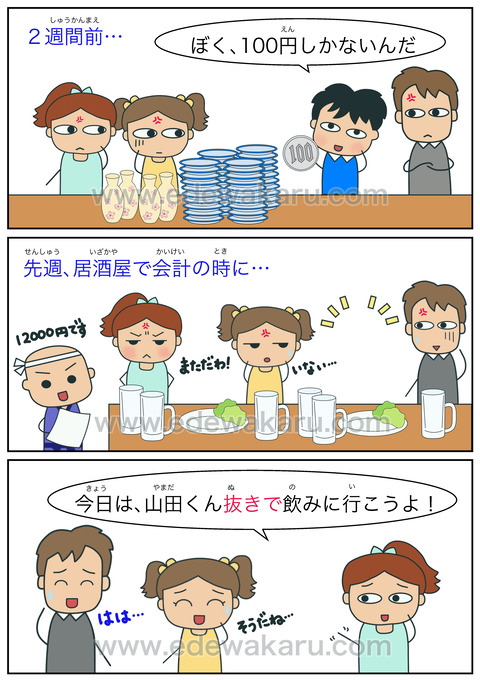
「〜抜きで」は「〜なしで〜する」という意味を表す文型です。「普通あるものはなしで〜する」「いつもいる人はなしで〜する」と言いたい時に使われます。
[例]
①今日は山田くん
抜きで
飲みに行こうよ
→いつも山田くんも一緒に行くが、今日は山田くんなしで行く
②A:デカフェって何?
B:カフェイン
抜きの
コーヒーのことよ
→コーヒーには普通カフェインが入っているが、デカフェには入っていない
③子供たちは、いつもわさび
抜きで
お寿司を食べます
→お寿司には普通わさびが入っているが、入っていないものを食べる
④二度寝してしまい、今日は朝ごはん
抜きで
会社に来た
→いつもは朝ごはんを食べるが、今日は朝ごはんなしで会社に来た
後ろに名詞がくる場合は「〜抜きの+名詞」になると覚えておきましょう。
【関連文法】
In context 4 examples
A:今日は、山田くん抜きで飲みに行こうよB:そうね。彼、いつも会計の時にいなくなるもんね
A:デカフェって何?B:カフェイン抜きのコーヒーのことよ
子供たちは、いつもわさび抜きでお寿司を食べます
二度寝してしまい、今日は朝ごはん抜きで会社に来た
毎日のんびり日本語教師
How to use it
名詞+抜きで
名詞+抜きの
名詞+は抜きで
名詞+は抜きにして
名詞+を抜きにして
Explanation
そのものを省略したり、取り除くことを表します。後項にはその状態で何かを行うことが述べられます。
Notes
特になし
In context 9 examples
体臭がひどいのは冗談抜きでNG。
あいつはお世辞抜きで本当にすごいと思う。
小難しいことは抜きにしてただ楽しめばいい。(不拘小难只要享受就好。)
堅苦しい挨拶は抜きにして、早速本題に入ろう。
解説抜きで見るスポーツの試合はあまり面白くない。
炭水化物抜きのダイエットは健康に良くない。
勝ち負けの話は抜きにして、お互いよくやったと思う。
そういう暗い話は抜きにしませんか。
先入観を抜きにして考えるべきだ。