Bunpro Grammar Reference
Usage 1
Meaning
Look like, Appear, Seem, Have a feeling that
How to use it
Verb[stem]+ そう + だ
[い]Adjective[い̶]+ そう + だ
[な]Adjective + そう + だ
Negative:
Verb[な̶い̶]+ な + そう + だ
[い]Adjective [な̶い̶] + なさ + そう + だ
[な]Adjective + では(1)な̶い̶ + なさ + そう + だ
Exceptions:
いい → よい̶ + さそう + だ → よさそうだ
(1) じゃ
Verb[stem]+ そう + です
[い]Adjective[い̶]+ そう + です
[な]Adjective + そう + です
Negative:
Verb[な̶い̶]+ な + そう + です
[い]Adjective [な̶い̶] + なさ + そう + です
[な]Adjective + では(1)な̶い̶ + なさ + そう + です
Exceptions:
いい → よい̶ + さそう + です → よさそうです
(1) じゃ
Nuance
A word used to make guesses about appearances, often with low confidence.
Explanation
そうだ is one of the 18 primary auxiliary verbs in Japanese, and can be used in two (2) different ways. The broad meaning in each of its applications is that something 'seems' to be a certain way. Due to this, そう is regularly translated as 'seems like', 'looks like', or 'appears as though'.
In this lesson, we will focus on the form that is used with the conjunctive (stem) form of words. Please examine the structure guide to see these forms.
彼女は毎日走っていそうだ。
She seems like she runs every day.
これは正しそうだ。
This seems correct.
あの店員は丁寧そうだ。
That clerk seems like he is attentive.
Caution
そう may also be used when attached to the い-Adjective, ない. In this case, there is a unique conjugation rule which we will need to be careful of. As always, い will be removed from ない before attaching そう. However, さ will be inserted between な, and そう. This creates the expression なさそう.
彼の部屋は汚くなさそうだ。
His room doesn't seem messy.
あの車は小さくて便利じゃなさそう。
That car is small and seems inconvenient.
Note that this addition of さ does not happen with verbs. This is due to the ない that is used with negative verbs being an auxiliary verb, and not an い-Adjective. With the auxiliary verb ない, simply remove the い, before adding そう directly to the stem.
彼はもうイギリスに帰らなそうだ。
It appears that he is not going back to England.
Caution
This そう is utilized exclusively to make predictions/guesses about something based on visual information. It is relatively low confidence, so should not be used for things that are obvious. In these cases, みたい would be used instead.
明日は朝から雨が降るみたいだ。
It looks like it is going to start raining tomorrow morning. (Higher confidence)
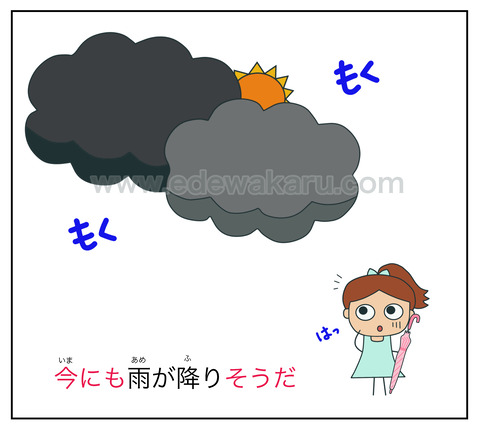
明日は朝から雨が降りそうだ。
It seems like it is going to start raining tomorrow morning. (Lower confidence)
Nuance · 日本語
様子について推測するために使われる言葉で、自信があまりないときに使われることが多い。
In context 20 examples
- 雪が降りそうです。
It looks like it is going to snow.
- これは正しそうだ。
This seems correct.
- 彼女は毎日走っていそうだ。
She seems like she runs every day.
- あの店員は丁寧そうだ。
That clerk seems like he is attentive.
- 先生の仕事は難しそうです。
The job of being a teacher looks difficult.
- 今日の宿題は簡単そうだ。
Today's homework looks easy.
- その食べ物は食べやすそう。
That food looks easy to eat.
- この教科書はとても難しそうです。
This textbook seems very difficult.
- けっこう難しいけど、大丈夫そうですか?
It is pretty hard, does it look like you'll be okay?
- あのレストランの寿司は美味しそうです。
That restaurant's sushi looks delicious.
- あなたの小さい車でもこの駐車場に入らなそうです。
Even your small car doesn't look like it will fit in the parking spot.
- アメリカには大きいハンバーガーがありそうですね。
It would seem that there are big hamburgers in America.
- 晩ご飯でニンニクを食べたら、口が臭くなりそうです。
If I eat garlic at dinner, I have a feeling that my breath will become stinky.
- 「仲直りできそうですか?」「いいえ、出来なそうです。」
'Does it look like you can work it out?' 'No, it does not appear so.'
- あの遊園地のジェットコースターは楽しくなさそうです。
That amusement park's rollercoaster doesn't seem fun.
- 彼の部屋は汚くなさそうだ。
His room doesn't seem messy.
- あの車は小さくて便利じゃなさそう。
That car is small and seems inconvenient.
- 彼はもうイギリスに帰らなそうだ。
It appears that he is not going back to England.
- 明日は朝から雨が降るみたいだ。
It looks like it is going to start raining tomorrow morning. (Higher confidence)
- 明日は朝から雨が降りそうだ。
It seems like it is going to start raining tomorrow morning. (Lower confidence)
Usage 2
Meaning
And (adverb)
How to use it
Examples:
早く → はや̶く̶ + よ(う)
小さく → ちいさ̶く̶ + そ(う)
高く → たか̶く̶ + こ(う)
Exceptions:
大きく → おおき̶く̶ + きゅ(う)
Nuance
The Kansai way of using い-adjectives like adverbs.
Explanation
One of the common sound (euphonic) changes in 関西弁 is that of い-Adjectives. Usually, a euphonic change is something that changes the pronunciation of a specific word, without changing the meaning/using a different word. The sound change that occurs with い-Adjectives in the Kansai dialect is that of the く form, otherwise known as the indeterminate form.
In the Kansai dialect, く will be replaced by う, while the previous kana will be replaced by an お sound kana from the same row. This means that い-Adjectives in 関西弁 actually behave in exactly the same was as the auxiliary verb う, when paired with う - Verbs. Let's take a look at a few examples.
早く Will become 早 (with or without う).
小さく Will become 小そ (with or without う).
高く Will become 高 (with or without う).
大きく Will become 大きゅ (with or without う).
Note with the last example that きゅう is used instead of きう in order to prevent an unnatural (two syllable) pronunciation change.
Caution
In almost all cases, う may be omitted, meaning that the お sound change will appear by itself.
For い-Adjectives that have an お sound kana before く, they will retain their previous form, rather than being changed. This can be seen with 広く 'wide', which already has a ろ before く, and therefore will remain the same when paired with う.
Caution
い-Adjectives actually have two forms that use く. The indeterminate form, and the conjunctive form. The reason that we are able to determine that indeterminate form is being used in this case is primarily due to う itself behaving in the same way as it would with う - verbs, making this う a pseudo auxiliary verb.
Notes
関西弁
Nuance · 日本語
関西弁で形容詞を副詞として使う際に使われる活用法。
In context 14 examples
- はやく食べて。
はよ食べて。Hurry up and eat.
- はよう起き。
Hurry up and wake up.
- 全然会わないうちに太うなったな。
You got fat while we haven't seen each other. (You got fatter since the last time I saw you)
- 最近は米も高うなったな。
Recently, even rice has been rising in price, don't you think?
- 自転車やすくして。
自転車やそして。Can you make the bicycle cheaper for me?
- ここにはやく来て。
ここにはよう来て。Hurry up and come here.
- このリンゴ高くなった。
このリンゴたこうなった。These apples got more expensive.
- はやく寝て。
はよ寝て。Hurry up and sleep for me.
- 冷蔵庫やすくしてくれた。
冷蔵庫やそうしてくれた。They made the refrigerator cheap for me.
- 電車がくる!はやく来て!
電車がくる!はよ来て!The train is coming! Come here quickly!
- はやく起きて、遅れるよ!
はよう起きて、遅れるで!Hurry up, wake up! You are going to be late!
- はよ寝ぇ。
Hurry up and sleep.
- この数ヶ月の間でほそなったね。
In the past few months you got skinnier.
- この辺も昔と比べて道路がひろうなったな。
The roads around here have gotten wider, compared to how it was back in the days.
絵でわかる日本語
Yokubi — The Common Grammar Guide (https://yoku.bi)
Explanation
There are many ways in Japanese to say "X resembles Y" or "X looks like Y".
One of them, is the な adjective suffix みたい. It looks like the たい form of 見る \-\> 見たい, however in modern Japanese this is considered a completely separate thing and should not be confused.
みたい (it is **always** written in kana and should **never** be written as 見たい) is a な-adjective and conjugates like one. It means "seems".
While みたい is for all intents and purposes a な adjective, when used adverbially it sometimes conjugates like an い adjective. This is seen as casual/slang, but you'll see it often enough in Japanese media that it is good to be aware of it.
Both of these examples are valid, but the former is more proper.
らしい is an auxiliary adjective that attaches to nouns or verbs/adjectives and says that something factually "seems so" based on circumstance. らしい is appropriate for things that would translate to "seems X", rather than "Xish".
You might also see らしい used to mean "I heard that", used to convey hearsay or information obtained from third parties.
ぽい/っぽい is a suffix い adjective that says that something subjectively "seems so" based on appearance or stereotypical properties. It translates well as "Xish" or "X-like". It sounds casual.
There are two separate constructions of the auxiliary suffix そう.
The first one attaches to the masu stem of a verb or adjective, and it means "seems like". It is used to describe things from a subjective impression or perspective, often from physical appearances. そう turns whatever it attaches to into a な adjective.
The other そう attaches to the complete form of the word before it, so for な adjectives and nouns it becomes だそう. This usage means "I heard that" and it is similar to the hearsay usage of らしい we saw earlier. It feels a bit more formal.
In context 2 examples
おいしそうなスープです。
A delicious-looking soup.
2000人以上が死んだそうです。
I heard that over 2000 people died.
AIUEO JLPT Grammar
Meaning
「こう」「そう」「ああ」「どう」are demonstrative pronouns used to indicate the state or condition of something. “こう” refers to something close to the speaker, “そう” to something near the listener, “ああ” to something far from both, and “どう” is used to inquire about the condition or state. Similar to "like this”, "like that” and "like which” in English.
Explanation · 日本語
「こう」「そう」「ああ」「どう」は、物事の状態や様子を指し示す指示語で、話し手や聞き手との距離や、事柄がどちらに関連しているかによって使い分けます。「こう」は話し手に近い事柄の様子、「そう」は聞き手に近い事柄の様子、「ああ」は話し手と聞き手のどちらからも離れている事柄の様子を指します。「どう」は物事の状態や様子を尋ねるときに使います。
In context 5 examples
こうすればいいんだよ。
You should do it like this.
そう考えるなら、この案は最適です。
If you think like that, this proposal is the best.
ああすればもっと良くなります。
If you do it like that, it will be even better.
どうしたら解決できますか?
How can we solve this?
こうしたらどう?
How about doing it like this?
日本語文型辞典
Meaning
基本情報説明「それほど、そんなに…ない」という意味。例文① 夕食はそうおいしくなかったが全部食べた。② 日本語はそうむずかしくないと思う。③ 松子は明るい感じの子でしたが、クラスではそう目立たない生徒でした。④ このあたりでは雪で学校が休みになるのはそうめずらしいことではない。
日本語文型辞典 英語版
Meaning
Means “not so much, not very....”
In context 4 examples
夕食はそうおいしくなかったが全部食べた。
Dinner wasn’t particularly good but I finished it anyway.
日本語はそうむずかしくないと思う。
I don’t think Japanese is that hard.
松子は明るい感じの子でしたが、クラスではそう目立たない生徒でした。
Matsuko was a cheerful girl, but she wasn’t a particularly outstanding student in the class.
このあたりでは雪で学校が休みになるのはそうめずらしいことではない。
It isn’t so unusual for schools in this area to close because of snow.