AIUEO JLPT Grammar
Meaning
This sentence pattern is used to express that, due to a specific situation or reason, the speaker cannot take a certain action due to moral, social, or personal constraints.
How to use it
動詞辞書形+わけにはいかない
Explanation · 日本語
この文型は、特定の状況や理由から、どうしてもその行動を取ることができないことを表す表現です。道徳的、社会的な制約や自身の信念などによる理由で使われることが多いです。
In context 5 examples
今日は大事な会議があるので、休むわけにはいきません。
I can’t take a day off because I have an important meeting today.
明日は試験があるので、遊ぶわけにはいきません。
I can’t play because I have an exam tomorrow.
家族が心配するから、無理をするわけにはいかないんです。
My family would worry, so I can’t overexert myself.
彼は断るわけにはいかないと思う。
I don't think he can refuse.
試験が近いから、勉強しないわけにはいかない。
The exam is approaching, so I have to study.
文法
Meaning
①~したい気持ちはあるが理由があって~できない
②〜しなければならない / 〜するのが当然だ
How to use it
①V(辞書形) + わけにはいかない
②V(ナイ形) + わけにはいかない
In context 12 examples
明日はテストがあるから、ゲームをするわけにはいかない。
ちょっと熱があるけど、今日は大事な会議があるから休むわけにはいかない。
今日は彼女の誕生日だけど、システムトラブルでみんな頑張っているし、私だけ帰るわけにはいかない。
これは母がくれた大切なものですから、誰にもあげるわけにはいかないんです。
自分から立候補したのだから、途中でやめるわけにはいかない。
まだ初戦だし、こんなところ負けるわけにはいかない。
飲み会に誘われたが、明日は大事な試験があるので、行くわけにはいかない。
たとえ1分でも遅刻は遅刻ですから、試験を受けさせるわけにはいきません。
せっかく東京へ来たのだから、秋葉原に行かないわけにはいかない。
親友の結婚式なのだから、出席しないわけにはいかないだろう。
お世話になった上司の送別会なので、どんな理由があっても、参加しないわけにはいかないだろう。
先輩に飲めと言われたので、飲まないわけにはいかなかった。
Bunpro Grammar Reference
Meaning
Cannot afford to, No way, Impossible to do
How to use it
Verb + わけにはいかない
Verb + わけにはいきません
Nuance
A strong expression that states (A) as being impossible, or unable to proceed if so.
Explanation
わけにはいかない is a statement that combines わけ 'to be so', 'reason', or 'cause', with the case marking particle に, the adverbial particle は, and the 'cannot go' meaning of 行かない. It can be translated as 'cannot afford to (A)', or 'impossible to (A)'. However, the literal meaning is much closer to 'it cannot be so that (A)'.
This structure will be used directly after the non-past form of verbs, in order to highlight them as being either highly undesirable, or highly unattainable.
この料理は妻が頑張って作ってくれたやつだから、不味くても残すわけにはいかない。
This food is something that my wife tried her best to make for me, so even if it tastes bad, there's no way that I can leave it.
明日は人手が足りないから、休むわけにはいかない。
Since we are short-handed tomorrow, I cannot afford to take a day off.
Although わけにはいかない primarily highlights things that are undesirable, it may also highlight something that is desirable, but impossible for some reason. This will depend largely on the speaker's tone of voice, and context of the conversation.
このジャケットが欲しいけど、今月はお金を使い過ぎたから買うわけにはいかない。
I want this Jacket, but because I spent too much money this month, it cannot be so that I buy it.
先輩に誘われたから、断るわけにはいかない。
I was invited by my senpai, so there is no way that I can decline the offer.
In these types of sentences, the expression is quite similar to the 'I guess it's just not meant to be so' nuance that can be conveyed in English, highlighting regret.
Nuance · 日本語
(A)が不可能だ、又はこのままでは進めないということを示す表現。
Explanation · 日本語
「わけにはいかない」は、「わけ」(意味:理由・原因)と、格助詞「に」、副助詞「は」、そして動詞「行く」の否定形「行かない」を合わせてできた表現です。「(A) をすることはできない」や「(A) をしてはいけない」のような意味で使われます。
この文法は、過去形ではない動詞のあとに付きます。
この料理は妻が頑張って作ってくれたやつだから、不味くても残すわけにはいかない。
This food is something that my wife tried her best to make for me, so even if it tastes bad, there's no way that I can leave it.
明日は人手が足りないから、休むわけにはいかない。
Since we are short-handed tomorrow, I cannot afford to take a day off.
「わけにはいかない」は、主に話し手が何かを「してはいけない」と感じているときに使われます。しかし、場合によっては、それをした方がよくても、事情によって「できない」ことを表すこともあります。これは話し手の声のトーンや文脈によって変わります。
このジャケットが欲しいけど、今月はお金を使い過ぎたから買うわけにはいかない。
I want this Jacket, but because I spent too much money this month, it cannot be so that I buy it.
先輩に誘われたから、断るわけにはいかない。
I was invited by my senpai, so there is no way that I can decline the offer.
この文法は、「そうするしかない」という、諦めや後悔の気持ちを含んで使われることもあります。
In context 16 examples
- 僕はその問題を黙って見過ごす訳には行かない。
I cannot afford to silently overlook that problem.
- この料理は妻が頑張って作ってくれたやつだから、不味くても残すわけにはいかない。
This food is something that my wife tried her best to make for me, so even if it tastes bad, there's no way that I can leave it.
- 明日は人手が足りないから、休むわけにはいかない。
Since we are short-handed tomorrow, I cannot afford to take a day off.
- このジャケットが欲しいけど、今月はお金を使い過ぎたから買うわけにはいかない。
I want this Jacket, but because I spent too much money this month, it cannot be so that I buy it.
- 先輩に誘われたから、断るわけにはいかない。
I was invited by my senpai, so there is no way that I can decline the offer.
- まだやるべきことがあるから、死ぬ訳には行かないんだ!
I can't afford to die, because there are still some things I have to do!
- 大統領に頼まれたので断る訳には行かない。
Since I was asked by the president I can't afford to say no.
- それは捨てる訳には行きません。大切な人からもらったんです。
I can't afford to throw it away. I got it from my special someone.
- まだ許す訳には行きません。ちゃんと反省してないでしょ。
I can't afford to forgive you yet. You haven't taken the time to properly reflect on what you have done.
- ダイエット中だから、こんな美味しいケーキ、食べる訳には行かない。
I am on a diet, so I cannot afford to eat this delicious cake.
- 30分遅刻したから、これ以上お客さんを待たせる訳には行きません。
Since I was 30 minutes late, I cannot afford to keep my customers waiting anymore.
- 彼はまだ初心者だから、あの仕事を一人でやらせる訳には行かない。
I can't afford to let him do that job alone, because he is still a newbie.
- 引退するし、このチームの選手として最後の勝負だから、負ける訳には行かない。
Because I am retiring and this is my last game as a team member, I can't afford to lose.
- 前に一度、彼女との約束を破ったから、今度は破る訳には行かない。
I broke a promise with her once before, so this time I cannot afford to break another.
- 前回の日本語能力試験に不合格だったので、次は失敗する訳には行かない。
I failed the JLPT last time, so I cannot afford to fail it a second time.
- 硬貨を持ってないから、何も買う訳には行かない。
I don't have any hard currency on me, so I cannot afford to buy anything.
DoJG 日本語文法辞典(全集)
Meaning
Cannot; cannot but ~; cannot help -ing; have no (other) choice but to ~
How to use it
(i) Vinformal nonpast | わけにはいかない | |
| 行くわけにはいかない | Someone cannot go |
(ii) Vinformal negative nonpast | ないわけにはいかない | |
| 読まないわけにはいかない | Someone has no other choice but to read something |
Explanation
A phrase which is used to indicate that one cannot do something due to an external circumstance.
In context 9 examples
来週は期末試験があるから、今週末は遊んでいるわけにはいかない。
There will be final examinations next week, so I cannot fool around this weekend.
親友の結婚式だから、出席しないわけにはいかない。
Since it is the wedding of my close friend I have no other choice but to attend it.
私のような若い者がそんな会議に出席するわけにはいきません。
A young person like me cannot attend such a meeting.
まだ定職もないんだから、結婚するわけにはいかないんですよ。
I don't have a regular job, so I cannot get married.
これから運転しなければなりませんから、酒を飲むわけにはいきません。
I have to drive from now, so I cannot drink.
まだ仕事が残っているので、帰るわけにはいきません。
I still have work to do, so I cannot go home.
これは秘密なので、話すわけにはいきません。
This is a secret, so I cannot talk about it.
この論文は重要だから、読まないわけにはいかない。
This paper is important, so I have no choice but to read it.
上司の命令なのだから、報告書を書かないわけにはいかない。
It is my boss's order, so I cannot avoid writing this report.
どんなときどう使う 日本語表現文型辞典
Meaning
can't
How to use it
Vる+わけにはいかない
Explanation
~できない
「したい気持ちはあるが、社会的な通念や常識から考えて、また、心理的な理由があってできない」と言いたいときに使う。
Someone wants to do something but cannot because of social conventions, common sense, or for psychological reasons.
In context 3 examples
あしたは試験があるから、今日は遊んでいるわけにはいかない。
これは亡くなった友人がくれた大切なもので、あげるわけにはいかないんです。
資源問題が深刻になってきて、企業もこれを無視するわけにはいかなくなった。
絵でわかる日本語
Meaning
(何か事情があって)〜することができない
How to use it
動詞[原形]+わけにはいかない
Explanation
「〜わけにはいかない」は、何か事情があって「〜することができない」という意味で使われます。この文型は、
(自分の)周囲の事情があって
〜することができない
という表現ですから、能力や個人的な事情が理由でできないという場合には使用できません😣
❌魚のにおいが苦手なので、食べるわけにはいかない
⭕️魚のにおいが苦手なので、食べることができない(個人的理由)
❌英語の授業が嫌いだったので、今でも話すわけにはいかない
⭕️英語の授業が嫌いだったので、今でも話すことができない(個人的理由)
❌人とうまく話せないので、合コンに行くわけにはいかない
⭕️人とうまく話せないので、 合コンに行くことができない(能力・個人的理由)
【「わけ」シリーズ】
〜ないわけにはいかない
〜わけ(実質名詞)
〜わけがない
〜わけがわからない(実質名詞)
〜わけだ(納得)
〜わけではない
〜わけない(実質名詞)
In context 3 examples
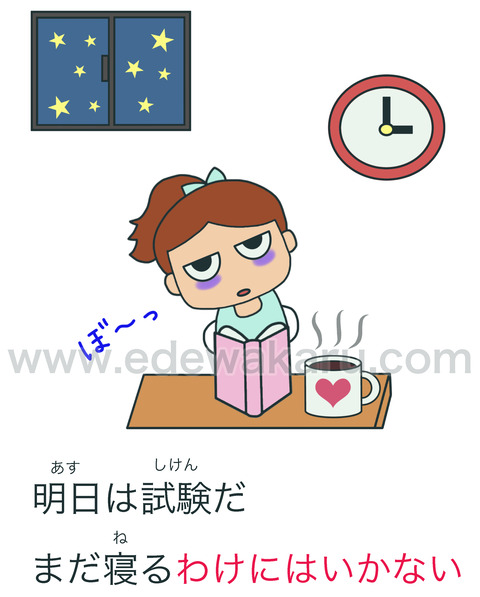
明日は試験だ。まだ寝るわけにはいかない
→明日は試験だから、まだ寝ることができない(周囲の事情:試験がある)今日は大事な会議がある。熱があるが会社を休むわけにはいかない
→今日は大事な会議があるから、熱があるが会社を休むことができない(周囲の事情:会議がある)上司はまだ残業中だ。部下の私が先に帰るわけにはいかない
→上司はまだ残業中だから、部下の私が先に帰ることはできない(周囲の事情:上司が残業中)
日本語文型辞典
Meaning
「そうすることは不可能だ」という意味を表す。単に「できない」という意味ではなく、「一般常識や社会的な通念、過去の経験から考えてできない、してはいけない」ということ。「私はお酒が飲めない」は、体質的にお酒に弱くて飲めないという意味を表し得るが、「お酒を飲むわけにはいかない」の場合は、体質的に飲めないのではなく、例えば「今日は車で来ているから飲めない」のように飲んではいけないという意味になる。また、⑥の「そういうわけにはいかない」(=内緒にするわけにはいかない)のように前の文を受けて使うこともある。
動詞の否定形に接続し「その動作をしないということは不可能だ=しなければならない」という義務を表す。これも一般常識や社会通念、過去の経験がその義務の理由となる。④のように、前の文や発話を受けて「そういうわけ」(=やらないわけ)の形でも用いられる。
How to use it
V-るわけに(は)いかない
V-ないわけに(は)いかない
In context 10 examples
ちょっと熱があるが、今日は大事な会議があるので仕事を休むわけにはいかない。
カラオケに誘われたが、明日から試験なので行くわけにもいかない。
体調を崩した仲間を残して行くわけにもいかず、登山隊はしかたなくそこから下山することになった。
いくらお金をもらっても、お宅の息子さんを不正に入学させるわけにはいきません。
もう30近い娘をいつまでも甘やかしておくわけにもいかないが、かと言って自立できる収入もないのに出て行けと放り出すわけにもいかない。
A:うちで猫を飼っていること、大家さんには内緒にしてもらえませんか。
B:いや、そういうわけにはいきませんよ。契約ではだめなことになっているんですから。それにみんな猫の鳴き声で迷惑しているんですよ。他の人ならともかく、あの上司に飲みに誘われたら付き合わないわけにはいかない。断わると後でどんなめんどうな仕事を押しつけられるかわからないのだから。
実際にはもう彼を採用することに決まっていたが、形式上はめんどうでも試験と面接をしないわけにはいかなかった。
今日は車で来ているのでアルコールを飲むわけにはいかないがこもし先輩に飲めと言われたら飲まないわけにもいかないし、どうしたらいいのだろう。
A:あんなハードな練習、もうやりたくないよ。疲れるだけじゃないか。
B:そういうわけにはいかないだろう。監督に逆らったらレギュラーから降ろされるぞ。
日本語文型辞典 英語版
Meaning
B:いや、そういうわけにはいきませんよ。契約ではだめなことになっているんですから。それにみんな猫の鳴き声で迷惑しているんですよ。
No, I can’t do that. It’s against the terms of the contract. Besides, everyone is annoyed by its cries.
Means “It is not possible to do so.” It does not simply mean “cannot do” but rather that “thinking from general knowledge, socially accepted ideas or past experience (something) cannot be done.”
私はお酒が飲めない shows that the speaker is constitutionally a weak drinker and, therefore “cannot drink.” However, お酒を飲むわけにはいかない does not mean that constitutionally they are a weak drinker, but rather that, for some reason (for example, they have come by car), they cannot drink. Also, as in the そういうわけにはいかない of example
(6)
where it refers to the inability to keep the secret, it can also be used in acknowledging the previous sentence.
B:そういうわけにはいかないだろう。監督に逆らったらレギュラーから降ろされるぞ。
That’s no excuse. If you go against the coach you’ll be dropped as a regular.
Connected to the negative form of a verb, this expresses the obligation that “It is not possible not to carry out that action,” in other words, “must do.” This also takes as its reason generally knowledge, socially accepted ideas or past experience. As in
(4)
, it can also be used in the form そういうわけ or, in other words, やらないわけ.
How to use it
1. V-るわけに(は)いかない
2. V-ないわけに(は)いかない
In context 10 examples
ちょっと熱があるが、今日は大事な会議があるので仕事を休むわけにはいかない。
I have a bit of a fever but there is an important meeting today and so I can’t take a holiday from work.
カラオケに誘われたが、明日から試験なので行くわけにもいかない。
I was invited to karaoke but I have tests from tomorrow and so I cannot make it.
体調を崩した仲間を残して行くわけにもいかず、登山隊はしかたなくそこから下山することになった。
They couldn’t leave their unwell friend behind and so the mountaineering party had no choice but to descend the mountain from there.
いくらお金をもらっても、お宅の息子さんを不正に入学させるわけにはいきません。
However much money you give me, I can’t dishonestly allow your son to pass into this school.
もう 30 近い娘をいつまでも甘やかしておくわけにもいかないが、かと言って自立できる収入もないのに出て行けと放り出すわけにもいかない。
I can’t keep spoiling my daughter who is almost thirty but, having said that, as she has no income by which she can be independent, neither can I just throw her out.
A:うちで猫を飼っていること、大家さんには内緒にしてもらえませんか。
Will you keep it a secret from the landlord that we’re keeping a cat in the house?
他の人ならともかく、あの上司に飲みに誘われたら付き合わないわけにはいかない。断ると後でどんなめんどうな仕事を押しつけられるかわからないのだから。
If it’s somebody else it’s okay, but if that supervisor invites you to go drinking with him, you have to go. If you refuse, you don’t know what kind of drudging job you’ll be made to do.
実際にはもう彼を採用することに決まっていたが、形式上はめんどうでも試験と面接をしないわけにはいかなかった。
In reality we had already decided to employ him but, formally, even though it’s troublesome, we had to conduct an exam and interview.
今日は車で来ているのでアルコールを飲むわけにはいかないが、もし先輩に飲めと言われたら飲まないわけにもいかないし、どうしたらいいのだろう。
As I’ve come by car today I can’t drink alcohol, but if my superior tells me to drink I’ll have to. What should I do?
A:あんなハードな練習、もうやりたくないよ。疲れるだけじゃないか。
I don’t want to do that kind of hard exercise any more. It will just make me tired (without any benefit).
くらべてわかる日本語表現文型辞典
Meaning
意味1:いろいろな事情があって、Aをすることができない。
意味2:「Aないわけにはいかない」の形で。Aをしたくないが、いろいろな事情があってするしかないという意味。
意味3:「Aのようなわけにはいかない」の形で。Aのかわりはできない、Aと同じにはできないという意味。
How to use it
Aわけに(は)いかない(Aわけにもいかない/Aないわけに(は)いかない/Aのようなわけに(は)いかない)
接続1:
[動詞-る形]わけに(は)いかない
接続2:
[動詞-ない形]ないわけにはいかない
接続3:
[名詞-の]ようなわけにはいかない
Explanation
【対比1】
「Aわけがない」(意味1 P.326)
「Aわけがない」は、絶対にAではないという話し手の強い確信を持った推量表現であるが、「Aわけにはいかない」は、Aをすることができないという話し手の判断を示す。
○助けたいが、助けるわけにはいかないんだ。
×助けたいが、助けるわけがないんだ。
○テストがあるから、休むわけにはいかない。(私は休めない)
○テストがあるから、休むわけがない。(休まないだろう)
【対比2】
「Aわけがない(Aないわけがない)」(意味3 P.327)
「Aないわけがない」は絶対にAだという強い確信をもった推量表現であり、「Aないわけにはいかない」は、Aをしたくないがしなければならないという話し手の判断を示す。
○秀才の彼女が合格しないわけがない。
×秀才の彼女が合格しないわけにはいかない。
「Aざるをえない」(意味1 P.103)
「Aざるをえない」は、唯一Aしか方法がないので話し手の意志に関係なく自然の成り行きとしてAをしなければならないという切羽詰まった状況であり、「Aないわけにはいかない」は理性的にAするべきだと自らの意志で行動すると判断した表現。
○借金が返せなくなり、倒産せざるをえなくなった。
×借金が返せなくなり、倒産しないわけにはいかなくなった。
In context 12 examples
社長が働いているのだから、社員が休んでいるわけにもいかない。
今日は車を運転してきたので、酒を飲むわけにはいかないんだ。
テストがあるので、今日の授業は休むわけにいかない。
財布を忘れたが、取りに帰るわけにもいかないし、ちょっと貸してくれないか。
社長の命令だから、日曜日でも出社しないわけにはいかないんだ。
約束したから、行かないわけにはいかない。
嫌いな酒でも上司に勧められたら、飲まないわけにはいかない。
彼女がせっかく作ってくれたんだから、おなかが一杯でも食べないわけにいかない。
先生のようなわけにはいかないが、少しぐらいなら教えられるよ。
日本人がレディーファーストを気取ってもスマートにできない。欧米人のようなわけにはいかないものだ。
いくら景気がいいといっても、ボーナスの額は大企業のようなわけにはいかない。
アウェー(敵地)での試合は、ホームのようなわけにはいかない。
日本語NET JLPT文法解説まとめ
Meaning
①~したい気持ちはあるが理由があって~できない
②〜しなければならない / 〜するのが当然だ
How to use it
①V(辞書形) + わけにはいかない
②V(ナイ形) + わけにはいかない
In context 6 examples
明日はテストがあるから、ゲームをするわけにはいかない。
ちょっと熱があるけど、今日は大事な会議があるから休むわけにはいかない。
せっかく東京へ来たのだから、秋葉原に行かないわけにはいかない。
親友の結婚式なのだから、出席しないわけにはいかないだろう。
お世話になった上司の送別会なので、どんな理由があっても、参加しないわけにはいかないだろう。
先輩に飲めと言われたので、飲まないわけにはいかなかった。
毎日のんびり日本語教師
Usage 1
Read this source entry ↗How to use it
動辞形+わけにはいかない/わけにもいかない
動ない形+ないわけにはいかない/ないわけにもいかない
Explanation
文によっては強い義務感や正義感を表します。
Notes
「わけ」シリーズ
In context 8 examples
この試合は、絶対に負けるわけにはいかない。
倒れている人が目の前にいるのに、助けないわけにはいかない。
俺はこんなところで死ぬわけにはいかない。
他人に迷惑をかけるわけにはいかない。
ここはまだスタート地点、躓くわけにはいかない。
年下に払わせるわけにはいかない。(不能让晚辈付钱。)
早く寝たいけど、ベッド行く前にお風呂も入りたいし、歯磨かないわけにもいかない。
コロナウイルスで外出制限といっても冷蔵庫何も入ってないし、出かけないわけにはいかない。
Usage 2
Read this source entry ↗How to use it
動詞普通形+(という)わけ
い形容詞普通形+(という)わけ
な形容詞語幹+な/である/という+わけ
名詞+な/である/という+わけ
Explanation
4つの用法があります。
①理由
②結論・事実を強調して述べる
③言い換え、要約
④納得・理解
③言い換えの時は、前件に「つまり」「要するに」等が呼応することがあります。
④納得・理解の時は、前件に「どうりで」「だから」「それで」「なるほど」等が呼応することがあります。
Notes
「わけ」シリーズ
In context 14 examples
今日は子どもの誕生日なんです。そういうわけだから私先に帰らせてください。
双子は生まれる前からずっと一緒にいたわけだから、心が通じ合っているのも当然だ。
この映画は、人々が主人公に共感できるから人気になったわけだ。
人間は視覚から得る情報量が最も多いわけだから、身だしなみを整えることで第一印象を良くすることができる。
数年ぶりに地元へ帰って来たわけだが、昔のまま何一つ変わっていなかった。
大学4年生になったわけだが単位足りなくて卒業できなさそう。
明日から夏休みなわけだけど何か予定とかあるの?
別れは出会いの始まり。終わりは始まりなわけである。
距離が近くなるほど、長く一緒にいるほど素が出てくる。つまりそれが本性なわけだ。
人は潜在意識に支配されている。つまり人の動機は潜在意識にあるわけだ。
窓を開けて寝ていた。どうりで寒いわけだ。
彼とは趣味が同じだった。なるほど、だから気も合うし話も合うわけだ。
人は後悔することができる。だから悩むわけだ。(人可以后悔。 所以才烦恼。)
内通者がいたから、それでこちらの情報が向こうに筒抜けだったわけか。
NINJAL 日本語文型データベース
Meaning
常識・規範など社会的な制約や、道徳的価値観に対する心理的な抵抗があるので、〜したくてもできないと言いたいときに使います。
How to use it
Vるわけにはいかない
Notes
主語はふつう一人称ですが、文中に表さないことが多いです。
できない理由を説明する表現をよく一緒に使います。
In context 6 examples
この仕事を完成させるまでは、自分の国へ帰るわけにはいかない。
これは個人情報が書かれている書類なので、許可なく誰にでも見せるわけにはいきません。
この絵はお売りするわけにはいかないんです。祖父の宝物だったんです。
仕事がたまっていて忙しかったが、結婚式でスピーチをしてほしいという友人の頼みを断るわけにはいかなかった。
体調が悪かったのに、欠席するわけにはいかない会議が4日間も続いて、つらかった。
海外赴任に年老いた両親を連れて行くわけにはいかなくて、困ってしまった。
IMABI
Ikanai/ikenai
Read this IMABI lesson ↗Explanation
いかない vs いけない
To be or not to be, or in this case, to choose いかない or いけない is a not so simple choice for the Japanese learner to make at times. They both come from the verb 行く, which has the basic meaning of “to go.” Unsurprisingly, the basic meanings of 行かない and 行けない are “to not go” and “cannot go” respectively.
1. 何なにもかもうまくいかないときは、自分じぶんを変かえる、いいチャンスではないでしょうか。
Isn’t when everything goes wrong a great chance to change oneself?
2. でも、そうかといって俺おれが投票とうひょう(をし)に行いっても行いかなくても別べつに一票いっぴょうの重おもみを感かんじない。
But even so, whether I go vote or not, I don’t particularly feel the weight of one vote.
3. 読よんでもらえないだけならまだしも、本当ほんとうに注目ちゅうもくしてほしいところに注意ちゅういが行いかないってことが問題もんだいなんですよ。
If it were just not being able to have him read that would be one thing, but the problem is that his attention doesn’t go to the areas that I really want paid attention to.
4. トイレに行いけないときに限かぎって腹痛ふくつうが起おこるのはなぜでしょうか。
Why is it that occurrences of abdominal pain is limited to when I can’t go to the bathroom?
5. 空港くうこうに見送みおくりに行いけなくてごめんね。
I’m sorry for not being able to see you off at the airport.
Orthography Note: The uses of these two phrases that are to be discussed are typically written in Hiragana.
わけにはいかない
Translated as “there’s no way…can…” or “…cannot (afford to) …” this expression is used to state that an action is not reasonable/proper for obvious reasons and cannot be done as a result.
6. 日本語にほんごの授業じゅぎょうでは英語えいごを話はなすわけにはいきません。
You cannot speak English in Japanese class.
7. アメリカ史しの授業ではガムを噛かむわけにはいきません。
You cannot chew gum in American history.
8. 授業じゅぎょうでは寝ねるわけにはいきません。
You cannot afford to sleep in class.
9. 忙いそがしくても寝ねないわけにはいかないよ。
Even if you’re busy, you can’t afford to not sleep.
10.
A: 漢字かんじは勉強べんきょうするのに時間じかんがかかりますねえ。
B: ええ、でも覚おぼえないわけにはいかないしねえ。
A: It must take a lot of time to study Kanji.
B: Yeah, but I can’t afford not to remember them.
11. 「この頃ごろサークル活動かつどうで忙いそがしいようだね」「うん、でも、忙いそがしいといって宿題しゅくだいをしないわけにはいかないしね」
“You seem pretty busy these days with club activities, don’t you?” “Yeah but, just because I’m busy with them, I can’t afford not to do my homework.”
12. 「漢字かんじは難むずかしいねえ」「うん、でもそうかと言いって漢字かんじで書かかないわけにはいかないしねえ」
“Kanji are difficult, aren’t they?” “Yeah, but even so, I can’t afford not to write with them, you know…”
13. 「毎日忙まいにちいそがしくて寝ねる時間じかんもない」「でもそうかといって全然寝ぜんぜんねないわけにはいかないでしょ」
“I’m so busy every day that there’s no time to sleep.” “Yeah, but even so, there’s no way you can just not sleep at all.”
いけない
The not so literal usages of いけない revolve around being a euphemism of 悪い.
14. 彼かれは事故じこに遭あったって?それはいけない、あいつは大丈夫だいじょうぶなの?
He got in an accident? That’s not good; is he alright?
15. 最近さいきん、日本酒にほんしゅを飲のめるようになったんですが、熱燗あつかんはあまりいけない口くちなんですね。
Recently, I’ve become able to drink sake, but I can’t really handle hot sake.
16. 異物混入いぶつこんにゅうなんか全部報道ぜんぶほうどうしていたら、どこの店みせもいけなくなるわ。
If every single instance of contamination were reported (in the media), all stores would go out.
17. 馬鹿ばかな美容師びようしだなあ、この店みせもいけなくなるだろう。
What a stupid stylist…well that shop will probably go under.
18. 飲のみすぎは体からだにいけない。
Drinking too much is not good for the body.
ていけない
The phrase ていけない is used to show that something is “undesirable/unpleasant.”
19. 口くちの中なかが塩辛しおからくていけないので、水みずを飲のんだ。
I drank water since having the inside of my mouth being salty would be unpleasant.
20. あのくらいの年齢ねんれいの女性じょせいは本当ほんとうにお喋しゃべりでいけないっすね。
Women at that age are chatterboxes, which is really unpleasant, you know.
21. 冬ふゆは寒さむくていけないね。
Winter is cold and unpleasant, you know.
22. 君きみがいなきゃ生いきていけない。
I can’t live without you.
23. 最近何さいきんなにかとやりたいことが多おおいせいか、どうにも気きが散ちっていけない気きがする。
Recently one way or another, perhaps from having a lot of stuff I want to do, I feel like getting distracted by no means would be good.
てはいけない
The phrase てはいけない is used to show that some state/action is not permissible/acceptable. It is typically translated as “must/may not.”
24. 芝生しばふに入はいってはいけません。
You must not get on the lawn.
25. 教室きょうしつの中なかでタバコを吸すってはいけません。
You must not smoke inside the classroom.
26. 水みずと一緒いっしょに飲のんではいけません。
You must not take (the medicine) with water.
27. 猫ねこはネギを食たべてはいけません。
Cats must not eat scallions.
28. 外そとで遊あそんじゃいけないぞ。(Masculine)
You mustn’t play outside.
To ikenai/Tara ikenai と・たらいけない
The phrase といけない is used to show that if said state comes to be, the speaker and or persons involved will be troubled. たらいけない is also possible, and as expected, it simply shows that a certain state/action would not be pleasant if it happens/is done.
29. 遅刻ちこくするといけない ので、何なにより時間厳守じかんげんしゅです。
Being late is bad, and so strict observance of time is above all.
30. 野菜やさいが腐くさるといけないから、一旦家いったんいえに帰かえって冷蔵庫れいぞうこに入いれてから出でかけましょう。
It won’t be good if the vegetables go bad, so let’s return to the house for a moment, put them in the refrigerator, and then go out.
31. 毎日まいにち歯はを磨みがかないといけない。
You must brush your teeth every day.
Literally: It’ll be bad if you don’t brush your teeth every day.
32. 賞味期限しょうみきげんが切きれたら、絶対ぜったいに食たべたらいけないものといえば、確たしかに卵たまごや鶏肉とりにくとかですね。
In speaking of foods you should never eat once it’s passed its expiration date, there’s definitely eggs and poultry, right?
33. 高血圧こうけつあつの薬くすりを服用ふくようしているときに、グレープフルーツなど食たべたらいけないとよく言いわれます。
When taking high blood pressure medicine, you’re often told not to eat things like grape fruit.
なくては・なければいけない
The phrase なくては・なければいけない is used to express some obligation/necessity to do something and it is typically translated as “must do…” As we have discussed once before when we discussed the “must/must not” phrases, double negatives like in this situation create positive expressions just as in English.
34. 足下あしもとに注意ちゅういしなくてはいけません。
You must watch your step.
35. 必要ひつような書類しょるいを提出ていしゅつしなくてはいけません。
You must submit necessary documents.
36. 有料道路ゆうりょうどうろを通とおらなければいけません。
We must go through a toll road.
37. そうしたチャンスは稀まれなので、見みつけたときには大おおきく投資とうししなくてはいけません。
Such chances are rare, and so when you find them, you need to invest a lot.
38. タオルも大量たいりょうに購入こうにゅうしなくてはいけません。
We have to purchase a large quantity of towels as well.
いかん・いかぬ
In addition to what we’ve seen, it’s important to note that いかない sometimes becomes いかん・いかぬ. The latter is more dialectical and or potentially old-fashioned, but you will still frequently encounter it in anime/manga among other places. Interestingly enough, despite having seen the different usages of いかない and いけない, いかん・いかぬ can be used in the same instances as both いかない and いけない.
39. 背中を見せるわけにはいかんぞ。
You cannot show your backside.
40. 通すわけにはいかぬぞ。
I cannot have you pass by.
41. やられたわ、もういかん。
Ugh, I’m done for.
42. 威張ってはいかん。
Don’t be stuck up.
43. 無理をしてはいかん。
You mustn’t push yourself.
あかん
Another noteworthy variant that can be used for any of the usages we’ve discussed thus far is あかん. This word is famously used in Kansai dialects and likely derives from the set phrase 埒が明かない, which means “to not get anywhere.” This word, not being in Standard Japanese, has a peculiar pitch accent in that all three syllables are high pitch. This word is so well-known and frequently used that there is no way that you can watch TV for more than an hour before it’s used.
As far as grammar is concerned, many of the example sentences below will incorporate dialectical grammar that we have yet to ever cover, but contrary to the “must” patterns you’ve grown accustomed to, あかん follows verb by adding ない and dropping the /i/.
Ichidan Verbs 食べる + あかん = 食べなあかん
Godan Verbs 飲む + あかん = 飲まなあかん
Suru する + あかん = せなあかん
Kuru 来る + あかん = 来なあかん
45. そないことしたら、あかん。
You shouldn’t do stuff like that.
Dialect Note: そんな becomes そない for most Kansai dialect speakers.
46. 子共は見たらあかん。
Kids don’t need to watch.
47. 一回ぐらいは見に来なあかんで。
You must come see at least once!
Dialect Note: The particle で the end of a sentence in Kansai dialect is similar in meaning to the particle よ.
48. あかんゆうたら、あかん。
If you say it’s no good, then it’s no good.
Dialect Note: 言ったら tends to be pronounced as yūtara in Kansai dialects. The verb 言う also tends to be used without the quotation particle と.
49. あかん子やなあ。
What a messed up kid.
Dialect Note: The copula verb is usually や in Kansai dialects.
50. 体重を減らすどころか増やさなあかんぐらいやで。
Rather than losing weight, you’ve gotten to the point you need to be gaining some.
51. あかん、雨降ってきた。
Crap, it’s started to rain.
52. こんだけ頼んでもあかん。
You can’t entrust anything to (him) even if it’s just something like this.
Dialect Note: これだけ becomes こんだけ in most Kansai dialects.
53. しっかり勉強せなあかんで。
I have to properly study.
54. こら、あかんわ。
This is no good.
Dialect Note: これは is frequently contracted to こら in most Kansai dialects.
55. 何で朝起きなあかんのか。
Why do I have to wake up in the morning?
In context 53 examples
何なにもかもうまくいかないときは、自分じぶんを変かえる、いいチャンスではないでしょうか。
Isn’t when everything goes wrong a great chance to change oneself?
でも、そうかといって俺おれが投票とうひょう(をし)に行いっても行いかなくても別べつに一票いっぴょうの重おもみを感かんじない。
But even so, whether I go vote or not, I don’t particularly feel the weight of one vote.
読よんでもらえないだけならまだしも、本当ほんとうに注目ちゅうもくしてほしいところに注意ちゅういが行いかないってことが問題もんだいなんですよ。
If it were just not being able to have him read that would be one thing, but the problem is that his attention doesn’t go to the areas that I really want paid attention to.
トイレに行いけないときに限かぎって腹痛ふくつうが起おこるのはなぜでしょうか。
Why is it that occurrences of abdominal pain is limited to when I can’t go to the bathroom?
空港くうこうに見送みおくりに行いけなくてごめんね。
I’m sorry for not being able to see you off at the airport.
日本語にほんごの授業じゅぎょうでは英語えいごを話はなすわけにはいきません。
You cannot speak English in Japanese class.
アメリカ史しの授業ではガムを噛かむわけにはいきません。
You cannot chew gum in American history.
授業じゅぎょうでは寝ねるわけにはいきません。
You cannot afford to sleep in class.
忙いそがしくても寝ねないわけにはいかないよ。
Even if you’re busy, you can’t afford to not sleep.
「この頃ごろサークル活動かつどうで忙いそがしいようだね」「うん、でも、忙いそがしいといって宿題しゅくだいをしないわけにはいかないしね」
“You seem pretty busy these days with club activities, don’t you?” “Yeah but, just because I’m busy with them, I can’t afford not to do my homework.”
「漢字かんじは難むずかしいねえ」「うん、でもそうかと言いって漢字かんじで書かかないわけにはいかないしねえ」
“Kanji are difficult, aren’t they?” “Yeah, but even so, I can’t afford not to write with them, you know…”
「毎日忙まいにちいそがしくて寝ねる時間じかんもない」「でもそうかといって全然寝ぜんぜんねないわけにはいかないでしょ」
“I’m so busy every day that there’s no time to sleep.” “Yeah, but even so, there’s no way you can just not sleep at all.”
彼かれは事故じこに遭あったって?それはいけない、あいつは大丈夫だいじょうぶなの?
He got in an accident? That’s not good; is he alright?
最近さいきん、日本酒にほんしゅを飲のめるようになったんですが、熱燗あつかんはあまりいけない口くちなんですね。
Recently, I’ve become able to drink sake, but I can’t really handle hot sake.
異物混入いぶつこんにゅうなんか全部報道ぜんぶほうどうしていたら、どこの店みせもいけなくなるわ。
If every single instance of contamination were reported (in the media), all stores would go out.
馬鹿ばかな美容師びようしだなあ、この店みせもいけなくなるだろう。
What a stupid stylist…well that shop will probably go under.
飲のみすぎは体からだにいけない。
Drinking too much is not good for the body.
口くちの中なかが塩辛しおからくていけないので、水みずを飲のんだ。
I drank water since having the inside of my mouth being salty would be unpleasant.
あのくらいの年齢ねんれいの女性じょせいは本当ほんとうにお喋しゃべりでいけないっすね。
Women at that age are chatterboxes, which is really unpleasant, you know.
冬ふゆは寒さむくていけないね。
Winter is cold and unpleasant, you know.
君きみがいなきゃ生いきていけない。
I can’t live without you.
最近何さいきんなにかとやりたいことが多おおいせいか、どうにも気きが散ちっていけない気きがする。
Recently one way or another, perhaps from having a lot of stuff I want to do, I feel like getting distracted by no means would be good.
芝生しばふに入はいってはいけません。
You must not get on the lawn.
教室きょうしつの中なかでタバコを吸すってはいけません。
You must not smoke inside the classroom.
水みずと一緒いっしょに飲のんではいけません。
You must not take (the medicine) with water.
猫ねこはネギを食たべてはいけません。
Cats must not eat scallions.
外そとで遊あそんじゃいけないぞ。(Masculine)
You mustn’t play outside.
遅刻ちこくするといけない ので、何なにより時間厳守じかんげんしゅです。
Being late is bad, and so strict observance of time is above all.
野菜やさいが腐くさるといけないから、一旦家いったんいえに帰かえって冷蔵庫れいぞうこに入いれてから出でかけましょう。
It won’t be good if the vegetables go bad, so let’s return to the house for a moment, put them in the refrigerator, and then go out.
毎日まいにち歯はを磨みがかないといけない。
You must brush your teeth every day.
賞味期限しょうみきげんが切きれたら、絶対ぜったいに食たべたらいけないものといえば、確たしかに卵たまごや鶏肉とりにくとかですね。
In speaking of foods you should never eat once it’s passed its expiration date, there’s definitely eggs and poultry, right?
高血圧こうけつあつの薬くすりを服用ふくようしているときに、グレープフルーツなど食たべたらいけないとよく言いわれます。
When taking high blood pressure medicine, you’re often told not to eat things like grape fruit.
足下あしもとに注意ちゅういしなくてはいけません。
You must watch your step.
必要ひつような書類しょるいを提出ていしゅつしなくてはいけません。
You must submit necessary documents.
有料道路ゆうりょうどうろを通とおらなければいけません。
We must go through a toll road.
そうしたチャンスは稀まれなので、見みつけたときには大おおきく投資とうししなくてはいけません。
Such chances are rare, and so when you find them, you need to invest a lot.
タオルも大量たいりょうに購入こうにゅうしなくてはいけません。
We have to purchase a large quantity of towels as well.
背中を見せるわけにはいかんぞ。
You cannot show your backside.
通すわけにはいかぬぞ。
I cannot have you pass by.
やられたわ、もういかん。
Ugh, I’m done for.
威張ってはいかん。
Don’t be stuck up.
無理をしてはいかん。
You mustn’t push yourself.
そないことしたら、あかん。
You shouldn’t do stuff like that.
子共は見たらあかん。
Kids don’t need to watch.
一回ぐらいは見に来なあかんで。
You must come see at least once!
あかんゆうたら、あかん。
If you say it’s no good, then it’s no good.
あかん子やなあ。
What a messed up kid.
体重を減らすどころか増やさなあかんぐらいやで。
Rather than losing weight, you’ve gotten to the point you need to be gaining some.
あかん、雨降ってきた。
Crap, it’s started to rain.
こんだけ頼んでもあかん。
You can’t entrust anything to (him) even if it’s just something like this.
しっかり勉強せなあかんで。
I have to properly study.
こら、あかんわ。
This is no good.
何で朝起きなあかんのか。
Why do I have to wake up in the morning?
わけではない, わけがない, わけにはいかない
Read this IMABI lesson ↗Explanation
わけではない, わけがない, わけにはいかない
In the previous lesson, we learned all about the phrase わけだ and its relation with similar phrases. What we did not do is cover what happens when we use this in the negative, of which there are three patterns to choose from:
わけではない
わけがない
わけにはいかない
わけではない
わけではない is, simply put, the basic negation of わけだ. Therefore, it may be used in all five usages mentioned in the previous lesson. As such, context will be necessary to show whether it used in negating reason, cause/effect, acknowledge, or (re)stating fact. It is simply translated as “it is not that…” However, despite showing negation, it can be viewed as not being a 100% denial.
1. 絶対ぜったいに反対はんたい(だ)というわけではないんですが、もうすこし考かんがえてみたいんです。
It’s not that I’m absolutely against it, but I would like to think about it a little more.
2. 「僕ぼくは何なんとも言いえないんですけれど、根本ねもとさんも賛成さんせいなんでしょうか」「いや、うちもその意見いけんには全面的ぜんめんてきに賛成さんせい(だ)というわけじゃありません」
“I can’t really say anything, but are you too in support of it, Mr. Nemoto?” ”No, it’s not that I’m wholeheartedly in support of the opinion either.”
3. 彼氏かれしの考かんがえてることがすべて分わかるわけじゃないが、おおよそは分わかるよ。
It’s not that I understand everything my boyfriend is thinking, but I generally do.
4. 「ベジタリアンということは、肉にくや魚さかなは全然食ぜんぜんたべないということですか。」「いろいろなベジタリアンがいますが、私わたしの場合ばあいは、全然ぜんぜん食たべないというわけではありません。魚さかなは食たべることがありますから。つまり、魚菜食主義者ぎょさいしょくしゅぎしゃなんです。ペスクタリアンとも言いいますよ。」
“Is being a vegetarian not eating any meat or fish?” “There are many kinds of vegetarians, but as for myself, it’s not that I don’t completely eat (meat). That’s because I eat fish. In other words, I follow pescaterianism. You can also call me a pescatarian.”
5. お酒さけはあまり飲のみませんが、飲のめないわけじゃないですよ。
I don’t really drink alcohol, but it’s not that I can’t drink it.
6. 全すべてが私わたしの責任せきにん(だ)というわけではありません。
That doesn’t mean it’s entirely my fault.
7. そこまで本気ほんきで英語えいごを勉強べんきょうしたいわけではない。
It’s not that I want to seriously study English to that extent.
8. 梅雨つゆの頃ころはよく降ふりますが、毎日降まいにちふるわけではありません。
In the rainy season it frequently rains, but it’s not the case that it rains every day.
9. 死しぬ気きでやっても本当ほんとうに死しぬわけじゃないよ。
Even if you did it with the will to die, it’s not that you will really die.
10. まだ結婚けっこんしていないですが、結婚けっこんしたくないわけでもないんです。
I’m not married yet, but it’s not that I don’t want to get married.
11. ホタテのこういうことを知しりたかったわけじゃないのよ。
It’s not the case at all that I wanted to know this about scallops.
12. 「この患者かんじゃは全然助ぜんぜんたすからないんですか。」「いいえ、全然助ぜんぜんたすからないというわけではありませんが、難むずかしいでしょう。」
“Can this patient not be saved?” “No, well it’s not the case that he can’t be helped at all, but it’ll be difficult.”
13. 恋こいを知しらないわけじゃないし、逃にげてるわけでもない。
It’s not that I don’t know love, and it’s also not even that I’m running away.
14.「智君さとしくんのこと、好すきじゃないの?」「好すきじゃないってわけじゃないけど…」
“Do you not like Satoshi?” “It’s not that I don’t like him, but…”
15. 悪わるいことをしたわけじゃない。
It’s not that I did something bad.
わけがない
わけがない is used when you are negating the commonsense reasoning behind something being right/correct/impossible. In its own way, it is very similar to phrases ありえない and 信じられない. It can be translated as “there’s no way that…”
16. ビッグフートが存在そんざいするわけがない。
There’s no way that Big Foot exists.
17. 六月ろくがつに雪ゆきが降ふるわけがない。
There’s no way that it will/can snow in June.
18. ペンギンは絶滅ぜつめつするわけがないでしょう。
Surely there’s no way that penguins will go extinct.
19. 偶然ぐうぜんなわけがないでしょう。
Surely there’s no way it was a coincidence.
20. 英語えいごはおろか、中国語ちゅうごくごも学まなべるわけないでしょう。
English is one thing, but there’s no way that I could learn Chinese, no?
21. 黙だまって見送みおくることなど出来できるわけがないでしょう。
There’s no way I can just stay silent and see (him) off, you know.
22. 皆みんなに信用しんようされるわけがないでしょう。
There’s definitely no way that (he) would be trusted by everyone, you know.
23. 退院たいいんして1いち日にちも過すぎていないんだから、旅行りょこうに行いけるわけなんてないよ。
It hasn’t even been a day since (he) left the hospital, so there’s absolutely no way he’d go traveling.
24. 稚魚ちぎょはたとえば小ちいさい池いけだったら、全部駆除ぜんぶくじょできるのかもしれないけど、琵琶湖びわこみたいなところでは完全かんぜんに駆除くじょできるわけがないでしょう。
If say it were a small pond, you could exterminate all the juvenile fish, but if it were a large place like Lake Biwa, there’s no way that you could possibly completely exterminate them.
25. いくら頭あたまがいい人ひとでも、一年間いちねんかんで広東語かんとんごがマスターできるわけがありません。
No matter how smart someone is, there’s no way one could master Cantonese in year.
わけにはいかない
When stating that an action is not reasonable/proper for obvious reasons and cannot be done as an effect, you use わけにはいかない. It can be translated as “there’s no way…can…/…cannot afford to…”
26. まだまだ終了報告出しゅうりょうほうこくだしてないから、帰かえるわけにはいかないだろう。
I still haven’t done the end of the day report, so there’s no way I can go home.
27. 曖昧あいまいな態度たいどを取とるわけにはいきません。
You cannot afford to take a vague attitude.
28. 風邪かぜを引ひいてしまったんですが、今日きょうは大事だいじな会議かいぎがあるので、休やすむわけにはいきません。
I caught a cold, but because I have an important meeting today, I can’t afford to take the day off.
29. 車くるまで来きちゃったから、お酒飲さけのむわけにはいかん。
I accidentally came by car, so there’s no way I can drink.
30. 彼氏かれしが作つくった料理りょうりは辛からすぎても、食たべないわけにはいかない。
Even if my boyfriend’s cooking is too spicy, there’s no way I can just not eat it.
31. 休やすみだからといって、勉強べんきょうしないわけではない。
I can’t afford to not be studying just because we’re on holiday.
32. 義父母ぎふぼが訪たずねてくるから、掃除そうじしないわけにはいかないですね。
My in-laws are coming to visit, so I can’t afford not to clean.
33. 山口やまぐちさんも一緒いっしょに来こてくださるわけにはいきませんか。
Is there no way that you can’t come with us, Mr. Yamaguchi?
34. 冬ふゆだからって、毎日髪まいにちかみを洗あらわないわけにはいかない。
I can’t afford to not wash my hair every day just because it’s winter.
35. 日本語教育にほんごきょういくは理想りそうばかり言いっても現実げんじつを無視むしするわけにはいきません。
Even if Japanese education only speaks of ideals, we can’t afford to ignore reality.
36. 負まけるわけにはいかないよ。
I can’t afford to lose!
37. 疲つかれたからってやめるわけにはいかない。
You can’t afford to quit just because you got tired.
38. そうかといって、信しんじるわけにはいかない。
Even so, you can’t afford to believe (that).
39. 「明日あすまで待まっていただけないでしょうか」「ええ、でも、急いそいでいるので、長ながい間待あいだまつわけにはいかないんです」”Could you wait until tomorrow?” “Yes, but, since I’m in a hurry, I can’t afford to wait long.”
40. 断ことわるわけにはいかないので、命令めいれいに従したがおう。
I cannot afford to refuse, and so I’ll follow the order.
In context 40 examples
絶対ぜったいに反対はんたい(だ)というわけではないんですが、もうすこし考かんがえてみたいんです。
It’s not that I’m absolutely against it, but I would like to think about it a little more.
「僕ぼくは何なんとも言いえないんですけれど、根本ねもとさんも賛成さんせいなんでしょうか」「いや、うちもその意見いけんには全面的ぜんめんてきに賛成さんせい(だ)というわけじゃありません」
“I can’t really say anything, but are you too in support of it, Mr. Nemoto?” ”No, it’s not that I’m wholeheartedly in support of the opinion either.”
彼氏かれしの考かんがえてることがすべて分わかるわけじゃないが、おおよそは分わかるよ。
It’s not that I understand everything my boyfriend is thinking, but I generally do.
「ベジタリアンということは、肉にくや魚さかなは全然食ぜんぜんたべないということですか。」「いろいろなベジタリアンがいますが、私わたしの場合ばあいは、全然ぜんぜん食たべないというわけではありません。魚さかなは食たべることがありますから。つまり、魚菜食主義者ぎょさいしょくしゅぎしゃなんです。ペスクタリアンとも言いいますよ。」
“Is being a vegetarian not eating any meat or fish?” “There are many kinds of vegetarians, but as for myself, it’s not that I don’t completely eat (meat). That’s because I eat fish. In other words, I follow pescaterianism. You can also call me a pescatarian.”
お酒さけはあまり飲のみませんが、飲のめないわけじゃないですよ。
I don’t really drink alcohol, but it’s not that I can’t drink it.
全すべてが私わたしの責任せきにん(だ)というわけではありません。
That doesn’t mean it’s entirely my fault.
そこまで本気ほんきで英語えいごを勉強べんきょうしたいわけではない。
It’s not that I want to seriously study English to that extent.
梅雨つゆの頃ころはよく降ふりますが、毎日降まいにちふるわけではありません。
In the rainy season it frequently rains, but it’s not the case that it rains every day.
死しぬ気きでやっても本当ほんとうに死しぬわけじゃないよ。
Even if you did it with the will to die, it’s not that you will really die.
まだ結婚けっこんしていないですが、結婚けっこんしたくないわけでもないんです。
I’m not married yet, but it’s not that I don’t want to get married.
ホタテのこういうことを知しりたかったわけじゃないのよ。
It’s not the case at all that I wanted to know this about scallops.
「この患者かんじゃは全然助ぜんぜんたすからないんですか。」「いいえ、全然助ぜんぜんたすからないというわけではありませんが、難むずかしいでしょう。」
“Can this patient not be saved?” “No, well it’s not the case that he can’t be helped at all, but it’ll be difficult.”
恋こいを知しらないわけじゃないし、逃にげてるわけでもない。
It’s not that I don’t know love, and it’s also not even that I’m running away.
「智君さとしくんのこと、好すきじゃないの?」「好すきじゃないってわけじゃないけど…」
“Do you not like Satoshi?” “It’s not that I don’t like him, but…”
悪わるいことをしたわけじゃない。
It’s not that I did something bad.
ビッグフートが存在そんざいするわけがない。
There’s no way that Big Foot exists.
六月ろくがつに雪ゆきが降ふるわけがない。
There’s no way that it will/can snow in June.
ペンギンは絶滅ぜつめつするわけがないでしょう。
Surely there’s no way that penguins will go extinct.
偶然ぐうぜんなわけがないでしょう。
Surely there’s no way it was a coincidence.
英語えいごはおろか、中国語ちゅうごくごも学まなべるわけないでしょう。
English is one thing, but there’s no way that I could learn Chinese, no?
黙だまって見送みおくることなど出来できるわけがないでしょう。
There’s no way I can just stay silent and see (him) off, you know.
皆みんなに信用しんようされるわけがないでしょう。
There’s definitely no way that (he) would be trusted by everyone, you know.
退院たいいんして1いち日にちも過すぎていないんだから、旅行りょこうに行いけるわけなんてないよ。
It hasn’t even been a day since (he) left the hospital, so there’s absolutely no way he’d go traveling.
稚魚ちぎょはたとえば小ちいさい池いけだったら、全部駆除ぜんぶくじょできるのかもしれないけど、琵琶湖びわこみたいなところでは完全かんぜんに駆除くじょできるわけがないでしょう。
If say it were a small pond, you could exterminate all the juvenile fish, but if it were a large place like Lake Biwa, there’s no way that you could possibly completely exterminate them.
いくら頭あたまがいい人ひとでも、一年間いちねんかんで広東語かんとんごがマスターできるわけがありません。
No matter how smart someone is, there’s no way one could master Cantonese in year.
まだまだ終了報告出しゅうりょうほうこくだしてないから、帰かえるわけにはいかないだろう。
I still haven’t done the end of the day report, so there’s no way I can go home.
曖昧あいまいな態度たいどを取とるわけにはいきません。
You cannot afford to take a vague attitude.
風邪かぜを引ひいてしまったんですが、今日きょうは大事だいじな会議かいぎがあるので、休やすむわけにはいきません。
I caught a cold, but because I have an important meeting today, I can’t afford to take the day off.
車くるまで来きちゃったから、お酒飲さけのむわけにはいかん。
I accidentally came by car, so there’s no way I can drink.
彼氏かれしが作つくった料理りょうりは辛からすぎても、食たべないわけにはいかない。
Even if my boyfriend’s cooking is too spicy, there’s no way I can just not eat it.
休やすみだからといって、勉強べんきょうしないわけではない。
I can’t afford to not be studying just because we’re on holiday.
義父母ぎふぼが訪たずねてくるから、掃除そうじしないわけにはいかないですね。
My in-laws are coming to visit, so I can’t afford not to clean.
山口やまぐちさんも一緒いっしょに来こてくださるわけにはいきませんか。
Is there no way that you can’t come with us, Mr. Yamaguchi?
冬ふゆだからって、毎日髪まいにちかみを洗あらわないわけにはいかない。
I can’t afford to not wash my hair every day just because it’s winter.
日本語教育にほんごきょういくは理想りそうばかり言いっても現実げんじつを無視むしするわけにはいきません。
Even if Japanese education only speaks of ideals, we can’t afford to ignore reality.
負まけるわけにはいかないよ。
I can’t afford to lose!
疲つかれたからってやめるわけにはいかない。
You can’t afford to quit just because you got tired.
そうかといって、信しんじるわけにはいかない。
Even so, you can’t afford to believe (that).
「明日あすまで待まっていただけないでしょうか」「ええ、でも、急いそいでいるので、長ながい間待あいだまつわけにはいかないんです」”Could you wait until tomorrow?” “Yes, but, since I’m in a hurry, I can’t afford to wait long.”
I cannot afford to refuse, and so I’ll follow the order.
断ことわるわけにはいかないので、命令めいれいに従したがおう。
I cannot afford to refuse, and so I’ll follow the order.