くらべてわかる日本語表現文型辞典
Meaning
意味1:Aと同時にあるいは直後にBが続いて起こる。
意味2:Aと同じようにBも並行的に変化する。
意味3:Aといっしょに、B。Aの状態でB。
意味4:AとBが並立している状態を示す。
How to use it
AとともにB
接続1,2:
[動詞-る形]とともに
[名詞-∅]とともに
接続3:
[名詞-∅]とともに
接続4:
[動詞-る形]とともに
[名詞-∅]とともに
Explanation
【対比1】
「AたとたんにB」(意味1 P.121)
「AとともにB」はAB間で一続きの流れがあるが「AたとたんB」はAと全くつながりのないことがBで起こるという意表をつかれるニュアンスがある。
○ドアを開けたとたん、ガスの臭いがした。
×ドアを開けるとともに、ガスの臭いがした。
「AにしたがってB」(意味1 P.230)
【対比2】
「AにつれてB」(意味1 P.250)
意味のうえでは同じであるが、ニュアンスにやや違いがある。「AにつれてB」は少しずつ変化する様子に視点があるが、「AとともにB」は変化を全体的に見渡す表現である。したがって、「AにつれてB」はAが変化の意味を含む言葉でないと使いにくいが、「AとともにB」には、その制限はない。
○山の景色は時間とともに変化していった。
×山の景色は時間につれて変化していった。
○山の景色は時間の経過につれて変化していった。
さらに、短時間に急速変化するものには、「AとともにB」は合わない。
○雨足が強くなるにつれて、道を行く人々の姿もまばらになってきた。
×雨足が強くなるとともに、道を行く人々の姿もまばらになってきた。
「AにしたがってB」(意味1 P.231)
「AにともなってB」(意味1 P.252)
【対比3】
「AをもってB」(意味3 P.343)
Notes
【注意3】
・「AとともにB」は硬い表現で、書き言葉的。
In context 16 examples
雷鳴とともに部屋に閃光が走った。
ピストルの合図とともに、選手たちは一斉に走りだした。
部屋の電気が消えるとともに、演奏が始まった。
昔の人々は日が昇るとともに働きはじめ、沈むとともに床に就いた。
スポーツ科学の進歩とともに、世界記録は塗り替えられていく。
彼は日本語が話せるようになるとともに、友人も増えていった。
ビルの建設が進むとともに、町の風景も変化した。
台風の接近とともに、風雨が強くなるでしょう。
夫とともに会に出席する。
展示会場には作品とともに、作者のプロフィールも紹介されていた。
人類は自然とともに生きていかなければならない。
大きな仕事を成し遂げ、満足感とともに眠りについた。
工場の縮小を進めるとともに、従業員の希望退職も募った。
よい選手になるには肉体とともに、精神力も鍛える必要がある。
出生率の低下は義務教育に影響を与えるとともに、大学経営も変化せざるを得ない状況を生み出している。
わが社は新商品の販売開始とともに、新しいサービス体制を整えた。
日本語文型辞典
Meaning
人や機関を表す名詞を受けて、それと「いっしょに」「共同で/協力して」といった意味を表す。書きことば的。
動作・変化を表す動詞や名詞を受けて、一方の動作・変化に応じて別の動作・変化が起こるという意味や、二つのことが同時に起こるという意味を表す。書きことば的。「…につれて」「…とどうじに」。
How to use it
Nとともに
…とともに
Nとともに
V-るとともに
In context 8 examples
仲間とともに作業に励んでいる。
夫とともに幸せな人生を歩んできた。
隣国とともに地域経済の発展に努めている。
テレビの普及とともに、映画は衰退した。
国の経済力の発展とともに、国民の生活も豊かになった。
地震の発生とともに津波が発生することがある。
年をとるとともに記憶力が衰えてきた。
≪スピーチ≫今後、教育内容の充実を図るとともに、地域社会に貢献する大学の建設に努力する所存でございます。
絵でわかる日本語
Usage 1
Read this source entry ↗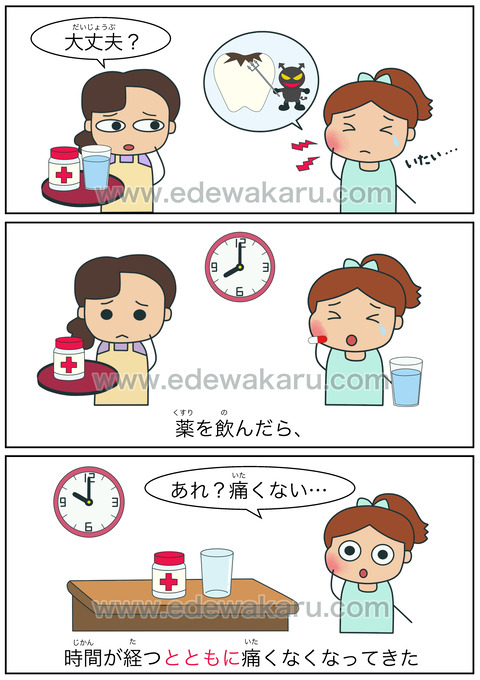
Meaning
〜が変化すると、一緒に〜も変化する
〜が変化すると、〜もだんだん変化する
How to use it
動詞[辞書形]+とともに
名詞[辞書形]+とともに
Explanation
「AとともにB」は「Aが変化すると、一緒にBも変化する」「Aが変化すると、Bもだんだん変化する」という意味の文型です。この文型は2つの変化が同時に進行するという意味ですので、変化を表す言葉と一緒に使われます。
「〜とともに」には、いくつか意味がありますので一緒に覚えておきましょう。また、類似文型(るいじぶんけい)もありますので復習しておくといいと思います。
【類似文型】
In context 5 examples
薬を飲んだら、時間が経つとともに痛くなくなってきた
→時間が経つと、痛みもだんだんなくなってきたスマホの普及とともに、歩きスマホをする人が増えている
年をとるとともに、目が悪くなってしまった
春になるとともに、いろんな花が咲き始めた
時代とともに、ファッションも変わるものだ
Usage 2
Read this source entry ↗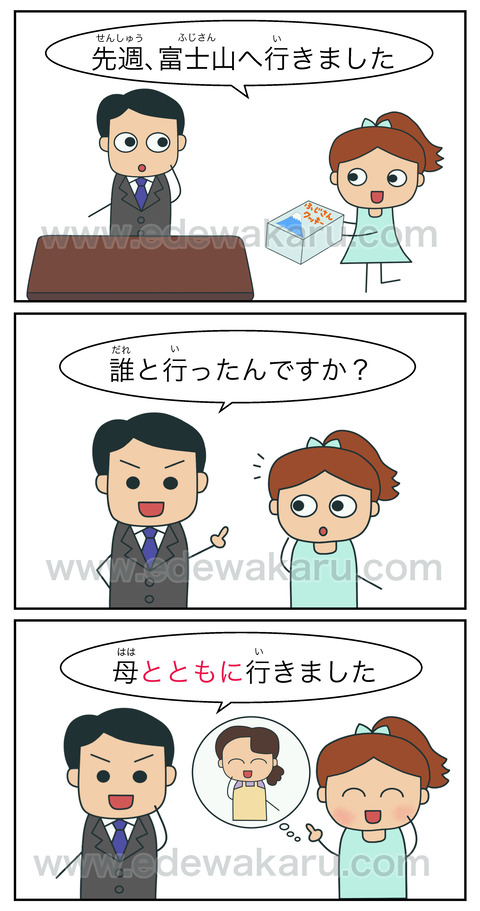
Meaning
〜と一緒に
〜と協力して
How to use it
名詞[辞書形]+とともに
Explanation
「〜とともに」は「〜と一緒に」「〜と協力して」という意味を表す文型です。「Aとともに」の形で「A」には【人】や【グループ】などがきます😊かたい言い方ですので、ほとんどの場合は
書き言葉
として使われます。
(復習:〜として)
「〜とともに」は、漢字で書くと「〜と共に」と書くということも覚えておくといいと思います😉「〜とともに」には、他にも意味がありますので一緒に覚えておきましょう。
In context 3 examples
先生:誰と旅行に行きましたか?学生:母とともに行きました
→母と一緒に行きましたおおみそかは家族とともにおせち料理を作りました
→おおみそかは家族と一緒におせち料理を作りました(復習:おおみそか)(復習:おせち料理①)(復習:おせち料理②)クラスメートとともに、あの絵を描きました
→クラスメートと協力して、あの絵を描きました
Usage 3
Read this source entry ↗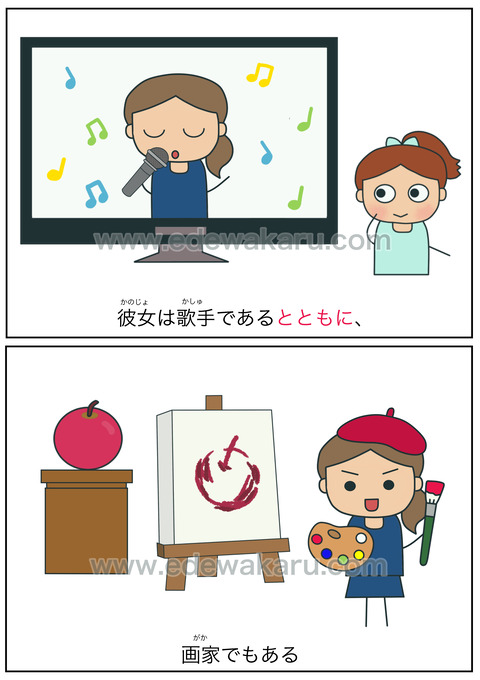
Meaning
〜であると同時に〜
〜と同時に〜
How to use it
動詞[辞書形]+とともに
い形容詞[ーい]とともに
な形容詞[ーな]+である+とともに
名詞[辞書形]+である+とともに
Explanation
「AとともにB」は「Aであると同時にB」「Aと同時にB」という意味の文型です。これは同時に2つの状態が存在することや、同じ時間に2つのことが発生する時に使われます。
[例]
①彼女は歌手である
とともに、画家でもある
【2つの状態が存在】
歌手・画家
②田中さんは、結婚
とともに
会社を辞めた
【2つのことが発生】
結婚・会社を辞める
③娘の結婚は、嬉しさ
とともに
寂しさも感じる
【2つの状態】
嬉しい・寂しい
④彼らは卒業する
とともに
結婚した
【2つのことが発生】
卒業・結婚
⑤転勤
とともに、引越しした
【2つのことが発生】
転勤・引越し
「〜とともに」には他にも意味がありますので、一緒に覚えておきましょう😊
In context 5 examples
彼女は歌手であるとともに、画家でもある
→彼女は歌手であると同時に、画家でもある田中さんは、結婚とともに会社を辞めた
→田中さんは、結婚と同時に会社を辞めた娘の結婚は、嬉しさとともに寂しさも感じる
→娘の結婚は、嬉しいと同時に寂しいと感じる彼らは卒業するとともに結婚した
→彼らは卒業と同時に結婚した転勤とともに、引越しした
→転勤すると同時に引越しした
どんなときどう使う 日本語表現文型辞典
Usage 1
Meaning
as…gradually…
How to use it
Vる/N+とともにW
Explanation
とともに〈相関関係〉
~すると、それに応じてだんだん
1)「~とともに、…」の形で、「~が変化すると、…も変化する」という表現。
2)「~」にも「…」にも変化を表す言葉が来る。
1)When one thing changes, another does, too.
2)Words expressing change appear both before and after.
In context 4 examples
日差しが強まり、気温が高くなるとともに次々と花が開き始める。
秋の深まりとともに今年も柿がおいしくなってきた。
この国では内戦の拡大とともに、人々の生活の安定は次第に失われていった。
体が慣れていくとともに、トレーニングの種類を増やそうと思っている。
Usage 2
Meaning
together with
How to use it
N+とともにW
Explanation
とともに〈いっしょに〉
~といっしょに/~に添えて
「といっしょに・と共同で・に添えて」などの意味を表す。書き言葉的。
Expresses notions of being together, with, added to, etc. Written language.
In context 2 examples
手紙とともに当日の写真も同封した。
彼はその薬をコップ1杯の水とともに飲んだ。
Usage 3
Meaning
and in addition
How to use it
N/〔普通形〕(ナAである/Nである)+とともにW
Explanation
とともに〈付加〉
~と、さらに
「~とともに…」の形で「~のほかに、さらに…も(を)」という意味を表す。
Not only will one thing occur, but so will another.
In context 3 examples
病気の子どものこととともに、いなくなった犬のことも気になって今日は仕事が手につきませんでした。
現代の親は教育問題とともに子どもの健康や安全について頭を悩ませている。
JRとしては、今後サービスの向上を図るとともに、よりいっそうの安全性の向上を図っていかなければならない。
Usage 4
Meaning
at the same time
How to use it
Vる/イAい/ナAである/する動詞のN・Nである+とともにW
Explanation
とともに〈同時〉
~すると同時に
1)「~とともに…」の形で、「~」が起こるとほとんど同時に「…」が起こると言いたいときに使う。
2) ❹ ❺ は「~」でもあり「…」でもある、という意味。
1)Two actions occur nearly simultaneously.
2)In sentences ❹ and ❺ , means both…and.
In context 5 examples
ベルが鳴るとともに、子どもたちはいっせいに運動場へ飛び出した。
彼は京都に転勤するとともに、結婚して家庭を持った。
試合の終了とともに、観客は総立ちとなって勝者に盛大な拍手を送った。
佐藤さんはわたしの親友であるとともに、人生の大先輩でもある。
この賞をいただいて、うれしいとともに感謝の気持ちでいっぱいです。
日本語NET JLPT文法解説まとめ
Usage 1
Read this source entry ↗Meaning
〜といっしょに / 〜と同時に
How to use it
N + とともに
Explanation
with
少し硬い表現で、改まった場面で使う。
It's a slightly formal expression used in more official settings.
In context 14 examples
地方への転勤が決まったので、家族とともに引っ越すことにした。
遠距離恋愛になってしまったので、彼女とともに過ごす時間が少なくなってしまった。
メールとともに二人で撮った写真も添付した。
この国では長男が両親とともに暮らすのが普通だそうだ。
お正月は毎年、実家に帰って家族とともに過ごしています。
みなさんとともに、この舞台に立てることを大変嬉しく思います。
新人研修ではビジネスマナーの基本を身につけるとともに、同期同士の交流を深めてもらうことが狙いだ。
この商品は「自然とともに暮らそう」をテーマに作られた。
今日はプロジェクトの成功を、みなさんとともに祝いたいと思います。
「よーい、どん!」の掛け声とともに、皆いきおいよく走り出した。
子供たちとともに過ごす時間が、私にとっての宝物です。
私とともに生きていこう。
大学の仲間たちとともに、会社を作ろうと思っています。
私が一番好きな映画は「風とともに去ぬ」だ。
Usage 2
Read this source entry ↗Meaning
~すると、それに応じてだんだん
~が変化すると、・・・も一緒に変化する
How to use it
V(辞) + とともに
N + とともに
Explanation
When
In context 4 examples
時間がたつとともに、手の痛みが引いてきた。
インターネットの普及とともに、いつでもどこでも色々な情報が手にはいるようになった。
SNSの普及とともに、セルフィーをする人が増えてきた。
春が近づくとともに、少しずつ暖かくなってきた。
日本語文型辞典 英語版
Meaning
Placed after nouns denoting people or organizations to express doing something “together” or “jointly/cooperatively.” Tends to be used in written language.
Placed after a verb or noun that denotes an action or change. Expresses that another action or change will occur in response to the first, or that two things will happen at the same time. Used in written language. Means the same as ...につれて (as/with...), ...とどうじに (at the same time as...).
How to use it
1. Nとともに
2. ...とともに[Nとともに][V-るとともに]
In context 8 examples
仲間とともに作業に励んでいる。
I’m working hard on this task with my colleagues.
夫とともに幸せな人生を歩んできた。
I’ve lived a happy life with my husband.
隣国とともに地域経済の発展に努めている。
Along with our neighboring countries, we are striving for regional economic development.
テレビの普及とともに、映画は衰退した。
With the spread of television, movies fell into a decline.
国の経済力の発展とともに、国民の生活も豊かになった。
Along with the development of the country's economic strength, the lifestyle of the people became more affluent.
地震の発生とともに津波が発生することがある。
Sometimes a tsunami occurs along with an earthquake.
年をとるとともに記憶力が衰えてきた。
My memory has declined as I have grown older.
《スピーチ》今後、教育内容の充実を図るとともに、地域社会に貢献する大学の建設に努力する所存でございます。
《speech》In the future, I am committed to building a university that will contribute to the local community as I work to enrich the educational content.
AIUEO JLPT Grammar
Meaning
This sentence pattern expresses actions or phenomena occurring simultaneously. It is used when changes or progress happen in parallel, or when something is closely related to something else. This is commonly used in written form as a formal expression.
How to use it
動詞辞書形と+ともに形容詞と+ともに名詞と+ともに
Explanation · 日本語
この文型は、同時に行われる事柄や一緒に存在する事象を表す表現です。また、変化や進行が並行して起こる場合や、何かが他のことと密接に関連している場合にも使われます。形式的な表現として、書き言葉でよく用いられます。
In context 5 examples
年を取るとともに、体力が衰えてきた。
As I age, my physical strength has declined.
彼は昇進するとともに、責任も増えた。
Along with his promotion, his responsibilities also increased.
経済の発展とともに、環境問題が深刻化している。
Along with economic development, environmental issues are becoming more serious.
彼女は優れたリーダーシップを発揮するとともに、営業力も抜群だ。
She has excellent leadership skills and is also an excellent salesperson.
新しい制度が導入されるとともに、業務の効率が大幅に向上した。
With the introduction of the new system, work efficiency improved significantly.
文法
Usage 1
Meaning
〜といっしょに / 〜と同時に
How to use it
N + とともに
Notes
少し硬い表現で、改まった場面で使う。
In context 14 examples
地方への転勤が決まったので、家族とともに引っ越すことにした。
遠距離恋愛になってしまったので、彼女とともに過ごす時間が少なくなってしまった。
メールとともに二人で撮った写真も添付した。
この国では長男が両親とともに暮らすのが普通だそうだ。
お正月は毎年、実家に帰って家族とともに過ごしています。
みなさんとともに、この舞台に立てることを大変嬉しく思います。
新人研修ではビジネスマナーの基本を身につけるとともに、同期同士の交流を深めてもらうことが狙いだ。
この商品は「自然とともに暮らそう」をテーマに作られた。
今日はプロジェクトの成功を、みなさんとともに祝いたいと思います。
「よーい、どん!」の掛け声とともに、皆いきおいよく走り出した。
子供たちとともに過ごす時間が、私にとっての宝物です。
私とともに生きていこう。
大学の仲間たちとともに、会社を作ろうと思っています。
私が一番好きな映画は「風とともに去ぬ」だ。
Usage 2
Meaning
~すると、それに応じてだんだん
~が変化すると、・・・も一緒に変化する
How to use it
V(辞) + とともに
N + とともに
In context 4 examples
時間がたつとともに、手の痛みが引いてきた。
インターネットの普及とともに、いつでもどこでも色々な情報が手にはいるようになった。
SNSの普及とともに、セルフィーをする人が増えてきた。
春が近づくとともに、少しずつ暖かくなってきた。
NINJAL 日本語文型データベース
Meaning
[1] 〜と同時に、または、〜の直後に、別の動作や出来事が起こると言いたいときに使います。
[2] 2つの動作、出来事や物事の状態を並列的に表すときに使います。
[3] ~という変化・進展があると、それと並行して後のことも変化・進展すると言いたいときに使います。
How to use it
Vるとともに
Nとともに
i-Aとともに
na-Aであるともに
Nとともに・Nであるとともに
Notes
[1] 「〜」には瞬間的な動作や出来事を表す言葉がきます。「~とともに」の後にも、瞬間的な動作や出来事を表す文がきます。
[3] 「~」にも「〜とともに」の後の文にも、一方方向の変化や進展を表す言葉がきます。「〜とともに」の後には、話し手の希望・意向を表す文や相手への働きかけの文はきません。
In context 34 examples
新学期が始まるとともに、キャンパスには学生たちが戻ってきた。
このドラマの最新話は、毎週日曜日、日付が変わるとともにインターネット配信されます。
山のホテルに着いて窓の外をながめていると、日が沈むととともにあたりが真っ暗になり、物音も途絶えた。
大学卒業とともに内定していた会社で働き始めた。
試合開始とともに雨が激しさを増した。
夜明けとともに起きて、散歩することから私の一日が始まる。
宇宙はビッグバンと呼ばれる大爆発とともに誕生したと考えられている。
このバッグは発売とともに売り切れるほどの人気だった。
この会社では、新型プログラムを用いたシステムを導入することで、業務の効率化が図れるとともにコストダウンも実現できることを期待している。
この論文では調査結果をもとに、飲酒と寿命との関係を明らかにするとともに、先行研究の再分析を行う。
この会社の社員同士の傷害事件が報じられた。会社は事実関係の把握に努めるとともに、事態の収拾に全力を尽くしているという。
亡くなった両親の写真を見て懐かしくなるとともに、時間の過ぎゆく早さがしみじみ感じられた。
後半の授業では、最終回で行う口頭発表の資料を作成するとともに、発表の練習も行います。
児童虐待のニュースを聞くたび、腹立たしいとともに悲しい気持ちになる。
ピンクダイヤモンドは、希少性が高いとともにその美しさから人気があるため、高値で取引きされている。
具体的なデータに基づいた説明は、理解しやすいとともに、説得力がある。
公的な文書は、正確であるとともに理解しやすくなければならない。
このたび会長の職をお引き受けしますこと、光栄であるとともに責任の重さを実感しております。
日本語能力が不十分な外国人は、災害時、情報の入手が困難であるとともに、地域コミュニティからの援助を受けにくいなどの問題に直面する可能性がある。
日本への留学が決まり、うれしさとともに家族と離れる寂しさも感じている。
売り上げを伸ばすには、新商品の開発とともに販売促進企画を進めていく必要がある。
子どもはチームスポーツに取り組むことで、体力、運動能力とともにコミュニケーション能力も向上させることができます。
私は人の親であるとともに人の子でもある。
「児童の権利に関する条約」では、子どもは特別に保護される存在であるとともに一人の人間として権利を持つ主体だとされている。
年齢が上がるとともに慎重に判断できる力が身についていく。
スマートフォンが普及するとともに人々はテレビを見なくなってきた。
秋が深まるとともに空気が澄んで、星座が美しく見えるようになる。
日が昇るとともに気温が上がり、午前9時の時点で25度を超えた。
認知症が進むとともに、視覚や聴覚を使って正しく周囲の状況を認識する能力が低下していく。
病状の回復とともに生きる意欲も増してきた。
日本では、生活様式の変化とともに、家屋の構造も機能を優先するスタイルに変わってきた。
高度情報社会の進展とともに、個人情報の管理も厳重になっていく。
震災後、インフラ整備の進行とともに、人々の表情に明るさが戻ってきた。
春は気温が上昇し、それとともに生き物の活動が活発になっていきます。
IMABI
As (change)
Read this IMABI lesson ↗Explanation
As (change): ~につれて, ~に従って, ~に伴って, ~とともに, ~に応じて, & ~に応えて
~につれて, ~に従って, ~に伴って, and ~とともに all have meanings of showing the transition/change of one situation as another transition/change is under way. We will also see how ~に応じて・応えてrelate to them.
~につれて
~につれて is either after a noun or a verb in the 連体形 to express “as one thing changes, another thing changes as well”. These changes are simultaneous. Although it can be after nouns or verbs, it is after verbs more often. ~につれて is often used in situations where there is a proportional relationship with the two events in the respective clauses.
As such, the first clause acts as the trigger, proportionately raising the degree of the change/transition of the latter clause. Common translations include “as”, “together with”, and “in accordance to/with”.
Variant Note: It can be seen in more formal/written language as ~につれ.
Examples
1. 歌は世につれ世は歌につれ。
Song changes by generation, and generations change by song.
2. 昭和から平成へと時代が変わるにつれて軍歌ぐんかは歌われなくなりました。
With the changing of periods from the Showa to the Heisei, military songs became unsung.
3. 時間が経つにつれて忘れっぽくなる。
As time passes, I become forgetful.
4. 都心化(が進む)につれて自分の地域への関心が薄うすれる。
As urbanization progresses, the concern towards one’s region fades.
5. 夜が更ふけるにつれて嵐あらしは激しくなった。
The storm became fierce as the night grew late.
6. 季節の変化につれて気温が変わる。
The temperatures change in accordance to the seasons. 7. 冬になるにつれて、山が白くなってくる。
The mountains become white as winter depends.
8. イナゴは稲に付く害虫なので駆除しなくてはなりません。昔の人はそこからイナゴを食べることを思いつきました。当時は、食べることを前提に捕まえていたので、殺虫剤は使っていませんでした。しかし戦後、 農薬が普及し、それにつれてイナゴは激減してしまいました。現在では、殺虫剤を使ったイナゴの駆除も行われていますが、安全な無農薬栽培やオーガニック栽培をしている農家では一匹ずつ捕まえているそうです。大変な作業ですね。
Locusts are harmful insects which stick to rice plants and have to be exterminated. People in the past thought of eating locusts from this. At the time, they wouldn’t use pesticides with eating them as a premise. However, after the war, agrochemicals spread, and with this locusts were decreased in number. Presently, there is extermination involving pesticides, but at farms which use safe non-agriculture chemical and organic cultivation, locusts are caught by hand one by one. That’s definitely a tough job.
~に従って
~に従って can be used in a hierarchical sense to mean “according to”. As should be expected, ~に従い is more formal and indicative of the written language. Both に従っての and に従った are appropriate attribute forms.
9. 命令に従って、行動しろ。
Act according to the command.
10. 私の合図に従って行動してください。
Please act in according to my signals.
It may also be used like ~につれて. In the first usage above, it attaches to nouns. As for this usage, it attaches primarily to verbs. It, however, simply states that the two actions described in the respective clauses are happening in parallel.
11. 南に行くに従い、気温がどんどん高くなる。(Somewhat literary)
The temperature gets higher as you go south.
12. 人口が増えるにしたがって、住宅問題が起こってくる。
As the population increases, housing problems will come to occur.
13. 人口が増えるにしたがって、犯罪が多発する。
As the population increases, crime will frequently occur.
The contrast in nuance between ~につれて and ~にしたがって can definitely be seen in the following example.
14. スタジアムで場内の歓声が高まる{につれて・にしたがって}。実況アナウンサーの声も大きくなっていった。
As the cheers in the stadium intensified, the commentator’s voice got ever louder.
With ~につれて, the suspense is captured with the first clause being the trigger for the events of the second. With ~にしたがって, the sentence doesn’t become ungrammatical, but it loses the emotive drive and merely states that the two events described in the respective clauses are happening in parallel.
~に伴って
伴う means “to accompany” and ~に伴って means “associated/accompanied with” or “as”. Just like ~につれて, it may show that something is happening together with a change/transition of a certain situation. There is a temporal context of “taking A as the opportunity, therefore…B”. It is also often the case that it infers that the thing in the second clause continues.
What precedes it is either a noun or verb. In the case of a verb, unlike the other options, the particle の may be optionally used after the verb for nominalization. To be clear, this is not required and is not done in the first place for the other options. Lastly, ~に伴って is more literary.
Variant Note: It may also be seen in writing as ~に伴い.
15. 汚染おせんに伴う問題について話しましょう。
Let’s talk about the problems accompanied with pollution.
16. 人口の増加に伴って、たくさんの住宅が建てられる。
Many houses are constructed in association to the increase in population.
Particle Note: 伴う is used with を when used transitively.
~とともに
~とともに also behaves like ~につれて to show that something happens together with a change/transition of a certain situation. However, unlike ~につれて, the entire sentence doesn’t necessarily have to show a state of progress. In other cases it can have meanings equivalent to 同時に and 一緒に. As for its usage similar to ~につれて, it’s also the case that the words it follows must show change in situation. It cannot be words pertaining to action, which ~につれ and ~にしたがって can be.
17. 人口の増加とともに、犯罪が多発する。
Along with the increase in population, crimes will frequently occur.
18. 子供が卒業するとともに、父母会ふぼかいも解散かいさんしました。
The parents’ association also dissolved at the same time the kids graduated.
19. 皆さんとともに快適かいてきな道づくりを進めます。
With everyone we will go forward with a pleasant road construction.
漢字 Note: This pattern may also be written in 漢字 as ~と共に.
~に応じて
~に応じて means “accordingly” or “as to”. The first meaning is important in this lesson as it ties with the other patterns. When it is used with a verb that shows change, it describes the corresponding/dealing with a certain change. In this instance, it is possible to switch it out with ~につれて, ~にしたがって, ~にともなって, and ~とともに.
In its other meaning, it is equivalent to ~に応えて (as to/to satisfy). Although this, too, sounds like it is of the vein of the other phrases, it’s not. Although in such situations it may seem that ~に従って is possible, it would be considerably more negative.
20a. 住民の要求に応じて、説明会を開くことになりました。〇
20b. 住民の要求に従って、説明会を開くことになりました。△
20c. 住民の要求{にともなって・とともに}、説明会を開くことになりました。?
20d. 住民の要求につれて、説明会を開くことになりました。X
In meeting the wants of the citizens, it has been decided that we open an information seminar.
It has the attribute forms ~に応じての and ~に応じた. When に応じて comes before a noun, の is necessary after 応じて. Or, you can use に応じた. The 一段 conjugating verb 応じる either means “reply” or “to comply”.
21. 質問に応じて、彼女は問題の解答を詳くわしく説明しました。
As to answer the question, she explained the answer to the problem well.
22. 命令に応じた服従。
Obedience in accordance to command.
23. 料金が距離きょりと時間に応じて決まります。
The fee is determined according to distance and time.
24. 「うん」と応じる。
To respond with a “yes”.
25. 相手の依頼いらいに応じましたか。
Have you responded to your partner’s request?
26. 車の速さに応じてガソリンの消費量が変わる。
Fuel use will change depending upon the car’s speed.
~に応えて
The 一段 verb 応える may be used to mean “to come through/satisfy/answer” or “to tell/go to one’s heart”. The latter usage shows some sort of burden.
27. 要求に応こたえて、社員の給料が上がりました。
To meet demand, the employee’s salaries went up.
28. 国民に応えて、法律は廃止はいしされました。
The law was repealed in response to the citizens.
29. 期待に応える。
To come through with expectations.
30. 深酒ふかざけは身体に応えるのです。
Hard drinking takes its toll on the body.
31. その当時供給は需要に{応えて・満たして}いなかった。
In those days, the supply didn’t meet the demand.
In context 33 examples
歌は世につれ世は歌につれ。
Song changes by generation, and generations change by song.
昭和から平成へと時代が変わるにつれて軍歌ぐんかは歌われなくなりました。
With the changing of periods from the Showa to the Heisei, military songs became unsung.
時間が経つにつれて忘れっぽくなる。
As time passes, I become forgetful.
都心化(が進む)につれて自分の地域への関心が薄うすれる。
As urbanization progresses, the concern towards one’s region fades.
夜が更ふけるにつれて嵐あらしは激しくなった。
The storm became fierce as the night grew late.
季節の変化につれて気温が変わる。
イナゴは稲に付く害虫なので駆除しなくてはなりません。昔の人はそこからイナゴを食べることを思いつきました。当時は、食べることを前提に捕まえていたので、殺虫剤は使っていませんでした。しかし戦後、 農薬が普及し、それにつれてイナゴは激減してしまいました。現在では、殺虫剤を使ったイナゴの駆除も行われていますが、安全な無農薬栽培やオーガニック栽培をしている農家では一匹ずつ捕まえているそうです。大変な作業ですね。
Locusts are harmful insects which stick to rice plants and have to be exterminated. People in the past thought of eating locusts from this. At the time, they wouldn’t use pesticides with eating them as a premise. However, after the war, agrochemicals spread, and with this locusts were decreased in number. Presently, there is extermination involving pesticides, but at farms which use safe non-agriculture chemical and organic cultivation, locusts are caught by hand one by one. That’s definitely a tough job.
命令に従って、行動しろ。
Act according to the command.
私の合図に従って行動してください。
Please act in according to my signals.
南に行くに従い、気温がどんどん高くなる。(Somewhat literary)
The temperature gets higher as you go south.
人口が増えるにしたがって、住宅問題が起こってくる。
As the population increases, housing problems will come to occur.
人口が増えるにしたがって、犯罪が多発する。
As the population increases, crime will frequently occur.
スタジアムで場内の歓声が高まる{につれて・にしたがって}。実況アナウンサーの声も大きくなっていった。
As the cheers in the stadium intensified, the commentator’s voice got ever louder.
汚染おせんに伴う問題について話しましょう。
Let’s talk about the problems accompanied with pollution.
人口の増加に伴って、たくさんの住宅が建てられる。
Many houses are constructed in association to the increase in population.
人口の増加とともに、犯罪が多発する。
Along with the increase in population, crimes will frequently occur.
子供が卒業するとともに、父母会ふぼかいも解散かいさんしました。
The parents’ association also dissolved at the same time the kids graduated.
皆さんとともに快適かいてきな道づくりを進めます。
With everyone we will go forward with a pleasant road construction.
住民の要求に応じて、説明会を開くことになりました。〇
In meeting the wants of the citizens, it has been decided that we open an information seminar.
住民の要求に従って、説明会を開くことになりました。△
In meeting the wants of the citizens, it has been decided that we open an information seminar.
住民の要求{にともなって・とともに}、説明会を開くことになりました。?
In meeting the wants of the citizens, it has been decided that we open an information seminar.
住民の要求につれて、説明会を開くことになりました。X
In meeting the wants of the citizens, it has been decided that we open an information seminar.
質問に応じて、彼女は問題の解答を詳くわしく説明しました。
As to answer the question, she explained the answer to the problem well.
命令に応じた服従。
Obedience in accordance to command.
料金が距離きょりと時間に応じて決まります。
The fee is determined according to distance and time.
「うん」と応じる。
To respond with a “yes”.
相手の依頼いらいに応じましたか。
Have you responded to your partner’s request?
車の速さに応じてガソリンの消費量が変わる。
Fuel use will change depending upon the car’s speed.
要求に応こたえて、社員の給料が上がりました。
To meet demand, the employee’s salaries went up.
国民に応えて、法律は廃止はいしされました。
The law was repealed in response to the citizens.
期待に応える。
To come through with expectations.
深酒ふかざけは身体に応えるのです。
Hard drinking takes its toll on the body.
その当時供給は需要に{応えて・満たして}いなかった。
In those days, the supply didn’t meet the demand.
DoJG 日本語文法辞典(全集)
Meaning
As well as; with; along with; at the same time; when, as; while
How to use it
(i) Noun | と共に | |
| 山田先生と共に | As well as Mr. Yamada; with Mr. Yamada |
| 退職と共に | At the same time as one’s retirement |
| 気候の変化と共に | With the climate change; as the climate changes |
(ii) Vinformal nonpast | と共に | |
| 景気が回復すると共に | As business recovers |
(iii) {Noun/Adjective な stem} | であると共に | |
| 医者であると共に | As well as being a doctor |
| 経済的であると共に | As well as being economical |
(iv) Adjective い informal nonpast | と共に | |
| 興味深いと共に | As well as being interested |
Explanation
A phrase which is used to express the idea that A and B share a common property or do the same thing together, that two things take place at the same time, or that someone or something possesses two properties.
In context 13 examples
スタインベックはへミングウィイと共にアメリカの代表的作家の一人だ。
Steinbeck, as well as Hemingway, is a writer representative of American writers.
私は職場の同僚達と共にそのデモに参加した。
I took part in the demonstration with my office colleagues.
病気が回復すると共に食欲も出てきた。
As I'm recovering from my illness, my appetite is coming back.
彼は科学者であると共に哲学者でもあった。
He was a philosopher as well as a scientist.
原子力は石油と共に重要なエネルギー源だ。
Atomic energy, as well as petroleum, is an important energy source.
轟音と共にジェット機が飛び去った。
A jet flew off with a roaring sound.
終戦と共に激しいインフレが人々を襲った。
Severe inflation hit people when the war ended (literally: with the end of the war).
景気の回復と共に失業率が下がってきた。
As business is recovering (literally: With the recovery of business), the unemployment rate is coming down.
年をとると共に耳が遠くなってきた。
As I get older, I am losing my hearing.
調査が進むと共に新しい事実が次々に明らかになっていった。
As the investigation progressed, one new fact after another was revealed.
文法を復習すると共に漢字の勉強も忘れてはならない。
While you review grammar, you must not forget to study kanji.
現在のエネルギー利用技術を改良すると共に新しいエネルギー源を探すことが急務である。
It is urgent that we improve current energy utilization technology while looking for a new energy source.
その提案は建設的であると共に革命的であった。
The discovery was revolutionary as well as constructive.
毎日のんびり日本語教師
How to use it
①随着…
動辞形+とともに
名詞+とともに
②和…一起
名詞+とともに
③既…又…/与…同时
動辞形+とともに
(動た形+とともに)
い形容詞原形+とともに
な形容詞語幹+である+とともに
名詞+(である)とともに
Explanation
この文法は3つの意味があります。
①何らかの変化と同時に、他のことも徐々に変化することを表す用法
名詞に接続する時は、変化を含む動作性の名詞である必要があります。
②「~と一緒に」を表す用法
人や物等を表す名詞に接続します。この言い方はやや硬く書き言葉です。
③同一時間内に2つの現象や状態が存在、または発生していることを表す用法
前項と後項の動作は同時に発生します。
Notes
特になし
In context 12 examples
人々の考え方は時代の流れとともに変わっていくものなのかもしれない。
年と共に涙脆くなってきた。
日本は少子高齢化とともに本格的な人口減少社会を迎えている。
スマホの普及と共に、ながらスマホなどの問題も出てきている。
小学校の頃からペットの猫とともに生きてきた。
荷物と共に実家へ帰る。(带着行李回老家。)
自然と共に生きていきたい。(想跟自然共存。)
母と共に温泉旅行へ行く。(跟妈妈一起去温泉旅行。)
卒業は嬉しさと共に寂しさも感じる。(毕业让人感到高兴同时又有点寂寞。)
この曲を聴いて懐かしくなると共に、時間の流れを痛感した。
彼女が羨ましいと共に憎たらしい。
ご迷惑をおかけしたことを深くお詫び申し上げると共に、今後一切このような事を起こさないよう精進してまいりますので、何卒宜しくお願い致します。