日本語文型辞典
Meaning
基本情報N/Na だったらA-かったらV-たら説明述語の活用形の一つで、条件や契機を表す。「と」「ば」「なら」と重なる用法をもつ。一般的な真理や法則を述べる「一般条件」よりも、特定の個別的なことがらについて述べる場合に使われる傾向が強い。他の三つに比べると、文末表現の制約が少なく、話しことばでよく使われる。丁寧体は「N/Naでしたら」「V-ましたら」となるが、イ形容詞は丁寧体はとらない。やや古めかしい言い方では「ば」を伴って「たらば」となることもある。
個別的な事態について「Xが実現した場合にYが実現する」あるいは「Xが実現した状況でYが実現するよう求める」といった関係を表す。Xは未実現のことがら、あるいはすでに実現していることがらを表すが、Yはいつも未実現のことがらを表す。Yには未実現のことがらの述べ立てや推量を表す「平叙文」や、意志・希望を表す「表出」の文、命令・禁止・勧誘などを表す「働きかけ」の文などが用いられる。
a. …たら+未実現のことがら
Yが未実現のことがらについての述べ立てを表す場合の用法。文末には述語の辞書形、またはそれに推量の「だろう」などが付いた形が用いられる。①~④は、XもYも未実現のことがらを表し、Xが実現した場合にYが実現するということを述べる表現。まだ起こっていない不確実なことがらや実現しそうもないことがらを仮定するような場合には「もし」「万一」などが使われることがある。④は「Xの後にYが起こる/行われる」といった未来に憶を追って実現することがらをそのまま述べるような用法で、仮定的な意味は薄い。⑤~⑦は、Xがすでに実現していることがらの場合で、そうした現状に基づいてYを予測的に述べる表現。Xには現状を示す「こ/そ/あ」の付く語を伴うことが多い。「たら」は、個別的なことがらに使われる傾向が強く、恒常的な真理や法則を述べる「一般条件」には用いられにくい。ただし、話しことばでは、次のように、個人の習慣や、特定の事物の反復動作を表す場合に使わ繁ることもある。
⑧~⑪は、「Xが成立した後に、Yが成立する」という意味を表す。XはYの成立する時間的状況を表し、そうした時間的条件のもとで繰り返される動作を表す。この場合は「たら」から「と」への言いかえが可能。
b. …たら+表出・働きかけ
「Xが実現した場合にYをしよう/したい」「Xが実現した場合にYをしなさい/するな/してもいい/してください」といった意味を表す。Yには、話し手の意志・希望を表す「表出」の表現や、聞き手に対する命令・禁止・許可・依頼・勧誘といった「働きかけ」の表現が続く。
「たら」は普通、その時だけの具体的なことがらの関係に使われ、Xが成立した状洗で成立するYについて述べる場合に使われる。XはYに時間的に先行することがらを表し「こういうことが起こった場合には」「…した時に」「このあとで」のような言葉で言いかえられる。以下のように、「たら」の前が「ある」や形容詞、名詞などの状態性の述語の場合は、「そのような状況であれば」という意味を表し、その状況が成立した場合の話し手の意志・希望や聞き手に対する要求や勧めなどを表す。聞き手の都合や意向を問題にする場合は【前置き】の用法に近い表現になる。
「たら」と比べた場合、「と」「ば」は使用できる表現に制約がある。「と」は「表出」や「働きかけ」の表現とともに使えないし、「ば」はXが動作・変化を表す動詞の場合は、「表出」や「働きかけ」の表現が使われにくい。
c. …たら+問いかけ
「XたらYか」の形で、聞き手に答えを要求する疑問文での「たら」の用法。
①②は、「はい」「いいえ」を問う肯否疑問文、③~⑦は「何」「どう」などの疑問詞を伴う疑問詞疑問文の場合である。③~⑤は、「XたらYか」のYが不明の場合、⑥⑦は、Xが不明の場合の疑問詞疑問文である。⑥⑦のように、よい結果を得るための方法・手段Xを問う疑問文では、「たら」から「ば」への言いかえが可能だが、②~⑤のように、Xが成立した場合にYでどのような行動をとるかを問う疑問文では、たいてい「たら」が使われ、「ば」の使用は不自然である。
d. 疑問詞+V-たら…のか
「何/どれだけ/どんなに」などの疑問詞に動詞のタラ形が続く反語的表現。「いくら付してもなかなか思い通りにならない」という意味で、状況に対するいらだちや絶望的な気持ちを表す。文末には「のか」や「のだ/のだろう(か)」などが用いられる。「V-たら」は「V-ば」に言いかえ可能。
e. …たらどんなに…か
「もしXが実現したらどんなにいいか分からない」という意味で、Xの実現を強く望んだり、それが実現したらとてもうれしいという気持ちを表す。文末には「だろう(か)」「ことか」などが使われる。
a. …たら …だろう/…はずだ
実際に起こったことと違うこと、あるいは反対のことを仮定して、その場合はこうなっただろうという言い方。普通、動詞は状態性にして「V-ていたら」とすることが多い。過去の事実に反することを仮定する場合は、①~⑤のように、文末には「…ただろう/はずだ/のに」などタ形の述語が用いられる。これに対し、現状と異なることを仮定する場合は、⑥⑦のように「…するのに/のだが」のような辞書形が用いられる。この用法の「たら」は「ば」で言いかえが可能だが、「たら」のほうが話しことば的。【反事実】を表す条件文のとる文型についての詳しい説明は【ば】4 を参照。
b. …たらどんなに…か
Xが実現が不可能だったり、現実と反対のことがらの場合の言い方で、「もしXが実現したら(していたら)どんなにいい(よかった)か分からない」という意味の表現。Xの実現を強く望むが、実際にはそれが不可能なことをとても残念に思う気持ちを表す。
すでに実現していることがらと反対のことがらを仮定する場合は、①~③のように、「…ただろうか」の形を、まだ実現していないがそれが不可能なような場合は、④のように「…るだろうか」を使う。
「XたらYた」という形で前後ともすでに実現していることがらを表す。Xが成立した場面でYを話し手が新たに認識したり、それをきっかけに新しいことがらが起こったりするようなことを言う場合に使う。Yには、話し手の意志が及ばないようなことがらの出現や、それが新たに見つかった、分かったといった意味の表現が続く。
①~④は、Xという動作が行われた場面で、Yという状況を話レ手が発見するといった用法だが、その場合に「…たら、私はした」のようにYでは発見者「私」を表さないで、「…たら…ということが分かった」「…たら…がいた」「…たら…があった」など、状況を描写する表現を使う。
また、新たに分かったこと、発見したことがらを表すYには、①②のように「V-ていた」「Nだった」などの状態性の表現が用いられる。一方、「V-ていた」の代わりに「V-た」が用いられると次のように意味が変わる。
(例)は「来ていた」の代わりに動作性の表現「来た」が用いられているが、この場合は空港に迎えに来ていた友達を発見したという①の状況ではなく、話し手が着いた後に友達が迎えに来たという状況で用いる。
⑩⑪のように、前半で予想を立てる場合、後の文に予想したことが続くときは「案の定」「やっぱり」、予想外のときには「案外」「意外なことに」「思いがけず」などの言葉がよく使われる。
この用法の「たら」は「と」で言いかえられることが多いが、XとYが意志でコントロールできる同一人物の動作の連続を表すような場合、「と」は使用可能だが、「たら」は不可能である。
また、「と」が小説や物語などで使われるのに対し、「たら」は、話し手が直接経験したことがらを述べるような場合に用いられる。
一度あることが起こると、そのものの性質や固い決意などで、以後その状態を変えないという意味。「一度…たらさいご絶対に…」の形でよく使われる。
前後に同じ形容詞や動詞を2度繰り返して使う。対照的なことがらを取り上げて、どちらにしても同じだという意味を表す。
①②のように「問題はあるにしてもさほど困らない/何とかなる」といった意味を表す場合と、③~⑤のように、状況をあまり好ましいととらえないで、「どちらにしても大変だ/問題だ」という意味を表す場合がある。イ形容詞は、たいてい「A-かったらA-かったで」の形で使われるが、①のように「なかったらないで」の形が使われることもある。
「…ば…で」は類義表現。
後に続く発言がどのような条件でなされるものなのか、前もってその範囲を限定したり、予告や注釈を行う場合に用いる。ある程度固定化の進んだ慣用表現。「ば」で言いかえが可能。
a. …たら+依頼・勧め【前置き】
依頼や勧めをするときに相手の都合を丁寧にたずねる慣用化した表現。
b. …たら【前置き】
「見る」「思う」「比べる」など、発言や思考、比較などを表す動詞を受けて、後に続く発言・判断がどのような立場・観点から行われているかを前もって予告する言い方。ある程度慣用化した言い方。
「からしたら」「から言ったら」なども類義的な表現。
「V-たらどうか」の後半が省略されたもので、聞き手にその動作を行うように勧める表現。上昇調で発音される。普通親しい間柄の相手に使う。丁寧に話す必要がある場合には、後半を省略しないで「たらどうですか/いかがですか」などを使う。
「V-ば」での言いかえが可能だが、「たら」には、相手に本気で勧めているというニュアンスがあるのに対し、「ば」を使うと話し手とってはどうでもいいことだという投げやりなこュアンスが伴うことがある。
⇾からいう1
⇾からする1
⇾からみる1
⇾といったらありはしない⇾といったらありゃしない⇾といったらない
⇾ときたら
⇾としたら
⇾となったら
⇾てみる4
⇾にかかっては
⇾にかけたら⇾にかけて2
⇾にしたら
⇾にしてみれば
⇾によると1b
⇾だったら
How to use it
…たら【仮定条件】
…たら【反事実】
…たら…た【確定条件】
…たらさいご
…たら…で
A-かったらA-いで
A-かったらA-かったで
V-たらV-たで
…たら【前置き】
V-たら【勧め】
…からいったら
…からしたら
…からみたら
…といったら
…ときたら
…としたら
…となったら
V-てみたら
…にかかったら
…にかけたら
…にしたら
…にしてみたら
…によったら/ことによったら
だったら
In context 94 examples
雨だったら道が混雑するだろう。
もしも、あまり高かったら誰も買わないでしょう。
万一雨が降ったら試合は中止です。
この薬を飲んだらすぐにせきはとまりますが、3時間たったら効き目がなくなります。
あんなに美人だったら、男性がほうっておかないだろう。
ここまで来たら、一人でも帰れます。
そんなにたくさん食べたらおなかをこわしますよ。
いつも、5時になったらすぐ仕事をやめて、テニスをします。
ここは冬になったら雪が1メートルぐらいつもる。
ふだんは昼ご飯を食べたら昼寝をしますが、今日は買物に行かなければなりません。
古くなったらすぐに新しいのに買いかえるというような生活では、お金は貯まらない。
この仕事が完成したら、長い休みをとるつもりだ。
もしも1千万円の宝くじに当たったら、何でも買ってあげますよ。
教師になったら子どもたちにものをつくる楽しさを教えたい。
お風呂に入ったらすぐ寝なさい。
この予防注射をしたら、風呂に入ってはいけません。
お酒を飲んだら絶対に運転はするな。
宿題が済んだら遊びに行ってもいいよ。
A:あちらで野田さんに会われますか。
B:ええ、その予定ですが。A:じゃ、お会いになったらよろしくお伝えください。もしも遅れたら、連絡してください。
会議が終わったら食事をしに行きましょう。
暇があったら海外旅行をしたい。
暑かったら、窓を開けてください。
お暇でしたら、いらっしゃいませんか。
そんなに勉強が嫌だったら大学なんかやめてしまえ。
熱があったら休んでもいいよ。
(誤) 結婚すれば仕事をやめたい。
(正) 結婚したら仕事をやめたい。
(誤) お風呂に入ればすぐ寝なさい。
(正) お風呂に入ったらすぐ寝なさい。
雨だったら試合は中止になりますか。
A:結婚したら仕事はやめるの。
B:ううん、しばらく続けるつもりよ。万一雨が降ったらどうしましょうか。
A:もし宝くじに当たったら、何に使いますか。
B:すぐに使わないで貯金しておきます。A:大学を卒業したらどうするつもりですか。
B:オーストラリアに留学したいと思っています。A:社長はただ今出かけておりますが。
B:何時ごろでしたらお帰りでしょうか。どのぐらい勉強したら日本語の新聞が読めるようになりますか。
(誤) 結婚すれば仕事をやめるつもりですか。
(正) 結婚したら仕事をやめるつもりですか。
(誤) 大学を卒業すればどうしますか。
(正) 大学を卒業したらどうしますか。
何度言ったら分かるんだ。
人間は戦争という愚行を何度繰り返したら気がすむのであろうか。
何年たったら一人前になれるのだろうか。
何回繰り返したら覚えられるのか。
どれだけ待ったら平和な世界になるのだろうか。
一体どうしたら今の思いを伝えることができるのか。
宝くじに当たったらどんなにうれしいだろう。
合格したら両親はどんなに喜んでくれるだろうか。
子供たちがもどってきたらどんなににぎやかになることか。
あのとき精密検査を受けていたら、手遅れにならなかっただろう。
隕石が地球に衝突していなかったら恐竜は絶滅していなかったかもしれない。
ひどい話を聞かなかったら、こんなに酔うまで飲んだりしなかつたにちがいない。
あの時彼と結婚していたら、私の人生はもっと幸せだったはずだ。
あの当時この「薬の害」という本を読んでいたら今ごろ苦しまなくてもよかったのに残念だ。
A:面接試験、うまくいった。
B:うまくいっていたら、こんな顔していないよ。点数があと10点高かったらこの大字に合格できるんだけど。
背があと10センチ高かったらどんなによかっただろうか。
10年前に彼女に会っていたらどんなによかっただろう。
祖母が生きていたら、どんなに喜んだことか。
今すぐあなたに会えたらどんなにうれしいだろうか。
空港に着いたら友達が迎えに来ていた。
トンネルを出たら一面の銀世界だった。
変な音がするので隣の部屋に行ってみたらねずみがいた。
山田さんは無口でおとなしい人だと思っていたが、よく話をしたらとても面白い人だということが分かった。
お風呂に入っていたら、電話がかかってきた。
デパートで買い物していたら、隣の奥さんにばったり会った。
5月に入ったら急に暑くなった。
薬を飲んだら熱が下がった。
会社をやめたらストレスがなくなって元気になった。
落ちてもともとと思って試験を受けたら、思いがけず合格した。
部屋の様子が変だと思ったら、案の定、空き巣に入られていた。
(誤) 隣の部屋に行ったら、私はねずみを見た。
(正) 隣の部屋に行ったら、ねずみがいた。
(例) 空港に着いたら友達が迎えに来た。
(誤) 男は部屋に入ったら友達に電話した。
(正) 男は部屋に入ると友達に電話した。
彼は寝たら最後、まわりでどんなに騒いでも絶対に目をさまさない。
賭事は一度手を出したら最後ずるずると抜けられなくなる人が多い。
すっぽんは一度かみついたら最後どんなことがあっても離れない。
金というのはあったらあったで使うし、なかったらないで何とかなるものだ。
自動車はあれば便利だが、なかったらなかったで何とかなるものだ。
母は寒がりで冬が苦手だが、それでは夏が好きかというとそうではない。暑かったら暑かったで文句を言っている。
息子には大学に受かってほしいが、受かったら受かったでお金が要って大変だ。
平社員のときは給料が少なくて困ったけど、昇進したらしたでつきあいも増えるしやっぱり金はたまらない。
もし差し支えなかったら事情を聞かせてください。
よろしかったら、もう一度お電話くださいませんか。
よかったら、週末、家にいらっしゃいませんか。
私から見たら、こんなことはたいした問題ではない。
私に言わせたら、責任はあなたの方にあるんじゃないかと思う。
一時代前と比べたら、家事は格段に楽になったと言える。
立って見てないで、ちょっと手伝ってあげたら。
危ないからやめといたら。
そんなに疲れているなら、すこし休んだら?
IMABI
The Conditionals
Read this IMABI lesson ↗Explanation
Conditionals I: The Particles と, なら(ば), たら, & ば
Creating an “if” statement in Japanese is not easy. This lesson will showcase to you three of the most common grammar points in Japanese to make conditional phrases. By no means, though, does this mean you will be able to master them completely by reading this lesson. The differences between these patterns are highly contextual, and it will still take a lot of practice to get the hang of them. So, by all means, please take your time as you read through this lesson.
The Conjunctive Particle と
The conjunctive と can be described as being in the part of the construction of the following constructs. For all of these constructs, the particle follows the non-past tense of a verb.
When X happens, Y will happen. For example, “when you turn, there will be a bank.”
When X happens, Y happens. For example, “when I opened the door, snow came in.”
When/if…, then… (Certain)
So, “when X happens, Y happens.” Y is predictable or an unavoidable fact. This is not an “if” statement. Even when it is translated with the word “if”, Y is still something that is certain. So, this means that this pattern is not correct for requests, judgments, etc. These sorts of things don’t have a 100% degree of certainty, and they can be easily refuted.
1. 四月になると、桜さくらが咲さく。
When it becomes April, cherry blossoms will blossom.
2. 先生だと、きっと年上としうえなんじゃないですか。
If he’s a teacher, surely he has to be older, right?
3.病院びょういんに行くと藤原さんがいました。
When I went to the hospital, Mr. Fujiwara was there.
4. 今出かけないと遅おくれるよ。
If you don’t depart now, you’ll be late.
5. 窓まどを開あけると、牛が見えます。
When you open the window, you can see cows.
6. 日が昇のぼると、明るくなります。
When the sun rises, it becomes bright.
7. 日が沈しずむと、暗くなります。
When the sun sets, it becomes dark.
8. 昆布こんぶや何かで出汁だしを取るといい。
It would be good to gather soup stock withkombu or something.
9. 3に2を足たすと、5になります。
When we add 2 to 3, we get 5.
10. 雪が降ふり始めると、動物どうぶつたちは冬眠とうみんを始める。
When it begins to snow, the animals begin hibernation.
11. ワカメやヒジキを食べると髪が生える。
Your hair grows when you eat wakame and hijiki.
12. ♪さかなさかなさかな~魚を食べると~♪あたまあたまあたま~頭がよくなる~♪
Fish, fish, fish, when you eat fish, your brain gets smart, your brain gets smart, your brain gets smart.
Practice (1): Translate the following. You may use a dictionary.
1. If you warm ice, it melts.
2. 部屋に入るとカーテンを開けた。
3. ボーイフレンドと京都に行きました。
4. ドアを開けると、犬がいた。窓まどを開けると、鳥がいた。そして、ゴミ箱ばこを開けると、ねずみがいた。
Practice (8): Translate the following. You may use a dictionary.
1. If you warm ice, it melts.
2. 部屋へやに入るとカーテンを開あけた。
3. ボーイフレンドと京都に行きました。
4. ドアを開けると、犬がいた。窓まどを開けると、鳥がいた。そして、ゴミ箱ばこを開けると、ねずみがいた。
The Conjunctive Particle なら(ば)
なら may show advice. It can show things that would be realistic if something were to ever be the case. なら is called the contextual conditional because it is equivalent to “if you are talking about…, then…“. Overall, なら(ば) is used to give suggestions, speculation, or requests.
13. 中国に行くなら、万里ばんりの長城ちょうじょうを見みてください。
If you are going to China, please see the Great Wall.
14. カメラを買いたいなら、秋葉原に行った方がいいです。
If you want to buy a camera, it’s best to go to Akihabara.
15. 郵便局ゆうびんきょくに行くなら、60円の切手きってを5枚買ってきてください。
If you are going to the post office, please buy five 60 yen stamps.
16. いいえ、売り切れましたが、自由席じゆうせきならあります。
No, they are sold out, but we have unreserved seats.
17. どうしてもというなら仕方しかたがない。
If you must, you have no choice.
18. それなら話は早い。
That makes it easy.
19. 仕事を終えたのなら、帰かえっていいよ。
You may leave provided/providing that you finished your work.
20. 知っているんなら、教えてください。
Providing that you know, please tell me.
Grammar Note: なら expresses the speaker’s supposition or defines the basis of the statement. There is no required temporal ordering of the two situations presented. So, it can’t be used to show a consequence in the past or condition for the future.
Nuance Note: のなら is stronger and enforces a confirmation of the content of the condition.
Usage Note: なら can also be used as a conjunction at the front of a sentence in broken down speech for それなら.
Practice (2): Translate the following.
1. 韓国かんこくに行くなら(ば)、飛行機ひこうきの方がよいです。
2. みなが行くなら、私も行きます。
3. 電車がないなら、歩くまでだ。
4. 大阪おおさかに行くなら、新幹線しんかんせんがいいですよ。
5. その話なら何度なんども聞いているよ。
The Conjunctive Particle たら
1. Shows an unrealized event being hypothesized, not completely certain. It’s often preceded by もし. In a temporal condition, the next action is to happen after the action with たら. So, something happens once certain conditions are met.
21. 会議かいぎが終わったら、電話でんわしますね。
I’ll call you once the meeting ends, OK?
22. 金持かねもちになったら、城しろを買う!
If I were rich, I’d so buy a castle!
23. もし雨が降らなかったら、行きましょう。
If it doesn’t rain, let’s go.
24. 雨が(降り)やんだら、どこかに行くと決めた。
After it finished raining, we decided to go somewhere.
25. 日本に行けたらいいなあ。
It would be nice if I could go to Japan.
26. もし地球ちきゅうに引力いんりょくがなかったら、空中くうちゅうに浮ういているでしょう。
If there wasn’t gravity on earth, you would probably be floating in the air.
27. 地震じしんが収おさまったら、正しい情報じょうほうを聞いてください。
Once an earthquake subsides, get accurate information.
2. When you do X, Y happens. The latter part is typically unexpected.
28. ドアを開けたら、加藤かとうさんが立っていました。
When I opened the door, Mr. Kato was standing there.
29. 本を読んであげたら、弟が喜よろこびました。
When I read the book for my younger brother, he was very happy.
30. 休んだら、元気になった。
When I rested, I got better.
31. 銀行に行ったら、友人ゆうじんに会いました。
When I went to the bank, I saw a friend.
3. Shows an obvious conditional. This is a generic condition. This means that something is almost always followed by some situation. This “almost always” diction suggests that it is not as certain as と.
32. この会社かいしゃの社員しゃいんだったら、あの大学だいがくで割引わりびきがもらえる。
If you are an employee of this company, you can get a discount at that college.
33. 人を殺ころしたら、死刑しけいになります。
If you kill a person, you’ll get the death penalty.
34. 風邪かぜを引いたら、くしゃみが出でます。
If we catch a cold, we sneeze.
4. (の)だったら emphasizes a topic because of the condition of someone else.
35. やりたくないんだったらやめてくれ。(Vulgar)
If you don’t want to do it, stop!
36. お父さんだったら部屋にいるよ。
If you’re talking about dad, he’s in the room.
たら may be たらば in formal situations. In hypothetical situations, もし(も) is almost always added. Unlike と or なら, たら may be in a hypothetical yet unrealistic gesture. It’s also the most common conditional because of its wide usage. However, it’s often avoided in formal writing.
The Adverb もし
We saw that in the first usage of たら, もし was always present. もし is related to hypothetical events. If you looked in a Japanese dictionary, you would find a definition similar to the following.
37. ある事態じたいを仮定かていして述のべることを表あらわす。
It shows an event of hypothesizing and stating a certain condition.
When a clause with たら is used to show a hypothetical condition–where it may or may not happen–it is usually used with もし. もし is also used with counter-factual hypothetical statements where the event is extremely unrealistic. Even here, もし simply adds more uncertainty.
38. 毎日すしが食べられたら、私は幸せでしょう。
If I could eat sushi every day, I would be very happy.
39. もし雨が降れば私は家にいます。
If it rains tomorrow, I will stay at home.
40. もし私があなただったらすこし待つでしょう。
If I were you, I’d wait a while.
41. もし君が僕の立場たちばだったら、どうしますか?
Suppose you were in my place, what would you do?
The Conjunctive Particle ば
ば creates the provisional conditional form with the 仮定形. Never confuse this with the potential form (可能形) .
Part of SpeechExample仮定形+~ば
一段動詞食べるtabere–食べれば
五段動詞歌うutae–歌えば
サ変するsure–すれば
カ変来るkure–来れば
形容詞新しいatarashikere–新しければ
形容動詞簡単kantan.nara–
kantan.deare–簡単なら (ば)
簡単であれば
であるであるdeare–であれば
だだnara–なら(ば)
Conjugation Note: Do not confuse the potential form (可能形) with the 仮定形. All potential forms conjugate as 一段 verbs – e.g. 買えば (if… buys) vs. 買えれば (if.. can buy).
ば indicates that the previous stated condition’s establishment is the condition for the latter stated condition to occur. The subjects of both clauses should not show volition. So, although the subject may be the same in both clauses, the resultant outcome should be natural in such instance.
This particle is perfect for showing desired result, so it would sound unnatural if the latter clause had some negative/undesired result specifically stated. This, then, does not mean “negative words” used in making suggestions/commands are then ungrammatical because you are soliciting a desired outcome.
ば may also show the cue for a latter stated recognition or judgment.
42. ほかに意見がなければ、これで終わりましょう。
If you don’t have any other opinions, let’s end here.
43. まあ、無理むり{なら・であれば}、月曜日までに出してください。
Well, if it’s impossibility, turn it in by Monday.
Like たら, it can show generic, temporal, and hypothetical conditions, but it is more forceful and places emphasis on the future aspect. The main clause should not suggest with an action in the following manner.
44a. 京都へ来たら、ぜひ連絡してください。〇
44b. 京都へ来れば、ぜひ連絡してください。X
Once you come to Kyoto, please contact me.
The suggestion is to do something once the condition of reaching Kyoto is met. Both conditionals can be followed by expressions reflecting the will of the speaker, but phrases with ば tend to be stronger and directed more specifically on something.
45. 押おせば、開ひらきます。
It will open once you push it.
46. 冬になれば、雪が降る。
When it becomes winter, snow will fall.
Grammar Note: たら has a sequence requirement, but this “once” nuance of ば focuses on the conditional as the instigator for the latter to occur.
47. 都合がよければ、一緒いっしょに大阪に行きませんか。
How about going to Osaka together if it’s convenient with you?
48. 自信じしんがあれば半なかば成功せいこうしたも同然どうぜんだ。(Proverb)
Confidence is half the battle.
49. 見上げれば、星ほしが宙ちゅうをうねり、闇やみが覆おおっている。
If you look up, the stars are projected in the air, and the dark is spreading.
50. あれだけ勉強すれば、合格ごうかくするのも当然とうぜんです。
If you’ll study to that extent, passing is only natural.
51. 酒も飲めば、タバコも吸う。
If you drink sake, you also smoke.
52. 歌手かしゅになりたいのであれば、楽器がっきの弾ひき方かたも習ならった方ほうがよいのです。
If it is the case that you wish to become a singer, it is best that you also learn how to play an instrument.
Pronunciation Note: Do not pronounce 楽器 as がき because 餓鬼 = brat. So, be careful.
Practice (3): Translate the following.
1. 高ければ、買わない方がいいですよ。
2. 僕の家に来ればどう?
3. 犬と話せれば、楽しいでしょう。
4. 勉強すれば、Aがもらえますよ。
5. 安ければ、買った方がいいと思います。
Proverb Note: 一犬虚いっけんきょに吠ほゆれば万犬実ばんけんじつを云いう。This proverb means that “if a single dog barks a lie, ten thousand dogs will then speak it as the truth”. This is meant to show that once a rumor spreads, it will eventually be taken as the truth. 吠ゆれば is the Classical Japanese form 吠えれば, and in proverbs such as this, old forms of grammar are common.
Slang Note: ~ば may be turned into ~や in slang. Generally, this is seen when れ precedes ば, and then the combination becomes りゃ. For instance, どうすりゃいいの? However, you can still say things like どう言いやいいんだよ. Of course, this would be very casual and slang and is rather 乱暴.
Keys
Practice (1):
1. 氷を温あたためると、溶とける。
2. When I entered the room, I opened the curtains.
3. I went to Kyoto with my boyfriend.
4. When I opened the door, there was a dog. When I opened the window, there was a bird. And, when I opened the trash can, there was a rat.
Practice (2):
1. If you are going to Korea, it is best to go by plane.
2. If everyone’s going, I’ll go too.
3. If there’s not a train, you just got to walk.
4. If you are going to Osaka, the bullet train is good.
5. If it’s that you’re talking about, I’ve heard it numerous times.
Practice (3):
1. It’s best not to buy it if it’s expensive.
2. How about coming to my house?
3. It would probably be fun if you could talk to dogs.
4. You’ll be able to receive an A if you study.
5. If it’s cheap, I think that it’s best to buy it.
In context 71 examples
四月になると、桜さくらが咲さく。
When it becomes April, cherry blossoms will blossom.
先生だと、きっと年上としうえなんじゃないですか。
If he’s a teacher, surely he has to be older, right?
病院びょういんに行くと藤原さんがいました。
When I went to the hospital, Mr. Fujiwara was there.
今出かけないと遅おくれるよ。
If you don’t depart now, you’ll be late.
窓まどを開あけると、牛が見えます。
When you open the window, you can see cows.
日が昇のぼると、明るくなります。
When the sun rises, it becomes bright.
日が沈しずむと、暗くなります。
When the sun sets, it becomes dark.
昆布こんぶや何かで出汁だしを取るといい。
It would be good to gather soup stock withkombu or something.
3に2を足たすと、5になります。
When we add 2 to 3, we get 5.
雪が降ふり始めると、動物どうぶつたちは冬眠とうみんを始める。
When it begins to snow, the animals begin hibernation.
ワカメやヒジキを食べると髪が生える。
Your hair grows when you eat wakame and hijiki.
♪さかなさかなさかな~魚を食べると~♪あたまあたまあたま~頭がよくなる~♪
Fish, fish, fish, when you eat fish, your brain gets smart, your brain gets smart, your brain gets smart.
部屋に入るとカーテンを開けた。
Practice (8): Translate the following. You may use a dictionary.
ボーイフレンドと京都に行きました。
Practice (8): Translate the following. You may use a dictionary.
ドアを開けると、犬がいた。窓まどを開けると、鳥がいた。そして、ゴミ箱ばこを開けると、ねずみがいた。
Practice (8): Translate the following. You may use a dictionary.
部屋へやに入るとカーテンを開あけた。
中国に行くなら、万里ばんりの長城ちょうじょうを見みてください。
If you are going to China, please see the Great Wall.
カメラを買いたいなら、秋葉原に行った方がいいです。
If you want to buy a camera, it’s best to go to Akihabara.
郵便局ゆうびんきょくに行くなら、60円の切手きってを5枚買ってきてください。
If you are going to the post office, please buy five 60 yen stamps.
いいえ、売り切れましたが、自由席じゆうせきならあります。
No, they are sold out, but we have unreserved seats.
どうしてもというなら仕方しかたがない。
If you must, you have no choice.
それなら話は早い。
That makes it easy.
仕事を終えたのなら、帰かえっていいよ。
You may leave provided/providing that you finished your work.
知っているんなら、教えてください。
Providing that you know, please tell me.
韓国かんこくに行くなら(ば)、飛行機ひこうきの方がよいです。
みなが行くなら、私も行きます。
電車がないなら、歩くまでだ。
大阪おおさかに行くなら、新幹線しんかんせんがいいですよ。
その話なら何度なんども聞いているよ。
Shows an unrealized event being hypothesized, not completely certain. It’s often preceded by もし. In a temporal condition, the next action is to happen after the action with たら. So, something happens once certain conditions are met.
I’ll call you once the meeting ends, OK?
会議かいぎが終わったら、電話でんわしますね。
I’ll call you once the meeting ends, OK?
金持かねもちになったら、城しろを買う!
If I were rich, I’d so buy a castle!
もし雨が降らなかったら、行きましょう。
If it doesn’t rain, let’s go.
雨が(降り)やんだら、どこかに行くと決めた。
After it finished raining, we decided to go somewhere.
日本に行けたらいいなあ。
It would be nice if I could go to Japan.
もし地球ちきゅうに引力いんりょくがなかったら、空中くうちゅうに浮ういているでしょう。
If there wasn’t gravity on earth, you would probably be floating in the air.
地震じしんが収おさまったら、正しい情報じょうほうを聞いてください。
Once an earthquake subsides, get accurate information.
ドアを開けたら、加藤かとうさんが立っていました。
When I opened the door, Mr. Kato was standing there.
本を読んであげたら、弟が喜よろこびました。
When I read the book for my younger brother, he was very happy.
休んだら、元気になった。
When I rested, I got better.
銀行に行ったら、友人ゆうじんに会いました。
When I went to the bank, I saw a friend.
Shows an obvious conditional. This is a generic condition. This means that something is almost always followed by some situation. This “almost always” diction suggests that it is not as certain as と.
If you are an employee of this company, you can get a discount at that college.
この会社かいしゃの社員しゃいんだったら、あの大学だいがくで割引わりびきがもらえる。
If you are an employee of this company, you can get a discount at that college.
人を殺ころしたら、死刑しけいになります。
If you kill a person, you’ll get the death penalty.
風邪かぜを引いたら、くしゃみが出でます。
If we catch a cold, we sneeze.
(の)だったら emphasizes a topic because of the condition of someone else.
If you don’t want to do it, stop!
やりたくないんだったらやめてくれ。(Vulgar)
If you don’t want to do it, stop!
お父さんだったら部屋にいるよ。
If you’re talking about dad, he’s in the room.
ある事態じたいを仮定かていして述のべることを表あらわす。
It shows an event of hypothesizing and stating a certain condition.
毎日すしが食べられたら、私は幸せでしょう。
If I could eat sushi every day, I would be very happy.
もし雨が降れば私は家にいます。
If it rains tomorrow, I will stay at home.
もし私があなただったらすこし待つでしょう。
If I were you, I’d wait a while.
もし君が僕の立場たちばだったら、どうしますか?
Suppose you were in my place, what would you do?
ほかに意見がなければ、これで終わりましょう。
If you don’t have any other opinions, let’s end here.
まあ、無理むり{なら・であれば}、月曜日までに出してください。
Well, if it’s impossibility, turn it in by Monday.
京都へ来たら、ぜひ連絡してください。〇
Once you come to Kyoto, please contact me.
京都へ来れば、ぜひ連絡してください。X
Once you come to Kyoto, please contact me.
押おせば、開ひらきます。
It will open once you push it.
冬になれば、雪が降る。
When it becomes winter, snow will fall.
都合がよければ、一緒いっしょに大阪に行きませんか。
How about going to Osaka together if it’s convenient with you?
自信じしんがあれば半なかば成功せいこうしたも同然どうぜんだ。(Proverb)
Confidence is half the battle.
見上げれば、星ほしが宙ちゅうをうねり、闇やみが覆おおっている。
If you look up, the stars are projected in the air, and the dark is spreading.
あれだけ勉強すれば、合格ごうかくするのも当然とうぜんです。
If you’ll study to that extent, passing is only natural.
酒も飲めば、タバコも吸う。
If you drink sake, you also smoke.
歌手かしゅになりたいのであれば、楽器がっきの弾ひき方かたも習ならった方ほうがよいのです。
If it is the case that you wish to become a singer, it is best that you also learn how to play an instrument.
高ければ、買わない方がいいですよ。
僕の家に来ればどう?
犬と話せれば、楽しいでしょう。
勉強すれば、Aがもらえますよ。
安ければ、買った方がいいと思います。
氷を温あたためると、溶とける。
2. When I entered the room, I opened the curtains.
Conditional Phrases
Read this IMABI lesson ↗Explanation
Conditional Phrases
Now that you have learned about the conditional particles, it’s time for you to learn about all the different phrases you can make with them. Now, this lesson won’t be totally exhaustive in its coverage on these phrases. So, you will still learn more in the future.
たら Phrases
~としたら
~としたら is like “if it happens that”. Notice that it can follow verbs in the non-past or past tense, but this decision has to be solely made on the circumstances.
1. もしたくさんの遺産いさんがあったとしたらどのように使うのですか?
Say if it so happened that you had a lot of inheritance, how would you use it?
2. 仮に、お金が一億円あるとしたら、何に使いますか。
If you were to have 100 million yen for instance, what would you use it for?
~たらいい? ~たらどう?
There are many ways to make suggestions, some of which are made with たら. These phrases may show noninterference, light commands, and suggestions–“how about?”. In plain speech it’s more common to drop か in a question in order to not sound curt/rude.
3. 他たの人と話したらどうですか。
How about talking to other people?
4. もし来なかったらどうしよう?
What shall we do if he doesn’t come?
5. どうやって償つぐないをしたらいいのでしょうか。
How can I make it up to you?
6. 先生もお使いになってみたらいかがですか。(Very polite/formal)
Sensei, how about you try using this?
7. どうしたらいいですか。
What shall/should I do?
8. どうしたらいいと思いますか。
What do you think I should do?
9. 何で行ったらどうですか。
How do I get there?
Grammar Note: This 何で is read as なにで, and it refers to the means by which you are going. As this is also expressed by the word “how” do not be confused.
10. どこでチケットを買ったらいいですか。
Where should I buy a ticket?
In casual speech, the final part after the conditional is often dropped. When this is done, the sentence ends with a rising intonation.
11. 先生に聞いてみたら?
How about you ask the teacher?
~てはどう and its variants can also be used to mean “how about (you)?”.
12. この本を読んでみてはどうですか。
How about you read this book.
13. この薬を飲んでみてはいかがでしょう。
Why don’t you take this medicine?
Conditional…だけ
With a conditional, だけ can express “the more, the…”. Some patterns include したら…しただけ, …しただけ, …したらそれだけ, and ~ば…だけ”. At this point, just recognize what role だけ plays.
14. 希望きぼうした会社かいしゃに就職しゅうしょくしたら就職したぶん(だけ)気苦労きぐろうも増ふえるでしょう。
Just by getting a job at your dream company, anxiety will also surely increase.
Word Note: 希望する and 望のぞむ both mean “to hope”, but they’re not used like the English word. They are mainly literary, but when spoken they show sincere desire, beseeching, etc. 希望する is more like “to desire”. If wanted to say, “I hope it’s cold tomorrow”, you’d say something like明日寒あすさむいといいね. In short, these words are too serious to be used in more practical settings.
15. (時間じかんが)十分じゅっぷん(だけ)あれば、仕上しあげられるけど、もう零時れいじになったから床とこに就ついた方がいいです。
If I just had ten minutes, I would be able to finish it. But, because it’s already midnight, it’s best to go to bed.
でもしたら・でもしようものなら
でもしたら or でもしようものなら–“(even) if you were”. This pattern attaches to the 連用形 of a verb.
16. 遅おくれでもしたら大変たいへんですよ。
It would be awful even if you were just late.
17. でも突つっ切きる時に万まんが一いち子供を轢ひきでもしたら大変である。
But, if by chance when I break across, it would be awful if I were to run over a kid.
From 雨天炎天―ギリシャ・トルコ辺境紀行 by 村上春樹.
Conditional…(た)で
There are three conditional patterns in which で acts as a conjunctive particle. Unlike the case particle, this classification means that it is to follow something that acts as a clause. This is completely different than just following a noun phrase.
These phrases below that utilize this odd で show an effect on something due to a conditional. So, there is some causality implied. So, if something happens, there is a certain effect. This use of で can surface as any of the following patterns. The table is followed by example sentences.
With なら 名詞・形容動詞+なら+形容動詞+で 広大なら広大で
With たら 連用形+たら+た+で 引っ越したら引っ越したで
安かったら安かったで
With ば 動詞: 已然形+ば+連用形+た+で
形容詞: 已然形+ば+終止形+で
形容動詞: 已然形+ば+語根+で
名詞: であれば+ 名詞 + で あればあったで
広ければ広いで
難解であれば難解で
暇であれば暇で
Say we note this pattern as A + Conditional +A + B. While you adequately assess the establishment of A, you lead into a situation B that is not foreseen.
18. 休んだら休んだで、たくさんやることがある。
From having taken a break, I have a lot of stuff to do.
19. 一段落したらしたで、次の難問が待っている。
Just from following down one step, the next difficult problem awaits.
20. お金というものはあったらあったで無駄に使ってしまうものだ。
Money is something that when you have it, you end up wasting it.
21. 部屋が広ければ広いで掃除機なんか結構時間がかかります。
The bigger the room gets, the more time it takes to do stuff like vacuuming.
In all four of these examples, because of the event transpiring before で, there is an effect from it that leads to the result stated after で. This pattern tends to get used a lot more when the past tense precedes で.
Because this pattern doesn’t get used extremely frequently, judgments may vary on exact instances of it. This is because it should be used within the explanation provided above. If you are told that you are using it incorrectly, you should use ほど instead of で. This does not mean で → ほど in most cases. Nor does this mean that these different patterns are the same by any means. It’s just that if you use this pattern incorrectly, it more than likely should be ほど.
一段落いちだんらくしたらしたで、次の難問なんもんが待っている。
Just from following down one step, the next difficult problem awaits.
ば Phrases
~ばいい
~ばいい is like “it would be good”. In the past tense, ~ばよかった, the perspective changes to first person to show a feeling of regret or criticism at something not happening. In question form it is essentially the same thing as ~たらいいですか。
22. あの家を買えばいいんです。
It would be good for you to buy that house.
23. 私がすればよかったんですが。
It would have been good if I had done it.
24. 時間があればよかった。
It would have been nice if there were time.
25. もっと早く来ればよかった。
It would have been nice if you had come earlier.
~{から・と・に}すれば
~からすれば, ~とすれば, and ~にすれば show a particular position. There isn’t really any significant differences between them, although judging from the translations below, you can get a sense of slight nuance differences based on the particle used.
26. 彼にすれば悪意あくいから出た行為こういだったのでしょう。
Considering it’s him, the action was probably out of malice thought.
27. 彼女の顔つきからすれば、本当に美しいですよね。
Starting with her looks, she’s really pretty, isn’t she!
In context 27 examples
もしたくさんの遺産いさんがあったとしたらどのように使うのですか?
Say if it so happened that you had a lot of inheritance, how would you use it?
仮に、お金が一億円あるとしたら、何に使いますか。
If you were to have 100 million yen for instance, what would you use it for?
他たの人と話したらどうですか。
How about talking to other people?
もし来なかったらどうしよう?
What shall we do if he doesn’t come?
どうやって償つぐないをしたらいいのでしょうか。
How can I make it up to you?
先生もお使いになってみたらいかがですか。(Very polite/formal)
Sensei, how about you try using this?
どうしたらいいですか。
What shall/should I do?
どうしたらいいと思いますか。
What do you think I should do?
何で行ったらどうですか。
How do I get there?
どこでチケットを買ったらいいですか。
Where should I buy a ticket?
先生に聞いてみたら?
How about you ask the teacher?
この本を読んでみてはどうですか。
How about you read this book.
この薬を飲んでみてはいかがでしょう。
Why don’t you take this medicine?
希望きぼうした会社かいしゃに就職しゅうしょくしたら就職したぶん(だけ)気苦労きぐろうも増ふえるでしょう。
Just by getting a job at your dream company, anxiety will also surely increase.
(時間じかんが)十分じゅっぷん(だけ)あれば、仕上しあげられるけど、もう零時れいじになったから床とこに就ついた方がいいです。
If I just had ten minutes, I would be able to finish it. But, because it’s already midnight, it’s best to go to bed.
遅おくれでもしたら大変たいへんですよ。
It would be awful even if you were just late.
でも突つっ切きる時に万まんが一いち子供を轢ひきでもしたら大変である。
But, if by chance when I break across, it would be awful if I were to run over a kid.
休んだら休んだで、たくさんやることがある。
From having taken a break, I have a lot of stuff to do.
一段落したらしたで、次の難問が待っている。
Just from following down one step, the next difficult problem awaits.
お金というものはあったらあったで無駄に使ってしまうものだ。
Money is something that when you have it, you end up wasting it.
部屋が広ければ広いで掃除機なんか結構時間がかかります。
The bigger the room gets, the more time it takes to do stuff like vacuuming.
あの家を買えばいいんです。
It would be good for you to buy that house.
私がすればよかったんですが。
It would have been good if I had done it.
時間があればよかった。
It would have been nice if there were time.
もっと早く来ればよかった。
It would have been nice if you had come earlier.
彼にすれば悪意あくいから出た行為こういだったのでしょう。
Considering it’s him, the action was probably out of malice thought.
彼女の顔つきからすれば、本当に美しいですよね。
Starting with her looks, she’s really pretty, isn’t she!
語尾 III
Read this IMABI lesson ↗Explanation
語尾 III: かな, かしら, じゃん, い, け, が, こと, & たら
As the curriculum remastering progresses, the goal is to have all final particles given proper discussions, with most receiving their own lessons.
The Final Particle かな & かしら
かな = “I wonder” and is a colloquial variant of ~でしょう. ~ないかな shows wishful thinking by stressing desire for something to happen already. かしら is a feminine version.
1. 終わるかな。
I wonder if it’s going to end.
2. 悲しいかな。
How sad!
3. 窓まどを開けてくれないかな。
Could you open up the window?
Nuance Note: As demonstrated, かな may also elicit a request to people familiar/close to you.
4. 喋しゃべりすぎたのかな。
I wonder if I chatted too much?
5. どのくらい雪が積つもったかしらね。
I wonder how much snow accumulated.
6. どうかしら?
How does it look?
7. これをいただけるかしら?
May I take this?
9. 大丈夫だいじょうぶかしら。
I wonder if he’s OK.
10. あの男、誰だれかしら。
I wonder who that man is.
11a. 売らんかなの宣伝せんでん (慣用句)
11b. 売ってなんぼの姿勢が見え隠れする宣伝 (普通の言い方)
Exploitation/sales talk
Phrase Note: 売らんかな is a set phrase made up of the verb 売る (to sell), the auxiliary verb ~ん, which is a contraction of ~む (a Classical ending that shows guess here), and かな.
13. 「トルコで最もっとも危険な道路」と言われるのもむべなるかなである。
It’s also plausible that it’s called “the most dangerous road in Turkey”.
From 雨天炎天 by 村上春樹.
Phrase Note: むべなるかな is a set phrase made up an old 形容動詞 in its 連体形, むべなる, which is equivalent to もっともな (plausible; quite right), followed by かな.
果 はたせるかな means “just as expected”. It is interchangeable with 果たして, but it may be confusing to some simply because it has かな in it.
14. {果たせるかな・案の定じょう・思った通り}試こころみはことごとく失敗しっぱいしたんだ。
As expected, the experiment failed altogether.
The Final Particle じゃん
じゃん started out as a contraction of じゃないか. Once it reached Tokyo, it reached national stardom. Unlike what it came from, it is quite casual and is by no means blunt.
15. 足元あしもとが危なっかしいじゃん?
Isn’t your footing unsteady?
Word Note: 危なっかしい is not a typo of 危ない (dangerous). The word is very similar and refers to a situation that is either unsteady or dangerous. It is very similar to the word “precarious”.
16. いいじゃん。
Isn’t that good?
The Final Particle い
い is quite explosive and normally rude. It is almost always used by guys but is most importantly used by people of high temperament. It is often seen after だ, や, or じゃ and is also seen often after the 命令形.
17. 当たり前だぜぃ。
That is obvious!
18. おい、こりゃ何だい?
Hey, what is this!?
19. 何か飲むかい?
Will you drink anything?
20. こりゃ何じゃい?
What’s that?
Etymology Note: This particle comes from the particle よ. よ → え → い.
The Final Particle け
(っ)け is casually used in attempt to recall something by jogging one’s memory and perhaps also the listener(s). っけ can only follow either the plain non-past or the plain or polite past forms. So, ですっけ isn’t used. It is most often used with the plain forms, probably due to the fact that it is a contraction. However, with adjectives and verbs in the non-past, んだ is almost always inserted. So, you will see 新しいんだっけ but not 新しいっけ. This, though, may be acceptable in certain dialects.
This restriction stems from the fact that its usage with the past tense has a much longer history. -た can show confirmation in sentences like “what was his name?”. Obviously the person’s name hasn’t changed, but we still use the past tense form of the verb.
Similarly, with interrogatives it solicits a response from the listener, whether it’s something that the listener(s) have actually said before or not. Some situations, then, require the past tense. For instance, if you’re recalling an event that’s already happened, だっけ is wrong.
Examples
21. よく喧嘩けんかしたっけねえ。
We often bickered, didn’t we?
22. このパンはもう賞味期限しょうみきげんが切れてるんだっけ?
Isn’t this bread already passed the expiration date?
23. いつ象ぞうを捕つかまえたっけ?
When did you catch the elephant?
24. アメリカでは、税金ぜいきんが去年ぐーんと引き上げられたっけ。
Weren’t taxes raised straight up in America last year?
25. いつだ(った)っけ。
When is it?
Historical Note: ~たっけ comes from ~たりけり. It does not come from ~たかえ. ~かえ is now old-fashioned, but it is a feature of Eastern Japanese dialects similar to かい without the vulgarity.
26. 出来たかえ。
Could you do it?
From 我輩わがはいは猫である by 漱石.
Dialect Note: In some dialects け can be a ruder or typical version of か.
27. これ要るけ。(京都弁)
Do you need this?
Also, in some dialects け → かいな. In Standard Japanese, though, this is an old ending that stresses a thought with a sense of doubt or is a contraction of そうかな.
28. やったかいな (京都弁) = やったっけ
The Final Particle が
1. The final particle が shows malice by speaking ill of someone. This usage is very rude and may cause sharp backlashes.
29. ガキめが!
You brat!
2. The final particle が may hint at one’s own thoughts rather than what’s at hand.
30. 今日はもう閉店なんですが。
But we’re already closed for today. (Polite)
31. 引っ越こせばよかったんだが。
It would be good if we had moved, but…
32. 僕も注意したんだが。
I also warned them, but…
33. もしもし、鈴木ですが。
Hello, this is Suzuki. (Polite)
34. 社長がお呼びですが。 (Respectful)
The company president has called for you.
The Final Particle たら
This たら brings up something to someone’s attention with a sense of surprise, criticism, or impatience. This has nothing to do with the conditionals, but don’t be surprised when you hear it. It’s not a good thing if such a statement is directed to you.
35. やめてったら!
Stop that!
36. だまってたら!
Shut it!
Multiple 語尾
You will often see more than one 語尾 at once. There are several important combinations that you should be aware that you can make. Exact combinations may not be common in some parts of Japan. Plus, there are plenty of interjectory particles that are very regional.
かね
かな is the combination of か and な. かね is also possible. It works the same way as かな, but it is definitely more common in certain age groups and or dialects in Japanese. It can also be used to soften a criticism like in “どうしてそんなことをしているのかね?” It is softer than かな.
がな
This comes from the archaic particle もがな, which shows wishful thinking. This is equivalent to といいなあ. がな is still occasionally used. It may also be dialectal to emphasize (a reminder).
37. もう済すんだがな!
It should already be done!
かい
かい is a more harsh version of か. Its use is declining and can be associated with foreigner speech as learners tend to overuse it.
38. もういいのかい。
Are you done already?
わい
わい is typical of (older) male speech, and it is more common in dialectical speech, especially in West Japanese Dialects. This ending shows exclamation.
39. こんな老人を目の前にして「お墓」の一語をさらりと口に出すというのはなかなか良い根性をしておるわいと平岡は思い一転して愉快な気分になってきた。
Having such an old man in front of his eyes without hesitation express the word “grave” shows good tenacity, Hiraoka thought, and in turn, he came to feel delightful.
From 不可能 by 松浦寿輝.
40. 困ったことだわい。
I’m troubled.
41. そんなことないわい。
That’s not it at all.
In context 42 examples
終わるかな。
I wonder if it’s going to end.
悲しいかな。
How sad!
窓まどを開けてくれないかな。
Could you open up the window?
喋しゃべりすぎたのかな。
I wonder if I chatted too much?
どのくらい雪が積つもったかしらね。
I wonder how much snow accumulated.
どうかしら?
How does it look?
これをいただけるかしら?
May I take this?
大丈夫だいじょうぶかしら。
I wonder if he’s OK.
あの男、誰だれかしら。
I wonder who that man is.
売らんかなの宣伝せんでん (慣用句)
Exploitation/sales talk
売ってなんぼの姿勢が見え隠れする宣伝 (普通の言い方)
Exploitation/sales talk
「トルコで最もっとも危険な道路」と言われるのもむべなるかなである。
It’s also plausible that it’s called “the most dangerous road in Turkey”.
{果たせるかな・案の定じょう・思った通り}試こころみはことごとく失敗しっぱいしたんだ。
As expected, the experiment failed altogether.
足元あしもとが危なっかしいじゃん?
Isn’t your footing unsteady?
いいじゃん。
Isn’t that good?
当たり前だぜぃ。
That is obvious!
おい、こりゃ何だい?
Hey, what is this!?
何か飲むかい?
Will you drink anything?
こりゃ何じゃい?
What’s that?
よく喧嘩けんかしたっけねえ。
We often bickered, didn’t we?
このパンはもう賞味期限しょうみきげんが切れてるんだっけ?
Isn’t this bread already passed the expiration date?
いつ象ぞうを捕つかまえたっけ?
When did you catch the elephant?
アメリカでは、税金ぜいきんが去年ぐーんと引き上げられたっけ。
Weren’t taxes raised straight up in America last year?
いつだ(った)っけ。
When is it?
出来たかえ。
Could you do it?
これ要るけ。(京都弁)
Do you need this?
やったかいな (京都弁) = やったっけ
The final particle が shows malice by speaking ill of someone. This usage is very rude and may cause sharp backlashes.
You brat!
ガキめが!
You brat!
The final particle が may hint at one’s own thoughts rather than what’s at hand.
But we’re already closed for today. (Polite)
今日はもう閉店なんですが。
But we’re already closed for today. (Polite)
引っ越こせばよかったんだが。
It would be good if we had moved, but…
僕も注意したんだが。
I also warned them, but…
もしもし、鈴木ですが。
Hello, this is Suzuki. (Polite)
社長がお呼びですが。 (Respectful)
The company president has called for you.
やめてったら!
Stop that!
だまってたら!
Shut it!
もう済すんだがな!
It should already be done!
もういいのかい。
Are you done already?
こんな老人を目の前にして「お墓」の一語をさらりと口に出すというのはなかなか良い根性をしておるわいと平岡は思い一転して愉快な気分になってきた。
Having such an old man in front of his eyes without hesitation express the word “grave” shows good tenacity, Hiraoka thought, and in turn, he came to feel delightful.
困ったことだわい。
I’m troubled.
そんなことないわい。
That’s not it at all.
文法
Meaning
〜の場合は、当然・・・すべきだ / 〜の場合は、必ず・・・という結果になる
How to use it
V(タ形)+ ら + V(タ形) + で
イAかったら + イAかった + で
ナAなら + ナAな + で
Nなら + N + で※同じ単語を繰り返して使う。
In context 8 examples
試験に落ちたら落ちたで、また来年受けるだけだ。
失敗したらしたで、もう一度チャレンジすればいい。
学校に行くのは面倒だが、行ったら行ったで楽しい。
時々、息子に会いたいが、会ったら会ったでうるさい
もちろん、安く買えるほうがいいが、安かったら安かったで少し不安になる。
恋人が欲しいが、いたらいたで自由な時間もなくなるしなあ・・・。
仕事、暇そうでいいねなんて言われますが、暇なら暇で眠くなるし、つまらないし、ストレスもたまりますよ。
反対なら反対で、きちんとその理由を述べてください。
Bunpro Grammar Reference
Usage 1
Meaning
Even if, If
How to use it
Verb[たら](1) + Verb[た]+ で
[い]Adjective[たら](2) + [い]Adjective(3) + で
[な]Adjective + なら + [な]Adjective + で
(1) Verb[ば]
(2) [い]Adjective[ば]
(3) [い]Adjective[た]
Nuance
A hypothetical expression, implying that when doing (A), (A) comes with (B). (B) is usually a negative or unwanted truth about (A).
Explanation
たら〜で is an expression that appears with repeating words, and may be used either positively or negatively in order to show that 'if (A), then with (A), (B)'. It is often simply translated as 'even if (A), (B)'.
たら〜で may use either the conjunction particle たら or ば when paired with verbs or い-Adjectives, but will use なら when paired with な-Adjectives.
ニートになったらなったで大変だと思うよ。
Even if you become a NEET, I think it would still be tough.
明日雨が降れば降ったでなんとかすればいい。
If it rains tomorrow, we can do something about it.
大きい方が荷物とかいっぱい積めるけど、大きかったら大きいでデメリットがある。
The bigger the car, the more luggage it can carry, but if the car is big, there are many disadvantages.
力がなくてもできる仕事は沢山あるから、弱ければ弱いでいい。
There are plenty of jobs that can be done even if you are weak.
嫌なら嫌で大丈夫!田中くんに頼むこともできるし。
If you hate it that's fine! Since you could also just request Tanaka-kun to do it.
In たら〜で constructions, it is important to remember that the nuance will change depending on the first half of the sentence. Basically, the most common interpretations are as follows.
In the good situation of (A), the problem of (B) will arise.
In the problematic situation of (A), (B) can still be done.
So in either case, it can be seen that (B) will be something that is contradictory to (A).
Caution
In this meaning, なら~で will only ever follow な-Adjectives. If you see なら〜で following another type of word, then it will be the meaning used for showing dissatisfaction, or telling people what to do.
難しい文法を見ると怯んでしまうけど、簡単なら簡単でやりがいはない。
It's daunting to see difficult grammar, but if it's easy then it's not worth doing. (This grammar point's meaning)
辞めるなら辞めるでいいけど、後からやっぱりやめなければよかったとかって言わないでね。
If you want to quit, then go ahead and quit, but don't say later that you wish you hadn't quit after all. (The other なら~で meaning)
Nuance · 日本語
(A)を行っている間は(A)に(B)がついてくるということを示す仮定表現。一般的には(B)は(A)の悪い面、又は望んでいない真実であることが多い。
Explanation · 日本語
「たら〜で」は、「(A) たら (A) で」という形で、同じ言葉を繰り返して「(A) の場合は (B) になる」といった意味を表す表現です。これは、肯定的な文脈にも否定的な文脈にも使えます。
この表現を動詞やイ形容詞と組み合わせるときは接続助詞の「たら」または「ば」を使います。ナ形容詞と組み合わせるときは「なら」を使います。
ニートになったらなったで大変だと思うよ。
Even if you become a NEET, I think it would still be tough.
明日雨が降れば降ったでなんとかすればいい。
If it rains tomorrow, we can do something about it.
大きい方が荷物とかいっぱい積めるけど、大きかったら大きいでデメリットがある。
The bigger the car, the more luggage it can carry, but if the car is big, there are many disadvantages.
力がなくてもできる仕事は沢山あるから、弱ければ弱いでいい。
There are plenty of jobs that can be done even if you are weak.
嫌なら嫌で大丈夫!田中くんに頼むこともできるし。
If you hate it that's fine! Since you could also just request Tanaka-kun to do it.
「たら〜で」の文では、文の前半 (A) の内容によって後半 (B) のニュアンスが変わります。基本的なニュアンスの違いは、以下のように考えるといいでしょう。
(A) が良い状況の場合、(B) という問題が発生する。
(A) が悪い状況の場合、(B) という可能性や対処法があるので問題ない。
このように、どちらのニュアンスの場合でも、(A) と (B) は対立する内容になります。
注意点
上で述べた通り、この意味の「なら~で」はナ形容詞と結びつきます。「なら〜で」がナ形容詞以外の語に付いている場合は、話し手の不満を表したり、相手がすべきことを伝えたりする「なら〜で」だと考えられるので、気をつけましょう。
難しい文法を見ると怯んでしまうけど、簡単なら簡単でやりがいはない。
It's daunting to see difficult grammar, but if it's easy then it's not worth doing. (This grammar point's meaning)
辞めるなら辞めるでいいけど、後からやっぱりやめなければよかったとかって言わないでね。
If you want to quit, then go ahead and quit, but don't say later that you wish you hadn't quit after all. (The other なら~で meaning)
In context 19 examples
- 「もし失敗したら失敗したで、また最初からやり直そうと思う。」
'Even if I fail, I will do it again from the beginning.'
- 大きい方が荷物とかいっぱい積めるけど、大きかったら大きいでデメリットがある。
The bigger the car, the more luggage it can carry, but if the car is big, there are many disadvantages.
- 嫌なら嫌で大丈夫!田中くんに頼むこともできるし。
If you hate it that's fine! Since you could also just request Tanaka-kun to do it.
- ニートになったらなったで大変だと思うよ。
Even if you become a NEET, I think it would still be tough.
- 明日雨が降れば降ったでなんとかすればいい。
If it rains tomorrow, we can do something about it.
- 力がなくてもできる仕事は沢山あるから、弱ければ弱いでいい。
There are plenty of jobs that can be done even if you are weak.
- 「結婚したい。」
「結婚したらしたで大変だよ。」'I want to marry…' 'Even if you get married, it's (still) tough.'
- 「また子供になりたいな。」
「けど、子供になったらなったで子供なりの苦労があるよ」'I want to be a child again…' 'But, children have problems of their own even if you become (are) one.'
- 「金は沢山あったらあったで悩みも増えるものだよ。」
「それはそうだけど、でも、なかったらないで困るでしょ。」'Even if you have a lot of money, problems will also multiply.' 'That might be right, but even if you don't have any, then it's (still) troublesome.'
- 「スーパーとかで高い棚に手が届けばいいんだけど、背が低ければ低いで、なんとかなるはずだ。」
'It'd be nice if I could reach the high shelves in the supermarket and such, but I should be able to manage one way or the other even if I'm short.'
- 遠く離れた場所に住む家族のことが恋しいけれど、会ったら会ったで喧嘩をするはずだ。
I miss my family that lives far away, but even if I saw them, we are bound to just fight.
- 運動をするのは確かに億劫だが、運動をしたらしたで気分も体調も良くなるのは事実だ。
While working out is indeed bothersome, it is a fact that if you exercise, your mood and condition will improve.
- 子供が欲しいとは思っていますが、子供がいたらいたで、時に子供がいない人を羨ましく思ってしまうでしょう。
I think that I want kids, but even if I had kids, I would sometimes be jealous of those that do not have them, right?
- あんなに授業中は眠かったのに、休み時間に入ったら入ったで途端に眠気が覚めてしまった。
Despite being that tired during class, when it was break time, my tiredness went away instantly.
- 「ったく、いつも、彼は、雨が降ったら降ったで『外に出かけられない』と文句を言うし、晴れたら晴れたで「暑い暑い」と文句を言う。」
'Good grief, if it rains, he always complains that he cannot go outside, and if it's sunny he always complains that it's really hot.' (even if)
- 部屋が寒かったのでエアコンの設定温度を一度上げたが、上げたら上げたで今度は部屋がムシムシしてきた。
I raised the temperature setting on the aircon in my room by one degree because it was cold, but even when I raised it just a bit, it got hot and humid this time.
- 母は「試験に落ちたら落ちたで浪人すればいい」と言うけど、僕は何としてでも浪人だけは避けるつもりです。
Although mom says 'even if you fail your exams, you can just have a gap year', I intend to avoid that no matter what it takes.
- 難しい文法を見ると怯んでしまうけど、簡単なら簡単でやりがいはない。
It's daunting to see difficult grammar, but if it's easy then it's not worth doing. (This grammar point's meaning)
- 辞めるなら辞めるでいいけど、後からやっぱりやめなければよかったとかって言わないでね。
If you want to quit, then go ahead and quit, but don't say later that you wish you hadn't quit after all. (The other なら~で meaning)
Usage 2
Meaning
When, From when, Just when, If
How to use it
Verb[た]+ ら
[い]Adjective[た]+ ら
[な]Adjective + だった + ら
Noun + だった + ら
Nuance
A word that often highlights the specific time that an event may hypothetically happen.
Explanation
The conjunction particle たら is used as a kind of 'halfway point' between 'if' and 'when' in Japanese. It expresses the completion of an (A) action, and then a (B) action that is considered to be the result of (A). It may be hypothetical, or it may be presenting a one-time result of something that happened in the past.
To use たら, it will replace た in the simple past form of verbs, い-Adjectives, な-Adjectives, and nouns.
今度遅れたら、許さないよ。
Next time, when/if you are late, I will not let it slide.
寒かったら、エアコンつけてね。
When/if you are cold, turn on the air conditioner.
彼の事が好きだったら、彼に言った方がいい。
When/if you like him, you should tell him.
明日だったら、遊べるよ。
When/if it is tomorrow, I can hang out.
Caution
Despite appearing to be the past form of the word that it is attached to, たら itself does not actually carry the nuance of 'past'. Other words in the sentence will need to be examined to see whether たら is truly highlighting something from the past, or simply the completion of something (which may or may not happen in the future).
来週だったら、いけるよ。
If it is next week, I can go. (Highlighting a future event)
先週だったら行けたのに。
If it was last week, I could have gone. (Highlighting a past event)
Fun Fact
Although たら is regularly used to mean 'if', it almost always has a nuance of 'when'. This is due to たら specifically highlighting the following situations:
Completion: 完了 - Completion of (A).
Materialization: 成立 - Coming to fruition of (A).
These meanings are opposed to other 'if' structures like ば, and なら, which focus far more strongly on the hypothetical 'if' meaning.
買い物に行ったら、クッキーを買ってきて。
When/if you go shopping, please get me some cookies.
あなたがその本を読まないなら、私が読みます。
If you are not going to read that book, I will read it.
Nuance · 日本語
ある出来事が起こる可能性がある時間帯を示す時に使われることが多い言葉。
In context 20 examples
- 勉強したら、テストは簡単になる。
When you study, the test will become easy. (if・from when)
- 明日だったら、遊べるよ。
When/if it is tomorrow, I can hang out.
- 今度遅れたら、許さないよ。
Next time, when/if you are late, I will not let it slide.
- 寒かったら、エアコンつけてね。
When/if you are cold, turn on the air conditioner.
- 彼の事が好きだったら、彼に言った方がいい。
When/if you like him, you should tell him.
- お茶の味が薄かったら、言ってください。
Please let me know if the tea is weak. (if・just when)
- もし食べに行きたかったら、行こう。
If/when you want to go out to eat, let's go! (from when)
- 週末だったら、時間ありますよ。
If/when it is the weekend, I have time. (from when・just when)
- 辛かったら、牛乳を飲んでください。
If it is spicy, please drink some milk. (from when・just when)
- 明日より、今日にしたらいいと思います。
If/when you do it today instead of tomorrow, I think that would be good. (from when・just when)
- 旅行に行くつもりだったら、パスポートを忘れないで。
When you intend to go abroad, don't forget your passport. (from when・just when)
- 勉強したら、もっと上手に話せますよ。
When you study you are able to speak more skillfully. (from when...)
- 暇だったら、一緒に映画を見に行きませんか。
When you are free, won't you go see a movie together (with me)? (from when・just when)
- ゲームをしたかったら、友達の家に行ってください。
When you want to play videogames, please go to your friend's house. (from when・just when)
- 部屋の掃除がまだだったら、まずそれをしなくてはいけない。
If you have not cleaned your room yet, first you have to do that. (from when・just when)
- これをしてみたら、きっと楽しいと思うよ。
When/if you try this, I think that it will surely be fun. (from when・just when)
- 来週だったら、いけるよ。
If it is next week, I can go. (Highlighting a future event)
- 先週だったら行けたのに。
If it was last week, I could have gone. (Highlighting a past event)
- 買い物に行ったら、クッキーを買ってきて。
When/if you go shopping, please get me some cookies.
- あなたがその本を読まないなら、私が読みます。
If you are not going to read that book, I will read it.
日本語NET JLPT文法解説まとめ
Meaning
〜の場合は、当然・・・すべきだ / 〜の場合は、必ず・・・という結果になる
How to use it
V(タ形)+ ら + V(タ形) + で
イAけかったら + イAかった + で
ナAなら + ナAな + で
Nなら + N + で
※同じ単語を繰り返して使う。
Explanation
"In the case of 〜, it is natural that ... should be done / In the case of 〜, it will inevitably lead to ... as a result."
In context 4 examples
もちろん、安く買えるほうがいいが、安かったら安かったで少し不安になる。
恋人が欲しいが、いたらいたで自由な時間もなくなるしなあ・・・。
仕事、暇そうでいいねなんて言われますが、暇なら暇で眠くなるし、つまらないし、ストレスもたまりますよ。
反対なら反対で、きちんとその理由を述べてください。
NINJAL 日本語文型データベース
Usage 1
Meaning
[1] 〜の動作や出来事をきっかけに、あることが起こったことを表します。
[2] ~の動作をすることで、その前に起こっていた事実に気づいたと言いたいときに使います。話し手が新しく気づいたり、偶然に発見したりしたことを言います。
[3] ~しているときに、予期していなかった出来事が起こったと言いたいときに使います。
How to use it
Vたら~た
Vていたら~た
Notes
[1] 「~たら」の後には、話し手の意志的な行為を表さない文がきます。
[2] 「〜たら」の前後の主語は異なります。
「〜たら」の後には、少し意外感のある状態を表す文がくることが多いです。話し手の意志的な行為を表す文はきません。文末は「あった・いた・~ていた・~てあった・だった」などの形になることが多いです。
[3] 「たら」の前の動詞は「〜てい(たら)」の形になります。
「たら」の前後の主語はふつう異なります。「〜たら」の前の部分の主語は話し手であることが多いです。
「〜たら」の後には少し意外感のある出来事を表す文がくることが多いです。話し手の意志的な行為を表す文はきません。
In context 19 examples
窓を開けたら、部屋の中に虫が入ってきた。
立ち上がったら、急にめまいがして倒れてしまいました。
フライパンに野菜を入れたら、油がはねて腕にやけどをした。
先生が大きな声で注意したら、その子どもはびっくりして泣き出してしまった。
夕立が降ったら、しおれていた植木鉢の花がたちまち元気になった。
空腹だったところに、一口お酒を飲んだら急に気分が悪くなった。
地震で慌てて外に出たら、自転車が倒れていた。
うちで収穫したみかんを食べてみたら、すっぱかった。
プレゼントの箱を開けたら、メッセージカードが入っていました。
インターネットで紹介されていた店へ行ってみたら、定休日だった。
テレビをつけたら、ちょうどバドミントンのワールドカップの決勝戦をやっていた。
「1月に入ってから大阪は寒くてね。東京はどう?」「こっちも結構寒い。今朝起きたら、雪が積もってたよ」
5年ぶりに帰省したら、商店街の様子がすっかり変わっていました。
深夜に家に帰ったら、食卓に「パパ、おかえり」というメモが置いてあった。
公園を歩いていたら、急に雨が降ってきた。
部屋を掃除していたら、昔の古い写真が出て来た。
スーパーで買い物していたら、いきなり知らない人が声をかけてきた。
夜、寝ていたら、電話が鳴ったので、起こされてしまった。
「昨日の夜ね、空を見ていたら、流れ星がすーっと流れて消えたんだ」
Usage 2
Meaning
状況が~であっても、想像した通りになっていないと言いたいにときに使います。
「〜」という条件が好ましい条件の場合、後には好ましくない状況や状態が続いて、意外な気持ちや残念な気持ちを表します。
「〜」という条件が好ましくない条件の場合、その条件に関係なくどんな状況や状態でも同じなので、大した問題ではないという意味を表します。
How to use it
Notes
「〜たら」の前と後には同じ言葉がきます。
In context 19 examples
自分の意見を言えと上司に言われたから正直に言ったのに、言ったら言ったで激しく非難された。
朝から体調が悪かったが、薬を飲んで会社に来た。しかし、薬を飲んだら飲んだで、眠くなって仕事に集中できない。
希望の会社に就職することができた。しかし、就職したらしたで、覚えなければならないことばかりで思った以上に大変だ。
晴れた日の湖は、太陽の光が反射して大変きれいだ。しかし、雨が降ったら降ったで湖に雨の模様が浮かび上がって美しいものである。
一人暮らしには何かとお金がかかるが、お金がなかったらなかったで、できる範囲でなんとかするしかない。
長期の休みは、旅行したらしたでお金を使いすぎるし、どこにも行かなかったら行かなかったで、時間を無駄にしたと後悔してしまう。
消費者は常に安さを求めているが、安かったら安かったで、品質を疑うのも消費者だ。
スーツケースは大きいほうがいいと言うものではない。大きかったら大きかったで、運びにくいのでかえって使いにくい。
寝るときは部屋を真っ暗にして寝るとよく眠れるそうだが、私の場合、暗かったら暗かったでなかなか寝つけない。
職場と家は近いほうが何かと便利だが、近かったら近かったで不都合なこともある。
学校の成績が悪くて悩む子どもがいる一方、よかったらよかったで、それを維持しなければならないというプレッシャーに悩む子どももいる。
子どもは毎日外で走り回るぐらい元気なことが一番だが、元気だったら元気だったで、怪我が絶えないのは、困ったものだ。
さとみ「パーティに着ていく服って悩むよね」ゆりか「派手だと目立ちすぎるし、地味だったら地味だったで、暗い印象になりそうだしね…」
今の職場に不満だったら不満だったで、他の職場を探せばいいだけだ。
人前で話すのが苦手だったら苦手だったで、無理してやることはない。できる人に頼めばいい。
家族は一番身近な存在だ。でも、家族だったら家族だったで、冷静に話し合えないこともある。
確かに彼は天才と呼ばれたすばらしい作曲家だった。しかし、天才だったら天才だったで、普通の人とは違う苦労があったはずだ。
今年は入院して大学の授業を休んだので、留年の可能性がある。留年だったら留年だったで、もう一度頑張るしかない。
出かけるついでに隣町に住む妹の家に寄ろう。留守であったら留守であったで、また今度来ればいいだけのことだ。
Usage 3
Meaning
[1] ~が実現した後で、あることをする・あることが起こると言いたいときに使います。
[2] もし~が成立した場合には、ある事柄が成立すると言いたいときに使います。「〜たら」の後のことに注目して述べる言い方です。
[3] ~の後に続く内容(発言・判断・考えなど)が、どのような条件・立場・観点から行われるのかを前もって言うときに使います。
「よかったら・よろしかったら」は慣用的な言い方です。
[4] 実際には事実でない(事実でなかった)ために、実現しない(実現しなかった)と言いたいときに使います。
How to use it
Notes
[1] 「~」には、これから必ず実現することがわかっていることを表す文がきます。「〜たら」の後には、話し手の意向を表す文や相手への働きかけの文がくることが多いです。
[3] 「〜」には、「言う・見る・考える」など、発言、思考などを表す動詞がきます。
[4] 「~」には、事実ではないことを表す文がきます。「〜たら」の後には、実現しないことや実現しなかったことを表す文がきます。
「〜」が動詞で、過去のことを言う場合は「~ていたら」の形をよく使います。
文末に「~のに・~のだが」を加えると、実現しなくて残念だという気持ちがはっきりします。
In context 53 examples
夏休みになったら暇になるなあ。何をしようかな。
「この辺りでは桜はいつごろ咲くんですか」「たいてい4月下旬になったら咲きますよ」
「あと10分ぐらいでキャンプ場に着くよ。着いたらすぐテントを張ろうね」
「診察の順番が来たらお呼びしますので、それまで待合室でお待ちください」
「その本、面白そうだね」「面白いよ。読み終わったら貸してあげる」
もし宝くじに当たったら、何に使いますか。
体調が悪いと思ったら、すぐに医者に診てもらったほうがいい。
このパソコンが壊れたら、私は仕事ができなくなってしまう。
奨学金を打ち切られたら、どうしよう。
この企画が通らなかったら、私は会社を辞めるつもりだ。
「これ、私の国の料理なんだけど、食べてみて。口に合わなかったら、気にしないで残していいから」
もし森さんの都合が悪かったら、旅行は別の日にします。
明日のミーティングには子連れで参加しますが、もしうちの子どもたちがうるさかったら、遠慮なく注意してください。
「スーパーに行くけど、何か買うものある?」「じゃ、もし高くなかったら、りんごを2、3個買ってきてくれる?」
このビデオを見よう。もし面白くなかったら、途中でやめてほかのにしよう。
「明日、雨が降るって。せっかくのドライブなのに」「でも、あまりひどくなかったら、大丈夫だよ」
アパートの隣の部屋の人「引越しのとき、もし手伝いが必要だったら、お声をかけてください。その日は一日中うちにいますから」
夜アパートに帰ってきたとき部屋が真っ暗だったら怖いから、朝から玄関に小さい電気をつけて出かけるんです。
「中川さん、もし話すのが苦手でなかったら、今度の祝賀パーティーでスピーチをお願いできないでしょうか」
「とうもろこしがたくさんあるから、もし迷惑じゃなかったら持っていってくれない?」
この実験方法でもう一度やってみて、もしだめだったら別の方法を考えてみよう。
このごろどうも体調がよくない。明日こそ病院に行ってみよう。ああ、もし悪い病気だったら嫌だな。
「日曜日、もしいい天気だったらバラ園に行ってみない? 今、園内のバラがすごくきれいなんだって」
「わあ、大きいケーキ! こんなに大きいのは食べられないけど、半分だったら食べたいな」
「食事会はいつがいい?」「月曜日じゃなかったら、私はいつでもいいよ」
今日の日替わりランチ、唐揚げかな。唐揚げでなかったら、このカレーセットのほうがいいかな。
公平な立場で考えたら、規則を守っていた幸田さんが非難されるのはおかしい。
兄は自分のしたいことをさせてほしいと言っている。私から見たら、兄の言い分はもっともだ。
「世間の常識からしたら、そんな普段着みたいな服では面接試験には通らないと思うよ」
彼女は、一言で言ったら、切れ者っていう感じですね。
「日本料理に興味があるんですか。もしよかったら、この本読んでみませんか」
「あのー、よろしかったら、この席どうぞ」
僕に音楽の才能があったら、父のように音楽家になっていたのに。
この子はまもなく親を離れていく。ずっとそばにいてくれたらいいのにと思うことがある。
もしあの日、事故があったあの電車に乗っていたら、私も大けがをしていただろう。乗り遅れてよかった。
父が生きていたら私の結婚を誰よりも喜んでくれたと思う。
イギリスに転勤されたそうで、びっくりしました。もっと早く知っていたらお別れのご挨拶に伺いましたのに。
もしもあのときあんな大災害がなかったら、今ごろ私は穏やかな暮らしをしていただろう。
もしあの日の同窓会に行かなかったら、大木さんとお会いすることはなかったと思う。
私がもっと若かったら、登山家として世界の高い山々に挑戦するのに。
外回りの営業の仕事はきつい。こんなにきつくなかったら、あと10年ぐらいやれるのだが。
毎日の通勤は本当に大変だ。職場がもう少し近かったらいいのになあ。
日本の夏がこんなに蒸し暑くなかったらもっと過ごしやすいのに。これでは毎日蒸し風呂に入っているみたいだ。
この物件、新築だし駅に近いし、気に入ったけど、ちょっと高いなあ。ああ、もう少し安かったらなあ。
ゴルフは時間とお金の余裕がないとできない。ゴルフがもっと手軽だったら毎週でもプレーできるのだが。
祖母は自分の実家のことをよく嘆いていた。もう少し裕福だったら苦労はしなかったのにと。
伯父は本来は優しい人だが、年をとって頑固になってしまった。あんなに頑固でなかったら、今でもみんなに慕われるのにと思う。
商談の席で私は軽はずみな発言をしてしまった。私が軽率でなかったらこの話はまとまっていたのにと思って、大いに反省している。
転勤先が国内だったら毎週でも会えるのにねえ。遠い外国では無理だね。
私たち夫婦の趣味は違いすぎる。二人の趣味が同じだったら一緒に楽しめるのだが。
夢の中に亡母が出てきた。ああ、これが夢ではなく本当のことだったら、と思った。
もし僕の病気ががんでなかったら、僕は人生を真剣に考えることはなかっただろう。
こんなにひどい天気じゃなかったら、海へ遊びに行けたんだけどなあ。
Usage 4
Meaning
聞き手が~することを提案するときに使います。「~しないのはよくない」と忠告する意味で使うこともあります。
「〜てみたら?」の形でもよく使います。
「~たらどうですか」の「どうですか」を省略した形です。
How to use it
Vたら?
In context 5 examples
「頭、まだ痛い? 薬を飲んだら?」
「疲れているの? 今日は仕事、休んだら?」
「もう12時だよ。そろそろ寝たら?」「うん、そうする」
「今日はもう遅いから、出かけるのは明日にしたら?」「そうだね」
「粉チーズってどこにあるんだろう」「うーん、お店の人に聞いてみたら?」
DoJG 日本語文法辞典(全集)
Meaning
If; when; after
How to use it
{V/Adjective (い/な)N+copula} informal past | ら | |
| 話したら | If/when someone talks/talked |
| 高かったら | If something is/were expensive |
| 静かだったら | If something is/were quiet |
| 先生だったら | If someone is/were a teacher |
Explanation
A subordinate conjunction which indicates that the action/state expressed by the main clause in a sentence takes place after the action/state expressed by the subordinate clause.
In context 6 examples
山田さんが来たら私は帰る・帰ります。
When/If Mr. Yamada comes, I'll go home.
先生に聞いたら直ぐ分かった。
When I asked my teacher, I understood right away.
私は大学を出たら小学校の先生になります。
I'll be an elementary school teacher after graduating from college.
私は忙しいですから、面白かったら読みますが、面白くなかったら読みませんよ。
I'm busy, so I'll read it if it's interesting, but I won't if it's not interesting.
嫌いだったら残して下さい。
If you don't like it, please leave it.
英語だったら分かると思います。
I think I'll understand it if it's English.
絵でわかる日本語
Usage 1
Read this source entry ↗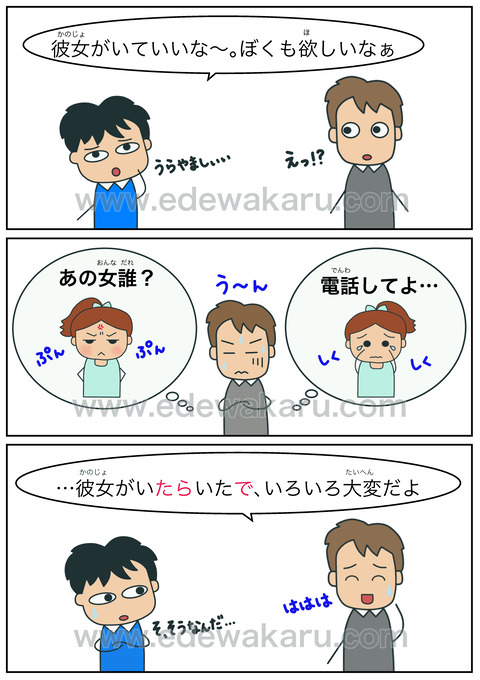
Meaning
〜た場合は、〜という問題がある
〜た場合でも、問題はない
How to use it
動詞・形容詞・名詞[た形]+たら〜で
動詞・形容詞・名詞[なかった形]+たら〜で
Explanation
「AたらAで」は「Aた場合は、〜という問題がある」「Aた場合でも、問題はない」という意味の文型です。「A」には同じ単語が入ります。
「Aた場合は、〜という問題がある」は「〜でも〜でも、どちらの場合でも問題がある」
と言いたい時に使われます。また
「Aた場合でも、問題ない」は「そんなに大きな問題ではない。大丈夫だ」
と言いたい時に使います。
[例]
①A:彼女がいていいな〜。ぼくも彼女が欲しいなぁ
B:い
たら
いた
で、いろいろ大変だよ…
→彼女がいても、いろいろ大変だよ…
「彼女がいないと悲しいが、いる場合でもいろいろ大変だ」
②N1に合格できなかっ
たら
できなかった
で、また次がんばればいいよ
→合格できなかったら、また次がんばればいいよ
「合格できないことは、そんなに大きな問題ではない」
③失敗し
たら
失敗した
で、その時考えよう
→失敗した場合は、その時考えよう
「失敗しても、そんなに大きな問題ではない」
④大学に合格し
たら
合格した
で、なにかとお金が必要になる
→合格した場合でも、なにかとお金が必要になる
「不合格では困るが、合格してもお金の問題はある」
⑤A:暑くて死にそう…やっぱり私は冬の方が好きだわ
B:冬になっ
たら
なった
で
「寒くて死にそう」っていうんだろ?
→冬になったら、「寒くて死にそう」っていうんだろ?
「夏でも冬でも、どちらの場合でも文句を言うんだろ?」
「な形容詞・名詞」の場合は「〜なら〜で」の方がよく使われます。
[例]
嫌だっ
たら
嫌だった
で、そう言えばよかったじゃない!
=嫌
なら
嫌
で、そう言えばよかったじゃない!
反対だっ
たら
反対
で、ちゃんと理由を説明しなさい
=反対
なら
反対
で、ちゃんと理由を説明しなさい
「〜たら〜で」は、覚えにくい文型の1つです。N1を受ける人はしっかりと復習をしておきましょう😊
In context 5 examples
A:彼女がいていいな〜。ぼくも彼女が欲しいなぁB:いたらいたで、いろいろ大変だよ…
N1に合格できなかったらできなかったで、また次がんばればいいよ
失敗したら失敗したで、その時考えよう
大学に合格したら合格したで、なにかとお金が必要になる
A:暑くて死にそう…やっぱり私は冬の方が好きだわB:冬になったらなったで「寒くて死にそう」っていうんだろ?
Usage 2
Read this source entry ↗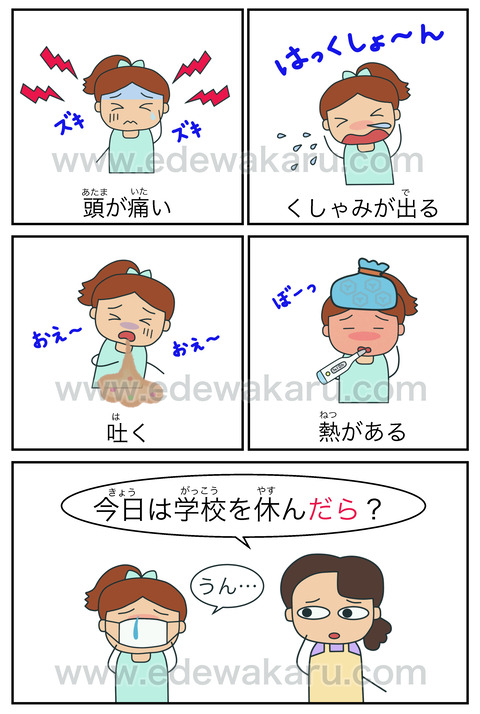
Meaning
〜たらどう?
〜たらどうか?
How to use it
動詞+たら?
Explanation
「〜たら」は「〜たらどう?」という意味で、相手に何かを勧める場合に使われる文型です。
これは、
家族や友達との間で使われる文型ですので、目上の人には使えません
😨上司や先輩と話す時は「〜たらどうですか?」「〜たらいかがですか」と言いましょう😊
最後を上げて使うと上手に聞こえま
す😉
[例]
①今日は学校を休ん
だら?
(
⤴︎)
②山田くんに英語を教えてあげ
たら?
(⤴︎)
③新しいデパートへ行ってみ
たら?
(⤴︎)
【余裕のある人へ】
②の例文の「教えてあげたら?」を口語形の
「〜たげる」
(復習:〜たげる)と一緒に使ってみてください。
「〜たら」も「〜たげる」も友達や家族ととてもよく使う文型ですので、一緒に使う機会がたくさんありますよ
😄
[例]
①山田くんに英語を教え
てあげたら?
→山田くんに英語を教え
たげたら?
②ちょっと手伝っ
てあげたら?
→ちょっと手伝っ
たげたら?
「〜たげる」の使い方を詳しく知りたい人は「〜たげる」の記事を見てみてくださいね😊(復習:〜たげる)
会話でとてもよく使いますので、ぜひ使ってみてください😀
In context 3 examples
今日は学校を休んだら?
→今日は学校を休んだらどう?山田くんは英語を教えてあげたら?
→山田くんは英語を教えてあげたらどう?A:駅前に新しいデパートができたって。(復習:〜って(伝聞))B:へえ〜。行ってみたら?
→へえ〜。行ってみたらどう?
どんなときどう使う 日本語表現文型辞典
Usage 1
Meaning
would have if
How to use it
Vたら/イAかったら/ナAだったら/Nだったら+~だろう(に)
Explanation
たら~だろう(に)
もし~たら、~のに
Vば/イAければ/ナAなら/Nなら+~だろう(に)
1)「過去または現在の事実に反することを仮想して、その場合は違う状況が起こっていただろう。事実はそうならなかったが」という意味で使う。
2)文の終わりに「に」「のに」をつけると、そうならなかったことを残念に思う気持ちが強まる。
3) ❺ は「(事実は)高いから、買えない」という現在の状況を言う。 ❶ ❸ のように丁寧な言い方では「たら~でしょうに」という形になる。
2)If に or のに are appended to end of sentence, feeling of regret is strengthened.
3)In sentence ❺ , speaker implies she can't buy the item because it is actually too expensive. In polite speech, becomes たら~でしょうに, as in sentences ❶ and ❸ .
1)Supposes an event contravening past or present actuality; suggests some different situation would have arisen if contravention had been true. Implies that things did not turn out as hoped.
In context 5 examples
先月お会いしたとき、彼が日本に戻っているのを知っていたら、お話ししたでしょうに。
田中課長が今回の担当だったら、契約は成立していただろう。
きのうのうちにあなたからのメールを読んでいれば、今朝すぐに連絡したでしょうに。
若いうちにもっと語学を勉強しておけば、好きな旅行の仕事ができただろう。
もう少し値段が安ければ、わたしにも買えるだろうに。
Usage 2
Meaning
if (only)
How to use it
Vたら/イAかったら/ナAだったら/ Nだったら+~(のに)
Explanation
たら~(のに)
1)「~たら、…(のに)」の形で、「~たら」で事実とは違うことを仮想して、「…」で実現しなかったことなどについて、残念な気持ちやよかったという気持ちなどを述べる。
2)文末は「よかった・よかったのに・けれど」などの表現が多い。
2)Often phrases such as よかった,よかったのに, and けれどcome at end of sentence.
1)Speaker supposes something different from the actual situation, and expresses feelings of regret or gladness that event was not realized.
In context 3 examples
(遅れてパーティーに来た友だちに)もうおいしい料理は残っていないよ。もっと、早く来たら食べられたのに。
(婚約者に)ぼくの父が生きていて、君を紹介することができたらよかったのに。
昨夜、あのレストランはとても込んでいた。もし予約していなかったら、入ることもできなかっただろう。
Usage 3
Meaning
if
How to use it
Vたら/イAかったら/ナNだったら/Nだったら
Explanation
たら〈条件〉
1)「~たら、…」は「もし~が成立した場合には、…が成立する」という仮定の条件を表す。
2)「たら」の文の文末には、話す人の意志のある文や相手への働きかけの文を使うことができる。「たら」には「ば・なら・と」などのような文末の制限がない。
1)This たら indicates supposition that if something occurs, then something else will happen.
2)Sentence endings with たら can take words expressing speaker's volition or appeal to others. No limitations on sentence endings as with ば, ならand と.
In context 6 examples
もし、おもしろい本があったら、買ってきてください。
気分が悪かったら、帰ってもいいんですよ。
もし、かばんが高くなかったら、わたしも一つ買いたいです。
さと子の病気が心配だったら、電話をかけてみたらいいじゃないか。
もし、男の子だったら、「あきら」という名前をつけましょう。
もし、あした雨でなかったら、海へ遊びに行きましょう。
Usage 4
Meaning
after
How to use it
Vたら
Explanation
たら〈その後で〉
1)「Vたら、…」の形で、Vの動作・作用(未来のこと)が完了した後、「…」をする、「…」になるという意味を表す。この「Vたら」には仮定の意味はない。
2)「…」には話す人の意志や考え・意見・助言などを表す文が来ることが多い。
3)この使い方は「Vたら」だけの特別の用法である。
1)After completion of verb action or operation (future), will do something. This Vたら is not suppositional.
3) This usage is specific to Vたら.
2)Often verb conveys the speaker's volition, thoughts, opinions, or advice.
In context 3 examples
夏休みになったら、国へ帰ります。
京都駅に着いたら、わたしに電話をください。すぐ迎えに行きます。
今撮った写真ができたら、わたしにも1枚ください。
毎日のんびり日本語教師
How to use it
~だったら~だったで (後件省略可)
~たら~たで
~なら~で
~れば~で
Explanation
2つの対立した物事を挙げ、どちらであっても同じであることを表す文型です。
同じ形式の過去形を2度使って接続します。
過去形に接続することが多いです。
Notes
特になし
In context 12 examples
「はい」って言いながら聞いていたら「ちゃんと聞いてるのか」と怒られるし、何か言ったら言ったで「口答えするな」って怒られるし、どうしたらいいか分からない。
最初はあまり興味なかったけど、観たら観たで面白かった。
お金持ちになるのは簡単じゃないし、お金持ちになったらなったでお金持ちなりの苦労も待っている。
すごく眠いのに寝たら寝たですぐ起きてしまう。
眠かったのに布団に入ったら入ったでなぜか寝れない。
初恋の人に会ってみたいけど会ったら会ったで気まずいだろう。
エアコンつけっぱなしは健康に悪いかなと思ったけど、消したら消したで蒸し暑さで寝れないし生命の危機感じる。
声が低めの人も好きです。もちろん高かったら高かったで別の良さもあると思います。
ダメだったらダメだったでまた来年の試験頑張ればいいでしょ。
一応女の子が欲しいけど、男の子だったらだったでそれも良い。
あまりに経験豊富だったらだったで嫌だけど、童貞だったらだったでそれも嫌。
たくさん寝て熱が下がったのはいいけど、元気になればなったで今度は眠れなくなってしまった。
日本語文型辞典 英語版
Meaning
【たら1】[N/Na だったら][A-かったら][V-たら]One of the conjugations of predicates. Expresses a condition or opportunity. Has the same meaning as と, ば and なら (and expresses a general truth or law.) Tends to be used to describe a particular isolated matter rather than a general condition. In comparison to the other three, there are fewer restrictions on clause-final forms. Often used in spoken language. Polite forms are N/Na でしたら and V-ましたら. There is no polite form for たら clauses with i-adjectives. There is also a slightly old-fashioned expression たらば, in which ば is appended.
a. ...たら+未実現のことがら
Usage for when Y expresses a statement about matters which have not yet come about. The dictionary form of the predicate, or such a predicate combined with the supposition だろう, are used at the end of sentences.
In
(1)
-
(4)
, both X and Y are matters which have not yet come about, and when X comes about, then Y will follow. もし or 万一 are sometimes used when making suppositions about uncertain matters which have not yet come about or matters which are unlikely to come about.
(4)
is a usage which simply describes future matters that will come about in sequence, and has less of a suppositional meaning.
In
(5)
-
(7)
, X has already come about, and based on this a supposition Y is made. X often includes こ/そ/あwords (e.g. ここ, そんな) to indicate a current status.
たら tends to be used for isolated matters, and is unlikely to be used for general conditions expressing a universal truth or law. However, in spoken language, it is sometimes used for expressing repetition of one’s habit or a certain matter, as the following examples show:
(8)
-
(11)
express the meaning “after X is accomplished, Y will be done.” X expresses a time frame in which Y will come about or that the action will be repeated within that time frame. In this case, たらcan be replaced byと.
b. ...たら+表出・働きかけ
B:ええ、その予定ですが。
Yes, that’s the plan.
A:じゃ、お会いになったらよろしくお伝えください。
Well, in that case please give her my regards.
Expresses meanings such as “When X comes about, let’s do/I want to do Y” and “When X comes about, do Y/don’t do Y/I can do Y/please do Y.” Y contains “expressive” expressions which indicate the speaker’s will/hope or “indicative” expressions, such as commands, prohibitions, permissions, requests, or invitations.
Usually used to express a specific actual outcome about Y, which will come about when X has occurred. X expresses matters that precede Y, and can be replaced by expressions such as “when this happens,” “when you do...,” or “after this.” As shown below, when たら is preceded by a situational predicate such as ある, an i-adjective, or a noun, it means “if that’s the situation”; moreover, if such a situation obtains, the expression shows the will or hope of the speaker or a demand or recommendation to the listener.
When the sentence concerns the listener’s schedule or wish, it is closer to Usage 6 of たら (<introductory utterance>).
When compared to たら, とand ばhave more restriction on their usage. とcannot be used with “expressive” or “indicative” expressions and when X is a verb indicating action or change, it is odd to use ば for “expressive” or “indicative” meaning.
(×)結婚すれば仕事をやめたい。
I want to quit my job if I marry.
(○)結婚したら仕事をやめたい。
I want to quit my job when I get married.
(×)お風呂に入ればすぐ寝なさい。
Go to sleep as soon as if you have a bath.
(○)お風呂に入ったらすぐ寝なさい。
Go to sleep as soon as you have taken a bath.
c. ...たら+問いかけ
B:ううん、しばらく続けるつもりよ。
No, I plan to continue for a while.
B:すぐに使わないで貯金しておきます。
I won’t use it right away, I’ll save it.
B:オーストラリアに留学したいと思っています。
I am thinking of studying abroad in Australia.
B:何時ごろでしたらお帰りでしょうか。
What time will he be returning?
Used in interrogative sentences which require an answer from the listener, in the form X たら Y か.
(1)
and
(2)
are interrogatives, seeking “yes” or “no” answers;
(3)
-
(7)
are cases of interrogatives with question words such as “what” and “how”;
(3)
-
(5)
are cases where the Y in “is it Y, if X?” is unknown; and
(6)
-
(7)
are cases where X is unknown.
In interrogative sentences where the method or means X for getting a good result is asked about, as in
(6)
and
(7)
, たらcan be replaced byば, but in interrogatives where it is asked what action Y will take when X comes about, as in
(2)
-
(5)
, たら is mostly used, and the use of ば is unnatural.
(×)結婚すれば仕事をやめるつもりですか。
Do you intend to quit your job if you marry?
(○)結婚したら仕事をやめるつもりですか。
Do you intend to quit your job when you get married?
(×)大学を卒業すればどうしますか。
What are you going to do if you graduate from university?
(○)大学を卒業したらどうしますか。
What are you going to do after graduating from university?
d. 疑問詞+V-たら...のか
This is an ironic expression where the たら form of the verb is attached to question words such as 何/どれだけ/どんなに. Means “no matter how ..., things won’t happen the way one wants them to,” and expresses irritation or despair regarding the situation. These sentences end with のか or のだ/のだろう(か). V-たらcan be replaced by V-ば.
e. ...たらどんなに...か
Means “how good it will be if X comes about.” Used when expressing a strong wish that X will be realized or expressing the feeling that if it comes about, then one would be really happy. だろう(か) or ことかare used at the end of the sentence.
B:うまくいっていたら、こんな顔していないよ。
I wouldn’t look like this if it had gone well.
Used to make a supposition different from what has actually happened or the opposite of what has actually happened, and expresses what something would have been like if such were the case. In most cases, the verb is put into the stative form V-ていたら.
When making a supposition which is contrary to the facts in the past, the ta-form of predicates, such as ただろう/はずだ/のに, is used at the end of the sentence. On the other hand, when making a supposition which is contrary to the current situation, the dictionary form, such as ...するのに/のだが, is used, as in
(6)
and
(7)
.
In this usage, たら can be replaced by ば, but たら is more colloquial. Refer to ば (Usage 4) for a more detailed explanation of conditional sentence patterns expressing counter-factual matters.
b. ...たらどんなに...か
Used when X is impossible or contrary to reality, and means “how good it would have been if X were the case.” Expresses the feeling that one has the strong wish that X will come about, but regrets that such a thing cannot ever happen.
When making a supposition contrary to what has already come about, ただろうか is used, as in
(1)
-
(3)
, and when something has not come about yet, and it seems impossible that it will ever happen, るだろうか is used, as in
(4)
.
The XたらYた pattern is used to indicate that both the former and the latter have already come about. It is used when the speaker realizes Y at the point when X has already come about, or when a new situation happens as a result of it. Following Y are expressions stating that something has occurred beyond the speaker’s control, or some fact has been newly discovered or realized.
(1)
-
(4)
are usages in which the speaker discovers situation Y at the scene where action X has already been done. The discoverer, 私, is not mentioned in Y as in ...たら、私は...した, but instead the speaker uses expressions to portray the situation, such as ...たら...ということが分かった, ...たら...がいた or ...たら...があった.
(×)隣の部屋に行ったら、私はねずみを見た。
If I go to the room next door, I saw a mouse.
(○)隣の部屋に行ったら、ねずみがいた。
When I went to the room next door, there was a mouse.
Expressions of state, such as V-ていた or Nだった, are used for Y where newly-realized discoveries are expressed, as in
(1)
and
(2)
.
On the other hand, if V-たis used instead of V-ていた, the meaning changes as follows.
(例)空港に着いたら友達が迎えに来た。
After I arrived at the airport, my friend came to meet me.
In the example above, the active expression来たis used instead of 来ていた. This is used to indicate that after the speaker arrived at the airport, the friend arrived to meet him, rather than that the speaker found the friend upon arrival, as in
(1)
above.
As in
(10)
and
(11)
, when what follows the supposition in the second clause is the expected outcome, 案の定 or やっぱりare used; when the result is unexpected, then 案外、意外なことに or 思いがけず are frequently used.
たら in this usage is often replaced by と. However, if X and Y both indicate the same person’s consecutive action of which that person has control, only と can be used, and not たら.
(×)男は部屋に入ったら友達に電話した。
If the man entered the room, he phoned his friend.
(○)男は部屋に入ると友達に電話した。
The man called his friend when he entered the room.
While と is used in novels or stories, たら is used to describe things which the speaker has directly experienced.
Means that once something has happened, because of its characteristics or a strong determination, the situation will not change subsequently. Often used in the form 一度...たらさいご絶対に....
Repeats the same adjectives or verbs twice, before and after. Describes a contrasting circumstance that, despite what happens, will ultimately not differ from the present one.
Some sentences express the meaning “there are problems but they are not too bad/they can be managed somehow,” as in
(1)
and
(2)
, while other sentences see the situation as undesirable, indicating that “either way it is troublesome/a problem,” as in
(3)
-
(5)
.
i-adjectives are normally used in the form A-かったらA-かったで, but sometimes the なかったらないでform is also used, as in
(1)
.
...ば...で is a synonymous expression.
a. ...たら+依頼・勧め〈introductory utterance〉
Idiomatic expression used for politely asking the convenience of the other person when making a request or recommendation.
b. ...たら〈introductory utterance〉
This is one way of warning in advance from what viewpoint the utterance or judgment in the latter part of the sentence is made. It follows verbs that express a statement, an idea, or a comparison, such as 見る(see), 思う(think) and 比べる(compare), in the first part of the sentence. It is to a certain degree an idiomatic expression.
からしたら or から言ったらare synonymous expressions.
This is an expression to recommend that the listener take a certain action. The latter half of V-たらどうか is omitted. It is usually used when speaking to someone with whom the speaker is on familiar terms. When it is necessary to speak politely, たらどうですか or いかがですか are used without abbreviating the latter half.
Can be replaced by V-ば; however, たら has the nuance that the speaker is seriously recommending something, while the use of ば can contain the nuance that the speaker in fact is merely stating an option without any particular preference.
1
1
1
1
1
【といったらありはしない】、
【といったらありゃしない】、
1
1
1
1
4
1
1
【にかけたら】、
2
1
1
2
【によると】1b
2
→
How to use it
1. ...たら〈not-yet-realized condition〉Expresses the relation of two isolated matters, such as “if X comes about, then Y will, too” or “if X comes about, then it will make Y come about, too.” X expresses both matters that have and have not come about, while Y always expresses something that has not yet come about. Y is used in declaratory sentences stating an unrealized matter or supposition, sentences expressing intention or hope, and indicative sentences which express imperatives, prohibitions, or invitations.
2. ...たら〈counter-factual〉a. ...たら ...だろう/...はずだ
3. ...たら...た〈already-realized condition〉
4. ...たらさいご
5. ...たら...で[A-かったらA-いで][A-かったらA-かったで][V-たらV-たで]
6. ...たら〈introductory utterance〉Used to indicate under what condition the action in the second part of the sentence may be carried out, by restricting the scope or giving a warning or explanation in advance. It is, to a certain extent, a fixed idiomatic expression. It can be replaced by ば.
7. V-たら〈suggestion, recommendation〉
8. ...からいったら→
9. ...からしたら→
0. ...からみたら→
1. ...といったら→
2. ...ときたら→
3. ...としたら→
4. ...となったら→
5. V-てみたら→
6. ...にかかったら→
7. ...にかけたら→
8. ...にしたら→
9. ...にしてみたら→
0. ...によったら/ことによったら→
1. だったら→
In context 83 examples
雨だったら道が混雑するだろう。
If it rains, the road will probably get crowded with traffic.
もしも、あまり高かったら誰も買わないでしょう。
If it should be too expensive, probably no one will buy it.
万一雨が降ったら試合は中止です。
In the event that it rains, the match will be canceled.
この薬を飲んだらすぐにせきはとまりますが、3時間たったら効き目がなくなります。
If you take this medicine, your cough will stop immediately, but the effect will wear off after three hours.
あんなに美人だったら、男性がほうっておかないだろう。
Such a beauty like that will probably not be left alone by any man.
ここまで来たら、一人でも帰れます。
Once I’ve come this far, I can make my way home alone.
そんなにたくさん食べたらおなかをこわしますよ。
You’ll upset your stomach if you eat so much.
いつも、5時になったらすぐ仕事をやめて、テニスをします。
I always stop working right away and play tennis when it is five o’clock.
ここは冬になったら雪が1メートルぐらいつもる。
We get about three meters of snow here when it’s winter.
ふだんは昼ご飯を食べたら昼寝をしますが、今日は買物に行かなければなりません。
I usually take a nap after lunch, but I have to go shopping today.
古くなったらすぐに新しいのに買いかえるというような生活では、お金は貯まらない。
You can’t save money if you have the kind of lifestyle where you always buy new things when something gets old.
この仕事が完成したら、長い休みをとるつもりだ。
Once this job is completed, I intend to take a long vacation.
もしも1千万円の宝くじに当たったら、何でも買ってあげますよ。
I’ll buy you anything you want if I win 10 million yen in the lottery.
教師になったら子どもたちにものをつくる楽しさを教えたい。
If I become a teacher, I want to teach children the joy of making things.
お風呂に入ったらすぐ寝なさい。
Go to sleep immediately after your bath.
この予防注射をしたら、風呂に入ってはいけません。
You should not take a bath after you have this vaccination.
お酒を飲んだら絶対に運転はするな。
Never drink and drive.
宿題が済んだら遊びに行ってもいいよ。
You may go play once you have finished your homework.
A:あちらで野田さんに会われますか。
Will you meet Noda-san there?
もしも遅れたら、連絡してください。
Please let me know if you’ll be late.
会議が終わったら食事をしに行きましょう。
Let’s go and have dinner after the meeting is finished.
暇があったら海外旅行をしたい。
I’d like to travel abroad if I have time.
暑かったら、窓を開けてください。
Please open the window if you’re hot.
お暇でしたら、いらっしゃいませんか。
Would you like to visit me if you are free?
そんなに勉強が嫌だったら大学なんかやめてしまえ。
If you dislike studying that much, then quit college.
熱があったら休んでもいいよ。
You may take time off if you have a fever.
雨だったら試合は中止になりますか。
If it rains, will the match be canceled?
A:結婚したら仕事はやめるの?
You’re going to quit work when you get married?
万一雨が降ったらどうしましょうか。
What shall we do in case it rains?
A:もし宝くじに当たったら、何に使いますか。
If you win the lottery, what will you use it for?
A:大学を卒業したらどうするつもりですか。
What are you going to do after you graduate?
A:社長はただ今出かけておりますが。
The company president is currently out of the office.
どのぐらい勉強したら日本語の新聞が読めるようになりますか。
How long do you have to study to be able to read a Japanese newspaper?
何度言ったら分かるんだ?
How many times do I have to tell you so you understand?
人間は戦争という愚行を何度繰り返したら気がすむのであろうか?
How many times do humans have to repeat the foolish action we call war before they have had enough?
何年たったら一人前になれるのだろうか?
How many years will it take before I am a full-fledged member of society?
何回繰り返したら覚えられるのか?
How many times do you have to repeat it before you remember it?
どれだけ待ったら平和な世界になるのだろうか?
How long do we have to wait to see a world at peace?
一体どうしたら今の思いを伝えることができるのか?
Just how can I best convey my thoughts now?
宝くじに当たったらどんなにうれしいだろう。
How happy I would be if I won the lottery!
合格したら両親はどんなに喜んでくれるだろうか。
How happy my parents would be if I passed the examination!
子供たちがもどってきたらどんなににぎやかになることか。
How lively it will be when the children return!
あのとき精密検査を受けていたら、手遅れにならなかっただろう。
Had there been a detailed check-up at that time, it wouldn’t have been too late.
隕石が地球に衝突していなかったら恐竜は絶滅していなかったかもしれない。
Dinosaurs might not have died out had a meteorite not hit the earth.
ひどい話を聞かなかったら、こんなに酔うまで飲んだりしなかったにちがいない。
If I hadn’t heard the horrible story, I’m sure I wouldn’t have drunk myself to this point.
あの時彼と結婚していたら、私の人生はもっと幸せだったはずだ。
Had I married him at the time, my life would have been happier.
あの当時この「薬の害」という本を読んでいたら今ごろ苦しまなくてもよかったのに残念だ。
What a pity. Had I read the book The Harm of Medicine in those days, I might not have had to suffer as I do now.
A:面接試験、うまくいった?
Did the interview test go all right?
点数があと 10 点高かったらこの大学に合格できるんだけど。
I would be able to pass the entrance exam to this university if only my score were ten points higher.
背があと 10 センチ高かったらどんなによかっただろうか。
How nice it would be if only I were ten centimeters taller.
10 年前に彼女に会っていたらどんなによかっただろう。
How nice it would have been had I met her ten years ago.
祖母が生きていたら、どんなに喜んだことか。
If my grandmother were alive, how pleased she would have been.
今すぐあなたに会えたらどんなにうれしいだろうか。
How happy I would be if I could meet you right now!
空港に着いたら友達が迎えに来ていた。
When I arrived at the airport, my friend was waiting to meet me.
トンネルを出たら一面の銀世界だった。
Coming out of the tunnel brought us into a winter wonderland.
変な音がするので隣の部屋に行ってみたらねずみがいた。
I went to the room next door because I heard a strange sound, and there was a mouse.
山田さんは無口でおとなしい人だと思っていたが、よく話をしたらとても面白い人だということが分かった。
I thought Yamada-san was a quiet, timid person, but when I spoke to him, I realized that he was a very amusing person.
お風呂に入っていたら、電話がかかってきた。
The phone rang when I was in the bath.
デパートで買い物していたら、隣の奥さんにばったり会った。
I ran into the lady from next door when I was shopping at the supermarket.
5月に入ったら急に暑くなった。
The weather suddenly turned hot right at the beginning of May.
薬を飲んだら熱が下がった。
My temperature went down when I took the medicine.
会社をやめたらストレスがなくなって元気になった。
After I quit the company, my stress went away and I recovered.
落ちてもともとと思って試験を受けたら、思いがけず合格した。
I took the examination thinking I would fail, but I unexpectedly passed it.
部屋の様子が変だと思ったら、案の定、空き巣に入られていた。
I thought something about the room seemed strange and, just as I feared, someone had broken in.
彼は寝たら最後、まわりでどんなに騒いでも絶対に目をさまさない。
Once he falls asleep, he won’t wake up no matter how noisy it is around him.
賭事は一度手を出したら最後ずるずると抜けられなくなる人が多い。
With gambling, many people cannot break free from it once they have given it a try.
すっぽんは一度かみついたら最後どんなことがあっても離れない。
Once a snapping turtle bites something, it won’t let go no matter what happens.
金というのはあったらあったで使うし、なかったらないで何とかなるものだ。
Money is something that you’ll spend if you have it, and somehow get by if you don’t.
自動車はあれば便利だが、なかったらなかったで何とかなるものだ。
A car is convenient if you have one, but you can manage to get by if you don’t.
母は寒がりで冬が苦手だが、それでは夏が好きかというとそうではない。暑かったら暑かったで文句を言っている。
My mother hates being cold and dislikes winter, but if you think that she likes summer, that’s not the case. If it's hot, she'll complain about that, too.
息子には大学に受かってほしいが、受かったら受かったでお金が要って大変だ。
I want my son to pass the university entrance examination, but if he does pass, then it’ll be hard because he’ll need money.
平社員のときは給料が少なくて困ったけど、昇進したらしたでつきあいも増えるしやっぱり金はたまらない。
My low salary was a problem when I was a junior employee, but since being promoted I have more socializing and whatnot to do so I still can’t save any money after all.
もし差し支えなかったら事情を聞かせてください。
Please tell me the circumstances, if you don’t mind.
よろしかったら、もう一度お電話くださいませんか。
Would you call me again, if you don’t mind?
よかったら、週末、家にいらっしゃいませんか。
Would you like to visit our home this weekend?
私から見たら、こんなことはたいした問題ではない。
From where I stand, it doesn’t seem like a serious problem.
私に言わせたら、責任はあなたの方にあるんじゃないかと思う。
If you ask me, I’d say the responsibility lies with you.
一時代前と比べたら、家事は格段に楽になったと言える。
It can be said that housework has become far easier in comparison with a generation ago.
立って見てないで、ちょっと手伝ってあげたら。
Why don’t you lend a hand instead of just standing and watching?
危ないからやめといたら。
It’s dangerous, so don’t do it.
そんなに疲れているなら、すこし休んだら?
How about resting a little, if you’re so tired?
あなたったら、何考えてるの?
What on earth are you thinking?
やめろったら。
I told you to stop.
AIUEO JLPT Grammar
Usage 1
Meaning
「たら」is a conjunction that indicates hypothetical or assumed conditions, used when describing the result or action that follows after a condition is met. It is also used when expressing unexpected situations or surprises.
How to use it
動詞た形+たら形容詞た形+たら形容動詞だ+ったら名詞だ+ったら
Explanation · 日本語
「たら」は、仮定条件や想定された状況を示す接続助詞で、ある条件が満たされた後に起こる結果や行動を述べるときに使われます。また、予想外の状況や驚きを含む場合にもよく使われます。
In context 5 examples
資料が揃ったら、会議を始めます。
If the documents are ready, we will start the meeting.
宿題が終わったら、遊んでもいいです。
If you finish your homework, you can play.
時間があったら、友達に会いたいです。
If I have time, I want to meet my friends.
新しい技術を導入したら、効率が上がります。
If new technology is introduced, efficiency will increase.
お金があったら、新しい家を買いたいです。
If I have money, I want to buy a new house.
Usage 2
Meaning
This sentence pattern is used when the speaker, while feeling some familiarity with a person or thing, lightly criticizes or expresses concern. It is often used in daily conversation and casual settings to convey the speaker’s intent to inform or emphasize something.
How to use it
名詞+たら名詞+ったら
Explanation · 日本語
この文型は、話し手が特定の人や物に対して親しみを持ちながら、軽く批判したり、心配したりするときに使う表現です。特に日常会話やカジュアルな場面で使用され、話し手が相手に何かを伝えたい、または強調したい気持ちが込められています。
In context 5 examples
も~。彼ったら!
That guy!
お母さんったら、心配しすぎだよ。
Mom, you’re worrying too much!
田中さんたら、本当におっちょこちょいなんだから。
Tanaka, you’re really such a scatterbrain.
彼女たら、本当に面白い人なんだ。
She’s really such a funny person.
山田君ったら、いつも遅刻してくるんだから。
Yamada, you’re always late!