AIUEO JLPT Grammar
Meaning
This sentence pattern emphasizes that the existence of a certain matter causes other related matters to be established. It is used when showing the foundation or cause of a particular event or situation.
How to use it
名詞 (+が)+あっての+名詞
Explanation · 日本語
この文型は、ある事柄が存在することで、それに関連した他の事柄が成立することを強調する表現です。ある事象や状況の基盤や原因を示すときに使われます。
In context 5 examples
努力あっての成功だ。
Success exists because of hard work.
健康あっての幸せです。
Happiness exists because of good health.
信頼あっての友情です。
Friendship exists because of trust.
平和あっての繁栄だ。
Prosperity exists because of peace.
あなたあっての私です。
I am who I am because of you.
文法
Meaning
〜があるから・・・が成り立つ
=〜がなかったら、・・・が成り立たない
How to use it
N1 + あってのN2
In context 7 examples
お客様あっての仕事ですから、いつもご来店いただくお客様には感謝しております。
学生あっての学校ですから、いくら設備が良くても、素晴らしい先生がいても、学生が来なければ意味がない。
愛あっての結婚生活でしょ。愛がないならどうして一緒に暮らしてるの?
自分がこんなにも早く出世できたのも、厳しい上司の指導あってのことです。
健康あっての幸せ。
プロジェクトお疲れ様でした。今回は皆の協力あっての成功だと思っています。本当にありがとうございました。
あなたあっての私だから、あなたがいないと生きていけないのよ。
Bunpro Grammar Reference
Meaning
Exist only because of or due to, Owe everything to
How to use it
Noun (A) + (が)+ あっての + Noun (B)
Nuance
A structure emphasizing that (B) is only possible because (A) exists. (B) owes everything to (A).
Explanation
あっての is a pattern which emphasizes that (B) is something that only exists because of (A). It will often be translated as '(B) owes everything to (A)', or '(B) existing is only due to (A)'. This structure is a combination of the う-Verb ある 'to be' in its て-form, and the case-marking particle の.
あっての will be preceded and followed directly by nouns, where the first noun is (A), and the second noun is (B).
お客様あっての仕事だと思うのですが、理不尽なクレームを言われるとちょっとイラっときます。
My job only exists because of the customers, but I get a little annoyed when people make unreasonable complaints.
今回は皆様の努力あっての結果です。皆様本当にありがとうございました。
This time, the results are because of your efforts. Thank you very much.
あっての will primarily be used when (B) is something that benefits positively from (A), and therefore is showing or should show some kind of gratitude toward it.
Occasionally, the case-marking particle が will come between the (A) noun and あっての. However, it is often omitted.
私はお金がなかったら愛もない、お金があっての幸せだと思います。
I think that without money, there’s no love and happiness is something that exists only due to money.
Fun Fact
あっての can be thought of as an evolution of the basic grammar structure がある 'to have'. The main difference being that の allows (B) to be marked as the thing that has (A), while the て-form indicates that there is more information that will be given later about why this is important. Since this information is an explanation, (B) will almost always be followed by structures like から, or ので.
Nuance · 日本語
(B)は(A)が存在しているから可能だということを強調する表現。(B)は(A)なしでは成り立たない。
Explanation · 日本語
「あっての」は「(A) があるからこそ (B) が成り立つ」や「(A) のおかげで (B) が存在する」といった意味で使われる表現です。(B) が存在するためには (A) が不可欠であることを強調します。これは、五段動詞「ある」のテ形と、格助詞「の」の組み合わせでできています。
「あっての」の前後には名詞が入り、語順は「(A) あっての (B)」になります。
お客様あっての仕事だと思うのですが、理不尽なクレームを言われるとちょっとイラっときます。
My job only exists because of the customers, but I get a little annoyed when people make unreasonable complaints.
今回は皆様の努力あっての結果です。皆様本当にありがとうございました。
This time, the results are because of your efforts. Thank you very much.
「あっての」は、(B) が (A) に支えられていたり、何かしらの恩恵を受けているときに、感謝の気持ちを表すために使われることが多いです。
名詞の (A) と「あっての」の間に、格助詞の「が」が入ることもありますが、大抵は省略されます。
私はお金がなかったら愛もない、お金があっての幸せだと思います。
I think that without money, there’s no love and happiness is something that exists only due to money.
豆知識
「あっての」は「がある」という文型からできた表現です。「の」が付くことで、(B) が (A) を含み、その上に成り立っている関係であることが示されます。さらに、テ形の「あって」によって、そのあとに「なぜ (A) が大切なのか」を説明する文が続くことが示されます。そのため、この表現の後には「から」や「ので」を使った、理由を説明する文が続くことが多いです
In context 15 examples
- 彼が大学をやめるのは、何か理由があってのことだろう。
I guess he is dropping out of university only because some sort of reason exists.
- お客様あっての仕事だと思うのですが、理不尽なクレームを言われるとちょっとイラっときます。
My job only exists because of the customers, but I get a little annoyed when people make unreasonable complaints.
- 今回は皆様の努力あっての結果です。皆様本当にありがとうございました。
This time, the results are because of your efforts. Thank you very much.
- 私はお金がなかったら愛もない、お金があっての幸せだと思います。
I think that without money, there’s no love and happiness is something that exists only due to money.
- 「あなたあってのわたしです。あなたがいなければ私の人生は無意味ですよ。」
'I can only exist because of you. My life would be meaningless without you.' (owe everything to)
- 支配人、社員に:「ゲストあっての遊園地だということを忘れてはいけません。」
Manager to employees: 'You must not forget that the amusement park exists only because of the customers.'
- 恋愛は相手あってのことだから一人だけでは無理だ...と思っていませんか?
Love only exists because you have a partner, so it is impossible to love when you are alone… don't you think? (owe everything to)
- 部員あってのクラブ活動なんだから、部員に対してもっと優しくするべきだ。
Since club activities exist only because of our club members, we must be nicer to them.
- 娘:「お金と愛、どっちが大事だと思う?」母:「そうね〜、お金あっての幸せだと思うわ。」
Daughter: 'Money and love, which do you think is more important?'Mom: 'Hmm, happiness exists only because of money I think.'
- 兄が一人暮らしを始め、私たちの家族は兄あっての家族だった事が分かった。
When he started living independently, I realized that my family existed only because of my older brother.
- 君が志望校に合格したのは君の努力あっての成果で、僕はただ側にいただけさ。
Successfully getting your first-preference school was only possible due to your own efforts, all I did was stay by your side. (owe everything to)
- 結婚という契約は愛あってのものであって、愛の無い結婚など全く意味を成しません。
The contract of marriage owes everything to love, and something such as a loveless marriage will amount to nothing.
- お客様や取引先相手あってのビジネスなので、ビジネスにおいて礼儀を欠く事は命取りになります。
Since we are a business that owes everything to our customers and clients, lacking manners in business would prove fatal.
- ベストセラー作者の演説:「 私の本は、家族の支えあってのものです。息子と夫がいなければここまでやってこれなかったと思います。」
Best Selling author's speech: 'My books exist only because of the support from my family. I believe, if it was not for my son and husband, I would not have gotten this far.' (owe everything to)
- 切手のコレクションが火事で全焼して悲しいのは分かっているけどさ、生きて逃げられたのは何よりだよ。「命あっての物種」だね。
I understand that you are sad because your stamp collection was destroyed in the fire, but getting out of there with your life is more important than anything. 'While there is life, there is hope,' right? (only exist because of)
どんなときどう使う 日本語表現文型辞典
Meaning
comprised of; indispensable to
How to use it
N+あっての
Explanation
~があるから成り立つ
「N1 +あっての+ N2」の形で、「N1があるからN2が成立する」と強調するときの表現。
In context 3 examples
愛あっての結婚生活だ。愛がなければ、いっしょに暮らす意味がない。
わたしたちはお客さまあっての仕事ですから、お客さまを何より大切にしています。
交渉は相手あってのことですから、自分の都合だけ主張してもうまくいかない。
絵でわかる日本語
Meaning
〜があるから〜が成立する
〜があるから、〜が可能になる
How to use it
名詞[辞書形]+あっての+名詞
Explanation
「AあってのB」は「AがあるからBが成立する」「Aがあるから、Bが可能になる」という意味を表す文型です。
ということを強調して言う場合によく使われます😊また「〜あってのこと」「〜あってのもの」という形もよく使われます。
[例]
N1合格は、努力
あってのことだ
「〜あっての」は「〜があっての」という形も使われると覚えておきましょう。
In context 4 examples
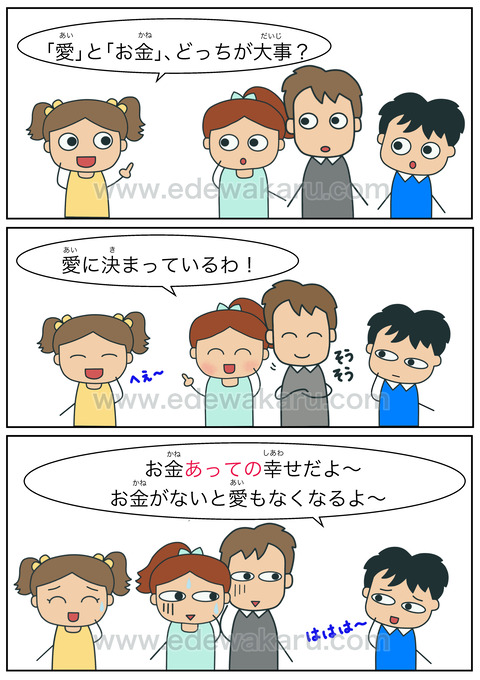
A:愛とお金、どっちが大事?B:愛に決まっているわ!!C:お金あっての幸せだよ。お金がないと愛もなくなるよ〜
→お金があるから幸せになれる学生:先生のおかげで、N1に合格しました!先生:努力あっての合格ですよ。がんばりましたね
→努力したから合格したんですよみんなの協力あっての成功だ
→みんなの協力があるから成功できるお客さんあっての商売だ
→お客さんがいるから商売ができる
日本語文型辞典
Meaning
基本情報NあってのN説明「XあってのY」の形で、「XがあるからYも成り立つ」という意味を表す。「XがなければYは成り立たない」という含みをもつ。Xには人を表す名詞が用いられるのが普通。例文① 学生あっての大学だ。学生が来なければ、いくらカリキュラムが素晴らしくても意味がない。② 私を見捨てないでください。あなたあっての私なんですから。③ お客あっての商売なんだから、まずお客さんのニーズに応えなければならないだろう。
日本語文型辞典 英語版
Meaning
【あっての】[NあってのN]
XあってのY expresses that Y can be realized because Y has X. It includes the meaning that Y is not realized if Y doesn’t have X. Nouns that refer to human beings are used for X.
In context 3 examples
学生あっての大学だ。学生が来なければ、いくらカリキュラムが素晴らしくても意味がない。
A university needs students. If students don’t come, the university’s existence is meaningless, no matter how good a curriculum it has.
私を見捨てないでください。あなたあっての私なんですから。
Please don’t leave me. I do not exist without you.
お客あっての商売なんだから、まずお客さんのニーズに応えなければならないだろう。
Business cannot be carried out without customers, so we have to meet the needs of customers first.
くらべてわかる日本語表現文型辞典
Meaning
Aが存在するからBが存在する。もしAがなければBも存在しないと話者が思っている。Aから多くの世話、愛、加護、恩恵などを受けていることを表すことが多い。
How to use it
AあってのB
[名詞-∅]あっての[名詞-∅]
In context 4 examples
ご両親あっての君なんだ。もっとご両親を大切にしないとだめだよ。
お客様あってのわが社です。何なりとお申し付けください。
親会社あっての下請けだから、指示には従わざるをえない。
この成功は皆さんのご協力あってのことです。
日本語NET JLPT文法解説まとめ
Meaning
〜があるから・・・が成り立つ
=〜がなかったら、・・・が成り立たない
How to use it
N1 + あってのN2
Explanation
"Because there is ..., ... is possible."
In context 7 examples
お客様あっての仕事ですから、いつもご来店いただくお客様には感謝しております。
学生あっての学校ですから、いくら設備が良くても、素晴らしい先生がいても、学生が来なければ意味がない。
愛あっての結婚生活でしょ。愛がないならどうして一緒に暮らしてるの?
自分がこんなにも早く出世できたのも、厳しい上司の指導あってのことです。
健康あっての幸せ。
プロジェクトお疲れ様でした。今回は皆の協力あっての成功だと思っています。本当にありがとうございました。
あなたあっての私だから、あなたがいないと生きていけないのよ。
毎日のんびり日本語教師
Meaning
AがなければBは成り立たない
How to use it
名詞A+あっての+名詞B
名詞+あってのことだ
名詞+があってのことだ
Explanation
AがなければBは成り立たないことを表します。
「が」は省略可能です。
Notes
「命あっての物種」は慣用句で「すべては命がなければできないので、命は大切にしなければならない」の意。
In context 10 examples
過去があっての現在
ここまで成果を上げられたのは、周囲の協力があってのこと。
彼があんなことをしたのも、事情があってのことだろうと思う。
あのドラマの面白さは演者の演技力あってのものだ。
命あっての物種
今の私があるのも、先生あってのことです。
選手たちは頑張った。色んな思いあっての涙なんだろう。
動物あっての動物園。お客さんよりも動物を大切にしなければいけない。
デザインも重要だけど、やっぱり着心地あっての服だと思う。
すべては偶然で起こっているものではなく、原因があってのことだ。