AIUEO JLPT Grammar
Meaning
This sentence pattern expresses acting in a way unaffected by circumstances or overcoming challenges. It emphasizes actions carried out in the face of adversity or difficult situations.
How to use it
名詞に+あっては名詞に+あっても
Explanation · 日本語
この文型は、ある状況や条件の下で、その状況に影響されずに行動することや、状況を乗り越える様子を表す表現で、逆境や困難な状況においても、特定の行動が行われることを強調します。
In context 5 examples
この困難な状況にあっても、彼は諦めずに挑戦を続けている。
Even in this difficult situation, he continues to face challenges without giving up.
彼は貧しい環境にあっても、常に前向きな考え方を持ち続けている。
Even in a poor environment, he always maintains a positive attitude.
非常時にあっては、冷静に行動することが求められる。
In times of emergency, it is important to act calmly.
この不況の時代にあっても、うちの会社は売り上げが伸びています。
Even in these times of recession, our company's sales are increasing.
どんなに困難な状況にあっても、チームワークは崩れない。
No matter how difficult the situation, teamwork never falls apart.
文法
Meaning
〜(という特別な事態や場所)において / で /に
How to use it
N + にあって
Notes
「〜で」や「〜において」よりも硬い表現
In context 4 examples
A:この不景気にあって、私たちがすべきことは何だと思いますか。
B:副業解禁とも言われているので、自分でお金を稼ぐ行動力が大切だと思います。大企業じゃなくてもいいので、不況下にあっても、成長し続けられる会社に僕は就職したいと思っている。
山根部長は、普段めちゃくちゃ怖いけど、家庭にあって私たちが想像できないほど優しいパパだそうだよ。
国際化社会にあって、大切なことはTOEICの勉強ではなく、英会話の勉強ではないだろうか。どこの会社もTOEICの点数ばかりを評価していて、疑問に思う。
Bunpro Grammar Reference
Meaning
At, In the (place or situation), Under ~ conditions or circumstances, During, Suited to
How to use it
Noun + にあって
に + ある → にあって
Nuance
A phrase showing that under the circumstances or situation of (A), (B). When in the existing situation of (A), (B).
Explanation
にあって is a fairly formal grammar construction used in Japanese in the same way as its component parts. The particle に indicates a location, while あって is the て-form of the う-Verb ある 'to be'. As such, にあって can be and is often translated simply as 'in the situation of (A)', or 'under the conditions of (A)'.
にあって will be used after a noun marking the condition, before the second clause will then go on to explain something remarkable or noteworthy about that situation or circumstance.
彼女は校長先生という立場にあって、いつも生徒たちのために一生懸命働いている。
In the position of a principal, she is always working hard for the students.
インフルエンザが流行っているという状況にあって、外にいる人はみんなマスクをしている。
In a situation where the flu is spreading, everyone outside is wearing masks.
緊急事態宣言にあって、県を跨ぐ移動が制限された。
Under the state of emergency, movements across prefectures were restricted.
Occasionally, にあって will be followed by も. This slightly alters the meaning and indicates that despite being in the noteworthy situation of (A), (B) is not being affected in the way that one would expect.
緊急時にあっても、常に冷静を保つようにしてください。
Even under emergencies, please stay calm at all times.
こんな厳しい状況にあっても、諦めずに営業を続けていたから彼は儲けることができた。
Even under difficult circumstances like this, they were able to make a profit because they kept running their business without giving up.
Caution
Be careful not to get にあって mixed up with the にあって used in sentences like 事故にあって 'to meet with an accident'. This あって is a conjugation of 遭う, 'to meet or happen upon (often something negative)', while the あって is this grammar point is simply the て-form of ある.
Nuance · 日本語
(A)という状況、又は状態では(B)であるということを表す表現。(A)という状況が存在している場合は(B)。
Explanation · 日本語
「にあって」は、場所を表す助詞「に」と五段動詞「ある」のテ形「あって」でできている硬い文型です。 この表現は「に」と「ある」の意味や働きをそのまま活かした形で、「(A) の状況で」や「(A) という条件下で」といった意味で使われます。
「にあって」は、条件や状況を示す名詞の後に置かれ、その次の節で、その中で起こっている特に注目すべき事柄についての説明が続きます。
彼女は校長先生という立場にあって、いつも生徒たちのために一生懸命働いている。
In the position of a principal, she is always working hard for the students.
インフルエンザが流行っているという状況にあって、外にいる人はみんなマスクをしている。
In a situation where the flu is spreading, everyone outside is wearing masks.
緊急事態宣言にあって、県を跨ぐ移動が制限された。
Under the state of emergency, movements across prefectures were restricted.
「にあって」の後には「も」がつくことがあり、その場合、意味が少しだけ変わります。具体的には「特別な状況 (A) にもかかわらず、(B) は話し手が予想していたような影響を受けない」といった意味になります。
緊急時にあっても、常に冷静を保つようにしてください。
Even under emergencies, please stay calm at all times.
こんな厳しい状況にあっても、諦めずに営業を続けていたから彼は儲けることができた。
Even under difficult circumstances like this, they were able to make a profit because they kept running their business without giving up.
注意点
「事故にあって」などの「にあって」は、この文型とは異なり、「遭う」(意味:予期しない悪い出来事に出合う)の活用形です。 このページで学んでいる「あって」は「ある」のテ形なので、混同しないようにしましょう!
In context 17 examples
- 好況にあっても破産を申請している企業がある。
Even during a boom, there are companies applying for bankruptcy.
- 彼女は校長先生という立場にあって、いつも生徒たちのために一生懸命働いている。
In the position of a principal, she is always working hard for the students.
- インフルエンザが流行っているという状況にあって、外にいる人はみんなマスクをしている。
In a situation where the flu is spreading, everyone outside is wearing masks.
- 緊急事態宣言にあって、県を跨ぐ移動が制限された。
Under the state of emergency, movements across prefectures were restricted.
- 緊急時にあっても、常に冷静を保つようにしてください。
Even under emergencies, please stay calm at all times.
- こんな厳しい状況にあっても、諦めずに営業を続けていたから彼は儲けることができた。
Even under difficult circumstances like this, they were able to make a profit because they kept running their business without giving up.
- 危険な非常時にあっては、安全確保が第一だ。
Under emergency conditions, ensuring safety is the most important.
- このような状況下にあって、医療機関へのアクセスは限定されているかもしれない。
Under conditions like this, access to the medical institutions might be limited.
- CEO(シーイーオー)のスピーチ:「混乱期にあっても心配せずに将来を見据えます。」
CEO's speech: 'Even in this chaotic time, without fear, we look into the future.' (under...circumstances)
- 歴史の教科書:「総理大臣という立場にあって、言論の自由のみならず動物の権利も提唱した。」
History textbook: 'In the position of Prime Minister, she advocated not only for the freedom of speech but also for animal rights.' (under...circumstances)
- 警告サイン:「被災地にあっては、破片から目を保護するため安全メガネを必ず着用して下さい。」
Warning sign: 'In the disaster zone, be sure to wear safety glasses to protect your eyes from debris.' (under...circumstances)
- 逆境という状況にあっては、何があっても諦めないという強い意志が必要になります。
During adverse situations, having the strong intention to not give up no matter what happens is necessary.
- いくら後輩を指導する職にあっても、指導の中で暴力を振るう事や暴言を吐く事は禁止されています。
No matter how much you are in the situation of guiding juniors, lashing out with violence during direction, or spitting abuse is forbidden.
- 旅行会社のパンフレット:「紛争が続いている地域にあっては、我が社の保険は適用されませんのでご注意下さい。」
Travel agency's pamphlet: 'Since our company's insurance is not suitable for zones that are in an ongoing conflict, please take heed.' (under...circumstances)
- 僕は長年に渡って社員の教育係という立場にあって、そのおかげで人を指導する事には自信があります。
In the position of being in charge of staff training for many years, I have self confidence in guidance thanks to that.
- 家庭環境や金銭的に恵まれた環境にあってそれに感謝できていない人は、社会に出て苦労する事になるだろう。
For a person that cannot be thankful toward being blessed environmentally and financially within the household, they will surely suffer upon going out into society. (under...circumstances)
- 我が党内にあって唯一原発についての専門知識を持っている彼女は、党内からも党外からも厚い支持を得ている。
Within the party, having unique specialist knowledge about nuclear power generation, she receives warm reception from both inside and outside of the party. (under...circumstances)
どんなときどう使う 日本語表現文型辞典
Meaning
in, at
How to use it
N+にあってW
Explanation
~に/~で
1)「~のような特別な事態・状況に身をおいているので、または身をおいているのに」と言いたいときに使う。
2) ❶ ❷ のように、「こんな大変な状況にいるので」と後の文と順接的につながることもあるし、 ❸ のように「こんな大変な状況にいるのに」と逆接的につながることもある。
1)Since someone is in some special state or condition, or even though someone is in certain situation, react contrary to expectations.
2)In sentences ❶ and ❷ , clause following shows regular progression (since we're in such dire straits). Sometimes used as in sentence ❸ , showing paradox (even though we are in such dire straits).
In context 3 examples
今、A国は経済成長期にあって、人々の表情も生き生きとしている。
数学は高度情報社会にあって、必要な学問的教養となっている。
この非常時にあって、あなたはどうしてそんなに平気でいられるのですか。
絵でわかる日本語
Meaning
〜の状況なので
〜の場所なので
How to use it
名詞[辞書形]+にあって
Explanation
「Aにあって」は「Aという状況なので〜」「Aという場所にいるので〜」という意味の文型です。「A」には[状況][場所][立場]などが入ります。書き言葉として使われるかたい言い方です。
「〜にあっては」や「〜にあっても」と一緒に覚えておきましょう😊
In context 4 examples
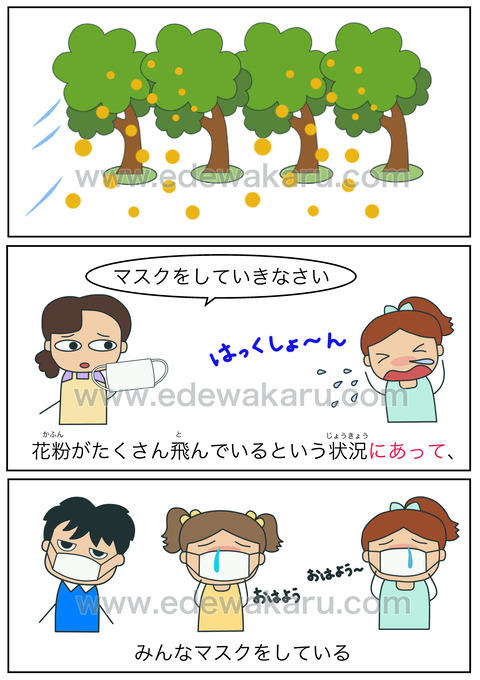
花粉がたくさん飛んでいるという状況にあって、みんなマスクをしている
→花粉がたくさん飛んでいるという状況なので、みんなマスクをしている彼は社長という立場にあって、会社のために寝ずに仕事をしている
→彼は社長という立場なので、会社のために寝ずに仕事をしている国際化社会(こくさいかしゃかい)にあって、言語の習得はとても重要だとされている
→国際化社会という状況なので、言語の習得はとても重要だとされているあの会社は経営状況の悪化にあって、倒産を余儀なくされたそうだ
→あの会社は経営状況の悪化という状況だったので、倒産を余儀なくされたそうだ
日本語文型辞典
Meaning
名詞を受けて、「そこで示された状況のもとで」の意味を表す。その状況とそれ以後に述べられることがらとの関係はゆるやかなもので、前後の文脈に応じて順接の場合も逆接の場合も考えられる。①と②は順接の例。③と④は逆接の例で、「その状況にありながら/あるにもかかわらず」という意味。
名詞を受けて、「そこで表された状況の中におかれていても」の意味を表す。後には、その状況で起こると予測されることとは食い違うことがらが続く。書きことば的。
場所や状況を表す名詞を受けて、「そこで表された状況の中では」の意を表す。…において。「厳寒の地」や「病床」など状況が厳しいことを表す表現が用いられた場合は、後ろに好ましくない状態を表す表現が続くが、そうでないときは、④や⑤のように単に「そこにおいて」という意を表す。書きことば的。
人を表す名詞を受けて、その人には誰もかなわないという評価を下すのに用いる。③は相手の言葉上手な誘いや強引な要求を断わりきれなかった時の発話で、多少相手をからかうようなニュアンスが感じられる。「…にかかっては」とも言う。
How to use it
Nにあって
Nにあっても
Nにあっては【状況】
Nにあっては【人】
In context 15 examples
異国の地にあって、仕事を探すこともままならない。
住民代表という立場にあって、寝る時間も惜しんでその問題に取り組んでいる。
大臣という職にあって、不正を働いていたとは許せない。
母は病床にあって、なおも子供達のことを気にかけている。
彼は苦境にあっても、まげずに頑張っている。
暖かい家庭の中にあっても、彼女の心は満たされなかった。
母は死の間際にあっても、子供達の幸福を願い続けた。
こんな厳寒の地にあっては、新鮮な野菜が食卓に上るなど、滅多にないことだ。
いつ戦争が起こるか知れない状況にあっては、明るい未来を思い描くことなどできない。
夫が病床にあっては、子供達に十分な教育を受けさせることもできなかった。
わが社にあっては、若者が自由に発言できる雰囲気を大切にしている。
「鉄の女」といわれた彼女も家庭にあっては良き母であった。
高橋さんにあっては、どんな強敵でも勝てそうにありませんね。
あの男にあっては、嘘もまことと言いくるめられる。油断は禁物だ。
あなたにあってはかなわないな。しょうがない。お望み通りに致しましょう。
日本語文型辞典 英語版
Meaning
With a noun, expresses the meaning of “under the circumstance mentioned in the noun.” The relationship between the circumstance and the thing/state/event stated in the following is not always fixed. Depending on the contexts before and after the expression, it can be adversative or sequential. The sentences in
(1)
and
(2)
are adversative examples, whereas those in
(3)
and
(4)
are sequential examples. にあって in
(3)
and
(4)
means “even in the circumstance/although under the circumstance.”
With a noun, expresses the meaning of “even under the circumstances stated in the noun.” Followed by some state/event which contradicts what can normally be expected under such circumstances. A formal, written expression.
With a noun expressing a place or circumstances, expresses the meaning of “under the circumstances stated in the sentence.” This is similar to ...において. When an expression which shows some difficult situation, such as 厳寒の地 (bitterly cold place) or 病床(sickbed) is used with にあっては, expressions of some unfavorable circumstances follow. If this is not the case, にあっては simply expresses the meaning of “at, in, as for” as shown in
(4)
and
(5)
. This is a formal, written expression.
With a noun expressing a person, used to assess the person who cannot be beaten by anybody else. The sentence in
(3)
is uttered when the speaker cannot decline the listener’s adroit invitation or assertive demand, and may contain a slight shade of meaning that the speaker is teasing the hearer. にあっては can be rephrased with ...にかかっては.
How to use it
1. Nにあって
2. Nにあっても
3. Nにあっては〈circumstances〉
4. Nにあっては〈person〉
In context 15 examples
異国の地にあって、仕事を探すこともままならない。
Being in a foreign country, it isn’t easy looking for a job.
住民代表という立場にあって、寝る時間も惜しんでその問題に取り組んでいる。
As a representative of the residents, I am tackling the problem sparing little time for sleep.
大臣という職にあって、不正を働いていたとは許せない。
For someone in the position of a minister, committing an injustice is inexcusable.
母は病床にあって、なおも子供達のことを気にかけている。
Even from her sickbed, my mother is caring for her children.
彼は苦境にあっても、めげずに頑張っている。
Even with hardships, he’s doing his best without giving up.
暖かい家庭の中にあっても、彼女の心は満たされなかった。
Even with her warmhearted family, she felt dissatisfied.
母は死の間際にあっても、子供達の幸福を願い続けた。
Even on her deathbed, the mother kept wishing for her children’s happiness.
こんな厳寒の地にあっては、新鮮な野菜が食卓に上るなど、滅多にないことだ。
In such a bitterly cold place, it’s rare for fresh vegetables to make it to the table.
いつ戦争が起こるか知れない状況にあっては、明るい未来を思い描くことなどできない。
In a situation where one never knows when a war might break out, it’s difficult to imagine a bright future.
夫が病床にあっては、子供達に十分な教育を受けさせることもできなかった。
Since my husband was ill in bed, I couldn’t have my children receive an adequate education.
わが社にあっては、若者が自由に発言できる雰囲気を大切にしている。
In our company, we value an atmosphere in which young employees can speak out freely.
「鉄の女」といわれた彼女も家庭にあっては良き母であった。
Even the woman called “the Iron Lady” was a good mother at home.
高橋さんにあっては、どんな強敵でも勝てそうにありませんね。
When it comes to Takahashi-san, she can’t lose no matter how strong her opponent is.
あの男にあっては、嘘もまことと言いくるめられる。油断は禁物だ。
Talking about that man, he can wheedle you into believing his lies. You don’t dare let down your guard.
あなたにあってはかなわないな。しょうがない。お望み通りに致しましょう。
No one can get the better of you. OK, OK. I’ll do what you want.
日本語NET JLPT文法解説まとめ
Meaning
〜(という特別な事態や場所)において / で /に
How to use it
N + にあって
Explanation
In the context of a particular situation or condition, this expression indicates that something special or specific occurs as a result of that situation.
「〜で」や「〜において」よりも硬い表現
In context 4 examples
A:この不景気にあって、私たちがすべきことは何だと思いますか。
大企業じゃなくてもいいので、不況下にあっても、成長し続けられる会社に僕は就職したいと思っている。
山根部長は、普段めちゃくちゃ怖いけど、家庭にあって私たちが想像できないほど優しいパパだそうだよ。
国際化社会にあって、大切なことはTOEICの勉強ではなく、英会話の勉強ではないだろうか。どこの会社もTOEICの点数ばかりを評価していて、疑問に思う。
毎日のんびり日本語教師
Meaning
【にあって/にあっては】
【にあっても】
How to use it
名詞+にあって
名詞+にあっては
名詞+にあっても
Explanation
場所や状況、時間、立場などの名詞につき、「その状況下で」という意味を表します。
特別な状況、良くない状況などについて述べることが多い文型です。
書き言葉です。
「にあっても」は逆接表現です。
Notes
特になし
In context 12 examples
現代はイスに座るような仕事が増え運動能力の低下が懸念されているが、古代にあってはこうした運動能力は生活の中で十分に鍛えられ誰もが当たり前に肉体を使いこなしていた。
嫉妬は男においては弱さであるが、 女にあっては一つの強さである。
決断の場面にあっては、トップは常に孤独である。
イノベーションを行おうとしない企業は衰弱していく。特に現代にあってはその衰弱のスピードは急速である。
相互理解と言うのは、戦場にあっては難しい。
看護のような仕事にあっては、全ての人たちから賞賛を浴びる時こそ一番危険な時である。
外国の地にあって、現地の生活になかなか馴染めない。
彼女は普段人見知りな性格だが、彼との恋愛にあっては積極的に働きかけている。
緊急時にあっても冷静な佐藤さんがカッコよくみえる。
どんな困難な状況にあっても、解決策は必ずある。
孤独な環境の中にあっても、光り輝いている人はたくさんいます。
どの時代にあっても、教師は子どもの人権を守らなければならない。
NINJAL 日本語文型データベース
Meaning
~のような特別な状況だからこそ、または〜のような特別な状況でも、あることが起こると言いたいときに使います。
How to use it
Nにあって
Notes
「~」には、状況・時期・場所などを表す言葉がきます。
In context 6 examples
少子高齢化社会にあって、労働力確保の問題が深刻になっている。
当時の日本は高度経済成長期にあって、景気は右肩上がりだった。
グローバル化が進んだ現代にあって、国と国との相互理解は必須となっている。
AIが普及するインターネット社会にあって、フェイクニュースを見分けることはますます困難となっている。
戦地にあってなお、他者を思いやることのできる彼の人間性は素晴らしいと思う。
この高度情報社会にあって、個人情報をずさんに扱う企業があるとは信じられない。