AIUEO JLPT Grammar
Meaning
「〜ておく」is used to express performing an action in advance for preparation or to keep something in reserve. In colloquial speech, it can be shortened to 「〜とく」.
How to use it
動詞て形+おく動詞て形+とく
Explanation · 日本語
「〜ておく」は、準備や保留のためにある動作を事前に行うことを表す表現です。口語では「〜ておく」が「〜とく」に短縮されることがあります。
In context 5 examples
お客様のために資料を準備しておきます。
I will prepare the materials for the customer.
宿題を忘れないようにメモしておいてください。
Please make a note so you don’t forget the homework.
災害に備えて食料を蓄えておくことが重要です。
It is important to store food in preparation for disasters.
先にホテルを予約しとくね。
I will book the hotel before the trip.
出発前にパスポートを確認しといてください。
Please check your passport before departure.
文法
Meaning
① 何かの目的のために、前もって~する(準備)。
② 何もしないで、そのままの状態を維持する(放置・現状維持)。
How to use it
V(て形) + おく
Notes
動詞は意志動詞のみ使える
In context 13 examples
来月、北海道に行くから、ホテルを予約しておきます。
来週、パーティーに行くから、髪を切っておきます。
後で友達が家に来るから、掃除しておきます。
もうすぐJLPTがあるから、習った文法を復習しておきます。
雨が降るかもしれないから、傘を持って行っておきます。
あとで彼とデートするから、歯を磨いておきます。
来週、友達の誕生日パーティーがあるから、プレゼントを買っておきます。
明後日、友達の結婚式があるから、スーツを買っておきます。
先生、ホワイトボードは消さずにそのままにしておいてください。あとで、私が消しますから。
プロジェクターは次の会議でも使いますから、そのままにしておいてください。
今晩、友達と焼肉食べ放題に行くので、あまり食べないでおこう。
エアコンはつけたままにしておいてください。
A:トム、まだ寝ているね。
B:アルバイトや勉強で疲れているんでしょう。起こさないでおきましょう。
Bunpro Grammar Reference
Meaning
To do something in advance
How to use it
Verb[て]+ おく
Verb[て̶] +とく
Verb[て]+ おきます
Verb[て̶] + ときます
Nuance
A grammar point that expresses an action done either to enable or prevent something else.
Explanation
When the conjunction particle て is followed by the う-Verb 置く in Japanese, it regularly has the meaning of 'to do (A) in advance'. 置く as a verb itself means 'to place something' (down), but also has the nuance 'to leave something alone', or to 'drop something' (like a topic). In this way, ておく can be thought of as meaning 'to do (A) and leave it (until later)'.
寝る前に食器を洗っておく。
Before sleeping, I will wash the dishes in advance. (So that it does not need to be done later)
あなたの財布を鞄に入れておきます。
I am going to put your wallet in your bag. (So that you won't forget it later)
予約しておくね。
I am going to make a reservation in advance. (So that the bookings don't fill up while we wait)
When using ておく, the 'future event' that the (A) action is being done for may be something that is coming soon, or may be something that the speaker doesn't want to ever come. Due to this, ておく is also regularly used when the speaker is doing something specifically to prevent another thing from happening.
毎日歯を磨いておくと、虫歯が防ぎます。
If you brush your teeth everyday (in advance), you will be able to prevent cavities. (That may or may not come in the future)
Caution
ておく is sometimes contracted to とく (or どく in verbs where て would usually be said as で). This is very common in casual conversation, drama, manga, and similar media. However, it would not commonly be heard in any kind of formal or business situation.
机の上に明日の旅行に必要なパスポートを置いとくね。
I am going to leave the passport we need for the trip tomorrow on top of the table in advance. (So that I won't forget it later)
水筒に水を汲んどくね。
I am going to fill this thermos up with water in advance. (So that it is available when I am thirsty)
Nuance · 日本語
何かを可能にするため、又は防ぐために行われる行為を表現する文法。
In context 19 examples
- ここにリモコンを置いておくね。
I will put the remote here (in advance for future use).
- 毎日歯を磨いておくと、虫歯が防ぎます。
If you brush your teeth everyday (in advance), you will be able to prevent cavities. (That may or may not come in the future)
- 予約しておくね。
I am going to make a reservation in advance. (So that the bookings don't fill up while we wait)
- あなたの財布を鞄に入れておきます。
I am going to put your wallet in your bag. (So that you won't forget it later)
- 寝る前に食器を洗っておく。
Before sleeping, I will wash the dishes in advance. (So that it does not need to be done later)
- ちょっと調べておきます。
I will do a little research in advance.
- 帰ってくるのが遅くなるから、ご飯を作っておいた。
I won't get home until late, so I made food in advance.
- 明日のパーティーのためにジュースを買っておきました。
I bought juice (in advance) for the party tomorrow.
- 今夜明日のお弁当を作っておいてくれますか?
Will you make tomorrow's bento (in advance) for me tonight?
- 旅行に行く前にトイレに行っておく。
Before going on a trip I will go to the bathroom in advance.
- アメリカに帰る前に円をドルに変えておく。
Before returning to America, I will change my yen into dollars in advance.
- 来週までに漢字を30字覚えておかなくてはいけない。
By next week, I have to memorize 30 kanji in advance.
- 冷蔵庫で冷やしておいていたコーラを二つください。
Could I have two of the colas that were being chilled (in advance) in the refrigerator?
- またバカなことしないで、ちゃんと覚えておこうね。
Don't do something stupid again. Let's remember this (experience) well in advance.
- 後でスーパーに行くの?お菓子をいっぱい買っておいて。
You are going to the store? Please buy a lot of snacks (in advance for future eating).
- 砂漠に入る前に水を沢山飲んでおいた方がいいよ。
Before you go into the desert, you had better drink a lot of water in advance.
- 暖房を点けておいたから、家が暖かい。
I turned on the heater in advance, so the house is warm.
- 机の上に明日の旅行に必要なパスポートを置いとくね。
I am going to leave the passport we need for the trip tomorrow on top of the table in advance. (So that I won't forget it later)
- 水筒に水を汲んどくね。
I am going to fill this thermos up with water in advance. (So that it is available when I am thirsty)
どんなときどう使う 日本語表現文型辞典
Meaning
in advance; leave
How to use it
Vて+おく
Explanation
B:はい、わかりました。
B:いえ、開けておいてください。
B:ちょっとそこに置いといてください。後でかたづけますから。
1)何かの目的のために、その準備としてある行為をするという意味を表す。意志動詞につく。また、 ❸ ❹ のように、一時的な処置を表す言い方もある。
2) ❹ のように、話し言葉では「Vておく→Vとく」となる。
2)In speech, Vておく becomes Vとく.
1)Preparation is done for an action to achieve some purpose. Appends to verbs of volition. Also applies to temporary measures, such as in sentences ❸ and ❹ .
In context 4 examples
A:山田君、コピー用紙がないから、買っておいてください。
引っ越しは9月の初めだから、夏休みに国へ帰る前に準備をしておこうと思います。
A:窓を閉めましょうか。
A:この箱、どうしましょうか。
絵でわかる日本語
Meaning
何か目的のために、〜する
〜のままにする
How to use it
動詞[て形]+おく
Explanation
「〜ておく」は【準備】【処置】【放置】を表す文型です。【
準備】【処置】の場合は「何かの目的のために、〜する」、【放置】の場合は「〜のままにする」という意味で使われます
😊
(復習:〜ために(目的))
[例]
【準備】「〜のために〜して準備する」
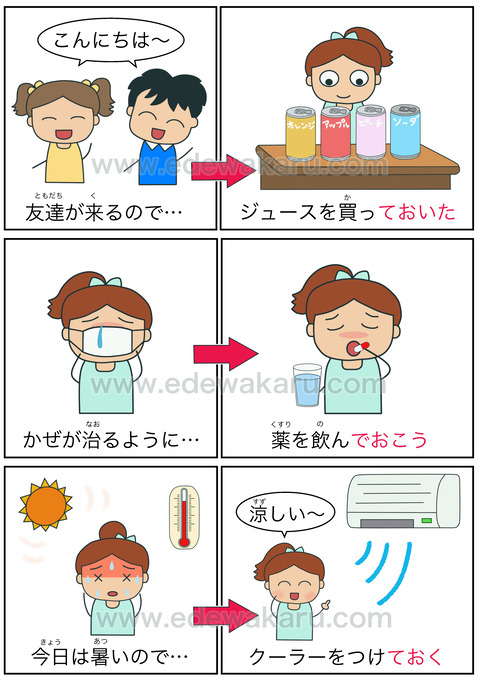
友達が来るので、ジュースを買っ
ておく
授業の前に予習をし
ておく
【処置】「〜のために〜する」
かぜが治るように、薬を飲ん
でおく
食べてしまったら、お皿を洗っ
ておく
【放置】「〜ままにする」
今日は暑いので、クーラーをつけ
ておく
窓を開け
ておいてください
「〜ておく」は「〜のために、〜の前に〜する」という意味ですので、
「前もって」
などとよく使われます😮
[「〜ておく」とよく使われる単語]
・
〜の前に
〜ておく
・
前もって
〜ておく
・
あらかじめ
〜ておく
・
事前に
〜ておく
【余裕がある人へ】
「〜ておく」の口語形は「〜とく」です。「〜とく」は、会話でもよく使いますので覚えておくといいと思います😊
(復習:〜とく・〜どく)
In context 6 examples
友達が来るので、ジュースを買っておいた
→友達が来るので、ジュースを買って準備をしたかぜが治るように、薬を飲んでおこう
→かぜが治るように、薬を飲もう(復習:〜ように(目的))今日は暑いので、クーラーをつけておく
→今日は暑いので、クーラーをつけたままにする授業の前に予習をしておく
→授業の前に、予習して準備をする食べてしまったら、お皿を洗っておいてちょうだいね
→食べてしまったら、お皿を洗ってちょうだいね(復習:〜てしまう(完了))(復習:〜てちょうだい)A:窓を閉めましょうか?B:開けておいてください
→開けたままにしてください
日本語文型辞典
Meaning
基本情報V-ておく説明ある行為を行い、その結果の状態を持続させるという意味を示す。文脈によって、一時的な処置を表したり、将来に備えての準備を表したりする。「…てある」も将来に備えての準備を表すが、構文の形式的違いのほかに、「…ておく」の場合は、準備として何らかの行為をすることを示し、「…てある」はその準備ができている状態を示すという違いがある。「…ておく」は話しことばでは、「…とく」となる。例文① このワインは冷たい方がいいから、飲むときまで冷蔵庫に入れておこう。② 帰るとき窓は開けておいてください。③ その書類はあとで見ますから、そこに置いておいて下さい。④ A:岡田教捜にお目にかかりたいんですが。
B:じゃあ、電話しておくよ。向こうの都合がつけば、来週にでも会えると思うよ。⑤ インドネシアヘ行く前にインドネシア語を習っておくつもりだ。⑥ よし子が遅れて衰てもわかるように、伝言板に地図を書いておいた。例文(例) お母さんに話しとくね。
ビール冷やしといてね。
日本語文型辞典 英語版
Meaning
【ておく】[V-ておく]
B:じゃあ、電話しておくよ。向こうの都合がつけば、来週にでも会えると思うよ。
Then I’ll call her. If she’s available, I think you can see her as soon as next week.
ておく has the meaning of “taking an action and maintaining the situation which has come about as a result of such action.” Depending on the context, it can mean either a temporary measure or preparation for the future. ...てある also expresses preparation for the future. Apart from the structural difference, ...ておく differs from ...てある in that the former expresses that the preparation has to take place while the latter expresses that the preparation has already been done. In spoken language, ...ておく becomes ...とく.
(例)お母さんに話しとくね。
I’ll let Mom know.
(例)ビール冷やしといてね。
Please chill the beer ahead of time.
In context 6 examples
このワインは冷たい方がいいから、飲むときまで冷蔵庫に入れておこう。
This wine is better chilled, so let’s keep it in the fridge until we’re ready to drink it.
帰るとき窓は開けておいてください。
Please leave the window open when you leave.
その書類はあとで見ますから、そこに置いておいて下さい。
I’ll look at the document later, so please leave it there.
A:岡田教授にお目にかかりたいんですが。
I would like to see Professor Okada.
インドネシアへ行く前にインドネシア語を習っておくつもりだ。
Before I go to Indonesia, I intend to learn Indonesian.
よし子が遅れて来てもわかるように、伝言板に地図を書いておいた。
So that Yoshiko will know, even if she arrives late, I drew a map on the notice board.
日本語NET JLPT文法解説まとめ
Meaning
① 何かの目的のために、前もって~する(準備)。
② 何もしないで、そのままの状態を維持する(放置・現状維持)。
How to use it
V(て形) + おく
Explanation
① To prepare or do something in advance for a specific purpose.
② To leave something as it is without doing anything (neglect or maintain the current state).
動詞は意志動詞のみ使える
In context 19 examples
来月、北海道に行くから、ホテルを予約しておきます。
来週、パーティーに行くから、髪を切っておきます。
後で友達が家に来るから、掃除しておきます。
もうすぐJLPTがあるから、習った文法を復習しておきます。
雨が降るかもしれないから、傘を持って行っておきます。
あとで彼とデートするから、歯を磨いておきます。
来週、友達の誕生日パーティーがあるから、プレゼントを買っておきます。
明後日、友達の結婚式があるから、スーツを買っておきます。
もうすぐ台風が来るかもしれないから、食べ物を用意しておきます。
来週、中間試験があるから、単語を復習しておきます。
明日、新しい課を勉強するから予習しておきます。
明日、プレゼンテーションがあるので、資料をコピーしておきます。
もうすぐ映画が始まるので、トイレに行っておきます。
夜中に頂上に向けて出発しますので、たくさん休んでおいてください。
先生、ホワイトボードは消さずにそのままにしておいてください。あとで、私が消しますから。
プロジェクターは次の会議でも使いますから、そのままにしておいてください。
今晩、友達と焼肉食べ放題に行くので、それまであまり食べないでおこう。
エアコンはつけたままにしておいてください。
A:トム、まだ寝ているね。
毎日のんびり日本語教師
How to use it
動て形+おく
Explanation
何らかの目的のために、あらかじめ物事を済ませること、準備を表します。
また、(9)(10)のように何もしないで放置するという意味の用法もあります。
Notes
特になし
In context 10 examples
お客さんが来る前に部屋を掃除しておきましょう。
混乱を避けるため、早めに皆さんに通知しておきましょう。
後で見ますので、そこに置いておいてください。
忙しいので、私の代わりに打ち合わせしておいてください。
ちゃんと挨拶しておけば、顔は覚えてもらえるかもしれない。
ここに置いておくので、使いたければ使ってください。
アイスは冷凍庫に入れておいたよ。
窓を開けておいてください。(準備)
窓を開けたままにしておいてください。(放置)
文句なんか勝手に言わせておけ。(随意让他抱怨。)
NINJAL 日本語文型データベース
Meaning
[1] 先のことを考えて、そのときうまくいくように、あるいは困らないように、あらかじめ~すると言いたいときに使います。
[2] ある意図があって、今の状態のままに放置・放任すると言いたいときに使います。
[3] ある意図があって今の状態のままに放置・放任しないで、何らかの処置・処理をすると言いたいときに使います
How to use it
Vておく
Notes
[1] 行為の結果の状態が残る場合に使います。
「〜」には、「買う・考える・準備する」など、意志的な行為を表す動詞がきます。
[2] 「~」には、「置く・開ける・出す」など、意志的な行為を表す動詞や、「遊ばせる・やらせる」など、動詞の使役の形がきます。
[3] 「~」には、「戻す・片付ける・修理する」など、意志的な行為を表す動詞がきます。
In context 15 examples
夏はいつも何か飲み物を冷やしておきます。
大会のスタッフたちは疲れて戻ってきます。人数分の弁当を買っておきましょう。
「客が来るから部屋をきれいにしておいてね」
「飛行機のチケットとホテルは大丈夫?」「はい、ちゃんと予約しておきました」
テレビの通信販売でよさそうな商品を見つけたので、注文先の電話番号をメモしておいた。
ゆっくり片づけたかったので、引っ越しの後、荷物はそのまま数日玄関に置いておいた。
「お皿、洗おうか。ごみは?」「いいよ。あとは私が片付けるから、そのままにしておいて」
朝食の時間だが、息子はまだ寝ている。昨日の試合で疲れているだろうから、寝させておこう。
4時になってもまだ公園で子どもが遊びたがっていたので、しばらくそのまま遊ばせておいた。
オリンピックに出たいという私の夢を笑う人もいるが、笑いたい人には笑わせておけばいいと思う。
使った掃除道具は、元のところに戻しておく。
けがをした指に、とりあえずばんそうこうを貼っておいた。
買ってきた魚は、鮮度が落ちないようにすぐに冷蔵庫に入れておこう。
「雨に濡れた靴は靴箱の前に並べておいてね。あとで干してからしまうから」
授業で習ったことはその日のうちにしっかり復習しておいたほうがいい。
Yokubi — The Common Grammar Guide (https://yoku.bi)
Explanation
てしまう indicates that something is "complete" or "done completely". It's also used when things "end up" in such a "complete" state, like after mistakes. A good way to remember this is to think about "it's done" and "now I've done it". It can often have a nuance of regret.
てしまう can also be ちまう or ちゃう in speech (or じゃう for voiced verb conjugations like 死んでしまう \-\> 死んじゃう).
Once something is done with てしまう, the implication is that it cannot be taken back.
ておく means to do something and then leave it untouched/leave it alone with the expectation that it will bear fruit in the future. This is often described as "do something in preparation" because practically speaking that's what it often implies. It can also be used metaphorically to mean "do something and then put it out of mind". ておく is often contracted as とく
IMABI
Advanced Preparation: ~ておく
Read this IMABI lesson ↗Explanation
Advanced Preparation: ~ておく
~ておく is most known by Japanese learners as expressed advanced preparation, and it is typically simply translated as “in advance”. However, there are many syntactic and semantic differences between the Japanese pattern and the English equivalent. With that being the case, this lesson will provide you the information necessary to fully utilize ~ておく.
~ておく
The basic sentence structure for ~ておく is “Xが +(Y) + Verb of Volition A+ ておく”. So, before knowing anything about what the pattern means, you already know that a lot of verbs are ungrammatical with it. Does someone have will over the action? If so, then without any additional information it should be OK.
Speech Style/Contraction Note: Before we get any farther, it’s important to know that this pattern may be contracted to ~とく in colloquial speech.
There are two broad usages of ~ておく. This initial coverage may suffice for most students, but the rest of the lesson delves into issues with it and other phrases that are very similar and ~ておく’s own limitations.
1. Before a situation occurs, X changes the current situation in a positive preparation for something. In the non-past tense, this means that verb A has yet to happen, and the speaker is saying that from now they will do so in advance of, again, a certain situation.
1. 韓国に駐在ちゅうざいといわれたよ。少しでも韓国語を習っておかないといけないね。
I was told that I’d be stationed in Korea. I guess I have to learn some Korean in advance.
2. こんなこともわかんないのか。これしきのこと、知っとかなきゃだめだぞ。
You don’t even know this sort of thing? You have to know at least just this much!
3. 帰るまでには、思い出しておいてよね。(ちょっと女性っぽい)
Remember by the time I return home, OK?
4. あれほど注意ちゅういしておいたほうがいいと思おもう。
I think it’s best to be careful to that extent.
5. あらかじめ連絡しておいた方がいいんじゃないでしょうか。
Perhaps it would be best to contact them beforehand?
2. Trying to actively maintain the current condition. Verb A is still not realized, but in trying to continue to maintain a certain condition, Verb A is to be done.
6. 先日のご本を金曜日までお借りしておいてもよろしいですか。
Is it alright if I borrow your book from the other day until Friday?
7. その道具どうぐは今要りませんから、そのまま入れておいてください。
That tool isn’t needed now, so please leave it [in there] as is.
8. とりあえず、ここでやめておきます。
Anyway, I’ll stop here.
9. もうこれ以上いじょうあんたをのさばらしておくことはできねーぞ。
I can no longer let you have your own way.
10. 演奏えんそうが演奏だけに放ってはおけないでね。
You mustn’t blow it off just because the performance is what it is.
11. もとのままにしておく。
To leave it as it has been from the start.
12. 金庫きんこにしまっとけ!
Keep it in the safe!
13. 自分は自分のその女にたいする感情を厚意こういの程度でとめておけたろう。(ちょっと古風)
I believe I’ve been able to keep my own emotions towards that woman to the degree of favor.
From 『友情』 by 武者小路実篤むしゃのこうじさねあつ.
In either case, one contemplates a situation to happen latter, and in order for that situation in time to be beneficial, one is going to perform Action A. So, X affirmatively does Verb A or Verb A being done is anticipated.
There also happens to be situations where the situation can’t be called positive. In this, the speaker expresses a negative manner in light of maintaining the current situation being the best option. In this sense, emotions of abandonment/resignation may be mixed in.
14. ひとりにしといてやれ。何言っても、どうせ聞きはしないよ。
I’ll leave you to yourself. I won’t listen to you no matter what you say.
15. 仕方ないよな、食べさせとこうよ。そのうち吠ほえはじめちゃうしさ。
I guess there’s no other choice; I’ll let you eat. You’ll end up starting to bark before long.
The Verb 置く
The literal meaning of the verb 置く, from which ~ておく derives, is “to place.” There are positive situations where it is used, and there are also instances where it negatively portrays negligence and abandonment.
16. 時計を友達の机の上に置く。
To place a watch on one’s friend’s desk.
17. 3軒おいた隣が、幼稚園教諭ようちえんきょうゆのお宅たくです。
Three houses down is the home of the kindergarten teacher.
18. 私の学校は外国語がいこくごに重点じゅうてんを置いていません。
My school is not putting stress on foreign languages.
19. 夫と子どもをおいて家出する。
To run away from home leaving one’s husband and children.
Orthography Note: While the independent verb 置く is usually written in kanji, ~ておく is normally spelled as is in hiragana in modern orthography.
~ておいた
While ~ておいた does into an action has been done in preparation, it does not necessarily mean that the change/effect that the verb implies has been completed (like as is the case for “to dry” in Ex. 27). In other situations such as in Ex. 30, it may even be the case the speaker leaves a situation (circumstance which began some point in the verb) as is.
20. 明後日はコンサートですから、切符きっぷを買っておきました。
Since the concert is two days from now, I bought tickets in advance.
27. その毛布はまだ乾かわいてなかったから、そのまんま干ほしといたよ。
Since the blanket wasn’t dry yet, I left it to dry.
28. サッちゃん、起こしても眠そうだったから、寝かせておいたの。
Since Satchan seemed sleepy even when she would wake up, I had her stay asleep.
29. 「できる」というから、させておいたのに、結局できなかったな。
Although I let you do it since you said you could, you ultimately couldn’t.
30. 祥子を泣かせておいたら、泣き寝入りしちゃったみたいわ。
It looks like Sachiko went to bed crying when I let her cry.
31. 持っていくものをケータイのそばに置いておきましたから、忘れないでね。
I put what to bring next to your cellphone, so don’t forget.
Phrase Note: Yes, 置いておく is completely fine and commonly used. After all, the two instances of 置く have separate purposes.
In either situation, ~ておいた strengthens the sense that preparations have been completed. Again, whether or not the past condition is continuing into the present depends on the situation. Whether the situation is positive or negative, the speaker is thinking of what’s to come ahead, and in intentions of having it beneficial, A is done.
Verb Compatibility with ~ておく
~ておくis used with a wide range of verbs of volition, and it just so happens that implied volition is a major prerequisite for using the modal verb ending, for without it, the resultant combination may be ungrammatical.
1. Full Volition: Verbs for which the agent has full control (extent of their willpower) over the action, ~ておく is allowed.
32. 万一のことに備えて、携帯などを持っておいた。
I kept my cellphone and other items close at hand, just in case.
33. 昨日あらかた用事や家事を済ましておいた。
I got most of my errands and housework out of the way yesterday.
2. In situations where a verb usually not volitional is endowed with a certain level of volition, ~ておく may be used.
34. 次の公演でデブの母さんをやるから、初日までには太っとかなきゃ。 (Casual)
I gotta get fat by the premiere because I’m playing a fat mother in the next performance.
35. さっき聞いたこと、殺されたくなかったら、忘れておくんだな。(男性語)
What you heard just now, if you don’t want to be killed, you’ll forget it.
So, if you are using the verb to express what a person is trying to do in preparation for a positive outcome, then ~ておいて・おいた can be used. Now, though, we will investigate some problems with this.
36. NHKの記事で事件を{〇知った・ X 知っておいた}。
knew about the matter in an NHK article.
37. 彼のことならよく{〇 知っています・△ 知っておきました}。
As for him, I know him well.
The reason why the verb 知る is typically incompatible with ~ておく is due to lack of volition on the part of the agent, as knowledge learned as expressed via this verb tends to be passively obtained. Thus, it is not possible for the agent to go out of their way to “知る” beforehand. In certain set expressions, however, it can be seen . In these situations, you cannot take measures beforehand. In other senses of the verb such as “to be aware of” or “to appreciate,” however, it becomes compatible with ~ておく as volition is then established.
38. 敵てきの情勢を知っておけ。
Keep yourself [informed/aware of] of the enemy’s situation.
39. 親の恩おんくらいは知っておけば大丈夫。
As long as you appreciate what your parents have done for you, you’ll be just fine.
A similar set of issues exist with 分かる + ~ておく. If 分かる is used to show a natural, non-volitional change of something unclear becoming clear, then ~ておく can’t be used with it. However, when used in a volitional sense, the combination becomes OK.
40. 彼のことをよく分かっておく。
To understand him well in advance.
41. 彼氏の気持ちも分かっておいてよ。
Understand your boyfriend’s emotions full well too.
The Two Faces of ~ておく・おいた
Depending on the nature of Verb A, this pattern can be understood in one of two ways.
1. With verbs that become duration verbs or non-internal limitation verbs, ~ておく expresses how the agent is changing the situation by affirmatively taking said measure beforehand.
42. 手てを清潔せいけつにしておきなさい。
Keep your hands clean.
43. メールで連絡しておく。
To contact in advance with e-mail.
44. 食事の用意をしておきました。
I did the preparations for dinner in advance.
2. With verbs that become instantaneous verbs or internal limitation verbs, ~ておく either shows an affirmative, urgent change to a condition or an affirmative/negative condition being maintained. In the case of a negative condition, the agent is neglecting, dismissing, or choosing not to intervene.
45. あとのために、鋏はさみを使つかったら、元もとの所ところに戻もどしておいてくださいね。
For later, please put back the scissors where you got them after you’re done using them.
46. ことがことだけに放ってはおけない。
Given the nature of the matter, (I) cannot simply leave it be.
47. だまっとけ!
Shut it!
As for duration/non-internal limitation verbs such as 連絡する, 用意する, 習う, and 食べる, these verbs are incompatible with the notion of maintaining a condition, as their actions are not completable instantaneously.
48. そのまま習っておく。 X
Intended Meaning: To have it learned as is.
Meanwhile, instantaneous/internal limitation verbs like 隠す and 壊す may have their results maintained upon completion of the action.
49. 犬たちが遊ぶといけないから、捨てておかないといけない。
Since the dogs can’t play (with it), I have to throw it away.
50. 犬たちが遊ぶといけないから、このまま壊しておくほうがいい。
Since the dogs can’t play (with it), it’s just best to have it destroyed like we’re doing.
The Effectiveness of ~ておいた
When the past tense of ~ておく, ~ておいた, is invoked, the verb it attaches to (Verb A) is deemed to have already been accomplished by the time of utterance. However, it is not always the case that the expected change by the agent has been effective—as in the beneficiary factor of ~ておく.
51. パソコンの電源を切らないでくださいね。つけておいたんです。
Please don’t turn off the computer. I have it turned on (for something).
52. 後でアニメ見るんでしょう? コンピューターつけといたよ。
You’re going to be watching anime later, aren’t you? I turned on the computer in advance.
53. コンピューターをつけておいたのに、アニメを見なかったの?
Although I had turned on the computer, you didn’t watch anime?
In context 51 examples
韓国に駐在ちゅうざいといわれたよ。少しでも韓国語を習っておかないといけないね。
I was told that I’d be stationed in Korea. I guess I have to learn some Korean in advance.
こんなこともわかんないのか。これしきのこと、知っとかなきゃだめだぞ。
You don’t even know this sort of thing? You have to know at least just this much!
帰るまでには、思い出しておいてよね。(ちょっと女性っぽい)
Remember by the time I return home, OK?
あれほど注意ちゅういしておいたほうがいいと思おもう。
I think it’s best to be careful to that extent.
あらかじめ連絡しておいた方がいいんじゃないでしょうか。
Perhaps it would be best to contact them beforehand?
先日のご本を金曜日までお借りしておいてもよろしいですか。
Is it alright if I borrow your book from the other day until Friday?
その道具どうぐは今要りませんから、そのまま入れておいてください。
That tool isn’t needed now, so please leave it [in there] as is.
とりあえず、ここでやめておきます。
Anyway, I’ll stop here.
もうこれ以上いじょうあんたをのさばらしておくことはできねーぞ。
I can no longer let you have your own way.
演奏えんそうが演奏だけに放ってはおけないでね。
You mustn’t blow it off just because the performance is what it is.
もとのままにしておく。
To leave it as it has been from the start.
金庫きんこにしまっとけ!
Keep it in the safe!
自分は自分のその女にたいする感情を厚意こういの程度でとめておけたろう。(ちょっと古風)
I believe I’ve been able to keep my own emotions towards that woman to the degree of favor.
ひとりにしといてやれ。何言っても、どうせ聞きはしないよ。
I’ll leave you to yourself. I won’t listen to you no matter what you say.
仕方ないよな、食べさせとこうよ。そのうち吠ほえはじめちゃうしさ。
I guess there’s no other choice; I’ll let you eat. You’ll end up starting to bark before long.
時計を友達の机の上に置く。
To place a watch on one’s friend’s desk.
3軒おいた隣が、幼稚園教諭ようちえんきょうゆのお宅たくです。
Three houses down is the home of the kindergarten teacher.
私の学校は外国語がいこくごに重点じゅうてんを置いていません。
My school is not putting stress on foreign languages.
夫と子どもをおいて家出する。
To run away from home leaving one’s husband and children.
明後日はコンサートですから、切符きっぷを買っておきました。
Since the concert is two days from now, I bought tickets in advance.
その毛布はまだ乾かわいてなかったから、そのまんま干ほしといたよ。
Since the blanket wasn’t dry yet, I left it to dry.
サッちゃん、起こしても眠そうだったから、寝かせておいたの。
Since Satchan seemed sleepy even when she would wake up, I had her stay asleep.
「できる」というから、させておいたのに、結局できなかったな。
Although I let you do it since you said you could, you ultimately couldn’t.
祥子を泣かせておいたら、泣き寝入りしちゃったみたいわ。
It looks like Sachiko went to bed crying when I let her cry.
持っていくものをケータイのそばに置いておきましたから、忘れないでね。
I put what to bring next to your cellphone, so don’t forget.
Full Volition: Verbs for which the agent has full control (extent of their willpower) over the action, ~ておく is allowed.
I kept my cellphone and other items close at hand, just in case.
万一のことに備えて、携帯などを持っておいた。
I kept my cellphone and other items close at hand, just in case.
昨日あらかた用事や家事を済ましておいた。
I got most of my errands and housework out of the way yesterday.
In situations where a verb usually not volitional is endowed with a certain level of volition, ~ておく may be used.
I gotta get fat by the premiere because I’m playing a fat mother in the next performance.
次の公演でデブの母さんをやるから、初日までには太っとかなきゃ。 (Casual)
I gotta get fat by the premiere because I’m playing a fat mother in the next performance.
さっき聞いたこと、殺されたくなかったら、忘れておくんだな。(男性語)
What you heard just now, if you don’t want to be killed, you’ll forget it.
NHKの記事で事件を{〇知った・ X 知っておいた}。
knew about the matter in an NHK article.
彼のことならよく{〇 知っています・△ 知っておきました}。
As for him, I know him well.
敵てきの情勢を知っておけ。
Keep yourself [informed/aware of] of the enemy’s situation.
親の恩おんくらいは知っておけば大丈夫。
As long as you appreciate what your parents have done for you, you’ll be just fine.
彼のことをよく分かっておく。
To understand him well in advance.
彼氏の気持ちも分かっておいてよ。
Understand your boyfriend’s emotions full well too.
With verbs that become duration verbs or non-internal limitation verbs, ~ておく expresses how the agent is changing the situation by affirmatively taking said measure beforehand.
Keep your hands clean.
手てを清潔せいけつにしておきなさい。
Keep your hands clean.
メールで連絡しておく。
To contact in advance with e-mail.
食事の用意をしておきました。
I did the preparations for dinner in advance.
With verbs that become instantaneous verbs or internal limitation verbs, ~ておく either shows an affirmative, urgent change to a condition or an affirmative/negative condition being maintained. In the case of a negative condition, the agent is neglecting, dismissing, or choosing not to intervene.
For later, please put back the scissors where you got them after you’re done using them.
あとのために、鋏はさみを使つかったら、元もとの所ところに戻もどしておいてくださいね。
For later, please put back the scissors where you got them after you’re done using them.
ことがことだけに放ってはおけない。
Given the nature of the matter, (I) cannot simply leave it be.
だまっとけ!
Shut it!
そのまま習っておく。 X
Intended Meaning: To have it learned as is.
犬たちが遊ぶといけないから、捨てておかないといけない。
Since the dogs can’t play (with it), I have to throw it away.
犬たちが遊ぶといけないから、このまま壊しておくほうがいい。
Since the dogs can’t play (with it), it’s just best to have it destroyed like we’re doing.
パソコンの電源を切らないでくださいね。つけておいたんです。
Please don’t turn off the computer. I have it turned on (for something).
後でアニメ見るんでしょう? コンピューターつけといたよ。
You’re going to be watching anime later, aren’t you? I turned on the computer in advance.
コンピューターをつけておいたのに、アニメを見なかったの?
Although I had turned on the computer, you didn’t watch anime?