DoJG 日本語文法辞典(全集)
Meaning
Still; even more; all the more for ~; additional; and; additionally; furthermore
How to use it
(i) なお | Vている | |
| 噴火はなお続いている | The eruption is still going on |
(ii) なお | Adjective (い/な) | |
| なおいい | Even better |
| なお立派だ | Even more magnificent |
(iii) なお | {Adjectiveいstemく /Adjectiveなstemに}(なる) | |
| なお大きく(なる) | (become) even larger |
| なおきれいに(なる) | (become) even prettier |
(iv) なお | Number+Counter | |
| なお十年 | Another 10 years |
(v) Sentence1。 | なおSentence2。 | |
| 会は毎週月曜日です。なお詳しい情報は会のサイトをご覧下さい。 | The meeting is every Monday. And for detailed information, please look at the meeting’s site |
Explanation
An adverb that indicates that an action or state is still going on or the degree of something increases; a conjunction indicating that an additional comment follows what has just been said in the preceding sentence.
In context 11 examples
宮崎駿のアニメは、20年、30年たっても、なお古典アニメとして残っているだろう。
Anime by Hayao Miyazaki will still remain even in 20 or 30 years as anime classics.
この小説はパリを知っている人が読めばなお面白いだろう。
This novel must be all the more interesting if you know Paris.
日本へ行く前から日本が好きだったが、日本へ行ったらなお好きになった。
I liked Japan before I went there, but after going there I became even more fond of it.
来週の金曜日午後6時から拙宅で夕食会をしますので、お知らせいたします。なお、ご都合のつかない方はお電話下さい。
Let me inform you that there will be a dinner at my residence starting at 6:00 p.m. next Friday. Please call us if you can't come.
欧米やアジアでは景気は拡大し、総じて良好な状態がなお続いている。
In Europe, the United States and Asia the economy has expanded and, generally speaking, favourable conditions continue to prevail.
テレビで「3億円強奪事件」というドラマを見たが、面白かった。実話をもとにしているから、なお面白い。
I saw a drama called ""The ¥300,000,000 Robbery"" and found it interesting. It was even more so because it is based on a true story.
考えていることを書くのは勉強になる。その文章を先生が読んで感想を書いてくれるから、なお勉強になる。
It is instructive to write down what we think, and still more instructive when our teacher reads our essays and gives comments on them.
日本語で話すことは難しいが、書くことはなお難しい。
It is difficult to speak in Japanese, but it is even harder to write it.
この論文を完成するまでには、なお2か月は必要だろう。
It will take an additional two months to finish this paper.
金沢での夏期日本語講座参加希望者は、今月末までに願書を提出して下さい。なお、奨学金応募希望者は、至急用紙を取りに学部事務所に来て下さい。
Those of you who want to participate in the summer Japanese language program in Kanazawa, please submit your applications by the end of this month. Additionally, those who want to apply for a scholarship, please come to the department office immediately to get the form.
私は月曜日と水曜日の午後2時から5時までは研究室にいますから、質問のある学生は自由に来て下さい。なお、それ以外の日に研究室に来たい学生は、あらかじめアポを取って下さい。
I will be in my office from 2:00 to 5:00 p.m. on Mondays and Wednesdays, so if you have a question feel free to visit me (during those times). However, if you want to see me at another time, please make an appointment in advance.
絵でわかる日本語
日本語文型辞典
Meaning
他の同類のものと比べて、「一層」「もっと」「さらに」「そのうえ」のように、それより程度が上だという意味や、「まだ」「相変わらず」「今もなお」のように、依然として同じ状態が続いているという意味を表す。⑤のように、前後が対立的な意味をもつ場合は「かえって」に近い意味になる。
これまでの話題をいったん打ち切って、それに関する但し書きや、補足説明、例外や特例を追加したり、前文とは直接的に関係のない別の話題を追加するような場合に用いる。④のように、前文から受ける予想からはずれるようなことがらを追加するような場合は「ただし」に近い意味をもつ。掲示やお知らせ、論文の注など、話しことばよりも書かれた文章中で用いられることが多い。
How to use it
なお【程度】
なお【但し書き】
In context 9 examples
あなたが来てくれれば、なお都合がよい。
薬を飲んだのに、病状はなお悪化した。
祖父は老いてもなお精力的に仕事を続けている。
退院するまでには、なお1週間ぐらい必要だ。
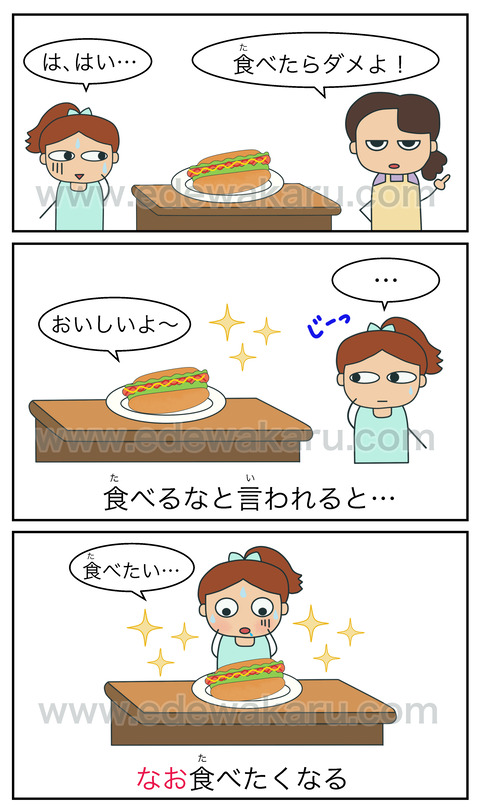
反対されると、なおやってみたくなる。
入学希望者は期日までに、入学金を納入してください。なお、いったん納入された入学金は、いかなる場合にもお返しできませんので、ご了承ください。
毎月の第三水曜日を定例会議の日とします。なお、詳しい時間などは、1週間前までに文書でお知らせすることにします。
参加希望者は葉書で申し込んでください。なお、希望者多数の場合は、先着順とさせていただきます。
明日は、2、3年生の授業は休講になります。なお、4年生のみが対象の授業は、通常どおり行いますので注意してください。
日本語文型辞典 英語版
Meaning
Means that one thing has a comparatively higher degree of something than another, in which case it is similar to 一層 (all the more), もっと (further), さらに (still more), and そのうえ (on top of that). In other contexts, it means that the same situation continues as before, in which case it is similar to まだ (still/yet), 相変わらず (as usual), and 今もなお (still). When the first and second clauses contrast in meaning, as in
(5)
, the meaning of なお is close to that of かえって (instead/all the more).
Used to add a proviso, supplementary explanation, exception, or special case to a topic that has just been concluded, or to present a new topic that is not directly related to the previous sentence. As illustrated in
(4)
, when the sentence after なお adds information that is not consistent with the expectation created by the previous sentence, the meaning of なお is similar to that of ただし (but/however). なお is not used often in spoken Japanese. However, it is used often in posted notices, written announcements, explanatory notes in academic papers, and other written contexts.
How to use it
1. なお〈degree〉
2. なお〈provisional clause〉
In context 9 examples
あなたが来てくれればなお都合がよい。
If you could come, it would be even better.
薬を飲んだのに、病状はなお悪化した。
Even though I took the medicine, my condition kept getting worse.
祖父は老いてもなお精力的に仕事を続けている。
Even though my grandfather is getting old, he is still working energetically.
退院するまでには、なお1週間ぐらい必要だ。
You still need another week before you can be released from the hospital.
反対されるとなおやってみたくなる。
The more they oppose me, the more I want to do it.
入学希望者は期日までに、入学金を納入してください。なお、いったん納入された入学金は、いかなる場合にもお返しできませんので、ご了承ください。
Prospective students should pay the enrollment fee by the due date. Also, please note that once the enrollment fee has been paid, it is not refundable under any circumstances.
毎月の第三水曜日を定例会議の日とします。なお、詳しい時間などは、1週間前までに文書でお知らせすることにします。
The day for the regular meeting will be the third Wednesday of every month. Note that further details, including the time, will be communicated in writing no later than one week in advance.
参加希望者は葉書で申し込んでください。なお、希望者多数の場合は、先着順とさせていただきます。
Applicants are requested to register by postcard. Please also note that if the number of applicants exceeds the limit, selection will be made on a first-come-first-served basis.
明日は、2、3年生の授業は休講になります。なお、4年生のみが対象の授業は、通常どおり行いますので注意してください。
Classes for second- and third-year students will be canceled tomorrow. However, please be aware that classes for fourth-year students will be held as usual.
Bunpro Grammar Reference
Usage 1
Meaning
Still, Even, Yet
How to use it
なお + Verb[ている]
なお + Nounもいる
なお + Nounもある
なお + Noun + だ(1)
(1) である
Nuance
A formal phrase which highlights that something is still now or even now continuing. Esteeming or supplementing the base information of (A).
Explanation
When used at the beginning of a statement, the adverb 尚 'furthermore' will often carry the meaning of 'still', 'even', or 'yet'. This use is regularly seen after the previous statement ends in も, and will emphasize that 'even after (A)', or 'even though (A) is a fact, (B) is still true'. Especially when the information expressed in the (B) part of the sentence is surprising or shocking in some way.
This structure will almost always appear without the kanji being used. Additionally, the (B) part of statements that include 尚 will also frequently include も, in order to specify that the new information is 'in addition to (A)'.
上司のパワハラを人事に報告してもなお、上司のパワハラが続いている。
Even after reporting my boss to human resources for power harassment, his harassment is still continuing.
彼は先生に注意されてもなお、指摘された事を直そうとしない。
He still refuses to fix what was pointed out to him, even after being warned by his teacher.
豊橋市では今もなおチンチン電車が走っている。
Trams are still running in Toyohashi-city.
浜崎先生は卒業後もなお、私たちの事をしっかりと覚えている。
Mr. Hamasaki still remembers us even after graduation.
今もなお has come to be used as a set phase, and may be heard in many different situations. Despite this, 尚 itself is quite a formal grammar structure.
Nuance · 日本語
何かが起こっている、又はいまだに継続しているということを強調する表現。(A)の情報を尊重したり補足したりすること。
Explanation · 日本語
副詞の「尚」(意味:また)は文の前半で使われるとき、(A) であるのに同じ状態 (B) が続いていることを表します。この用法は、前の文が「も」で終わるときによく見られ、「(A) だが、それでもまだ (B)」や「(A) にもかかわらず (B)」のような意味で使われます。特に文の (B) の部分で述べられている情報に驚きや意外性がある場合に多く使われます。
この文型は漢字ではなく、ひらがなで書かれるのがふつうです。「尚」を含む文の (B) には「も」が入ることがよくあり、(A) に (B) という新たな情報が提示されていることを強調します。
上司のパワハラを人事に報告してもなお、上司のパワハラが続いている。
Even after reporting my boss to human resources for power harassment, his harassment is still continuing.
彼は先生に注意されてもなお、指摘された事を直そうとしない。
He still refuses to fix what was pointed out to him, even after being warned by his teacher.
豊橋市では今もなおチンチン電車が走っている。
Trams are still running in Toyohashi-city.
浜崎先生は卒業後もなお、私たちの事をしっかりと覚えている。
Mr. Hamasaki still remembers us even after graduation.
「尚」そのものはかなり硬い表現ですが、「今もなお」という表現は定型句としてさまざまな場面で使われます。
In context 16 examples
- アメリア・イアハートの消失は今も尚謎である。
The disappearance of Amelia Earhart is still a mystery.
- 上司のパワハラを人事に報告してもなお、上司のパワハラが続いている。
Even after reporting my boss to human resources for power harassment, his harassment is still continuing.
- 浜崎先生は卒業後もなお、私たちの事をしっかりと覚えている。
Mr. Hamasaki still remembers us even after graduation.
- 彼は先生に注意されてもなお、指摘された事を直そうとしない。
He still refuses to fix what was pointed out to him, even after being warned by his teacher.
- 豊橋市では今もなおチンチン電車が走っている。
Trams are still running in Toyohashi-city.
- 大学院生になっても尚、夜遊びをやめない人もいる。
There are people who become graduate school students, but still don't quit their nightlife.
- 大工になっても尚、高いところが苦手な人もいるらしい。
Apparently there are people who become carpenters but are still scared of heights.
- 短所に気づいても尚認めようとしない人に未来はありませんよ。
People who notice their shortcomings and still don't acknowledge them, have no future.
- 蒸気機関車は今も尚、電気がない地域において使用されている。
Steam locomotives are still used in areas where there is no electricity.
- 討議を続けても尚問題の解決が見られなかった。
Even after continuously discussing the problem, a solution has yet to present itself.
- 時間を超過しても尚話し続ける校長先生をなんとかしてください。
Please do something about the principal who (still) continues to talk even after talking too much.
- 追加しても尚足りないということなので、工場で商品を生産します。
Even if it received supplementation, it is still insufficient, so they will make merchandise at the factory.
- 店を潰しても尚強気な元店長のあの態度は謎だ。
Even though (he) shut the store down, it is a mystery why the former store manager still has such an attitude.
- 定員に達しても尚申し込みの電話が鳴り止まないほど人気だ。
It is so popular that even if we reach our staff quota, the phone calls will still not stop coming in with requests.
- ある旅館は718年以来今も尚一家族によって経営されている。これからもそのまま続いていくだろう。
A certain ryokan is still managed by one family since 718. It seems it will continue like that in the future.
- 退院しても尚病院に遊びに来る人が絶えないほど人気の病院があるらしい。
Apparently there are hospitals that are so popular that even after being released, people still come to visit.
Usage 2
Meaning
In addition, Incidentally, Furthermore, Moreover
How to use it
Phrase. なお、+ Phrase
Nuance
A formal expression which aims to esteem or supplement the base information of (A). (A) and furthermore (B).
Explanation
When used at the beginning of a sentence, 尚 'furthermore' takes on the role of a conjunction, and will often carry the meaning of 'in addition', 'furthermore', 'even more', or 'moreover'. This use is regularly seen after the previous sentence or clause has expressed some base fact or situation that the second sentence will then add to. Especially when the information expressed in the (B) part of the sentence is surprising or shocking in some way.
This structure will almost always appear without the kanji being used.
それでは只今から説明会を開始したいと思います。なお、ご不明な点がある場合はお気軽にお申し付けください。
Well then, I'd like to begin the information session. In addition, if you have any questions, please feel free to ask.
5日の土曜日には11時までに待ち合わせ場所に集合してください。なお、遅れる場合は私のLINEまで連絡をください。
Please be at the meeting place by 11:00 am on Saturday the 5th. Moreover, if you are going to be late, please message me on LINE.
内容の確認が出来ましたら、「次へ」をクリックしてください。なお、「次へ」をクリックした後には内容の変更ができないのでご注意ください。
After confirming the details, please click 'Next'. Furthermore please note that you cannot make changes after clicking 'Next'.
As 尚 is a formal grammar structure, it will most frequently appear in letters, posters, commercials and other similar material.
Fun-fact
In all of its uses, なお simply indicates that taking the previous information of (A) into account, although (B) may not be expected, it is in fact true. This can be used either positively or negatively, and just highlights (B) as exceeding expectations.
Nuance · 日本語
(A)の情報を尊重したり補足したりする丁寧な表現。(A)に加えて(B)。
Explanation · 日本語
接続助詞の「尚」が文の頭で使われるとき、「また」「ちなみに」「ただし」のような意味を表します。この用法は、前の文や節で基本的な情報や状況が述べられた後、それに補足説明を加える場合や例外を伝える場合に使われます。また、(A) と (B) に直接的な関係がない場合や、(A) を聞いただけでは (B) の内容を予想できないような場合にも使うこともできます。 特に文の (B) の部分で述べられている情報に驚きや意外性がある場合によく使われます。
これは、漢字ではなく、ひらがなで書かれるのがふつうです。
それでは只今から説明会を開始したいと思います。なお、ご不明な点がある場合はお気軽にお申し付けください。
Well then, I'd like to begin the information session. In addition, if you have any questions, please feel free to ask.
5日の土曜日には11時までに待ち合わせ場所に集合してください。なお、遅れる場合は私のLINEまで連絡をください。
Please be at the meeting place by 11:00 am on Saturday the 5th. Moreover, if you are going to be late, please message me on LINE.
内容の確認が出来ましたら、「次へ」をクリックしてください。なお、「次へ」をクリックした後には内容の変更ができないのでご注意ください。
After confirming the details, please click 'Next'. Furthermore please note that you cannot make changes after clicking 'Next'.
「尚」は硬い文法なので、公式文書やポスター、広告などに使われることがよくあります。
豆知識
「なお」には、全ての用法において、「(A) という情報からは予想できないかもしれないけれど、実際には (B) という事実があるよ」と新しい情報を示す働きがあります。この文型は肯定的にも否定的にも使えます。
In context 15 examples
- 明日は臨時休業です。尚、定休日は水曜日です。
Tomorrow is a temporary holiday. In addition, Wednesday is our set store holiday.
- 5日の土曜日には11時までに待ち合わせ場所に集合してください。なお、遅れる場合は私のLINEまで連絡をください。
Please be at the meeting place by 11:00 am on Saturday the 5th. Moreover, if you are going to be late, please message me on LINE.
- それでは只今から説明会を開始したいと思います。なお、ご不明な点がある場合はお気軽にお申し付けください。
Well then, I'd like to begin the information session. In addition, if you have any questions, please feel free to ask.
- 内容の確認が出来ましたら、「次へ」をクリックしてください。なお、「次へ」をクリックした後には内容の変更ができないのでご注意ください。
After confirming the details, please click 'Next'. Furthermore please note that you cannot make changes after clicking 'Next'.
- 作品の提出は今月いっぱいまで。尚、テーマは各自で考えること。
The window for turning in your work is through the end of the month. In addition, you should think about your theme individually.
- 只今パンを焼いております。尚、出来上がりは11時を予定しております。
Bread is currently being baked. In addition, it is scheduled to be ready at 11.
- 説明は以上です。尚、手続きは明後日までにお願いします。
This concludes the explanation. In addition, please do the formalities by the day after tomorrow.
- では、これで試験を終わります。尚、点数は追って発表いたします。
Well, this concludes the test. In addition, I will announce the score afterwards.
- 本日はありがとうございました。尚、お問い合わせは私ではなく会社にお願いします。
Thank you for today. In addition, please send all inquiries to the company, not me.
- マングースにはすばやい反射神経や分厚い毛皮がある。尚、コブラの毒に対して強い。したがって、蛇を食べることが多い。
The mongoose has fast reflexes and thick fur. Moreover, the mongoose is also resistant to snake venom. Therefore, it often eats snakes.
- 打ち合わせはこれくらいでいいですね。尚、意見を統一した文書を作成し、後ほどメールで送ります。
This is good for the business meeting, I believe. In addition, I will write up a document with our unified opinions and email it later on.
- 就職面接は8月2日に開催されます。尚、希望者は何か質問があれば、ご連絡ください。
The job interview will be held on August 2nd. Furthermore, if you have any questions, feel free to contact us.
- 大会の日程は以下の通りです。尚、当日の天候によっては延期になる場合がありますので、ご了承ください。
The schedule for the tournament is as follows. In addition, please understand that the weather on the day of could result in a postponement.
- この部屋はご自由にお使いください。尚、盗難などの責任は負いかねますので、ご自分で管理してください。
Please use this room freely. In addition, please manage it yourself as we are not responsible for lost or stolen items.
- 202X年7月24日にマンション周辺の草取りを行います。尚、同時に、住人の子供向きのイベントも行います。
On 07/24/202X, weeding will take place around the apartment buildings. In addition, an event for residents' children will also be held at the same time.