日本語文型辞典
Meaning
基本情報…たりとも…ないNたりとも…ない数量詞+たりとも…ない説明最小の人数、最小の量も許容しないという意味で、「一人/一滴/一日たりとも…ない」などの形で使う。数量表現は「一」が普通である。ややくだけたときは「ひとりも」「一滴も」などとなる。文語表現で、かたい書きことばや、フォーマルな話しことば(会議、演説など)に用いる。例文① 試験まであと一カ月しかない。一日たりとも無駄にはできない。② 水がどんどんなくなっていく。これ以上は一滴たりともむだにはできない。③ 密林の中では、一瞬たりとも油断してはいけない。④ この綱領(こうりょう)について変更は一字たりとも許されない。⑤ だれもが敵は一人たりとも逃がさないと決意していた。
IMABI
The Particles ども, とも, & たりとも
Read this IMABI lesson ↗Explanation
The Particle ども, とも, & たりとも
In this lesson, we will learn about the conjunctive particles ど(も), とも, and たりとも, both of which are contrastive (逆接) in nature. Putting aside their lack of use, we will investigate the uniquely nuanced contrasts that can be made with these particles.
Curriculum Note: Occasional examples from older stages of Japanese will be provided; however, you are not required to study other archaic grammar present in those examples. For the benefit of any who wish to research these topics further, all such examples will be shown in their original orthography, a modern orthography adaptation, along with a Modern Japanese translation.
The Conjunctive Particle ど(も)
Learning of another particle so late into your Japanese studies may come as a surprise, but the conjunctive particle ど(も)is actually already quite familiar to you via its antecessor けれど(も), which is most commonly abbreviated to けど.
Though the exact etymology of けれど(も) is contested, its meaning of “although” is almost identical to that of ど(も). While also translated into English as “even though/although,” the relationship between the dependent clause marked by ど(も)and the main clause that follows is more nuanced.
The conjunctive particle ど(も)is also unique in how it attaches to the 已然形 of verbs. Although this base is typically referred to as the 仮定形 in the context of Modern Japanese grammar, the use of the term 已然形 is still often applied to ど(も)because of the temporal nature of the verb implied in this construction being something already set in motion.
Verb Class已然形例
一段-re– 見れど
五段-e–行けど
サ変sure–すれど
カ変kure–来(く)れど
だde.are–
nare1–であれど(も)
なれど(も)
In Classical Japanese, ど(も) possessed two interrelated nuances that contribute to how it is perceived in Modern Japanese.
逆接確定条件: Translating into Modern Japanese as ~けれども or ~が, a “established contrastive conditional” refers to Situation B, a result contrary to an expectation implied from whatever Situation A is.
Situation A necessitates that tense/aspect be properly defined so as to make clear how Situation A is established, given how ど(も) attaches to the 已然形. In Modern Japanese, however, the array of aspect markers that once existed have been condensed to largely ~た, and although that alone would not necessarily prevent ど(も) from attached to its 已然形 tare-, this nuance has been entirely taken over by けれど(も). This is even the case when the verb of the dependent clause marked by ど(も) is in the non-past tense.
1.
Original Text: 足ずりをして泣けども甲斐なし。
現代日本語: 足をばたつかせて泣くけれどもどうにもならない。
Throwing a tantrum amounts to nothing.
From the 伊勢物語.
2. 去れど、我は追わず。
Though (they) leave, I will not pursue.
逆接恒常条件: Translating into Modern Japanese as ~であっても、やはり…, a “constant contrastive conditional” refers to Situation B ALWAYS being the case even though Situation A is the case.
The meaning of “even though…” lives on in Modern Japanese, albeit largely limited to set phrases and the written language. This is likely due to ど(も)functioning more like ~ても, which limits the aspect of said dependent clause to being “in the moment.”
3. 行けども、行けども、砂ばかりだった。
Though I kept going and going, there was only sand.
4. 行けども行けども、山また山。
(We) went on and on, but there was nothing but mountain after mountain to be seen.
5. しかし、結果は一そう悪く、待てど暮らせど何の返事も無く、自分はその焦燥しょうそうと不安のために、かえって薬の量りょうをふやしてしまった。
But, the result was even worse, and having waited and wanted and not received a response of any sort, I ended up increasing my dosage all the more out of impatience and anxiety.
From 『人間失格』 by 太宰治.
~といえども
The pattern ~といえど(も)is used to acknowledge Situation A, which is a condition (fact) that is presumed established, while introducing Situation B, which contrasts with what would expect from Situation A.
6. たとえ帝王とはいえど、法を犯せば罰せられる。
Even if (they) were the emperor, (they) would still be punished for breaking the law.
This grammar essentially combines aspects of both nuances of ~ど(も), indicating how interrelated they truly are due to their shared utilization of the 已然形. Both nuances rely on Situation A being presumed established, but the exact nature of the contradiction set by Situation B differs – whether Situation B is a one-off, unexpected consequence or always so conversely consequential. In Ex. 5, even if someone were the 帝王, their being the 帝王 would be established and uncontested; nonetheless, their status (situation) as emperor would not exempt them from being punished for violating the law if and when they do, and that established contrastive conditional is always maintained. By unpacking the logical relationship between Situation A and Situation B in this manner, “nonetheless/nevertheless” are often provided as translations, even though doing so would be consequentially longwinded.
7a. さすがのラファエル君といえども、この夏の暑さには参ってるだろう。
Even with Rafael being how he is, he must be exhausted by the heat this summer.
In this example, Situation B is not a constant. Yet, not even Rafael’s presumed ability to withstand the heat is withstanding this summer’s heat. The simplest paraphrasing of といえども out of this example would be でも.
7b. さすがのラファエル君でも、この夏の暑さには参ってるだろう。
Even with Rafael, given how he is, he must be exhausted by the heat this summer.
While this paraphrasing happens to work just fine on account of [さすがのラファエル君] being a simple nominal predicate, for a more faithful, modern representation of といえども in this context, とは言っても serves as a better candidate.
Now, what prompts modern speakers to purposefully revert to using といえども despite being antiquated goes back to how Situation A is perceived. Whether Situation A is presumed to be the case or just a happenstance contrastive hypothetical condition (逆接仮定条件) is not disambiguated via ~ても.
8. いくら暑さに強いとは言っても、この夏の暑さには参ってるだろう。
No matter how heat-resistant you say you are, you’d be overwhelmed by the heat this summer.
From ~ても alone, we do not know the exact nature of Situation A as it pertains to it being established fact or a hypothetical (and a hyperbolized one at that). This brings us full circle back to how ど(も)may translate as ~が・けれど, which at least can present Situation A as a concession made.
9. さすがのラファエル君も、猛暑日でも平気とは言うが、この夏の暑さには参ってるだろう。
Even given how Rafael-kun is, saying how he can handle scorching heat, he must be feeling overwhelmed by the heat this summer.
While ~が・けれど are more suitable for presenting 逆接確定条件 than ~ても, the uncontested nature of Situation A presented via ~ど(も) is unique enough to keep the grammar point from dying out of modern speech entirely.
Another point of contention to consider is nuancing provided by the emphatic adverbial particles は and も.
The inclusion of the particle は into this pattern inherently adds a distinct layer of contrast being made between Situation A and other similar situations that could just as easily result in the same contrary scenario had with Situation B.
6. たとえ帝王とはいえど、法を犯せば罰せられる。
Even if (they) were the emperor, (they) would still be punished for breaking the law.
With this in mind, we see how [帝王] could be swapped out with other similar nouns, and such comparisons are implied by using は, and with Situation A still holding true, the conditional statement is more emphatic as an effect.
Now, as for the inclusion of も in ~ど(も), も plays the role of an intensifier after various types of adverbial expressions, which contrastive dependent clauses may count as. Due to the propensity of using も in similar structures like ~ても, however, も is more likely used than not2.
While it may be tempting to view ~ども as being grammaticalized as one word, its absence does not have a profound change in meaning as is the case for other similar patterns such as ~ても or ~とも.
だ-Ellipsis w/ ~といえど(も)
While anachronistic in practice, the thought of だ coexisting with an archaic dependent clause structure which predates its existence would seem odd, but as is often the case with archaisms, neoclassical applications do result in だ being optional when ~といえど(も) follows nominal and adjectival noun predicates. However, its ellipsis3 is far more common.
10. 同じ秘書経験者(だ)といえども、菅と安倍を分けるものはまさしくそれだった。
Despite both being experienced secretaries, it was that very point of commonality which separated Suga and Abe from each other.
~と雖も
In 漢文, 雖 indicates a contrastive conditional, and because of this, it has been adopted as an alternative means of spelling ~といえども.
11. 自ら顧かえりみて縮なおくんば4千万人と雖いえども我われ往ゆかん。(Famous Quote)
If I reflect upon myself and find myself to be in the right, no matter if ten million people (tell you otherwise), I shall move forward.
By 吉田松陰.
12. 中らずと雖も遠からず。(Set Phrase=Idiom)
Literal Translation: Though not landing (on the mark), (it) is not far off.
Near the mark.
Historical Segue
Since Old Japanese (上代日本語), the stage of the language spoken in the Nara Period (8th century AD), the bare 已然形 could be used to create an established contrastive conditional all on its own, but it just so happened that the particle ど(も) frequently accompanied it.
13.
Traditional Orthography: さこそ言へ、まだ追ひやらず。
Modern Orthography: さこそ言え、まだ追いやらず。
Modern Translation: そうは言うけれど、まだ完全に追い出さない。
English Translation: Easier said than done, though, as I’m still not completely driving (her) away.
From the 伊勢物語5.
14.
Original 万葉仮名: 不聴雖謂話礼〻〻常詔許曽志斐伊波奏強話登言
Traditional Orthography: 否と言へど語れ語れと詔らせこそ志斐い6は奏せ強語といふ。
Modern Orthography: 否と言えど語れ語れと詔らせこそ志斐いは強語という。
Modern Translation: いやだと申し上げても、語れ語れと仰せになるからこそ、志斐は申し上げるのです。それを「強い語り」とおっしゃる。
I’m the one who, despite saying no, am told by you to keep going, which is precisely why I (Shii) keep telling my stories. Here you are calling them “stories I force upon you.”
From Poem 237 of the 万葉集.
吉田金彦 suggests that ど may derive from the particle と and that the voicing occurred due to a morpheme expressing conjecture fusing with it before Japanese’s written history began.
Putting aside whether ど is the fusion of two morphemes or not, the uncanny resemblance between it and the particle とも does indicate an etymological relationship. With that in mind, let’s delve into the conjunctive particle とも.
The Conjunctive Particle とも
The conjunctive particle とも consists of the conjunctive particle と7 used in conditional expressions and the intensifier adverbial particle も, grammaticalized as a single word to indicate a contrastive hypothetical condition (逆接仮定条件).
Unlike ~ど(も), though the relationship between the dependent clause marked by とも and the main clause is contrastive in nature, the outcome itself is fine, if not even “only nature,” as far as the speaker’s attitude toward the relationship is concerned.
Traditionally, the conjunctive particle とも attaches to the 終止形 of affirmative, verbal predicates and to the 連用形 of adjectival predicates and the /zu-/ 連用形 of the negative auxiliary verb ~ず.
15. 去るとも、我は追わず。
Even if (they) are to leave, I shall not pursue.
16. 上手くいけば誰も犠牲にせずとも好いかも知れませぬ。
If all goes well, we might not have to sacrifice anyone.
17. 遅くとも、来月末までに提出してください。
Please submit it by the end of next month at the latest.
In Modern Japanese, in addition to these environments, とも may also be found after the volitional form.
18. いくら困難が立ちはだかろうとも、ただ突き進むだけさ。
No matter how many difficulties stand in my way, I just keep going.
The overall meaning of “even if,” especially in contexts like “no matter what,” has also resulted in とも gaining a final particle function denoting the speaker’s agreeance or consent as something that is only “obvious.”
19. もちろん、行くとも!
Of course, I’m going!
While understanding how とも semantically works is no difficult task, knowing how these various applications are used practically and how they relate to similar patterns will be our next goal, as it would be inappropriate to label all these usages as being merely old-fashioned.
V終止形(肯定)+とも
Instances of the conjunctive particle とも following verbs without intervening morphology are exceedingly rare in Modern Japanese. However, one does not look hard at all in Classical Japanese.
20. 千年を過ぐすとも、一夜の夢の心地こそせめ。
Even if I were to watch ten thousand years go by, it would likely feel like a single night’s dream.
From the 『徒然草』.
Similarly to ~としても, it is also possible to see ~とも after the predecessor of ~た, ~たり. In these scenarios, the conjunctive particle とも does pertain to established concessive contrasts but with the added sensation that the speaker feels the result is to be expected.
21.
Traditional Orthography: たとひ弓を持ちたりとも、矢をはげずはかなひがたし
Modern Orthography: たとい弓を持ちたりとも、矢を矧げずは敵い難し。
Modern Translation: たとえ弓を持ったとしても、矢を番えなければ敵わない。
English Translation: Even if you did have a bow in hand, you are no match unless you nock an arrow.
From the 『平家物語』.
Rare instances of ~とも attaching to the 連用形 do appear in Old Japanese, and in Middle Japanese, especially during the time period when the 終止形・連体形 were merging together, it could also be seen appearing after the 連体形.
22.
Traditional Orthography: 万代に携はり居て相見とも思ひ過ぐべき恋にあらなくに
Modern Orthography: 万代に携わり居て相見とも思い過ぐべき恋にあらなくに
Modern Translation: いつも手を繋ぎ体を交わし合おうとも、それで忘れられるべき恋ではないのだな。
English Translation: Even as we always be holding each other’s hands and intimate with one another, this is by no means a love that we should let fade.
From Poem 2024 of the 万葉集.
23. 死ぬるとも敵に後を見すな。
Even if you are to die, do not show your back to the enemy.
From the 『平家物語』.
~ずとも
Simply put, ~ずとも is the predecessor of ~なくても. In Modern Japanese, the use of ~ずとも is limited to the written (≈poetic) language, and it is largely restricted to verbal predicates, although there are still occasional instances of it with other predicates, especially in more (neo)classical speech.8
Predicate Type例
動詞(一段)
動詞(五段)
動詞(サ変)
動詞(カ変)見ずとも
降らずとも
せずとも
来(こ)ずとも
形容詞高からずとも
名詞・形容動詞:~なり~ならずとも
Out of brevity, the classical copula なり stands for both nominal and adjectival noun predicates.
24. マニアならずとも世界が認めるデザインは、目から鱗なはずだ。
Even without being an enthusiast, a design that is recognized worldwide ought to be eye-opening.
25. 言わずとも、知れたことだよ。
That goes without saying, it’s so obvious.
24. 一石を投ぜず9とも、第一に、「伝統的社会」はすでに自壊作用をはじめたという見方も可能である。
Without even casting the first stone, it is possible to take the view that “traditional society” has already begun the process of disintegrating.
From 『NPO/NGOと国際協力』by 西川潤,佐藤幸男.
26. そんな人物は、長からずとも人生を生きてきていれば、会社でも学校でも、いくらでもいたはずだ。
A person like that will surely have been in our lives, even if one hasn’t been on the block for that long, whether in the workplace, at school, etc.
27. 「息子さえおれば、こんな歳になってこんな情けない目に遭わずともすんだものを。」篠突く雨の中、関ヶ原へと進軍する途中の家康は、馬上幾度もそうぼやいたという。
If only my son were here, I would not have to suffer such a pitiful fate as this at my age,” Ieyasu muttered to himself repeatedly while on horseback in the pouring rain on his way to Sekigahara.
From 『聚楽』by 宇月原晴明.
Why the 連用形?
As can be deduced from the chart above, ~ず itself attaches normally to the 未然形 of all predicate types, albeit to the traditional version if any discrepancies exist between Classical Japanese and Modern Japanese, as is the case for サ変 and predicates involving the copula (なり).
As for why ず is viewed as being in the 連用形 in this construction as opposed to the 終止形 like it does in the affirmative for verbal predicates, the argument for this rests on the acute affinity the bases of ず have with that of adjectives, as both exhibit ラ変型活用, and even their non-ラ変型 conjugates bear uncanny resembles to one another.
Bases~ず
(非ラ変型)~ず
(ラ変型)形容詞
(非ラ変型)形容詞
(ラ変型)
未然形ずざら(く)から
連用形ずざりくかり
終止形ず〇し〇
連体形ぬざるきかる
已然形ねざれけれ〇
命令形〇ざれ〇かれ
~くとも
When combined with adjectival predicates, ~とも follows the 連用形. In this environment, it has been largely replaced by ~ても in modern speech, but more can be said about this transition.
In highly emphatic contrastive conditionals, often accompanied by adverbs such as どんなに・どれだけ・いくら・たとえ, ~とも holds on, albeit still overshadowed by ~ても in the spoken language.
28. どんなに辛くともくじけるな。
No matter how tough (things) are, do not be disheartened.
29. どんなに美しくとも、闇夜に咲く花は誰の目にも映らぬ。
No matter how beautiful they may be, flowers which bloom in the dark of night are seen by no one.
30. 地方の酒屋も、小さくともなんとか職人の意地で酒を造り続けてほしい。
I hope that local brewers, no matter how small, will continue to make sake with the pride one would expect of a craftsman.
As a subset of this environment, ~でなくとも with nominal and adjective noun predicates is also possible. Likewise, ~でなくとも has largely been replaced by ~でなくても in modern speech.
31. 逆に、人間でなくとも、殺すことは許されない。
Conversely, even it is not human, it is not permissible to kill it.
32. 特別な才能を示す少年は、家柄がそれほどでなくとも、入学を許可される場合がある。
There are cases of lads who display exceptional talent being admitted even with a modest family background.
Given that the auxiliary verb ~ない and ない are no different, (~)なくとも is to be expected in formal, written contexts, even preferred over (~)なくても. As for its used in the spoken language, such use is indicative of Early Modern Japanese-style speech, which remains alive in the speech of older generations.
33. 台木を用いなくともよい。
There is no need to use rootstocks.
34. 事前の許可がなくとも、治療用規制物質の投与が認められる。
The administration of controlled substances for medical purposes is allowed even without prior authorization.
35. 理解されなくともまったくかまわない。
I really don’t care if its not understood.
36. 特に英語を勉強しなくとも、楽勝だろうね。
Particularly English, it’s probably a piece of cake for you even if you don’t study.
These instances of ~なくとも should not be confused with its appearance in 少なくとも. It turns out that 少なくとも (at least) along with 遅くとも (at the latest) and 多くとも (at most) have become set instances of ~とも being grammaticalized into adverbial expressions with said definitions.
37. 少なくとも10人は要ります。
We need ten people at the least.
38. 無所属候補は、多くとも何千票(か)しか獲得できないだろう。
Independent candidates will likely receive only a few thousand votes at most.
39. 車だと早くとも5時間はかかる。
By car, the quickest it would take would be at least 5 hours.
Nuance Note: At first glance, 早くとも may seem similar to 早ければ. However, upon further inspection, the impression of 早くとも is quite negative in tone. In Ex. 39, the journey by car is still long, and the likelihood of it taking longer than five hours is quite high.
This adverbial use of とも may even be seen attached to plain adverbs pertaining to amount.
40. そのために多少ともお役に立てばと思って本書を刊行することとした。
That is why I decided to publish this book in the hope that it will be of some help.
It is only when these adjective + とも combinations are used as typical dependent clauses that replacement with ~ても is possible.
41. あまりに本数が少なくても、人は乗るんでしょうか。
Will people still ride (bus/train) lines even when there are so few of them?
42. いくら多くても、絶対に売ってはいけなかったのだ。
No matter how many of (them) there was, (we) were to never sell (them).
形容詞(終止形)+~とも
While the conjunctive particle traditionally attaches to the 連用形 of adjectives, there are rare instances of it following the 終止形, especially in Early Modern Japanese literature. Such instances can be interpreted as ~とも functioning as an abbreviation of ~と言っても.
43. 前列と後列の間はわずか一尺五寸10ぐらいだろう、左右の間隔はそれより短いとも長くはない。
The space between the front and back rows measured about one foot and five inches, and the space between the men, left and right, might have been even less than that, certainly no greater.
From 『坊ちゃん』by 夏目漱石.
~(よ)うと(も)
When ~とも follows the auxiliary verb ~(よ)う, either in it capacity as suppositional markers or as volitional markers, the particle maintains its role of marking a “contrastive conditional,” and with the addition of ~(よ)う , resulting statements are highly emotionally charged, with adverbs such as どんなに (how)・どれだけ (to what extent) ・いくら (how much)・たとえ (even if) frequently accompanying.
Because this pattern may follow all predicate types, below is a recap on how ~(よ)う connects to the 未然形.
Predicate Type未然形+~(よ)う
一段動詞-∅-見よう
五段動詞–o– 言おう
サ変shi–しよう
カ変ko–来(こ)よう
形容詞–karo–新しかろう
形容動詞daro–
de.aro–簡単だろう
簡単であろう
だ・であるdaro–
de.aro–~だろう
~であろう
44. たとえ雨が降ろうとも洗濯物を取り込まない。
I do not bring in the laundry, even if it rains.
45. 誰が何と言おうとも、美味しければそれでいいのだ。
No matter what anyone says, as long as it tastes good, that’s all that matters.
46. 頻発する一揆11は、それがいかに大規模であろうとも、いかに激しかろうとも、階層を横に連帯する論理、すなわち新しい時代への展望とこれを実現する手段とを欠いており、しょせんが一揆にすぎなかった。
The frequent uprisings, no matter how large or violent they were, lacked the logic to unite people across classes, in other words, the vision for a new era and the means to realize it, and were ultimately nothing more than uprisings.
From 『「経済大国」に明日はないか』by 吉田春樹.
Interestingly, も is not grammaticalized to と in this environment. This means its absence does not affect the meaning of the expression. This suggests that と in this construction retains some affinity to its quotative particle iteration. However, a change in tone can still be observed. Without も, the conditional brought forth feels far more punctual.
47. 我らホモ・サピエンスはどれだけ努力しようと、どれだけ達成しようと、生物学的に定められた限界を突破できないというのがこれまで暗黙の了解だった。
Until now, it has been tacitly understood that we, Homo sapiens, could not surpass the limitations imposed on us by our biology, no matter how hard we might try and no no matter the accomplishments we would make.
48. 宇宙の終わりがあろうとなかろうと、我々人類は見ることはできないだろう。
Whether there will be an end to our universe or not, we humans will likely not be there to see it.
Curriculum Note: See also ~ようと~まいと.
~とも~とも
Speaking of the quotative と+も, it is important not to confuse this combination with the conjunctive particle とも when said combination is in the pattern ~とも~とも to indicate inability to draw a conclusion.
49. どれも正しいとも間違っているとも判断できません。
I can’t judge any of it as being right or wrong.
50. きょうのところは、私は明確に右とも左とも申し上げかねますから、少し研究さしていただきたいと思います。
As for today, I would like do some more research (on this matter), as I’m afraid I cannot state one way or another definitively.
From these two examples, it is clear that the clausal relationship between とも and the rest of the sentence is not the same as when とも functions as a conjunctive particle. Whereas the conjunctive particle とも would follow a dependent clause, clearcut instances of “quotative と+も” follow embedded quotes, which are subordinate clauses.
終助詞「とも」
The final particle usage of とも ultimately derives from its conjunctive particle functionality. While the conjunctive particle とも is contrastive in nature, the outcome itself is obvious, unworthy of doubt, as far as the speaker is concerned12. This “only natural” nuance is what gives the final particle とも’s flare in denoting what is only a natural response.
52. 「結論があるんですか」「あるとも。」
“That means you have reached a conclusion?” “That I have!”
53. 食ったとも、食ったとも!あきれちゃったよ。
I sure did eat it! That I did! I was quite fed up!
The final particle とも may follow plain and polite speech variants. As for its relationship with the copula, copula ellipsis is notably possible with そうだ13 but limited to sociolects such as female speech. This is likely due to a conflict of modality, in which the final particle とも matches the affirmative modality of the copula.
54. もちろん、思いましたとも。
Of course, I thought that!
55 ああ、そうです!そうですとも!あれが最後です。
Ah, yes! That is correct! That is the last one.
56. それはそう(だ)とも!
Of course, that’s the case!
Though somewhat dated, the final particle とも may also appear after interjections which indicate affirmation such as ああ and おう.
57. おうとも、さようで!
Why yes, that is so indeed!
Typically, the final particle とも does not attach to modal phrases which indicate supposition, especially if there is a certain level of uncertainty involved. This means ~とも naturally does not pair well with endings like ~らしい・そうだ because of how they indicate hearsay, but it does naturally pair well with endings like ~に違いない for expressing the speaker’s brimming confidence in something being the case. Interestingly, though, ~だろうとも is quite common. In this environment, the speaker is not describing the high factualness of the statement at hand, but rather that the likelihood of it being so high is undeniable.
58.「事件はこの後に起こる。」「そうだろうとも。」
“The incident would occur after this point.” “Of course, it would.”
The Particle たりとも
Next, we will look at the conjunctive particle たりとも, which is a combination of the defunct copula verb たり and the conjunctive particle とも attaching to its /tari-/ 終止形.
The conjunctive particle たりとも is largely limited to counter expressions, translating as “not even…” given how the main clause is always in the negative. Furthermore, the counter expression itself must be a unit that is “minimal” in nature, and the number used is always one or replaced with 何~.
59. なにより、自らの「同志」の一人が政権に参画したのだ。しかも彼は事務方の官房副長官という、過去一度たりとも民間人の就いたことのない重要ポストに座っている。
More than anything else, there was one person who took part in planning in the administration with the same sentiments as [the Prime Minister]. Furthermore, he was sitting in a high-level post, the administrative Deputy Chief Cabinet Secretary, for which no civilian had been appointed to even once in the past.
60. 一瞬たりともおろかにはできぬ。
You can’t even neglect it even for a moment.
61. 2001年、同じ場所で演説をした前首相の小泉純一郎は、街宣車から降りた途端、一歩たりとも動けなくなった。
The moment Former Prime Minister Koizumi Jun’ichiro stepped out from the propaganda vehicle onto the same spot he had given a speech in 2001, he was unable to make even a step.
61. 邪魔する者は何人たりとも咬み殺す!
I will kill any number of men with my bite if he so dares to get in my way!
Similarly to とも is grammaticalized in phrases like 少なくとも as adverbs in their own right, the same can be said of “1 + Counter + たりとも.” While the underlying clausal structure is still present in its etymology, たりとも does not function as a full-fledged dependent clause in these expressions.
The Classical Japanese ancestor of だ is なり, and given ど(も)’s tendency to be used with archaic speech, it may appear after the 已然形 of なり as opposed to だ. ↩︎
Written works from as far back as Old Japanese such as the 万葉集 indicate a high tendency toward using ども, and in Middle Japanese 漢文訓読文-style texts, ども was exclusively used. ↩︎
To be non-anachronistic in our approach, なり ellipsis would also need to be examined. It just so happens that なり was also just as optional and with parallel effects on the mood attributed to its subordinate clause. ↩︎
~くんば is the combination of the /ku-/ 連用形 of adjectives followed by the particle は, which is incidentally etymologically tied to the particle ば, deriving from は being voiced. As voiced consonants were pre-nasalized in older stages of Japanese, this explains the ん in this pattern. ↩︎
The 伊勢物語 itself is not from Old Japanese but from the later period of Middle Japanese. Also, the bare 已然形 is still occasionally utilized in Modern Japanese when paired with the bound particle こそ. ↩︎
The particle い is a fascinating grammatical structure lost to time that was present in Old Japanese. Its purpose was to hone in on nominal expressions as “especially” being the point of contention, exhibiting case-like and adverbial-like properties. ↩︎
There is also the argument to made that と in this construction derives from its case particle usage. While the resultant structure behaves as a conjunctive particle with predicates, the combination of the case particle と (as a comparison (standard) marker≈quotative particle) and も after nouns and nominalized expressions is parallel in meaning. The ultimate difference, however, is that, while と may still function as a comparison marker or a quotative particle without も, も is grammaticalized as one word for its contrastive conjunctive functionality. ↩︎
The predicate types listed are those that pertain to Modern Japanese grammar. In a neoclassical context, it would be anachronist to assume that a speaker, even one versed in any particular older stage of Japanese, would have internalized an archaism pure to its original grammatical environment(s). ↩︎
Included as サ変 are verbs which in Modern Japanese end in ~じる which originally ended in ~ず(る) in earlier stages of Japanese. ↩︎
尺 30.3 cm = 11.92 inches; 寸 = 3 cm = 1.18 inches. ↩︎
The word 一揆 has great historical significance in Japanese history, but the exact nature of the “uprisings” it refers to depends on the time period and sociopolitical circumstances involved. ↩︎
This is not the exact same as definitively stating that something is true. Otherwise, we would expect a typical declarative sentence. At the heart of the final particle ~とも is the mindset of the speaker that the matter at hand is obviously so without giving it any thought=need to verify, and possibly even that the listener could reach the same conclusion just as easily. ↩︎
Examples of copula ellipsis with generic nominal predicates are excessively rare in Modern Japanese. ↩︎
In context 57 examples
去れど、我は追わず。
Though (they) leave, I will not pursue.
行けども、行けども、砂ばかりだった。
Though I kept going and going, there was only sand.
行けども行けども、山また山。
(We) went on and on, but there was nothing but mountain after mountain to be seen.
しかし、結果は一そう悪く、待てど暮らせど何の返事も無く、自分はその焦燥しょうそうと不安のために、かえって薬の量りょうをふやしてしまった。
But, the result was even worse, and having waited and wanted and not received a response of any sort, I ended up increasing my dosage all the more out of impatience and anxiety.
たとえ帝王とはいえど、法を犯せば罰せられる。
Even if (they) were the emperor, (they) would still be punished for breaking the law.
さすがのラファエル君といえども、この夏の暑さには参ってるだろう。
Even with Rafael being how he is, he must be exhausted by the heat this summer.
さすがのラファエル君でも、この夏の暑さには参ってるだろう。
Even with Rafael, given how he is, he must be exhausted by the heat this summer.
いくら暑さに強いとは言っても、この夏の暑さには参ってるだろう。
No matter how heat-resistant you say you are, you’d be overwhelmed by the heat this summer.
さすがのラファエル君も、猛暑日でも平気とは言うが、この夏の暑さには参ってるだろう。
Even given how Rafael-kun is, saying how he can handle scorching heat, he must be feeling overwhelmed by the heat this summer.
同じ秘書経験者(だ)といえども、菅と安倍を分けるものはまさしくそれだった。
Despite both being experienced secretaries, it was that very point of commonality which separated Suga and Abe from each other.
自ら顧かえりみて縮なおくんば4千万人と雖いえども我われ往ゆかん。(Famous Quote)
If I reflect upon myself and find myself to be in the right, no matter if ten million people (tell you otherwise), I shall move forward.
中らずと雖も遠からず。(Set Phrase=Idiom)
Literal Translation: Though not landing (on the mark), (it) is not far off.
去るとも、我は追わず。
Even if (they) are to leave, I shall not pursue.
上手くいけば誰も犠牲にせずとも好いかも知れませぬ。
If all goes well, we might not have to sacrifice anyone.
遅くとも、来月末までに提出してください。
Please submit it by the end of next month at the latest.
いくら困難が立ちはだかろうとも、ただ突き進むだけさ。
No matter how many difficulties stand in my way, I just keep going.
もちろん、行くとも!
Of course, I’m going!
千年を過ぐすとも、一夜の夢の心地こそせめ。
Even if I were to watch ten thousand years go by, it would likely feel like a single night’s dream.
死ぬるとも敵に後を見すな。
Even if you are to die, do not show your back to the enemy.
マニアならずとも世界が認めるデザインは、目から鱗なはずだ。
Even without being an enthusiast, a design that is recognized worldwide ought to be eye-opening.
言わずとも、知れたことだよ。
That goes without saying, it’s so obvious.
一石を投ぜず9とも、第一に、「伝統的社会」はすでに自壊作用をはじめたという見方も可能である。
Without even casting the first stone, it is possible to take the view that “traditional society” has already begun the process of disintegrating.
そんな人物は、長からずとも人生を生きてきていれば、会社でも学校でも、いくらでもいたはずだ。
A person like that will surely have been in our lives, even if one hasn’t been on the block for that long, whether in the workplace, at school, etc.
「息子さえおれば、こんな歳になってこんな情けない目に遭わずともすんだものを。」篠突く雨の中、関ヶ原へと進軍する途中の家康は、馬上幾度もそうぼやいたという。
If only my son were here, I would not have to suffer such a pitiful fate as this at my age,” Ieyasu muttered to himself repeatedly while on horseback in the pouring rain on his way to Sekigahara.
どんなに辛くともくじけるな。
No matter how tough (things) are, do not be disheartened.
どんなに美しくとも、闇夜に咲く花は誰の目にも映らぬ。
No matter how beautiful they may be, flowers which bloom in the dark of night are seen by no one.
地方の酒屋も、小さくともなんとか職人の意地で酒を造り続けてほしい。
I hope that local brewers, no matter how small, will continue to make sake with the pride one would expect of a craftsman.
逆に、人間でなくとも、殺すことは許されない。
Conversely, even it is not human, it is not permissible to kill it.
特別な才能を示す少年は、家柄がそれほどでなくとも、入学を許可される場合がある。
There are cases of lads who display exceptional talent being admitted even with a modest family background.
台木を用いなくともよい。
There is no need to use rootstocks.
事前の許可がなくとも、治療用規制物質の投与が認められる。
The administration of controlled substances for medical purposes is allowed even without prior authorization.
理解されなくともまったくかまわない。
I really don’t care if its not understood.
特に英語を勉強しなくとも、楽勝だろうね。
Particularly English, it’s probably a piece of cake for you even if you don’t study.
少なくとも10人は要ります。
We need ten people at the least.
無所属候補は、多くとも何千票(か)しか獲得できないだろう。
Independent candidates will likely receive only a few thousand votes at most.
車だと早くとも5時間はかかる。
By car, the quickest it would take would be at least 5 hours.
そのために多少ともお役に立てばと思って本書を刊行することとした。
That is why I decided to publish this book in the hope that it will be of some help.
あまりに本数が少なくても、人は乗るんでしょうか。
Will people still ride (bus/train) lines even when there are so few of them?
いくら多くても、絶対に売ってはいけなかったのだ。
No matter how many of (them) there was, (we) were to never sell (them).
前列と後列の間はわずか一尺五寸10ぐらいだろう、左右の間隔はそれより短いとも長くはない。
The space between the front and back rows measured about one foot and five inches, and the space between the men, left and right, might have been even less than that, certainly no greater.
たとえ雨が降ろうとも洗濯物を取り込まない。
I do not bring in the laundry, even if it rains.
誰が何と言おうとも、美味しければそれでいいのだ。
No matter what anyone says, as long as it tastes good, that’s all that matters.
頻発する一揆11は、それがいかに大規模であろうとも、いかに激しかろうとも、階層を横に連帯する論理、すなわち新しい時代への展望とこれを実現する手段とを欠いており、しょせんが一揆にすぎなかった。
The frequent uprisings, no matter how large or violent they were, lacked the logic to unite people across classes, in other words, the vision for a new era and the means to realize it, and were ultimately nothing more than uprisings.
我らホモ・サピエンスはどれだけ努力しようと、どれだけ達成しようと、生物学的に定められた限界を突破できないというのがこれまで暗黙の了解だった。
Until now, it has been tacitly understood that we, Homo sapiens, could not surpass the limitations imposed on us by our biology, no matter how hard we might try and no no matter the accomplishments we would make.
宇宙の終わりがあろうとなかろうと、我々人類は見ることはできないだろう。
Whether there will be an end to our universe or not, we humans will likely not be there to see it.
どれも正しいとも間違っているとも判断できません。
I can’t judge any of it as being right or wrong.
きょうのところは、私は明確に右とも左とも申し上げかねますから、少し研究さしていただきたいと思います。
As for today, I would like do some more research (on this matter), as I’m afraid I cannot state one way or another definitively.
「結論があるんですか」「あるとも。」
“That means you have reached a conclusion?” “That I have!”
食ったとも、食ったとも!あきれちゃったよ。
I sure did eat it! That I did! I was quite fed up!
もちろん、思いましたとも。
Of course, I thought that!
それはそう(だ)とも!
Of course, that’s the case!
おうとも、さようで!
Why yes, that is so indeed!
「事件はこの後に起こる。」「そうだろうとも。」
“The incident would occur after this point.” “Of course, it would.”
なにより、自らの「同志」の一人が政権に参画したのだ。しかも彼は事務方の官房副長官という、過去一度たりとも民間人の就いたことのない重要ポストに座っている。
More than anything else, there was one person who took part in planning in the administration with the same sentiments as [the Prime Minister]. Furthermore, he was sitting in a high-level post, the administrative Deputy Chief Cabinet Secretary, for which no civilian had been appointed to even once in the past.
一瞬たりともおろかにはできぬ。
You can’t even neglect it even for a moment.
2001年、同じ場所で演説をした前首相の小泉純一郎は、街宣車から降りた途端、一歩たりとも動けなくなった。
The moment Former Prime Minister Koizumi Jun’ichiro stepped out from the propaganda vehicle onto the same spot he had given a speech in 2001, he was unable to make even a step.
邪魔する者は何人たりとも咬み殺す!
I will kill any number of men with my bite if he so dares to get in my way!
The Auxiliary ~たる: たるや、たるもの、たりとも
Read this IMABI lesson ↗Explanation
The Auxiliary ~たる: たるや、たるもの、たりとも
In Classical Japanese, there were two copular auxiliaries: ~なり and ~たり. Both could be used after nouns and adjectival nouns alike, but the narrower scope of the latter auxiliary ~たり, defined how the two differed across their shared domains.
As Japanese entered its modern era, many grammatical changes unfolded across the various conjugatable parts of speech. Verbs experienced a complete merger with their 終止形 and 連体形, while adjectives and adjectival nouns experienced a reduction in the number of distinct classes, and one such distinction was the loss of adjectival nouns marked by ~たり – known as タル形容動詞1 – as a fully functioning part of speech.
In this lesson, we will learn to what degree these タル形容動詞 still exist as well as what high-level grammar points in which they are utilized. We will also look briefly at how the copular auxiliary ~たり may still function with nouns in its limited capacity.
タル形容動詞→ タルト型活用
Classical Japanese possessed a class of adjectival nouns known as タリ型形容動詞. These words all derive from Sino-Japanese compounds, often utilizing obscure Kanji rarely seen in the lexicon. Such descriptive words were heavily favored in Kundoku-style (Chinese-style) writing.
In Modern Japanese, the タリ型形容動詞 of Classical Japanese has been reduced to just two bases: its たる‐連用形 and its と- 連用形, and as such, the class as a whole is most often referenced as タルト型活用.
The たる‐連用形 is predominantly used before nominals, and because the 終止形 (to be seen) is defunct, where one would typically expect the 終止形 to appear, the 連体形 is instead used with a generic nominalizer such as もの・こと following.
1. 兵士は正々堂々たる態度を見せました。
The soldier displayed a sporting and dignified attitude.
2. 荒涼たる光景を見下ろした。
(I) looked down upon the desolate scene.
3. 迷亭はあいかわらず飄然2たる事を云う。
Meitei, as usual, is aloof in response.
From 『吾輩は猫である』by 夏目漱石.
4. 金田夫人は判然たる直線流の言葉遣いをする。
Mrs. Kaneda choice of words is direct in style and evident as such.
From 『吾輩は猫である』by 夏目漱石.
5. 河の周囲は茫々たる砂漠のみ。
All that surrounds the river is an expanse of desert.
6. 政府の行動は泰然たるものだ。
The government’s actions are firm.
7. 彼らは武志の鬱勃たる野心を抑えられなかったのである。
They could not suppress Takeshi’s irrepressible ambition.
8. 純然たる違法行為であると断じてよい。
It is appropriate to conclude that it is an utterly illegal act.
9. 御母堂の鼻はシーザーのそれのごとく、正しく英姿颯爽たる隆起に相違ございません。
(Her) mother’s nose is just like that of Caesar’s, without a doubt a protrusion both valiant and formidable.
From 『吾輩は猫である』by 夏目漱石.
10. 淼々たる大海原を彷徨うた。
(I) wandered the vast, endless ocean.
11. 面前めんぜんでの嘲笑ちょうしょうは侮辱ぶじょくの最さいたるものだ。
Being scorned in one’s presence is the utmost insult.
The と‐連用形 is used adverbially and is analogous in function to the に-連用形 of 形容詞.
12. 毎日塾に行って、兀々と勉強していると成績はどんどん上がった。
By going to cram school daily and studying diligently, my grades quickly went up.
More often than note, して appears as an adverbial affix (often attributed as a particle) after the と‐連用形, producing として. In Classical Japanese, all possible interpretations possible within the syntactic scope of the particle て were valid. Meaning, として functioned as the て形 which connected clauses.
In Modern Japanese, however, として functions merely as an adverbial gerund, being syntactically identical to just using と. The choice between the two is arbitrary. Whereas として has appeared heavily in Kundoku-style writing for centuries (as an analogous structure to both にて>で and に), と has simply held a purely adverbial function akin to に. Nowadays, として is more likely used with words deemed obscure and/or indicative of the written language (Ex. 13), while と persists as the preferred adverbial form for the handful of examples of タルト活用 that have remained in use in the spoken language (Ex. 12).
13. 但し男子は一人も交らない。ただ遠くから見ている。遠く見ていると暮色蒼然たる波の上に、白い肌(はだえ)が模糊として動いている。
However, not one guy mingled (with them). (They) merely watched from afar. As (they) looked from afar, the white skin (of the girls) could be seen faintly moving about above the waves in the somber light of dusk.
From 『吾輩は猫である』by 夏目漱石.
14. 執着せず、悠々と(して)暮らす。
To live life leisurely without fixating (on anything).
15. 学術的な書物としては、読者を間違った方向に導くことは厳{として 〇・と △}慎むべきだ。
As an academic publication, one must strictly abstain from directing readers down the wrong direction.
して, however, may also possess a copular quality when paired with the と-連用形. In doing so, the forms ~とした and ~としている serve as alternative 連体形 and 終止形 respectively which have subsequently become predominant. The aspect dynamic of ~た・ている3 are mapped onto these structures, with ~とした only appearing before nominals and ~としている appearing in both before nominals and in predicate position though heavily favoring the latter. Notice, though, how ~としている is still normally followed by a nominalizing component when used as the predicate.
16. 彼は歴然(れっき)としたプロだ。
He is a full-fledged pro.
17. 二人とも堂々とした方でした。
Both of them were dignified individuals.
18. 女性は、淡々とした口調で犯行に及んだその経緯を語り始めた。
The woman began telling the sequence of events which led to the crime in a detached tone.
19. 生徒はスポットライトに負けまいと、堂々とした姿でステージに立った。
The student stood up on the stage with a dignified appearance, daring not to lose to the spotlight.
20. 危機感とは、漠然とした不安を抱いている状態です。
The sense of danger is the state of having a vague sense of unease.
21. お家に流れる空気はとても清々しくて凛としているものです。
The air flowing the home is both very brisk and chilly.
22. 優れた音楽家はどんな時も泰然自若としているものだ。
Superb musicians are always self-possessed no matter the moment.
Neologic use of Defunct Bases
While the bases of タル形容動詞 have been principally limited to the two bases discussed above, the full base paradigm that they possessed in Classical Japanese may still be invoked in modern diction for various literary effects. Note, though, that other changes in Modern Japanese grammar still affect this paradigm.
未然形連用形終止形連体形已然形4命令形
文語たらたり・とたりたるたれたれ
現代語たろ(たり) ・と(たり)たるたれたれ
In the examples that follow Version A illustrates how a speaker might purposefully utilize these defunct bases, whereas Version B illustrates a far modern approach in totality. Notice how Version B heavily utilizes derivations of ~とする.
23a. 先生未だに快然たらず。(未然形)
23b. 先生は未だに快然としていない。
Sensei has yet to recover.
24a. 北には青山峨々たりして5、松吹く風索々たり。(たり‐連用形)
24b. 北には青山が峨々としており、松を吹く風が索々としている。
In the north, the green mountains are steep, and the wind which blows through the pines is has a desolate ring to it.
25a. 自国の権益を守るため断固たる措置を取る。(連体形)
25b. 自国の権益を守るため断固とした措置を取る。
(We) will take firm measures to protect (our) own country’s interest.
26a. 皆事故に騒然たれど、見直しに言及せしは未だ野党のみ。(已然形)
26b. 皆が事故に騒然としているけれど、見直しに言及したものは野党のみ。
Though everyone may be in an uproar of the accident, the only ones who have alluded to reviewing (the incident) has been the opposition party.
27a. 焔の如く堂々たれ。(命令形)
27b. 炎のように堂々としろ。
Be brazen like a flame.
It is not always a given that ~たり is replaced by an etymologically tied structure in modern speech. In the case of 主(しゅ)たり meaning “primary,” we see that it is replaced by 主(な)in typical discourse, but when 主たり is invoked, we see that 主たる remains as its 連体形 and that 主とした is indicative of XをYとする grammar, which is demonstrated by the use of the particle を (Ex. 18).
28. 本文ではその{主たる 〇・主とした X・主な ◎}理由をどう考えているか、100字以内で説明しなさい。
Explain within 100 characters what you think of the primary reason for that in this passage.
29. 監査報酬の値上げ{を主とした ◎・が主たる X}理由に公認会計士を交代した上場企業は増えている。
Listed companies, which have changed their certified public accountant(s) with increase in audit fees as their primary reason for doing so, are on the rise.
In fact, there are examples such as 最たり meaning “prime (example of)” that not only did not inherent even ト活用 (the use of the と-連用形), but is replaced likewise by various paraphrases which do not include its base morpheme.
30a. その最たる例として挙げられる。
30b. その最も顕著な例として挙げられる。
(It) is given as a prime example.
Some タル形容動詞 such as 全然たり meaning “absolute” have completely lost their adjectival noun nature in favor of being strictly used adverbially, foregoing the need to mark said adverbial nature with the と-連用形 altogether. Though there is still a semantic connection between 全然たり and 全然 (completely (so or not so)), 全然たり, too, would be paraphrased completely out in modern speech.
31a. 彼は全然たる狂人である。
31b. 彼は全くの狂人である。
He is an absolute maniac.
With the proper たり-終止形 being particularly moribund, when the need arises, it is of course best to replace it with the たる-連体形 followed by a nominal component, but on rare occasion, the corrupted form ~たるだ may be observed.
32. 行政改革は号令のみで旧態依然たる(状態 ◎)だ。
The administrative reform is merely an order, and the (system) is still as the old state.
The Copular Verb ~たり
While the タル形容動詞 described thus far also utilize the copular verb ~たり to behave adjectivally, the copular verb itself is an analogous structure to ~なり (the latter which ultimately gave rise to the modern だ・である).
The auxiliary verb ~たり first appears in Late Old Japanese, and it gained prominence in Kundoku-style writing, just as it did when used with adjectival nouns. As for the nouns it followed, ~たり tended to emphasize the qualifications and/or circumstances of whatever it followed. In English, it is often translated as “to have the qualities of” as opposed to “to be” to reflect this nuancing.
Given that the copular verb ~たり is archaic, whenever its use is invoked in modern speech, any of its bases may be seen along with other archaisms.
未然形連用形終止形連体形已然形命令形
たらたり・とたりたるたれたれ
33. 若き兵士たり。(終止形)
(He) is a soldier.
34. 清盛、嫡男たるによって、その跡を継ぐ。(連体形)
Since Kiyomori was the first son, he inherited that position.
From the 『平家物語』.
35. 日本よ国家たれ。(命令形)
Japan, have the qualities of a nation!
~たるや
One still somewhat productive use of the copular verb ~たり in Modern Japanese in literary fashion is ~たるや, which utilizes its 連体形 followed by the adverbial particle や.
The particle や in Classical Japanese began as a bound particle fixated mid-sentence at the start of an interrogative main clause. Depending on the context, the question could either just cast doubt over the content of said clause or pose it as a rhetorical question. As we know from Modern Japanese, though, it has since transformed into an exclamatory final particle used to emphasize a sentence similarly to how the final particle よ does.
Consequently, ~たるや can be understood in two ways: either to emphatically emphasize a topic, or to cast doubt in its original sense, though the latter reading is excessively rare in modern contexts. In either sense, や functions as an adverbial particle, as it is placed at the end of a dependent clause (opposite of its original function). When no main clause follows, ~たるや can be viewed as an exclamatory affirmative affix similar to ~だよ but with the quantifying effect ellipsed.
36. その技術たるや、ものすごい。
As far as the technique is concerned, it’s terrific.
37. 教師たるや、生徒の信頼なくして存在し得ぬ職業である。
Being a teacher is an occupation which cannot exist without the trust of one’s students.
38. 女王の威厳たるや!
Oh, how the queen had dignity!
39. 人の善果たして狐疑善たるや否を知らず・・・
Knowing not whether to doubt the virtue of man is truly good……
From 『唯心的、凡神的傾向に就て』by 山路愛山.
~たるもの(は)
The most ubiquitous use of the copular verb ~たる in Modern Japanese is in the pattern ~たるもの(は), which utilizes もの as a nominalizing agent given that the 連体形 does not retain its nominalizing power in and of itself as it does in Classical Japanese (Ex. 34).
The purpose of ~たるものは is to denote that the noun it follows is exemplary of the certain quality/condition that follows. What follows is most often a role or status statement that is expected of the subject.
40. 社会人たるもの、挨拶や時間を守ることなどができて当然でしょう。
It’s only natural for a person of society to maintain salutations and time.
41. 紳士たるもの、強くなければならない。
A gentleman must be strong.
42. 政治家たるものは、失言があってはならない。
Politicians must not make gaffes.
43. 教師たるものは、言動に気をつけなければならない。
Teachers must pay attention to their behavior.
44. 大統領たるものは、鋭利えいりな頭脳を持たなければならない。
A president must hold a sharp mind.
~たりとも
The conjunctive particle たりとも is analogous in structure to ではあっても. Being the combination of the copular verb ~たり in its 終止形 and the conjunctive particle とも, syntactically it ought to follow all sorts of nouns as it did in Classical Japanese.
However, in modern speech it is largely limited to counter phrases, and the number used is restricted to one – though counter entities which indicate large degrees such as years, tons, etc. are excluded. Another peculiarity is that it is paired with the negative ~ない, causing the pattern to translate as “not even6.”
45. 一字たりとも許さぬぞ。
I won’t allow even a single letter (being wrong).
46. 1日たりとも忘れたことはありません。
I haven’t forgotten even a single day.
47. 一瞬いっしゅんたりとも気を抜ぬいてはいけないよ。
You mustn’t lose focus for even a moment.
48. これからは1日たりとも日本語の練習を怠なまけてはいけない!
You mustn’t slack off your Japanese practice for even a day from now on!
49. 1円たりとも無駄にしてほしくありません。
I don’t wish for even a single yen to be wasted.
50. 1分たりとも遅れないようにしてください。
Please make it toward you are not late for even one minute.
In line with how the modern adjectival noun class ナ形容動詞 is denoted by its 連体形 as opposed to its 終止形, the defunct タル形容動詞 class is also denoted by its 連体形, as the naming convention タリ形容動詞 which uses its 終止形 is used when referring to the same class in respect to Classical Japanese grammar as opposed to Modern Japanese grammar.
It must be noted that the exact naming today is in flux. Some choose to refer to all adjectival classes as 形容詞. You may also see this class referred to simply by タルト(型)活用. ↩︎
~然, a Sino-Japanese suffix indicating affinity, frequently precedes ~たり. ↩︎
As タル形容動詞 still behave as adjectival predicates, tense is restricted to the non-past tense regardless of the morphology involved. Meaning, ~としている ought to be viewed as a static representation of continuous state and not as an action in progress. This also goes for ~とした, which should be viewed likewise and never as the past tense. ↩︎
In the context of Modern Japanese, the 已然形 is rendered as the 仮定形 due to a semantic shift which affected the particle ば which attaches to it. ↩︎
~たりして involves the たり‐連用形 which largely was restricted to auxiliary verbs, followed by して, which serves as a conjunctive agent here to allow the two clauses to connect together. In this context, して is much like how て would function in modern grammar. ↩︎
In Classical Japanese, ~たりとも had greater freedom as an emphatic contrastive conjunction, which is in line with its etymology. ↩︎
In context 57 examples
兵士は正々堂々たる態度を見せました。
The soldier displayed a sporting and dignified attitude.
荒涼たる光景を見下ろした。
(I) looked down upon the desolate scene.
迷亭はあいかわらず飄然2たる事を云う。
Meitei, as usual, is aloof in response.
金田夫人は判然たる直線流の言葉遣いをする。
Mrs. Kaneda choice of words is direct in style and evident as such.
河の周囲は茫々たる砂漠のみ。
All that surrounds the river is an expanse of desert.
政府の行動は泰然たるものだ。
The government’s actions are firm.
彼らは武志の鬱勃たる野心を抑えられなかったのである。
They could not suppress Takeshi’s irrepressible ambition.
純然たる違法行為であると断じてよい。
It is appropriate to conclude that it is an utterly illegal act.
御母堂の鼻はシーザーのそれのごとく、正しく英姿颯爽たる隆起に相違ございません。
(Her) mother’s nose is just like that of Caesar’s, without a doubt a protrusion both valiant and formidable.
淼々たる大海原を彷徨うた。
(I) wandered the vast, endless ocean.
面前めんぜんでの嘲笑ちょうしょうは侮辱ぶじょくの最さいたるものだ。
Being scorned in one’s presence is the utmost insult.
毎日塾に行って、兀々と勉強していると成績はどんどん上がった。
By going to cram school daily and studying diligently, my grades quickly went up.
但し男子は一人も交らない。ただ遠くから見ている。遠く見ていると暮色蒼然たる波の上に、白い肌(はだえ)が模糊として動いている。
However, not one guy mingled (with them). (They) merely watched from afar. As (they) looked from afar, the white skin (of the girls) could be seen faintly moving about above the waves in the somber light of dusk.
執着せず、悠々と(して)暮らす。
To live life leisurely without fixating (on anything).
学術的な書物としては、読者を間違った方向に導くことは厳{として 〇・と △}慎むべきだ。
As an academic publication, one must strictly abstain from directing readers down the wrong direction.
彼は歴然(れっき)としたプロだ。
He is a full-fledged pro.
二人とも堂々とした方でした。
Both of them were dignified individuals.
女性は、淡々とした口調で犯行に及んだその経緯を語り始めた。
The woman began telling the sequence of events which led to the crime in a detached tone.
生徒はスポットライトに負けまいと、堂々とした姿でステージに立った。
The student stood up on the stage with a dignified appearance, daring not to lose to the spotlight.
危機感とは、漠然とした不安を抱いている状態です。
The sense of danger is the state of having a vague sense of unease.
お家に流れる空気はとても清々しくて凛としているものです。
The air flowing the home is both very brisk and chilly.
優れた音楽家はどんな時も泰然自若としているものだ。
Superb musicians are always self-possessed no matter the moment.
先生未だに快然たらず。(未然形)
Sensei has yet to recover.
先生は未だに快然としていない。
Sensei has yet to recover.
北には青山峨々たりして5、松吹く風索々たり。(たり‐連用形)
In the north, the green mountains are steep, and the wind which blows through the pines is has a desolate ring to it.
北には青山が峨々としており、松を吹く風が索々としている。
In the north, the green mountains are steep, and the wind which blows through the pines is has a desolate ring to it.
自国の権益を守るため断固たる措置を取る。(連体形)
(We) will take firm measures to protect (our) own country’s interest.
自国の権益を守るため断固とした措置を取る。
(We) will take firm measures to protect (our) own country’s interest.
皆事故に騒然たれど、見直しに言及せしは未だ野党のみ。(已然形)
Though everyone may be in an uproar of the accident, the only ones who have alluded to reviewing (the incident) has been the opposition party.
皆が事故に騒然としているけれど、見直しに言及したものは野党のみ。
Though everyone may be in an uproar of the accident, the only ones who have alluded to reviewing (the incident) has been the opposition party.
焔の如く堂々たれ。(命令形)
Be brazen like a flame.
炎のように堂々としろ。
Be brazen like a flame.
本文ではその{主たる 〇・主とした X・主な ◎}理由をどう考えているか、100字以内で説明しなさい。
Explain within 100 characters what you think of the primary reason for that in this passage.
監査報酬の値上げ{を主とした ◎・が主たる X}理由に公認会計士を交代した上場企業は増えている。
Listed companies, which have changed their certified public accountant(s) with increase in audit fees as their primary reason for doing so, are on the rise.
その最たる例として挙げられる。
(It) is given as a prime example.
その最も顕著な例として挙げられる。
(It) is given as a prime example.
彼は全然たる狂人である。
He is an absolute maniac.
彼は全くの狂人である。
He is an absolute maniac.
行政改革は号令のみで旧態依然たる(状態 ◎)だ。
The administrative reform is merely an order, and the (system) is still as the old state.
若き兵士たり。(終止形)
(He) is a soldier.
清盛、嫡男たるによって、その跡を継ぐ。(連体形)
Since Kiyomori was the first son, he inherited that position.
日本よ国家たれ。(命令形)
Japan, have the qualities of a nation!
その技術たるや、ものすごい。
As far as the technique is concerned, it’s terrific.
教師たるや、生徒の信頼なくして存在し得ぬ職業である。
Being a teacher is an occupation which cannot exist without the trust of one’s students.
女王の威厳たるや!
Oh, how the queen had dignity!
人の善果たして狐疑善たるや否を知らず・・・
Knowing not whether to doubt the virtue of man is truly good……
社会人たるもの、挨拶や時間を守ることなどができて当然でしょう。
It’s only natural for a person of society to maintain salutations and time.
紳士たるもの、強くなければならない。
A gentleman must be strong.
政治家たるものは、失言があってはならない。
Politicians must not make gaffes.
教師たるものは、言動に気をつけなければならない。
Teachers must pay attention to their behavior.
大統領たるものは、鋭利えいりな頭脳を持たなければならない。
A president must hold a sharp mind.
一字たりとも許さぬぞ。
I won’t allow even a single letter (being wrong).
1日たりとも忘れたことはありません。
I haven’t forgotten even a single day.
一瞬いっしゅんたりとも気を抜ぬいてはいけないよ。
You mustn’t lose focus for even a moment.
これからは1日たりとも日本語の練習を怠なまけてはいけない!
You mustn’t slack off your Japanese practice for even a day from now on!
1円たりとも無駄にしてほしくありません。
I don’t wish for even a single yen to be wasted.
1分たりとも遅れないようにしてください。
Please make it toward you are not late for even one minute.
文法
Meaning
〜も / 〜でも前件で最小単位の語を示して、それさえも〜ないと否定する言い方。
How to use it
1 + 助数詞 + たりとも
In context 10 examples
試験まであと1週間。今は1日たりとも無駄にできない。
あの日の出来事は今まで1日たりとも忘れたことがない。
試合が終わるまで、1秒たりとも気を抜いてはならない。
1分たりとも遅刻は許しません。
試合が終わるまで、何が起こるかわからないので、一瞬たりとも油断はできない。
これはみんなが寄付してくれたお金だから1円たりとも無駄にはできない。
私の国では水不足が深刻なので、1滴たりとも無駄にはしません。
ジョンさんは1日たりとも学校を休んだことがない。
ラーメンのスープは体によくないと知りつつも、つい一滴たりとも残さず飲んでしまう。
蟻を一匹たりとも逃さず駆除しました。
Bunpro Grammar Reference
Meaning
Not even one, Not a single, No (at all)
How to use it
1 + Counter + たりとも + Phrase[ない](1)
(1) Verb[な]
Nuance
A formal phrase, emphasizing when not even a single (A) can or will (B). The single (A) is often an extremely small amount.
Explanation
たりとも is a grammar pattern that is most often used in negative sentences, in order to indicate that (A) is not an exception to something. It will follow either number words, or nouns. Possible translations include 'not even one (A)', and 'not a single (A)'.
However, due to たりとも just being a combination of the auxiliary verb たり 'presenting examples', and the conjunction particle とも 'presenting approximate limitations', the literal translation of たりとも is just 'even limited to (A) as an example, not (B)', with the 'not (B)' coming from the negative structure in the second half of the sentence.
みんなで押し入れようとしたが、一ミリたりとも動かなかったから、ユンボで押し込みました。
We all tried to push it in together, but it did not even move a millimeter, so we pushed it in using a backhoe.
消防士などは一秒たりとも気を抜くことができない。
People like firefighters can't lose focus, even for a second.
私は一分たりとも残業をしたくないので毎日定時に帰っています。
I don't want to work overtime even for a minute, so I go home on time every day.
少したりとも油断をすると、ミスをして命を落とす恐れがあります。
If you let your guard down even a little, you could make a mistake that could cost you your life.
This is a very formal expression, so will not be used in daily conversation.
Fun Fact
何人たりとも 'no matter who it is, no exceptions' is a set expression that may see more frequent use than any of the other たりとも structures.
この洞窟へは20年前に起きた事故以来、何人たりとも立ち入ることが許されない。
Since the accident that occurred 20 years ago, no one has been allowed to enter this cave.
Nuance · 日本語
一つの(A)も(B)をすることができない、又は(B)にならないということを表す丁寧な表現。一つの(A)はものすごく少量だということが多い。
Explanation · 日本語
「たりとも」は、否定的な文で最もよく使われる文型で、(A) でさえも例外ではないことを表します。数詞や名詞の後に置かれ、「たった一つの (A) でさえ〜ない」や「一人の (A) でさえ〜ない」といった意味で使われます。
「たりとも」は、例を挙げる助動詞の「たり」と、おおよその制限を示す接続助詞の「とも」が組み合わさった表現で、文字通りの意味は「例として (A) に限っても (B) ではない」となります。この「(B) ではない」は、文の後半の否定文から来ています。
みんなで押し入れようとしたが、一ミリたりとも動かなかったから、ユンボで押し込みました。
We all tried to push it in together, but it did not even move a millimeter, so we pushed it in using a backhoe.
消防士などは一秒たりとも気を抜くことができない。
People like firefighters can't lose focus, even for a second.
私は一分たりとも残業をしたくないので毎日定時に帰っています。
I don't want to work overtime even for a minute, so I go home on time every day.
少したりとも油断をすると、ミスをして命を落とす恐れがあります。
If you let your guard down even a little, you could make a mistake that could cost you your life.
これはとても硬い表現で、日常会話ではほとんど使われません。
豆知識
「何人たりとも」は、「誰であっても例外はない」という意味を持つ定型表現で、ほかの「たりとも」構文よりも頻繁に使われます。
この洞窟へは20年前に起きた事故以来、何人たりとも立ち入ることが許されない。
Since the accident that occurred 20 years ago, no one has been allowed to enter this cave.
In context 18 examples
- 人間は酸素なしには1日たりとも生きられない。
Humans can not live even one day without oxygen.
- 消防士などは一秒たりとも気を抜くことができない。
People like firefighters can't lose focus, even for a second.
- 私は一分たりとも残業をしたくないので毎日定時に帰っています。
I don't want to work overtime even for a minute, so I go home on time every day.
- みんなで押し入れようとしたが、一ミリたりとも動かなかったから、ユンボで押し込みました。
We all tried to push it in together, but it did not even move a millimeter, so we pushed it in using a backhoe.
- 少したりとも油断をすると、ミスをして命を落とす恐れがあります。
If you let your guard down even a little, you could make a mistake that could cost you your life.
- 安全や生命を脅かすものは何人たりとも許されない。
Not even one person is allowed to threaten life or security.
- 今日は沢山の仕事があるので、一分たりともぼーっとして過ごすわけにはいきません。
I have stacks of work to do today, so there’s no way I can zone out for even one minute.
- 小説:「一瞬たりとも無駄にしないつもりで生きている。」
Novel: 'He follows his belief of wasting not even one moment in his life.'
- 茜雫の死以来15年経ったが、彼女を忘れたことは一度たりともなかった。
Even though 15 years have passed since the death of Senna, I have not forgotten her even one time.
- 回顧録:「食糧不足を経験した祖母はいつも「ご飯は一粒たりとも残すな」と言ったものだ。」
Memoir: 'My grandmother, who has experienced food shortages used to say: "Do not leave even one grain of rice".'
- 自衛隊:「救出活動は時間との戦いだ。一秒たりとも無駄には出来ないんだ。」
Self-defense force: ‘Extraction missions are a battle against the clock. You can’t even waste a single second.’
- 先生が生徒に:「レポートの提出が遅れたら成績を下げるぞ!一秒たりとも遅れるな!」
Teacher to students: ‘If report submission is late, I will reduce your grades. Don’t be late by even a single second!’
- 治療をしている最中は、一秒たりとも気を抜いてはいけない。その一秒が命取りになる。
In the middle of medical treatment, you can’t lose focus for even a single second. That one second could be fatal.
- ダイエットの停滞期が来てしまった。この三日間、百グラムたりとも痩せる事ができていないので焦っている。
I have unfortunately reached a point of stagnation in my diet. I’m flustered because I haven’t lost even 100 grams in the last 3 days.
- 天国で夫と再会する:「はぁ、や〜っと会えた。あなたの事を考えなかった日は一日たりともありませんでしたよ。」
Reuniting with your husband in heaven: ‘Ahh, we could finally meet. There was not a single day that I did not think about you.’
- 水不足で悩む事が多いこの村の住民は、大事な資源である水を一滴たりとも無駄にしないそうです。
For the people of this town, who face many difficulties due to water shortage, they won’t waste even one drop of the valuable resource.
- 小説、敵役:「貴様らは全員、今日この場所で死ぬことになる。一匹たりとも逃がすつもりはない。」
A novel, the villain: 'It is decided, you all die here today. I do not intend to let even one of you escape.'
- この洞窟へは20年前に起きた事故以来、何人たりとも立ち入ることが許されない。
Since the accident that occurred 20 years ago, no one has been allowed to enter this cave.
日本語NET JLPT文法解説まとめ
Meaning
”〜も / 〜でも”
前件で最小単位の語を示して、それさえも〜ないと否定する言い方。
How to use it
1 + 助数詞 + たりとも
Explanation
"not even one ~ / not even a single ~"
Used to emphasize that even the smallest amount or the least possible instance of something is not allowed or does not happen.
AIUEO JLPT Grammar
Meaning
This sentence pattern emphasizes the minimum unit, expressing that not even the smallest amount or scope is acceptable or tolerable. It is used with a negative expression to emphasize that no leeway is allowed.
How to use it
名詞+たりとも
Explanation · 日本語
この文型は、最小単位を強調し、その最小限の量や範囲でさえ許さない、容認しないという意味を持つ表現です。後ろに否定的な表現を伴い、少しの余裕もないことを強調します。
In context 5 examples
1円たりとも無駄にできない。
Not even a single yen can be wasted.
1秒たりとも時間を無駄にしてはいけない。
Not even a single second should be wasted.
その書類は1枚たりとも紛失してはならない。
Not even a single document should be lost.
彼の言うことは、1ミリたりとも信用できない。
I can’t trust even a millimeter of what he says.
水を1滴たりとも無駄にしてはいけない。
Not even a single drop of water should be wasted.
どんなときどう使う 日本語表現文型辞典
Meaning
not even
How to use it
1助数詞+たりとも~ない
Explanation
たりとも~ない
~も
「1助数詞+たりとも~ない」の形で最低のものを挙げて、「1~も~ない」と全否定を強調する言い方。同様の言い方に「といえども~ない」がある。
Emphasizes complete denial by stating that there isn't even one minimal factor. Similar pattern is といえども~ない.
In context 3 examples
彼の働きぶりは1分たりとも無駄にしたくないという様子だった。
開会式までの日数を考えると、工事は1日たりとも遅らせることはできない。
1日2時間給水という厳しい制限の中で、この夏は水を1滴たりとも無駄にすることはできなかった。
絵でわかる日本語
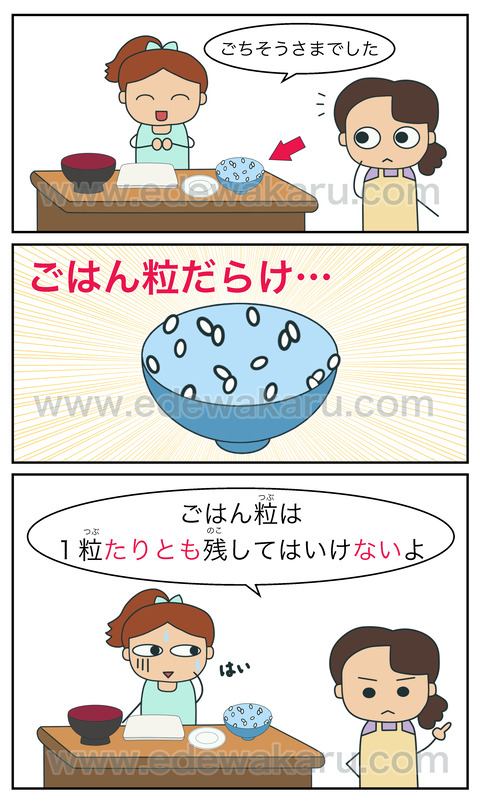
Meaning
1〜も〜ない
〜であっても、絶対に〜ない
How to use it
1+助数詞+たりとも〜ない
名詞[辞書形]+たりとも〜ない
Explanation
「1〜たりとも〜ない」は「1〜も〜ない」という意味を表す文型です。「1〜も〜ない」を強調して言いたい時に使われますが、かたい言い方ですので、あまり会話では使われません😅日常会話では「1〜も〜ない」を使うのが一般的です。
ほとんどの場合は「1〜たりとも〜ない」というように「1」と一緒に使われます。
後ろには「〜するな」「〜てはいけない」など、禁止・命令などの表現がよくきます😀
【上級レベルの人へ】
「何人たりとも」は慣用表現です。とてもかたい表現ですから、普段の会話では使うと不自然に聞こえますので、聞いてわかればOKです😉
「何人たりとも」→誰でも例外なく
書き言葉的な表現ですが、N1を受ける人はしっかりと覚えておきましょう😊
In context 3 examples
ごはん粒は1粒たりとも残してはいけないよ!
→ごはん粒は1粒も残してはいけないよ!明日は試験だ。1日たりとも無駄にはできない
→明日は試験だ。1日も無駄にはできない試合中は1分たりとも油断するな!
→試合中は1分も油断するな!
日本語文型辞典 英語版
Meaning
【たりとも】[...たりとも...ない][Nたりとも...ない][数量詞+たりとも...ない]
Expresses the meaning that even the smallest number of people or quantity cannot be tolerated, and is used in forms such as 一人, 一滴, 一日たりとも...ない. 一 is the normal form (number) used. In more informal language, forms such as ひとりも and 一滴も are used. This is a literary expression used for very polite written language or formal spoken language (e.g. in meetings or for public speeches).
In context 5 examples
試験まであと一カ月しかない。一日たりとも無駄にはできない。
There is only one more month before the exam. I can’t waste even one day.
水がどんどんなくなっていく。これ以上は一滴たりともむだにはできない。
The water is rapidly being used up. We can’t waste even one drop from now on.
密林の中では、一瞬たりとも油断してはいけない。
One cannot relax even for a split second in a dense forest.
この綱領について変更は一字たりとも許されない。
Not even one letter of this manifesto may be changed.
だれもが敵は一人たりとも逃がさないと決意していた。
Everyone was determined not to let even one enemy escape.
くらべてわかる日本語表現文型辞典
Meaning
Aは最小の単位としての例示であり、まったくBないことを表す。
How to use it
AたりともBない
[名詞-∅]たりとも
Explanation
【対比1】
「AもBない」
「AもBない」と意味は同じ。「AたりともBない」は強調表現である。
○あなたのことを一日たりとも忘れたことはなかった。
○あなたのことを一日も忘れたことはなかった。
Notes
【注意1】
・Aには「1」を含む語しかこない。また、Aは最小の単位のため、「1年・1キロ…」など、あまり大きい単位では使わない。
・慣用的表現に「何人たりとも」(だれであっても)がある。
○この部屋には、何人たりとも立ち入りを禁ず。
In context 4 examples
車を運転するなら、酒は一滴たりとも飲んではいけない。
税金は国民の汗の結晶なのだから、一円たりとも無駄遣いは許せない。
疲れてしまい、もう一歩たりとも歩けない状態だった。
私はあなたのことを一瞬たりとも疑ったことなどありません。
毎日のんびり日本語教師
How to use it
1+助数詞+たりとも~ない
Explanation
「たりとも」の前には1日、1人、1秒などの「1+助数詞」の形が接続され、後件に必ず否定が伴います。
「~さえも~ない」とほぼ同義で、特に数量が少ないことを強調する文型です。
命令や禁止にもよく使われます。
「何人(なんぴと/なんびと)」は慣用句。
Notes
似ている文型「【N1文法】~として~ない」も「1+助数詞」の形で接続して数量が少ないことを表せますが、こちらには「2+助数詞」の形でも接続できます。
〇
彼みたいな人は2人としていない。
✕
彼みたいな人は2人たりともいない。
In context 8 examples
渋滞で1mmたりとも進まない。
1秒たりとも気を抜くな。(即使是1秒也不要放松。)
何人たりともこの先に立ち入ることは許されない。
和平交渉は1cmたりとも進まなかった。
申し訳ないという気持ちは1mmたりともありません。
ダイエットして2週間経ったけど1kgたりとも落ちなかった。
何を言ってるのか1mmたりとも分からない。
プライベートでは1杯たりともビールを飲みたくない。(私底下哪怕是一杯啤酒也不想喝。)