日本語文型辞典
Meaning
a. Nのあいだ【空間】
二つの場所・物にはさまれた空間を表す。両方を示す場合は①のように「NとNのあいだ」を使う。
b. Nのあいだ【関係】
「複数の人やことがらの関係の中で」という意味を表す。そこでの状態や動作、そこで起こる出来事などを述べるのに用いる。
a. …あいだ
ある状態、動作が続いている期間を表す。後にはその期間中継続する状態や並行して起こっている動作を表す文が続く。後の文の述語は、動作を表す動詞の場合は「V-ている」「V-つづける」など継続の意味を表す形になる。
過去のことについて言う場合は「V-ていた/A-かった あいだ」の形も用いられる。
b. …あいだに
ある状態・動作が続いている期間を表す。後にはその時間内に行われる動作、起こる事態などを表す文が続く。後の文の述語は動詞で、「…する」「…しはじめる」「…になる」など、継続を表さない形になる。
過去のことを言う場合は「…たあいだに」の形も用いられる。⑤のように、前と後ろの動作主が異なる場合は、二人が同時に並行して動作を行うという意味になる。
How to use it
Nのあいだ
あいだ【時間】
Nのあいだ
A-いあいだ
V-ている/V-る あいだ
Nのあいだに
Naなあいだに
A-いあいだに
V-ている/V-る あいだに
In context 24 examples
ステレオと本棚の間にテレビを置いた。
古本を買ったら、ページの間に1万円札がはさまっていた。
大阪までの間のどこかで駅弁を買って食べよう。
最近二人の間はうまくいっていないようだ。
そのホテルは安くて清潔なので、旅行者たち間で人気がある。
二つの事件の間にはなにか関係があるらしい。
彼は会議の間ずっといねむりをしていた。
彼女が戻ってくるまでの間、喫茶店で本を読むことにした。
一生懸命泳いでいる間はいやなことも忘れてしまう。
子供が小さい間は、なかなか夫婦での外出ができなかった。
友子は、大阪にいる間は元気だったが、東京に引っ越したとたんに体をこわしてしまった。
私たちがお茶の用意をする間、彼らは緊張して一言もしゃべらずに座っていた。
(誤) 私が勉強している間、弟は遊んだ。
(正) 私が勉強している間、弟は遊んでいた。
(例) 彼はドイツに留学していた間、スウェーデン人の女の子と一緒に生活していたらしい。
留守の間にどろぼうが入った。
4時から5時までの間に一度電話をください。
家族がみんな寝ている間に家を出ることにした。
リサが日本にいる間に一緒に旅行したかったのだが、残念ながらできなかった。
私がてんぷらを揚げる間に、母はおひたしと酢の物と味噌汁まで作ってしまった。
あそこも日本人旅行者が少ない間に行っておかないと、きっとすぐに開発されて日本人だらけになるだろう。
祖母が元気な間にいろいろ話を聞いておこう。
(誤) 授業の間にずっとおしゃべりをしていた。
(正) 授業の間に3回質問をした。
絵でわかる日本語
Usage 1
Read this source entry ↗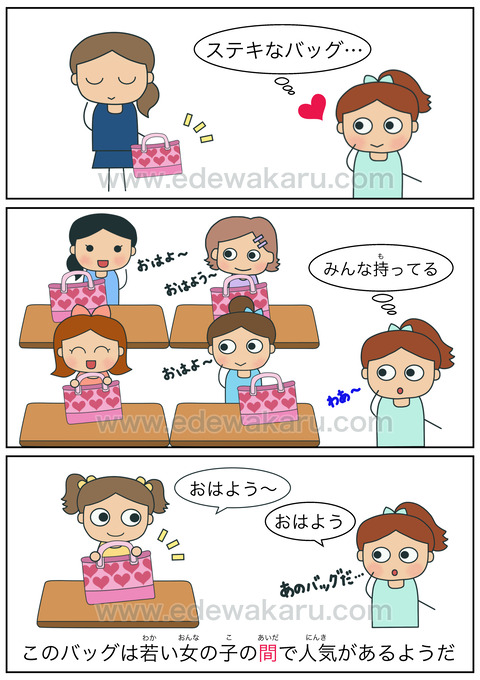
Meaning
〜の中で
〜の関係の中で
How to use it
名詞[辞書形]+の間
Explanation
「〜間」は「〜の中で」「〜の関係の中で」という意味を表す文型です。
【複数の人の中での状態】
や
【〜と〜の関係の中のこと】
などを言いたい時に使います😊
[例]
このバッグは若い女の子の
間
で人気があるようだ
【複数の人の中での状態】
複数の人→若い女の子たち
状態→人気
OLの
間
で話題になっているカフェ
【複数の人の中での状態】
複数の人→OLたち
状態→話題になっている
あのアニメは小学生の
間
で大人気なんだって
【複数の人の中での状態】
複数の人→小学生たち
状態→大人気
私たち夫婦の
間
に秘密なんてありません
【〜と〜との関係の中のこと】
夫と妻の関係の中のこと
このことは親子の
間
の問題だから、口を出さないほうがいいよ
【〜と〜との関係の中のこと】
親と子供の関係の中のこと
「〜間」とつく文型はいくつかありますので、しっかりと区別をして覚えておきましょう😉
In context 5 examples
このバッグは若い女の子の間で人気があるようだ
OLの間で話題になっているカフェ
あのアニメは小学生(しょうがくせい)の間で大人気なんだって
私たち夫婦の間に秘密なんてありません
このことは親子の間の問題だから、口を出さないほうがいいよ
Usage 2
Read this source entry ↗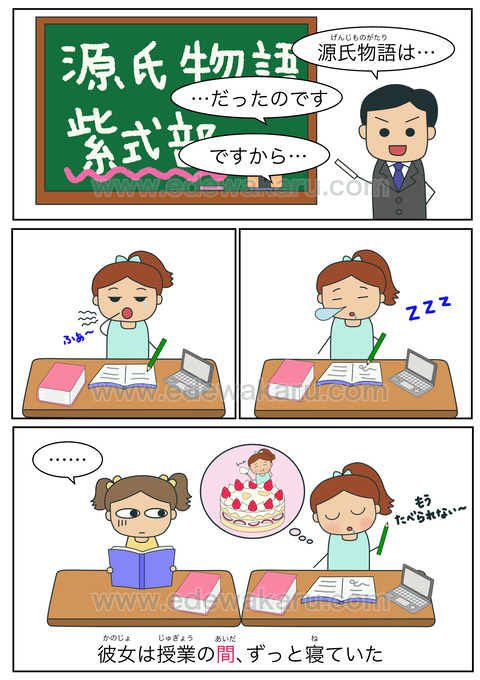
Meaning
〜の状態が続いている期間、ずっと〜する
〜の動作が続いている期間、ずっと〜する
How to use it
動詞[辞書形・ている]+間
形容詞[辞書形]+間
名詞[辞書形]+の間
Explanation
「〜の状態が続いている期間、ずっと〜する」という意味を表す文型です。この文型のポイントは
「〜の状態が始まってから終わるまで、その期間中、ずっと〜する」
というところです。
[例]
①彼女は授業の
間、ずっと寝ていた
→授業
が始まって、終わるまでずっと
寝ていた
②夏休みの
間、アルバイトをするつもりです
→夏休み
が始まってから終わるまでずっと
アルバイトをするつもりだ
③友達を待っている
間、音楽をきいていた
→友達が来る
まで、ずっと
音楽をきいていた
④彼女が料理をしている
間、ゲームをして待っていた
→彼女が料理を
作り始めてから作り終わるまで、ずっと
ゲームをして待っていた
⑤台風のせいで、旅行の
間
ずっと雨が降っていた
→旅行に行った
最初の日から、最後の日までずっと
雨が降っていた
「〜間」とつく文型はいくつかあり、とても複雑です😨この「〜間」は「〜の期間、ずっと〜する」と覚えておきましょう😉
(復習:〜間に)
(復習:〜間(関係))
In context 5 examples
彼女は授業の間、ずっと寝ていた(復習:〜ている(いつもの状態))
夏休みの間、アルバイトをするつもりです
友達を待っている間、音楽をきいていた
彼女が料理をしている間、ゲームをして待っていた
台風のせいで、旅行の間ずっと雨が降っていた(復習:〜せいで)
どんなときどう使う 日本語表現文型辞典
Meaning
throughout (the time…)
How to use it
〔普通形〕(ナAな/Nの)+間
Explanation
「間」は時間幅のある状態を表す言葉につながり、「その時間ずっと」という意味を表す。後にも継続する動作や状態を表す言葉が来る。
Appends to expressions of time, i.e., "throughout the entire time." Words expressing continuing action and conditions follow.
In context 4 examples
わたしは夏の間、ずっと北海道にいました。
両親が旅行をしている間、ぼくが毎日食事を作りました。
兄がゲームをしている間、弟はそばで見ています。
夏休みにとなりのうちがにぎやかな間は、わたしも楽しい気分になる。
日本語NET JLPT文法解説まとめ
Meaning
〜の期間ずっと
How to use it
V(普通形) + 間
イAい + 間
ナAな + 間
Nの + 間
Explanation
while / during
「間」の後ろには継続性のある動作や状態を表す言葉が来る。
In context 14 examples
夏休みの間、実家で過ごすつもりです。
友達が髪を切っている間、私は雑誌を読んで待ちました。
地震で家具や家電が揺れている間は机の下に避難してください。
学校にいる間は、携帯電話の使用は禁止です。
授業の間は、スマホを使ってはいけません。
日本にいる間はなるべく日本語だけを使って生活するつもりです。
電車に乗っている間、ずっと英語のCDを聞いています。
子供が小さい間は、できるだけ早く帰って妻をサポートするつもりです。
友達を待っている間、椅子に座って音楽を聞いていました。
校長先生が話している間、しっかりと話を聞きましょう。
飛行機に乗っている間、ずっと寝ていました。
友達を待っている間、小説を読んでいました。
妻が晩ご飯を作っている間、私はずっとスマホでゲームをしていました。
留守の間、しばらくうちのペットを預かっていただけないでしょうか。
毎日のんびり日本語教師
How to use it
名詞+の+間/間に
動詞普通形+間/間に
Explanation
「~間」も「~間に」も期間を表す文法です。
しかしその使い方は少しだけ違います。
詳しくは 「~間」と「~間に」の違い にまとめていますので、あわせてご覧ください。
Notes
より詳しくという方は 「~間」と「~間に」の違い を見てください。
In context 10 examples
ここ数日の間ずっと待ち望んでたものがうちに届いた。
息子が寝ている間に私も寝なければ…。(儿子睡觉的时候我也必须睡觉)
台風接近に伴いより風雨ともに強くなりますので、避難は日の出ている間にお願いします。
二度寝している間に一回停電したっぽい。(再睡着的时候好像又停了一次电)
ランチとディナーの間に、図書館へ調べ物をしに行った。
休みの間に髪を染めたい。(好想在休息的时候染发)
宇宙の謎とか多分自分が生きている間には解明されないんだろうと思うと悲しい。
GWの間に1回はカラオケにいきたい。(黄金周的时候想去唱次卡拉OK)
料理してる間につまみ食いしちゃう悪い癖。
大学生の間は一度もアルバイトしたことない。
AIUEO JLPT Grammar
Meaning
「〜間」is a sentence pattern used to indicate that an action occurs during a specific period or range of time. It emphasizes continuous actions or events that happen during a set period.
How to use it
動詞+間名詞の+間
Explanation · 日本語
「〜間」は、ある特定の期間や時間の範囲内である動作が行われることを表す表現です。この表現は、特定の期間中に継続的に行われる動作や出来事を強調するときに使われます。
In context 5 examples
休暇の間、家族と一緒に過ごしました。
I spent time with my family during the vacation.
授業の間、携帯電話を使わないでください。
Please do not use your mobile phone during the class.
旅行の間、多くの写真を撮りました。
I took a lot of photos during the trip.
実験している間、研究者たちは慎重に観察を続けました。
The researchers carefully continued their observations during the experiment.
彼は論文を書いている間、図書館にこもっていました。
He holed himself up in the library while he was writing his thesis.
文法
Meaning
〜の期間ずっと
How to use it
V(普通形) + 間
イAい + 間
ナAな + 間
Nの + 間
Notes
「間」の後ろには継続性のある動作や状態を表す言葉が来る。
In context 14 examples
夏休みの間、実家で過ごすつもりです。
友達が髪を切っている間、私は雑誌を読んで待ちました。
地震で家具や家電が揺れている間は机の下に避難してください。
学校にいる間は、携帯電話の使用は禁止です。
授業の間は、スマホを使ってはいけません。
日本にいる間はなるべく日本語だけを使って生活するつもりです。
電車に乗っている間、ずっと英語のCDを聞いています。
子供が小さい間は、できるだけ早く帰って妻をサポートするつもりです。
友達を待っている間、椅子に座って音楽を聞いていました。
校長先生が話している間、しっかりと話を聞きましょう。
飛行機に乗っている間、ずっと寝ていました。
友達を待っている間、小説を読んでいました。
妻が晩ご飯を作っている間、私はずっとスマホでゲームをしていました。
留守の間、しばらくうちのペットを預かっていただけないでしょうか。
NINJAL 日本語文型データベース
Meaning
~の期間中ずっと、ある状態や動作・出来事が続くと言いたいときに使います。
「〜間のN」の形でも使います。
How to use it
Vる間・Vている間/Vない間
Nの間
Notes
「〜」には、継続的な動作・状態を表す文や期間を表す言葉がきます。「〜間」の後には、継続的な動作・状態を表す文がきます。
In context 12 examples
シュミットさんは日本にいる間、ずっと英語を教えていました。
このフリーの仕事がある間は、私は何とか食べていけるだろう。
雨天の日が続いている間、車いす生活の私は結局どこへも行けなかった。
子どもたちがテレビを見ている間、私は旅行先のホテルを調べていた。
赤ちゃんが寝ている間の、ほっとした時間が私は好きだ。
上司が出張でいない間、私がプロジェクトのリーダーを務めた。
夏休みの間、ずっと海外にいました。
留守の間締め切っていたので、部屋の中に湿気がこもってしまった。
この3連休の間、ずっとインスタントラーメンばかり食べていた。
由美はパーティーの間、なぜか不機嫌だった。
パスポートは旅行の間、常時持っていてください。
「留守の間のペットの世話は誰がしたの?」「ペットホテルに預けたよ」
IMABI
While I: ~間
Read this IMABI lesson ↗Explanation
While I: ~間
The word 間(あいだ) has two basic meanings that are interrelated but differ by whether it is treated as a physical interval or a temporal interval. Both meanings can be related to the English word “between,” but it is often more natural to translate it as “while” when used to indicate the interval of time in which Verb 2 (V2 ) coincides with Verb 1 (V1).
Physical Intervals: 間 = Between
When used to indicate a physical interval, 間 may be translated as “between” or even “among.” It may even also literally be translated as “space/interval.” As 間 itself is a typical noun which denotes location, it may be used with any case particle provided that its function makes sense in context.
1. テイラー君は、セス先生とケイトさんの間に座りました。
Taylor-kun sat in between Seth Sensei and Kate-san.
2. 気候変動は、特に若者の間で関心が高まっています。
Interest in climate change is rising especially among young people.
3. その列車はベルリンとメクレンブルクの間を走っています。
That train runs between Berlin and Mecklenburg.
4. イノシシが木々の間から現れた。
A boar emerged from among the trees.
5. 電車とホームの間が広くなっています。
The space between the train and platform has widened.
間 literally means “between.” This can be used in a physical or spatial sense. However, what we want to focus on here is how this is applied to temporal situations. 間 with time phrases means “while.” The actions in the first and second clause respectively aren’t necessarily happening at the same time. However, the latter action does happen within the time frame of the first.
Temporal Intervals: ~間 = “While”
When indicating temporal intervals to mean “while,” ~間 behaves very similarly to other non-deictic time expressions which mark subordinate clauses (after V1) . As the use of particles—に・は・には・∅・も・にも in particular—inherently function no differently with ~間, we will first focus on how ~間 itself generally functions.
The grammar pattern ~間 is broadly defined as denoting that while V1 is ongoing, V2 occurs. In addition to meaning “while,” it may also translate as “during.” Imagine V1 and V2 as being parallel timelines in which the latter happens to coincide as a point within V1, and ~間 helps set up the entire duration from start to end.
6. 食べている間は、テレビを見ません。
I do not watch TV while I am eating.
7. 宿題をしている間、ピザを食べました。
I ate pizza while I was doing my homework.
8. ロンドンに滞在している間に、シェイクスピアの生誕地を訪れるつもりです。
I plan on visiting the birthplace of Shakespeare during my stay in London.
V1 may also be used in the negative. In this scenario, V2 happens during the time interval in which V1 does not occur. Though natural English translations involving ~ない間 often render this structure as “before,” it can be more accurately and literally interpreted as the time period in which V1 has yet to occur.
9. あいつなんだけど、お酒を飲まない間は、大人しいが、酔い始めると、愚痴を言いだすから、気をつけろよ。
About that guy, before he gets to drinking, he’s well-behaved, but when he starts getting drunk, he starts venting, so be careful.
Tense Marking w/ ~間
In the example sentences that we have seen thus far, the tense of V1 has been rendered largely in the progressive form with ~ている minus Ex. 9 which exhibits ~ない, and from just this small sample, it may be difficult to ascertain what difference that choice in tense makes. To complicate matters, it is also possible for V1 to be in the past progressive form (~ていた) in a past perfect continuous1 interpretation.
■V1 ~ている間
As we have seen, the most common tense/aspect used with V1 with ~間 is the progressive aspect marked by ~ている.
10. ゆうべ、寝ている間に大地震がありました。
Last night while I was sleeping, there was a large earthquake.
11. 買い物をしている間に、財布をなくしてしまいました。
While I was shopping, I accidentally lost my wallet.
12. セスは彼氏が買い物をしている間、本屋で時間をつぶした。
While Seth’s boyfriend was shopping, he killed time at a bookstore.
In the event that the agent (doer) of both clauses is the same entity, and if both verbs are simultaneously occurring, ~ている間 shares interchangeability with the conjunctive particle ~ながら, which explicitly denotes how the timelines of both actions overlap perfectly. Because V1 and V2 share the same timeline2, the particle に, which would denote V1 as the particular period of time in question, cannot follow ~間 as an effect.
13a. 今日も、こんなことを一人でもくもくと食べている間ずっと考えていたんです。
13b. 今日も、こんなことを一人でもくもくと食べながら、ずっと考えていたんです。
Even today, I thought about this sort of stuff the whole time while I was munching away by myself.
■V1 ~ていた間
While the past tense marker ~た alone cannot be used with ~間3, it is possible to see ~ていた間. The concurrent nature of how V1 occurs along the same timeline as V2 remains in tact, but the choice of rendering V1 in the past perfect interpretation of ~ていた is done out of an attempt to recollect on said act as a past event, which is often parallel to how the past perfect aspect works in English.
14a. 彼氏が晩ご飯の支度をしている間に、宿題を済ませた。
14b. 彼氏が晩ご飯の支度をしていた間に、宿題を済ませた。
I finished my homework while my boyfriend was preparing dinner.
I had finished my homework while my boyfriend had been preparing dinner.
15a. 子供が昼寝をしている間に、本を読み終えました。
15b. 子供が昼寝をしていた間に、本を読み終えました。
While my kids were taking a nap, I finished reading my book.
I had finished reading my book while my kids were napping.
Returning briefly to how ~ている間 exhibits interchangeability with ~ながら, provided the agent of both clauses is the same, ~ている may not appear in another form with 間, and the tense of the main clause determines when both actions occur.
■V1 (Non-Past) ~る間
The purpose of using ~ている in conjunction with ~間 is to indicate that the timeline it creates is lengthy enough to visualize the whole context: from start to finish. However, as we are painfully aware of, ~ている’s interpretation hangs on what sort of verb is used in the first place.
It turns out that ~間 can be used with instantaneous verbs (瞬間動詞) because, even though they are generally characterized as occurring in an instant, this grammar point allows us to superimpose a timeline.
16. 家へ{帰る間に 〇・途中で4 ◎}、手をポケットに入れて財布を休憩室のテーブルに置いてきたのに気付いた。
[While (=in the period of time) I was returning home/on the way going back home], I put my hand in my pocket and noticed that I had left my wallet on the breakroom table.
When these verbs are used with ~ている間, we see that the action described by the instantaneous verb has occurred but that the resulting state is the timeline set forth by ~間 for V2 to occur.
17. 私が出産して実家に帰っている間に旦那が浮気していました。
During the time I was back home at my parents’ house upon giving birth, my husband was having an extramarital affair.
With existential verbs such as いる, which cannot be used with ~ている, the choice of tense/aspect is limited to the non-past tense with ~間.
18. セスさんは、東京にいる間は元気でしたが、帰国したとたんに体を壊してしまったそうです。
Seth-san was well while he was in Tokyo, but I hear that his health deteriorated right after returning to his country.
As for verbs that are neither instantaneous or existential, the use of ~ない間 indicates that the affirmative of this, that being the non-past form, should be possible. Though not nearly as common, provided that the duration of V1 is just enough time for V2 to reasonably occur within its time frame, the non-past tense is possible but rather unlikely.
19. 私がお茶の用意をする間、気まずい沈黙が降りた。
While I prepared tea, an awkward silence ensued.
Particle Use w/ ~間
As mentioned, how particles behave with ~間 does not differ with any other time phrase. For the sake of argument, however, we will take a closer look at this dynamic to ensure that you do not fall victim to a simple particle mistake.
■~間∅
When there is no particle after ~間, V1 and V2 are concurrent though not necessarily correlated to one another. With the absence of the particle に, their timelines are parallel.
20. セス先生が話している間、しっかりと話しを聞きましょう。
Let’s listen closely to what Seth Sensei has to say while he is talking.
21. 電車に乗っている間、ずっと韓国語の勉強用のCDを聴いています。
While I’m on the train, I’m listening to Korean study CDs the whole time.
22. 飛行機に乗っている間、ずっと寝ていました。
I was asleep the whole time while I was on the plane.
23. 返事を待っている間、緊張していました。
I was nervous while I was waiting for a response.
■~間に
The use of the particle に with ~間 is done to indicate that V2 happened within the span of V1, but that by the time V1‘s time span has ended, it is no longer ongoing. This can be interpreted as a consequence of how に more clearly defines the ‘point’ in time when the main clause occurs.
24. 今朝コーヒーを飲んでいる間に、うちのわんこはどうやら小鳥を捕まえて食べてしまったらしいです。
This morning while I was having coffee, it seems as though my doggy somehow caught a little bird and ate it.
25. 友達がタバコを吸っている間に、僕はウォッカを一気に飲んだ。
While my friend was smoking, I downed my vodka in one go.
26. デニーズでは、お食事をしている間に充電ができます。
At Denny’s, you can charge (your device) while you’re eating.
■~間は
The use of just は after ~間 necessitates that the grammatical relationship between V1 and V2 be the same as ~間∅. As is borne from the examples that follow, we see that the the time spans of both clauses remain parallel, and that the use of the particle は brings added attention that V2 is happening concurrently when V1 is.
27. 電車に乗っている間はほとんど読んでいます。
I’m pretty much always reading while I’m on the train.
28. バックスペースボタンを長押ししている間は文字を消し続けてくれます。
While long-pressing the backspace button, (it) continues deleting characters for you.
29. バルセロナにいる間はなるべくカタルーニャ語だけを使って生活するつもりです。
While I am in Barcelona, I plan to go about using only Catalan as much as possible.
■~間も
Following in line with ~間は. ~間も also indicates that V1 and V2 are on parallel timelines, but the nature of V2 is rather surprising given V1.
30. うちの甘えん坊の猫は、家事している間もずっと側から離れません。
My spoiled cat never leaves my side even while I’m doing housework.
31. 先輩は怪我をしている間もずっとこうして物凄いトレーニングしてきていたのだ。
My senpai has accomplished tremendous training through and through like this even while he was injured.
32. 通勤している間も働いているわけじゃないけど、別に休んでいるのでもないよ。
It’s not as if I’m working even while I’m commuting to work, but it’s also not as if I’m taking a break (from work).
■~間には
In the specific timeline prescribed by V1 which is marked by ~間, V2 occurs within said bounds, and that relationship can be contrasted with other hypothetical V2. With the presence of the particle に, it is not the case that V2 is on a separate timeline as V1; it is a point on V1‘s timeline.
33. 自動車を運転している間には、スマホの使用は絶対禁止である。
The use of one’s smartphone is strictly prohibited while driving one’s vehicle (at any given point).
34. 宇宙の誕生の謎とかは多分自分が生きている間には解明されないんだろう。
Mysteries such as the birth of the universe will probably not get solved while (I/one) am alive.
■~間にも
With にも, we can see that V2 happens to also occur during the timeline prescribed by V1 marked by ~間. It, too, posits that V2 occurs on a point within V1, and that relationship is being honed in for some reason.
35. 君が迷っている間にも世界の誰かが成功していく。
Even while you hesitate, there is someone in the world out there who’ll go on to succeed.
36. 食べている間にも脂がにじみ出てくるのがわかる。
You can tell how the fat oozes out even while you’re eating it.
~間 w/ Non-Verbal Predicates
Also just like other similar non-deictic time expressions, the predicates that can be used before ~間 are not restricted to verbal predicates and noun-predicates (whose nouns are attributed or inherently possess verbal qualities). Meaning, it can also be seen used with adjectival and adjectival-noun predicates.
37. 夏の間はアイスを冷凍庫に常備する?
Do you always have ice cream stocked in your freezer during summer?
38. 冬休みの間、毎日カタルーニャ語を勉強していました。
I was studying Catalan every day during my winter break.
39. 夜の間に風向きは東に変わった。
During the night, the wind shifted to the east.
40. 授業の間はスマホを使ってはいけません。
You mustn’t use your smartphone during class.
41. 朝の涼しい間に、野菜の水やりをした。
I watered my vegetables during the cool part of the morning.
42. 近年、元気な間に老人ホームに住み替えたいと思う人が増えてきている。
In recent years, there are more and more people wishing to move into retirement homes while they are in good health.
You may even see ~間 used with adverbial predicates which denote time intervals, as well as after demonstratives like in その間 meaning “meanwhile.”
43. しばらくの間、動画を見ていた。
I was watching video clips for a while.
44. その間、紀美子は3軒の店を切り盛りすることになった。
Meanwhile, Kimiko went on to run three stores.
参照
日本語類義表現使い分け辞典 by 泉原省二 pgs 205-208
The past perfect continuous aspect (過去完了進行形) in English is created with “had been… -ing.” ↩︎
The parallel timelines of V1 and V2 need not necessarily be perfectly concurrent (begin and end at the same time) with ~ている, but this is a requirement for using ~ながら. ↩︎
~た間に is illogical because the interval created with V1 would have had to end before the duration of V2 ever begins, but in this structure, V1 and V2 are occurring within the same time frame, as that is marked by に. ↩︎
Distinguishing between 〇 and ◎ objectively is crucial in understanding what it means for a sentence to be grammatically correct and how it is subsequently interpreted due to the grammar at hand and for a sentence to be both grammatical and most natural (a reflection of what would most likely be said by a native speaker), and how this all ultimately shapes the wording of a discourse. Whether something has a 1-10% chance of being worded as so in light of a far more likely outcome, likelihood is not a factor in grammaticality more so than it is a correlation of naturalness (which could still be wrong if it is indeed what a speaker is trying to say). In this example, the use of ~途中で is far more natural than ~間に, as 途中で (on the way/en route) helps emphasize the vague point in both time and space in which V2 occurs, while ~間に is purely temporal in this construction. The same can actually be said about the English equivalents to these constructions. “On the way” is more likely to be used than “while” with movement verbs. ↩︎
In context 47 examples
テイラー君は、セス先生とケイトさんの間に座りました。
Taylor-kun sat in between Seth Sensei and Kate-san.
気候変動は、特に若者の間で関心が高まっています。
Interest in climate change is rising especially among young people.
その列車はベルリンとメクレンブルクの間を走っています。
That train runs between Berlin and Mecklenburg.
イノシシが木々の間から現れた。
A boar emerged from among the trees.
電車とホームの間が広くなっています。
The space between the train and platform has widened.
食べている間は、テレビを見ません。
I do not watch TV while I am eating.
宿題をしている間、ピザを食べました。
I ate pizza while I was doing my homework.
ロンドンに滞在している間に、シェイクスピアの生誕地を訪れるつもりです。
I plan on visiting the birthplace of Shakespeare during my stay in London.
あいつなんだけど、お酒を飲まない間は、大人しいが、酔い始めると、愚痴を言いだすから、気をつけろよ。
About that guy, before he gets to drinking, he’s well-behaved, but when he starts getting drunk, he starts venting, so be careful.
ゆうべ、寝ている間に大地震がありました。
Last night while I was sleeping, there was a large earthquake.
買い物をしている間に、財布をなくしてしまいました。
While I was shopping, I accidentally lost my wallet.
セスは彼氏が買い物をしている間、本屋で時間をつぶした。
While Seth’s boyfriend was shopping, he killed time at a bookstore.
今日も、こんなことを一人でもくもくと食べている間ずっと考えていたんです。
Even today, I thought about this sort of stuff the whole time while I was munching away by myself.
今日も、こんなことを一人でもくもくと食べながら、ずっと考えていたんです。
Even today, I thought about this sort of stuff the whole time while I was munching away by myself.
彼氏が晩ご飯の支度をしている間に、宿題を済ませた。
I finished my homework while my boyfriend was preparing dinner.
彼氏が晩ご飯の支度をしていた間に、宿題を済ませた。
I finished my homework while my boyfriend was preparing dinner.
子供が昼寝をしている間に、本を読み終えました。
While my kids were taking a nap, I finished reading my book.
子供が昼寝をしていた間に、本を読み終えました。
While my kids were taking a nap, I finished reading my book.
家へ{帰る間に 〇・途中で4 ◎}、手をポケットに入れて財布を休憩室のテーブルに置いてきたのに気付いた。
[While (=in the period of time) I was returning home/on the way going back home], I put my hand in my pocket and noticed that I had left my wallet on the breakroom table.
私が出産して実家に帰っている間に旦那が浮気していました。
During the time I was back home at my parents’ house upon giving birth, my husband was having an extramarital affair.
セスさんは、東京にいる間は元気でしたが、帰国したとたんに体を壊してしまったそうです。
Seth-san was well while he was in Tokyo, but I hear that his health deteriorated right after returning to his country.
私がお茶の用意をする間、気まずい沈黙が降りた。
While I prepared tea, an awkward silence ensued.
セス先生が話している間、しっかりと話しを聞きましょう。
Let’s listen closely to what Seth Sensei has to say while he is talking.
電車に乗っている間、ずっと韓国語の勉強用のCDを聴いています。
While I’m on the train, I’m listening to Korean study CDs the whole time.
飛行機に乗っている間、ずっと寝ていました。
I was asleep the whole time while I was on the plane.
返事を待っている間、緊張していました。
I was nervous while I was waiting for a response.
今朝コーヒーを飲んでいる間に、うちのわんこはどうやら小鳥を捕まえて食べてしまったらしいです。
This morning while I was having coffee, it seems as though my doggy somehow caught a little bird and ate it.
友達がタバコを吸っている間に、僕はウォッカを一気に飲んだ。
While my friend was smoking, I downed my vodka in one go.
デニーズでは、お食事をしている間に充電ができます。
At Denny’s, you can charge (your device) while you’re eating.
電車に乗っている間はほとんど読んでいます。
I’m pretty much always reading while I’m on the train.
バックスペースボタンを長押ししている間は文字を消し続けてくれます。
While long-pressing the backspace button, (it) continues deleting characters for you.
バルセロナにいる間はなるべくカタルーニャ語だけを使って生活するつもりです。
While I am in Barcelona, I plan to go about using only Catalan as much as possible.
うちの甘えん坊の猫は、家事している間もずっと側から離れません。
My spoiled cat never leaves my side even while I’m doing housework.
先輩は怪我をしている間もずっとこうして物凄いトレーニングしてきていたのだ。
My senpai has accomplished tremendous training through and through like this even while he was injured.
通勤している間も働いているわけじゃないけど、別に休んでいるのでもないよ。
It’s not as if I’m working even while I’m commuting to work, but it’s also not as if I’m taking a break (from work).
自動車を運転している間には、スマホの使用は絶対禁止である。
The use of one’s smartphone is strictly prohibited while driving one’s vehicle (at any given point).
宇宙の誕生の謎とかは多分自分が生きている間には解明されないんだろう。
Mysteries such as the birth of the universe will probably not get solved while (I/one) am alive.
君が迷っている間にも世界の誰かが成功していく。
Even while you hesitate, there is someone in the world out there who’ll go on to succeed.
食べている間にも脂がにじみ出てくるのがわかる。
You can tell how the fat oozes out even while you’re eating it.
夏の間はアイスを冷凍庫に常備する?
Do you always have ice cream stocked in your freezer during summer?
冬休みの間、毎日カタルーニャ語を勉強していました。
I was studying Catalan every day during my winter break.
夜の間に風向きは東に変わった。
During the night, the wind shifted to the east.
授業の間はスマホを使ってはいけません。
You mustn’t use your smartphone during class.
朝の涼しい間に、野菜の水やりをした。
I watered my vegetables during the cool part of the morning.
近年、元気な間に老人ホームに住み替えたいと思う人が増えてきている。
In recent years, there are more and more people wishing to move into retirement homes while they are in good health.
しばらくの間、動画を見ていた。
I was watching video clips for a while.
その間、紀美子は3軒の店を切り盛りすることになった。
Meanwhile, Kimiko went on to run three stores.