日本語文型辞典
Meaning
基本情報V-ないまでも説明動詞の否定形を受けて、「そこまでの程度でなくても、せめてこのぐらいは」という意味を表す。前の節に、量や重要性において程度の高いことがらが提示され、後の節にはそれより低い程度のことがらが続く。①②のように、「…とは言わない/言えないまでも」の形もよく使われ、「そこまでとは言わない/言えないが、少なくともこの程度のことは」という意味を表す。文末には「すべきだ」「…た方がよい」などの義務や、意志・命令・希望などの表現が用いられる。文語的なかたい表現に「V-ぬまでも」がある。例文① 毎日とは言わないまでも、週に2、3度は掃除をしようと思う。② 絶対とは言えないまでも、成功する確率はかなり高いと思います。③ 予習はしないまでも、せめて授業には出て来なさい。④ 授業を休むのなら、直接教師に連絡しないまでも、友達に伝言を頼むか何かすべきだと思う。
IMABI
Compare/Contrast
Read this IMABI lesson ↗Explanation
Compare & Contrast: ~に比べて, ~に引き換え, ~に反して,~にもまして, & ~ないまでも
The patterns in this lesson deal with compare and contrast. Although not near as similar to each other as topics in other lessons, you still need to pay attention to detail so that you don’t confuse them with each other.
~{に・と}比べて
The verb 比べる means “to compare,” and because it is the quintessential verb for establishing comparisons, it is heavily used with the standard marking function of both the case particle に and the case particle と, and the choice between the two rests in how they differ in directionality.
XをYと比べる compares X and Y on an even playing field regardless of whether the comparison is contrastive, resulting in a more formal tone. As for XをYに比べる, Y is viewed as the standard for which the contrast that follows is based. Imagine with と that X and Y are brought together and compared side by side (X→←Y), while with に, the direction of focus is pointed at Y (X→Y). Consequently, because the focus is pointed at Y with に, it carries an implication about the merits of the comparison, which is not had with と.
Instead of seeing this grammar point rendered in the て form, you may also see it without て in formal speech (連用形中止法), or you may even see 比べると or any other conditional provided that you account for the unique layer of nuancing provided by said conditional grammar pattern – with 比べると being neutral but to the point.
1. 外は暑いが、それに比べて中は寒い。
It’s hot outside, but, moreover, in contrast, it’s cold inside.
2. この本は昨日読んだのと比べると全くつまらない。
This book compared to the one I read yesterday is completely boring.
3. 彼は妹と比べて若く見えました。
He looked younger beside his younger sister.
4. 今年は去年に比べ、雪の量りょうが多い。
In contrast to last year, there has been a lot of snowfall this year.
5. 欧米諸国の薬剤費が全体の一〇~ニ〇%にとどまっているのに較べて異常な数値だ。
(That) is a bizarre figure in comparison to the pharmaceutical costs of Western countries being confined to 10~20% of their total (costs).
Orthography Note: In formal writing, you may also see the verb 比べる spelled as 較べる.
~に引き換え vs ~と引き換えに
The verb 引き換える has two definitions, each which produces two unique grammar structures which hinge on how に and と differ as standard markers.
The pattern ~に引き換え follows nouns or nominalized expressions to indicate a sharp contrast, one that is both subjective and pertaining to a good vs. bad judgment call by the speaker.
When following nominalized expressions, the nominalizer of choice is the particle の, as is to be expected due to the highly subjective nature of this pattern.
6. 健太の住んでいるマンションは新しくて、広い。それに引き換え、僕のところは古くて狭いし、駅からも遠いよ。
The apartment that Kenta is living at is new and wide. By contrast, my place is old, small, and also far from the train station.
7. 同じ年の人に引き換え、彼はとても頭がよくて、たくさんの素晴らしい偉業いぎょうを成し遂とげました。
In sharp contrast to people of his same age, he is very smart and has made a lot of wonderful achievements.
8. 惑星わくせいの大きさに引き換え、冥王星めいおうせいはとても小さい。
In sharp contrast to the size of a planet, Pluto is very small.
When a contrast is not subjectively charged and the contrast being made is neutral in nature, ~に引き換え will not be the natural word choice. Instead, something like ~に対して would need to be used to enforce neutrality.
9. 整備して明るくなった竹林にはタケノコが生えているのに{対して 〇・引き換え X}、まだ整備していないところは竹が密生して暗く、タケノコが生えていない。
In bamboo forest areas that have gotten brighter from (the light fixtures) we set up, bamboo shoots are growing, whereas in areas where we have not set up (light fixtures), with the bamboo so dense and it being so dark, bamboo shoots are not growing.
The pattern ~と引き換えに means “in exchange for,” and from this we can gather how there is always a difference in directionality between に and と. In Exs. 6-8, we can envision a shift from one expectation, which we will call X, to some other reality, which we will call Y. This X → Y directionality is a fundamental property of に. Meanwhile, the directionality of と is X→←Y, and in this context of “exchange,” factors X and Y merely swap places. Similarly to ~に引き換えに, though, ~と引き換えに often remains highly subjective and emotionally charged, especially when Y is a situation (not restricted to nouns) as opposed to a concrete noun.
10. あいつはわずかなお金と引き換えに、自分の友達を裏切った。
That guy betrayed his own friends in exchange for a measly amount of money.
11. 犯人は人質と引き換えに大金を要求してきた。
The criminal came demanding for a large sum of money in exchange for the hostage(s).
~に反して
The verb 反する may be defined as “to be contrary/go against/violate,” and it is often seen in the pattern Xに反してY to indicate that “Y is contrary to/against X.”
12. 予想よそうに反して成功するのはいつもいいことでしょう。
Succeeding against one’s expectations is always a good thing isn’t it?
13. 神の意に反して人間は互たがいに殺害している。
Against the will of God, humans are slaying each other.
14. 2006年に反して、2007年のステンレス鋼スクラップの貿易では、欧州が輸出を増し、東南アジアが輸入を増した。
Contrary to (the expectation set by) 2006, Europe increased its exports and Southeast Asia increased its imports in the 2007 stainless steel scrap market.
15. 大方の期待に反してサービスの展開が遅れている。
the extending of services is delayed contrary to most expectations.
Note that although this verb is often seen in the て form, it is not limited to it. You may see it as the main verb, modifying another noun in the 連体形, or even see て dropped via 連用形中止法.
16. 我々の期待に反していた。
It was contrast to our expectations.
17. これは直感に反しているが、正しい主張だ。
This may be contrary to intuition, but it is the correct assertion.
18. スポーツ精神に反する卑劣な行為であります。
(It) is a contemptible act contrary to sportsmanship.
19. アメリカの4月の耐久財受注は前の月から減少するとの市場予想に反し、0.7%増加しました。
Durable goods manufacture’s orders for America in April increase 0.7% contrary to market expectation which foresaw a decline from the previous month.
Some learners confuse the purpose of the 連用形 and 連体形 with this construction, but it is important to note how the components of the sentence in relation to ~に反する are not the same. In the case of the 連用形, Y is a verbal expression, whereas in the case of the 連体形, Y is another noun.
20. 国防長官こくぼうちょうかんは事実に反する報告をしました。
The Secretary of Defense made a report contradictory to the facts.
21. 予想に反した1結果が出ると「なぜだろう?」という探究心が生まれ、ますます学ぶ意欲が湧いてきます。
The inquisitive mind is borne from the question of “why?” from getting results contrary to one’s expectations, which brings about all the more ambition to study.
~にもまして
~にもまして, which attaches to nouns including interrogatives, indicates that a current extent builds on a previous/aforementioned one. If a comparison does not have it that both reference points share the same quality to start out with, the use of ~にもまして becomes unnatural and would need to be replaced with something else like the particle より.
22. 今年は去年にもまして暑さが厳しい。
The heat is far more severe than even last year.
23. 最近は以前にもまして物覚えが悪くなった。
Recently, my memory has gotten worse than it was even before.
24. テイラー君は病気がちなセス先生{にもまして X・より 〇}体力があります。
Taylor-kun has more stamina than Seth Sensei, who has a tendency of getting sick.
25. 遼平君は何にも増してマルガリータが好きだ。
Ryо̄hei-kun loves margaritas above all else.
26. 今日はいつにも増して暑い。
Today is hotter than it usually is.
As indicated by the Kanji spelling in Ex. 26, the 増して in this expression derives from the verb 増す meaning “to increase.”
~ないまでも
The pattern ~ないまでも indicates that V1, though not exactly reaching the extent the speaker would prefer, it still reaches the threshold with which V2 is carried out.
27. 毎週とはいわないまでも、せめて月に1回は映画館に行きたい。
Not that it’d have to be every week, but I’d like to at least go to the movies once a month.
28. 快晴かいせいとはいかないまでも、雨は降らないでほしい。
Not that I won’t go if it doesn’t turn out to be clear weather, but I’d like it to not rain.
The use of ~た emphasizes that the realization at hand (the results), which is contrary to the expectation that the speaker had, has occurred as such and remains the case. ↩︎
In context 28 examples
外は暑いが、それに比べて中は寒い。
It’s hot outside, but, moreover, in contrast, it’s cold inside.
この本は昨日読んだのと比べると全くつまらない。
This book compared to the one I read yesterday is completely boring.
彼は妹と比べて若く見えました。
He looked younger beside his younger sister.
今年は去年に比べ、雪の量りょうが多い。
In contrast to last year, there has been a lot of snowfall this year.
欧米諸国の薬剤費が全体の一〇~ニ〇%にとどまっているのに較べて異常な数値だ。
(That) is a bizarre figure in comparison to the pharmaceutical costs of Western countries being confined to 10~20% of their total (costs).
健太の住んでいるマンションは新しくて、広い。それに引き換え、僕のところは古くて狭いし、駅からも遠いよ。
The apartment that Kenta is living at is new and wide. By contrast, my place is old, small, and also far from the train station.
同じ年の人に引き換え、彼はとても頭がよくて、たくさんの素晴らしい偉業いぎょうを成し遂とげました。
In sharp contrast to people of his same age, he is very smart and has made a lot of wonderful achievements.
惑星わくせいの大きさに引き換え、冥王星めいおうせいはとても小さい。
In sharp contrast to the size of a planet, Pluto is very small.
整備して明るくなった竹林にはタケノコが生えているのに{対して 〇・引き換え X}、まだ整備していないところは竹が密生して暗く、タケノコが生えていない。
In bamboo forest areas that have gotten brighter from (the light fixtures) we set up, bamboo shoots are growing, whereas in areas where we have not set up (light fixtures), with the bamboo so dense and it being so dark, bamboo shoots are not growing.
あいつはわずかなお金と引き換えに、自分の友達を裏切った。
That guy betrayed his own friends in exchange for a measly amount of money.
犯人は人質と引き換えに大金を要求してきた。
The criminal came demanding for a large sum of money in exchange for the hostage(s).
予想よそうに反して成功するのはいつもいいことでしょう。
Succeeding against one’s expectations is always a good thing isn’t it?
神の意に反して人間は互たがいに殺害している。
Against the will of God, humans are slaying each other.
2006年に反して、2007年のステンレス鋼スクラップの貿易では、欧州が輸出を増し、東南アジアが輸入を増した。
Contrary to (the expectation set by) 2006, Europe increased its exports and Southeast Asia increased its imports in the 2007 stainless steel scrap market.
大方の期待に反してサービスの展開が遅れている。
the extending of services is delayed contrary to most expectations.
我々の期待に反していた。
It was contrast to our expectations.
これは直感に反しているが、正しい主張だ。
This may be contrary to intuition, but it is the correct assertion.
スポーツ精神に反する卑劣な行為であります。
(It) is a contemptible act contrary to sportsmanship.
アメリカの4月の耐久財受注は前の月から減少するとの市場予想に反し、0.7%増加しました。
Durable goods manufacture’s orders for America in April increase 0.7% contrary to market expectation which foresaw a decline from the previous month.
国防長官こくぼうちょうかんは事実に反する報告をしました。
The Secretary of Defense made a report contradictory to the facts.
予想に反した1結果が出ると「なぜだろう?」という探究心が生まれ、ますます学ぶ意欲が湧いてきます。
The inquisitive mind is borne from the question of “why?” from getting results contrary to one’s expectations, which brings about all the more ambition to study.
今年は去年にもまして暑さが厳しい。
The heat is far more severe than even last year.
最近は以前にもまして物覚えが悪くなった。
Recently, my memory has gotten worse than it was even before.
テイラー君は病気がちなセス先生{にもまして X・より 〇}体力があります。
Taylor-kun has more stamina than Seth Sensei, who has a tendency of getting sick.
遼平君は何にも増してマルガリータが好きだ。
Ryо̄hei-kun loves margaritas above all else.
今日はいつにも増して暑い。
Today is hotter than it usually is.
毎週とはいわないまでも、せめて月に1回は映画館に行きたい。
Not that it’d have to be every week, but I’d like to at least go to the movies once a month.
快晴かいせいとはいかないまでも、雨は降らないでほしい。
Not that I won’t go if it doesn’t turn out to be clear weather, but I’d like it to not rain.
The Particle まで II
Read this IMABI lesson ↗Explanation
The Particle まで II
Back in Lesson 63, we learned that the particle まで has four broad usages which all center around the concept of “extent” while differing on the exact grammatical mechanics. In that same spirit, we will be investigating other applications of まで, categorizing by how まで functions from the point of view of part of speech.
Usage 1: Case Particle まで = “Until/Up to”
Usage 2: (Range-Indicating) Case Particle まで = “From… To…”
Usage 3: Adverbial Particle まで = Extremity
Usage 4: Adverbial Noun/Dummy Noun = Severe Degree/Furthest
Usage III: ~てまで
A very important application of Usage III of まで which was not covered in the first lesson is when it follows the て form of verbs. This pattern indicates that the agent goes through the effort despite their reluctance to bring about the following clause. If the following clause fails, it is often followed by the particle のに, which is then followed by the ultimate consequence.
1. 県民大会けんみんたいかいを開いてまで反対を訴うったえたのに、オスプレイは配備はいびされてしまった。
Although we voiced our protest by going as far as to open a meeting of the prefecture citizens, the Ospreys ended up being deployed.
From NHK on January 22, 2012.
2. 体を壊してまで、仕事を続ける。
To continue the/a job to the point of damaging one’s health.
3. 「苦肉の策」は自分の身を傷めてまでも敵を欺くことを指す言葉です。
“Kuniku no saku” is a phrase that refers to deceiving an enemy even at the cost of hurting oneself.
As an application of Usage III, the relationship ~てまで has with the negative is complicated. Consider the following:
4. お金を払ってまでコーラを飲まない。
I don’t drink coke to the point of spending money for it.
One major reason for why the extreme degree (Usage III) iteration of まで is said to not work with the negative is because the extreme degree marked by まで necessitates that something occur because of it. This remains true for Ex. 4 in how it cannot be interpreted. Meaning, Ex. 4 cannot mean “I go so far to spend money to not drink coke.” Here, the negation can be seen negating the premise of the entire sentence. Even so, there are still two potential interpretations of the sentence.
4′. [お金を払ってまでコーラを飲ま]ない。
I don’t [drink coke to the point of spending money for it].
(Agent doesn’t drink coke)
4”. [お金を払って]までコーラを飲まない。
I don’t drink coke to the point of [spending money for it].
(Agent does drink coke but doesn’t pay for it)
5. 10万ドル払はらってまでテキサス大学に入りたくないよ。
I don’t want to go to the University of Texas to the point of paying $100,000.
Usage III: ~までして
Of the same vein as ~てまで but with a distribution, ~までして is seen after nouns (including verbal nouns with する) and adverbial determiners. Intrinsically, this is just the て form of Usage III being used with する, and as such,する is not restricted to being in this form (Ex. 9).
6. そこまでして勝ちたいのか。
You’d go that far just to win?
7. 何故そうまでして嘘をつかなきゃいけないんだよ!
Why would you have to go that far to lie?
8. 徹夜{までして・してまで}とても頑張ったそうです。
I heard that (he) tried so hard that he went so far as to stay up all night.
9. 借金{までして・してまで}物を買う人がいますが、どうしてお金が貯まってから買わないのでしょうか。
There are people who will by things to the point of going into debt, but why is it that they don’t buy (those things) once they’ve saved up the money (for them)?
10. 回収まですることなのでしょうか。
Do (they) really need to go so far as to recall (it)?
Usage IV: ~まで(のこと)だ = The Extent of the Matter at hand
The pattern ~まで(のこと)だ indicates that the intent of the agent does not extent beyond the action in question. This intent to not go beyond the extent declared, however, is borne from a willpower made possible only by there being no perceivable other option. That in and of itself, though, is presented in a light-hearted, unserious manner by the part of the agent.
The inclusion of のこと both emphasizes the structure and re-nominalizes the phrase as a whole. This subtle difference is what prevents this structure from being alternatively interpreted as severe degree, which would otherwise be inherent of the dummy-noun まで when it possesses a far more adverbial role.
11. 誰も協力してくれないんなら、自分でやってみるまでさ。
If no one else will help out, I’ll just have to do it myself.
12. 来月ビザが更新できないのであれば、帰国するまでのことです。
In the case I can’t renew my visa next month, then I’ll be returning to my country, and that’s that.
13. 給料があがらないのなら、転職するまでだ。
If your salary doesn’t go up, then switch jobs: that’s that.
14. ここまでして罪を認めないなら、裁判を起こすまでだ。
If you’ve gone this far yet won’t admit to your wrongdoing, then I am left with no other choice but to file a lawsuit.
Whenever this pattern is used with the past tense, it indicates how the action of the agent was inconsequential, which although in line with what is above, is usually discussed as a separate
15. 考え事をしていたまでです。
I was just thinking (and nothing more).
16. 人として正しいことをしたまでだ。
I did only what was right as a person (and nothing more).
Usage IV: ~までもない
~までもない indicates a lack of need to go so far as to do the act in question, and it is most often translated as “there is no need to…”
17. それをするまでもない。
There’s no need to do that.
18. 手紙に書くまでもないことだから、電話で伝える。
Because it’s not necessary to write a letter, I’ll tell you on the telephone.
19. 確かめるまでもなく明らかだった。
It was clear without even having to check.
20. それは言うまでもないよ。
That goes without saying.
Usage IV: ~ないまでも
The pattern ~ないまでも, while similar in construction to ~までもない, above, differs with how も functions grammatically. Here, も functions as a conjunctive particle indicating a contrastive circumstance (逆接).
The exact nuancing at hand indicates that V1, though not reaching the extent it could, still reaches the threshold with which V2 is true, translating more literally into English as “even though not quite to the point of…” The key to using this structure naturally is making sure that V1 be either an extreme example or ideal (that can never be reached = extreme situation) and that V2 (the actual result) be within the realm of acceptability.
21. セス先生のお父さんは、プロにはなれないまでも、ゴルフをやり続けていくつもりらしい。
Seth Sensei’s father apparently intends on continuing playing golf although he may never quite become a pro.
22. 毎年とは言わないまでも、数年に一度はエアコンフィルターを交換しておいた方がいいですよ。
Although not quite every year, it’d be best to change out your air conditioner’s filter at least once every other several years.
Usage III: ~(ほど)までに
When after the 連体形 of a verb, ~までに1 may indicate how said event is now well within the realm of possibility. In this sense, the severe degree to which this is in line with Usage IV, but given how the adverbial particle ほど may intervene in the structure, the adverbial particle nature of まで indicating an extremity is also strongly felt. This application of まで is best translated as “to the point of.”
23a. わたしは死ぬほど(までに)苦くるしんだ。
23b. わたしは死ぬ(ほど)までに苦しんだ。
I suffered to the point of death.
24. 彼らは生きている人間と見紛うまでに精巧なオートマトンを作り出した。
They produce an automaton so exquisitely to the point it could be confused for a living human being.
The use of the particle に clarifies the intensity as a metaphor as opposed to a literal realization of V1 This can be contrasted with Usage 1 of まで after verbs, which does have V1‘s realization taken literally. Note that, though not discussed in Lesson 63, Usage 1 of まで when after verbs may be preceded by とき (when) as well as くらい・ほど with no change in meaning or function.
25. テイラー君は死ぬ(とき)まで苦しんでいた。
Taylor-kun had suffered until (the moment) he died.
In the case of くらい・ほど being followed by まで, まで would normally not follow given how setting an estimated goal as the furthest extent would limit further development of the situation that might follow.
26. 胃痛になるほど(まで)悩んだ。
I worried by myself (up) to the point of having stomach aches.
27. カラオケで歌えるようになるくらい(まで)練習しなさい。
Please practice to the point (until) you can sing at karaoke.
These examples also indicate how the extent of time Usage I まで establishes blends into the particle’s ability to indicate degree/severity, as an intense situation unfolding described by the situation still requires time to occur, though whether time elapsing is really at the forefront of the speaker’s mind depends on the severity being described. For instance, in Ex. 26, the anxiety the speaker experienced could have onset the stomach pain instantaneously, but there is nothing intrinsic about Usage III まで seen here that indicates a more concrete temporal interpretation.
Meanwhile, in Ex. 27, まで can more safely be interpreted as Usage I > Usage III, as the degree is not severe. The same can be said for Ex. 28.
28. 小さい文字がはっきり読めるまで画面を明るくしました。
I brightened up the screen to the point I could clearly read (the) small print.
29. ミドリを入れるまで、ドリンクは緑色ではなかった。
The drink was not green until I added in the Midori.
However, a key difference between Usage I and Usage III is that severe degree as opposed to extent of time cannot be attributed to a negative outcome2 (Ex. 29), as we also saw with ~てまで. This critical feature of Usage III is what also distinguishes it from other particles which denote extreme situations like さえ3.
Grammatically speaking, the only context in which Usage 1/Usage III and さえ appear, albeit with different meanings, where confusion may consequently occur is when they follow a noun with the potential of an intervening case particle, most notably に. That being said, consider the difference between the following:
30a. 親にまでゲイであることを打ち明けた。
30b. 親にさえゲイであることを打ち明けた。
30c. 親にまでゲイであることを打ち明けなかった。
30d. 親にさえゲイであることを打ち明けなかった。
30e. 親にまではゲイであることを打ち明けなかった。
30f. 親にまでゲイであることを打ち明けたのではない。
30g. 親にもゲイであることを打ち明けなかった。
30h. 親にでもゲイであることを打ち明けなかった。
30a. I went so far as to come out as gay to my parents.
30b. I even came out as gay to my parents.
30c. I didn’t take that final step of coming out as gay to my parents.
30c’. I didn’t come out as gay to the extent of doing so to my parents.
30d. I didn’t even come out as gay to my parents.
30d’. I didn’t come out as gay to my parents on top of (who I did come out to). X
30e. I didn’t come out as gay to my parents (but I did manage to do so to others).
30f. I did not make that final step of coming out as gay to my parents.
30g. I also/even didn’t come out as gay to my parents.
30h. I didn’t come out as gay, even to my parents.
Ex. 30 forces us to consider how まで and さえ differ within the broad distribution – affirmative/negative sentences – where they may both occur.
30a. indicates that agent likely came out to their parents as a last resort, with their parents being the final extent.
30b. indicates that the agent coming out to their parents is a big deal, with さえ heavily emphasizing the sense of “even.” Whether their parents were the last, crucial people to find out is not indicated.
30c. has two interpretations – 30c and 30c’ – based on the consequence of the extent set by まで. In 30c, the agent’s parents are viewed as the highest source of trust between the agent and that the agent did not go to the extent of even coming out to them. This reading rests on the notion that まで is more akin to Usage III, which albeit irregular, is not impossible due to the agent’s situation not changing – the agent is still in the closet. 30c’ is the more likely interpretation, as it applies that while the agent’s parents may still be the furthest extent coming out to may be carried out, the issue is not serious enough to warrant having to go that far; meaning, some people were told, just not to the extent of telling the parents.
30d. The more natural rendering of the first interpretation of 30c, the agent highly emphasizes how they didn’t even come out to their parents; however, the possibility of 30d’, although unlikely, is striking both in how it exists and how it still differs from 30c’, which rests on a far more literal interpretation of さえ4 that has disappeared from negative sentences in modern usage, thus the X grammaticality judgment.
30e. is a non-ambiguous rendering of 30c’.
30f. is a non-ambiguous yet far heavier rendering of 30c, negating a result that the agent is culpable for not doing, which the agent will subsequently explain their reasoning for.
30g. The most no-strings-attached rendition, the use of も does not indicate that the choice of not coming out to their parents is extreme, but it does give the sense that their parents weren’t the only ones not told.
30h. With the use of でも, the negation is heavily stilted towards [親に], but just like with も, the predicate of “coming out” is not being presented as an extreme situation.
The paraphrases 30e-f are most telling as for how まで and さえ differ in negative constructions. While wide-scope interpretations like 30c are possible with まで but more likely to be rephrased with さえ, narrow-scope interpretations like in 30c’, 30e-f are far more likely with まで but also impossible with さえ.
31. テイラー君{まで 〇・さえ X}試験に合格したのではない。(Narrow Scope)
It is not the case (the students) passed the test to the point Taylor-kun did.
Usage I or III: まで + Case Particles
While まで’s relationship with the other particles is fairly predictable in general practice, its dual case/adverbial particle results in rather weird combinations. Excluding ~までに and ~までで which were covered in Lesson 63, consider the following combinations.
~までが
So long as the particle まで is used as a case particle, it may be optionally followed by the case particle が. The effect this has on the sentence is one of grammatical emphasis. This also applies when が is used in conjunction with から (Usage II).
32. 足の下の畳たたみまでが冷ひえて来るので、一人で湯ゆに行こうとすると、 「待って下さい。私も行きます。」と、今度は女が素直すなおについて来た。
While I was about to go bathe alone since even the tatami mat underneath my feet was getting cold, she finally came by this time and meekly said, “Wait for me. I’m going too.”
From 『雪国』 by 川端康成.
33. 緊急時において、経営層から現場の第一線までが適切に行動できるよう、それぞれの役割に応じた訓練を実施しております。
So that (we) can adequately mobilize from our management level to those on the front line, we routinely conduct drills suited to every role.
~までを
So long as the particle まで is used as a case particle, it may be optionally followed by the case particle を. The effect this has on the sentence is one of grammatical emphasis. This also applies when を is used in conjunction with から (Usage II).
34. 円周率は小数点以下2000桁までを暗記している。
I have pi memorized up to 2000 digits past the decimal point.
35. 子供からお年寄りまでを繋げるプロジェクトを開催いたしました。
We opened a project to connect (the community) from children to the elderly.
~をまで
Though excessively rare, the case particle を may appear before まで when it indicates extreme degree. This is highly literary and unlikely to ever be heard in the spoken language. Though, due to the emphatic nature of the combination, it is usually rendered as ~をまでも (see below).
~までへ
Structurally redundant though not impossible, this case particle combination would be used to exaggerate the distance factor behind the extent set by まで.
36. 我々は社員が納得できるビジョンを組織のトップから組織の隅々までへと浸透させていく。
We are aimed to spread a vision that our employees can back from those in the senior management of the organization to those in its every last nook and cranny.
~へまで
The reverse, ~へまで, is very common. Here, へ ought to be viewed as a case particle, while まで should be viewed as an adverbial particle (Usage III) which emphasizes such a great distance as the extent reached.
37. 彼は大破局で得た傷も癒えぬまま、未来へまで飛び込んだ。
With the wounds he had earned from his major collapse unhealed, he jumped into his future (that being the furthest extent he could jump).
~にまで
This combination has about just as many interpretations as に does usages, with the case particle role being established by に and the (extreme) degree being emphasized by まで.
38. この戦いは今日にまで至る。
This fight spans up into the present day.
39. 山の水が湖に流れるのだが、車の走っている道にまで流れているのだ。
Though the mountain water flows into the lake, it is flowing up into streets with cars passing.
40. 寒月君、君の事を譫語(うわがと)にまで言った婦人の名は、当時秘密であったようだが、もう話しても善かろう。
Coldmoon, my dear fellow, I seem to remember at the time the name of that young lady who called your name from the depths of her delirium was to be kept secret, but surely the time has now come when you can speak of her?
From 『吾輩は猫である』by 夏目漱石.
41. 客足が約1割にまで減ったという。
(They) report that customer traffic has dropped to approximately 10% (of what it usually is).
42. 女には逃げられるわ、ヤクザには脅されるわ、終いにゃ売春婦にまで騙された。
Being avoided by women and intimidated by the yakuza, in the end, I was even deceived by a prostitute.
43. 今までは車屋のかみさんでも捕
つらまえて、鼻づらを松の木へこすりつけてやろうくらいにまで怒
おこっていた主人が、突然この反古紙
ほごがみを読んで見たくなるのは不思議のようであるが、こう云う陽性の癇癪持ちには珍らしくない事だ。
The fact that my master, who until but a moment ago was so frenetically incensed that he could happily have grabbed the wife of the rickshawman and ground her snout against some pine tree, now suddenly wishes to read old scraps of paper may seem a little strange, but actually such conduct is not all that unusual in an extrovert so easily entered.
From 『吾輩は猫である』by 夏目漱石.
Usage III~IV: ~までも + {が・を}
While we have established how ~までも exists as an emphatic variant of Usage III, the adverbial nature of both まで and も also have the added effect of canceling out the case particles が・を, yet on seldom occasion, this factor alone fails to delete them. This results in three odd particle combinations:
・までもが
・までをも
・までもを
While ~までもを may be explained due to the combination をも being heavily used in old-fashioned speech – indicating that the ellipsing of を before adverbial particles5 is a recent phenomenon, the grammaticality of までもが and までもを are both contingent on the lexicalization of the particle も within adverbial noun6 phrases, most notably with interrogatives but also with Usage III of まで. If a speaker finds 誰もに acceptable (as opposed to using the established 誰にも), that same speaker will likely find ~までもを acceptable.
44. 日本人までをも魅了みりょうした異文化いぶんかの習慣しゅうかん
A tradition of another culture that has fascinated even Japanese people
45. あの戦争で愛する夫おっとと父をなくし、終戦後しゅうせんごの混乱こんらんの中で母までもをなくし、あわただしい結婚生活の中で子どもをもうけるいとまなく、以来天涯孤独いらいてんがいこどくの身みをかかえて生きて参まいりました。
I lost my beloved husband and father in that war, and I even lost my mother in the turmoil after the end of the war, and with there being no time to bear a child in my busy married life, I have since picked myself up and lived on alone with no relatives.
From 『海辺のカフカ 上』 by 村上春樹.
46. 忠雄名義の銀行預金口座から、ほぼ全額が引き出されていた。御丁寧なことに、定期預金までもが解約されていた。
Nearly all of the funds had been withdrawn from their bank account which was under his name, Tadao. Even the money that had been in his savings account had been thoroughly removed and account closed.
From 『祈りの幕が下りる時』by 東野圭吾.
Provided まで indicates extreme degree and it is already emphasized by を coming first, that means ~をまでも is also possible. Though highly literary, do not be surprised if you encounter this variant.
47. 同時に、一方では、あのおそろしい猛火と混乱との中で、しまいまで、おちついて機敏に手をつくし、または命をまでもなげ出して、多くの人々をすくい上げた、いろいろの人々のとうといはたらきをも忘れてはなりません。
Meanwhile, simultaneously, amid those terrifying flames and the chaos, one mustn’t forget the noble labor of all the people who, composed and with their quick wit left no stone unturned, sacrificing even their lives, rescued so many people.
From 『大震火災記』by 鈴木三重吉.
参照
二種のマデ節について by 小西正人.
とりたて詞「まで」「さえ」についてー否定との関わりからー by 茂木俊伸.
「さえ・まで」の分布についての一考察 by 朱武平.
This iteration of the particle に is its adverbial function, not its temporal function. ↩︎
It is the extreme situation which affirmatively brings about some change which prevents Usage III from being used with a main clause in the negative, as that change brought about such a severe threshold would consequently not occur. If the sentence does not necessarily describe a change in a situation and the speaker is trying to describe a severe lack of extent which something should have gone for emphatic effect, Usage III may appear valid with the negative, but distinguishing it from Usage I would be both impossible and unproductive. ↩︎
Usage III and さえ both describe extreme situations, but they denote opposite ends of what is meant by “extreme” in negative sentences. まで does not agree with negation as an intensifier, thus being rendered as Usage I when used with ~ない, and as such, it still describes a threshold at the furthest (think upward) extent the situation does not attain. さえ, on the other hand, does agree with negation as an intensifier, and it denotes the lowest extent (think downward) that the situation does not go. ↩︎
さえ’s literal interpretation is “in addition to,” in which case the “extent” of the action is expanded to fit the added element. In the context of さえ…ない, this would be a narrow interpretation, which it no longer has in negative sentences in Modern Japanese. ↩︎
In which case, もは has never existed due to conflicting semantics. ↩︎
While まで here still demonstrates an “extremity,” the appearance of both ~までをも and ~までもを indicates how まで is rather fluid when it comes to part of speech. ↩︎
In context 60 examples
県民大会けんみんたいかいを開いてまで反対を訴うったえたのに、オスプレイは配備はいびされてしまった。
Although we voiced our protest by going as far as to open a meeting of the prefecture citizens, the Ospreys ended up being deployed.
体を壊してまで、仕事を続ける。
To continue the/a job to the point of damaging one’s health.
「苦肉の策」は自分の身を傷めてまでも敵を欺くことを指す言葉です。
“Kuniku no saku” is a phrase that refers to deceiving an enemy even at the cost of hurting oneself.
お金を払ってまでコーラを飲まない。
I don’t drink coke to the point of spending money for it.
10万ドル払はらってまでテキサス大学に入りたくないよ。
I don’t want to go to the University of Texas to the point of paying $100,000.
そこまでして勝ちたいのか。
You’d go that far just to win?
何故そうまでして嘘をつかなきゃいけないんだよ!
Why would you have to go that far to lie?
徹夜{までして・してまで}とても頑張ったそうです。
I heard that (he) tried so hard that he went so far as to stay up all night.
借金{までして・してまで}物を買う人がいますが、どうしてお金が貯まってから買わないのでしょうか。
There are people who will by things to the point of going into debt, but why is it that they don’t buy (those things) once they’ve saved up the money (for them)?
回収まですることなのでしょうか。
Do (they) really need to go so far as to recall (it)?
誰も協力してくれないんなら、自分でやってみるまでさ。
If no one else will help out, I’ll just have to do it myself.
来月ビザが更新できないのであれば、帰国するまでのことです。
In the case I can’t renew my visa next month, then I’ll be returning to my country, and that’s that.
給料があがらないのなら、転職するまでだ。
If your salary doesn’t go up, then switch jobs: that’s that.
ここまでして罪を認めないなら、裁判を起こすまでだ。
If you’ve gone this far yet won’t admit to your wrongdoing, then I am left with no other choice but to file a lawsuit.
考え事をしていたまでです。
I was just thinking (and nothing more).
人として正しいことをしたまでだ。
I did only what was right as a person (and nothing more).
それをするまでもない。
There’s no need to do that.
手紙に書くまでもないことだから、電話で伝える。
Because it’s not necessary to write a letter, I’ll tell you on the telephone.
確かめるまでもなく明らかだった。
It was clear without even having to check.
それは言うまでもないよ。
That goes without saying.
セス先生のお父さんは、プロにはなれないまでも、ゴルフをやり続けていくつもりらしい。
Seth Sensei’s father apparently intends on continuing playing golf although he may never quite become a pro.
毎年とは言わないまでも、数年に一度はエアコンフィルターを交換しておいた方がいいですよ。
Although not quite every year, it’d be best to change out your air conditioner’s filter at least once every other several years.
わたしは死ぬほど(までに)苦くるしんだ。
I suffered to the point of death.
わたしは死ぬ(ほど)までに苦しんだ。
I suffered to the point of death.
彼らは生きている人間と見紛うまでに精巧なオートマトンを作り出した。
They produce an automaton so exquisitely to the point it could be confused for a living human being.
テイラー君は死ぬ(とき)まで苦しんでいた。
Taylor-kun had suffered until (the moment) he died.
胃痛になるほど(まで)悩んだ。
I worried by myself (up) to the point of having stomach aches.
カラオケで歌えるようになるくらい(まで)練習しなさい。
Please practice to the point (until) you can sing at karaoke.
小さい文字がはっきり読めるまで画面を明るくしました。
I brightened up the screen to the point I could clearly read (the) small print.
ミドリを入れるまで、ドリンクは緑色ではなかった。
The drink was not green until I added in the Midori.
親にまでゲイであることを打ち明けた。
30a. I went so far as to come out as gay to my parents.
親にさえゲイであることを打ち明けた。
30a. I went so far as to come out as gay to my parents.
親にまでゲイであることを打ち明けなかった。
30a. I went so far as to come out as gay to my parents.
親にさえゲイであることを打ち明けなかった。
30a. I went so far as to come out as gay to my parents.
親にまではゲイであることを打ち明けなかった。
30a. I went so far as to come out as gay to my parents.
親にまでゲイであることを打ち明けたのではない。
30a. I went so far as to come out as gay to my parents.
親にもゲイであることを打ち明けなかった。
30a. I went so far as to come out as gay to my parents.
親にでもゲイであることを打ち明けなかった。
30a. I went so far as to come out as gay to my parents.
indicates that the agent coming out to their parents is a big deal, with さえ heavily emphasizing the sense of “even.” Whether their parents were the last, crucial people to find out is not indicated.
30e. is a non-ambiguous rendering of 30c’.
has two interpretations – 30c and 30c’ – based on the consequence of the extent set by まで. In 30c, the agent’s parents are viewed as the highest source of trust between the agent and that the agent did not go to the extent of even coming out to them. This reading rests on the notion that まで is more akin to Usage III, which albeit irregular, is not impossible due to the agent’s situation not changing – the agent is still in the closet. 30c’ is the more likely interpretation, as it applies that while the agent’s parents may still be the furthest extent coming out to may be carried out, the issue is not serious enough to warrant having to go that far; meaning, some people were told, just not to the extent of telling the parents.
30e. is a non-ambiguous rendering of 30c’.
The more natural rendering of the first interpretation of 30c, the agent highly emphasizes how they didn’t even come out to their parents; however, the possibility of 30d’, although unlikely, is striking both in how it exists and how it still differs from 30c’, which rests on a far more literal interpretation of さえ4 that has disappeared from negative sentences in modern usage, thus the X grammaticality judgment.
30e. is a non-ambiguous rendering of 30c’.
The most no-strings-attached rendition, the use of も does not indicate that the choice of not coming out to their parents is extreme, but it does give the sense that their parents weren’t the only ones not told.
With the use of でも, the negation is heavily stilted towards [親に], but just like with も, the predicate of “coming out” is not being presented as an extreme situation.
テイラー君{まで 〇・さえ X}試験に合格したのではない。(Narrow Scope)
It is not the case (the students) passed the test to the point Taylor-kun did.
足の下の畳たたみまでが冷ひえて来るので、一人で湯ゆに行こうとすると、 「待って下さい。私も行きます。」と、今度は女が素直すなおについて来た。
While I was about to go bathe alone since even the tatami mat underneath my feet was getting cold, she finally came by this time and meekly said, “Wait for me. I’m going too.”
緊急時において、経営層から現場の第一線までが適切に行動できるよう、それぞれの役割に応じた訓練を実施しております。
So that (we) can adequately mobilize from our management level to those on the front line, we routinely conduct drills suited to every role.
円周率は小数点以下2000桁までを暗記している。
I have pi memorized up to 2000 digits past the decimal point.
子供からお年寄りまでを繋げるプロジェクトを開催いたしました。
We opened a project to connect (the community) from children to the elderly.
我々は社員が納得できるビジョンを組織のトップから組織の隅々までへと浸透させていく。
We are aimed to spread a vision that our employees can back from those in the senior management of the organization to those in its every last nook and cranny.
彼は大破局で得た傷も癒えぬまま、未来へまで飛び込んだ。
With the wounds he had earned from his major collapse unhealed, he jumped into his future (that being the furthest extent he could jump).
この戦いは今日にまで至る。
This fight spans up into the present day.
山の水が湖に流れるのだが、車の走っている道にまで流れているのだ。
Though the mountain water flows into the lake, it is flowing up into streets with cars passing.
寒月君、君の事を譫語(うわがと)にまで言った婦人の名は、当時秘密であったようだが、もう話しても善かろう。
Coldmoon, my dear fellow, I seem to remember at the time the name of that young lady who called your name from the depths of her delirium was to be kept secret, but surely the time has now come when you can speak of her?
客足が約1割にまで減ったという。
(They) report that customer traffic has dropped to approximately 10% (of what it usually is).
女には逃げられるわ、ヤクザには脅されるわ、終いにゃ売春婦にまで騙された。
Being avoided by women and intimidated by the yakuza, in the end, I was even deceived by a prostitute.
今までは車屋のかみさんでも捕
日本人までをも魅了みりょうした異文化いぶんかの習慣しゅうかん
A tradition of another culture that has fascinated even Japanese people
あの戦争で愛する夫おっとと父をなくし、終戦後しゅうせんごの混乱こんらんの中で母までもをなくし、あわただしい結婚生活の中で子どもをもうけるいとまなく、以来天涯孤独いらいてんがいこどくの身みをかかえて生きて参まいりました。
I lost my beloved husband and father in that war, and I even lost my mother in the turmoil after the end of the war, and with there being no time to bear a child in my busy married life, I have since picked myself up and lived on alone with no relatives.
忠雄名義の銀行預金口座から、ほぼ全額が引き出されていた。御丁寧なことに、定期預金までもが解約されていた。
Nearly all of the funds had been withdrawn from their bank account which was under his name, Tadao. Even the money that had been in his savings account had been thoroughly removed and account closed.
同時に、一方では、あのおそろしい猛火と混乱との中で、しまいまで、おちついて機敏に手をつくし、または命をまでもなげ出して、多くの人々をすくい上げた、いろいろの人々のとうといはたらきをも忘れてはなりません。
Meanwhile, simultaneously, amid those terrifying flames and the chaos, one mustn’t forget the noble labor of all the people who, composed and with their quick wit left no stone unturned, sacrificing even their lives, rescued so many people.
文法
Meaning
〜という程度には達しないが
How to use it
V(ナイ形)+ までも
Notes
後件には「少なくとも」、「せめて」といった言葉がよく使われる。
In context 7 examples
今の給料は十分とは言えないまでも、なんとか暮らしていけるだけはあります。
毎月帰ってこいとは言わないまでも、たまには顔を見せて欲しい。
海外旅行とは言わないまでも、国内旅行ぐらい年に1回はしたい。
すでに在庫がなく展示品を買うことになったので、30%引とはいかないまでも、せめて5%引きくらいにはしてほしかった。
毎日とは言わないまでも、週に1回ぐらいは掃除して欲しい。
今はインターネットでたいていのことは調べられるので、答えは見つからないまでも、ヒントぐらいは得られるはずだ。
誕生日なので高価なものとは言わないまでも、何かプレゼントは欲しかった。
Bunpro Grammar Reference
Meaning
May not … but (at least), Even though not, Even if not
How to use it
Verb[ない]+ までも + Phrase
Noun + ではない(1) + までも + Phrase
(1) じゃない
Nuance
A grammar point highlighting that although (A) may not happen, (B). Although not even until the extent of (A), (B).
Explanation
ないまでも is a combination of the negated form of a verb, the case-marking particle まで 'until', and the adverbial particle も 'even'. It will often be translated as 'even though not (A), (B)', or 'it may not be (A), but (B)'. This structure usually presents some form of extreme (A) which has not yet been reached, but the lower extent of (B) cannot be denied. The literal translation is 'even though not reaching (A), (B)'.
この作品は名作だとは言えないまでも、なかなかいい作品だと思う。
This may not be a masterpiece, but I think that it is a pretty good piece.
犯罪などは完全になくせないまでも、減らすように頑張るべきだ。
Even though it may not be possible to eliminate crime, we should try our best to reduce it.
プロ野球選手にはなれないまでも、プロ野球に関わる仕事をしているので満足している。
Even though I can't become a professional baseball player, I am satisfied because my job is related to professional baseball.
Depending on the source, this structure may occasionally be used with nouns. In this case, it will need to follow ではない, or the casual じゃない.
毎週ではないまでも、娘に会えるだけ幸せだ。
I'm just happy to see my daughter, even if it's not every week.
好きな仕事ができないから幸せじゃないまでも、生活費に困っていないから文句は言えない。
Even though I can't do what I love for work, I can't complain because I am not struggling with my bills.
This grammar pattern will be used in both positive and negative situations. For example, (A) may be the best outcome, where (B) is something just below that which is desirable, or (A) may be the worst outcome, where (B) is just below that, but still quite bad.
Often, the (B) phrase will express some kind of wish or demand that the speaker wants to meet with structures like たい, てほしい, てください, たらどう, つもり, といい, etc.
Nuance · 日本語
(A)が起こらないかもしれないが、(B)は起こるかもしれないということを強調する時に使われる文法。(A)までではないが(B)。
Explanation · 日本語
「ないまでも」は、(A) という極端な程度には達していないものの、(B) の程度も軽くは見られないことを表す表現です。「(A) ではないが (B)」や「(A) にはならないが (B)」といった意味で使われる表現です。これは、動詞の否定形と格助詞「まで」、副助詞「も」の組み合わせでできています。
この作品は名作だとは言えないまでも、なかなかいい作品だと思う。
This may not be a masterpiece, but I think that it is a pretty good piece.
犯罪などは完全になくせないまでも、減らすように頑張るべきだ。
Even though it may not be possible to eliminate crime, we should try our best to reduce it.
プロ野球選手にはなれないまでも、プロ野球に関わる仕事をしているので満足している。
Even though I can't become a professional baseball player, I am satisfied because my job is related to professional baseball.
教材の中には、この表現は名詞と一緒に使われると説明するものもあります。この場合、名詞の後には「ではない」や、砕けた言い方である「じゃない」が続きます。
毎週ではないまでも、娘に会えるだけ幸せだ。
I'm just happy to see my daughter, even if it's not every week.
好きな仕事ができないから幸せじゃないまでも、生活費に困っていないから文句は言えない。
Even though I can't do what I love for work, I can't complain because I am not struggling with my bills.
この文型は、肯定的な文脈でも否定的な文脈でも使うことができます。例えば、(A) が最良の結果を表す場合、(B) は「(A) にはちょっと劣るが、十分良い」という意味を表します。逆に、(A) が最悪の結果を表す場合、(B) は「(A) ほどではないにせよ、かなり悪い」ということを意味します。
また、(B) の部分には、話し手が実現させたい願望や要望が来ることもよくあります。このときは、「たい」「てほしい」「てください」「たらどう」「つもり」「といい」などの表現が使われます。
In context 18 examples
- これは不可能ではないまでも、実行するのは困難である。
This may not be impossible, but carrying it out is hard.
- プロ野球選手にはなれないまでも、プロ野球に関わる仕事をしているので満足している。
Even though I can't become a professional baseball player, I am satisfied because my job is related to professional baseball.
- 好きな仕事ができないから幸せじゃないまでも、生活費に困っていないから文句は言えない。
Even though I can't do what I love for work, I can't complain because I am not struggling with my bills.
- 毎週ではないまでも、娘に会えるだけ幸せだ。
I'm just happy to see my daughter, even if it's not every week.
- この作品は名作だとは言えないまでも、なかなかいい作品だと思う。
This may not be a masterpiece, but I think that it is a pretty good piece.
- 犯罪などは完全になくせないまでも、減らすように頑張るべきだ。
Even though it may not be possible to eliminate crime, we should try our best to reduce it.
- クビにはしないまでも、確実にボーナスは減額するつもりだ。
Even though I may not fire you, I certainly plan on lowering your bonus at least.
- リザ:「大谷は一番ハンサムといわないまでも、かなりカッコいい男だと思うよ。」
Riza: 'I won't say that Ooya is the most handsome, but I think he is quite a cool guy.'
- 急速充電はバッテリーを直ちに駄目にしないまでも、性能をより速く低下させる。
Fast charging may not immediately damage the battery, but it will decrease its performance faster.
- 初めてJLPT(ジェーエルピーティー) N1を受験したが、合格できないまでも、せめて80点は得点できたい。
I took the JLPT N1 exam for the first time, I may not pass, but at least I want to get 80 points.
- この小説は「戦争と平和」と並んで傑作だとは言えないまでも、それなりに素晴らしい。
I cannot say that this novel is a masterpiece on par with 'War and Peace', but it is brilliant in its own way.
- 警察:「犯人の名前は覚えていないまでも、顔や体の特徴だけでも覚えていませんか?」
Police: ‘Even though you may not remember the perpetrator’s name, you don’t at least remember their face or particular features, do you?’
- エベレストの頂上までは辿り着けないまでも、8合目までは何としてでも登るつもりだ。
Even though I may not make it to the summit of Everest, I plan to climb at least as far as the 8th marker.
- ファンタジー小説:「勇者えみりあを仲間にしないまでも、一度は会ってみたらどうですか?」
Fantasy novel: 'You may not make hero Emilia into an ally, but what about meeting her at least once?'
- 母親からの賛成は得られないまでも、私の決定に対する反感を無くす事なら出来るでしょう。
I may not be able to get my mother’s approval, but I can probably get rid of her animosity regarding my decision.
- 母親が息子に:「毎日とは言わないまでも、週に二日から三日くらいは家事をしてくれない?」
Mother to son: ‘I may not say every day, but could you at least do the chores from twice to three times a week for me?’
- 女性同士の愚痴:「私たちにムダ毛を処理しろって言うなら、完璧は求めないまでも、男性にも少しはムダ毛を処理してほしいわよね。」
Girls’ complaints: ‘If they’re going to tell us to get rid of unwanted hair, even though I may not demand perfection, I want men to at least get rid of their unwanted hair a little.’
- 人種や性別による差別を全て無くす事は出来ないまでも、この問題の深刻さを皆に認知してもらう事なら出来るに違いない。
Even though we may not be able to completely get rid of discrimination based on gender or race, there is no mistake that we can at least get everyone to acknowledge this problem’s gravity.
DoJG 日本語文法辞典(全集)
Meaning
May not ~ but; even though ~ not; although ~ not
How to use it
(i) Vnegative | ないまでも | |
| 行かないまでも | Someone may not go there, but |
| しないまでも | Someone may not do something, but |
(ii) Adjectiveいstemく | ないまでも | |
| よくないまでも | Something may not be good, but |
(iii) {Adjectiveなstem/ Noun} | {では/じゃ}ないまでも | |
| 元気{では/じゃ}ないまでも | Someone may not be peppy/healthy, but |
| 病気{では/じゃ}ないまでも | Someone may not be ill, but |
Explanation
An adverbial phrase expressing the speaker’s feeling that although an ideal action or state isn’t possible, at least the next best action or state is or should be available.
In context 11 examples
この公演は大成功とは言えないまでも、それなりの成果をもたらした。
Although you may not be able to call this public performance a great success, it produced results of a sort.
彼の論文は決して多くないまでも、その質は非常に高い。
Although he hasn't published many papers at all, the quality (of those he has published) is extremely high.
「生命とはこういうものです」とは言えないまでも、「少なくともこうではありません」とは言えるようになってくるはずだ。
We may not be able to say, "This is what life is," but we should come to a point where we can say, "At least this is what it isn't."
その彫刻は完璧とは言えないまでも、非常に可能性を感じさせる作品だった。
The sculpture may not be called a perfect work, but it is (literally: was) a work that makes you feel unusual potential.
虚偽だとは言わないまでも、かなり紛らわしい表現だ。
I can't go so far as to call this wording deceptive, but it sure is misleading.
中国語は漢字だから、読めないまでも意味はなんとなく分かるのだが、韓国語はまったく見当がつかない。
If it were written in Chinese I could get a sense of what it's saying because of the characters, even though I cannot read it, but I cannot make heads or tails of Korean.
インターネットは完璧ではないまでも、生涯学習もしくは生涯教育のメディアとして、いろいろな可能性をもっています。
The Internet is not perfect, but it does have various possibilities as a medium for lifelong learning and/or teaching.
運命には逆らえないまでも、それを味方にすることはできる。
We may not be able to turn back Fate, but we can make it our friend.
大方の日本人なら、「源氏物語」の原文に目を通したとまではいかないまでも、どんな話なのかは知っているだろう。
I believe most Japanese, even though they may not have read the original Tale of Genji, know the basic plot of the story.
明日は天気がよくないまでも、気温はあまり低くなりません。
Although the weather may not be good, the temperature will not drop much.
彼は正直者じゃないまでも、嘘つきじゃない。
He may not be an honest person, but he isn't a liar.
どんなときどう使う 日本語表現文型辞典
Meaning
can't go so far as; even if can't go as far as to
How to use it
Vない+までも
Explanation
~まではできないが/~まではできなくても
「~の程度には達しなくても、それより下の程度には達する」という意味。「せめて・少なくとも」という気持ちを込めて使う。
Even if something can't attain certain level, at least is attaining slightly lower level. Nuance of "at least," or "at the minimum."
In context 4 examples
休みごとには帰らないまでも、1週間に1回位は電話をしたらどうですか。
大会に出られないまでも、趣味としてスポーツを楽しみたい。
給料は十分とは言えないまでも、これで親子4人がなんとか暮らしていけます。
営業目標は100パーセント達成したとは言えないまでも、一応満足すべき結果だと言える。
絵でわかる日本語
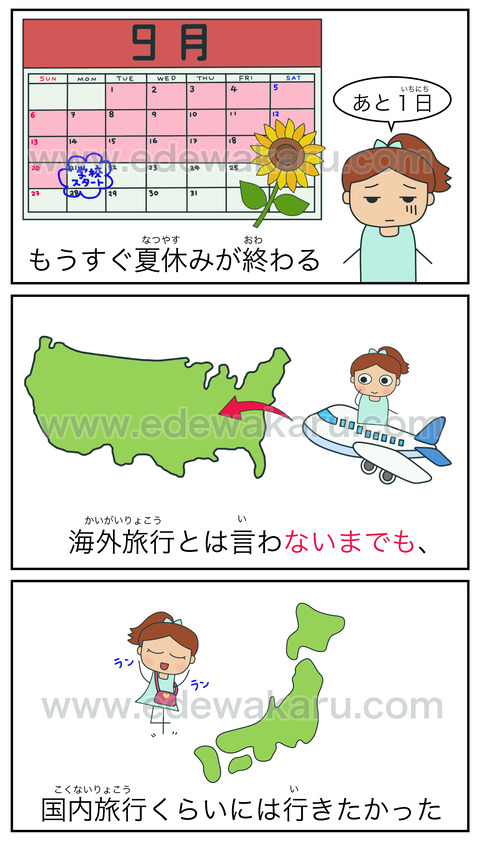
Meaning
〜の程度でなくてもいいから〜(最低限)くらい
How to use it
動詞・形容詞[ない形]+までも
名詞[ーでない]+までも
Explanation
「〜ないまでも」は「〜の程度でなくてもいいから、最低〜くらい」という意味で使われる文型です。「AないまでもB」の形で、「程度が高い「A」ではなくてもいいから、「A」より程度が低い「B」くらい〜」というように使用しますから、
「A」には必ず「B」よりも程度が高いものがこなくてはいけません
😮
[例]
①
海外旅行
とは言わ
ないまでも、国内旅行くらいには行きたかった
【A】海外旅行→国内旅行よりお金も時間もかかる
【B】国内旅行
②10kgとは言わ
ないまでも、5Kgはやせたい
【A】10Kg→5Kgよりも大変
【B】5Kg
また「〜ないまでも」は
「〜とは言わないまでも」
とよく使いますので、「〜とは言わないまでも」の形を暗記しておくといいと思います😉後ろにはよく使われる表現が決まっていますのでいくつか覚えておきましょう。
[「〜ないまでも」とよく使う表現]
・〜ないまでも+
〜たい
・〜ないまでも+
〜てほしい
・〜ないまでも+
〜なさい
・〜ないまでも+
〜てください
・〜ないまでも+
〜たほうがいい
・〜ないまでも+
〜べきだ
(復習:〜べきだ)
・〜ないまでも+
〜てたいものだ
(復習:〜たいものだ)
【余裕がある人へ】
①
「〜ないまでも」は「〜ないけれども、まあまあ〜」という意味でも使われることがあります
😮
(復習:〜ことがある)
[例]
彼女は美人だとは言わ
ないまでも、かわいいと思うよ
→彼女は美人では
ないけれども、まあまあ
かわいいと思うよ
十分とは言わ
ないまでも、ちゃんとお礼をしたよ
→十分では
ないけれども、ちゃんとお礼をしたよ
②「〜ないまでも」のかたい言い方は「〜ぬまでも」です。「〜ぬまでも」は
動詞にしか使わない
ということを覚えておきましょう😀
[例]
海外旅行とは言わ
ないまでも、国内旅行くらいには行きたかった
=海外旅行とは言わ
ぬまでも、国内旅行くらいには行きたかった
「〜ぬまでも」を会話で使用する機会はないと思いますが、上級レベルの人は一緒に覚えておきましょう😉
【「まで」がつく文型】
〜たまでだ・〜たまでのことだ
〜たらそれまでだ・〜ばそれまでだ
〜ないまでも
〜に至るまで
〜までして
〜までだ・〜までのことだ(V辞+までだ)
〜までに
〜までになる
〜までもない
In context 4 examples
海外旅行(かいがいりょこう)とは言わないまでも、国内旅行(こくないりょこう)くらいには行きたかった
→海外旅行でなくてもいいから、国内旅行くらいには行きたかった10Kgとは言わないまでも、3Kgはやせたいな…
→10Kgでなくてもいいから、5Kgはやせたいな100点とは言わないまでも、80点は取りたい
→100点でなくてもいいから、80点くらいは取りたい予習や復習はしないまでも、宿題くらいしなさい
→予習や復習はしなくてもいいから、宿題くらいしなさい
日本語文型辞典 英語版
Meaning
【ないまでも】[V-ないまでも]
Used with the negative form of a verb, ないまでも means “such a great extent is not necessarily expected, but at least this lesser extent is expected.” The first clause presents a situation or state of affairs of greater extent in terms of quantity or importance, followed by one of lesser extent in the second clause. As shown in
(1)
and
(2)
above, this expression is often used in the forms ...とは言わない/言えないまでも, in which case it means “one won’t/can’t ask that much, but at least this much is expected.” Expressions of obligation, such as すべきだ and ...た方がよい, or expressions of intention, command, or desire are used at the end of the sentence. V-ぬまでも conveys the same meaning but sounds more literary and formal.
In context 4 examples
毎日とは言わないまでも、週に2、3度は掃除をしようと思う。
I’m not saying every day, but I’d like to do the cleaning at least two or three times a week.
絶対とは言えないまでも、成功する確率はかなり高いと思います。
Even though I cannot say it is definite, I think there is a fairly high probability that it will succeed.
予習はしないまでも、せめて授業には出て来なさい。
Even if you haven’t prepared for it, you should at least come to class.
授業を休むのなら直接教師に連絡しないまでも友達に伝言を頼むか何かすべきだと思う。
If you’re going to be absent from class, even if you can’t contact the teacher directly, you should at least ask a friend to give her a message or something.
くらべてわかる日本語表現文型辞典
Meaning
意味1:Aの程度には至らなくても、少なくともB。
意味2:より望ましいAにはならなくても(せめて)Bが望まれる。
How to use it
AないまでもB
[動詞-ない形]ないまでも
In context 8 examples
口にこそ出さないまでも、みんな彼女のことを心配している。
軽率なミスを繰り返していると、大事に至らないまでも信用を失うぞ。
そんなに煙草を吸うとすぐ病気にはならないまでも、喉に悪いよ。
大漁とはいえないまでも、たくさん魚が釣れた。
電話をかけないまでも、せめてメールぐらいすればいいのに。
雨がやまないまでも、小降りになってくれないかなあ。
走れないまでも、歩くことができる程度には回復した。
初舞台なので、満席とはならないまでも、そこそこは入ってほしい。
日本語NET JLPT文法解説まとめ
Meaning
〜という程度には達しないが
How to use it
V(ナイ形)+ までも
Explanation
"Although it doesn't reach the level of 〜"
Used to indicate that while something may not reach a certain level or extent, it still somewhat meets a certain standard or condition.
後件には「少なくとも」、「せめて」といった言葉がよく使われる。
In context 7 examples
今の給料は十分とは言えないまでも、なんとか暮らしていけるだけはあります。
毎月帰ってこいとは言わないまでも、たまには顔を見せて欲しい。
海外旅行とは言わないまでも、国内旅行ぐらい年に1回はしたい。
すでに在庫がなく展示品を買うことになったので、30%引とはいかないまでも、せめて5%引きくらいにはしてほしかった。
毎日とは言わないまでも、週に1回ぐらいは掃除して欲しい。
今はインターネットでたいていのことは調べられるので、答えは見つからないまでも、ヒントぐらいは得られるはずだ。
誕生日なので高価なものとは言わないまでも、何かプレゼントは欲しかった。
毎日のんびり日本語教師
How to use it
動ない形+ないまでも
Explanation
前件の程度に達してはいないが、少なくとも後件の程度には達していること、あるいは少なくとも後件の程度を満たす必要があることを表します。前件は後件よりも程度が高くなければいけません。
Notes
特になし
In context 12 examples
死に物狂いで頑張れば、天才の域に辿り着けないまでもそこに近づけるはずだ。
この絵は細部は完璧ではないまでも、実物の特徴をよく捉えて描けている。
この案なら全員の賛成は得られないまでも、過半数の賛成は得られるだろう。
怪我は完治とは言えないまでも、ほぼ回復してきている。
相手チームに勝てないまでも、善戦できるように頑張る。
毎日とは言わないまでも、週1回くらいは掃除したほうがいい。
汚職や賄賂は完全に無くせないまでも減らすべきだ。(贪污和贿赂现象即使不能完全消除也应该减少。)
人生は楽しめないまでも苦しまないようにしたい。
土下座をしないまでも、謝るぐらいはしたらどうですか?
ムダ毛は綺麗に剃れとは言わないまでも、せめて清潔にはして欲しい。
ストレス発散とはいかないまでも、溜め込み過ぎないようにしてください。
今回のデート、100点とはいかないまでも80点くらいはいったかな。
NINJAL 日本語文型データベース
Meaning
~という程度には達していないが、少なくともその少し下の程度には達していることを表します。
How to use it
Vないまでも
i-Aく(は)ないまでも
na-Aではないまでも
Nではないまでも
Notes
「~」には、理想的な状態や極端な状態を表す言葉がきます。「~ないまでも」の後には、その状態より少し低い程度を表す文がきます。
In context 18 examples
弁護士になれないまでも、法律に関係する仕事には就きたいです。
日本語を勉強して半年たった。難しい漢字は書けないまでも、読める漢字が増えてきた。
今度の英語の期末試験は、満点は望めないまでも、90点はとれるはずだ。
今すぐとは言わないまでも、30歳までには結婚するつもりだ。
大企業とはいかないまでも、そこそこ安定した会社に勤めたいと思っている。
うちの庭でとれたみかんは、ひどくまずくないまでも特においしくはない。
今住んでいるマンションは家族で住めるほど広くないまでも、一人暮らしには十分だ。
留学費用は思っていたほど高くはないまでも、これまで貯めた貯金だけでは賄いきれない。
小学生の弟は算数が苦手なようだ。計算は極端に遅くはないまでも、早くはない。
私の英語は完璧ではないまでも、日常会話は問題ない。
夫は特におしゃれではないまでも、身だしなみには気を遣っている。
給料は十分ではないまでも、ぜいたくをしなければ暮らしていける。
この練習方法は効果的ではないまでも、無意味ではない。
家事は嫌いではないまでも、やらないで済むならできるだけやりたくない。
父はプロではないまでも、ケーキ作りが大得意だ。
自転車で転んで、大怪我ではないまでも、かなりの傷を負った。
彼は優秀で、試験の成績が毎回学年で1番ではないまでも、5番以内には入っている。
今回のイベントの収支は黒字ではないまでも、大きな赤字は出なかった。