AIUEO JLPT Grammar
Meaning
This sentence pattern conveys that one event leads to a series of subsequent developments, highlighting a chain of positive changes or continuous occurrences stemming from an initial action.
How to use it
名詞を+皮切りに(+して)
Explanation · 日本語
この文型は、何かが始まり、その後次々と続くことを表現する文法で、ある出来事や活動が発端となり、次々と物事が展開していく状況を強調します。主にポジティブな変化や連続する出来事に対して使われます。
In context 5 examples
このイベントを皮切りに、全国でのキャンペーンが展開される予定だ。
Starting with this event, a nationwide campaign is scheduled to unfold.
東京公演を皮切りに、全国ツアーが始まる。
The nationwide tour will start with the Tokyo performance.
新製品の発売を皮切りに、次々と新しいサービスが導入される。
Starting with the release of the new product, new services will be introduced one after another.
この店を皮切りにして、全国にチェーン展開する計画だ。
Starting with this store, there are plans to expand the chain nationwide.
この事件を皮切りに、多くの類似事件が起こった。
This incident was the beginning of many similar incidents.
文法
Meaning
〜を始まりとして、次々に・・・する
How to use it
N + を皮切りにして
Notes
ニュースやイベントの放送などで使われることが多い
In context 5 examples
このゲームソフトは日本で記録的なヒットをしたことを皮切りに、英語版や フランス語版など各国の言語に翻訳され発売されることになった。
東京のイベントを皮切りに、今度は全国各地でイベントを開催する予定だ。
彼の証言を皮切りに、この会社で起こっている問題が次々と世間に明るみになった。
映画が大ヒットしたことを皮切りにとして、その若手俳優はドラマや芸能番組など色々な場面で起用されるようになった。
彼は趣味で作ったアプリがヒットしたことを皮切りに、次々とアプリをリリースし、自分の会社を作るまでになった。
Bunpro Grammar Reference
Meaning
Beginning of, Starting with
How to use it
Noun + を皮切りにして(1)
Verb[る](2) + の + を皮切りにして(1)
(1) を皮切りとして
(2) Verb[た]
Nuance
A construction that presents (A) as the beginning of (B). (A) broke the skin, and now (B) keeps happening.
Explanation
を皮切りに is a grammar structure that will be utilized with nouns in order to show the starting point for something, from which it then expanded, or something kept happening after. In most cases, を皮切りに will just be translated as 'starting with (A)', or 'beginning with (A)'.
This structure is a combination of the adverbial particle を, the noun 皮切り 'beginning' or 'outset', and the case-marking particle に. It will appear after nouns or phrases that have been nominalized, before going on to explain how something continued to expand afterwards.
藤田先輩がやめたのを皮切りに、他の人たちもどんどんやめていった。
Starting with Fujita senpai quitting, others quit in quick succession.
あの俳優はテレビ東京に出演したのを皮切りに、色々な局に出演することになった。
That actor started by appearing on TV Tokyo and then went on to appear on various stations.
佐々木さんの発言を皮切りに、賛成する人が出てきた。
Starting with Sasaki-san's comment, some people began to agree with him.
クラスメイトの高橋さんを皮切りに、クラスみんな風邪になってしまった。
Starting with Takahashi-san, my classmate, everyone in my class caught a cold.
In place of に by itself, にして and として are also standard variations of the same grammar pattern.
彼女が社長に文句を言ったのを皮切りにして、みんな社長に文句を言い始めた。
Starting with her making a complaint to the boss, everyone started to make complaints to the boss.
あのグループは名古屋を皮切りとして、全国でライブを行った。
Starting with Nagoya, that group performed throughout the country.
Caution
It is rare for を皮切りに to be used in relation to natural phenomena, or negative results. What happens as a result of (A) will usually be something positive, and have a specific 'doer'.
Fun Fact
Although 皮切り is really only used to mean 'beginning', the kanji combination of 'to cut a hide' can be used as a helpful memory tool for the nuance of creating a starting point from which something expanded outwards over a large area, like skinning an animal.
Nuance · 日本語
(A)が(B)の始まりだということを示す表現。(A)が表面を破り、(B)が起こり続ける。
Explanation · 日本語
「を皮切りに」は、名詞に付いて何かの始まりを示し、そこから物事が発展したり続いたりしていくことを表す表現です。ほとんどの場合、「(A) から始まって」といった意味で使われます。
副助詞「を」、名詞「皮切り」、そして格助詞「に」の組み合わせです。「を皮切りに」は、開始点を示す名詞や名詞化した句の後に置かれ、その後に、それがどのように拡大・継続しているかについての説明が続きます。
藤田先輩がやめたのを皮切りに、他の人たちもどんどんやめていった。
Starting with Fujita senpai quitting, others quit in quick succession.
あの俳優はテレビ東京に出演したのを皮切りに、色々な局に出演することになった。
That actor started by appearing on TV Tokyo and then went on to appear on various stations.
佐々木さんの発言を皮切りに、賛成する人が出てきた。
Starting with Sasaki-san's comment, some people began to agree with him.
クラスメイトの高橋さんを皮切りに、クラスみんな風邪になってしまった。
Starting with Takahashi-san, my classmate, everyone in my class caught a cold.
「に」の代わりに、「にして」や「として」が使われることもあります。これらはどれも一般的に使われる表現です。
彼女が社長に文句を言ったのを皮切りにして、みんな社長に文句を言い始めた。
Starting with her making a complaint to the boss, everyone started to make complaints to the boss.
あのグループは名古屋を皮切りとして、全国でライブを行った。
Starting with Nagoya, that group performed throughout the country.
注意点
「を皮切りに」は、自然現象や悪い結果にはあまり使われません。 この表現は、(A) という誰かの行動をきっかけにして、何かが良い方向に広がっていくような状況でよく使われます。
豆知識
「皮切り」は「最初」という意味を持つ名詞ですが、「皮を切る」という漢字から、動物の皮を剥ぐときのようにどこか一点を始まりとして、そこから広範囲に広がっていくというイメージを持っておくと、この表現の意味が記憶に残りやすいかもしれません。
In context 18 examples
- 店の移転を皮切りとして、売上げがどんどんと上がっています。
Starting with the shop relocation, sales are rapidly increasing.
- あの俳優はテレビ東京に出演したのを皮切りに、色々な局に出演することになった。
That actor started by appearing on TV Tokyo and then went on to appear on various stations.
- 藤田先輩がやめたのを皮切りに、他の人たちもどんどんやめていった。
Starting with Fujita senpai quitting, others quit in quick succession.
- 佐々木さんの発言を皮切りに、賛成する人が出てきた。
Starting with Sasaki-san's comment, some people began to agree with him.
- クラスメイトの高橋さんを皮切りに、クラスみんな風邪になってしまった。
Starting with Takahashi-san, my classmate, everyone in my class caught a cold.
- 彼女が社長に文句を言ったのを皮切りにして、みんな社長に文句を言い始めた。
Starting with her making a complaint to the boss, everyone started to make complaints to the boss.
- あのグループは名古屋を皮切りとして、全国でライブを行った。
Starting with Nagoya, that group performed throughout the country.
- それを皮切りとして、コンビニは相次いで出店し始めた。
Starting with that, convenience stores started opening one after the other.
- 俳優の伝記:「『Y-MEN』に出演したのを皮切りにして、多数出演。」
Actor's biography: 'Starting with his appearance in Y-MEN he appeared in numerous performances.'
- 皆川さんが監督として選ばれたのを皮切りにして、うちのチームは次々とスポーツの成功を掴んだ。
Starting with Minagawa-san being chosen as our trainer, our team continued to be successful.
- 「レオナルド・ディカプリオはタイタニックの主人公になったのを皮切りにしてスターへの道を歩み始め、大ヒット映画に出演している。」
'Starting with his leading role in Titanic, Leonardo DiCaprio embarked on the road to stardom and has appeared in many hit movies.'
- その二十歳のシンガーソングライターは東京を皮切りに全国、そして全世界でライブを行った。
As for that 20 year old singer songwriter, starting with Tokyo, they went on to hold live events nationally, and then globally.
- 東京を皮切りに、明治時代を舞台にした演劇「〇〇(まるまる)」が全国30劇場で公演されます。
Starting with Tokyo, the play XX, which is set in the Meiji era, will be performed at 30 theaters nationwide.
- この学習塾は関西地方を皮切りに、全国に兄弟塾や姉妹塾を作りました。
As for this private tutoring school, starting with the Kansai region, they went on to make things like brother and sister cram schools nationally.
- 部長が反対意見を言ったのを皮切りに、社内からその改革に対してどんどん反対意見が出てきた。
Starting with the section manager stating an opposing opinion, there came to be more and more opposing opinions from within the company in relation to that reformation.
- 元々出勤日数が少なかった川瀬さんを皮切りに、優秀な成績を収めていた谷口さんまで次々に社員が首になっていった。
Starting with Kawase-san, who had a low number of working days from the beginning, to even Taniguchi-san, who had been accruing stellar results. One after the other, employees were getting fired.
- 彼の勇気ある告発を皮切りに、芸能界で蔓延するパワハラや性的搾取の問題が明るみになってきました。
Starting with his brave accusation, the problem of things like rampant power harassment and sexual exploitation within the performance industry began to come to light.
- 父は趣味で作った釣り道具がSNSで売れた事を皮切りに、その趣味を仕事にする事を決めたようだ。
Starting with dad being able to sell fishing accessories on social media, which were made as a pastime, it appears as though he has decided to turn that hobby into a job.
どんなときどう使う 日本語表現文型辞典
Meaning
make the beginning
How to use it
N+を皮切りに(して)
Explanation
をかわきりに(して)
~から始まって
「~から始まって、その後次々に」と言いたいときに使う。その後に続く行為の契機になる一番初めの行為を表す。
Subject will begin at some point, then continue same kind of activity. Describes first action that becomes impetus for those that follow.
In context 3 examples
わたしたちは大阪の出演を皮切りに、各地で公演をすることになっている。
彼の発言を皮切りにして、大勢の人が次々に意見を言った。
この作品を皮切りとして、彼女はその後、多くの小説を発表した。
絵でわかる日本語
Meaning
〜を出発点(しゅっぱつてん)として、次々に〜
〜から始まって、次々に〜
〜が〜し始めたら、次々に〜
How to use it
名詞[辞書形]+を皮切りに
名詞[辞書形]+を皮切りとして
Explanation
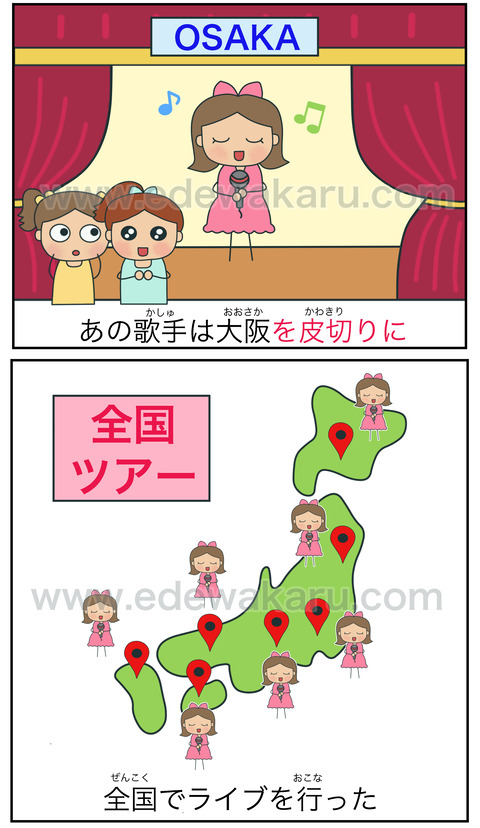
「〜を皮切りに」は「〜を出発点(しゅっぱつてん)として、次々に〜」という意味で、「〜から始まって、次々に〜」「〜が〜し始めたら、次々に〜」と言いたい時に使用される文型です。この文型の特徴は、
【同じようなことが次々に起こる】というように、同類(どうるいこうい)の発生を表すところです。
[例]
①大阪
を皮切りに、全国でライブを行った
最初のライブ地→
大阪
同類行為→
「大阪」
と同じように東京でも名古屋でも北海道でも仙台でも博多でもライブを行った
②東京
を皮切りに、世界中に分校をつくっていった
最初の分校→
東京
同類行為→
「東京」
と同じように台湾にも中国にも香港にもベトナムにも韓国にもアメリカにもフランスにもロシアにも分校をつくった
③彼
を皮切りに、反対する人が出てきた
「反対」を始めた人→
彼
同類行為→
「彼」
と同じように
AさんもBさんもCさんも反対し始めた
また「〜を皮切りに」は「〜を皮切りにして」「〜を皮切りとして」にチェンジすることができます😊
[例]
大阪を皮切りに、全国でライブを行った
=大阪
を皮切りにして、全国でライブを行った
=大阪
を皮切りとして、全国でライブを行った
「〜を皮切りに」はかたい言い方ですので、日常会話(にちじょうかいわ)ではあまり使われません😅ニュースなどでは聞く機会があると思います。この文型と似ているような文型がいくつかありますが、
「〜を皮切りに」は【同類行為の発生や始まり】を表す文型だと覚えておくといいと思います
😉
In context 4 examples
あの歌手は大阪を皮切りに、全国でライブを行った
→あの歌手は大阪を出発点として、次々に全国でライブを行ったあの日本語学校(にほんごがっこう)は東京を皮切りに、世界中に分校をつくっていった
→あの日本語学校は東京を出発点として、世界中に次々に分校をつくっていった(復習:〜ていく(変化の進行))彼を皮切りに、反対する人が出てきた
→彼が反対し始めたら、次々に反対する人が出てきた山田くんを皮切りに、同僚が会社を首になっていった
→山田くんから始まって、次々に同僚が会社を首になっていった(復習:首にする・首になる)(復習:〜ていく(消滅))
くらべてわかる日本語表現文型辞典
Meaning
Aはひとつづきの出来事Bのはじめの部分を表す。
How to use it
Aを皮切りにB(Aを皮切りとしてB/Aを皮切りにしてB)
[名詞-∅]を皮切りに
Explanation
【対比1】
「Aを最初にB」
「Aを最初にB」は順番を表す言葉であり、一続きのものでなくてもよいが、「Aを皮切りにB」はBが長く続くことのはじめの部分という意味。
○野菜を最初に煮てください。
×野菜を皮切りに煮てください。
In context 4 examples
A大学入試を皮切りに、今年も受験シーズンに突入した。
一部の県での公費不正使用発覚を皮切りに、全国の自治体の乱脈会計が明らかになった。
北海道を皮切りとして、コンサートツアーが予定されている。
彼は小学校時代の話を皮切りにして、延々5時間も身の上話を続けた。
日本語NET JLPT文法解説まとめ
Meaning
〜を始まりとして、次々に・・・する
How to use it
N + を皮切りにして
Explanation
"starting with ~ / beginning with ~ / with ~ as the starting point"
Used to indicate that something marks the beginning of a series of events or actions.
ニュースやイベントの放送などで使われることが多い
Often used in news broadcasts and events.
In context 2 examples
映画が大ヒットしたことを皮切りにとして、その若手俳優はドラマや芸能番組など色々な場面で起用されるようになった。
彼は趣味で作ったアプリがヒットしたことを皮切りに、次々とアプリをリリースし、自分の会社を作るまでになった。
NINJAL 日本語文型データベース
Meaning
一連の事柄が発展していくことの始まりを表します。
How to use it
Nを皮切りに
Notes
「~を皮切りに」の後には、「~」と同じような出来事が次々に起こることを表す文がきます。出来事が一続きであることがはっきりしている場合に使うことが多いです。
マイナスイメージのことには使いません。
In context 5 examples
この展覧会は東京会場を皮切りに、全国各地を回ります。
この作家は1971年の芥川賞を皮切りに、以後、数々の文学賞を受賞している。
昨日の祝賀会では、主催者の挨拶を皮切りに来賓の方々が次々に挨拶した。
私は学生時代に初めてヨーロッパを一人旅したのを皮切りに、この30年間、毎年1、2度外国を旅して歩いている。
柔道の林選手は高校生の時に県大会で優勝したことを皮切りに、次々と勝利し無敗記録を更新している。
IMABI
Defining Parameter
Read this IMABI lesson ↗Explanation
Defining Parameter: ~を始め(として), ~を皮切りに(して), ~に至るまで, ~をもって, & ~といったところだ
Defining the beginning and limitation of a parameter is something that people do all the time. These phrases, although not an exhaustive list of phrases in Japanese that fit this description, will allow you to become even more sophisticated in how you can articulate yourself in this regard.
~を始め(として)
As you should know, 始める means “to start”. をはじめ = “starting with”. It may also be expanded to をはじめとして, which is a bit more poignant.
1. 社長を始め、社員一同です。
Starting with the company president, all employees are present.
2. 日本の会社を始めとして、沢山の企業が業績悪化しています。
Starting with Japanese companies, a lot of businesses are in a downturn.
3. 彼は中国語を始め、日本語と韓国語にも堪能ですよ。
Starting with Chinese, he is also proficient in Japanese and Korean.
4. 春になると、桜をはじめとして、いろんな花が咲きます。
When it becomes spring, starting with cherry blossoms, various flowers blossom.
~を皮切りに(して)
皮切 かわきり means the “outset of things” and is used in the speech modal を皮切りに(して)・を皮切りとして to show that starting with X, you do something in succession. This pattern shouldn’t really be used with natural phenomena or bad things. What follows should be similar in nature, and it is especially used in situations where you want to clearly state such a chain of events.
5. 冗談じょうだんを皮切りに演説をする。
To give a speech by starting out with a joke.
6. 公演を皮切りに各地かくちで演奏会えんそうかいを開きました。
They opened up concerts in various/every place(s) as the start out of their public performance.
7. 今月6日の東京公演を皮切りにして、全国ツアーを予定しております。
We are planning to do a nationwide tour starting with a Tokyo performance on the sixth of this month.
8. 塩川さんの発言を皮切りにして、みんなが次々に意見を言った。
Starting with Shiokawa’s remarks, everyone said their opinions one after another.
9. カリフォルニアへの旅行を皮切りとして、国外をあちこち旅行しています。
Starting with a trip to California, I’m traveling all over outside the country.
~に至るまで
~に至るまで shows that a certain matter’s extent reaches a surprising state. As you will see in the examples, this speech modal attaches to nouns.
Examples
10. 今度の出張のスケジュール表ひょうは綿密めんみつすぎる!起床時間から飛行機内の食事開始時間に至るまで書いてあるよ。
This business trip’s schedule is too detailed! It has written on it the time from when we wake up to the time we start eating in the plane.
11. 畑中先生には卒業後の進路はもちろん、恋愛れんあいの悩なやみに至るまで何でも相談している。
My path after graduation is one thing, but I’m also consulting about everything to even love problems with Hatanaka Sensei.
12. 外国で暮らすことになったので、ベッドから台所用品だいどころようひんに至るまでみんなリサイクルショップに売った。
As it’s been decided that I live abroad, I sold everything from my bed to kitchen utensils to the recycling shop.
13. 今に至るまで作られている。
Even until now they are being made.
14. 頭から足先に至るまでのほぼ全身がびしょ濡ぬれだよ。
Basically my entire body is soaked from head to toe.
15. その大都市の学校はもちろんのこと、小さな分校に至るまで、統一されたカリキュラムで教育が行われている。
Of course, as far as that big city’s schools, education is done with a unified curriculum to even the smallest campus.
16. 彼は頭の上から爪先つまさきに至るまで全身泥まみれになった。
His entire body became covered in mud from the top of his head to his tiptoes.
Usage Note: This construction is not used in reference to animals. It is always used with something concerning humans.
More About 至る
至る means “to reach…”. It may follow the 連体形 or stem of する to show that something has finally reached a certain condition. ~に至って(は) and に至ると focus on something as the topic by raising an extreme example. Lastly, 至って as an adverb means “very” or “extremely”.
17. 中国語はもちろん、英語に至ってはからきしだめだよ。
Not to mention Chinese, reaching English is completely hopeless.
18. 年老いたとはいえ、至って健康です。
Although he has aged, he is extremely healthy.
19. 実施じっしするに至った状況を説明します。
I’ll explain the situation that’s led to this being implemented.
~をもって
Though only the first usage relates to the topic of this lesson, as this phrase has other important usages to know about, they will also be discussed at this time.
1. ~をもって marks the end of things, and is not used in daily conversation and it is very formal and official-like.
20. 本日の営業は10時をもって閉店致します。
Today’s business will close at 10 o’ clock.
21. 当店は10月末日をもちまして閉店させていただきました。長い間のご利用ありがとうございました。
This store will close at the end of October. Thank you for your long use (of our store).
22. 以上をもちまして本日の演説大会は終了いたします。
With this being the end, today’s speech convention is concluded.
23. 今期をもって私は退職するつもりでございます。
At the end of this term, I plan to retire.
24. 展覧会てんらんかいはこの時点を以って閉会とします。
We have decided to close this exhibition with/at this occasion.
It can also show a basis for something or object of judgment.
25. 一事いちじを以って人を判断するなかれ。(Archaic)
Do not judge a man by one action.
26. やつを以って嚆矢こうしとす。(Set phrase; archaism)
To hit the enemy as the aim with an arrow to signal the start of the battle.
27. 非人ひにんをもって任にんじるは悪し。(Archaic; classical)
It is bad to pose as a hinin.
Historical Note: A 非人 was a person of the lowest rank of society.
2. In でもって meaning “furthermore”. This is still used in formal writing.
28. 美人で以って頭も良い女
A woman who is a beautiful person, and furthermore smart
3. In まったくもって, a stronger version of まったく. Although more literary, it’s still possible to hear it used in the spoken language.
29. 宮城県は全くもって困った地方だね。
Miyagi Prefecture is a completely troubled region, isn’t it?
4. Older usages of this include being used as a conjunction to mean “thereupon” and as an equivalent to the case particle で to show means of action.
30. 以って瞑めいすべし。
Thereupon you should sleep.
31. 手紙を以って皇帝こうていを通達つうたつす。
To notify the Emperor with a letter.
~といったところだ
~といったところだ is used to say that at the most, something isn’t that high. It can be after nouns or verbs. It should only be used with phrases that concern a low number/amount.
41. せいぜい1泊で温泉に行くといったところでしょうか。
How about at the most going to an onsen for a night?
42. 私の睡眠すいみん時間は4時間といったところです。
My sleeping time is just at most four hours.
In context 37 examples
社長を始め、社員一同です。
Starting with the company president, all employees are present.
日本の会社を始めとして、沢山の企業が業績悪化しています。
Starting with Japanese companies, a lot of businesses are in a downturn.
彼は中国語を始め、日本語と韓国語にも堪能ですよ。
Starting with Chinese, he is also proficient in Japanese and Korean.
春になると、桜をはじめとして、いろんな花が咲きます。
When it becomes spring, starting with cherry blossoms, various flowers blossom.
冗談じょうだんを皮切りに演説をする。
To give a speech by starting out with a joke.
公演を皮切りに各地かくちで演奏会えんそうかいを開きました。
They opened up concerts in various/every place(s) as the start out of their public performance.
今月6日の東京公演を皮切りにして、全国ツアーを予定しております。
We are planning to do a nationwide tour starting with a Tokyo performance on the sixth of this month.
塩川さんの発言を皮切りにして、みんなが次々に意見を言った。
Starting with Shiokawa’s remarks, everyone said their opinions one after another.
カリフォルニアへの旅行を皮切りとして、国外をあちこち旅行しています。
Starting with a trip to California, I’m traveling all over outside the country.
今度の出張のスケジュール表ひょうは綿密めんみつすぎる!起床時間から飛行機内の食事開始時間に至るまで書いてあるよ。
This business trip’s schedule is too detailed! It has written on it the time from when we wake up to the time we start eating in the plane.
畑中先生には卒業後の進路はもちろん、恋愛れんあいの悩なやみに至るまで何でも相談している。
My path after graduation is one thing, but I’m also consulting about everything to even love problems with Hatanaka Sensei.
外国で暮らすことになったので、ベッドから台所用品だいどころようひんに至るまでみんなリサイクルショップに売った。
As it’s been decided that I live abroad, I sold everything from my bed to kitchen utensils to the recycling shop.
今に至るまで作られている。
Even until now they are being made.
頭から足先に至るまでのほぼ全身がびしょ濡ぬれだよ。
Basically my entire body is soaked from head to toe.
その大都市の学校はもちろんのこと、小さな分校に至るまで、統一されたカリキュラムで教育が行われている。
Of course, as far as that big city’s schools, education is done with a unified curriculum to even the smallest campus.
彼は頭の上から爪先つまさきに至るまで全身泥まみれになった。
His entire body became covered in mud from the top of his head to his tiptoes.
中国語はもちろん、英語に至ってはからきしだめだよ。
Not to mention Chinese, reaching English is completely hopeless.
年老いたとはいえ、至って健康です。
Although he has aged, he is extremely healthy.
実施じっしするに至った状況を説明します。
I’ll explain the situation that’s led to this being implemented.
~をもって marks the end of things, and is not used in daily conversation and it is very formal and official-like.
Today’s business will close at 10 o’ clock.
本日の営業は10時をもって閉店致します。
Today’s business will close at 10 o’ clock.
当店は10月末日をもちまして閉店させていただきました。長い間のご利用ありがとうございました。
This store will close at the end of October. Thank you for your long use (of our store).
以上をもちまして本日の演説大会は終了いたします。
With this being the end, today’s speech convention is concluded.
今期をもって私は退職するつもりでございます。
At the end of this term, I plan to retire.
展覧会てんらんかいはこの時点を以って閉会とします。
We have decided to close this exhibition with/at this occasion.
一事いちじを以って人を判断するなかれ。(Archaic)
Do not judge a man by one action.
やつを以って嚆矢こうしとす。(Set phrase; archaism)
To hit the enemy as the aim with an arrow to signal the start of the battle.
非人ひにんをもって任にんじるは悪し。(Archaic; classical)
It is bad to pose as a hinin.
In でもって meaning “furthermore”. This is still used in formal writing.
A woman who is a beautiful person, and furthermore smart
美人で以って頭も良い女
A woman who is a beautiful person, and furthermore smart
In まったくもって, a stronger version of まったく. Although more literary, it’s still possible to hear it used in the spoken language.
Miyagi Prefecture is a completely troubled region, isn’t it?
宮城県は全くもって困った地方だね。
Miyagi Prefecture is a completely troubled region, isn’t it?
Older usages of this include being used as a conjunction to mean “thereupon” and as an equivalent to the case particle で to show means of action.
Thereupon you should sleep.
以って瞑めいすべし。
Thereupon you should sleep.
手紙を以って皇帝こうていを通達つうたつす。
To notify the Emperor with a letter.
せいぜい1泊で温泉に行くといったところでしょうか。
How about at the most going to an onsen for a night?
私の睡眠すいみん時間は4時間といったところです。
My sleeping time is just at most four hours.