日本語文型辞典
Meaning
基本情報Nにそって説明川や道など長く続くものや、手順やマニュアルなど作業の流れを示すものを表す名詞に付いて、「それが続いていくとおりに/そのふちにずっと/それにしたがって」などの意味を表す。この場合、漢字は「沿う」を用いる。また、⑥のように、人やものに離れずに付き従うという意味を表すこともあるが、この場合の漢字は「添う」を用いる。名詞を修飾するときは⑤のように「NにそったN」となる。例文① この道に沿ってずっと行くと、右手に大きい公園が見えてきます。② 川岸に沿って、桜並木が続いていた。③ この塀に沿って植えてある花は、日陰でもよく育つ。④ 書いてある手順に沿ってやってください。⑤ マニュアルに沿った手紙の書き方しか知らないのでは、いざというとき困る。⑥ 妻は夫に添って病室に入っていった。
日本語文型辞典 英語版
Meaning
【にそって】[Nにそって]
With a noun expressing something that leads to somewhere such as a river or a street, or something that shows some sequence such as procedures or manuals, expresses the meaning of “as something follows, along the edge of something, following something.” Written as 沿う. There is another use in にそって, which means that something is accompanied by a thing or a person without parting as shown in
(6)
. Written as 添う in this case. When modifying a noun, にそって becomes NにそったN, as shown in
(5)
.
In context 6 examples
この道に沿ってずっと行くと、右手に大きい公園が見えてきます。
If you go straight along this street, you’ll find a big park on your right.
川岸に沿って、桜並木が続いていた。
There was a line of cherry trees along the river bank.
この塀に沿って植えてある花は、日陰でもよく育つ。
The flowers that were planted along this fence grow well even in the shade.
書いてある手順に沿ってやってください。
Please do it following the written procedures.
マニュアルに沿った手紙の書き方しか知らないのでは、いざというとき困る。
If you only know how to write a letter based on what the manual says, you’ll have problems in an emergency.
妻は夫に添って病室に入っていった。
The wife entered the hospital room alongside her husband.
くらべてわかる日本語表現文型辞典
Meaning
意味1:長く続いているAに並行してB。長く続いているものに並行して進む。
意味2:目的や期待、考え、意見などに合わせる。
How to use it
AにそってB(AにそったB)
[名詞-∅]にそって
Explanation
【対比1】
「Aに面してB」(意味2 P.261)
「Aに面してB」はAを基準にして、XとAの位置関係を示す。Aが長く続くもの(例:道)であっても、それを「面」として捉える。
a:ホテルは海に面して建っている。
b:ホテルは海にそって建っている。
上記の二文を比べると、aはホテルを一つの個体として捉えておりbは海岸線に合わせ、長く延びたリゾートホテルのようなものが続いている感じを与える。また、線状に点在、あるいは続いているものがきた場合は、
a:通りに面して看板が並んでいる。
b:通りにそって看板が並んでいる。
二文とも表している情景は同じであるが、話し手の視点はbの方が広い。
【対比2】
「AにしたがってB」(意味2 P.231)
「AにしたがってB」は命令や規則の通りにすること。具体的な意見を示すため、拘束性は強い。「AにそってB」はその考えや意見の示す方向にしたがうという意味で拘束性はゆるい。
○規則にしたがって罰する。
×規則にそって罰する。
○会議で提出された案にしたがって都市開発を進める。
○会議で提出された案にそって都市開発を進める。
ただし、上の二文は、案の指し示す方向から外れないようにという意味で両方使える。
「Aに即してB」(意味1 P.242)
「Aに即してB」のAは事実として存在するもの。「AにそってB」のAは事実として存在するものでも、期待や計画など変化していくものでもいいので「Aに即してB」から「AにそってB」への置き換えは可能。
○式はこの進行表にそって進めていく予定だ。
○式はこの進行表に即して進めていく予定だ。
「AにこたえてB」(意味1 P.229)
In context 8 examples
並木道にそって歩くと、季節の移り変わりを感じる。
歴史の流れにそった学習をすれば、理解が深まる。
リンパの流れにそって、マッサージをするといい。
この点線にそって切り取ってください。
給料に関しては、できるかぎりご希望にそっていくつもりです。
皆さんのご期待にそえず、誠に申し訳ございません。
裁判は被害者の感情にそった対応も必要だ。
この開発計画にそって、都市の開発を進めていこう。
IMABI
Based on
Read this IMABI lesson ↗Explanation
Based on: に基づいて、を踏まえて, をもとにして, に沿って, に即して, & に則って
These phrases are definitely very similar to each other, but as you will see during the compare and contrast sections of this lesson, there are important differences to keep in mind.
~に基づいて
~に基づいて means “based on.” Its attribute form may either be ~に基づいての or ~に基づいた. Broadly speaking, there are two main usages of Xに基づいてY. The first is “without deterring from a standard/criterion/norm/rule/law X, one carries out/executes an action Y.” The other, which is found primarily in the written language, is “having A as a basis/foundation/modal/example/pattern/reference, one does/makes a decision B.”
1. 事実に基づいた記述きじゅつをする。
Describe on the basis of reality.
2. 彼女の議論は確かに証拠しょうこに基もとづいていなかった。
Her argument was certainly not on the basis of evidence.
3. 明らかなことに基づいた議論の余地よちのない事実。
Unarguable facts based on obvious things.
4. このマニュアルに基づいて操作します。
I will operate it based on this manual.
5. 規則に基づいて処理する。
To process according to regulations.
6. さっきの例文に基づいた、もっと複雑なものです。
These are more complicated ones based off of the previous example sentences.
7. 証拠に基づいて、加害者かがいしゃに死刑しけいを言い渡わたした。
In line with the evidence, the assailant was sentenced to death.
Variant Note: ~に基づいて may also be ~に基づき in stiffer writing.
Grammar Note: For the attribute form, ~に基づいての must only be used when what it precedes is a standard of some sort. If it is not, you must use ~に基づいた instead.
を踏まえて
The 一段 verb 踏まえる means “to be based on”. So, ~を踏まえて means “on the basis of” just like ~に基づいて. It can also be seen as ~を踏まえ in the written language. Its attribute form may either be ~を踏まえての or ~を踏まえた. As its original literal meaning is “to tread on” in a defensive posture, it is used after words that can show a basis/foundation/precedent for something. Again, it cannot follow material for reference as a standard. Rather, it must follow an extant basis. This pattern is usually seen in the written language and finds itself in news reports all the time.
8. 自分の経験を踏まえてこういう。
To say such based on one’s own experience.
9. これまでの状況を踏まえて得た最終結論です。
This is the last argument gotten based on the conditions up to now.
10. 報告を{踏まえた・踏まえての}処理
Processing based on the report
Translation Note: 踏まえる may also mean “to tread”.
11. 両足で大地を{踏まえて・踏んで}立って!
Tread on the ground with both your legs and stand!
~をもとにして
~をもとにして is used to show that one bases off of the good qualities of something. It does not necessarily have to be 100% congruent with the full truth in the circumstances. It shows willful change, and it is usually shortened in the spoken language to ~をもとに. When this pattern happens to be used as an attribute, it becomes ~をもとにした.
12. 私は親譲おやゆずりの財産をもとにして富とみを作りました。
I built my wealth on the fortune from my father.
13. 嘘うそをもとにして行おこなう。
To act upon a lie.
14. 事実を基にして書かれた劇だ。
It is a play written on the basis of the truth.
漢字 Note: Although this pattern is used both in the spoken and written language, when もと is written in 漢字, you have the options 基, 本, 素, 原, 源, 元, and 下. Thus, the meaning of this expression can be further refined. The first refers to a standard. The second refers to the foundation of something. The third refers to the subject matter. The fourth refers to raw materials. The fifth refers to a source. The sixth refers to the original way. The seventh refers to being under an influence. However, most natives cannot distinguish this well, and this is only knowledge relevant for when reading through literature.
~に沿って & More
~に沿って
~に沿って is used in a physical or cause and effect sense. It can also be seen as ~に沿い is stiff writing, but even here it is considerably rare. The attribute forms ~に沿った and ~に沿っての are slightly different. The former can be used when A fits nicely with B, but there can be some deviance. However, there can be no such deviance with the latter.
15. 時勢じせいに沿って生きる。
To live in consonance of the times.
16. 土手に沿って、苔こけが生えている。
Moss is growing along the embankment.
17. 事実に沿って、話しをしてくださいますか。
Could you please talk along the facts (of the case)?
18. 湖に{〇 沿った・X 沿っての}公園を歩きました。
I walked through the park that’s alongside the lake.
19. 事業計画に{沿った・沿っての}実施状況じっしじょうきょう
The status of implementation along the business plan
20. 僕は川に沿って歩いた。
I walked along the river.
Variant Note: ~に沿って may be replaced by the suffixes ~沿ぞい and ~伝づたい in the physical sense.
21. 軒のきづたいに倉庫そうこの裏に廻って行った。
Along the eaves, I went around the back of the storehouse.
22. 川伝いに走り回る。
To run around along the river.
23. 湖畔こはん沿いの道路を歩く。
To walk through the street alongside the lake shore.
24. 流れに沿うてやがて広野に出ると、頂上ちょうじょうは面白く切り刻きざんだようで、そこからゆるやかに美しい斜線しゃせんが遠い裾すそまで伸びている山の端はに月が色づいた。野末のずえにただ一つの眺めである、その山の全まったき姿を、淡い夕映えの空がくっきりと濃深縹色ふかはなだいろに描き出した。
Along the stream, when we at last entered the wide, the moon changed colors in the edge of the mountain, which had a gently beautiful slant with the peak interestingly cutting it that stretched to the far base of the mountain. The light sunset sky sharply drew the perfect view of the mountain for the single view at the corner of the field a light yet deep indigo.
From 雪国 by 川端康成.
漢字 Note: The spellings 添う・副う exist. The first is seen with the sense of “addition” and the latter is seen with the sense of “expectation/satisfaction”.
25. 身に添った悲しみ
The sadness on oneself
26. 花が期待に副って見事に咲いたよ。
The flowers bloomed splendidly to my expectations.
~に即して
~に即して is reserved to writing and often very stiff. If used in the spoken language, it is very formal or official sounding. It is frequently used to show that something is based on/along things. In even more formal writing, it can be seen as ~に即し.
27. 時代に即した教育
Education according to the times
28. 事実に即したドラマ
A drama in accordance with the facts
29. 法律に即した判断
A decision in accordance with the law
30. 理念に即した行動
Actions in accordance to an ideal
Spelling Note: As for spelling そくして, when the situation is based off of a given fact or observation you use 即して. However, if the situation is based on rules you use 則して, following the meanings of the 漢字 in question. There is a tendency to only use the former.
31. 前例に則して処理する。
To process according to precedent.
Attribute Note: The attribute forms available depends on the spelling. If 即して, you can only use に即した. If 則して, you can use either ~に則しての or ~に則した. Although with ~に即して one can’t feel any sense of excess or deviance, with ~に則して you can. Thus, the differences in possible attribute forms arise. It’s opposite to that of ~に沿って’s attribute forms, so be careful.
~にのっとって
~に則って is from the て形 of 則る, which is used to show that one protects some sort of tradition/rule set up in the past. This part of the meaning comes from an old verb のる in combination with 採る. This のり can still be found in many words written as 法: 御法 (humble law), 内法 (inside measure), etc. This is why 則る can also, but rarely, be seen written as 法る. It is no surprise that these two concepts are found in the word 法則 (law; rule).
Whether this pattern is used in the spoken language or not is debatable, but it is very literary/rather stiff written speech modal. It can be used in official situations and in technical terms in relation to rules/costumes. It can also be seen as ~に則り, and the attribute form can be seen as ~に則っての or ~に則った without any restriction.
32. 遺言状に則って、遺産相続がなされます。
Inheritance will be carried out according to the will.
33. 憲法に則り、最高裁判所の判断が示される。
The Supreme Court’s decision will be presented in accordance with the Constitution.
34. 仕来りに{則った・則っての}儀式
A ceremony that is in accordance with tradition
Points of Confusion
Although this section is not meant to exhaustively nitpick things, by the end of this section you will certainly have a better understanding of the differences between these phrases taught. Note that only those that truly seem synonymous will be addressed here.
35a. これまでの経験に基づいて、これからも頑張りたいと思う。X
35b. これまでの経験を元にして、これからも頑張りたいと思う。〇
If you paid any attention to the kind of words and situations above with ~に基づいて, you should have noticed that they are all in the same vein in regards to the basis of something in regards to fact or circumstances. The problem with the first sentence, though, will lead us into a serious issue: what are the differences between ~に基づいて, ~をもとにして, ~に沿って, ~に即して, and ~に則って.
1. ~に基づいて, ~に基いて being a less common spelling, shows that an action or circumstance is taking place based on fundamentals, matter at hand, or in combination with some sort of proof.
36. 判決に{基づいて・基づき}、刑が執行される。
The verdict will be carried out according to the punishment.
37. 人は法に基づいて裁かれる。
People are judged according/based on the law.
Usage Note: This pattern is often used after words like 事実, 証拠, 経験, 規則, 情報, etc. Words that often follow this pattern include 判断する, 行動する, 決める, 作る, 裁く, 言い渡す, 下す, 等.
2. ~をもとにして, on the other hand, shows a meaning of “basing on fundamentals or matter at hand, while one capitalizes/utilizes on it or while one utilizes a certain part…”. The orientation of the expressions, thus, are quite different.
38. 資料を基にする。
To base it on the materials.
39. 人の噂をもとにして判断してはいけないよ。
I mustn’t judge something based on people’s rumors!
40. これまでの経験をもとにして、頑張りたいと思う。
I wish to try hard based on my experience up to now.
Usage Note: This pattern is often used after words like データ, 情報, 事件, 話, 噂, 等. Words that often follow this pattern include 頑張る, 書く, 作る, 対処する, 等.
3. ~に沿って, like the above two, all share the feature of being based on the matter at hand or fundamentals of something, but the peculiar part about this is that the meaning of “without there being a physical distance” is included.
41. 道に沿って花が植えられている。
Flowers are planted along the street.
42. 塀にそって進んでくれ。(Vulgar command)
Move forward along the wall!
43. 川に沿って歩きなさい。
Walk along the river.
44. 私の考えにそってやってほしい。
I would like for it to be done along my ideas.
Usage Note: This pattern is often used after words like 道路, 道, 川, 壁, 歩道, 考え, 意向, 等. Words that often follow this pattern include 行く, 歩く, する, やる, 進む, 等.
Without getting into the other two remaining patterns, there are still times when all three structures appear to work. However, there will always be nuance differences based on the lines outlined above.
45. 事実{に基づいて・をもとにして・にそって}作ってある。
It was created and based on facts.
Nuances differences still exist. The first sounds purely factual. The second sounds like it was based on fact but not entirely. The third sounds like it was closely aligned with the facts. In more complex sentences, these differences can be large enough for ungrammaticality calls if violated.
46. 取材{〇 に基づいて・〇 をもとにして・X にそって}書かれている。
It is written based on collected data.
Grammar Note: ~にそって is bad because collected data could be conflicting. If this were known not to be the case, the unnaturalness would go away. Contextual environment and what kind of word(s) you’re using a pattern with help you put things together within grammatical restrictions.
47. その図面{〇 に基づいて・X をもと(にして)・X にそって}、配線工事をお願いします。
Please do the wiring work according to the blueprint.
48. この判例{に基づいて・をもと(にして)}裁判での闘い方を考えてみよう。
Let’s try to consider the ways of fighting in the trial based on this judicial precedent.
49. 高校で得た経験に基づいて頑張りたい。X → をもとにして
I will try hard based on experience I got from high school.
50. 過去の経験に基づいて判断した。〇
I judged based on past experience.
~に即して・に則って
Besides getting the reading wrong for the last one, which is ~にのっとって, the latter is often attached to words concerning standards/norms. Experiences are personal, so using it with such expressions would be unnatural. On the other hand, ~に即して also has the same meaning of “being based on/following”, just not with the particular restraint as ~に則って. If the spelling of the first is changed to ~に則して, it can have a meaning of showing something is done along rules/laws.
51. 伝統に{則って・即して・基づいて}行われている。
It is being done according to tradition.
52. 不法入国者は法律に則して強制送還される。
Illegal immigrants will be forcefully repatriated according to the law.
In context 56 examples
事実に基づいた記述きじゅつをする。
Describe on the basis of reality.
彼女の議論は確かに証拠しょうこに基もとづいていなかった。
Her argument was certainly not on the basis of evidence.
明らかなことに基づいた議論の余地よちのない事実。
Unarguable facts based on obvious things.
このマニュアルに基づいて操作します。
I will operate it based on this manual.
規則に基づいて処理する。
To process according to regulations.
さっきの例文に基づいた、もっと複雑なものです。
These are more complicated ones based off of the previous example sentences.
証拠に基づいて、加害者かがいしゃに死刑しけいを言い渡わたした。
In line with the evidence, the assailant was sentenced to death.
自分の経験を踏まえてこういう。
To say such based on one’s own experience.
これまでの状況を踏まえて得た最終結論です。
This is the last argument gotten based on the conditions up to now.
報告を{踏まえた・踏まえての}処理
Processing based on the report
両足で大地を{踏まえて・踏んで}立って!
Tread on the ground with both your legs and stand!
私は親譲おやゆずりの財産をもとにして富とみを作りました。
I built my wealth on the fortune from my father.
嘘うそをもとにして行おこなう。
To act upon a lie.
事実を基にして書かれた劇だ。
It is a play written on the basis of the truth.
時勢じせいに沿って生きる。
To live in consonance of the times.
土手に沿って、苔こけが生えている。
Moss is growing along the embankment.
事実に沿って、話しをしてくださいますか。
Could you please talk along the facts (of the case)?
湖に{〇 沿った・X 沿っての}公園を歩きました。
I walked through the park that’s alongside the lake.
事業計画に{沿った・沿っての}実施状況じっしじょうきょう
The status of implementation along the business plan
僕は川に沿って歩いた。
I walked along the river.
軒のきづたいに倉庫そうこの裏に廻って行った。
Along the eaves, I went around the back of the storehouse.
川伝いに走り回る。
To run around along the river.
湖畔こはん沿いの道路を歩く。
To walk through the street alongside the lake shore.
流れに沿うてやがて広野に出ると、頂上ちょうじょうは面白く切り刻きざんだようで、そこからゆるやかに美しい斜線しゃせんが遠い裾すそまで伸びている山の端はに月が色づいた。野末のずえにただ一つの眺めである、その山の全まったき姿を、淡い夕映えの空がくっきりと濃深縹色ふかはなだいろに描き出した。
Along the stream, when we at last entered the wide, the moon changed colors in the edge of the mountain, which had a gently beautiful slant with the peak interestingly cutting it that stretched to the far base of the mountain. The light sunset sky sharply drew the perfect view of the mountain for the single view at the corner of the field a light yet deep indigo.
身に添った悲しみ
The sadness on oneself
花が期待に副って見事に咲いたよ。
The flowers bloomed splendidly to my expectations.
時代に即した教育
Education according to the times
事実に即したドラマ
A drama in accordance with the facts
法律に即した判断
A decision in accordance with the law
理念に即した行動
Actions in accordance to an ideal
前例に則して処理する。
To process according to precedent.
遺言状に則って、遺産相続がなされます。
Inheritance will be carried out according to the will.
憲法に則り、最高裁判所の判断が示される。
The Supreme Court’s decision will be presented in accordance with the Constitution.
仕来りに{則った・則っての}儀式
A ceremony that is in accordance with tradition
これまでの経験に基づいて、これからも頑張りたいと思う。X
これまでの経験を元にして、これからも頑張りたいと思う。〇
~に基づいて, ~に基いて being a less common spelling, shows that an action or circumstance is taking place based on fundamentals, matter at hand, or in combination with some sort of proof.
The verdict will be carried out according to the punishment.
判決に{基づいて・基づき}、刑が執行される。
The verdict will be carried out according to the punishment.
人は法に基づいて裁かれる。
People are judged according/based on the law.
~をもとにして, on the other hand, shows a meaning of “basing on fundamentals or matter at hand, while one capitalizes/utilizes on it or while one utilizes a certain part…”. The orientation of the expressions, thus, are quite different.
To base it on the materials.
資料を基にする。
To base it on the materials.
人の噂をもとにして判断してはいけないよ。
I mustn’t judge something based on people’s rumors!
これまでの経験をもとにして、頑張りたいと思う。
I wish to try hard based on my experience up to now.
~に沿って, like the above two, all share the feature of being based on the matter at hand or fundamentals of something, but the peculiar part about this is that the meaning of “without there being a physical distance” is included.
Flowers are planted along the street.
道に沿って花が植えられている。
Flowers are planted along the street.
塀にそって進んでくれ。(Vulgar command)
Move forward along the wall!
川に沿って歩きなさい。
Walk along the river.
私の考えにそってやってほしい。
I would like for it to be done along my ideas.
事実{に基づいて・をもとにして・にそって}作ってある。
It was created and based on facts.
取材{〇 に基づいて・〇 をもとにして・X にそって}書かれている。
It is written based on collected data.
その図面{〇 に基づいて・X をもと(にして)・X にそって}、配線工事をお願いします。
Please do the wiring work according to the blueprint.
この判例{に基づいて・をもと(にして)}裁判での闘い方を考えてみよう。
Let’s try to consider the ways of fighting in the trial based on this judicial precedent.
高校で得た経験に基づいて頑張りたい。X → をもとにして
I will try hard based on experience I got from high school.
過去の経験に基づいて判断した。〇
I judged based on past experience.
伝統に{則って・即して・基づいて}行われている。
It is being done according to tradition.
不法入国者は法律に則して強制送還される。
Illegal immigrants will be forcefully repatriated according to the law.
どんなときどう使う 日本語表現文型辞典
Meaning
follow
How to use it
N+に沿って
Explanation
~に合うように/~に従って
1)「~から離れないで・~からずれないで」という意味を表す。期待・希望・方針・マニュアルなどの語につくことが多い。
2)後に名詞が来る場合は ❷ ❸ のように「に沿うN・に沿ったN」という形になる。
2)When followed by a noun, becomes に沿うN, に沿った N, as in sentences ❷ and ❸ .
1)Doesn't deviate from some norm. Often appends to words of expectation, hope, or policies, or in manuals.
In context 3 examples
本校では創立者の教育方針に沿って年間の学習計画を立てています。
ただ今のご質問に対してお答えします。ご期待に沿う回答ができるかどうか自信がありませんが……。
安全対策の基準に沿った実施計画を立てる必要がある。
絵でわかる日本語
Usage 1
Read this source entry ↗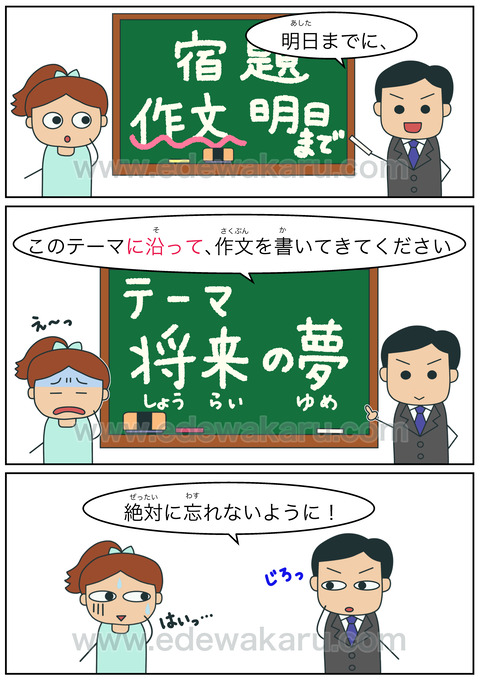
Meaning
〜の通りに
〜に合うように
How to use it
名詞[辞書形]+に沿って
Explanation
「〜に沿って」は「〜の通りに」「〜に合うように」という意味の文型です。[ルール]や[方針]、[マニュアル]などを基準にして、「〜の通りに〜する」と言いたい時に使います。例文⑤のように、
名詞につく場合は「〜に沿った+名詞」「〜に沿う+名詞」になります。
[例]
希望のデザイン
に沿って
バッグを作ってもらった
=希望
に沿った
デザインのバッグを作ってもらった
=希望
に沿う
デザインのバッグを作ってもらった
「〜に沿って」には「〜から離れないで〜」という意味の用法もありますので、一緒に覚えておきましょう😊
In context 5 examples
明日までに、このテーマに沿って作文を書いてきてください
→このテーマに合うように作文を書いてきてください計画に沿って作業をする
→計画の通りに作業をするお客様の対応は、マニュアルに沿って行ってください
→マニュアルの通りに行ってください会社の方針に沿って、仕事を進める
→会社の方針の通りに、仕事を進める私の希望に沿ったデザインのバッグを作ってもらった
→私の希望にあったデザインのバッグを作ってもらった
Usage 2
Read this source entry ↗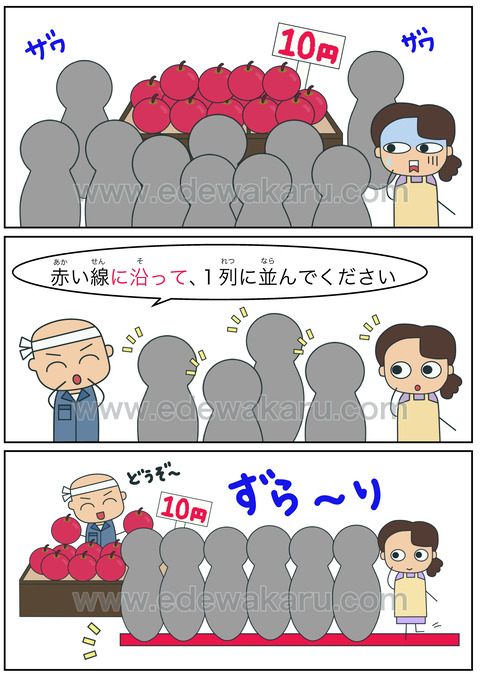
Meaning
〜から離れないように
〜が続いていく通りに
How to use it
名詞[辞書形]+に沿って
Explanation
「Aに沿って」は「Aから離れないように〜」という意味の文型です。「A」には、長く続いているものが入り、「Aが続いていく通りに〜」「長く続いていくAから離れないように〜」と言いたい時に使います。
「〜に沿って」は【基準】を表す用法もありますので、復習をしておきましょう😊
In context 4 examples
赤い線に沿って、1列に並んでください
→赤い線から離れないように、1列に並んでください川に沿って桜の木が並んでいる
→川が続いていく通りに桜の木が並んでいる線路に沿って歩いていくと、駅がありますよ
→線路が続いていく通りに歩いていくと、駅がありますよ道に沿って、花が植えてある
→道が続いていく通りに花が植えてある
毎日のんびり日本語教師
How to use it
名詞+に沿って
名詞+に沿った+名詞
Explanation
意味は2つあります。
①道路や河川、建造物の沿線上、あるいはそれまでの流れ
②状況や方針に応じること、あるいはマニュアル、書などの操作手順に従うこと
Notes
特になし
In context 8 examples
運命に沿って生きる。
川に沿って歩く。(沿河行走。)
この辺りは川に面した崖に沿って建てられている家が多い。
通りに沿って3階建ての建物が建ち並んでいる。(沿着街道排列着3层楼的建筑物。)
お客様のご意向に沿った最適な提案をいたします。(按照顾客的意愿提出最合适的建议。)
成功するイメージを思い描き、そのシナリオに沿って行動する。
マニュアルに沿って作業しなければ大事故を招く恐れがある。
改善案も出されたが、原点に立ち戻り当初の方針に沿って行われることになった。
NINJAL 日本語文型データベース
Meaning
基準となる道筋の~から離れないで、それに合うように何かをすると言いたいときに使います。
How to use it
Nに沿って
Notes
「~」には「方針・計画表・プログラム・教え」など、一連の流れがあることを思わせる言葉がきます。「〜に沿って」の後には、「~」に合わせて進む一連の動作を表す文がきます。
In context 4 examples
本日のピアノ発表会は、お手元のプログラムに沿って進めてまいります。
次の文章を読み、筆者の考えに沿って、高度経済成長期における社会の変化を150字以内で説明しなさい。
茶道とは、定められた「型」に沿って茶を客に提供する一連の儀式的な行為のことを言います。
ハーモニカの吹き方は難しくはありません。当社が開発したこのテキストにそって基礎から練習すれば、誰でも上手に吹けるようになります。