絵でわかる日本語
Meaning
〜以上する・〜以上ある・〜以上の
〜もする・〜もある
How to use it
数量詞+からする
数量詞+からある
数量詞+からの
Explanation
「〜からする・〜からある・〜からの」は「〜以上する・〜以上ある・〜以上の」という意味を表し、数量が「多い」という気持ちを入れて使用される文型です
😊何に使うかによって使い分けが必要です😥
[使い分け]
①
「〜からする」→値段
②
「〜からある」→距離・重さ・高さ・広さ・大きさ
③
「〜からの」→人数
上級レベルの文法ですが、覚えてしまえばとても簡単です😉
【「から」シリーズ】
〜から〜にかけて
〜からする・〜からある・〜からの
〜からといって・〜からって
〜からなる
〜からには
〜てからでないと〜ない
〜てからというもの
In context 4 examples
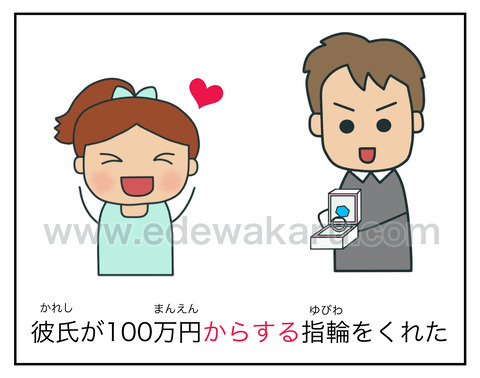
彼氏が100万円からする指輪をくれた
→彼氏が100万円以上する指輪をくれた健康のために、毎日5キロからある距離を歩いています
→健康のために、毎日5キロ以上ある距離を歩いています彼女は10キロからある荷物を持ち上げることができます
→彼女は10キロ以上ある荷物を持ち上げることができる昨日の事故で、100人からの人がケガをした
→昨日の事故で、100人以上の人がケガをした
IMABI
The Particle から II: ~からある, ~からの, & ~からする
Read this IMABI lesson ↗Explanation
The Particle から II: ~からある, ~からの, & ~からする
These phrases are all quite similar, but it’s important to understand how they don’t overlap.
Emphasizing Degree
からある basically shows that a something is a certain amount, but in other contexts it may imply that the quantity is large or even more than the number phrase being used. It is used with phrase involving length, width, wideness, depth, weight, size, and quantity.
However, because it is generally not used as much and is very 書き言葉的, it may be best to avoid it in the spoken language in order to not sound unnatural. For instance, 1a is completely grammatically correct, but many speakers would prefer you say 1b.
1a. 2000からある漢字 〇/△
1b. 2000もの漢字 〇
As much as 2000 Kanji
One application that has not been affected much is when からある is preceded by some time phrase.
2.{古く・昔}からある物語
A story from a long time ago
3. この神社は鎌倉時代からあります。
This temple is from the Kamakura Period.
Before seeing more examples, it’s important to know about the similar ~からの and ~からする which find themselves used more than ~からある. ~からの has some overlap with ~からある at times, but its main purpose to be used with cost and expenses as well as basic number statements in which ある would be inappropriate like in Ex. 13. ~からする is used to show prices as in purchases.
4. 17兆6000億ドルからの国債
National debt of over 17 trillion, 600 billion dollars
5. 年間一万ドルからする特別教室
Special classroom costing ten thousand dollars annually
6. この地方では毎年100㎝からある積雪のため、スキーが盛んだ。
Due to snow accumulation of 100 cm or more each year in this region, skiing has flourished.
7. 夜の間に、10トンからある大量のバイオ廃棄物はいきぶつがゴミ捨て場に捨てられていた。
During the night, more than 10 tons of biological waste was dumped in the dump site.
8. 今年は大雪で、ダラスでも30㎝からある積雪が観測された
This year has had heavy snow, and 30 cm has been recorded even in Dallas.
9. その男の人は50キロからある荷物をひょいと肩に担かついで、大型トラックに載せた。
The man hoisted luggage of more than 50 kilos with ease on his shoulders and loaded it into the semi-trailer.
10. インドネシア諸島は1万3000からある島で構成されている。
The Indonesian Isles is composed of more than 13,000 islands.
11. 安くても大体1頭3、4万円からする。
Even if it’s cheap, a head will basically cost 3-4000 yen.
12. 数時間前に、40キロからある荷物をいくつも運んだので、体中が痛くて動けない。
Several hours ago, I was lifting a lot of luggage over 40 kills, and so my whole body aches, and I can’t move.
13. 千人せんにんからの観光客かんこうきゃくが、毎日水族館まいにちすいぞくかんを訪おとずれます。
As many as a thousand tourists visit the aquarium every day.
14. 木の重おもさは2百トンからある。
The tree’s weight is as much as 200 tons
15. 身長6メートルからあるキリンが、突然、目の前に現れた。
A giraffe of over 6 meters in height suddenly appeared in front of my/our eyes.
16. 10メートルからある大木たいぼくが集落の家のある方向へ倒れてきた。
A large tree of 10 meters came crashing down in the direction where a village house was.
17a. 50台だいからのトラックが並ならんでいる。
17b. 50台以上だいいじょうのトラックが並んでいる。(もっと自然しぜん)
There are as many as fifty trucks lined up.
Warning Note: Do not confuse this からある with the particle から being followed by ある meaning a certain distance.
18. 至るとは、始点からある経路けいろを辿たどって終点に到達するという意味です。
“Itaru” means following a certain route from the start point and reaching the end point.
In context 20 examples
2000からある漢字 〇/△
As much as 2000 Kanji
2000もの漢字 〇
As much as 2000 Kanji
{古く・昔}からある物語
A story from a long time ago
この神社は鎌倉時代からあります。
This temple is from the Kamakura Period.
17兆6000億ドルからの国債
National debt of over 17 trillion, 600 billion dollars
年間一万ドルからする特別教室
Special classroom costing ten thousand dollars annually
この地方では毎年100㎝からある積雪のため、スキーが盛んだ。
Due to snow accumulation of 100 cm or more each year in this region, skiing has flourished.
夜の間に、10トンからある大量のバイオ廃棄物はいきぶつがゴミ捨て場に捨てられていた。
During the night, more than 10 tons of biological waste was dumped in the dump site.
今年は大雪で、ダラスでも30㎝からある積雪が観測された
This year has had heavy snow, and 30 cm has been recorded even in Dallas.
その男の人は50キロからある荷物をひょいと肩に担かついで、大型トラックに載せた。
The man hoisted luggage of more than 50 kilos with ease on his shoulders and loaded it into the semi-trailer.
インドネシア諸島は1万3000からある島で構成されている。
The Indonesian Isles is composed of more than 13,000 islands.
安くても大体1頭3、4万円からする。
Even if it’s cheap, a head will basically cost 3-4000 yen.
数時間前に、40キロからある荷物をいくつも運んだので、体中が痛くて動けない。
Several hours ago, I was lifting a lot of luggage over 40 kills, and so my whole body aches, and I can’t move.
千人せんにんからの観光客かんこうきゃくが、毎日水族館まいにちすいぞくかんを訪おとずれます。
As many as a thousand tourists visit the aquarium every day.
木の重おもさは2百トンからある。
The tree’s weight is as much as 200 tons
身長6メートルからあるキリンが、突然、目の前に現れた。
A giraffe of over 6 meters in height suddenly appeared in front of my/our eyes.
10メートルからある大木たいぼくが集落の家のある方向へ倒れてきた。
A large tree of 10 meters came crashing down in the direction where a village house was.
50台だいからのトラックが並ならんでいる。
There are as many as fifty trucks lined up.
50台以上だいいじょうのトラックが並んでいる。(もっと自然しぜん)
There are as many as fifty trucks lined up.
至るとは、始点からある経路けいろを辿たどって終点に到達するという意味です。
“Itaru” means following a certain route from the start point and reaching the end point.
Bunpro Grammar Reference
Meaning
Combined particles
How to use it
Noun + Particle(1) + の + Noun
(1) から、と、へ、で、まで
Nuance
A particle construction which shows the ownership or relationship of (B) with where (A) is from, going, done with, done until, etc.
Explanation
In Japanese, many particles are often grouped together with the case marking particle の. The primary function of this is to form a link between noun (A), and noun (B). In each of these cases, noun (B) will be considered to have all of the qualities described by noun (A), and the first particle that follows it.
The particle that comes before の will always be something that adds some form of immediate information about noun (A). The most common ones are as follows:
Noun (A) から の Noun (B) - The (B) that is 'from' (A).
これはアメリカからのお土産です。
This is a souvenir from America.
Noun (A) と の Noun (B) - The (B) that is 'grouped with' (A).
別れた後、彼との関係はどうなるんだろう。
After breaking up with him, I wonder what our relationship would be like.
Noun (A) へ の Noun (B) - The (B) that is 'toward' (A).
海外への手紙はこちらのポストにお入れください。
Please put letters to be sent internationally into this mailbox.
Noun (A) で の Noun (B) - The (B) that is 'done with' (A).
環境に悪いので車での通勤は控えてください。
Because it is bad for the environment, please refrain from commuting by car.
Noun (A) まで の Noun (B) - The (B) that is 'until' (A).
出発までの時間、何をします?
What do you want to do until departure?
Caution
Because noun (A) is describing noun (B), noun (B) will be considered as the subject of the statement. Due to this, particles that usually mark subjects, topics, or objects of actions cannot be paired directly with の. This includes に, も, は, が, and を.
Nuance · 日本語
(A)がどこから来たのか、行くのか、終わったのか、終わるまでやるのか、などと一緒に(B)の所有関係や関係を示す助詞。
Explanation · 日本語
格助詞の「の」には、これをほかの助詞と合わせる使い方があります。「の」は、名詞(A) と名詞(B) をつなぎます。そして、名詞(A) と助詞が、名詞(B) の内容を説明します。
「の」の直前に来る助詞は、名詞(A) の内容に関係しています。以下、よく使われる「助詞」と「の」の例を見てみましょう!
名詞 (A) から の 名詞 (B) - (A) から来た (B)
これはアメリカからのお土産です。
This is a souvenir from America.
名詞 (A) と の 名詞 (B) - (A) と一緒の (B)
別れた後、彼との関係はどうなるんだろう。
After breaking up with him, I wonder what our relationship would be like.
名詞 (A) へ の 名詞 (B) - (A) に行く (B)
海外への手紙はこちらのポストにお入れください。
Please put letters to be sent internationally into this mailbox.
名詞 (A) で の 名詞 (B) - (A) で行われる (B)
環境に悪いので車での通勤は控えてください。
Because it is bad for the environment, please refrain from commuting by car.
名詞 (A) まで の 名詞 (B) - (A) まで続く (B)
出発までの時間、何をします?
What do you want to do until departure?
注意点
名詞(A) は、名詞(B) の説明なので、文の主語になるのは、名詞(B) の方です。「の」の前には、「に」「も」「は」「が」「を」など、主語・話題・目的語を表す助詞を置くことはできません。
In context 17 examples
- あちゃんとの握手会に行こう!
Let's go to the handshake event with A-chan! (A-chan's event)
- これはアメリカからのお土産です。
This is a souvenir from America.
- 出発までの時間、何をします?
What do you want to do until departure?
- 別れた後、彼との関係はどうなるんだろう。
After breaking up with him, I wonder what our relationship would be like.
- 海外への手紙はこちらのポストにお入れください。
Please put letters to be sent internationally into this mailbox.
- 環境に悪いので車での通勤は控えてください。
Because it is bad for the environment, please refrain from commuting by car.
- これまでの話はなかなかおもしろい。
The story so far is interesting.
- 彼は癌との戦いに勝ったそうだ。
I heard that he won the battle with cancer.
- なぎさんは、はやてさんへの手紙をずっと書いている。
Nagi constantly writes letters to Hayate.
- サマーキャンプでの生活はとても楽しいですよ!
Life at summer camp is very fun.
- 14時からのパネルディスカッションに出るつもりだ。
I plan on attending the panel discussion that starts from 2 p.m.
- 昨晩からの雨はやっと止んだよ。とうとう友達に会いに行けるよ。
The rain that started from yesterday evening finally stopped! I can finally go meet up with my friends!
- おじいちゃんはポーランドでの思い出をだんだんと忘れてきた。
Grandpa has been slowly forgetting his memories of Poland.
- 彼は彼女への愛情でいっぱいのメッセージをいつも書いている。
He always writes messages that are filled with love towards her.
- 今までの対立の原因は広く知られていない。
The reason for the conflict up until now is not widely known.
- クライアントからの手紙には私への不満がいっぱい書かれていた。
The letter from the client was full of complaints about me.
- 郵便屋さんから母からの小包を受け取った。
I took the package from my mother from the postman.
NINJAL 日本語文型データベース
Meaning
数量を表す言葉と一緒に使って、だいたいそれくらいかそれ以上のという意味を表します。人数や資産などに対して使うことが多いです。話し手が数量が多いと感じている場合に使います。
How to use it
N(数量詞)からのN
In context 4 examples
人気絶頂のアイドルのコンサートには10万人からのファンがつめかけた。
この工場では1万人からの従業員が24時間体制で働いている。
彼は5年前、親の財産を受け継いで1000万円からの資本金で会社を設立した。
世界100カ国からの国と地域の代表が、先月の国際会議に出席した。