日本語文型辞典
Meaning
基本情報説明話しことばでは、「V-てる」になることが多い。
動作や作用を表す動詞を用いて、その動作・作用が継続中であることを表す。⑤⑥は動作が過去のある時点から現在まで続いていることを表している。動詞によっては、この意味を表さないものがあるので注意する必要がある。たとえば、「行く」を用いた「彼は今アメリカに行っている」は、アメリカヘ行く途中なのではなく、今アメリカにいるという意味になる。用法2を参照のこと。
ある動作・作用の結果としての状態を表す。この意味で使われる動詞は、「始まる」「乾く」「あく」「閉まる」など状態の変化を表す動詞や、「行く」「来る」「帰る」など。また、「知る」「持つ」「住む」なども「…ている」の形で状態を表す。これらは、普通、動作の継続進行の意味は表さない。ただし、繰り返し起こることを表す3の用法の場合は使われる。また、「着る」のように、文脈によって、進行継続、結果としての状態のどちらの用法も可能なものもある。
a. V-ている
動作作用が繰り返し起こることを表す。一組の人などが何回も行為を行う場合と、多くの人が次々に同じことを繰り返す場合の両方がある。
b. Nをしている
職業を表す名詞について、現在の職業を表す表現。「Nをしていた」は過去のある時期の仕事を表す。
過去に起こったことを回想的に表す。それが何らかの意味で現在にかかわりがあると思われる場合に用いる。
a. V-ている
「ている」の形で、未来のある時点において完了している事態を表す。また、「ていた」の形で過去においてすでに完了している事態を表す。
b. V-ていない
動作や作用の実現がまだであることを表す。「まだ来ません」のように、「まだV-ない」の形に言いかえられる場合もあるが、それができる動詞は限られている。普通は、「まだV-ていない」を用いるほうが自然である。
恒常的な状態を表す。「そびえる」「似る」などの動詞は、普通「ている」「ていた」でしか使わない。また、このような動詞は、名詞の前では、「曲がっている道」より「曲がった道」の形の方が自然なことが多い。
How to use it
V-ている【継続】
V-ている【結果】
V-ている【繰り返し】
V-ている【経験】
V-ている【完了】
V-ている【状態】
In context 44 examples
雨がざあざあ降っている。
わたしは、手紙の来るのを待っている。
子供たちが走っている。
A:今、何してるの。
B:お茶飲んでるところ。五年前から、日本語を勉強している。
このテーマはもう三年も研究しているのに、まだ結果が出ない。
授業はもう始まっている。
せんたくものはもう乾いている。
彼女が着ている着物は高価なものだった。
その集まりには彼も来ていたそだ。
A:お母さんはいらっしゃいますか。
B:母はまだ帰っていません。今5時だから、銀行は、もうしまっている。
電灯のまわりで、たくさん虫が死んでいた。
A:あそこにいる人の名前を知っていますか。
B:さあ、知りません。疲れていたので、そこで会った人のことはよく覚えていません。
わたしが新聞を読むのはたいてい電車に乗っているときだ。
今はアパートに住んでいるが、いずれは一軒家に住みたいと思っている。
このプリントを持っていない人は手を上げてください。
彼は今はあんなにふとっているが、若いころは、やせていたのだ。
その家の有り様はひどいものだった。ドアは壊れているし、ガラスは全部割れているし、ゆかはあちこち穴があいていた。
毎年、交通事故で多くの人が死んでいる。
いま週に一回、エアロビクスのクラスに適っている。
この病院では毎日二十人の赤ちゃんが生まれている。
いつもここで本を注文している。
戸田さんはデパートで働きながら、大学の夜間部へ行っているそうだ。
彼は、トラックの運転手をしている。
わたしの父は、本屋をしている。
彼女は、以前、新聞記者をしていたが、今は主婦をしている。
A:お仕事はなにをしていらっしゃいますか。
B:コンピュータ関係の会社につとめています。調べてみると、彼はその会社を三か月前にやめていることがわかった。
わたしは、十年前に一度ブラジルのこの町を訪れている。だから、この町を知らないわけではない。
記録をみると、彼は過去の大会で優勝している。
北海道にはもう3度行っている。
子供が大学に入るころには、父親はもう定年退職しているだろう。
遅刻した高田が会場に着いたときにはもう披露宴が始まっていた。
彼女が気づいたとき、彼はもう彼女の写真をとっていた。
A:もう終わりましたか。
B:いいえ、まだ終わっていません。A:試験の結果を聞きましたか。
B:いや、まだ聞いていません。
C:わたしは、もう聞きました。卒業後の進路についてはまだはっきりとは決めていない。
ここから道はくねくね曲がっている。
北のほうに高い山がそびえている。
日本と大陸はかつてつながっていた。
先がとがっている。
母と娘はよく似ている。
絵でわかる日本語
Usage 1
Read this source entry ↗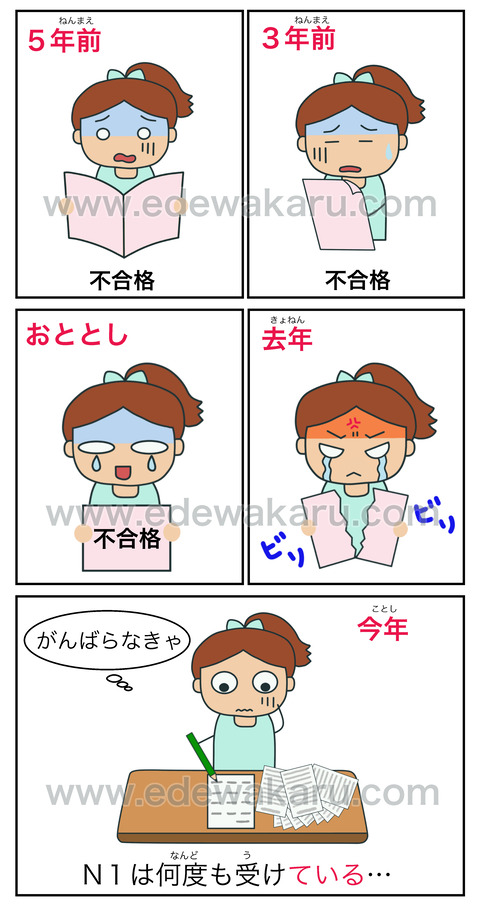
Meaning
以前〜したことがある
過去に〜したことがある
How to use it
動詞[て形]+ている
Explanation
「〜ている」は「前に〜したことがある」という意味で【過去の経験】を表す文型です。
過去に経験したことが、現在の状況や、その時の会話に関係する場合に使います
😮
[例]
A:N1の聴解はとても難しいんだよ!
B:N1は何度も受け
ている
よ(だから、知っているよ)
A:この本は、すごくおもしろいから貸してあげる!
B:この本は前に読ん
でいる
よ(だから、いらないよ〜)
(復習:貸す・借りる)
彼女はアメリカの大学を卒業し
ている
(だから、英語がペラペラだ)
今回は【過去の経験】を表す「〜ている」でした😊「〜ている」には、たくさん意味がありますのでがんばって覚えていきましょう😉
(復習:〜ていく(継続))
In context 5 examples
N1は何度も受けている
→N1は何度も受けたことがある(復習:なん+助数詞+も)この本は前に読んでいる
→この本は前に読んだことがある彼女はアメリカの大学を卒業している
→彼女はアメリカの大学を卒業した5年前に事故にあっている
→5年前に事故にあったことがある北海道へは何度となく行っている
→北海道へは何度となく行ったことがある(復習:なん〜となく(なん+助数詞+となく))
Usage 2
Read this source entry ↗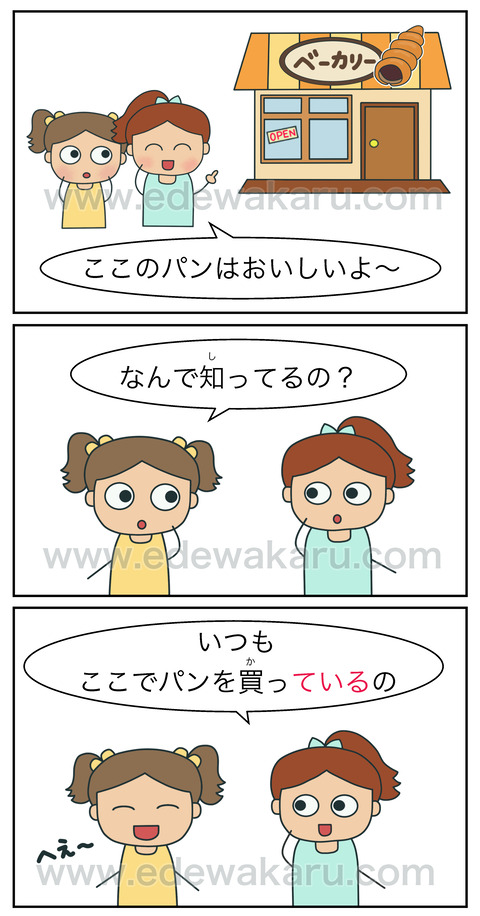
Meaning
同じことを繰り返してする
いつも同じことをする
いつも同じことが起こる
How to use it
動詞[て形]+ている
Explanation
「〜ている」は【繰り返し】を表す文型で、「いつも(同じこと)をする」「よく(同じこと)が起こる」という意味です。
「何度も同じことをする」「何度も同じことが起こる」
と言いたい時に使いましょう😀
(復習:なん+助数詞+も)
[例]
いつもここでパンを買っ
ている
【同じ行為】
同じパン屋でパンを買う
→
「同じパン屋でパンを買う」ことを何度もする
よく図書館で宿題をし
ています
【同じ行為】
図書館で宿題をする
→「図書館で宿題をする」ことを何度もする
ここで、よく事故が起き
ている
とのことだ
【同じこと】
この場所で事故が起きる
→
「同じ場所で事故が起きる」ということが何度もある
「〜ている」は初級で勉強する文型ですが、たくさん意味がありとても複雑です😨どの「〜ている」も会話でよく使いますので、しっかりと復習をしておきましょう😉
(復習:〜をしている)
In context 6 examples
いつもここでパンを買っているの
→いつもここでパンを買うのお母さんは、毎日5時に起きている
→お母さんは、毎日5時に起きる毎年たくさんの外国人が日本旅行(にほんりょこう)に来ている
→毎年たくさんの外国人が日本旅行に来るよく図書館で宿題をしています
→よく図書館で宿題をします週に1回、ピアノを習いに行ってるの
→週に1回、 ピアノを習いに行くの(復習:〜てる・〜でる)ここで、よく事故が起きているとのことだ
→ここで、よく事故が起きるとのことだ(復習:〜とのことだ)
Usage 3
Read this source entry ↗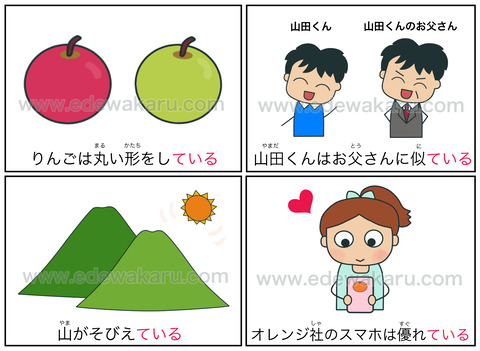
Meaning
いつも〜という状態だ
How to use it
動詞[て形]+ている
Explanation
「〜ている」は「いつも〜という状態だ」という意味で、【もとからの状態】や【(いつも〜で、)変わらない状態】を表す場合に使用される文型です。「似ている」や「そびえている」などは、よく、この文型が使われます😊
⭕️りんごは丸い形をし
ている
❌りんごは丸い形をする
⭕️山田くんはお父さんに似
ている
❌山田くんはお父さんに似る
この「〜ている」は外見を表す「〜をする」と一緒に使って、ものの形や色を表すことがよくあります。
「〜をする」はとても大切な文型ですので、復習をしておきましょう😉
(復習:〜をする(外見))
In context 5 examples
りんごは丸い形をしている
→りんごの形は丸い(復習:〜をする(外見))山田くんはお父さんに似ている
→山田くんはお父さんと同じような顔だ山がそびえている
→高い山がある*「そびえる」とは「山やビルなどが高く立つ」という意味(復習:〜とは(定義・説明))オレンジ社のスマホは優れている
→オレンジ社のスマホは他の会社のスマホよりいい*「優れる」とは「他のものよりもいい」という意味あの道は曲がっている
→あの道はまっすぐではない
Usage 4
Read this source entry ↗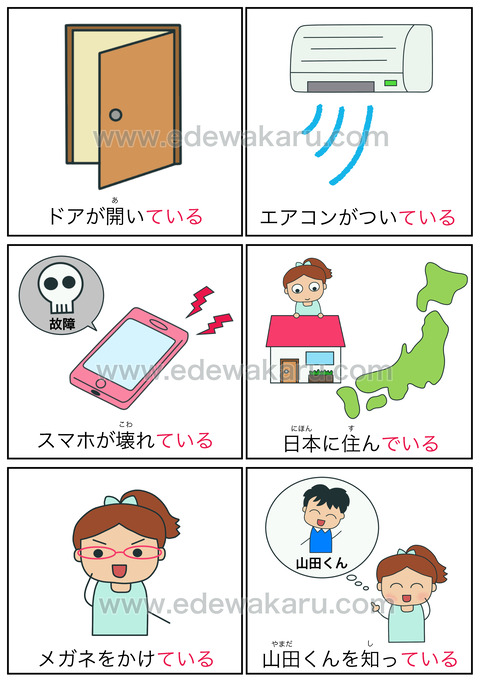
Meaning
〜になった結果の状態がそのまま残っている
〜した結果の状態をそのまま続けている
How to use it
動詞[て形]+ている
Explanation
「〜ている」は「【動作】や【作用】の結果としての状態」を表す文型です。
「〜になった結果の状態が、まだそのまま残っている」
と言いたい時に使います😊
[例]
ドアが
開い
ている
【作用の結果】
開く
→
「開く」状態が続いている
エアコンが
ついている
【作用の結果】
つく
→
「つく」状態が続いている
日本に
住んでいる
【動作の結果】
住む
→日本に
「住む」状態が続いている
今回の「〜ている」は【結果の状態】を表すものです。「〜ている」にはたくさん意味がありますので復習をしておいてくださいね😊
(復習:〜ている(繰り返し))
(復習:〜をしている(職業))
In context 10 examples
ドアが開いている
→ドアが開いて、今もその状態のままだエアコンがついている
→エアコンがついて、今もその状態のままだ(復習:エアコン)スマホが壊れている
→スマホが壊れて、今もその状態のままだ日本に住んでいる
→今も日本に住む状態が続いているメガネをかけている
→メガネをかけて、今もその状態のままだ山田くんを知っている
→山田くんの顔と名前を知り、今もその状態が続いているスマホを持っている
→今もスマホを自分のものとして所有する(復習:〜として)火が消えている
→火が消えて、今もその状態のままだ桜が咲いている
→桜が咲いて、今もその状態のままだ洗濯物が乾いている
→洗濯物が乾いて、今もその状態のままだ
Usage 5
Read this source entry ↗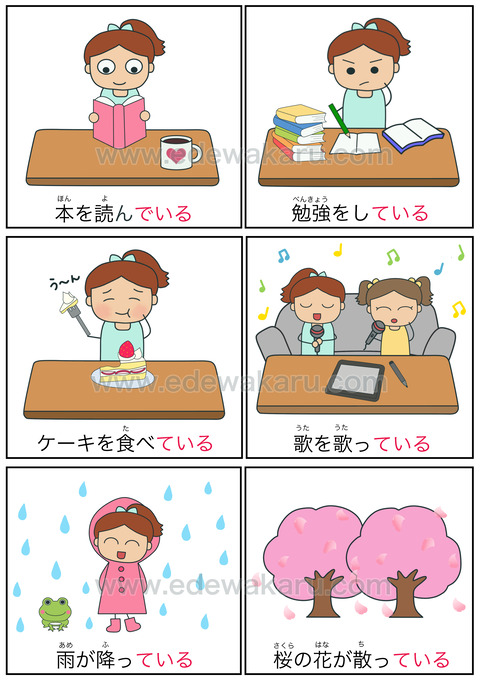
Meaning
今〜の動作が進行中(しんこうちゅう)
〜中
(復習:〜中)
How to use it
動詞[て形]+ている
Explanation
「〜ている」は「今〜という動作が進行中(しんこうちゅう)だ」という意味を表す文型です。【動作】や【作用】が
「現在進行中だ」
と言いたい時に使います😊この文型は、ほとんどの場合【他動詞】に使われますが、【動きを表す自動詞】や【自然現象(しぜんげんしょう)を表す自動詞】にも使われます。
[「自動詞」を使う例]
公園を
走っている
魚が泳いでいる
雨が降っ
ている
桜が散っ
ている
風が吹い
ている
など
進行中を表す「〜ている」は日常会話(にちじょうかいわ)でもとてもよく使われます😊「〜ている」にはたくさん意味がありますので、しっかりと復習をしておきましょう😉
(復習:〜ている(繰り返し))
(復習:〜ている(結果の状態))
(復習:〜ている(経験))
In context 6 examples
本を読んでいる
→今「本を読む」という動作が進行中(しんこうちゅう)勉強をしている
→今「勉強をする」という動作が進行中ケーキを食べている
→今「ケーキを食べる」という動作が進行中歌を歌っている
→今「歌を歌う」という動作が進行中雨が降っている
→今「雨が降る」という自然現象(しぜんげんしょう)が起きている桜の花が散っている
→今「桜の花が散る」ということが起きている
どんなときどう使う 日本語表現文型辞典
Usage 1
Meaning
narrative present tense
How to use it
Vて+いる
Explanation
ている〈経歴・経験〉
過去に~した
歴史的な事柄、経歴・経験などを述べる言い方。
Describes historical events, careers, or experience.
In context 3 examples
アポロ11号は1969年に月に着陸している。
モーツァルトは12歳のときに、オペラを作曲している。
わたしは3歳のときにこの病気(はしか)にかかっているから、もうかかることはない。
Usage 2
Meaning
-s, -ing
How to use it
Vて+いる
Explanation
ている〈初めからの外見、状態〉
もともとの形状、性質などを表す。ほかに「優れている・面している」などがある。
Original shape or essence of something. Other expressions include: 優れている and 面している.
In context 3 examples
弟は父によく似ています。
500メートルぐらい行くと、この道は少し左に曲がっています。
この道は海の方まで続いています。
Usage 3
Meaning
always
How to use it
Vて+いる
Explanation
ている〈習慣・反復・職業・身分〉
1)習慣や行為の反復を表す。習慣・反復の意味の場合は ❷ のように瞬間動詞(瞬間的な動作・作用を表す動詞)も使える。 ❹ ~ ❻ は職業、身分などを表す。
2) ❸ のようにくだけた会話では「Vている」が「Vてる」になる。
2)In informal speech, Vている becomes Vてる, as in sentence ❸ .
1)Practice or repetition of action. For practice and repetition, verbs of momentary action or operation can also be used, as in sentence ❷ . Sentences ❹ to ❻ express occupation or position.
In context 6 examples
わたしは毎年富士山に登っています。
この道ではよく交通事故が起きているから気をつけてください。
父は昨年から仕事で毎月1回中国へ行ってるんです。
山田さんはタイの大学で日本語を教えています。
弟はドイツの大学でヨーロッパの歴史を勉強しています。
林さんは貿易会社の社長をしている。
Usage 4
Meaning
is -ing
How to use it
Vて+いる
Explanation
ている〈進行・継続〉
1)動作や作用が進行中・継続中であることを表す。動詞は継続動詞を使う。 ❸ ❹ のように自然現象を表すのにも使う。
2)くだけた会話では「Vている」が「Vてる」になる。
2)In informal speech Vている becomes Vてる.
1)Progression or continuation of action or operation. Verbs of continuation are used. Also used as in sentences ❸ and ❹ for natural phenomena.
In context 5 examples
父は部屋で新聞を読んでいます。
わたしが家に帰ってきたとき、子どもたちは庭で遊んでいました。
(テレビのニュース)北海道では雪が降っています。
冷たい風が吹いています。
わたし、ここで待ってるわ。
Usage 5
Meaning
has been; is
How to use it
Vて+いる
Explanation
ている〈変化の結果の残存〉
B:ああ、あの赤いシャツを着た人ね。あれはリーさんですよ。
1)主体の変化の結果が残っている状態を表す。動詞は瞬間動詞(瞬間的な動作を表す動詞)を使う。 ❶ ❷ は、人が何かの目的を持ってそうしたのか、自然にそうなったのかに関係なく、ただ見える状況を言う場合に使う。 ❸ ❹ は行為の後の状態がそのまま続いていることを表す。 ❺ ❻ は「着脱を表す他動詞+ている」で、服装を表す言い方。
2)名詞を説明するときは、 ❻ のように、「VているN」を「VたN」で置き換えることができる。動作の進行中であることを表す「Vている」にはこの使い方はない。
◆ めがねをかけている人(状態)
=めがねをかけた人/
ピアノを弾いている人(進行中)
≠ピアノを弾いた人
3)くだけた会話では❼のように「Vている」が「Vてる」になる。
1)Result of change continues. Uses verbs of momentariness (verbs that express momentary action). In sentences ❶ and ❷ describes externally certain state, whether someone had a purpose in causing that state or it naturally came about. Sentences ❸ and ❹ show that action continues unabated. Sentences ❺ and ❻ describe clothing using transitive verb for clothing + ている.
2)When explaining nouns, Vている N can be replaced with Vた N, as in sentence ❻ . Forms Vている N and Vた N are interchangeable. Forms V ているN and V たN are interchangeable, but not for action in progress.
◆ めがねをかけている人(状態)=めがねをかけた人/
ピアノを弾いている人(進行中)≠ピアノを弾いた人
3)In informal speech, Vている becomes Vてる, as in sentence ❼.
In context 7 examples
あ、この時計は止まっています。
あ、かばんの口が開いていますよ。さいふが落ちますよ。
遠山さんは今フィリピンに行っています。マニラにいます。
田中さんは結婚しています。子どもが3人います。
みちこさんは、白いスカートをはいて、白いぼうしをかぶっています。
A:あの、サングラスをかけている人はどなたですか。
あ、電気がついてるよ。部屋にだれかいるんだね。
日本語文型辞典 英語版
Meaning
【ている】In spoken Japanese, V-ている is often shortened to V-てる.
B:お茶飲んでるところ。
I’m just having a cup of tea.
With verbs that express an action or effect, ている indicates that the action/effect is in progress.
(5)
and
(6)
express actions that continue into the present from a point in the past. Note, however, that not all verbs indicate continuation of an action when used with ている. For example, in the sentence 彼はアメリカに行っている, 行く does not mean “He is on his way to the U.S.” but rather “He is now in the U.S.” See Usage
2.
B:母はまだ帰っていません。
She’s not back yet.
B:さあ、知りません。
Hmm, no, I don't.
Expresses a state that is the result of an action or effect. Verbs that express a change of state, such as 始まる(begin), 乾く(dry), あく(open/become empty), and 閉まる(close), have this meaning when used with ている, as do 行く(go), 来る(come), and 帰る(return). Verbs such as 知る(know), 持つ(have), and 住む(live) also express a state when followed by ている. These verbs do not usually express actions in progress. However, they can be used to express repetition, as in Usage
Expresses that an action is repeated. There are cases when a person or a group of people repeats the same action many times, and cases when many people perform the same action one after another.
b. Nをしている
B:コンピューター関係の会社につとめています。
I work at a computer company.
When をしている follows a noun that describes an occupation, it indicates someone’s current job. Nをしていた indicates someone’s previous job.
Expresses recollection of a past event. Used when the past event is thought to be relevant to the present in some way.
ている expresses a matter which will have been completed at a certain point in the future, and ていた expresses a matter that has already been completed in the past.
b. V-ていない
B:いいえ、まだ終わっていません。
No, not yet.
B:いや、まだ聞いていません。
No, not yet.
C:わたしは、もう聞きました。
I have already heard them.
Expresses that a movement or action has not yet come about. May be replaced in some cases by the まだV-ない form, as in まだ来ません, but such verbs are limited. More natural to use the form まだV-ていない.
Expresses an unchanging situation. Verbs such as そびえる(rise/tower) and 似る(resemble) are usually only used in ている and ていた forms. When these verbs are followed by a noun, it is more natural to say, for example, 曲がった道 rather than 曲がっている道.
How to use it
1. V-ている〈duration〉
2. V-ている〈result〉
3. Some verbs, like 着る(wear), can be used to express either an action in progress or a resulting state, depending on the context.
3. V-ている〈repetition〉a. V-ている
4. V-ている〈experience〉
5. V-ている〈completion〉a. V-ている
6. V-ている〈state〉
In context 44 examples
雨がざあざあ降っている。
It’s raining hard.
わたしは、手紙の来るのを待っている。
I’m waiting for a letter to arrive.
子供たちが走っている。
Some children are running.
A:今、何してるの。
What are you doing right now?
五年前から、日本語を勉強している。
I’ve been studying Japanese for five years.
このテーマはもう三年も研究しているのに、まだ結果が出ない。
I’ve been researching this topic for three years already, but I still haven’t gotten any results.
授業はもう始まっている。
The class has already started.
せんたくものはもう乾いている。
The laundry is already dry.
彼女が着ている着物は高価なものだった。
The kimono she’s wearing was an expensive one.
その集まりには彼も来ていたそうだ。
I heard that he came to the meeting, too.
A:お母さんはいらっしゃいますか。
Is your mother home?
今5時だから、銀行は、もうしまっている。
It’s five o’clock now, so the bank is already closed.
電灯のまわりで、たくさん虫が死んでいた。
There were a lot of dead bugs around the light.
A:あそこにいる人の名前を知っていますか。
Do you know the name of that person over there?
疲れていたので、そこで会った人のことはよく覚えていません。
I was tired, so I don't really remember much about the people I met there.
わたしが新聞を読むのはたいてい電車に乗っているときだ。
It’s when I’m riding the train that I usually read a newspaper.
今はアパートに住んでいるが、いずれは一軒家に住みたいと思っている。
I live in an apartment now, but I think I’d like to live in a house someday.
このプリントを持っていない人は手を上げてください。
Anyone who doesn’t have this handout, please raise your hand.
彼は今はあんなにふとっているが、若いころは、やせていたのだ。
He’s gotten that heavy now, but when he was young he used to be slim.
その家の有り様はひどいものだった。ドアは壊れているし、ガラスは全部割れているし、ゆかはあちこち穴があいていた。
The house was in terrible condition. The door was damaged, the windows were all broken, and there were holes in the floor everywhere.
毎年、交通事故で多くの人が死んでいる。
Many people die in traffic accidents every year.
いま週に一回、エアロビクスのクラスに通っている。
I go to an aerobics class once a week now.
この病院 では毎日二十人の赤ちゃんが生まれている。
Twenty babies are born in this hospital every day.
いつもここで本を注文している。
I always order books here.
戸田さんはデパートで働きながら、大学の夜間部へ行っているそうだ。
I heard that Toda-san goes to night classes at the university while working at a department store during the day.
彼は、トラックの運転手をしている。
He’s a truck driver.
わたしの父は、本屋をしている。
My father runs a bookstore.
彼女は、以前、新聞記者をしていたが、今は主婦をしている。
She used to be a newspaper reporter, but now she’s a homemaker.
A:お仕事はなにをしていらっしゃいますか。
What sort of work do you do?
調べてみると、彼はその会社を三か月前にやめていることがわかった。
When we checked, we found out that he had left the company three months earlier.
わたしは、十年前に一度ブラジルのこの町を訪れている。だから、この町を知らないわけではない。
I once visited this town in Brazil ten years ago. That’s why it’s not like I don’t know this town.
記録をみると、彼は過去の大会で優勝している。
According to the records, he has won a tournament in the past.
北海道にはもう3度行っている。
I’ve been to Hokkaido three times already.
子供が大学に入るころには、父親はもう定年退職しているだろう。
By the time the children go to college, their father will probably already have retired.
遅刻した高田が会場に着いたときにはもう披露宴が始まっていた。
By the time Takada-san—who was running late—got to the venue, the wedding reception had already started.
彼女が気づいたとき、彼はもう彼女の写真をとっていた。
By the time she noticed, he’d already taken her picture.
A:もう終わりましたか。
Have you finished it?
A:試験の結果を聞きましたか。
Have you heard the results of the examination?
卒業後の進路についてはまだはっきりとは決めていない。
I haven’t decided for sure what I’ll do after graduating.
ここから道はくねくね曲がっている。
The road curves a lot from here onwards.
北のほうに高い山がそびえている。
A high mountain towers to the north.
日本と大陸はかつてつながっていた。
Japan and the continent used to be linked.
先がとがっている。
The tip is sharp.
母と娘はよく似ている。
The mother and her daughter look very similar.
AIUEO JLPT Grammar
Meaning
「〜ている」is used to indicate the ongoing action, the continuation of a result, or habitual behavior. It is used when expressing the present continuous form, the continuation of an action after it has been completed, or repeated actions. In colloquial speech, the “い” in “〜ている” is often omitted, making it “〜てる.”
How to use it
動詞て形+いる
Explanation · 日本語
「〜ている」は、動作の進行中、結果の継続、または習慣的な行為を表す表現です。この表現は、現在進行形や、動作が完了してその状態が続いていること、または繰り返される行動を示すときに使用されます。口語表現では「〜ている」の「い」が省略されて「〜てる」となります。
In context 5 examples
彼は今、映画を見ている。
He is watching a movie now.
あなたはどこに住んでいますか?
Where do you live?
彼は疲れてる。
He is tired.
毎週末、彼はテニスをしているんですか?
Does he play tennis every weekend?
彼はいつも文句を言っている。
He is always complaining.
文法
Usage 1
Meaning
発話時点より以前に起こったことの結果の状態が継続していることを表す表現。
How to use it
V(自動詞のテ形)+ いる
Notes
[代表的な自動詞]
開く、閉まる、入る、出る、つく、消える、壊れる、汚れる、落ちる、沸く、集まる、決まる、始まる
In context 13 examples
窓が開いていますね。
ドアが閉まっていて開きません。
あれー。レストランが閉まってる。なんでだろう。
家に帰ると、誰もいないはずなのに、テレビがついていた。
あれ?さっき、パソコンの電源を入れたのに、消えていますね。
この時計、壊れていますね。
あ、財布が落ちてる。誰のだろう。
あ、服が汚れてるよ。
お風呂はもう沸いてるよ。
トム、お湯が沸いてるから教えてくれる?
入院日はもう決まっています。
遅くなってごめん。パーティーはもう始まってる?
ゴミが床に落ちている。
Usage 2
Meaning
移動後の状態・状況の変化を表す。
(例) キムさんは中国に行っています。
→キムさんは中国に行きました。キムさんは今、中国にいます。
How to use it
Vている
In context 7 examples
母は買い物に行っています。
弟は私の家に来ています。
父は今、会社に行っています。
部長は出張のため、ベトナムへ行っています。
すみません。田中はまだ来ておりません。
現在、私は駅前にできた新しいモールに来ています。
ナタポンさんは今、国へ帰っていますから、パーティーに参加できません。
Yokubi — The Common Grammar Guide (https://yoku.bi)
Explanation
Let's look at ている and てある now. They make use of いる/ある as auxiliary verbs.
ている indicates an enduring action or state. For a lot of verbs, this means progressive or continuous (enduring action), but for others, it means the result of an action remains in a certain condition (enduring state).
The い in ている is commonly dropped in conversation, both in writing and in speech. This includes ます form to (as てます).
ておる is a formal variant of ている. おる and いる have mostly the same meaning. ておる can be spoken as とる.
てある is about something being in an enduring state resulting from someone's action. てある always expresses a resulting state, **never** an action.
てある can turn the direct object into a subject. This means that the verb's normal "logical object" gets marked by が or は (or unmarked), like dinner in the example above. However, because Japanese is linguistically weird, sometimes を can be used, too.
Finally, it expresses a state, not an action, so てある should not be considered "the passive" version of the verb. Japanese has a real passive that we'll cover soon.
In context 1 examples
食べている
I'm eating. (enduring action)
NINJAL 日本語文型データベース
Meaning
[1] 動作や出来事が、進行中・継続中であることを表します。
[2] ある動作や出来事が、一定期間、反復的または習慣的に続くことを表します。職業や身分を言うときにも使います。
[3] 過去に経験したことを表します。そのことが現在の状況に影響を及ぼしている場合に使います。
[4] ある動作や出来事が、ある時点よりも前に完了した状態であることを表します。
[5] ~という出来事や動作の結果がそのまま続いている状態を表します。対象の状態だけに注目する言い方です。その変化が人の行為で起こった変化か自然に起こった変化かは意識していません。
[6] 物の外見・様子・状態などを説明するときに使います。一時的な様子や状態ではなく、その物が持つ変わらない特徴や形状などを言います。
How to use it
Vている
Vている
Notes
[1] 「~」には、「読む・待つ・働く・降る」など、継続的な動作や出来事を表す動詞がきます。
[5] 「〜」には、状態が変化することを表す動詞がきます。「壊れる・消える・開く」など、瞬間的な動きを表す自動詞を使うことが多いですが、「目を開ける・手を挙げる」など、体の一部の変化を表す他動詞、「着る・かぶる」など、服装などの着脱を表す他動詞も使います。
In context 38 examples
この飛行機は今、富士山の上空を飛んでいます。
では、来週水曜日にお会いしましょう。9時に会議室でお待ちしています。
昨夜は一晩中雨が降っていました。
「どの人がお兄さん?」「僕の隣で酒を飲んでいるのが兄だよ」
「誰も見ていないなら、テレビは消しましょうか」
電話が鳴った。国の母からだった。ちょうど母のことを考えていたので、その偶然に驚いた。
父は週末はたいていゴルフに行っている。
この頃ビタミン剤を飲んでいる。効き目があるかどうかわからないが……。
このところ日本では、毎年あちこちで水害が起きている。
兄は高校の数学教師をしている。
毎年大勢の人が富士山に登っています。
木村さんは今はボランティア活動をしていません。
最近、山田さんとは会っていない。
若いころ銀行で働いていたので、銀行のことは少しわかる。
この作家は1996年にインドを訪れている。受賞作からは、その旅の空気を感じることができる。
私は3歳のときにはしかにかかっています。免疫があると思います。
あの方にはずっと前にレセプションでお会いしているので、初対面ではありません。
「明日の試合、楽しみだね。原選手は今までこの相手には3回負けているんだけど、明日は勝ってほしいね」
林さんは、二十歳のとき上京してから、故郷の町には一度も帰っていないそうだ。
私が会場に着いたとき、パーティーはもう始まっていた。
いよいよ留学だ。明日の今頃は、もう日本に着いているんだなあ。楽しみ。
試験は9時からですから、9時少し前には必ず教室に入っていてください。
「送ったりんご、もう届いている?」「ううん、まだ届いていない」
出発時間まで5分しかないのに、まだみんな集まっていない。
あれ、ちゃんと電気を消して出たのに、うちの部屋の電気がついている。
あの店は先週からずっとシャッターが閉まっています。どうしたんでしょう。
「この掃除機は壊れているようで、使えません。ほかの掃除機はありますか」
台風の後、公園の桜の木の枝が折れていた。
玄関に500円玉が落ちていた。誰のかな?
「おばあさんはどこ?」「あそこです。あの着物を着ているのが祖母です」
歯医者で、治療中、目を開けている人と開けていない人の割合は、半々ぐらいだそうだ。
目の前に高い山がそびえている。
この川は下流の方で大きく東にカーブしている。
この道は海に続いています。まっすぐ行けば海に出ますよ。
我が家は海に面しているので、強い潮風を受けて、植物が育ちにくい。
町の中央を流れているのは、朝日川です。
先がとがっていない箸のほうが、子どもには安全だ。
弟は父に声が似ていて、電話だと間違えそうになる。
IMABI
The Progressive/Continued State: ~ている
Read this IMABI lesson ↗Explanation
The Progressive/CONTINUED STATE: ~ている
When used with the particle て, いる functions as a supplementary verb. In Japanese, a supplementary verb is a verb that loses some or all of its literal connotations to serve (a) specific grammatical purpose(s). Although it retains some resemblance to its basic meaning of indicating state, ~ている should be treated separately from いる.
~ている is most known for its role in making the “progressive form” (進行形), but it is also known for having several interrelated nuances that relate to other structures in English, causing great difficulty for learners to distinguish between them in context as well as execute in practice.
Conjugation Recap
This grammar point uses the conjunctive particle て. Conjunctions made with it remain the same. The only thing being done is that we are adding something after て itself. Nonetheless, let’s recap how to conjugate with て and how to conjugate いる (in the context of being after て).
Verb ClassBasic Form連用形+~て
–iru1 Ichidan見る (to see)見て
–eru Ichidan食べる (to eat)食べて
K-Type Godan書く (to write)書いて
G-Type Godan脱ぐ (to undress)脱いで
S-Type Godan貸す (to lend)貸して
N-Type Godan死ぬ (to die)死んで
M-Type Godan打ち込む (to hammer in)打ち込んで
T-Type Godan立つ (to stand)立って
R-Type Godan 知る (to know)知って
K-Type Godan (Irregular)行く (to go)行って
W-Type Godan (Irregular)言う (to say)言って
Sahen する (to do)して
Kahen来る (to come)来(き)て
Copula だ (to be)で
Plain SpeechPolite Speech
Non-Past~ている~ています
Past~ていた~ていました
Negative~ていない~ていません
~ていないです
Negative Past~ていなかった~ていませんでした
~ていなかったです
The meaning of ~ている is dependent on the semantic nature of the verb it is used with; therefore, single-word translations for its conjugations are not reliable. Over the course of this lesson, take note of how examples are translated to get a feel for how to translate it.
~ている
Correctly interpreting ~ている depends on what kind of verb is being used with it. “Kind” here does not refer to how the verb conjugates, but rather what it means semantically and its relation to verbs of similar meaning.
-ing
The main usage of ~ている is to indicate the progressive form, also known as the “-ing form” in English. The agent of the verb is doing something, which itself is an ongoing state in the present time. Likewise, the progressive form can also indicate events that are happening without a willful agent. This divide usually manifests as the difference between action verbs (動作動詞) and stative verbs (状態動詞) respectively. In either case, the verb ought to be one that takes time to occur.
1. 太朗たろうは朝ご飯を食べています。(食べる = 動作動詞)
Taro is eating breakfast.
2. お母さんは晩御飯の準備をしています。(準備をする = 動作動詞)
My mother is preparing dinner.
3. 日が短くなっている。(短くなる = 状態動詞2)
The days are getting shorter.
4. 今日も穏おだやかなお天気が続いていますね。(続く = 状態動詞)
The mild weather is continuing into today, huh?
5. 明治大学で法律ほうりつを勉強しています。(勉強する = 動作動詞)
I am studying law at Meiji University.
6. ファイルを編集しています。(編集する = 動作動詞)
I am editing the file.
When paired with the negative, the progressive sense of “not doing something” overlaps with the notion of “having not done something.” In Japanese, context clues would distinguish these aspect dynamics which would always be morphologically clear in English.
7. まだ食べていませんよ。
I’m still not eating.
≈I haven’t eaten yet.
When used with a time expression showing duration, ~ている may be interpreted as the present progressive perfect tense – “has been…-ing.”
8. かれこれ一時間ずっと同じ作業をやっています。
I’ve been doing the same work for the last hour or so straight.
As for ~ていた, it may correspond to the past progressive—”was/were… -ing”—or the past progressive perfect—”had been… -ing”—depending on context as Japanese lacks separate perfect tense conjugations.
9. 子供は宿題をしていた。
The kid(s) was/were doing homework.
10. 川崎幸太郎は同じ工場で10年ほどチーズケーキを作っていた。
Kotaro Kawasaki had been making cheesecakes at the same factory for around 10 years.
Habit
There are instances when the action marked with ~ている is not literally being done now, but it is, in fact, something the agent habitually does. At times, context will be needed to distinguish something being done now from something being done continuously (as a habit).
11. A学校に通っています。
Meaning 1: I go to School A.
Meaning 2: I am commuting to School A.
12. 天才てんさいはいつも勉強に打うち込こんでいる。
Geniuses are always diving into studies.
13. お父さんは毎朝早起きしています。
My father wakes up early every morning.
14. 長いことシャワーを浴びてる人って3中でいったい何をやっていますか?
So, the people who take long showers, what exactly are they doing in there?
An extension of this meaning is to indicate history of having done something, which may or may not be cyclical.
15. アレックスさんはもう10回も日本に旅行していますよ。
Alex has already traveled to Japan 10 times.
16. 阿部元首相が亡くなってからもう一年経っているんだね。
A year has already passed since Former Prime Minister Abe passed away, huh.
Resultant State
Many verbs in Japanese known as 瞬間動詞 (instantaneous verbs), meaning they capture the instant in time in which the action occurs. When used with ~ている, they denote the maintaining of said state that began with the onset of the verb itself. For instance, when you stand up, the act of standing is marked by 立つ, whereas 立っている indicates that the agent is still standing upon having stood up.
17. ネクタイが曲まがっている。
(My) necktie is crooked.
18. 古着ふるぎを着ています。
I’m wearing old clothes. 〇
I’m putting on old clothes. X
19. 彼女は長い髪かみをしている。
She has long hair.
20. 教師きょうしをしています。
I am a teacher.
21. 私は東京駅えきの近くに住んでいます。
I live near Tokyo Station.
22. お母かあさんによく似にていますね。
You resemble your mother well.
Many such verbs that are interpreted this way are intransitive. Great examples include 開く (to be open), 閉まる (to be closed), 入る (to go/be in), 出る (to go/come out), 壊れる (to be broken), 汚れる (to be dirty), etc. If the intransitive verb indicates a change to the status quo, ~ている indicates the state of being that comes into being upon that change.
23. その橋はしは石でできている。
The bridge is made of stone.
24. この机は壊こわれています。
This desk is broken.
25. 砂糖さとうはもう入はいっています。
Sugar is already in it.
26. 町は谷たにに位置いちしている。
The town lies in the valley.
27. 山がそびえている。
The mountain towers above (everything).
28. その教科書は初学者しょがくしゃに適てきしています。
The textbook is suitable for beginners.
29. その時計とけいは5分進んでいます。
The clock is five minutes fast.
30. 疲つかれています。
I’m tired.
31. お風呂ふろはもう沸わいていますか。
Is the bath hot yet?
32. 東京はどこへ行っても混んでいる。
Tokyo is crowded wherever you go.
~ている may still be interpreted in this way with transitive verbs. In such contexts, the verb is not one that is acted out.
33. 私は車を持っています。
I own a vehicle.
34. この金額きんがくは総合保険そうごうほけんを含ふくんでいますか。
Does this price include fully comprehensive insurance?
It must be noted that the existential verbs ある and いる cannot be used with ~ている4. Avoiding ~ている with them may involve not using ~ている at all or even switching to another verb that expresses a state of being.
35. 今晩空あいている部屋へやはありますか。
Do you have any vacant rooms this evening?
36a. 木になっていたリンゴを集めた。〇
36b. 木にあっていたリンゴを集めた。X
36c. 木にあったリンゴを集めた。??
I gathered the apples that [had ripened/were] on the tree.
The verb なる used in Ex. 36a is written in kanji as 生る with the meaning of “to bear fruit.” What makes 36c unnatural is that it sounds as if the apple is somehow out of place inside a tree.
Similarly, the existential verb 存在する (to exist) is often not natural with ~ている unless context allows for the present perfect tense.
37a. 幽霊は存在する。
37b. 幽霊は昔々から存在している。
37a. Ghosts exist.
37b. Ghosts have existed since long ago.
Generally speaking, if the verb in question typically happens in an instant, describing the process in the moment will require other grammar points. How exactly one goes about this will vary based on the semantic nature of the verb. In the following examples, Iteration B indicates how one would salvage the progressive interpretation of ~ている at the cost of adding more grammar.
38a. お前はもう死んでいる!
38b. お前はもう死にかけている!
38a. You’re already dead!
38b. You’re already dying!
39a. あの赤ちゃんが生まれて初めて両足で立っているよ!
39b. あの赤ちゃんが生まれて初めて両足で立とうとしているよ!
39a. That baby is standing on their feet for the first time in their life!
39b. That baby is attempting to stand on their feet for the first time in their life!
40a. ジャケットを身に着けている。
40b. ジャケットを身に着けているところだ。
40a. I’ve put on a jacket.
40b. I’m putting on a jacket.
41a. 田中は銀行に行っています。
41b. 田中は銀行に行く途中です。
41a. Tanaka has gone to the bank.
41b. Tanaka is on the way to the bank.
42a. 数学が重要になっている。
42b. 数学がだんだん重要になってきている。
42a. Math has become important.
42b. Math is becoming ever more important.
43. 店員さんが飲み物を持ってきている最中だ。
The store employee is in the middle of bringing over the drinks.
Resultant State w/ Motion Verbs
For verbs of motion like 行く and 帰る, ~ている typically indicates the state of having already made said transition to the new location and is still there.
44. 彼女は東京に来ています。
She has come to Tokyo.
45. 彼はもう帰っている。
He’s already gone home.
46. 台風8号は小笠原諸島に向かって(きて)います。
Typhoon No. 8 is headed/heading towards the Ogasawara Islands.
The Negative Forms: ~ていない vs ~ないでいる vs ~ずにいる
The typical negative form of ~ている is ~ていない, which simply indicates that some action/state is not (and has not been) happening. However, you may also see ~ないでいる and ~ずにいる5. These forms indicate a perpetual state of some state not being able to come into fruition. The difference between ~ないで and ~ず comes down to style, with the latter being more formal and poetic.
47. 覚えていません。
I don’t remember.
48. 僕ぼくは何もしていません。
I’m not doing anything.
49. 決けっして病気にならないでいることは不可能ふかのうだ。
It is impossible to never get sick.
50. 彼はいつも落おち着つかないでいる。
He is always not at ease.
51. そもそも愛って何なのか誰にも定義ができずにいるのだ。
No one is capable of defining what “love” even is in the first place.
Contractions
~ている is usually contracted to ~てる in casual conversation. Even in polite speech, it is commonplace to hear ~てます instead of ~ています. However, in truly polite situations such as being in an interview, it is avoided.
52. 今の、聞いてましたか。
Were you listening to what I was saying just now?
53. 父は私が何を勉強してるか6知らない。
My dad doesn’t know what I am studying.
54. 動いとる7!
It’s moving!
Word Note: 動く is “to move ” as in to physically move about, not “to move to a different house.” That meaning of the English verb “to move” is carried out by the verb 引っ越こす.
Ongoing Action → Static Result
To conclude, we will look at a sample of verbs with which ~ている defaults to its meaning of marking a resultant state as opposed to the progressive form. The verbs chosen have been specifically selected for commonly being misinterpreted by learners. In the chart below, you also get a glimpse at how ~ている overlaps with ~た, especially when used in the 連体形.
~た・ている Noun V~ているV~た
割われ{た・ている}卵たまご
A broken egg.卵が割れている。
The egg is broken.卵が割れた。
The egg broke.
やせ{た・ている}姿すがた
A slim figure姿がやせている。
To have a slim figure姿がやせた。
Figure got skinny.
太ふとっ{た・ている}彼
He who is fat彼は太っている。
He is fat.彼は太った。
He got fat.
穴あなが開あい{た・ている}壁
A wall with a hole壁に穴が開いている。
There’s a hole in the wall.壁に穴が開いた。
A hole opened up in the wall.
歪ゆがん{だ・でいる}見方みかた
A distorted viewpoint見方が歪んでいる。
(Your/their) viewpoint is distorted.
腐くさった橋はし
A rotten bridge
腐っている8橋
A rotting/rotten bridge橋が腐っている。
The bridge is rotting/rotten.橋が腐った。
The bridge rotted.
凹へこん{だ・でいる}ドア
A dented doorドアが凹んでいる。
The door is dented.ドアが凹んだ。
The door got dented.
凍こおっ{た・ている}川
A frozen river川が凍っている。
The river is frozen/freezing.川が凍った。
The river froze.
乾かわい{た・ている}砂すな
Dry sand砂が乾いている。
The sand is dry/drying.砂が乾いた。
The sand dried.
ひびが入っ{た・ている}壁かべ
Cracked wall壁にひびが入っている。
There are cracks in the wall.壁にひびが入った。
Cracks have gotten in the wall.
曲がっ{た・ている}細道ほそみち
A twisted narrow path細道が曲がっている。
The narrow path is twisted.
欠かけ{た・ている}茶碗ちゃわん
A chipped teacup茶碗が欠けている。
The teacup is chipped.茶碗が欠けた。
The teacup got chipped.
Previous Lesson
Next Lesson
The proper terminology for –iru-ending and –eru-ending ichidan verbs respectively are 上一段動詞 and 下一段動詞. ↩︎
短くなる is labeled as a stative verb instead of a stative adjective because なる is the verb, with 短く, the 連用形 of the adjective 短い, adverbially modifying it, not the other way around. ↩︎
って, a contraction of ~というのは here, can be viewed as a colloquial topicalizer. ↩︎
In some dialects, いる can be used with ~ている, resulting in いてる. This is commonplace in Kansai Dialects, and it is always used in the present progressive perfect tense. ↩︎
While not grammatically incorrect, the omission of に from ~ずにいる is excessively rare. ↩︎
The particle か here is used to indicate an embedded question, which is “what am I studying.” ↩︎
In other regions of Japan, you will hear ~とる, ~よる, or even ~ちょる instead of ~てる. Sometimes, these different forms are used for specific meanings of ~ている. Because this is beyond the realm of Standard Japanese, such differences will be for a future discussion. Incidentally, all of these dialectal variants involve おる, which in Standard Japanese is the humble form of いる. ↩︎
腐っている橋 has two interpretations: the bridge can be perceived as already being in the state of rot—”rotten” or in the process of “rotting.” Meaning, in contrast to the other verbs in the chart which are all interpreted as instantaneous verbs, the process behind 腐る necessitates some time. In the context of a bridge, the likelihood of enough time having already passed is high, leading to there being little difference between either interpretation. ↩︎
In context 62 examples
太朗たろうは朝ご飯を食べています。(食べる = 動作動詞)
Taro is eating breakfast.
お母さんは晩御飯の準備をしています。(準備をする = 動作動詞)
My mother is preparing dinner.
日が短くなっている。(短くなる = 状態動詞2)
The days are getting shorter.
今日も穏おだやかなお天気が続いていますね。(続く = 状態動詞)
The mild weather is continuing into today, huh?
明治大学で法律ほうりつを勉強しています。(勉強する = 動作動詞)
I am studying law at Meiji University.
ファイルを編集しています。(編集する = 動作動詞)
I am editing the file.
まだ食べていませんよ。
I’m still not eating.
かれこれ一時間ずっと同じ作業をやっています。
I’ve been doing the same work for the last hour or so straight.
子供は宿題をしていた。
The kid(s) was/were doing homework.
川崎幸太郎は同じ工場で10年ほどチーズケーキを作っていた。
Kotaro Kawasaki had been making cheesecakes at the same factory for around 10 years.
A学校に通っています。
Meaning 1: I go to School A.
天才てんさいはいつも勉強に打うち込こんでいる。
Geniuses are always diving into studies.
お父さんは毎朝早起きしています。
My father wakes up early every morning.
長いことシャワーを浴びてる人って3中でいったい何をやっていますか?
So, the people who take long showers, what exactly are they doing in there?
アレックスさんはもう10回も日本に旅行していますよ。
Alex has already traveled to Japan 10 times.
阿部元首相が亡くなってからもう一年経っているんだね。
A year has already passed since Former Prime Minister Abe passed away, huh.
ネクタイが曲まがっている。
(My) necktie is crooked.
古着ふるぎを着ています。
I’m wearing old clothes. 〇
彼女は長い髪かみをしている。
She has long hair.
教師きょうしをしています。
I am a teacher.
私は東京駅えきの近くに住んでいます。
I live near Tokyo Station.
お母かあさんによく似にていますね。
You resemble your mother well.
その橋はしは石でできている。
The bridge is made of stone.
この机は壊こわれています。
This desk is broken.
砂糖さとうはもう入はいっています。
Sugar is already in it.
町は谷たにに位置いちしている。
The town lies in the valley.
山がそびえている。
The mountain towers above (everything).
その教科書は初学者しょがくしゃに適てきしています。
The textbook is suitable for beginners.
その時計とけいは5分進んでいます。
The clock is five minutes fast.
疲つかれています。
I’m tired.
お風呂ふろはもう沸わいていますか。
Is the bath hot yet?
東京はどこへ行っても混んでいる。
Tokyo is crowded wherever you go.
私は車を持っています。
I own a vehicle.
この金額きんがくは総合保険そうごうほけんを含ふくんでいますか。
Does this price include fully comprehensive insurance?
今晩空あいている部屋へやはありますか。
Do you have any vacant rooms this evening?
木になっていたリンゴを集めた。〇
I gathered the apples that [had ripened/were] on the tree.
木にあっていたリンゴを集めた。X
I gathered the apples that [had ripened/were] on the tree.
木にあったリンゴを集めた。??
I gathered the apples that [had ripened/were] on the tree.
幽霊は存在する。
37a. Ghosts exist.
幽霊は昔々から存在している。
37a. Ghosts exist.
お前はもう死んでいる!
38a. You’re already dead!
お前はもう死にかけている!
38a. You’re already dead!
あの赤ちゃんが生まれて初めて両足で立っているよ!
39a. That baby is standing on their feet for the first time in their life!
あの赤ちゃんが生まれて初めて両足で立とうとしているよ!
39a. That baby is standing on their feet for the first time in their life!
ジャケットを身に着けている。
40a. I’ve put on a jacket.
ジャケットを身に着けているところだ。
40a. I’ve put on a jacket.
田中は銀行に行っています。
41a. Tanaka has gone to the bank.
田中は銀行に行く途中です。
41a. Tanaka has gone to the bank.
数学が重要になっている。
42a. Math has become important.
数学がだんだん重要になってきている。
42a. Math has become important.
店員さんが飲み物を持ってきている最中だ。
The store employee is in the middle of bringing over the drinks.
彼女は東京に来ています。
She has come to Tokyo.
彼はもう帰っている。
He’s already gone home.
台風8号は小笠原諸島に向かって(きて)います。
Typhoon No. 8 is headed/heading towards the Ogasawara Islands.
覚えていません。
I don’t remember.
僕ぼくは何もしていません。
I’m not doing anything.
決けっして病気にならないでいることは不可能ふかのうだ。
It is impossible to never get sick.
彼はいつも落おち着つかないでいる。
He is always not at ease.
そもそも愛って何なのか誰にも定義ができずにいるのだ。
No one is capable of defining what “love” even is in the first place.
今の、聞いてましたか。
Were you listening to what I was saying just now?
父は私が何を勉強してるか6知らない。
My dad doesn’t know what I am studying.
動いとる7!
It’s moving!
Bunpro Grammar Reference
Usage 1
Meaning
Has/have done, Is ~ing (Repetition)
How to use it
Verb[て]+ いる
Verb[て]+ る
Verb[て̶] + とる
Verb[て]+ います
Verb[て]+ ます
Verb[て̶] + とります
Nuance
A verb form indicating that someone or something is continually performing the action of (A) habitually.
Explanation
The 3rd most common meaning (in no specific order) that ている is used for in Japanese, is the repetition of common activities. This is for things that are not 'continuing', but happen so often that they are considered to be continuous (like going to work, having a hobby, and similar things).
私は毎日ギターを弾いている。
I play my guitar everyday. (This is a hobby of the speaker)
毎晩9時に寝ている。
I sleep at 9 every night. (This is a habit of the speaker)
彼は学校で働いている。
He works at a school. (This is a regular activity for him)
Due to いる being one of the verbs for 'existing' in Japanese, the ている form is closer to 'continuing to exist in a specific state', rather than (A)~ing in English. In this construction, it can be thought of as 'to be existing in the state of performing a regular activity'.
Caution
With this meaning of ている, to make it easier to understand, expressions of time are often used. This can be things like 毎日, 毎晩, 毎週, and similar phrases.
Fun Fact
Regularly in novels, manga, and specifically some parts of Japan, とる may be used instead of ている with the same meaning.
俺、毎日勉強しとる。
I study every day.
Nuance · 日本語
ある物または人が習慣的に何かを継続する姿を表現するために使われる動詞の活用。
In context 16 examples
- 俺は毎週金曜日の夜にスーパーに行っているのだ。
I go to the supermarket every Friday night. (I am going...)
- 彼は学校で働いている。
He works at a school. (This is a regular activity for him)
- 私は毎日ギターを弾いている。
I play my guitar everyday. (This is a hobby of the speaker)
- 毎晩9時に寝ている。
I sleep at 9 every night. (This is a habit of the speaker)
- ふうたろうさんは毎日みくさんと一緒に歴史を勉強している。
Fuutarou-san studies history every day with Miku. (Fuutarou-san is studying...)
- 魔王さまはバーガークイーンで働いています。
The Demon Lord works at Burger Queen. (The Demon Lord is working...)
- この公園では毎週末多くの人が走っています。
Many people run in this park every weekend. (Many people are running...)
- どうしてスティーブンはいつも黒いタートルネックを着ているのですか。
Why does Steven always wear a black turtleneck? (is wearing)
- ともこは国語の教科書を読んでいる。
Tomoko reads a Japanese textbook. (Tomoko is reading...)
- ひとみさんのお母さんは教師をしている。
Hitomi's Mother is a teacher. (Hitomi's mother is doing the act of being...)
- 電車は毎日、午前11時ごろに来ています。
The train comes every day at around 11 a.m. (The train is coming...)
- ばあさんは毎晩、薬を飲んどる。
Grandmother takes medicine every night. (Grandmother is drinking...)
- 鹿田さんは駄菓子屋をしている。
Mr. Shikada runs a small-time candy store. (Mr. Shikada is doing...)
- 俺は毎月、両親の家に帰っています。
I return to my parents' home every month. (I am returning home...)
- 姉は銀行に勤めています。
My sister works in a bank. (My sister is working...)
- 俺、毎日勉強しとる。
I study every day.
Usage 2
Meaning
Is, Am, Are (~ing)
How to use it
Verb[て]+ いる
Verb[て]+ る
Verb[て]+ います
Verb[て]+ ます
Nuance
A verb pattern which may express the constant state of doing something.
Explanation
ている is a construction used in Japanese to convey that someone or something is existing in a constant state of 'doing' the verb that comes before て. In English, depending on the verb, this can be translated as 'is (A)', 'am (A), or 'are (A)~ing'. The expression is made by adding いる to the て form of either る-Verbs, or う-Verbs.
シャンプーは何を使っているの?
What shampoo are you using?
今ラーメンを食べています。
I am eating ramen now.
Due to いる being one of the verbs for 'existing' in Japanese, the ている form means something closer to 'continuing to exist in a specific state', rather than (A)~ing in English. This is why verbs like 死ぬ, and 知る, appear as the ている form in Japanese, when they would appear as the past form in English.
お前はもう死んでいる。
You are already dead.
この人誰か知っている?
Do you know who this is?
Nuance · 日本語
何かが継続中だということを表す動詞の型。
In context 15 examples
- 何をしている?
What are you doing?
- この人誰か知っている?
Do you know who this is?
- シャンプーは何を使っているの?
What shampoo are you using?
- 今ラーメンを食べています。
I am eating ramen now.
- お前はもう死んでいる。
You are already dead.
- 寿司を食べている。
I am eating sushi.
- 今、勉強していないよ。
I am not studying now.
- 今、兄は寝ていません。
My older brother is not sleeping now.
- 彼は図書館で日本語を勉強しているだろう。
He is studying Japanese at the library, right?
- 私のお父さんが、高い時計をしています。
My father is wearing an expensive watch.
- トムとスティーブが公園でサッカーをしている。
Tom and Steve are playing soccer in the park.
- 今、お母さんが病院で寝ています。
My mother is sleeping in the hospital now.
- 君の妹が一人で遊んでいる。
Your little sister is playing by herself.
- お寿司を食べている男の人は、私の兄です。
The man who is eating sushi is my older brother.
- 映画を見ている女の人は、田中さんのお母さんだろう。
The woman who is watching the movie is Tanaka-san's mother, right?
Usage 3
Meaning
Verb modified noun, Relative clause
How to use it
Verb[た](*) + Noun
Verb[ている](*) + Noun
(*) Only verbs in short (plain) form can modify nouns. Do not use polite-ます.
Nuance
A structure used to create a noun phrase to show that (B) is something that did or is doing (A).
Explanation
In Japanese, if you want to describe something or someone that is performing an action, one of the ways you can do this is through a relative clause. A relative clause is when two phrases are joined into one sentence, rather than two individual sentences. The た (plain-past), or ている (continuous) form of verbs are usually used.
たかしさんは東京に住んだ男。
Takashi-san is a man that lived in Tokyo.
貴方が食べたハンバーガー。
The hamburger that you ate.
田中さんが飲んでいるコーヒー。
The coffee that Tanaka-san is drinking.
道で寝ている犬。
A dog that is sleeping on the road.
る-Verbs and う-Verbs follow their regular conjugation rules when making a relative clause. In the first example, we can see that 'Takashi-san is a man that lived in Tokyo', is one sentence, rather than 'Takashi-san is a man. He lived in Tokyo'. In English, words like 'that', and 'which' are used to create a relative clause. However, seeing as though these words do not exist in Japanese, the first phrase is simply attached to the noun.
Caution
The ます (polite) forms of verbs may not be used when making a relative clause.
たかしさんは東京に住んでいました男。
Takashi-san is a man who lived in Tokyo. (Unnatural Japanese)
Nuance · 日本語
(B)が(A)をやった、又は(A)をおこなっているということを表す名詞句を作るために使われる構造。
In context 17 examples
- 洗った服。
Washed clothes.
- 道で寝ている犬。
A dog that is sleeping on the road.
- たかしさんは東京に住んだ男。
Takashi-san is a man that lived in Tokyo.
- 田中さんが飲んでいるコーヒー。
The coffee that Tanaka-san is drinking.
- 貴方が食べたハンバーガー。
The hamburger that you ate.
- たくさん勉強をした生徒。
A student who studied a lot.
- 日本に住んでいる外国人。
A foreigner living in Japan.
- 友達から借りたペン。
A pen borrowed from a friend.
- 私が作った椅子。
A chair I made.
- 先生が教えた文法。
Grammar taught by a teacher.
- それは、あの店が売ったお弁当でしょう。
That is a bento box that was sold by that store over there, right?
- 掃除をした人。
A person who cleaned.
- アメリカから来た外国人。
A foreigner who came from America.
- 買いに行った飲み物。
A drink I went to buy.
- 東から来た風。
A wind that came from the east.
- 結婚する前に言った言葉。
Words they said before marriage.
- たかしさんは東京に住んでいました男。
Takashi-san is a man who lived in Tokyo. (Unnatural Japanese)
Usage 4
Meaning
State of being, Has (have) done
How to use it
Verb[て]+ いる
Verb[て]+ る(*)
(*) The い can be omitted in casual language.
Verb[て]+ います
Verb[て]+ ます(*)
(*) The い can be omitted in casual language.
Nuance
A verb form used when highlighting that someone or something is in the ongoing state of (A).
Explanation
As mentioned in our first ている lesson, this construction is used to convey that someone or something is existing in a constant state of 'doing' the verb that comes before て. Here we will take a closer look at several of the verbs that will be used with ている, to express 'existing in a state of (A) having been done'.
クラスは始まっている。
The class has already started. (Existing in the state of having started)
お母さんは今買い物に行っています。
My mom went out to go shopping. (Existing in the state of having gone)
あの犬は死んでいるだろう、悲しいね 。
That dog over there is probably dead… How upsetting. (Existing in the state of having died)
先生がめちゃ怒っている。
My teacher is very angry. (Existing in the state of having gotten angry)
All of these verbs would appear as the past form in English, after the initial thing has 'started', 'come', 'died', or 'gotten angry'. However, this is not the case in Japanese. In Japanese, once something is angry, it exists in the state of being angry, once something has started, it exists in the state of being ongoing, once something dies, it exists in the state of being dead, and so on.
Fun Fact
One of the easiest ways that you can tell whether a verb will use the ている form, or the past form, is to think about whether it can happen twice. Something cannot 'start' twice, so it will use ている. Something cannot die twice, so it will use ている, etc. This does not work with every verb, but will help with over 90% of the verbs that require this form.
ピアノが落ちている。
The piano has fallen. (Existing in the state of having fallen)
Something has fallen and is already on the ground, so it cannot fall again. ている will be used.
Nuance · 日本語
誰か、または何かが(A)を継続中だということを示すときに使われる動詞の活用。
In context 17 examples
- あのカバは太っていない。
That hippopotamus over there isn't fat. (The hippopotamus is in the state of not being fat)
- お母さんは今買い物に行っています。
My mom went out to go shopping. (Existing in the state of having gone)
- あの犬は死んでいるだろう、悲しいね 。
That dog over there is probably dead… How upsetting. (Existing in the state of having died)
- 先生がめちゃ怒っている。
My teacher is very angry. (Existing in the state of having gotten angry)
- クラスは始まっている。
The class has already started. (Existing in the state of having started)
- バスは今大阪に来ています。
The bus is in Osaka now. (The bus has come to Osaka and is there now)
- パーティーは始まっている。
The party has begun. (The party has begun and is still going on)
- 電車は東京に行っています。
The train is in Tokyo. (The train has gone to Tokyo and is there)
- ななさんのバナナは腐っています。
Nana's banana is rotten. (Nana's banana is in a state of being rotten)
- 喫茶店はもう閉まっています。
The coffee shop is already closed. (The coffee shop has been closed and remains closed)
- E(イー).T(ティー).は家に帰っている。
E.T. is at home. (ET has gone home and remains home)
- サスケさんは結婚していないでしょう?
Mr. Sasuke is not married, right? (Mr. Sasuke is not in the state of being married)
- お前はもう死んでる。
You are already dead. (You are in the state of being dead already)
- 「あの、すみません。どうして、あの人たちは、あそこに並んでいるのですか?」
'Errr, excuse me. What are those people standing in line over there for?' (...those people who are in line and continue to stay in line...)
- 「あの映画のタイトル、知ってる?」
「知らない。」'Do you know the title of this movie? (pointing to the TV)' (...the title of the movie is known and is still remembered) 'I don't.'
- テストに失敗したからお母さんは怒っている。
Mom is angry because I failed the test. (Mom got angry and continues to be angry)
- ピアノが落ちている。
The piano has fallen. (Existing in the state of having fallen)
Usage 5
Meaning
Does, Is doing
How to use it
Verb[て]+ る
Verb[て̶] + とる
Nuance
A casual Kansai verb pattern used to show that an action, activity or state is ongoing.
Explanation
A common abbreviation that is used in the Kansai region is てる, and とる. Both of these expressions replace ている, the combination of the conjunction particle て, and the る - Verb, いる. These structures convey the same meaning as ている, and express that something is ongoing.
てる is used equally by both genders, and is also relatively common in standard Japanese. とる on the other hand tends to be used almost exclusively by males, and is more unique to 関西弁.
Caution
As とる interacts with verbs in the same way as ている, と will change to ど with the same verbs that て would usually change to で.
Notes
関西弁
Nuance · 日本語
関西弁で、カジュアルに動作、状況、又は状態が進行中であることを示す際に使われる動詞活用法。
In context 12 examples
- 私はここでサッカーをしている。
私はここでサッカーをしてる。I play soccer here.
- めっちゃ緊張しとるな。
You are being so nervous. (You look so nervous)
- 今勉強しとるから、あとでかけなおすな。
I'm studying right now, so I will call you back later.
- 久しぶり!元気にしてる?
Long time no see! Are you healthy? (It's been a long time! How are you doing)
- 今何してる?暇やったら、飲みに行かへん?
What are you doing right now? If you are free, do you want to go out for a drink?
- トムと話している。
トムと話してる。I am talking with Tom.
- 何をしている?
何しとる?What are you doing?
- 兄はアメリカに住んでいる。
兄はアメリカにすんどる。My older brother is living in the United States.
- 今デートをしている。
今デートしてる。I am on a date now.
- 寿司を食べている。
寿司たべとる。I am eating sushi.
- お祖母ちゃん、ちゃんと毎日薬飲んどる?ちゃんと毎日飲まんとあかんで。
Grandma, are you taking your meds everyday? You have to make sure to take them everyday.
- 今日も道が混んどるな。
The road is congested today also. (The traffic is terrible today too)
日本語NET JLPT文法解説まとめ
Usage 1
Read this source entry ↗Meaning
移動後の状態・状況の変化を表す。
(例) キムさんは中国に行っています。
→キムさんは中国に行きました。キムさんは今、中国にいます。
How to use it
Vている
Explanation
Indicates the condition or situation of something after movement
In context 7 examples
母は買い物に行っています。
弟は私の家に来ています。
父は今、会社に行っています。
部長は出張のため、ベトナムへ行っています。
すみません。田中はまだ来ておりません。
現在、私は駅前にできた新しいモールに来ています。
ナタポンさんは今、国へ帰っていますから、パーティーに参加できません。
Usage 2
Read this source entry ↗Meaning
発話時点より以前に起こったことの結果の状態が継続していることを表す表現。
How to use it
V(自動詞のテ形)+ いる
Explanation
Expressions indicating that the result or state of an event that occurred before the time of speaking continues.
In context 13 examples
窓が開いていますね。
ドアが閉まっていて開きません。
あれー。レストランが閉まってる。なんでだろう。
家に帰ると、誰もいないはずなのに、テレビがついていた。
あれ?さっき、パソコンの電源を入れたのに、消えていますね。
この時計、壊れていますね。
あ、財布が落ちてる。誰のだろう。
あ、服が汚れてるよ。
お風呂はもう沸いてるよ。
トム、お湯が沸いてるから教えてくれる?
入院日はもう決まっています。
遅くなってごめん。パーティーはもう始まってる?
ゴミが床に落ちている。