Bunpro Grammar Reference
Meaning
as one would expect, only natural, that is just like..., even
How to use it
さすが + (に)+ Phrase
さすが + (の)+ Noun
Nuance
A short exclamation which often highlights that (A) is just as the speaker had thought, or exactly what was expected.
Explanation
さすが, also often appearing in the kanji form 流石, is an adverb that indicates the speaker's feeling of being impressed that something has lived up to its reputation, or what was expected of it. In English, this comes across as 'as expected of (A)', or 'that is just like (A)'.
As 流石 is an adverb, it may appear at the beginning of phrases (either with or without に), or directly preceded a noun when の is used.
すごい!さすが先輩!
Wow! That's what I would expect from you senpai!
流石に今日は雨が降りすぎだろ...
As one would expect, it is raining way too much today.
さすがの君でもこの問題は難しいだろう。
Even for someone like you, this problem is difficult, isn't it?
Caution
Although uncommon, さすが may occasionally have a negative connotation. In these cases, it is similar to 'even' in English. This use of さすが implies that 'as one had thought, even (A) couldn't (B)', and similar nuances.
さすが田中くん!発注ミスの天才だね!
As expected, Tanaka-kun! You are a genius at making order errors!
Fun-fact
The kanji structure of 流石 is a type of kanji use known as 借字 in Japanese. This basically means 'borrowed symbol', and indicates that the meaning of the kanji is not related to the meaning of the word at all.
Nuance · 日本語
(A)は話し手の思った通りだった、又は予想通りだったということを強調する時に使われる表現。
Explanation · 日本語
「さすが」は、何かが評判通り・期待通りであると感じること、またはそれに感心していることを表す副詞です。この表現は「やはり (A) だ」や「それでこそ (A) だ」というような意味で使われ、漢字で「流石」と書かれることもあります。
「さすが」は副詞なので、文や節の頭に置かれることが多く、このとき「に」が付くこともあります。また、「の」を付けて名詞の前に置かれることもあります。
すごい!さすが先輩!
Wow! That's what I would expect from you senpai!
流石に今日は雨が降りすぎだろ...
As one would expect, it is raining way too much today.
さすがの君でもこの問題は難しいだろう。
Even for someone like you, this problem is difficult, isn't it?
注意点
稀に「さすが」が否定的な意味合いで使われることがあります。このような場合、「やはり (A) でさえ (B) できない」というようなニュアンスになります。
さすが田中くん!発注ミスの天才だね!
As expected, Tanaka-kun! You are a genius at making order errors!
豆知識
「流石」という漢字には、借字と呼ばれる漢字の表記方法が使われています。借字とは、漢字の意味とは関係なく、その漢字の音だけを「借りて」書き表す表記方法のことです。
In context 16 examples
- いいカーブだ。流石ダルビッシュ。
What a nice curveball. That's just like Darvish.
- 流石に今日は雨が降りすぎだろ...
As one would expect, it is raining way too much today.
- すごい!さすが先輩!
Wow! That's what I would expect from you senpai!
- さすがの君でもこの問題は難しいだろう。
Even for someone like you, this problem is difficult, isn't it?
- 流石に食いすぎたな。椅子から立てない。
As expected, I ate too much. I can't get up from a chair.
- こんなおめでたい席に、流石にあの格好はない。
As one would expect, that is not suitable for this highly auspicious seat.
- 一流のオーケストラの演奏は流石ですね。
The performance was as would be expected from a first rate orchestra.
- 流石に落し物が多すぎる。注意しないと。
As one would expect, you lose too many things. You need to be careful.
- 指圧のしすぎで、流石に親指が痛い。
I gave too many massages and as would be expected, my thumbs hurt.
- 涙が出るほど夕焼けが綺麗だ。流石神様だ。
The sunset was beautiful enough to elicit tears. As one would expect from the gods.
- 流石の君でも、あれだけ食べればカロリー取り過ぎです。
Even as would be expected from you, consuming that many calories is too much.
- 会話が漫才のようだ。流石関西人。
The conversation was like talking with a comedian. That's just like a person from Kansai.
- 流石の神戸牛だ。世界一脂の乗った肉だ。
As one would expect from Kobe beef, it has the best marbling in the world.
- 流石の解説者も、今日の試合の結末は予想できなかった。
Even (an established) commentator couldn't have predicted the ending of today's match.
- 流石に空手の稽古を積んできただけに、15kgのダンベルは持てる。
As might be expected from a person who trains karate, he can lift 15kg dumbbells.
- さすが田中くん!発注ミスの天才だね!
As expected, Tanaka-kun! You are a genius at making order errors!
DoJG 日本語文法辞典(全集)
Meaning
As might be expected; after all; it is only natural that ~; naturally; truly; really; indeed; impressive
How to use it
(i) さすが | にSentence | |
| さすがに、疲れた | It is only natural that I got tired |
(ii) さすが | (は)Nounだ | |
| さすが(は)日本の車だ | After all, it is a Japanese car |
(iii) さすが | {V/Adjective い}informalだけ{あって/に} | |
| さすがよく{勉強する/勉強した}だけ{あって/に} | As might be expected from the fact that someone studies/has studied hard |
| さすが{面白い/面白かった}だけ{あって/に} | As might be expected from the fact that something is/was interesting |
(iv) さすが | {Noun (Ø/だった)/Adjective な(な/だった)} だけ{あって/に} | |
| さすが{若い人/若い人だった} だけ{あって/に} | as might be expected from the fact that someone is/was a young person |
| さすが{綺麗/綺麗だった} だけ{あって/に} | As might be expected from the fact that something/someone {is/was} beautiful |
(v) さすが | のNounも | |
| さすがの天才も | Even a genius |
Explanation
An adverb that expresses the speaker's/writer's strong feeling that something has turned out as s/he expected.
In context 15 examples
ネルソンさんは日本に三年留学していたので、さすがに日本語が上手です。
Because Mr. Nelson has studied in Japan for three years, naturally he speaks Japanese well.
さすが(は)広島のかきだ。実に美味しい。
After all, they are Hiroshima oysters. They are really good.
さすが元ボートの選手だけ{あって/に}、体格がいい。
After all, he is a former boating man. He has a fine physique.
さすが、パリで十年暮らしただけ{あって/に}、彼は大変フランス通だ。
It is only natural that he is well versed in things French, because he lived in Paris for 10 years.
難しい質問に、さすがの大先生も、困ってしまった。
The great teacher that he was, even he had a hard time answering the difficult question.
昨日は十時間も運転をしたので、さすがに疲れました。
Yesterday I drove a car for 10 hours, so I got tired, as might be expected.
運動を何もしないで、食べてばかりいたから、さすがに太ってしまった。
It is only natural that I gained weight, because I was just eating without doing any exercise.
いつも、CDで音楽を聞いているんですが、生のコンサートはさすがにいいですね。
I'm always listening to music on CDs, but concerts are good, after all.
さすが(は)本場のイタリア料理だ。日本のイタリア料理とは味が違う。
After all, it is authentic Italian cuisine in Italy. It tastes different from the Italian cuisine in Japan.
さすが(は)科学者だ。観察が鋭い。
After all, he is a scientist. He makes sharp observations.
さすが、若い頃山に登っていただけに、今でも足が強い。
As may be expected of a person who used to climb mountains in his young days, he still has strong legs.
さすがの父も、今度の入院はこたえたようだ。
Even on my father the recent hospitalization seemed to have been hard.
さすがの先生にも、解答が分からなかった。
The great teacher that he was, even he couldn't figure out the solution.
彼は肉が大好物のようで、大きなステーキを二枚も平らげたのはさすがだった。
He seems to like meat a lot and it was impressive that he ate two large steaks.
ジョンはさすがだね。ビールを十本も飲んでしまったよ。
As might be expected of John, he drank 10 bottles of beer.
絵でわかる日本語
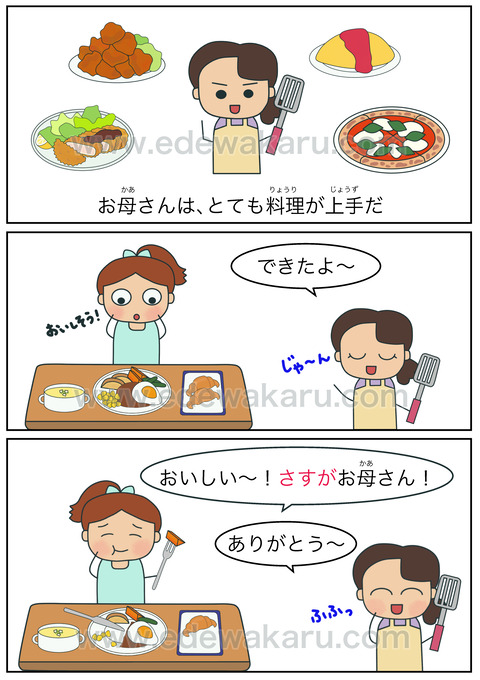
日本語文型辞典
Meaning
文頭にくることが多い。①②④のような「さすが(は)Nだ」の形と③のような「さすがだ」の形とがある。話し手が持つ知識や社会通念ビおりの結果になったときに使う。「やはり」と近いが、「さすが」はプラス評価のみに使う。
ある評価をあたえられているものが、ある特定の状現におかれることによって、その評価とはことなった結果を見せたときに使う。①で言えば、日本の中ではあたたかいと評価されている沖縄でも冬の夜という状況ではそうではない、という意味。プラス評価・マイナス評価いずれにも使う。
そのものやことについての話し手の知識や社会通念から予想されるとおりの結果になったときに使う。「やはり」と近いが、この「さすがに…だけあって」はプラス評価のみに使う。
ある結果や状態を見て、そのものやことについての話し手の知識や社会通念を使って、その原因や理由を見つけるときに使う。「やはり」と近いが、この「さすがに…だけのことはある」はプラス評価のみに使う。上の「さすがに…だけあって」と組み合わせて「さすがに…だけのことはあって」と言うこともできる。
ある評価をあたえられているものが、ある特定の状況におかれることによって、その評価とはことなった結果を見せたときに使う。副詞的に使う「さすがに」と基本的におなじ機能。
How to use it
さすが
さすがに
さすが(に)…だけあって
Nだけあって
Naなだけあって
A-いだけあって
Vだけあって
さすがに…だけのことはある
Nだけのことはある
Naなだけのことはある
A-いだけのことはある
Vだけのことはある
さすがのNも
In context 23 examples
これ、山田さんがつくったの?うまいねえ。さすが(は)プロだねえ。
さすが(は)山田さんだねえ。うまいねえ。
これ山田さんがつくったの?さすがだねえ。
さすが(は)世界チャンピオン、その新人の対戦相手を問題にせずしりぞけた。
沖縄でもさすがに冬の夜はさむいね。
いつもはおちついている山田さんだが、はじめてテレビに出たときはさすがに緊張したそうだ。
世界チャンピオンもさすがにかぜには勝てず、いいところなくやぶれた。
最近調子を落としている山田選手だが、このレベルの相手だとさすがにあぶなげなく勝った。
ふだんはそうぞうしいこどもたちも今夜ばかりはさすがにお通夜のふんいきにのまれているようだ。
さすがプロだけあって、アマチュア選手を問題にせず勝った。
さすがに熱心なだけあって、山田さんのテニスはたいしたもんだ。
さすがからだが大きいだけあって、山田さんは力があるねえ。
山田さんは、さすがによく勉強しているだけあって、この前のテストでもいい成蹟だった。
彼女は、さすがに10年も組合活動をしているだけあって、なにごとも民主的に考えることのできる人だ。
アマチュア選手が相手なら問題にしないね。さすがにプロだけのことはあるよ。
山田さんのテニスはたいしたもんだ。さすがに熱心なだけのことはあるよ。
山田さんはちからがあるねえ。さすがにからだがおおきいだけのことはある。
山田さんはこの前のテストでもいい成蹟だった。さすがによく勉強しているだけのことはあるね。
彼女はなにごとも民主的に考えることのできる人だ。さすがに20年も組合のリーダーをやっているだけのことはある。
さすがの世界チャンピオンもケガには勝てなかった。
さすがの山田さんも、はじめてテレビに出たときは緊張したそうだ。
さすがの機動隊も、ひとびとのからだをはった抵抗にたいしては、それ以上まえにすすむことができなかった。
私は小さいころよくいじめられるこどもだった。しかし、さすがのよわむしもおとうとやいもうとがいじめられているときだけは相手にとびかかっていったそうだ。
日本語文型辞典 英語版
Meaning
Often appears at the beginning of a sentence. Can take the form さすが(は)Nだ, as in
(1)
,
(2)
, and
(4)
, or さすがだ, as in
(3)
. Used when a result is obtained that is consistent with the speaker’s knowledge or conventional wisdom. Similar to やはり, but さすが is only used to convey positive evaluation.
Used when someone (or something) that is usually evaluated in a certain way is put into an extraordinary situation and shows a result or behavior that diverges from that evaluation. For instance, in
(1)
, it means that Okinawa, which in Japan is evaluated as being warm, is actually not so in the situation of winter nights. Used for both positive and negative evaluation.
Used to say that an outcome is as expected, based on conventional wisdom or the speaker’s knowledge of a person or thing. Although it is similar to やはり in meaning, さすがに...だけあって is used only for positive evaluation.
Used to look at a certain result or situation and then find the cause or reason for it, using the speaker’s knowledge or conventional wisdom. Similar to やはり, but さすがに...だけのことはある is used only for positive evaluation. Can be combined with さすがに...だけあって to create the form さすがに...だけのことはあって.
Used when someone or something that is usually evaluated in a certain way is put into a particular situation and then shows a result or behavior that diverges from that evaluation. Has basically the same function as さすがに, which is used like an adverb.
How to use it
1. さすが
2. さすがに
3. さすが(に)...だけあって[Nだけあって][Na なだけあって][A-いだけあって][Vだけあって]
4. さすがに...だけのことはある[Nだけのことはある][Na なだけのことはある][A-いだけのことはある][Vだけのことはある]
5. さすがのNも
In context 23 examples
これ、山田さんがつくったの? うまいねえ。さすが(は)プロだねえ。
Did Yamada-san make this? Marvelous! Just what you’d expect from a pro.
さすが(は)山田さんだねえ。うまいねえ。
That’s just what I’d expect from Yamada-san. Marvelous!
これ山田さんがつくったの? さすがだねえ。
Did Yamada-san make this? Only she could do it!
さすが(は)世界チャンピオン、その新人の対戦相手を問題にせずしりぞけた。
Being the world champion that he is, he defeated the rookie opponent without any difficulty.
沖縄でもさすがに冬の夜はさむいね。
It is cold at night in winter, even in Okinawa.
いつもはおちついている山田さんだが、はじめてテレビに出たときはさすがに緊張したそうだ。
I heard that even Yamada-san, who is usually imperturbable, got very nervous the first time he appeared on television.
世界チャンピオンもさすがにかぜには勝てず、いいところなくやぶれた。
Even the world champion could not defeat the common cold, and she lost without doing anything remarkable.
最近調子を落としている山田選手だが、このレベルの相手だとさすがにあぶなげなく勝った。
Even though Yamada-senshu (the athlete) has not been in the best condition lately, she won easily against this level of opponent.
ふだんはそうぞうしいこどもたちも今夜ばかりはさすがにお通夜のふんいきにのまれているようだ。
The children, who are usually very boisterous, seem to be overwhelmed tonight by the atmosphere of the wake.
さすがプロだけあって、アマチュア選手を問題にせず勝った。
Being the pro that he is, he beat the amateur player without any problem.
さすがに熱心なだけあって、山田さんのテニスはたいしたもんだ。
Just as you might expect from her enthusiasm, Yamada-san’s tennis is extraordinary.
さすがからだが大きいだけあって、山田さんは力があるねえ。
As might be expected of a big person like him, Yamada-san has a lot of power, doesn’t he.
山田さんは、さすがによく勉強しているだけあって、この前のテストでもいい成績だった。
Yamada-san got a good mark on the last test too, as might be expected from the fact that she studies so hard.
彼女は、さすがに 10 年も組合活動をしているだけあって、なにごとも民主的に考えることのできる人だ。
As you might anticipate from her being an active union member for ten years, she is a person who can think democratically about everything.
アマチュア選手が相手なら問題にしないね。さすがにプロだけのことはあるよ。
If the challengers are amateur players, he won’t care about it. They don’t call him a pro for nothing!
山田さんのテニスはたいしたもんだ。さすがに熱心なだけのことはあるよ。
Yamada-san’s tennis deserves admiration. It’s just as we might expect from her dedication.
山田さんはちからがあるねえ。さすがにからだがおおきいだけのことはある。
How powerful Yamada-san is! It’s just as might be expected from his large build.
山田さんはこの前のテストでもいい成績だった。さすがによく勉強しているだけのことはあるね。
Yamada-san got a good grade on the last test too. It’s just as you might expect from her studying so hard.
彼女はなにごとも民主的に考えることのできる人だ。さすがに20 年も組合のリーダーをやっているだけのことはある。
She is a person who can think democratically about everything. It’s just what you’d expect of someone who has been a union leader for more than twenty years.
さすがの世界チャンピオンもケガには勝てなかった。
World champion though she is, she couldn’t beat an injury.
さすがの山田さんも、はじめてテレビに出たときは緊張したそうだ。
I heard that even Yamada-san (who is always very calm) got nervous when he appeared on television for the first time.
さすがの機動隊も、ひとびとのからだをはった抵抗にたいしては、それ以上まえにすすむことができなかった。
Even the riot police (who are used to dealing with situations like this) couldn’t advance any further against the resistance of people who were laying their lives on the line.
私は小さいころよくいじめられるこどもだった。しかし、さすがのよわむしもおとうとやいもうとがいじめられているときだけは相手にとびかかっていったそうだ。
When I was a child, I was frequently bullied. However, people say that, wimp though I was, I would throw myself fiercely at the antagonist whenever my younger brother or sister was being bullied.
IMABI
やはり & さすが
Read this IMABI lesson ↗Explanation
The Adverbs やはり & さすが: “As One Thought”
Both the adverbs やはり and さすが are often translated as “as one thought.” Each are also frequently described as being great examples of unique Japanese words which are hard to directly translate. This is because although “as one thought” does a good job at capturing what they generally mean, nuancing often leads to other translations being more accurate depending on the context.
In this lesson, we will take a closer look at both words so that you may have a clearer understanding on how to use them. As both of these words are frequently used in both the spoken and written languages, you’ll certainly need to add them to your vocabulary.
The Adverb やはり
The adverb やはり is heavily used in both the written and spoken language with the meaning of “just as one thought,” but there is a wide range of situations in which it can be used in. Its nuances can be summarized into three distinct scenarios.
1. Emphasizing how something has not changed since last being compared to something else. In this sense, it can be translated as “as of yet.”
2. Emphasizing how something is just as one predicted. This is synonymous with the adverb 案の定. However, the latter is more nuanced to refer to “plans/situations” being carried out as predicted.
3. Emphasizing how something remains the same/true regardless of how one thinks about it. In this sense, it is synonymous with つまるところ and 結局(のところ). This can be translated as “in any case.”
Either nuance is common in speech and writing. However, it is still possible for やはり to be taken the wrong way if used incorrectly. In either case above, the speaker has in their mind a certain conjecture (推察)–in other words, ~〇〇であろう・・・–and it turns out that the speaker is right. One’s past thought is no different than one’s current thought. Thus, if your thought started out negative, the use of やはり remains negative.
1. 今日こそは雪は降ってほしくなかったが、やはり雪が降ってきた。
Even thought I didn’t want it to snow today of all days, it ultimately snowed.
2. あの不具合は、もう直っているかと思ったら、やはり同じところで発生してしまう。
Just when I thought that that bug had already been fixed, sure enough, it occurs in the same spot.
3. やはりコロナにかかってしまった。
Just as I (thought/had suspected), I had become infected with COVID.
Generally speaking, though, やはり is intended to be used in a more positive light. Although this is not a requirement by any means, contexts are generally positive/affirmative in nature.
4. 止められたとしても、やはりアメリカに行くつもりだ。
No matter if I’m stopped, in any case, I intend to go to America.
5. 自然の中で間近に見る富士山はやはり最高だ!
Looking at Mt. Fuji up close surrounded by nature is, as expected, the best!
6. 干ばつ後の雨はありがたいが、やはり嫌いだ。
Although rain after a drought is grateful, I still hate (the rain).
Etymology Note: Although やはり may be spelled in Kanji as 矢張り, this is 当て字 and not reflective of its origin. Considering that instances of /ha/ in modern native vocabulary occur from hypercorrections on former pronunciations, it is theorized that it was once pronounced as /yawari/ and that it shares its etymology with the /yawa-/ found in words like 柔らかい (soft).
Before seeing further examples, it must also be noted that やはり takes on several colloquial forms in the spoken language. The most common are やっぱり and やっぱ, but it is also possible to hear やっぱし in some regions.
7. やはり想像した通りの家です。
The house just as I had imagined.
8. やっぱり殺されちゃった。
(He) was killed–just as I had expected.
9. やっぱしだめだわ。
Yep, it’s no good.
10. やっぱり来たのね。
Here you’ve come (just as expected).
11.
先生:「夏休みはどうしたんですか」
リーさん:「日本語を勉強しました」
先生:「じゃあ、たくさん勉強できたでしょう」
リーさん:「ええ、でも、夏はやっぱり暇な時間がたくさんあると思いました」
先生: 「そうですね。ところで、きのうはどんなレストランへ行ったんですか」
リーさん:「メキシコ風の料理屋へ行ってみました」
先生:「おいしかったですか」
リーさん: 「ええ、でも、(私は)韓国人だから、やっぱり味が韓国料理店のとすごく違うと思いました」
Sensei: “How was your summer break?”
Lee: “I studied Japanese.”
Sensei: “Well, so you got to do a lot of studying, right?”
Lee: “Yes, but, I thought that there was a lot of free time.”
Sensei: “True, by the way, what kind of restaurant did you go to yesterday?”
Lee: “I went to a Mexican-style restaurant.”
Sensei: “Was it good?”
Lee: “Yes, but since I’m Korean, I thought that the flavor was quite different from a Korean restaurant.”
The Adverb/Adjectival Noun さすが
The first difference between やはり and さすが can be surmised from the difference in their grammatical categorization. The latter has the additional ability of being used as an adjectival noun. This can be demonstrated with the following simple sentences.
12a. やはり(そうだ)!
It is that way after all!
12b. さすがだ!
It’s as one would expect!
These sentences are almost identical in usage with the slightest difference between that さすが is more frequently directed at people’s behavior/abilities. Grammatically, however, there is an even clearer difference. It is ungrammatical to say やはりだ, although it is possible to omit そうだ altogether. In this case, though, it would function as an interjection rather than as an adjectival noun.
As can be further surmised from what we’ve seen already, the first usage of さすが is to show appreciation for how the facts line up with one had anticipated or made judgment on. When used as an adverb, it must be noted that it takes the form さすがに, which is further proof of how it is an adjectival noun.
13. そこに気づくとはさすがだな!
Of course you’d notice that!
14. 独り暮らしはさすがに寂しいよ。
Living by myself is really lonely just as expected.
15. 田中さんはプロだけあってさすがにホームランが打てるんですよね。
Mr. Tanaka can sure hit a homerun just from being a pro, huh.
16. 時は金なりとはさすがによく言えてるもんね。
It’s absolutely the case that “time is money,” you know.
17. 有名なレストランだけあって、さすがに予約をしておいても、いつも長い列ができているため、席に案内されるのに長い時間がかかることが確実といっていい。
Just from being a famous restaurant, since there is always a long line formed, it’s safe to say that waiting a long time to be sat down is a certain, as is to be expected.
さすがは
Occasionally, the form さすがは will be seen. Semantically, it is a very emphatic alternative to さすがに. The particle は in the construction, however, must not be confused for it topic function. Rather, it is merely used here as an adverb intensifier.
18. さすがはメルセデス!
Just what you’d expect from a Mercedes.
19. 国民もさすがは大統領の発言は素晴らしいという程度に受け止めるだろう。
The people, too, will most certainly take the president’s statements as being superb.
20. さすがは彼女だ。
Just what you’d expect from her!
さすがの~も~
Another meaning of さすが actually involves indicating contrast. Imagine a circumstance that the speaker admits to some degree but in certain situations has the opposite feelings. These situations are also described as being さすが. This is another contrast it has with やはり, which is not used contradictory (even in negative contexts).
21. 普段ならまだしも、さすがに今は少しばかり状況が違うから、辞めるべきだと思う。
It would be one thing if things were as per usual, but because the situation now is undoubtedly oh so different, I think that (the individual) ought to resign.
22. 素晴らしい映画でも、何回も見過ぎてしまうと、さすがに飽きてしまうものだね。
Even if it’s a fantastic movie, if you watch it too much over and over again, you’ll undoubtedly get bored of it.
Taking on this same meaning, it’s very common to see the pattern used in さすがの~も. Here, we see it uses the particle の when used before another noun phrase.
23. さすがのセスも日本語をミスることがあるんだね。
Even Seth of all people makes mistakes in Japanese.
24. さすがの僕もそこまでは言えませんよ。
Even I can’t say that much for certain.
25. さすがのファンも驚きを隠せないようだ。
Even the fans seem unable to hide their astonishment.
Phrase Note: さしもの is interchangeable with this use of さすがの. However, it is slightly more nuanced in that it’s akin to saying “even the most outstanding…” The Kanji spelling 然しもの exists but is outdated.
26. さしもの親方でも、木造の高層ビルは作れないだろう。
Even the most outstanding craftsmen would not be able to construct a wooden high-rise building.
Orthography Note: さすが is frequently spelled in Kanji as 流石, but this actually 当て字 and not reflective of its meaning or origin. Rarely, you may also see the character 遉 used.
In context 28 examples
Emphasizing how something is just as one predicted. This is synonymous with the adverb 案の定. However, the latter is more nuanced to refer to “plans/situations” being carried out as predicted.
Emphasizing how something remains the same/true regardless of how one thinks about it. In this sense, it is synonymous with つまるところ and 結局(のところ). This can be translated as “in any case.”
今日こそは雪は降ってほしくなかったが、やはり雪が降ってきた。
Even thought I didn’t want it to snow today of all days, it ultimately snowed.
あの不具合は、もう直っているかと思ったら、やはり同じところで発生してしまう。
Just when I thought that that bug had already been fixed, sure enough, it occurs in the same spot.
やはりコロナにかかってしまった。
Just as I (thought/had suspected), I had become infected with COVID.
止められたとしても、やはりアメリカに行くつもりだ。
No matter if I’m stopped, in any case, I intend to go to America.
自然の中で間近に見る富士山はやはり最高だ!
Looking at Mt. Fuji up close surrounded by nature is, as expected, the best!
干ばつ後の雨はありがたいが、やはり嫌いだ。
Although rain after a drought is grateful, I still hate (the rain).
やはり想像した通りの家です。
The house just as I had imagined.
やっぱり殺されちゃった。
(He) was killed–just as I had expected.
やっぱしだめだわ。
Yep, it’s no good.
やっぱり来たのね。
Here you’ve come (just as expected).
やはり(そうだ)!
It is that way after all!
さすがだ!
It’s as one would expect!
そこに気づくとはさすがだな!
Of course you’d notice that!
独り暮らしはさすがに寂しいよ。
Living by myself is really lonely just as expected.
田中さんはプロだけあってさすがにホームランが打てるんですよね。
Mr. Tanaka can sure hit a homerun just from being a pro, huh.
時は金なりとはさすがによく言えてるもんね。
It’s absolutely the case that “time is money,” you know.
有名なレストランだけあって、さすがに予約をしておいても、いつも長い列ができているため、席に案内されるのに長い時間がかかることが確実といっていい。
Just from being a famous restaurant, since there is always a long line formed, it’s safe to say that waiting a long time to be sat down is a certain, as is to be expected.
さすがはメルセデス!
Just what you’d expect from a Mercedes.
国民もさすがは大統領の発言は素晴らしいという程度に受け止めるだろう。
The people, too, will most certainly take the president’s statements as being superb.
さすがは彼女だ。
Just what you’d expect from her!
普段ならまだしも、さすがに今は少しばかり状況が違うから、辞めるべきだと思う。
It would be one thing if things were as per usual, but because the situation now is undoubtedly oh so different, I think that (the individual) ought to resign.
素晴らしい映画でも、何回も見過ぎてしまうと、さすがに飽きてしまうものだね。
Even if it’s a fantastic movie, if you watch it too much over and over again, you’ll undoubtedly get bored of it.
さすがのセスも日本語をミスることがあるんだね。
Even Seth of all people makes mistakes in Japanese.
さすがの僕もそこまでは言えませんよ。
Even I can’t say that much for certain.
さすがのファンも驚きを隠せないようだ。
Even the fans seem unable to hide their astonishment.
さしもの親方でも、木造の高層ビルは作れないだろう。
Even the most outstanding craftsmen would not be able to construct a wooden high-rise building.