AIUEO JLPT Grammar
Meaning
“〜向き” is a sentence pattern used with nouns to indicate the direction or suitability of a target. This expression emphasizes that something is suited for a particular person or purpose.
How to use it
名詞+向き
Explanation · 日本語
「〜向き」は、名詞に接続して、その対象や適応する方向を示す表現です。この表現は、特定の人や用途に適していることを強調するときに使われます。
In context 5 examples
このアニメは子供向きです。
This anime is suitable for children.
このトレーニングは初心者向きです。
This training is suitable for beginners.
この運動は女性向きです。
This exercise is suitable for women.
この服は若者向きです。
These clothes are suitable for young people.
このツアーは家族向きです。
This tour is suitable for families.
Bunpro Grammar Reference
Meaning
Suitable for, Facing
How to use it
Noun + 向き
Nuance
A phrase that highlights something as facing (A), or suitable for (A).
Explanation
向き is another noun in Japanese that is frequently used as a suffix. 向き comes from the intransitive verb 向く, meaning 'to face'. This word is often attached to the end of other nouns, in order to show that something is 'facing (A)', or 'suitable for (A)'.
あなたは本当に前向きな人なのですね。
You really are a forward facing person! (You really are a positive thinker)
この部屋のベランダは南向きですか?
Is this room's veranda south facing?
この本は初心者向きですか?
Is this book suitable for beginners?
Due to 向き being intransitive, it usually implies that something is facing toward (A) naturally, or through chance. Because of this, it may convey that something is 'suitable for (A)', but not necessarily designed specifically for it.
Caution
向け, coming from the transitive verb 向ける is used far more often to express that something has been specifically designed for (A).
私は子供向けの本を書いています。
I write books for children. (Intended for children)
子供向きの本を探しているのですが、お勧めはありますか?
I am looking for books suitable for children, but do you have any recommendations? (Not necessarily intended for children, but still suitable)
When comparing 向き and 向け, the primary difference is that 向き conveys that something is 'appropriate for (A)', while 向け is closer to 'intended for (A)'.
Nuance · 日本語
(A)の方に対面している、又は(A)に適しているということを表す表現。
Explanation · 日本語
「向き」は接尾語としてよく使われる名詞です。自動詞の「向く」から来ています。「向き」は、名詞の後ろに付いて、「(A) の方を向いている」や「(A) にちょうどいい」という意味を表します。
あなたは本当に前向きな人なのですね。
You really are a forward facing person! (You really are a positive thinker)
この部屋のベランダは南向きですか?
Is this room's veranda south facing?
この本は初心者向きですか?
Is this book suitable for beginners?
「向き」のもとになった「向き」は自動詞なので、何かが自然に、または偶然に (A) の方を向いていることを示します。そのため、「(A) にちょうどいい」や「(A) に適している」という意味はありますが、それは結果的にそうなっただけであり、「(A) のために特別に作られた」ものを指すわけではありません。
注意点
「向け」は他動詞「向ける」から来ている表現で、「(A) のために」や「(A) を対象に」という意味で使われます。
私は子供向けの本を書いています。
I write books for children. (Intended for children)
子供向きの本を探しているのですが、お勧めはありますか?
I am looking for books suitable for children, but do you have any recommendations? (Not necessarily intended for children, but still suitable)
「向き」と「向け」の違いは、「向き」が主に「(結果的に)(A) に適している」ことを表すのに対し、「向け」は「最初から (A) を対象に作られている」ことを表す点にあります。
In context 17 examples
- この部屋は南向きですか。
Does this room face south?
- あなたは本当に前向きな人なのですね。
You really are a forward facing person! (You really are a positive thinker)
- この部屋のベランダは南向きですか?
Is this room's veranda south facing?
- この本は初心者向きですか?
Is this book suitable for beginners?
- それだと向きが逆ですよ。
If that's the case, the way it's facing is back to front.
- 経済は上向きのようですね。
The economy seems to be looking up. (facing)
- あなたはいつも前向きな人だ。
You are always positive. (Facing forward)
- これは若い者向きの本だな。
This book is suitable for young people. (facing)
- 僕はいつも横向きで寝る。
I always sleep facing sideways.
- 風向きが変わってきたようだ。
It appears that the direction of the wind has changed. (facing)
- このテキストは初心者向きにできている。
This textbook is suitable for beginners. (Literally - Facing)
- この車は大人数の家族向きです。
This car is suitable for large families. (facing)
- これは小さな子供向きのおもちゃである。
This toy is suitable for small children. (facing)
- 誰にでも向き不向きがあるのは当然だ。
Of course, everyone has different suitabilities. (facing・suitable for)
- サラリーマンの仕事向きのスーツだから、これを買うことにしたんだ。
This suit is suitable for office work, so I decided to buy it. (facing)
- 私は子供向けの本を書いています。
I write books for children. (Intended for children)
- 子供向きの本を探しているのですが、お勧めはありますか?
I am looking for books suitable for children, but do you have any recommendations? (Not necessarily intended for children, but still suitable)
絵でわかる日本語
Meaning
〜にちょうどいい
〜に適している
How to use it
名詞[辞書形]+向き
名詞句+向き
Explanation
「〜向き」は「〜にちょうどいい」「〜に適している」という意味の文型です。「〜向き」は、話し手が「〜にちょうどいいね」「〜にぴったりだね」と思った時に使われます。後ろに何がくるかによって、形が変わります。
[「〜向き」の形]
〜向きの+名詞
〜向きに+動詞
また、否定形は「〜向きではない」で「〜に不向きだ」にチェンジすることができます。
[例]
このアニメは子供
向きではない
=このアニメは子供に
不向きだ
似ている文型に「〜向け」がありますので、復習をしておきましょう😊
【関連文型】
In context 5 examples
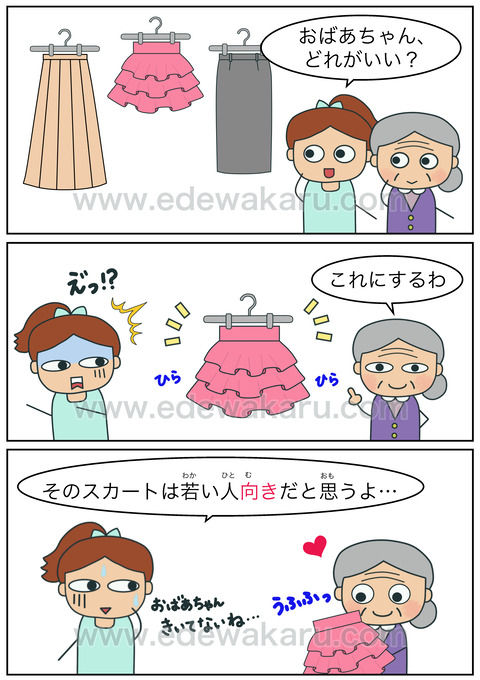
おばあちゃん、そのスカートは若い人向きだと思うよ…
→そのスカートは若い人に適していると思うよ…A:このカレーは辛くないねB:うん。子供向きだね
→子供にちょうどいいねA:ここのランチは量が多くて安いね〜B:私たちみたいな、お金のない学生向きだよね!
→お金のない学生にちょうどいいよね!A:このアニメ、なんだかこわいね…B:うん。大人向きのアニメだね
→大人に適したアニメだね彼女はキレやすいし、幼稚園の先生向きではないね
→幼稚園の先生には適していないね
日本語文型辞典
Meaning
東西南北などの方角や前後左右、上下など方向を表す名詞に付いて、その方向に正面を向けていることを表す。④は慣用的な表現の「前向きに」で、「なるべく実現させるように努力する」という意味。
「Nのためにちょうどよい/Nに適している」という意味。「Nむきでない」の替わりに、「Nに不向きだ」と言うことができる。⑤の「向き不向きがある」は、慣用的表現で、「その人によって、適性があったりなかったりする」という意味。「むけ」との違いについては「むけ」を参照。
「そういう人達もいる」という意味。①は、「快く思わない人もいる」、②は「実現は類しいと考えている人もいる」という意味。書きことば的なかたい表現。
「たいしたことでもないのに、本気になって怒ったり、激しく主張したりする」意味を表す。②は「少し落ちついて、平静になったほうがいい」という意味。
How to use it
Nむき【方向】
Nむき【通性】
Vむきもある
むきになる
In context 15 examples
南向きの部屋は明るくて暖かい。
右向きに置いてください。
横向きに寝てください。
前向きに検討したいと考えております。
女性向きのスポーツにはどんなものがありますか。
この映画は子供向きだ。
この家は部屋数も多く台所も広い。どちらかというと大家族向きだ。
この機械はたいへん性能がよいが、値段も高く大型で一般家庭向きではない。
セールスの仕事には向き不向きがある。
この機械は大きすぎて家庭で使うのには不向きだ。
君の活躍を快く思わないむきもあるようだから、はでな言動は慎んだ方がいい。
今回の計画については実現を危ぶむむきもある。
むきになって言い張った。
そんなにむきにならなくてもいいじゃないか。
彼はいい男だが、仕事の話となるとすぐむきになるので困る。