絵でわかる日本語
Meaning
例をあげて言う
How to use it
動詞・形容詞・名詞[た形]+たり+〜たりする
Explanation
「AたりBたりする」は、例をあげて言う時に使われる文型です。いくつか例がある時に、その中から「A」と「B」をあげて言いたい時に使用されます。3つ例をあげる場合は「AたりBたりCたりする」ということもできます。また「Aたりする」というように、1つだけ例をあげる場合にも使われます。
[例]
本を読ん
だり、歌を歌っ
たり、ゲームをし
たりする
のが好きです
本を読ん
だりする
のが好きです
「〜たり〜たりする」は、会話でもよく使われますので復習をしておきましょう😊
【関連文型】
In context 6 examples
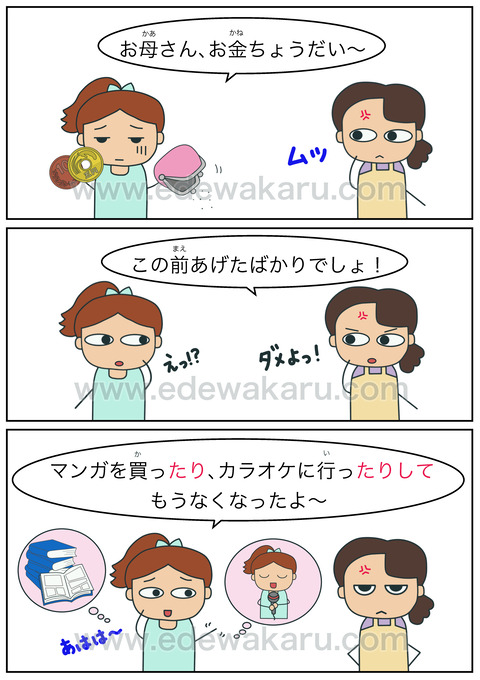
娘:お母さん、お金ちょうだい〜母:この前あげたばかりでしょ!娘:マンガを買ったりカラオケに行ったりして、もうなくなったよ
A:日曜日は何をしたの?B:ゲームをしたり、カフェに行ったりしたよ
本を読んだり、歌を歌ったりするのが好きです
日本に行ったら、お寿司を食べたりラーメンを食べたりしたい
最近忙しくて、本を読んだりテレビを見たりする時間がない
クラスメートは、アメリカ人だったり、中国人(ちゅうごくじん)だったりします
Bunpro Grammar Reference
Meaning
Things like ~ and ~
How to use it
Verb[た]り + (Verb[た]り) + する
Verb[た]り + [する]Verb(したり) + する
Verb[た]り + (Verb[た]り) + します
Verb[た]り + [する]Verb(したり) + します
Nuance
A grammar point that expresses lists of actions that occur in no particular order.
Explanation
In Japanese, たり is a 'conjunction particle' that is used in exactly the same way as て. However, instead of having the nuance of 'then', or 'and', it has the nuance of 'and things like'. Basically, it is used for listing sequences of events that do not happen in a specific order.
The last たり in any sequence should be followed by a form of する (for example, した for past tense).
休みの日は家でテレビを見たり、寝たりする。
On my days off, I do things like watch tv and sleep at home.
飲み会で食べたり、飲んだりした。
At the party, I did things like eat and drink.
From these examples we can see that たり will sometimes be said as だり. This happens with the same verbs that usually use だ for past tense (like 読んだ), or で for the て form ( like 泳いで). This will not change the meaning at all, and is only to help make the words easier to say.
To summarize, the difference between て form, and たり is as follows.
Events in order - I did (A) て, (B) て, (C) て, (D) た.
Events in no specific order - I did (D) たり, (B) たり, (A) たり, (C) たりした.
たり is frequently used when there is only one verb in the sentence. This just means that the speaker did 'things like (A)', without specifically listing anything else.
昔あそこの池で泳いだりした。
In the past, I used to swim in that lake over there. (Among other things)
Caution
In cases where a する verb is the last verb in a particular sequence, たり will often be omitted.
勉強をしたり、おやつを食べたり、掃除もします。
I do things like study, eat snacks, and also clean. (In no specific order)
Fun Fact
Sometimes sentences will end with たりして, which is たり combined with the て form of する. たりして is used at the end of a sentence to express uncertainty, ambiguity, or that something that is unlikely may actually be true. It can also be used in a joking way.
こんな夜遅くに上司から電話だ、なんか問題発生してたりして。
It's a phone call from my boss, at such a late time. I wonder if something happened.
そんなこと言って、実はお前もそいつのこと好きだったりして。
You say that, but I bet in reality you like her too. (Joking)
Nuance · 日本語
起こっている行動の一覧を順番に関係なく表すために使われる文法。
In context 18 examples
- 家でゲームをしたり、食べたりした。
At home, I did things like play video games and eat.
- 休みの日は家でテレビを見たり、寝たりする。
On my days off, I do things like watch tv and sleep at home.
- 飲み会で食べたり、飲んだりした。
At the party, I did things like eat and drink.
- 昔あそこの池で泳いだりした。
In the past, I used to swim in that lake over there. (Among other things)
- 音楽を聞いたり、本を読んだりしました。
I did things like listen to music and read books.
- 掃除をしたり、洗濯をしたりした。
I did things like cleaning and doing the laundry.
- 雨が降ったり、止んだりするね。
It keeps doing things like raining and stopping, doesn't it.
- 今日は、勉強したり、練習したりする。
Today I will do things like study and practice.
- スポーツしたり、ゲームしたりしたい。
I want to do things like play sports and video games.
- 朝から洗い物したり、掃除したりした。
From the morning, I did things like wash the dishes and clean.
- まだ食べたり、飲んだりしています。
I am still doing things like eating and drinking.
- もう晩ごはんを作ったり、洗い物をしたりした。
I already did things like make dinner and do the dishes.
- テレビを見たり、映画を見に行ったりするのが好き。
I like doing things like watching TV and going to the movies.
- 毎日、漢字を書いたり、文法を勉強したりします。
Every day I do things like write kanji and study grammar.
- お風呂に入ってから、ゆっくりしたり、本を読んだりしたい。
After taking a bath, I want to do things like relax and read books.
- 勉強をしたり、おやつを食べたり、掃除もします。
I do things like study, eat snacks, and also clean. (In no specific order)
- こんな夜遅くに上司から電話だ、なんか問題発生してたりして。
It's a phone call from my boss, at such a late time. I wonder if something happened.
- そんなこと言って、実はお前もそいつのこと好きだったりして。
You say that, but I bet in reality you like her too. (Joking)