AIUEO JLPT Grammar
Meaning
This sentence pattern expresses acquiring a new habit or ability as a result of change, indicating that a situation has changed.
How to use it
動詞可能形+ように+なる動詞辞書形+ように+なる動詞ない形+ように+なる
Explanation · 日本語
この文型は、変化の結果として新しい習慣や能力を獲得することを表す表現で、状況が変わったことを示すときに使われます。
In context 5 examples
毎日練習して、ピアノが弾けるようになった。
I practiced every day and became able to play the piano.
新しいシステムを導入して、効率的に仕事ができるようになりました。
With the introduction of the new system, we have become able to work more efficiently.
この計画のおかげで、多くの資金が調達できるようになりました。
Thanks to this plan, we have become able to raise a lot of funds.
彼は日本語が話せるようになった。
He has become able to speak Japanese.
赤ちゃんが歩けるようになる。
The baby will be able to walk.
文法
Meaning
以前は〜じゃないが、今は〜である。
状況や能力の変化を表す。
●誤用例
最近、運動不足なので、太るようになりました。
「太る」はその動詞自体に「変化」を持っているため、その場合には「ようになる」を基本的に使えないです
How to use it
V(辞書形)+ ようになる
V(ない形)なくなる
In context 15 examples
最近、納豆が食べられるようになりました。
うちの子は一人で自転車に乗れるようになりました。
日本語で書かれた小説が読めるようになりました。
日本に来た時は全然、映画の日本語が聞き取れませんでしたが、今では少し聞き取れるようになりました。
1年前は全然漢字が書けなかったけど、今はたくさん書けるようになりました。
以前よりも給料がだいぶ増えたので、一人で暮らしていけるようになりました。
出張がキャンセルになったので、今夜の飲み会に参加できるようになりました。
学校を卒業してからは、もう英語を勉強していないので、話せなくなりました。
子供の時はよく外で遊びましたが、大人になってからは遊ばなくなりました。
友達と大げんかして以来、一度も話さなくなりました。
子供の頃、よく家族と旅行したのに、今はあまりしなくなりました。
インフルエンザになって、学校に行けなくなりました。
交通事故で怪我をして、私は歩けなくなりました。
年をとったせいで、小さな文字が見えなくなってきました。
終電を逃して、帰れなくなりました。
Bunpro Grammar Reference
Meaning
To reach the point that, To come to be that, To turn into
How to use it
Verb[できる](1) + ように + なる
(1) Verb[ない]、Verb[る]
Verb[できる](1) + ように + なります
(1) Verb[ない]、Verb[る]
Nuance
A grammar point that expresses something becoming the manner or style of (A).
Explanation
When combined with the particle に, and the う-Verb なる, よう expresses that a particular action has reached the point of being completed/able to be completed. Because of this, ようになる is regularly translated as 'to reach the point that (A)', or 'to turn into (A)'.
To use ようになる, it will need to be added to the plain-potential, non-past form of a verb.
毎日、漢字の練習をすれば綺麗に漢字を書けるようになります。
If you practice kanji every day, you will reach the point where you can write them neatly.
早く走れるようになりたい。
I want to reach the point where I can run faster.
Caution
When using this grammar construction, we will need to remember that する does not have a potential form. Therefore, できる will be used with words that usually act as する verbs.
髪を綺麗にカット出来るようになるのが夢です。
It is my dream to reach the point where I can cut my hair nicely.
自分から行動が出来るようになってください。
Please turn into someone who can act on their own. (Please become more self sufficient)
However, ようになる is not limited to being used in affirmative sentences, and may also be used after a verb with ない. This shows that something has reached the point of 'not' being able to be completed.
来年から現金が使えないようになる。
From next year, it will reach the point where you will not be able to use cash.(Starting next year, you will not be able to use cash)
来月から会社で喫煙できないようになります。
Starting next month, it will reach the point where you will not be able to smoke at the company. (Starting next month, smoking will be banned)
Nuance · 日本語
ある物が(A)の特徴になってきているということを表現する文法。
In context 18 examples
- ちゃんと英語を勉強すれば、話せるようになる。
If you study English diligently, then you will reach a point where you can speak it.
- 毎日、漢字の練習をすれば綺麗に漢字を書けるようになります。
If you practice kanji every day, you will reach the point where you can write them neatly.
- 早く走れるようになりたい。
I want to reach the point where I can run faster.
- 来年から現金が使えないようになる。
From next year, it will reach the point where you will not be able to use cash.(Starting next year, you will not be able to use cash)
- 来月から会社で喫煙できないようになります。
Starting next month, it will reach the point where you will not be able to smoke at the company. (Starting next month, smoking will be banned)
- 泳げるようになった。
I reached the point that I was able to swim.
- 理解出来るようになった。
I reached the point that I could understand.
- 料理ができるようになりたい。
I want to reach a point where I can cook.
- 100メートルを10秒で走れるようになった。
I reached the point that I could run 100 meters in 10 seconds.
- そうするようになったが、もうそうしたくない。
I reached the point that I would do it, but I don't want to anymore.
- 以前はお金が足りなかったけど、スマートフォンを買えるようになった。
Before, I didn't have enough money, but I have reached the point where I can buy a smartphone. (Afford)
- 皆があの人はもう歩けないと言っていたが、歩けるようになった。
Even though everyone said that he would never walk again, he reached the point that he could walk.
- 前はだめでしたが、納豆を食べられるようになった。
Before, I couldn't, but I reached the point that I can eat natto.
- どんどん日本語を聞き取れるようになってきた。
I've reached the point where I can pick up (spoken) Japanese.
- 毎日勉強をしたから、日本語を上手に話せるようになった。
I studied everyday, so I reached the point that I could speak Japanese competently.
- 私は何か決める時に、誰かに相談するようになった。
I have come to the point of discussing it with someone whenever I will decide on something.
- 髪を綺麗にカット出来るようになるのが夢です。
It is my dream to reach the point where I can cut my hair nicely.
- 自分から行動が出来るようになってください。
Please turn into someone who can act on their own. (Please become more self sufficient)
DoJG 日本語文法辞典(全集)
Meaning
Reach the point where ~; come to ~; it has come to be that ~; have finally become
How to use it
Vinformal nonpast | ようになる | |
| {話す /話さない}ようになる | Someone reaches the where he talks/doesn’t talk |
| {食べる /食べない}ようになる | Someone reaches the point where he eats/doesn’t eat |
Explanation
Some change takes place gradually.
In context 6 examples
ジャクソンさんは日本語が話せるようになった・なりました。
Mr. Jackson has reached the point where he can speak Japanese.
林さんは酒を飲まないようになった・なりました。
Mr. Hayashi has reached the point where he does not drink sake. / Mr. Hayashi doesn’t drink sake any more.
難しい日本語が読めるようになりました。
I am finally able to read difficult Japanese.
パットは私と話さないようになった。
Pat doesn't talk with me any more.
もうすぐ面白さが分かるようになりますよ。
You'll soon come to understand the fun of it, I tell you.
この道は今通れないようになっている。
This street has reached a point where people cannot pass. / At present we cannot use this street.
どんなときどう使う 日本語表現文型辞典
Meaning
become such that; start to do
How to use it
Vる+ようになる Vなく+なる
Explanation
1)能力や状況や習慣などの変化を言うときに使う。
2) ❺ ~❼のように以前の状況がそうでなくなったことを言うときには、「Vないようになる」より「Vなくなる」の方がよく使われる。
3)変化を表す動詞にはつかない。
◆ × このごろ運動しないので、太るようになりました。→○このごろ運動しないので、太りました。/ × 最近、車の事故が増えるようになりました。→○最近、車の事故が増えました。
2)When indicating prior state no longer exists, as in sentences ❺ to ❼, Vなくなる is used more often than Vないようになる.
1)Abilities, conditions, or customs change.
3)Not appended to verbs expressing change.
In context 7 examples
最近、日本の食事に慣れて、さしみが食べられるようになりました。
来月からこの駅にも急行が止まるようになります。
妹はよくマンガを読んでいましたが、このごろ小説を読むようになりました。
母もやっとパソコンが使えるようになって、よろこんでいる。
工事が始まって、あの道は通れなくなりました。
最近、あまり勉強しないから、授業がわからなくなりました。
いつも庭に遊びに来ていたねこが、このごろ来なくなりました。
絵でわかる日本語
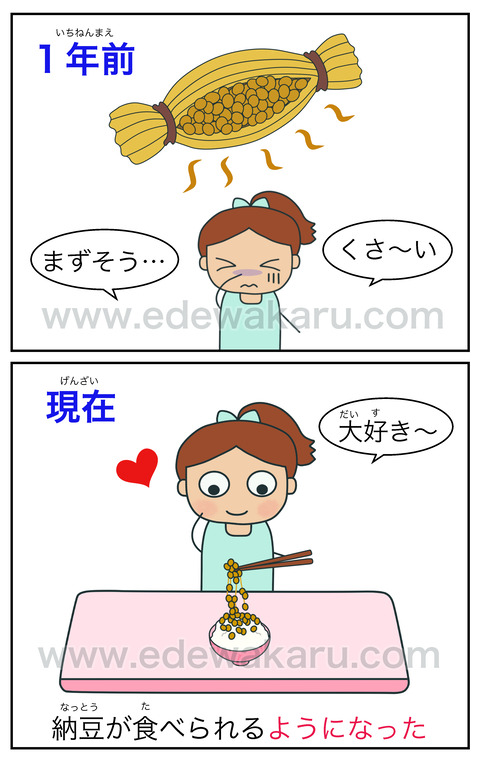
Meaning
〜ような状態に変わる
How to use it
動詞[辞書形]+ようになる
動詞[ない形]+ようになる
動詞[可能形]+ようになる
Explanation
「〜ようになる」は「〜ような状態に変化する」という意味を表す文型です。できなかったことができるような状態になったと言いたい時に使います😊可能形によく使われます😀
【余裕がある人へ】
「〜ようになる」は【変化】を表す文型ですが、「可能形」に使う場合と「辞書形」に使う場合は少し意味が変わります😮
・可能形+ようになる→上達・能力が上がったという変化
・辞書形+ようになる→ 習慣の変化
[例]
2歳になったので、1人でごはんが
食べられるようになった
→以前はお母さんがごはんをあげていたが、今は1人で食べられる
【能力の変化】
1人暮らしを始めたので、1人でごはんを
食べるようになった
→以前は家族でごはんを食べていたが、今は1人で食べている
【習慣の変化】
「〜ようになる」は初級の文型ですが、とてもよく使いますのでしっかりと覚えておきましょう😉
In context 5 examples
納豆が食べられるようになった
→納豆が食べられるように変化した日本語が話せるようになった
→日本語が話せなかったが、話せるように変化した漢字が読めるようになりました
→漢字が読めなかったが、読めるように変化した2歳になったので1人でごはんが食べられるようになった
→2歳になったので、1人でごはんが食べられるように変化したお酒を飲まないようになった
→以前はお酒を飲んでいたが、飲まないように変化した
日本語NET JLPT文法解説まとめ
Meaning
以前は〜じゃないが、今は〜である。
状況や能力の変化を表す。
●誤用例
最近、運動不足なので、太るようになりました。
How to use it
V(辞書形)+ ようになる
V(ない形)なくなる
Explanation
"become such that"
Expressing changes in situations or abilities.
In context 19 examples
最近、納豆が食べられるようになりました。
うちの子は一人で自転車に乗れるようになりました。
日本語で書かれた小説が読めるようになりました。
日本に来た時は全然、映画の日本語が聞き取れませんでしたが、今では少し聞き取れるようになりました。
1年前は全然漢字が書けなかったけど、今はたくさん書けるようになりました。
以前よりも給料がだいぶ増えたので、一人で暮らしていけるようになりました。
出張がキャンセルになったので、今夜の飲み会に参加できるようになりました。
日本語の勉強を始めてから、日本語で漫画を読んだり、アニメを見たりするようになりました。
大学生になってから自分で弁当を作るようになりました。
学校を卒業してからは、もう英語を勉強していないので、話せなくなりました。
子供の時はよく外で遊びましたが、大人になってからは遊ばなくなりました。
友達と大げんかして以来、一度も話さなくなりました。
子供の頃、よく家族と旅行したのに、今はあまりしなくなりました。
インフルエンザになって、学校に行けなくなりました。
交通事故で怪我をして、私は歩けなくなりました。
年をとったせいで、小さな文字が見えなくなってきました。
終電を逃して、帰れなくなりました。
社会人になってからはゲームをしなくなりました。
大学生になってからはテレビを見なくなりました。
毎日のんびり日本語教師
How to use it
動辞形+ようになる
動ない形+ないようになる
動詞可能形+ようになる
Explanation
能力的・状況的に不可能だった事柄が実現可能になったことを表します。
Notes
「よう」シリーズ
In context 8 examples
国民一人ひとりが政治に関心を持つようになると国は変わる。
できるようになると楽しいが、そこまでの道のりは長く辛い。
運転できるようになるのが今年の目標。
ハゲないようになる薬を早く開発してほしい。
自分の未来について少しだけ前向きに考えられるようになった。
近所のコンビニの店員さんが顔を覚えてくれて、毎回一言二言喋るようになった。
うちの猫昔はあちこちでウンチしてたのに、今はちゃんとトイレでするようになってくれた。
ここから先は、ログインしないと閲覧できないようになっている。
NINJAL 日本語文型データベース
Meaning
人や物事が、〜する状態や〜である状態に変わることを表すときに使います。
How to use it
Vるようになる
Notes
「〜」には変化を表す動詞(「変わる・増える・やせる・慣れる・直る」など)はきません。
In context 5 examples
来月からこの店でもクレジットカードが使えるようになる。
戦争を知らない世代が、日本人の大部分を占めるようになった。
たくさん練習したので、人前でも緊張しないで演奏できるようになりました。
小説を読めば、人の気持ちがもっとよくわかるようになるかもしれない。
近い将来、人の仕事の多くをロボットやAIがするようになっていくと言われている。
IMABI
Object Marking: が VS を
Read this IMABI lesson ↗Explanation
Object Marking: が VS を
In previous lessons, we learned that the particle が marks the subject, that the particle を marks the direct object, but that が may also mark the object of stative-transitive predicates which manifest in Japanese as no longer being transitive, therefore が marks what still semantically fills the role of the object. Then, when we learned about the auxiliary ~たい, we learned that this logic stems from a phenomenon known as ergativity, in which objects are treated as the subjects of intransitive verbs, with this only occurring with certain predicate types in Japanese, all of which exhibit this issue between が vs を that must be sorted out.
The purpose of this lesson will be to reexamine the differences between が・を from other angles, and in doing so, we will better understand how these particles function.
Established Interchangeability
Before we dive into this lesson’s analysis, let’s recap the instances we have learned が・を are absolutely NOT interchangeable and when they are interchangeable.
■NOT Interchangeable: In Typical Intransitive/Transitive Predicates
Typical intransitive predicates do not possess objects, and so the particle が cannot be interpreted as an object marker in said clauses. In turn, with a standard transitive predicate, が marks the subject and を marks the object.
1. 災害が起きた。(w/ Intransitive Predicate)
A natural disaster occurred.
2. 神々が災害を起こした。
The gods caused a natural disaster.
■Limited to Full-Fledged Interchangeability
In ergative-like stative-transitive predicates, we come across the notion that が is the most linguistically pure choice for the object marker wherever its use appears, and that it is a growing consequence of said predicates exhibiting heightened control on the part of their agents that allows for を to appear in those contexts, despite not having appeared in those contexts traditionally.
Incidentally, in modern speech, this has resulted in a spectrum of naturalness between が and を, with agency playing a major role. So far, we have delved into the following scenarios:
①With the Potential
In many potential statements, が・を may be interchanged with no apparent change in nuance in the simplest of statements in the spoken language.
3a. 韓国語が話せます。
3b. 韓国語を話せます。
I can speak Korean.
If one were to ponder how 3a and 3b would differ in nuance, the particle を would be akin to the simple exercise of freewill, whereas the particle が would highlight the object of capability as being a natural association with the ability manifesting.
The more typical an action is when the potential form is used, the more likely を is seen. Likewise, when the object’s importance in the situation cannot be ignored and places a quintessential role in the state at hand, が is used, to the point that を becomes unnatural.
4. 美恵子は自然に美しい歌詞{が 〇・を △}書けた。
Mieko was naturally able to write beautiful lyrics.
5. ホームラン{が 〇・を △}打てた。
I was able to hit a home run.
6. この漢字{が ◎・を 〇}書ける人はあまりいないでしょうね。
There probably isn’t a lot of people who can write this Kanji.
②With the Auxiliary ~たい
The same dynamic is found with the auxiliary ~たい, and in modern speech, there is a 50% likelihood of either が・を appearing as the object marker. Aside from が being preferred to highlight the object and を appearing with typical statements of desired action, が is preferred in simpler predicates, whereas を is found most frequently when other things are interjected between the object and the predicate.
7. SFが読みたい!
I want to read science fiction!
8. 自分のやることすべてを完璧にやりたいから。
Because I want to do everything I do perfectly.
9. 私はポケットモンスター新作{が・を}買いたいです。
I want to buy the latest Pokémon game.
③With 好きだ & 嫌いだ
These adjectival nouns derive from transitive verbs, similarly to how ~たい also ultimately derive from transitive verb forms—好く and 嫌う respectively. This provides a basis for how their predicates became ergative-like predicates which correspond to stative-transitive predicates in English.
Currently, the use of を is not quite accepted as other instances of it being interchangeable with が, only appearing ironically in simpler predicates void of other complex sentence structures.
10. 私は自分のこと{が ◎・を △}好きになった。
I’ve gotten to like myself.
④With 分かる
~を分かる has traditionally been incorrect, being the poster child for stative-transitive predicates manifesting as intransitive verbs in Japanese grammar, but the use of を marking the object with it has been observed since the late 1800s, and it is here to stay. The trigger for why を is being acceptable is a change in perceptible control implied by 分かる over an emotional circumstance.
11. 誰もあたしの気持ちを分かるはずなんてない!
There’s no way anyone understands my feelings!
⑤With 欲しい
In a rather limited capacity, we have also seen how ~をほしい is becoming possible, at least in very colloquial speech. The reasoning for the appearance of を here can be explained by what has already been occurring to ~たい.
12. ちゅーる{をほしくて △・がほしくて 〇・をほしがって ◎}待ち構えてるのに無反応な猫も超可愛い!
Cats with no reaction even though they’re waiting so much for that churu (kind of cat food treat) are so cute!
Sentence Note: Ex. 12 exhibits other relatively newer grammatical phenomena as well, most notably the use of な instead of の after 無反応.
⑥With ~やすい & ~にくい
Although both these endings are adjectival, when attached to transitive verbs, we find that を appears regardless of whether the agent is willfully acting or not as the subject-transitive predicate still has an object.
13. お腹を壊しやすい普段食べているものと腸内細菌の関係を知りたいです。
I want to know the relationship between the foods that I normally eat which often upset my stomach and my gut bacteria.
14. 体が柔らかいと怪我をしにくい。
You’re less likely to get injured if your body is flexible.
Particle Distribution w/ The Potential
Japanese phraseology generally frowns upon the same particle showing up more than once in a single clause, and this tendency becomes outright ungrammatical if the particle is being used to serve the same function.
In the context of a potential sentence, in which the object is marked by が by default, the subject, in theory, ought to be capable of being marked by が out of grammatical necessity. In practice, this is not what ends up happening. This then begs question: what can naturally follow the subject here? Also, how do those options pair up with the option between が and を for the object marker?
To get down to the bottom of things, let’s posit that there are four types of outcomes regarding particle choice with potential verb predicates. These types manifest as follows:
15a. 百合さんが英語が話せます。X (Type 1a)
15b. 百合さんは英語が話せます (Type 1b)
15c. 百合さんは英語を話せます。(Type 2a)
15d. 百合さんが英語を話せます。(Type 2b)
15e. 百合さんに英語が話せます。△ (Type 3)
15f. 百合さんに英語を話せます。X (Type 4)
The archetypal structure seen in 15a (XがYがZ) in which Z is a potential verb predicate1 is ungrammatical when spoken; however, it is nonetheless the underlining (deep sentence) structure for Type 1b. As we know, the particle は, when following a subject, prevents the subject marker が from manifesting.
Aside from が, of course, the particles that do overtly follow the grammatical subject varies between が, は, に, には, and にも in potential sentences, but to provide full coverage of its distribution, we must also keep in mind what is marking the object: が or を.
The chart illustrates the percentage each combination of case markings found for potential verb predicates as can be found in natural speech. Combinations that are marked as being 0-1% are indicative of ungrammatical statements to native speakers.
Particle w/ SubjectObject Marker がObject Marker を
が≧0%50%
は25%49%
に8%0%
には51%≧1%
にも16%≧0%
Chart Note: These statistics reflect neither the subject nor the object being dropped from a potential verb predicate as well as the sentence pattern [X (subject) が Y (object) が Z] in relative isolation. As such, when the object is dropped, the likelihood of が marking the subject is just as likely as when an overt object is marked with を.
From these statistics, we also see that on seldom occasion, [subject + に] occurs, albeit usually with は or も following. However, because this use of に derives from its role of marking the agent (doer) in passive as well as spontaneity grammar, and because the potential form derives from said passive grammar, the object marker does not manifest as を here when に takes on this role.
16a. 俺は涙を流せない。◎
16b. 俺には涙を流せない。△・X
I can’t shed a tear.
17. [人間には涙が流せる]し、[自分は涙を流せない]が、[涙を流す理由は理解できた]。
Man can cry, and so though I myself cannot shed tears, I have now understood the reason for crying.
In the final clause [涙を流す理由は理解できた], we see that the particle after the grammatical direct object is は, but は’s inherently adverbial nature trumps the use of が and を2.
Stative Predicates 状態的述語
The concept of the stative-(transitive) predicate cannot be overlooked. So far, we have seen how が is intrinsically tied to these predicates with various grammar points – the potential and the auxiliary ~たい being exemplary of this.
The biggest take away from the interchangeability seen between が・を is undoubtedly the shift in emphasis. This can be visualized as follows:
18a. 友里さんは英語が話せます。
18b.友里さんは英語を話せます。
Yuri can speak English.
19a. 僕はパンを食べたい。
19b. 僕はパンが食べたい。
I want to eat bread.
20a. その文型が説明できません。
20b. その文型を説明できません。
I can’t explain that grammar structure.
21. 北朝鮮はいつでもミサイルを発射できる状態だ。
North Korea is in the state of being able to fire a missile whenever.
We will see again this concept of whether the ending is modifying the verb only or the entire phrase itself. Also, you may be wondering why を is used in Ex. 21 even though the subject is clearly in the state of being able to do the action. That is because of the next factor: control.
Ultimate Control 最大限のコントロール
We have touched briefly on how を is associated with typical willpower, but what if control over what the speaker/agent does is truly within the hands of the speaker/agent? In Ex. 18a-b, we find that を is the natural choice.
22a. あいつは他人{を ◎・が △/X}偽れる男だ。
22b. あいつは自分{を ◎・が △/X}偽れる男だ。
22a. That guy is a man who can deceive others.
22b. That guy is a man who can deceive himself.
With を, the focus is on the action, and just from hearing the verb 偽る, how the agent goes about deceiving people is immediately on the mind. Deception is also inflammatory, meaning if the particle が were to be used before it, it would be hard to not view it as the subject marker. If, though, that ambiguity were to be alleviated in context, that would at least elevate the naturalness of が to a degree.
23. 俺に自分が偽れるだろうか?
Do I have it in me to be able to deceive myself?
~ようになる・~ようにする
~ようになる is inherently intransitive. When the subordinate clause that modifies ~よう is also intransitive, を marking the object with potential verbs that may happen to compose said subordinate clause becomes far less likely.
24. 毎日やっているうちに[自然に漢字{が ◎・を ?}書けるように]なりました。
I became able to naturally write Kanji while I was studying every day.
25. 乃理子は独学で[ハングル{が 〇・を ?}書けるように]なった。
Noriko became able to write Hangul through self-study.
That does not mean を is not possible. So long as the object does not bear the majority of the emphasis, を will at best sound colloquial.
26. 文法だけをひたすら勉強してても、フランス語を話せるようになるわけじゃないですよ。
Even if you’re wholeheartedly studying grammar alone, that doesn’t mean you’ll become able to speak French.
In contrast, ~ようにする is transitive, and we find that because する is the main verb of the overall sentence, [potential verb + よう]に truly behaves as an adverbial clause modifying する. Meaning, する’s direct object must be found elsewhere, and that direct object, must be marked by を. That direct object may happen to be placed right before the [potential verb + よう] clause, or it could appear earlier in the sentence. That much is irrelevant as to why the direct object must take を.
27. 4年生が終わるまでに常用漢字{が X・を 〇}[書けるように]します。
I will have (the students) able to write the Joyo Kanji by the time the fourth year students end.
28. 乃理子はハングル{が X・を 〇}独学で[読めるように]した。
Noriko had herself able to read Hangul through self-study.
The necessity for the transitive verb する to have its direct object marked by を is not obscured whenever する happens to be used in another complex structure. In Exs. 29-30, the presence of a potential verb in the clause containing ~ように is irrelevant as to why を is present.
29. 運転中は、絶対にスマホ{が X・を 〇}使えないようにしなくてはいけない。
You must make it that you can’t use your smartphone ever while you drive.
30. 引っ越しの前に、不要なもの{が X・を 〇}捨てられるようにしておけ。
Before moving, have it that you are able to throw away unneeded things.
Agency 動作主性
Control is directly tied to a sense of agency. An agent is the grammatical entity which carries out an action. In non-passive constructs, the agent is synonymous with the subject. When the agent has no control over an outcome at all, we find that を becomes unnatural. Conversely, when freewill is exercised and the object of desire/potential is not dwelled upon, を becomes the most natural choice – although が cannot be ruled out due to aforementioned etymological reasons.
31. 中国に長く住んでいて、英語を話す機会がほとんどなくなったので、英語{が 〇・を ??}話せなくなった。
I lived in China for a long time, and because I basically lost my chances to speak English, I became unable to speak English.
32. いつでも野良猫{を 〇・が ?}殺せるわけではない。
You aren’t able to just kill the stray cats whenever.
33. 思ったより早くエッセイを書けてよかった。
I’m so glad I was able to write the essay earlier than I thought.
34. 冬の間はあの洞窟にある氷柱を溶かせない。
You can’t melt the icicles in that cave during the winter.
35. 量が多すぎて、ビール{を 〇・が ?}{飲み干せなかった・飲み切れなかった}。
I was unable to {douse down/completely drink} all of the beer because there was just too much.
In Ex. 36a, [potential verb + よう] is a part of a larger subordinate clause preventing the subject of that clause, 山口さん, from being topicalized with は. This alleviates the unnaturalness of [subject + が object + が] somewhat.
36a. [山口さんがフランス語{を 〇・が △}話せる]ように、私はフランス人も招待しました。
So that Yamaguchi-san could speak French, I also invited French people.
Another possible route to alleviate this issue is by adding adverbial phrases to the clause containing the subject and object of the potential verb. Here, we see that this in tandem with both being in a subordinate clause makes [subject + が object + が] valid, but this ought not be extrapolated to independent clauses.
36b. 山口さんが、フランス語{が 〇・を ◎}好きなだけに話せる場を作るために、私はフランス人も招待しました。
When a supplementary verb that has a high level of volition behind it is used in combination with the main verb but the auxiliary ~たい still concludes the predicate, we find that the supplementary verb has just enough autonomy to cause the ergative-like nature of ~たい to not prevail in the sentence, allowing for を to appear in the previous clause ending in ~て.
37. [神経科学試験の前に韓国語の宿題{を 〇・が X}して]しまいたい。
I want to get my Korean homework over before my neurology exam.
38. [子供たちが来る前に、テーブル{を 〇・が X}片づけて]おきたい。
I want to have the table cleared off before the children come.
Confusing Intransitive & Potential Forms Together
There are instances in which the potential form of a transitive form looks just like the intransitive form in a transitive-intransitive pair. This renders Ex. 35 ambiguous.
39a. パンが焼ける。
For bread to bake.
I can bake bread.
This ambiguity is often left unnoticed depending on whether an agent is implied. Here, the difference would be negligible because for bread to bake, there must be an agent baking it and the ability to make it happen. Potential verbs also tend to be spontaneous in nature just like intransitive verbs. In their case, the agent can so happen to perform the action, whereas with intransitive verbs, spontaneity implies that the predicate just happens to occur. In either case, が is the best fit.
Of course, 39b is also possible but without this happenstance ambiguity. However, the use of を greatly diminishes the focus on bread and shifts it to being able to get the act of “baking” done.
39b. パンを焼ける。
I can bake bread.
Spontaneity 自発性
There is a subset of verbs in Japanese known as spontaneous verbs (自発動詞) in which the event/action described naturally happens on its own. All such verbs have transitive forms, with the spontaneous form being the most derived. These verbs, unsurprisingly are all viewed as intransitive with the focus of attention being marked with が.
This sense of spontaneity (自発性) bleeds into how が may be chosen over を whenever there is a total lack of control over the action. Of course, in actual practice, so long as no other critical grammatical restraint is present, the particle を may be seen used nonetheless, with spontaneity being beside the point.
40. セス先生は日本語の天才だから、次から次にとめどなく新しいレッスン{が・を ?/△}作れたんだ。
Because Seth Sensei is a genius at Japanese, he was able create new lessons nonstop one after the other.
41. 俺はお前{が 〇・を 〇 ?/△}好きで好きでたまらねーんだよ。
I like you so, so much I can’t stand it.
42. 僕はきのうから豚骨スープ{が・を ?/△}食べたくて、食べたくて仕方なかったので、あの屋台に行ってみた。
I wanted to eat tonkotsu soup so bad since yesterday, and so I tried that stand over there out.
Lines drawn in grey zones such as these truly rests in the individual speaker: how does each person internalizes spontaneity versus control and how both factors interrelate with potential (可能)and desire(願望).
Control ≈ Will
Though this connection has already been touched on to a degree, it goes without saying that when one has control over something, one usually willfully exercises said control.
Because of this sense of control, を is never possible with true spontaneous verbs. Meaning, ~を聞こえる or ~を見える are not grammatical; not only do these verbs express completely spontaneous actions, they fundamentally lack willpower (有意志性) in both a literal and a grammatical sense.
43. 山が見える。
I can see the mountain(s).
44. 音(が)聞こえてない?
Can’t you hear a sound?
Grey zones such as those seen in Exs. 40-42, although touching on the idea of spontaneity, show where separate semantic domains overlap. When no overlap exists and we are looking at the extreme case of a phenomenon being true, we cannot expect interchangeability that is only found in said overlap to hold true for that extremity.
The Ungrammaticality of ~をできる
This point of spontaneity is being brought up so heavily because of the tendency of mainstream textbooks to introduce 聞こえる and 見える as potential verbs, when in fact, they are not.
What, then, about 出来る? 出来る is often described as the potential form of する. This relationship, however, is a relatively recent development. Its primary means are still, in fact, describing something that used to not exist coming into existence. The idea of potential was borne from the idea of one’s ability to do something innately coming into being.
Meaning, 出来る has a naturally higher degree of spontaneity than other potential verbs, resulting in ~を出来る still being ungrammatical – although instances are starting to appear in highly colloquial speech.
45. 知也君は英語{が 〇・を X}出来る。
Tomoya can speak English.
46. 知也君は英語{が 〇・を X}出来るようになった。
Tomoya became able to speak English.
We saw earlier how ~ようになる and ~ようにする influence the interchangeability between が and を by how phrase boundaries function.
47. 知也君は英語{が 〇・を X}出来るようになりたいと思っている。
Tomoya wants to become able to speak English.
48. 知也君は英語{が ◎・を 〇}出来るようにしたいと思っている。
Tomoya wants to have himself able to speak English.
Yet, in Ex. 48, we find that が is far more common than を, which can be explained by 出来る’s high level of spontaneity. Using ~ようにする with it is not problematic, as the speaker is expressing the want to make themselves get to that level of capacity.
Next, let’s see examples of ~ておく used in conjunction with 出来る.
49. これまでに出来なかった問題{が・を}できるようにしておくことを願います。
We ask that you prepare yourself to be able to answer the problems that you haven’t been able to up to now.
50. 休み時間になったら、噂話{が・を}できるようにしておいた。
We had that we cold gossip once we were in free time.
51. 学校で使っている問題集の問題が出来るようにしておくこと。
Have it that you can do the problems in the problem set used at school.
52. お金の管理{が・を}できるようにしておくことが、自分の生活を守る上でも大切になってくる。
Being able to manage one’s money before will become even more important than protecting one’s way of life.
53. みだりに青年が埋立地に立ち入るのを防止すること{が 〇・を X}できるようにしておくこと。
Have it that you can prevent youths from trespassing recklessly into the land reclamation site.
Under normal circumstances, we see that が and を appear interchangeable, but the internalized clause boundaries will still differ. Whereas ~ができるよう functions as a subordinate clause, [~を][できるように~] constitutes as two separate clauses. Even so, ~が出来る will still usually prevail.
As for Ex. 53, we see that under no condition does ~することができる, an extended means of creating the potential form for する verbs, get altered to allow for を to appear inside it.
Speaking of する verbs, when 出来る creates their potential form, が・を interchangeability may be observed with transitive verbs so long as they are before the noun composing the する verb. This is allowed because できる is rendered as a supplementary verb, which means it loses its literal interpretation to simply serve the grammatical role of marking potential.
54. 汚染{が・を}防止できる。
(We) can prevent pollution.
When a する verb is in isolation, particles may be interjected in between the noun and する, but when turned into the potential, only が can mark the object. This is because 出来る regains its autonomy.
55. これで再発防止{が 〇・を X}できるのか?
Can (we) prevent it from happening again with this?
Returning to 見える・聞こえる briefly, the phenomenon seen with ~ておく and 出来る holds true for them. Either が or を may be used, but the clause boundaries will still differ.
56. 通学路の近くでは、どこからでも交通標識{が・を}見えるようにしておきなさい。
Please make sure that the traffic signs are visible from any direction near the school zone.
W/ 分かる
Traditionally, 分かる is viewed as an intransitive verb with all the hallmarks of being a stative predicate. Because its object is marked with が, it can also be viewed as being an ergative-like predicate.
The use of ~を分かる, though, has been on the rise, but for it to be made grammatical, a bending of its definition had to take place. When we see examples of this, the intended meaning is instead “emotionally understanding someone out of one’s own volition,” not intrinsically understanding something.
Through this redefining, we find 分かる used with a range of endings which pertain to one’s volition that it traditionally had no access to. Because of this redefining, though, 分かる is no longer being used as an intransitive verb, making が ironically ungrammatical.
57. 相手が自分のことを分かってくれないと気にするよりも、自分が相手のことを分かろうとしないことを気にしなさい。
Rather than worry about the other person not understanding you, worry about you yourself not trying to understand the other person.
58. 俺の気持ち{を 〇・が X}分かってくれ!
Understand my feelings!
参照
「~が~できる」と「~を~できる」について by 田村泰男.
While [X (subject) が Y (object) が Z] is possible for various predicate types, even for others featured in this lesson such as stative-transitive predicates, the pattern does not manifest with potential verb predicates due to the ergative-like nature of the potential affix(es) themselves. Ergo, the intransitive-like nature of the grammar structure is incompatibility with the exclusivity nuance of the exhaustive focus marking function of X which is inherent to the aforementioned sentence structure, which would direct focus onto the agent; yet, for potential grammar in the traditional sense, innate ability is spontaneous in nature and not reflective of a willful agent exercising said ability. If that were to be the case, を would be invoked as the object marker, at which point が could resume its focus marker function. ↩︎
Either particle would still have to be in the underlining, deep structure of the potential verb clauses. ↩︎
In context 71 examples
災害が起きた。(w/ Intransitive Predicate)
A natural disaster occurred.
神々が災害を起こした。
The gods caused a natural disaster.
韓国語が話せます。
I can speak Korean.
韓国語を話せます。
I can speak Korean.
美恵子は自然に美しい歌詞{が 〇・を △}書けた。
Mieko was naturally able to write beautiful lyrics.
ホームラン{が 〇・を △}打てた。
I was able to hit a home run.
この漢字{が ◎・を 〇}書ける人はあまりいないでしょうね。
There probably isn’t a lot of people who can write this Kanji.
SFが読みたい!
I want to read science fiction!
自分のやることすべてを完璧にやりたいから。
Because I want to do everything I do perfectly.
私はポケットモンスター新作{が・を}買いたいです。
I want to buy the latest Pokémon game.
私は自分のこと{が ◎・を △}好きになった。
I’ve gotten to like myself.
誰もあたしの気持ちを分かるはずなんてない!
There’s no way anyone understands my feelings!
ちゅーる{をほしくて △・がほしくて 〇・をほしがって ◎}待ち構えてるのに無反応な猫も超可愛い!
Cats with no reaction even though they’re waiting so much for that churu (kind of cat food treat) are so cute!
お腹を壊しやすい普段食べているものと腸内細菌の関係を知りたいです。
I want to know the relationship between the foods that I normally eat which often upset my stomach and my gut bacteria.
体が柔らかいと怪我をしにくい。
You’re less likely to get injured if your body is flexible.
百合さんが英語が話せます。X (Type 1a)
百合さんは英語が話せます (Type 1b)
百合さんは英語を話せます。(Type 2a)
百合さんが英語を話せます。(Type 2b)
百合さんに英語が話せます。△ (Type 3)
百合さんに英語を話せます。X (Type 4)
俺は涙を流せない。◎
I can’t shed a tear.
俺には涙を流せない。△・X
I can’t shed a tear.
[人間には涙が流せる]し、[自分は涙を流せない]が、[涙を流す理由は理解できた]。
Man can cry, and so though I myself cannot shed tears, I have now understood the reason for crying.
友里さんは英語が話せます。
Yuri can speak English.
友里さんは英語を話せます。
Yuri can speak English.
僕はパンを食べたい。
I want to eat bread.
僕はパンが食べたい。
I want to eat bread.
その文型が説明できません。
I can’t explain that grammar structure.
その文型を説明できません。
I can’t explain that grammar structure.
北朝鮮はいつでもミサイルを発射できる状態だ。
North Korea is in the state of being able to fire a missile whenever.
あいつは他人{を ◎・が △/X}偽れる男だ。
22a. That guy is a man who can deceive others.
あいつは自分{を ◎・が △/X}偽れる男だ。
22a. That guy is a man who can deceive others.
俺に自分が偽れるだろうか?
Do I have it in me to be able to deceive myself?
毎日やっているうちに[自然に漢字{が ◎・を ?}書けるように]なりました。
I became able to naturally write Kanji while I was studying every day.
乃理子は独学で[ハングル{が 〇・を ?}書けるように]なった。
Noriko became able to write Hangul through self-study.
文法だけをひたすら勉強してても、フランス語を話せるようになるわけじゃないですよ。
Even if you’re wholeheartedly studying grammar alone, that doesn’t mean you’ll become able to speak French.
4年生が終わるまでに常用漢字{が X・を 〇}[書けるように]します。
I will have (the students) able to write the Joyo Kanji by the time the fourth year students end.
乃理子はハングル{が X・を 〇}独学で[読めるように]した。
Noriko had herself able to read Hangul through self-study.
運転中は、絶対にスマホ{が X・を 〇}使えないようにしなくてはいけない。
You must make it that you can’t use your smartphone ever while you drive.
引っ越しの前に、不要なもの{が X・を 〇}捨てられるようにしておけ。
Before moving, have it that you are able to throw away unneeded things.
中国に長く住んでいて、英語を話す機会がほとんどなくなったので、英語{が 〇・を ??}話せなくなった。
I lived in China for a long time, and because I basically lost my chances to speak English, I became unable to speak English.
いつでも野良猫{を 〇・が ?}殺せるわけではない。
You aren’t able to just kill the stray cats whenever.
思ったより早くエッセイを書けてよかった。
I’m so glad I was able to write the essay earlier than I thought.
冬の間はあの洞窟にある氷柱を溶かせない。
You can’t melt the icicles in that cave during the winter.
量が多すぎて、ビール{を 〇・が ?}{飲み干せなかった・飲み切れなかった}。
I was unable to {douse down/completely drink} all of the beer because there was just too much.
[山口さんがフランス語{を 〇・が △}話せる]ように、私はフランス人も招待しました。
So that Yamaguchi-san could speak French, I also invited French people.
山口さんが、フランス語{が 〇・を ◎}好きなだけに話せる場を作るために、私はフランス人も招待しました。
[神経科学試験の前に韓国語の宿題{を 〇・が X}して]しまいたい。
I want to get my Korean homework over before my neurology exam.
[子供たちが来る前に、テーブル{を 〇・が X}片づけて]おきたい。
I want to have the table cleared off before the children come.
パンが焼ける。
For bread to bake.
パンを焼ける。
I can bake bread.
セス先生は日本語の天才だから、次から次にとめどなく新しいレッスン{が・を ?/△}作れたんだ。
Because Seth Sensei is a genius at Japanese, he was able create new lessons nonstop one after the other.
俺はお前{が 〇・を 〇 ?/△}好きで好きでたまらねーんだよ。
I like you so, so much I can’t stand it.
僕はきのうから豚骨スープ{が・を ?/△}食べたくて、食べたくて仕方なかったので、あの屋台に行ってみた。
I wanted to eat tonkotsu soup so bad since yesterday, and so I tried that stand over there out.
山が見える。
I can see the mountain(s).
音(が)聞こえてない?
Can’t you hear a sound?
知也君は英語{が 〇・を X}出来る。
Tomoya can speak English.
知也君は英語{が 〇・を X}出来るようになった。
Tomoya became able to speak English.
知也君は英語{が 〇・を X}出来るようになりたいと思っている。
Tomoya wants to become able to speak English.
知也君は英語{が ◎・を 〇}出来るようにしたいと思っている。
Tomoya wants to have himself able to speak English.
これまでに出来なかった問題{が・を}できるようにしておくことを願います。
We ask that you prepare yourself to be able to answer the problems that you haven’t been able to up to now.
休み時間になったら、噂話{が・を}できるようにしておいた。
We had that we cold gossip once we were in free time.
学校で使っている問題集の問題が出来るようにしておくこと。
Have it that you can do the problems in the problem set used at school.
お金の管理{が・を}できるようにしておくことが、自分の生活を守る上でも大切になってくる。
Being able to manage one’s money before will become even more important than protecting one’s way of life.
みだりに青年が埋立地に立ち入るのを防止すること{が 〇・を X}できるようにしておくこと。
Have it that you can prevent youths from trespassing recklessly into the land reclamation site.
汚染{が・を}防止できる。
(We) can prevent pollution.
これで再発防止{が 〇・を X}できるのか?
Can (we) prevent it from happening again with this?
通学路の近くでは、どこからでも交通標識{が・を}見えるようにしておきなさい。
Please make sure that the traffic signs are visible from any direction near the school zone.
相手が自分のことを分かってくれないと気にするよりも、自分が相手のことを分かろうとしないことを気にしなさい。
Rather than worry about the other person not understanding you, worry about you yourself not trying to understand the other person.
俺の気持ち{を 〇・が X}分かってくれ!
Understand my feelings!
~ようになる& ~ようにする
Read this IMABI lesson ↗Explanation
~ようになる& ~ようにする
Having learned about the result marker に in Lesson 75, it is now time we take a close look at the patterns ~ようになる and ~ようにする, which go hand in hand in demonstrating how changes come about.
The Noun 様
It goes without saying that both patterns, ~ようになる and ~ようにする, are made possible by the noun 様, which has the literal, utmost basic meaning of “state/condition.”
By understanding that the particle に serves to indicate a result/change, we already know a great deal about how these patterns work. Ultimately, both patterns represent change in state, condition, or circumstance, but what is meant by “change” and how that all comes about must all be taken into consideration.
~ようになる
While it is tempting to simply define ~ようになる as indicating a change in state, there is, of course, more to it than that.
Firstly, it is crucial to view what ~ようになる directly follows as an embedded clause (埋め込み文) that it is a part of. The embedded clauses that work with it exhibit the following two semantic restrictions:
The state, condition, or circumstance described does not intrinsically exhibit a sense of progression, as that role is held by ~ようになる itself.
The state, condition, or circumstance at hand occurs without active (volitional) input by an agent, including when an agent happens to be present.
These restrictions can be proven with the naturalness and interpretations of the following sentences.
1. だんだん疲れるようになった。?
Intended Meaning: I’ve gradually become tired.
Actual Meaning: Gradually, that would result in me becoming tired.
2. 太郎君が、毎日遊びにくるようになった。
Taro came to play every day.
3. テイラー君は本を読むようになった。
Taylor-kun reads books now.
The reason for why Ex. 1 is typically unnatural is because the verb 疲れる (to tire) is intrinsically a state that worsens over time, so for the sentence to be valid, that has to be put to the side, and in place of a moment, multiple occurrences leads the experiencer to be in the position of tiring in the first place.
On the flip side, what makes Ex. 3 natural even though the agent Taylor-kun is presumably reading those books of his own free will is the habitual nature of said conduct.
Next, taking a step back to Ex. 2, we see that while the verb phrase used in the embedded clause does not intrinsically relate to a situation that progresses over time, it is perceived as such thanks to ~ようになる.
By combining these factors together, five unique environments can be isolated which involve ~ようになる describing “reaching” said points as a progression.
Inanimate entity subjects exhibiting a change in state. The inanimate nature of the subject prevents it from being an agent of willful change, and volitional control is not a factor, even if the change at hand does sway the circumstances at hand in a significant way.
An object being rendered as the subject of a passive sentence, void of volitional=emotional input on the part of the subject, coming to a certain state.
With a verb in its potential form, it describes the agent reaching the point in which said action is within their capability – not to be confused with willfully exercising said ability.
With verbs pertaining to thought, it describes coming to said realization – connecting via the natural course of events.
Multiple instances resulting in a condition at hand coming to be so.
To get a sense for each of these environments, consider the following examples.
4. ネット上の言論が、政治を左右するようになっている。(Environment 1)
Online discussions have now been swaying politics.
5. その概念が受け入れられるようになった。(Environment 2)
That concept has/had come to be accepted.
6. 日本語を流暢に話すことができるようになった。(Environment 3)
I now can speak Japanese fluently.
7. 亮君と本気で付き合いたいと考えるようになった。(Environment 4)
That’s when I came to think seriously about wanting to date Ryo-kun.
8. そうして、リスさんたちが毎日のように窓際にやってくるようになった。(Environment 5)
And so, the squirrels began coming to the window almost every day.
Taking points that we can deduce from these examples include:
These new states that have been brought about, however they may have come about, are currently so.
Whether the verb used with ~ようになる is volitional in nature or not, the change in state comes about naturally.
When a habit coming into fruition is at hand, we get a sense of just how much time that progress took as well as the realization that the situation was not so beforehand – much like knowing a second language now as opposed to not knowing one a year ago.
Given that the exact reasoning behind using ~ようになる may slightly differ between these various environments, it is not feasible for there to be one direct translation into English. As such, you will even see translations such as “come to,” “start to,” etc. used in addition to “reach the point where” depending on the individual circumstance at hand.
Many mistakes made by learners involving ~ようになる fail to capture how the grammar point itself necessitates a perpetual state of being and that it does not denote one-off changes, even if one-off changes occur over time. First, let’s think back to Ex. 1.
1a. だんだん疲れるようになった。#
1b. だんだん疲れてきた。〇
I gradually got tired.
For the stated definition, 1b is the correct rendering. Here, with 疲れる and any other verb happens to pertain to change in state, ~ようになる is only valid for establishing the adherence to a certain repetition/habit. Otherwise, other grammar points like ~てくる or ~た may come into play instead.
9a. 5年前と比べて、お米の消費量が減った。〇
9b. 5年前と比べて、お米の消費量が減るようになった。X
9a. The consumption of rice has decreased compared to (what it was) 5 years ago.
9b. Compared to five years ago, it’s come to the point that the consumption of rice decreases. ???
~ようにする
While not explicitly mentioned above, a great segue for relating ~ようになる with ~ようにする is the notion of transitivity. The non-volitional representation of change in state denoted by ~ようになる touches on how intransitive structures work in Japanese, especially the ones that are not always rendered intransitive upon being translated into English. Whereas for ~ようにする, transitive structures by nature beg the question how the active agent is involved and on what.
With that in mind, while ~ようになる depicts changes in circumstances which come about through some process, endowed by its presence no less, oftentimes through building habits/skills, painting ~ようにする as merely the transitive version of this, with someone actively building a habit/skill, only describes how it is used when the agent actively addresses their own conduct (Usage 1).
Usage 1: “Try to…” = Building a Habit
For this usage, ~ようにする denotes a serious attempt on the part of the agent to perform some conduct/behavior. This is the transitive rendition of executing a habit, although it is worth noting that whether this constitutes a “change” in circumstance cannot be deduced from context like is the case for ~ようになる.
10. お酒を飲まないようにしています。
I am trying not to drink alcohol.
11. 遅れないようにしてください。
Please try not to be late.
12. 少すこしずつ野菜やさいを摂とるようにしています。
I am trying to have vegetables little by little.
13. 銀行口座ぎんこうこうざはまめにチェックするようにしています。
As for my bank account, I am trying to check it diligently.
14. できるだけ毎日運動するようにしています。
I’m making sure to exercise every day as much as possible.
As simple as these sentences are, the basic sentence structure implemented is as follows: Xは([X’1]が)Z, with ようにする being an extension of Z.
In this light, we see that the topicalized agent (X) of the main clause and the subject (X’), even when they are the same entity as is the case in these sentences, both elements must be accounted for, as this is also the syntactic basis for when X and X’ are not the same entities.
Usage II: Have/Make (…) So”
Incidentally, Usage II is the most complex of ~ようにする’s usages, and this is reflected by an additional element made available in its basic sentence structure.
Usage II adds the possibility of there being an object in the embedded clause Z. To accommodate for this, we will render its basic sentence structure as follows:
Xは[X’が(Y’2を)]=Z
15. 管理者しかアクセスできないようにしました。
I made it so only administrators can access (the website).
16. 本文のページ番号は、1から始まるようにした方がいいと思う。
I think it would be best to have the page numbers of the text start with 1.
17. クリックすると表示が変わるようにした。
I had it so that the display will change when you click (it).
One feature that is true of ~ようになる but is not necessarily the case for ~ようにする is that the changes in state set in place by ~ようにする CAN be framed as one-time events or as setting a new norm (by one-time events or implied progression like is the case with ~ようになる). In either event, the agent has what it is acting upon be in a state. If that so happens to be a helping hand reach that state in contexts that mirror ~ようになる, great, but that is by no means a limitation.
One ramification of this is that verbs like 減る (to decrease), 増える (to increase), etc. can be used just fine with ~ようにする without having to go through any mental gymnastics on framing such changes as constants under some certain circumstance.
18. この半年、体重が増えるようになった。X
During this first half of the year, I came to the point that I would gain weight. ???
19. 生活習慣が変化して子供たちも体重が増えるようになった。
With change(s) in lifestyle habits, the children would also begin to gain weight.
20. 幅広い世代の利用が増えるようにしたほうがいい。
It would be best to have it so that utilization increases across a wide range of generations.
21. ユーザーが動画をより長く視聴することで収入が増えるようにした。△
By users watching (my) videos longer, (the Youtuber) had it so his earnings would increase. △3
As for how volition is involved, we see that ~ようにする does represent the volition of the agent X, but whether Z itself is indicative of volition or not is irrelevant. For one, there might not even be an object in the embedded clause, and even if there is an embedded subject present, that subject might not be an agent.
22. 油をさしてドアがスムーズに開くようにした。
I oiled the door so that it would open smoothly.
Note: ドア = X’, and X’ is a subject, not an agent.
23. 僕は毎朝ゴミを出すようにした。
I made it a rule to take out the trash every morning.
Note: ゴミ = Y’, and X’ = X as the subject and agent. Meaning, this sentence is actually Usage 1. You also get to see how Usage 1 might be translated when ~ている is taken out of the equation.
24. 飲み会が嫌いなテイラー君は、いつも飲み会の時間と就寝時間が重なるようにしているんだ。
Taylor-kun, who hates drinking parties, always makes sure that drinking particles always coincide with his bedtime (so that he doesn’t have to go them).
Note: [いつも飲み会の時間と就寝時間] = X’, and X’ is a subject; the agent (X) is [飲み会が嫌いなテイラー君].
While it may be tempting to relate volitional embedded clauses (Z) with personal habit like in Exs. 10-14, 23, the volitional/non-volitional nature of Z is irrelevant. In Ex. 24, Z involves a repeated circumstance that the agent (Taylor-kun) sets in motion, even though Z is non-volitional in nature. Moreover, the Z clauses in Exs. 22-24 could all be interpreted as one-time events in isolation. Rather than volition or lack thereof determining whether Z is habitual or not, context clues such as adverbs like いつも (always) and 毎朝 (every morning) are what clues us in to that dynamic.
Negation w/ ~ように{なる・する}
Something that has been glossed over so far is how ~ようになる and ~ようにする manifest when Z is in the negative. In other words, how we go about the following:
Situation A undergoing change such that it is no longer so.
Have it so that Situation A is no longer so.
These scenarios are not the same as said changes not occurring at all, as that would simply involve なる・する being rendered in their negative forms.
25. なぜ大学や高校には希望すれば誰でも入れるようにはならないんですか。
Why can’t anyone get into the college or high school if they so wish to go there?
26. どうしてオフラインで使えるようにしてくれないんですか。
Why don’t you make (this) available offline?
In practice, the negation of Z for ~ようになる is usually expressed by means of ~なくなる, while the negation of Z for ~ようにする is usually expressed by means of ~ないようにする.
27. もう中国語を勉強していないので、話せなくなりました。
I haven’t been studying Chinese anymore, so I can no longer speak it anymore.
28. 彼はテレビを見なくなりました。
He stopped watching TV.
29. 傷が目立たないようにした。
(They) had it so (their) scars wouldn’t stand out.
30. 初めから期待しないようにしている。
I try not to get my hopes up from the start.
While most sentences involving ~ようになる・ようにする are rendered this way when Z is negated, there are, naturally, two questions that must be answered:
Why are these patterns rendered so morphologically different?
Are there parallel structures, and if so, how do they differ?
In answering the first question, many resources pivot to claiming that the alternative, at least in the case of ~ようになる, is too wordy and that by the grace of adjectival morphology inherited by the use of ~ない, ~なくなる is just more feasible than ~ないようになる. However, if that logic were entirely true, then ~なくする ought to be just as common as ~ないようにする. Putting frequency of use aside, the reality of the situation comes about from the answer to the second question.
Answer: There are two routes to negating Z for ~ようになる・ようにする and those routes are morphologically parallel, but the fundamental differences between the patterns cause these routes to have such skewed frequencies of use and, especially in the case of ~ようにする, consequential grammatical differences.
As a visualization, here are the four combinations at hand:
~ないようになる~ないようにする
~なくなる~なくする
~なくなる vs ~ないようになる
First, to compare these two forms, let’s consider what the basic sentence structure of both is, as that alone may clue us in to any concrete differences or limitations they might have at the grammatical level.
In the case of ~ないようになる, or ~ようになる for that matter, the basic sentence structure mirrors that of ~ようにする: XはYがZ. Incidentally, this is the basic sentence structure for the overwhelming majority of sentences in Japanese. So, the real question may be what can constitute Z. In this context, what we ought to be looking for is what all can go into the embedded clause.
Before seeing complicated embedded clauses, though, let’s start with basic examples then see if interchangeability holds and/or nuance differences emerge when modifiers are added to Z.
31a. 石田さんはお酒を飲まないようになった。
31b. 石田さんはお酒を飲まなくなった。
31a. Ishida-san has come to the point he doesn’t drink alcohol.
31b. Ishida-san doesn’t drink alcohol now.
Just as is the case for the English translation, Ex. 31a does indeed appear to be unnecessarily wordy. However, a minute change in nuance is still ascertainable. Due to the sense of progression endowed by ~ようになる, we can presume that it took Ishida-san effort to habitually no longer drink alcohol, whereas in Ex. 31b, which does not exhibit it, we just know that a change has occurred in his behavior, which is that he isn’t drinking alcohol now.
Incidentally, this difference does affect how these negation routes differ with adverbs that pertain to duration. This, though, is a matter of semantics and not an indicator as to whether modifiers can go inside embedded clauses within Z.
31c. 石田さんは急にお酒を飲まなくなった。〇
31d. 石田さんは急にお酒を飲まないようになった。△
31c. Ishida-san suddenly got to the point that he doesn’t drink alcohol. ??
31d. Ishida-san suddenly doesn’t drink alcohol now.
Let’s say the embedded clause in Z also has a clause inside it.
32. [ログインしないと閲覧できない]ようになっている。
Literal Meaning: It’s constructed in a way that you cannot view it unless you login.
Typical Translation: You cannot view it unless you login.
The short answer is that when an embedded clause is in Z, which conditional clauses are the main culprit, it is structurally impossible to replace ~ようになる with ~くなる, putting aside negation, which likewise does not allow for ~ないようになる to be replaced with ~なくなる. If that replacement were to occur, then the conditional phrase, adverbial in nature itself, would somehow only be applied to ~ない and not ~ている. This is proven by Ex. 33 being grammatical.
33. ログインしないと、閲覧できなくなるよ。
If you don’t login, you’ll end up unable to view it.
While the context at hand has been fundamentally altered, we can recognize [ログインしないと] as not being in the same clause as [閲覧できな-] as was the case in Ex. 32.
To avoid this clause-boundary/adverb scope extent issue altogether, many resources treat ~ようになっている as a separate grammar point. This is with good reason, as sentences with ~ようになっている, regardless of whether the embedded clause in Z is in the affirmative or in the negative, always have an IMPLICIT agent in the background which “designed” their situations to be how they are – without, of course, explicitly stating said agents.
34. スマホは、しばらく放置すると、画面が消えるようになっている。
If you leave your smartphone unattended (with its screen on), it’s set so that the screen will turn off.
8. そうして、リスさんたちが毎日のように窓際にやってくるようになった。
And so, the squirrels began coming to the window almost every day.
35. それから、リスさんたちが毎日のように窓際にやってくるようになっている。
Since then, the squirrels have been coming to the window almost every day.
Ex. 35’s translation does not go so far as to naturally insert a word “set” or “have it so that” to capture how, or better yet, who has gone about coaxing the squirrels to show up every day. Even if it can be presumed that someone did something, that exercise of willful control is simply not pertinent to the statement. This is in stark contrast with Ex. 34, in which case the designer=agent is readily assumed.
What if, though, we stripped the conditional from Ex. 34?
36. 画面が消えるようになっている。
(As for the device,) its screen is meant to turn off.
Even if the conditional is stripped from Ex. 34, the process itself begs the question as to how that comes about, which at this point, treating ~ようになっている as a separate grammar point seems almost certain. But, this means we would then need a way of differentiating sentences like Exs. 34 and 36 from those like Exs. 4 and 35, as both groups clearly manifest ~ようになっている. Is it really just the presence of a conditional clause?
In both groups, ~ている is simply an aspect marker that marks the change in state – putting aside how it came about – is still ongoing, but what we have not considered yet is how に works in both cases. In ~ようになる, に is a result marker, but in the group of sentences that contain Exs. 32, 34, and 36, it behaves more like its purpose marker function4, in which case ~ように is more like how it behaves in sentences like Ex. 37.
37. 画面が消えないように設定する。
To set (a device) so that its screen does not turn off.
With this now in mind, one could say that the presence of the conditional triggers the mind to interpret ~ように for denoting a desired outcome (purpose), although it is worth noting that this rabbit hole is not even possible via the ~なくなる route.
To conclude…
Z in Zようになる can come in two types: single clause or double clause.
When Z is a single clause, ~ようになる pertains to change in state, and so long as the duration is not particularly emphasized, it can be reduced to ~なくなる for when Z is in the negative.
When Z is a double clause, ~ようになる pertains to a purpose being fulfilled, and in practice, the aspect marker ~ている accompanies to highlight the lasting effect.
~ないようにする vs ~なくする
After having gone down what might have seemed like an unnecessary rabbit hole to come to the conclusion that two things are basically the same in a given context, it may come as a relief to hear that there are major differences between ~ないようにする and ~なくする, even if it means having to delve into more grammar.
To begin learning how these two options differ, taking a step back and learning how “having so that one thing is a certain way” is not the same thing as the causative form5 will aid in your understanding. That being said, first consider the following.
38a. 愛猫の愛莉ちゃんがいつでもうちの部屋に入れるようにしています。
38b. 愛猫の愛莉ちゃんをいつでもうちの部屋に入らせています。
38a. I have it so that my beloved cat Airi-chan can go in my room at all times.
38b. I allow my beloved cat Airi-chan to go into my room at all times.
While 38b. implies that the agent is actively allowing/having the cat go into the room, 38a. only goes so far as to set up the environment for the cat to go into the room. As such, despite the sentences being superficially similar, external factors like the cat’s own demeanor could drastically change the reality of these statements.
That being said, let’s return to Ex. 29 and compare it to the following alteration:
29a. 少年は傷が目立たないようにした。
The lad had it so that his wounds wouldn’t stand out.
29b. 少年は傷を目立たなくした。
The lad made his wounds not stand out.
In both cases, the lad is having it so that his wounds are not apparent, but in Ex. 29a there is still the possibility that someone might see his wounds anyway despite the effort, whereas in Ex. 29b that is not possible. In other words, ~なくする directly affects [傷が目立つ], rendering it NOT the case, while ~ないようにする indirectly affects [傷が目立つ], preventing it from happening6.
The consequence of this is massive. Meaning, if what follows ~なくする contradicts what the agent directly had not be the case, the resultant statement will become ungrammatical.
39a. 箱の中身が見えないようにしたが、やはり皆に見えてしまった。〇
39b. 箱の内容を見えなくしたが、やはり皆に見えてしまった。X
39c. 箱の内容を見えなくしたのに、どうやって見抜かれてしまったの?(△7)
39d. 箱の内容を見えないようにしたのに、どうやって見抜かれてしまったの?〇
39a. I had it so that the contents of the box couldn’t be seen, but everyone ended up seeing what was inside anyway.
39b. I made the contents of the box invisible, but everyone ended up seeing what was inside anyway. ???~X
39c. Even though I made the contents of the box invisible, how is it that (they) saw through it?
39d. Even though I had it so that the contents of the box would be invisible, how is it that (they) saw through it?
Another restriction that ~なくする has is that it does not match well with predicates that involve willful action, as its direct effect causes said action to be coerced, which would then fall under the domain of causative grammar.
40a. 僕は愛莉ちゃんが自宅から出ないようにした。〇
40b. 僕は愛莉ちゃんを自宅から出なくした。△~X
40a. I had/made it so that Airi-chan doesn’t leave the house.
40b. Intended Meaning: I halted Airi-chan from leaving the house.
The unnaturalness is not due to the verb 出る so much as it is due to 愛莉ちゃん, a sentient cat that can find a way to get out, that sheds doubt on the true effect of ~なくする. What prevents an outright ungrammatical ruling, however, is that if the speaker were to conceptualize “halting Airi-chan’s escaping” as being somehow separate from outright making her stay in the house, sobeit, but then Ex. 40a presenting itself as a far better alternative drowns that possibility out.
Volition being at fault as opposed to it being the predicate 出る’s fault can be proven with the following example, which incidentally uses both ~なくする and ~ようにする for their respective nuances:
41. 魔女が出なくしたと言う水汲み場の水を元通りに出るようにした。
The witch made it so that the water flow from the fountain was restored, which she had stopped.
The witch’s magic presumably being absolute is the direct input on the her (=the agent) part to bring about that effect, and it is also presumed that the fountain itself is not sentient. Nonetheless, 出なくした still comes off as a rather uncouth word choice, but one that was chosen for parallelism. In the greater context of Japanese phraseology, ~なくした is still quite uncommon.
The final factor we will consider is how the complexity of the embedded clause Z might also affect how ~ないようにする and ~なくする differ.
42a. 常に問題が発生しないようにした。〇
42b. 常に問題を発生しなくした。 ???
42a. I always made sure that problems wouldn’t arise.
42b. I always had problems not arise. ???
43a. 水がかかっても聖火が消えないようにした。〇
43b. 水がかかっても聖火を消えなくした。??
43a. (They) had it so the Olympic flame wouldn’t go out even when splashed with water.
43b. Even when splashed with water, (they) made the Olympic flame not go out. ??
Thankfully, the English translations for Ex. 42a and Ex. 43b are arguably just as nonsensical as they are confusing and for the same reasons as the Japanese versions.
In Ex. 42a, the adverbial modifier 常に clearly pertains to the overall action=habit of [問題が発生しないようにした], whereas in Ex. 42b, 常に only applies to “not arise,” leaving us the listeners confused as to how one can say with such certainty the agent (I) is halting problems that have not even necessarily come into the realm of possibility.
In Ex. 43a, [水がかかっても聖火が消えない] all fits within Z, and we see that, just like with ~ようになる, at least for Usage II of ~ようにする, pertains to a desired result happening because of the agent’s action, meaning the nature of に correlates to its purpose marker function, not its result marker function8. In Ex. 43, though, [水がかかっても] is not within the same clause, and as a result, it is not even clear who or what is actually getting wet.
Thanks to Ex. 43, we now have to contemplate how Usage 1 and Usage 2 of ~ようにする differ to see if any of what we have just gone over even applies to Usage 1.
44a. 食べ過ぎないようにしている。〇
44b. 食べ過ぎなくしている。X
I am trying not to overeat.
It turns out that there is no overlap between ~ないようにする and ~なくする with Usage 1, as the concept of trying to instill a habit of not doing something contradicts with the notion of making something no longer happen.
XはYを~(ない)ように~Z=する
To conclude this lesson, let’s get to the bottom of a particle discrepancy which you might have noticed in Ex. 39.
39a. 箱の中身が見えないようにしたが、やはり皆に見えてしまった。
39d. 箱の内容を見えないようにしたのに、どうやって見抜かれてしまったの?
39a. I had it so that the contents of the box couldn’t be seen, but everyone ended up seeing what was inside anyway.
39d. Even though I had it so that the contents of the box would be invisible, how is it that (they) saw through it?
Previously, we learned that Xは[X’が(Y’を)]=Z is the basic sentence structure for Usage II of ~ようにする, but there are two additional but oh-so significant dynamics at hand here: the ergative-like grammar behind 見えない and the apparent restructuring of the basic sentence structure at hand in 39d.
While verbs pertaining to spontaneity such as 見える have objects which manifest like subjects, the implied agents (≈experiencer) for these verbs often become marked by the particle に, which is made apparent from [皆に見えてしまう]. Here, we see that [箱の中身] does still function as X’ in 39a, but even if it were construed as a transformed Y’, that would not change that X of the main clause is a separate entity, which in this case would be the speaker (I).
As for the basic sentence structure of 39d, it is instead XはYをZ, with ~ないように rendered as an adverb modifying Z, and with Z no longer containing an embedded clause, it gets to function like a simple verbal predicate. This structural refiguring can also be mirrored in translation.
29a. 少年は傷が目立たないようにした。
29c. 少年は傷を目立たないようにした。
29a. The lad had it so that his wounds wouldn’t stand out.
29c. The lad had his wounds not stand out.
While it may seem that Ex. 29c is simpler, in actual speech, both means of structuring are equally plausible, with the ultimate phrasing predicated on how the speaker views the dynamics of the situation.
Lastly, you might have noticed that the basic sentence structure, as it is written in the title of this sub-section, indicates that ~ように in the affirmative can work the same way in this XはYをZ restructuring.
45a. 赤・緑が目立つようにした。
45b. 赤・緑を目立つようにした。
45a. I made it so that red and green stood out.
45b. I made red and green stand out.
When we jab at various other aspects of phrasing, though, the choice between が and を may not always be so simple.
17. クリックすると表示{が 〇・を X}変わるようにした。
I had it so that the display will change when you click (it).
Returning to Ex. 17, we see that the agent sets the result in motion via clicking, not by directly acting upon the display itself. As such, restructuring to XがYをZ is not possible.
46. 長所{を 〇・が X}目立つようにした。
Intended Meaning: I had my strong points stand out.
For the intended meaning of Ex. 46, が is not possible. If が were used, then “strong points” would no longer be inherent to the agent, reminding us that X’ in an embedded clause (Z) would have to be separate from X. Meaning, we are looking at an example of XがYをZ that cannot be restructured as Xは[X’が(Y’を)]=Z.
47. メッセージ{が ◎・を △}来ないようにしていないのに、来ない原因はなぜですか?
What’s the cause behind me not getting texts even though I haven’t set it so that I don’t get them?
The past two examples have demonstrated how XはYをZ and Xは[X’が(Y’を)]=Z, in the greater scheme of things, are separate structures which happen to overlap depending on what fits inside ~ようにする on the clausal level. That overlap can then be determined by comparing the logical outcome of both structures and seeing if they are still synonymous. As for Ex. 47, we see that it is in the grey zone of these structures. Is the agent actually acting upon the text messages? Maybe. Blocking texts from a specific person that one knows will continue coming in not stopped seems reasonable – granted ~ようにする itself is actually in the negative – but because blocking messages involves setting up the phone so that texts do not reach you, this results in が being the more appropriate choice.
Misnomers
Having learned so much about ~ようになる and ~ようにする, it is worth noting briefly what this lesson is not about:
Adjectives/Adjectival Nouns + ~ように, which may be followed by する to indicate behavior being a certain way.
Complex adverbial phrases created with ~ようにして.
47. 大丈夫、悪いようにはしないから9!
Don’t worry! I won’t be bad!
48. 町を引っ手繰たくるようにして奪うばい取った。
(They) snatched the town away as if (they) were reeling it in.
【参照】
『動詞の種類と「ようになる」の共起』 by 江田すみれ.
『~ようにする』の意味特徴』by 池上素子.
The parentheses makes it clear that in the surface rendition of the sentences, XはX’がZ is not how the structure manifests. With both X components the same, the embedded subject X’ is deleted. ↩︎
The reason Y’ is the given notation for an embedded object in Z is because it should not be confused with Y (objects) that occur in main clauses. ↩︎
While similar sentences can be found through Google searching, 収入を増やした “boost one’s earnings” would be more concise and straightforward in both languages. ↩︎
It is worth noting that this utilization of the purpose marker of に is not omissible in this rendition of ~ようになる despite usually being subject to being omitted. ↩︎
For learners whose first language is English, much of the confusion comes from how the words” to have…,” “to make…,” and “to allow…” do not map well with these grammar points in Japanese. Ex. 38a could just as easily be translated as “I (have) made it so that…” without implying that the agent is making their cat go in the room. Therefore, when “to make” is used to translate ~く・にする/~ようにする structures, just take a step back and realize that the agent is not forcing (or directly acting upon) another sentient entity to do said action. ↩︎
This is also why the translation “to try…” is often employed for ~ようにする. ↩︎
The potential unnaturalness behind Ex. 39c hinges on how 見抜く is perceived. While it does not mean to literally “see through,” hypercorrection could lead to an erroneous conclusion that someone actually still saw through the box through a certain means. ↩︎
Even so, the two functions are still very much interrelated to each other, as a purpose coming to fruition results in a result. ↩︎
While it may be tempting to translate 悪いようにする as “I won’t make things worse” so that it may seem like Usage II of ~ようにする discussed in this lesson, the ように in this expression is related to the speaker’s own behavior, which may very well affect the situation at hand, but that is beside the point. This meaning of “behavior” is just yet another nuancing of よう’s overall meaning of “condition” in this context. ↩︎
In context 71 examples
だんだん疲れるようになった。?
Intended Meaning: I’ve gradually become tired.
太郎君が、毎日遊びにくるようになった。
Taro came to play every day.
テイラー君は本を読むようになった。
Taylor-kun reads books now.
ネット上の言論が、政治を左右するようになっている。(Environment 1)
Online discussions have now been swaying politics.
その概念が受け入れられるようになった。(Environment 2)
That concept has/had come to be accepted.
日本語を流暢に話すことができるようになった。(Environment 3)
I now can speak Japanese fluently.
亮君と本気で付き合いたいと考えるようになった。(Environment 4)
That’s when I came to think seriously about wanting to date Ryo-kun.
そうして、リスさんたちが毎日のように窓際にやってくるようになった。(Environment 5)
And so, the squirrels began coming to the window almost every day.
だんだん疲れるようになった。#
I gradually got tired.
だんだん疲れてきた。〇
I gradually got tired.
5年前と比べて、お米の消費量が減った。〇
9a. The consumption of rice has decreased compared to (what it was) 5 years ago.
5年前と比べて、お米の消費量が減るようになった。X
9a. The consumption of rice has decreased compared to (what it was) 5 years ago.
お酒を飲まないようにしています。
I am trying not to drink alcohol.
遅れないようにしてください。
Please try not to be late.
少すこしずつ野菜やさいを摂とるようにしています。
I am trying to have vegetables little by little.
銀行口座ぎんこうこうざはまめにチェックするようにしています。
As for my bank account, I am trying to check it diligently.
できるだけ毎日運動するようにしています。
I’m making sure to exercise every day as much as possible.
管理者しかアクセスできないようにしました。
I made it so only administrators can access (the website).
本文のページ番号は、1から始まるようにした方がいいと思う。
I think it would be best to have the page numbers of the text start with 1.
クリックすると表示が変わるようにした。
I had it so that the display will change when you click (it).
この半年、体重が増えるようになった。X
During this first half of the year, I came to the point that I would gain weight. ???
生活習慣が変化して子供たちも体重が増えるようになった。
With change(s) in lifestyle habits, the children would also begin to gain weight.
幅広い世代の利用が増えるようにしたほうがいい。
It would be best to have it so that utilization increases across a wide range of generations.
ユーザーが動画をより長く視聴することで収入が増えるようにした。△
By users watching (my) videos longer, (the Youtuber) had it so his earnings would increase. △3
油をさしてドアがスムーズに開くようにした。
I oiled the door so that it would open smoothly.
僕は毎朝ゴミを出すようにした。
I made it a rule to take out the trash every morning.
飲み会が嫌いなテイラー君は、いつも飲み会の時間と就寝時間が重なるようにしているんだ。
Taylor-kun, who hates drinking parties, always makes sure that drinking particles always coincide with his bedtime (so that he doesn’t have to go them).
なぜ大学や高校には希望すれば誰でも入れるようにはならないんですか。
Why can’t anyone get into the college or high school if they so wish to go there?
どうしてオフラインで使えるようにしてくれないんですか。
Why don’t you make (this) available offline?
もう中国語を勉強していないので、話せなくなりました。
I haven’t been studying Chinese anymore, so I can no longer speak it anymore.
彼はテレビを見なくなりました。
He stopped watching TV.
傷が目立たないようにした。
(They) had it so (their) scars wouldn’t stand out.
初めから期待しないようにしている。
I try not to get my hopes up from the start.
石田さんはお酒を飲まないようになった。
31a. Ishida-san has come to the point he doesn’t drink alcohol.
石田さんはお酒を飲まなくなった。
31a. Ishida-san has come to the point he doesn’t drink alcohol.
石田さんは急にお酒を飲まなくなった。〇
31c. Ishida-san suddenly got to the point that he doesn’t drink alcohol. ??
石田さんは急にお酒を飲まないようになった。△
31c. Ishida-san suddenly got to the point that he doesn’t drink alcohol. ??
[ログインしないと閲覧できない]ようになっている。
Literal Meaning: It’s constructed in a way that you cannot view it unless you login.
ログインしないと、閲覧できなくなるよ。
If you don’t login, you’ll end up unable to view it.
スマホは、しばらく放置すると、画面が消えるようになっている。
If you leave your smartphone unattended (with its screen on), it’s set so that the screen will turn off.
そうして、リスさんたちが毎日のように窓際にやってくるようになった。
And so, the squirrels began coming to the window almost every day.
それから、リスさんたちが毎日のように窓際にやってくるようになっている。
Since then, the squirrels have been coming to the window almost every day.
画面が消えるようになっている。
(As for the device,) its screen is meant to turn off.
画面が消えないように設定する。
To set (a device) so that its screen does not turn off.
愛猫の愛莉ちゃんがいつでもうちの部屋に入れるようにしています。
38a. I have it so that my beloved cat Airi-chan can go in my room at all times.
愛猫の愛莉ちゃんをいつでもうちの部屋に入らせています。
38a. I have it so that my beloved cat Airi-chan can go in my room at all times.
少年は傷が目立たないようにした。
The lad had it so that his wounds wouldn’t stand out.
少年は傷を目立たなくした。
The lad made his wounds not stand out.
箱の中身が見えないようにしたが、やはり皆に見えてしまった。〇
39a. I had it so that the contents of the box couldn’t be seen, but everyone ended up seeing what was inside anyway.
箱の内容を見えなくしたが、やはり皆に見えてしまった。X
39a. I had it so that the contents of the box couldn’t be seen, but everyone ended up seeing what was inside anyway.
箱の内容を見えなくしたのに、どうやって見抜かれてしまったの?(△7)
39a. I had it so that the contents of the box couldn’t be seen, but everyone ended up seeing what was inside anyway.
箱の内容を見えないようにしたのに、どうやって見抜かれてしまったの?〇
39a. I had it so that the contents of the box couldn’t be seen, but everyone ended up seeing what was inside anyway.
僕は愛莉ちゃんが自宅から出ないようにした。〇
40a. I had/made it so that Airi-chan doesn’t leave the house.
僕は愛莉ちゃんを自宅から出なくした。△~X
40a. I had/made it so that Airi-chan doesn’t leave the house.
魔女が出なくしたと言う水汲み場の水を元通りに出るようにした。
The witch made it so that the water flow from the fountain was restored, which she had stopped.
常に問題が発生しないようにした。〇
42a. I always made sure that problems wouldn’t arise.
常に問題を発生しなくした。 ???
42a. I always made sure that problems wouldn’t arise.
水がかかっても聖火が消えないようにした。〇
43a. (They) had it so the Olympic flame wouldn’t go out even when splashed with water.
水がかかっても聖火を消えなくした。??
43a. (They) had it so the Olympic flame wouldn’t go out even when splashed with water.
食べ過ぎないようにしている。〇
I am trying not to overeat.
食べ過ぎなくしている。X
I am trying not to overeat.
箱の中身が見えないようにしたが、やはり皆に見えてしまった。
39a. I had it so that the contents of the box couldn’t be seen, but everyone ended up seeing what was inside anyway.
箱の内容を見えないようにしたのに、どうやって見抜かれてしまったの?
39a. I had it so that the contents of the box couldn’t be seen, but everyone ended up seeing what was inside anyway.
少年は傷を目立たないようにした。
29a. The lad had it so that his wounds wouldn’t stand out.
赤・緑が目立つようにした。
45a. I made it so that red and green stood out.
赤・緑を目立つようにした。
45a. I made it so that red and green stood out.
クリックすると表示{が 〇・を X}変わるようにした。
I had it so that the display will change when you click (it).
長所{を 〇・が X}目立つようにした。
Intended Meaning: I had my strong points stand out.
メッセージ{が ◎・を △}来ないようにしていないのに、来ない原因はなぜですか?
What’s the cause behind me not getting texts even though I haven’t set it so that I don’t get them?
大丈夫、悪いようにはしないから9!
Don’t worry! I won’t be bad!
町を引っ手繰たくるようにして奪うばい取った。
(They) snatched the town away as if (they) were reeling it in.