くらべてわかる日本語表現文型辞典
Meaning
意味1:Aを仲介として、AによってB。
意味2:Aの期間・範囲はずっと同じBという状況・状態。Aは一区切りの期間であり、それを一単位としている。
How to use it
Aを通じてB
[名詞-∅]を通じて
Explanation
【対比1】
「Aを通してB」
「Aを通じてB」には「Aを通してB」と置き換え可能な文が多い。「通す」はある地点から別の地点への物の通過・移動という意味で、「通じる」は結ぶ・つながるという意味のため、情報などに多く使われる。
○この商品は小売り業者を通して買った。
○この商品は小売り業者を通じて知った。
○窓ガラスを通して光が射しこんでいる。
×窓ガラスを通じて光が射しこんでいる。
また、「Aを通してB」はAをもとにBと判断するという意味もあるが、「Aを通じてB」はAを使って(情報源として)Bするという意味である。
○若者言葉を通して、現代の若者の考えを知ることができる。
×若者言葉を通じて、現代の若者の考えを知ることができる。
【対比2】
「Aを通してB」
「Aを通じてB」はAという一まとまりの期間、範囲はずっとBという状態が変わらない。「Aを通してB」はBをするのにAという期間の全部を費やしたという表現。
○夜を通して語り合った。
×夜を通じて語り合った。
○「秋の交通安全運動」は全国を通じて繰り広げられる。
×「秋の交通安全運動」は全国を通して繰り広げられる。
「AにわたってB」(意味1 P.265)
Notes
【注意2】
・「1」以外の数、例えば「6年を通じて」などは使えないが、「6年間の学生生活を通じて、一度も先生にほめられたことがない」など、その期間を限定する場合は使える。
In context 8 examples
その事件はニュースを通じて知りました。
我々は世界各地の情報をインターネットを通じて瞬時に集められる。
この研修を通じて、多くのことを学びとった。
彼とはテニスを通じて知り合いました。
この地方は年間を通じて、温暖な気候である。
彼の博愛の精神は、生涯を通じて変わることがなかった。
当社の住宅は四季を通じて、快適な生活をお約束します。
この作品全体を通じて、著者は平和の尊さを訴えている。
絵でわかる日本語
Usage 1
Read this source entry ↗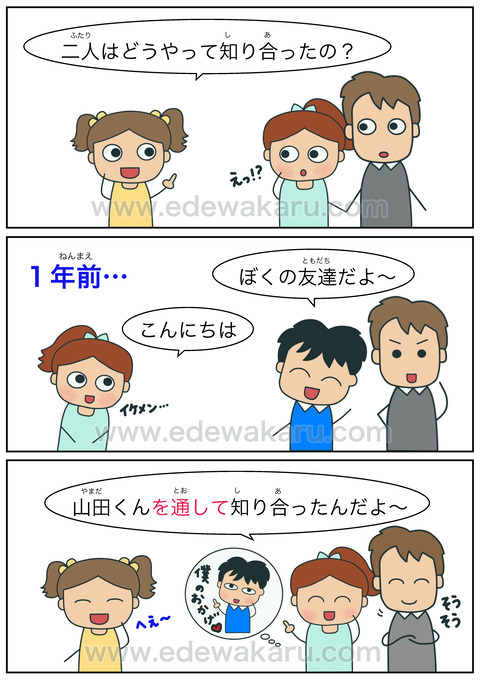
Meaning
〜を手段として[〜で]
〜が仲介となって[〜の紹介で]
〜を経由して
How to use it
名詞[辞書形]+を通して
名詞[辞書形]+を通じて
Explanation
「〜を通して・〜を通じて」は[手段・仲介・経由]を表す文型です。
「〜を手段として・〜で」「〜が仲介者(ちゅうかいしゃ)となって」「〜を経由して」
という意味で使われます。「仲介者」とは「紹介する人」のことです。
[例]
①山田くん
を通して、彼氏と知り合った
=山田くん
を通じて、彼氏と知り合った
②日本語の勉強
を通して、日本文化も学ぶことができました
=日本語の勉強
を通じて、日本文化も学ぶことができました
「〜を通して・〜を通じて」には
[期間]
を表す用法もありますので、一緒に覚えておきましょう😀
In context 6 examples
A:二人はどうやって知り合ったの?B:山田くんを通して、知り合ったんだよ〜
→山田くんが仲介となって知り合ったんだよ日本語の勉強を通して、日本文化も学ぶことができました
→日本語の勉強が手段となって、日本文化も学ぶことができた事故のことは、ニュースを通して知りました
→ニュースで知りました【手段】ボランティアを通して、たくさんの友達ができました
→ボランティアをしたことで、たくさんの友達ができました【手段】連絡は、秘書を通して行うようにしてください
→連絡は、秘書を経由して行うようにしてください今は、SNSを通して世界中に友達をつくることができる
→SNSを手段として、世界中に友達をつくることができる
Usage 2
Read this source entry ↗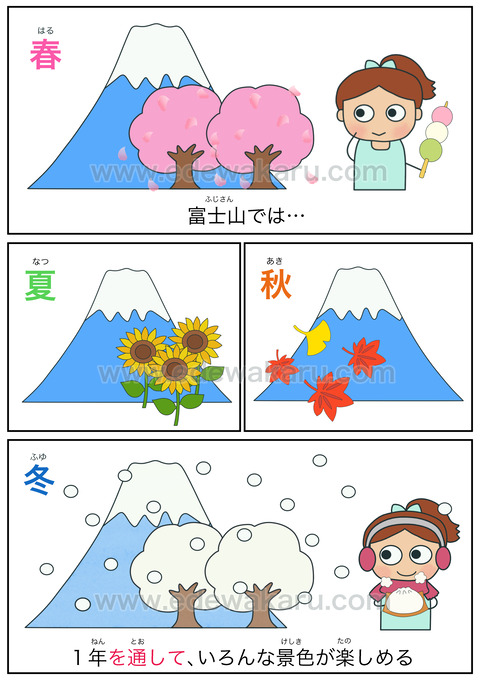
Meaning
〜の期間、ずっと〜
〜の期間、いつも〜
How to use it
名詞[辞書形]+を通して
名詞[辞書形]+を通じて
Explanation
「〜を通して・〜を通じて」は[期間]を表す文型で、「〜の期間、ずっと〜」「〜の期間、いつも〜」という意味で使われます。「1年を通して」「年間を通して」「四季を通して」は、「1年中〜」という意味になると覚えておくといいと思います😊また、「〜を通して」は「〜を通じて」にチェンジすることができます。
[例]
①富士山では、1年
を通して
いろんな景色が楽しめる
=富士山では、1年
を通じて
いろんな景色が楽しめる
②ここは1年
を通して
雨が多い
=ここは1年
を通じて
雨が多い
「〜を通して・〜を通じて」には[手段・仲介・経由]を表す用法もありますので、一緒に覚えておきましょう😀
In context 5 examples
富士山では、1年を通していろんな景色が楽しめる
→富士山では、1年の間、ずっといろんな景色が楽しめるここは年間を通して雨が多い
→ここは1年中(いちねんじゅう)雨が多いディズニーランドは、1年を通してお客さんがたくさん来る
→ディズニーランドは、1年の間、いつもお客さんがたくさん来るこの公園では、四季を通していろんな花が咲く
→1年中、ずっといろんな花が咲く彼女は大学生活(だいがくせいかつ)4年間を通して、一生懸命(いっしょうけんめい)勉強をした
→大学生活4年間、ずっと一生懸命勉強をした
どんなときどう使う 日本語表現文型辞典
Usage 1
Meaning
through
How to use it
N+を通じて
Explanation
をつうじて〈手段・媒介〉
~を手段として/~を媒介として
1)何かが成立するときや何かをするときの媒介や手段となる人や事柄を表す。
2)「をつうじて」と「をとおして」は同じように使える場合が多いが、「をつうじて」は何かが成立するときの媒介、手段としてとらえ、「をとおして」はそれを間に立てて何かをする、という積極的な意味で使われることが多い。
2)Often patterns をつうじて and をとおして can be used same way, but をつうじて is understood as intermediary or means when something occurs; をとおして often has proactive meaning of acting as intermediary for doing something.
1)Person who acts as intermediary, or something that serves as means to cause some event to happen.
In context 3 examples
わたしはそのことをテレビのニュースを通じて知りました。
彼とは共通の友人を通じて知り合った。
このような民間レベルの国際交流を通じて、両国間の理解が少しずつでも進んでいくことを願っています。
Usage 2
Meaning
throughout
How to use it
N+を通じて
Explanation
をつうじて〈継続期間〉
~の間ずっと
「~を通じて」の形で「~の間ずっと同じ状態だ」と言いたいときに使う。「をとおして」と意味・用法がほとんど同じ。
Continuous state throughout a time period. Usage is nearly same as for をとおして.
In context 3 examples
この地方は1年を通じてほとんど同じような天候です。
この公園には四季を通じていろいろな花が咲きます。
人類の歴史を通じて、地球のどこかでつねに戦争が行われてきた。
毎日のんびり日本語教師
How to use it
名詞+を通じて
名詞+を通して
動辞形+ことを通じて
動辞形+ことを通して
Explanation
2つの意味があります。
①期間
時間名詞に接続して、その間の期間を表します。
②仲介、手段
「動辞形+ことを通じて/通して」のときは、一般的に後項では「学ぶ」「知る」など動詞が用いられます。
Notes
似ている文法「【N1文法】~を経て」
「~通じて/通して」は経由地に使うことができません。経由地を表す場合は「を経て」が使えます。
✕
韓国を通じて日本に行く。
◯
韓国を経て日本に行く。
In context 8 examples
SNSなどを通じて見知らぬ人に会うことはしばしば危険を伴う。
この辺りは1年を通して温暖な気候だ。
親は子供を通じて人生の多くを学ぶ。
新元号が発表される瞬間はテレビを通じて見ました。
スポーツを通して心身の成長を図る。
将来は自分の演技を通して観客の心を動かしたいと思っています。
子供は失敗することを通して様々なことを学んでいく。
ボランティア活動を通して現地の人々とつながることができた。
AIUEO JLPT Grammar
Meaning
This sentence pattern expresses that something is done through a medium or within a certain period of time.
How to use it
名詞を+通じて名詞を+通して
Explanation · 日本語
この文型は、何かを媒介にして物事を行ったり、ある期間を表したりするときに使われる表現です。
In context 5 examples
彼女はテレビ番組を通して、料理のスキルを学んだ。
She learned cooking skills through TV programs.
このイベントは一年を通じて行われます。
This event takes place throughout the year.
インターネットを通じて、世界中の情報を手に入れることができる。
You can access information from around the world through the internet.
このキャンペーンは、新聞を通して多くの人に伝えられた。
This campaign was communicated to many people through newspapers.
彼女は仕事を通して、多くの貴重な経験を積みました。
She gained a lot of valuable experience through her work.
Bunpro Grammar Reference
Meaning
Through, Via, Throughout
How to use it
Noun + を通して
Noun + を通じて
Nuance
An expression which explains the means through which (A) was done. Literally with (A) as the flow point, (B).
Explanation
を通じて and を通して are two grammar patterns in Japanese that have very similar meanings to each other, and are used in many overlapping situations. Primarily, they can be thought of as meaning 'through (A), (B)', or 'via (A), (B)'. This 'through' may either indicate a method, or a location.
通じる 'to flow', or 'to go through' and 通す 'to make a path', only differ in that the former is intransitive, while the latter is transitive. Because of this, 通じる will be seen more often in regard to information or communication where (A) is the connection through which (B) occurs. 通す on the other hand more often refers to direct locations through which something is transferred or relocated. As this expression begins with を, it will appear after nouns, before expressing in the (B) part of the sentence exactly what was done 'through' (A).
その事件はネットニュースを通じて知りました。
I learned about that incident through online news.
彼はアニメを通じて日本語を学んだそうだ。
I heard that he learned Japanese through anime.
語学留学を通して日本の文化などを学びました。
I learned about Japanese culture and other aspects of Japan through language study.
仕事を通して今の妻と出会いました。
I met my current wife through work.
Caution
The primary difference between を通じて and を通して lies in the intransitive and transitive nature of the verbs themselves. Due to this, things that are being done 'intentionally', or 'by use of (A)' will tend to use を通して. を通じて is more common when something is being done 'throughout (A)'.
ロシアには年間を通して寒い村があるらしい。
I heard that there is a town in Russia that is cold throughout the year. (Unnatural Japanese)
ロシアには年間を通して寒い村があるらしい。
I heard that there is a town in Russia that is cold throughout the year. (Unnatural Japanese)
事故にあった際には弁護士を通して相手に連絡をするようにしてください。
If you are involved in an accident, you should contact the other party through your attorney. (Natural Japanese)
事故にあった際には弁護士を通して相手に連絡をするようにしてください。
If you are involved in an accident, you should contact the other party through your attorney. (Natural Japanese)
Nuance · 日本語
(A)が行われた手段を説明する表現。(A)の中を経て(B)を行う。
Explanation · 日本語
「を通じて」と「を通して」はとても似た意味を持ち、多くの場合に入れ替えて使うことができる文法です。主に手段や場所を示し、「(A) を手段として (B)」や「(A) を経由して (B)」のような意味を表します。
「通じる」と「通す」の違いは、前者が自動詞で、後者が他動詞であることです。そのため、「通じる」は、情報やコミュニケーションのような、(A) が (B) を成立させるための目に見えない繋がりや、情報の流れによく使われます。一方で「通す」は、物理的な場所を経由するときに使われることが多いです。「を」で始まるこれらの表現は、名詞の後に置かれ、その後の (B) の部分で (A) を通って行われたことが述べられます。
その事件はネットニュースを通じて知りました。
I learned about that incident through online news.
彼はアニメを通じて日本語を学んだそうだ。
I heard that he learned Japanese through anime.
語学留学を通して日本の文化などを学びました。
I learned about Japanese culture and other aspects of Japan through language study.
仕事を通して今の妻と出会いました。
I met my current wife through work.
注意点
「を通じて」と「を通して」の主な違いは、自動詞と他動詞という動詞そのものの性質の違いからきています。そのため、物事が意図的に「(A) を利用して」行われる場合には「通して」が使われやすく、意図せず受動的に「(A) を通過して」行われる場合には「通じて」が使われやすいです。
ロシアには年間を通して寒い村があるらしい。
I heard that there is a town in Russia that is cold throughout the year. (Unnatural Japanese)
ロシアには年間を通して寒い村があるらしい。
I heard that there is a town in Russia that is cold throughout the year. (Unnatural Japanese)
事故にあった際には弁護士を通して相手に連絡をするようにしてください。
If you are involved in an accident, you should contact the other party through your attorney. (Natural Japanese)
事故にあった際には弁護士を通して相手に連絡をするようにしてください。
If you are involved in an accident, you should contact the other party through your attorney. (Natural Japanese)
In context 20 examples
- このプロジェクトを通じて多くのことを学んだ。
I have learned a lot through participating in this project.
- その事件はネットニュースを通じて知りました。
I learned about that incident through online news.
- 彼はアニメを通じて日本語を学んだそうだ。
I heard that he learned Japanese through anime.
- 語学留学を通して日本の文化などを学びました。
I learned about Japanese culture and other aspects of Japan through language study.
- 仕事を通して今の妻と出会いました。
I met my current wife through work.
- 看病を通して人の愛を知りました。
Through nursing a patient, I came to know human affection.
- 叔父さんを通して仕事の依頼がきた。
Through my uncle, I got a job commission.
- 打合せを通して新たな発見をすることもよくある。
There are many new discoveries made through business meetings.
- 植木を通して自然の尊さを学びました。
I learned the nobility of nature through planting.
- 今の奥さんには友達を通じて出会った。
I met my current wife through a friend.
- オルガンを通して練習することの大切さを学んだ。
Through the organ, I learned the importance of practice.
- 学会を通して与えられた指針が役立ちました。
Throughout the academic conference, the guidelines that were given were helpful.
- 演劇を通じてコミュニケーション能力が向上した。
Through the theatrical play, my communication ability improved.
- 観測を通じて、研究の大変さがよく分かった。
Through observation, I fully understood the difficulty of research.
- 家屋調査を通じて、建物の現状がかなり理解できた。
Through the house inspection, I was able to understand a lot about the state of the building.
- 親と弁護士だけを通じて連絡できることになった。親が私のことを憎んでいる。
I ended up being able to communicate with my parents only via the lawyer. My parents hate me.
- ロシアには年間を通じて寒い村があるらしい。
I heard that there is a town in Russia that is cold throughout the year. (Natural Japanese)
- 事故にあった際には弁護士を通じて相手に連絡をするようにしてください。
If you are involved in an accident, you should contact the other party through your attorney. (Unnatural Japanese)
- 事故にあった際には弁護士を通して相手に連絡をするようにしてください。
If you are involved in an accident, you should contact the other party through your attorney. (Natural Japanese)
- ロシアには年間を通して寒い村があるらしい。
I heard that there is a town in Russia that is cold throughout the year. (Unnatural Japanese)
IMABI
Through: を通じて & を通して
Read this IMABI lesson ↗Explanation
Through: を通じて & を通して
~を通して and ~を通じて without context are completely interchangeable. So, getting the small details straight will probably be the hardest thing about this lesson.
漢字 Note: Note that there is also 通かよう and 通とおる. The first is used in the sense of “commute” or flowing/understanding such as in phrases like 学校に通う and 心が通う. 通る expresses transit. Ex. 道を通る.
~を通して VS ~を通じて
を通しで and ~通(とお)じて are incorrect. Pronunciation is perhaps the most common mistakes about these. That should be good news. Both show a meaning equivalent to ~を経て/を仲介して to show a means “of through (the intermediary of)”. They can also be used to mean “through” in a temporal sense.
1. 仕事を{通じて・通して}人脈が広がっていった。
My connections spread through my job.
2. 1年を{通じて・通して}スキーができる。
You can ski (here) throughout the year.
3. 日本語の勉強を{通じて・通して}日本人の考え方が少し分かってきました。
Through my Japanese studies, I have come to understand the Japanese way of thinking a little.
通じる is a verb used to show the result gained by a certain action; 通す is thought to hold a volitional side. Although even in these examples either is OK, when you want to show volitional, the latter is the best choice.
In a normal situation where this is not an exceptional circumstance, it is best not to use ~を通じて. The longer the sentence, the easier it gets to become to decide whether it fits this criterion or not. Certain speech modals also aid in the decision.
4. 私はインターネット{〇 を通して・X を通じて}役に立つニュースを得ました。
I got useful news through the Internet.
5. 一緒に働いた経験{〇 を通して・X を通じて}、ふたりは生涯かわらぬ友愛をもちつづけた。
Through the experience of working together, they continued to hold a friendship for life.
6. 仲人を通して縁談をすすめたほうがいいでしょう。
Isn’t it best to forward an engagement through a middleman?
7. ハッカーたちは、ウイルスに感染されたファイルが送りこめるインターネット{〇 を通じて、Xを通して}、ユーザーのシステムを破壊していく。
Hackers through the internet that can send files infected with viruses go on to destroy the user’s system.
Even when either is fine, there will always be slight nuance differences.
8. 社長との連絡は、すべて秘書を{通して・通じて}行われた。
All contact with the company president was carried out through the secretary.
The first option makes the situation far from out of the ordinary, but the second option makes it sound secretive.
There are two broad situations that can describe most sentences with these modals. There could be an intermediary between an X and Y, or through the means of A, B is done. Consider the following information for further distinguishing.
Aを通してB: Through the intermediation/means of A, B is done simply and clearly.
Aを通じてB: A, which is an intermediate or means, is something that can’t be public, must be a secret, or is something unjust.
As mentioned earlier, there is a peculiar nature about ~を通じて, and special circumstances are often mysterious, clandestine, and may involve some sort of secret means. In this sense, it contrasts the openness and simplicity of action implied by statements with ~を通して.
Now, what about a sentence like the following?
9. この種の松林は、日本全国を{通して・通じて}見ることができる。
You can see this kind of pine forest throughout all of Japan.
If you get a native speaker that doesn’t like one version or another, you probably need to find a different opinion. This sentence is different because there is no intermediation or means involved. In this sense they are similar to “throughout”. The decision as to which one should be used goes down to individual speaker variation pending on whether that person likes more native words over 漢語. With this, ~を通じて can be used in a stiffer and more literary fashion.
Attribute Forms
Don’t you just love attribute forms? As you may have guessed, ~を通した, ~通しての, ~通じた, and ~を通じての are all possible, but they are not completely interchangeable.
Aを{通した・通じた}B can’t be used in situations where A is a direct information source. This is because “Aを通す” and “A{を・が}通じる” originally meant that through the intermediation of A, two spaces are connected (examples of this will be shown later in this lesson).
Accordingly, A both can be used as the go-between X and Y, but when A becomes the information source, “Aを通じてのB” or “Aを通してのB” must be used.
10. 秘書を{通した・通じた・通しての・通じての}連絡が社長に届いた。
A contact through the secretary reached the company president
11. 今回、入手した情報は、その筋の人を{〇 通しての・〇 通じての・X 通した・X 通じた}ものです。.
The information I received this time is info from a person of that source.
When showing consistency temporally or geographically, ~を通しての and ~を通じての are your only options.
12. 日本全国を{通じての・通しての}この種の松林は、日本の森林を特徴づけるもののひとつである。
This kind of pine forest throughout Japan is one characteristic of the forests of Japan.
13. 山を{〇 通しての・△ 通じての}トンネル
A tunnel through a mountain
It does become more natural to rephrase them out, especially since there’s not much of a sense of familiarity in sentences like the second to last. Also, when there is not a sense of a go-between, ~を通じた・を通した mustn’t be used.
14. 彼らは一緒に働いた経験を通しての友愛を持ち続けた。
They continued to a hold friendship through the experience of working together.
Other Meanings
Remember that 通す means “pass through” and can be used in several contexts. This remains the case in ~を通して. 通じる can mean “to lead through/get through/get across”. Both are used in many idioms as well.
15. 道を開けて、車を通す。
To open up the road and let cars pass through.
16. 前に化け物が立ちはだかって、僕を通そうとしなかった。
A monster blocked my path in front of me, and it didn’t attempt to let me pass by.
17. 空港まで政府が高速道路と新幹線を開通させた。
The government created passage through a highway and bullet train line up to the airport.
Word Note: 開通する is more appropriate here, but 新幹線を通す is an appropriate phrase, but it is more general in nature and doesn’t fit well with 政府.
18. 肉に串を通す。
To put meet through a skewer.
19. 目を通す。
To scan.
20. やりたいことを通す。
To do what one wants.
21. 戻ってきてから、目を通すから。
I’ll look over it when I come back.
22. 針に糸を通す。
To thread yard in a needle.
23. 袖に手が通せるか。
Can you pass your hands through your sleeves?
24. 刺身を氷水に通さなきゃいけない。
You have to pass sashimi through ice water.
25. 彼らに私の中国語は通じませんでした。
I couldn’t make myself understood to them in Chinese.
26. 電話が通じなくなりました。
The phone went dead.
27a. バスがオースティンとサン・アントニオの間に通じている。
27b. バスがオースティンとサン・アントニオの間を通している。(もっと自然)
The bus runs between Austin and San Antonio.
28. 肉を熱湯に通すと、殺菌できる。
If you put meat through hot water, you’ll sterilize it.
29. 黒いものは熱を通しやすい。
It is easy for black objects to transmit heat.
30. これは水を通さない。
This will not let water pass through.
31. 通してくださいませんか。
Could you let me through?
32. {火・熱}を通す。
To heat (food).
33. 我を通す。
To have one’s way.
34a. 風を通さないように窓を閉めてください。
34b. 風が通らないように窓を閉めてください。(もっと自然)
In order to not ventilate air, please shut your windows.
35. 肉の中まで火を通す。
To pass the meat up to the center in the fire.
36. ステーキはよく火を通すべきだ。
You should cook steak well.
37. 堅を通して僕は彼女と知り合った。
I got acquainted with her through Ken.
38. 政界で成功したければ、自分の建て前を明確に通さなければなりません。
If you want to succeed in politics, you have to correctly put in one’s official stance.
39. 理屈を通す。
To correctly arrange the logic (in something).
40. 自己の信念を通すとは真に勇気があるという意味だ。
Persisting in one’s belief is the true definition of courage.
41. 独身で通すのはださいな。
Remaining single sucks.
42a. インターネットを通じてビデオゲームを注文する。(書き言葉)
42b. インターネットでビデオゲームを注文する。(話し言葉)
To order video games via the Internet.
43. 全歴史を通じて、東北関東大震災は第5番目のもっとも巨大な地震です。
Throughout all of history, the Tohoku-Kanto Earthquake Disaster is the 5th largest earthquake.
44. 一年を{通して・通じて}
Throughout the year
45. 週末を通じて仕上げられるのか。(ちょっと硬い)
Can you do it over the weekend?
46a. 名刺めいしを差し出して面会を求める。
46b. 刺しを通じて、面会を求める。(Very Rare)
47b. 名刺を通じて、面会を求める。(Rare)
To present one’s card and seek a meeting.
48. 気脈きみゃくを通じる。
To have secret connections with something/one.
49a. 電流でんりゅうを通じる。
49b. 電流が通じる。(More natural)
To connect an electric current.
50. あいつは敵てきに通じてる。
He’s colluding with the enemy!
51. そんなことでは社会では通じません。
In such manner is not accepted in society.
52. 事情じじょうに通じている。
I’m well-informed of the circumstances.
53. 僕の中国語は通じなかった。
My Chinese wouldn’t get across.
54. 電話が通じなくなった。
My phone went dead.
55. この道は頂上ちょうじょうに通じている。
This road leads to the summit.
56. 停電ていでんで何も通じない。
Nothing will go through due to the blackout.
57. 参議院{において・で}法案を通す。
To pass a bill through the House of Councilors.
58. 立法者たちは米議会で法律を無理矢理通しすぎる。
Lawmakers pass too many laws forcibly through the US Congress.
59a. 補聴器を通して話が聴けるようになった。(改まった)
59b. 補聴器で話が聴けるようになった。(自然)
I have become able to listen to conversations with a hearing aid.
60. フィルターを通して不純物を除去すればよい。
It is good for you to get rid of impurities through a filter.
61. 昼夜{を通して・を問わず}工事を続けた。
(The workers) continued to work on the construction around the clock.
62. 全幕を通して役者を見る。
To see through the entire curtain and watch the actors.
63. 一生独身を通す。
To live one’s whole life single.
64a. 傷にオキシドールを塗れば、消毒できるようになります。(もっと自然)
64b. 傷をオキシドールに通して、消毒できるようになります。
If you will pass your wound through hydrogen peroxide, you’ll be able to disinfect it.
65a. レインコートの中まで雨が沁みてきた。(もっと自然)
65b. レインコートを通して雨が沁みてきた。
Rain has started to soak in through my raincoat.
66a. 一年中和服で過ごす人は少ない。(自然)
66b. 一年中和服で通す人は少ない。(ちょっと不自然)
There are seldom people that wear traditional Japanese clothing throughout the year.
67. 気持ちが通じる。
To have one’s feelings get across.
68a. 世故せこに通つうじている。
68b. 世故にたけている。
I know fully about worldly affairs.
69. 人妻ひとづまと通じる。
To commit adultery.
70. 大便だいべんが通じる。
To have a bowel movement.
71. 自然しぜんであることは幸せに通じている。
Being natural is tied to happiness.
72. 『憶おく』は『臆おく』に通じる。
To not distinguish between 憶 and 臆.
73a. 服装を通して人の風俗を考える。
73b. 服装から人に品位を考える。(もっと自然)
To think about the manners of people through their dress.
74a. 高校生の女子は夜通し語り合った。
74b. 高校生の女子は夜を通して語り合った。(Wordier)
The high school girls talked to each other all through the night.
~によって VS ~に通して・に通じて
Although mentioned in the lesson about ~によって, there is some interchangeability between ~によって, ~を通じて, and ~を通して with this usage. However, the first places emphasis on the connection between the method and effect/result. The latter two place emphasis on the process.
75. インターネット{によって・を通じて・を通して}、アルバムを販売する。
To sell albums by/via/through the internet.
76. 選挙{〇 によって・X を通じて・X を通して]委員長になる。
To become the committee chairman by election.
In context 88 examples
仕事を{通じて・通して}人脈が広がっていった。
My connections spread through my job.
1年を{通じて・通して}スキーができる。
You can ski (here) throughout the year.
日本語の勉強を{通じて・通して}日本人の考え方が少し分かってきました。
Through my Japanese studies, I have come to understand the Japanese way of thinking a little.
私はインターネット{〇 を通して・X を通じて}役に立つニュースを得ました。
I got useful news through the Internet.
一緒に働いた経験{〇 を通して・X を通じて}、ふたりは生涯かわらぬ友愛をもちつづけた。
Through the experience of working together, they continued to hold a friendship for life.
仲人を通して縁談をすすめたほうがいいでしょう。
Isn’t it best to forward an engagement through a middleman?
ハッカーたちは、ウイルスに感染されたファイルが送りこめるインターネット{〇 を通じて、Xを通して}、ユーザーのシステムを破壊していく。
Hackers through the internet that can send files infected with viruses go on to destroy the user’s system.
社長との連絡は、すべて秘書を{通して・通じて}行われた。
All contact with the company president was carried out through the secretary.
この種の松林は、日本全国を{通して・通じて}見ることができる。
You can see this kind of pine forest throughout all of Japan.
秘書を{通した・通じた・通しての・通じての}連絡が社長に届いた。
A contact through the secretary reached the company president
今回、入手した情報は、その筋の人を{〇 通しての・〇 通じての・X 通した・X 通じた}ものです。.
The information I received this time is info from a person of that source.
日本全国を{通じての・通しての}この種の松林は、日本の森林を特徴づけるもののひとつである。
This kind of pine forest throughout Japan is one characteristic of the forests of Japan.
山を{〇 通しての・△ 通じての}トンネル
A tunnel through a mountain
彼らは一緒に働いた経験を通しての友愛を持ち続けた。
They continued to a hold friendship through the experience of working together.
道を開けて、車を通す。
To open up the road and let cars pass through.
前に化け物が立ちはだかって、僕を通そうとしなかった。
A monster blocked my path in front of me, and it didn’t attempt to let me pass by.
空港まで政府が高速道路と新幹線を開通させた。
The government created passage through a highway and bullet train line up to the airport.
肉に串を通す。
To put meet through a skewer.
目を通す。
To scan.
やりたいことを通す。
To do what one wants.
戻ってきてから、目を通すから。
I’ll look over it when I come back.
針に糸を通す。
To thread yard in a needle.
袖に手が通せるか。
Can you pass your hands through your sleeves?
刺身を氷水に通さなきゃいけない。
You have to pass sashimi through ice water.
彼らに私の中国語は通じませんでした。
I couldn’t make myself understood to them in Chinese.
電話が通じなくなりました。
The phone went dead.
バスがオースティンとサン・アントニオの間に通じている。
The bus runs between Austin and San Antonio.
バスがオースティンとサン・アントニオの間を通している。(もっと自然)
The bus runs between Austin and San Antonio.
肉を熱湯に通すと、殺菌できる。
If you put meat through hot water, you’ll sterilize it.
黒いものは熱を通しやすい。
It is easy for black objects to transmit heat.
これは水を通さない。
This will not let water pass through.
通してくださいませんか。
Could you let me through?
{火・熱}を通す。
To heat (food).
我を通す。
To have one’s way.
風を通さないように窓を閉めてください。
In order to not ventilate air, please shut your windows.
風が通らないように窓を閉めてください。(もっと自然)
In order to not ventilate air, please shut your windows.
肉の中まで火を通す。
To pass the meat up to the center in the fire.
ステーキはよく火を通すべきだ。
You should cook steak well.
堅を通して僕は彼女と知り合った。
I got acquainted with her through Ken.
政界で成功したければ、自分の建て前を明確に通さなければなりません。
If you want to succeed in politics, you have to correctly put in one’s official stance.
理屈を通す。
To correctly arrange the logic (in something).
自己の信念を通すとは真に勇気があるという意味だ。
Persisting in one’s belief is the true definition of courage.
独身で通すのはださいな。
Remaining single sucks.
インターネットを通じてビデオゲームを注文する。(書き言葉)
To order video games via the Internet.
インターネットでビデオゲームを注文する。(話し言葉)
To order video games via the Internet.
全歴史を通じて、東北関東大震災は第5番目のもっとも巨大な地震です。
Throughout all of history, the Tohoku-Kanto Earthquake Disaster is the 5th largest earthquake.
一年を{通して・通じて}
Throughout the year
週末を通じて仕上げられるのか。(ちょっと硬い)
Can you do it over the weekend?
名刺めいしを差し出して面会を求める。
To present one’s card and seek a meeting.
刺しを通じて、面会を求める。(Very Rare)
To present one’s card and seek a meeting.
名刺を通じて、面会を求める。(Rare)
To present one’s card and seek a meeting.
気脈きみゃくを通じる。
To have secret connections with something/one.
電流でんりゅうを通じる。
To connect an electric current.
電流が通じる。(More natural)
To connect an electric current.
あいつは敵てきに通じてる。
He’s colluding with the enemy!
そんなことでは社会では通じません。
In such manner is not accepted in society.
事情じじょうに通じている。
I’m well-informed of the circumstances.
僕の中国語は通じなかった。
My Chinese wouldn’t get across.
電話が通じなくなった。
My phone went dead.
この道は頂上ちょうじょうに通じている。
This road leads to the summit.
停電ていでんで何も通じない。
Nothing will go through due to the blackout.
参議院{において・で}法案を通す。
To pass a bill through the House of Councilors.
立法者たちは米議会で法律を無理矢理通しすぎる。
Lawmakers pass too many laws forcibly through the US Congress.
補聴器を通して話が聴けるようになった。(改まった)
I have become able to listen to conversations with a hearing aid.
補聴器で話が聴けるようになった。(自然)
I have become able to listen to conversations with a hearing aid.
フィルターを通して不純物を除去すればよい。
It is good for you to get rid of impurities through a filter.
昼夜{を通して・を問わず}工事を続けた。
(The workers) continued to work on the construction around the clock.
全幕を通して役者を見る。
To see through the entire curtain and watch the actors.
一生独身を通す。
To live one’s whole life single.
傷にオキシドールを塗れば、消毒できるようになります。(もっと自然)
If you will pass your wound through hydrogen peroxide, you’ll be able to disinfect it.
傷をオキシドールに通して、消毒できるようになります。
If you will pass your wound through hydrogen peroxide, you’ll be able to disinfect it.
レインコートの中まで雨が沁みてきた。(もっと自然)
Rain has started to soak in through my raincoat.
レインコートを通して雨が沁みてきた。
Rain has started to soak in through my raincoat.
一年中和服で過ごす人は少ない。(自然)
There are seldom people that wear traditional Japanese clothing throughout the year.
一年中和服で通す人は少ない。(ちょっと不自然)
There are seldom people that wear traditional Japanese clothing throughout the year.
気持ちが通じる。
To have one’s feelings get across.
世故せこに通つうじている。
I know fully about worldly affairs.
世故にたけている。
I know fully about worldly affairs.
人妻ひとづまと通じる。
To commit adultery.
大便だいべんが通じる。
To have a bowel movement.
自然しぜんであることは幸せに通じている。
Being natural is tied to happiness.
『憶おく』は『臆おく』に通じる。
服装を通して人の風俗を考える。
To think about the manners of people through their dress.
服装から人に品位を考える。(もっと自然)
To think about the manners of people through their dress.
高校生の女子は夜通し語り合った。
The high school girls talked to each other all through the night.
高校生の女子は夜を通して語り合った。(Wordier)
The high school girls talked to each other all through the night.
インターネット{によって・を通じて・を通して}、アルバムを販売する。
To sell albums by/via/through the internet.
選挙{〇 によって・X を通じて・X を通して]委員長になる。
To become the committee chairman by election.