日本語文型辞典
Meaning
基本情報Vそばから説明「…するとすぐに」の意味。少し古めかしい言い方。例文① 子供達は作るそばから食べてしまうので、作っても作ってもおいつかない。② 聞いたそばから忘れてしまう。③ 読んだそばから抜けていって何もおぼえていない。
IMABI
Tendency
Read this IMABI lesson ↗Explanation
Tendency: 嫌いがある, が早いか, が最後, & そばから
In this lesson we will learn about speech modals concerning tendency.
嫌いがある
嫌い means “to hate”–it is treated as a 形容動詞 instead of as a verb in Japanese–and is followed by がある to show what someone or something has a tendency of doing. As the word suggests, this is not a good tendency. This tendency has to be somewhat bad, so it doesn’t work with phrases like ぎりぎり間に合う.
1. 依存症の嫌いがあること
To have a tendency of dependence.
2. その生徒は遅刻する嫌いがありました。
That student had a tendency to be late.
3. 彼は酒を飲みすぎる嫌いがある。
He has a tendency of drinking too much sake.
4. 人には自分の聞きたくないことは耳に入れないというきらいがあるのではないか。
Isn’t there are tendency that what one doesn’t want to hear doesn’t get heard?
5. 彼女は優しいですが、無意識に人を傷付けることを言うきらいがある。
She’s nice but, she has a tendency to say things that hurt people without knowing it.
6. 人間は年を取ると、他の人の話を聞かなくなる嫌いがある。
When humans get older, they have a tendency of not wanting to listen to other people.
が早いか
が早いか is best translated as “the instant”. Basically the same as the noun 瞬間(instant). The situation in question must not be of one’s control. It has also become limited to actions done by people. The actions also have to be logically related to each other. が早いか can be used with the non-past or the past tense. However, the former is the most common and some speakers may not like it with the past tense.
7. 彼女は先生を見るが早いか、逃げ出しました。
She started running away the instant she saw the teacher.
8. 「飲んでみよう」と言ったが早いか、彼は全て飲んでしまった。
The instant I said, “Let’s try drinking it”, he completely drank it all.
9. 言うが早いかやってしまった。
No sooner said than done.
10. 弟は、口に押し込んだが早いか、玄関を出ていった。 (△)
My brother left the house just as soon as he shoved it down in his mouth.
11. 初級者向けのIMABIの教科書は店頭に並べられたが早いか、すぐに売れていきました。
The IMABI textbooks for beginners flew off the shelves the instant they were put up in front of the store.
12. ベルを聞くが早いか、生徒達は教室から飛び出していった。
The instant they heard the bell, the students dashed out of the classroom.
The verb must be one that describes something of an instant. It’s not a verb that entails a longer period of time. When you see, ask, arrive, etc. that is 瞬間的. The part of the sentence that comes after is unexpected. Again, this pattern must not be used to show the speaker’s wants or intentions.
~が最後
~が最後 shows that once some starts doing something, there is no end to their action in sight. Due to this, it is very similar to 一旦(いったん) meaning “once”. However, 一旦 doesn’t always have the implications of nonstop.
13. 飲みだしたが最後、止められなかった。
Once I started to drink it, I couldn’t stop.
14. 入ったが最後二度と出てこられなくなる場所に行ったことがありますか。
Have you ever gone to a place where once you entered, you became unable to leave (because it was so awesome)?
15. いったん始めたら、止めてはならない。
Once you start, you must not quit.
16. いったん封を切ると、返品できません。
Once you break the seal, you can’t return it.
そばから
そばから describes an event that repeatedly happens right over again, plain and simple. So, no matter what you do, right when you do it, something messes it up, and this cycle keeps repeating itself. So, it’s usually a bad thing. It’s usually used with the non-past form of a verb, but the past tense is also acceptable.
17. 返事を書いているそばからランスさんが次々とメールを送ってくる。まあ、日本語の勉強に非常に熱心ですね。
Every moment I write a response, but each instant Lance sends a new e-mail one after another. Well, he’s very earnest in his Japanese studies.
18. 妹が掃除するそばから散らかすから、もう諦めたくなりました。
My little sister messes the room up (repeatedly) as soon as I clean it up, so I’ve become tired of doing it.
19. IMABIは漢字が多くて大変ですね。調べたそばから新しい漢字がいつも出てきます。もっとシンプルな漢字でだけ書かれていたらいいのに。
It’s hard that IMABI has a lot of kanji, isn’t it? The moment I look one up, new kanji always show up. If only it were written with just simple kanji.
20. 習うそばから忘れてしまうので、ぜんぜん新しい単語が覚えられない。
Since as soon as I learn it I forget it, I can’t learn any new words.
In context 20 examples
依存症の嫌いがあること
To have a tendency of dependence.
その生徒は遅刻する嫌いがありました。
That student had a tendency to be late.
彼は酒を飲みすぎる嫌いがある。
He has a tendency of drinking too much sake.
人には自分の聞きたくないことは耳に入れないというきらいがあるのではないか。
Isn’t there are tendency that what one doesn’t want to hear doesn’t get heard?
彼女は優しいですが、無意識に人を傷付けることを言うきらいがある。
She’s nice but, she has a tendency to say things that hurt people without knowing it.
人間は年を取ると、他の人の話を聞かなくなる嫌いがある。
When humans get older, they have a tendency of not wanting to listen to other people.
彼女は先生を見るが早いか、逃げ出しました。
She started running away the instant she saw the teacher.
「飲んでみよう」と言ったが早いか、彼は全て飲んでしまった。
The instant I said, “Let’s try drinking it”, he completely drank it all.
言うが早いかやってしまった。
No sooner said than done.
弟は、口に押し込んだが早いか、玄関を出ていった。 (△)
My brother left the house just as soon as he shoved it down in his mouth.
初級者向けのIMABIの教科書は店頭に並べられたが早いか、すぐに売れていきました。
The IMABI textbooks for beginners flew off the shelves the instant they were put up in front of the store.
ベルを聞くが早いか、生徒達は教室から飛び出していった。
The instant they heard the bell, the students dashed out of the classroom.
飲みだしたが最後、止められなかった。
Once I started to drink it, I couldn’t stop.
入ったが最後二度と出てこられなくなる場所に行ったことがありますか。
Have you ever gone to a place where once you entered, you became unable to leave (because it was so awesome)?
いったん始めたら、止めてはならない。
Once you start, you must not quit.
いったん封を切ると、返品できません。
Once you break the seal, you can’t return it.
返事を書いているそばからランスさんが次々とメールを送ってくる。まあ、日本語の勉強に非常に熱心ですね。
Every moment I write a response, but each instant Lance sends a new e-mail one after another. Well, he’s very earnest in his Japanese studies.
妹が掃除するそばから散らかすから、もう諦めたくなりました。
My little sister messes the room up (repeatedly) as soon as I clean it up, so I’ve become tired of doing it.
IMABIは漢字が多くて大変ですね。調べたそばから新しい漢字がいつも出てきます。もっとシンプルな漢字でだけ書かれていたらいいのに。
It’s hard that IMABI has a lot of kanji, isn’t it? The moment I look one up, new kanji always show up. If only it were written with just simple kanji.
習うそばから忘れてしまうので、ぜんぜん新しい単語が覚えられない。
Since as soon as I learn it I forget it, I can’t learn any new words.
絵でわかる日本語
Usage 1
Read this source entry ↗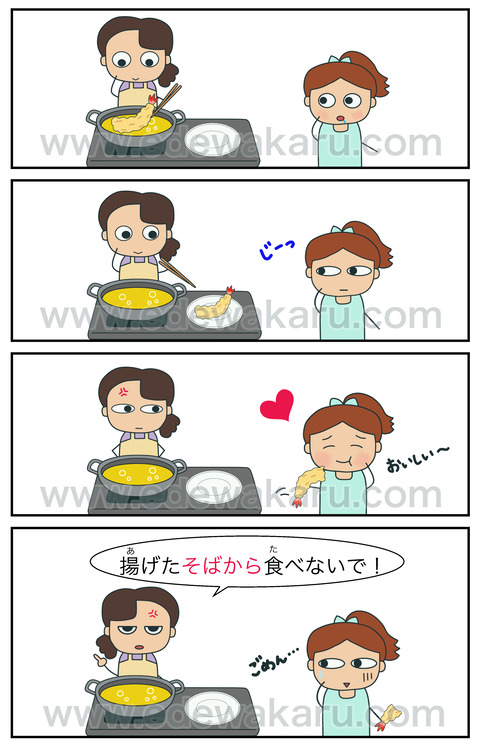
Meaning
〜するとすぐに
How to use it
動詞[辞書形・た形]+そばから
Explanation
「〜そばから」は「〜するとすぐに」という意味を表す文型です。N1には「〜や否や」「〜が早いか」(復習:〜が早いか)「〜なり」といった「〜するとすぐに」という意味の文型があります😨「〜そばから」は
「〜すると、繰り返してすぐに〜」というように、 同じことが連続して発生することを表します
😮
[例]
天ぷらを揚げる
そばから
食べる
→天ぷらを揚げるとすぐに(娘に)食べられてしまうということが
連続して発生している
新しい単語を覚える
そばから
忘れる
→新しい単語を覚えてもすぐ忘れるということを
何度も繰り返している
また、
動詞の「辞書形」「た形」はどちらを使っても同じ意味になります
😀
[例]
覚える
そばから忘れる=
覚えた
そばから忘れる
【「〜そばから」の特徴まとめ】
・
反復して発生すること
に使う
・
マイナスのこと
に使う
・
話者の「不満」を表す
「〜そばから」は「〜してもまた、同じことが繰り返される」というのを不満・非難の気持ちを込めて(復習:〜を込めて・〜を込めた)使う文型だと覚えておくといいと思います😊
【関連文型】
In context 3 examples
揚げるそばから食べないでちょうだい(復習:〜てちょうだい)
→揚げてすぐに食べないでちょうだい新しい単語を覚えたそばから忘れてしまう…
→新しい単語を覚えてすぐに忘れてしまう…うちの息子は洗濯するそばから服を汚すのよ
→うちの息子はせんたくすると、すぐにまた服を汚すのよ
Usage 2
Read this source entry ↗Meaning
〜するとすぐに
How to use it
動詞[辞書形・た形]+そばから
Explanation
「〜そばから」は「〜するとすぐに」という意味を表す文型です。N1には「〜や否や」「〜が早いか」(復習:〜が早いか)「〜なり」といった「〜するとすぐに」という意味の文型があります😨「〜そばから」は
「〜すると、繰り返してすぐに〜」というように、 同じことが連続して発生することを表します
😮
[例]
天ぷらを揚げる
そばから
食べる
→天ぷらを揚げるとすぐに(娘に)食べられてしまうということが
連続して発生している
新しい単語を覚える
そばから
忘れる
→新しい単語を覚えてもすぐ忘れるということを
何度も繰り返している
また、
動詞の「辞書形」「た形」はどちらを使っても同じ意味になります
😀
[例]
覚える
そばから忘れる=
覚えた
そばから忘れる
【「〜そばから」の特徴まとめ】
・
反復して発生すること
に使う
・
マイナスのこと
に使う
・
話者の「不満」を表す
「〜そばから」は「〜してもまた、同じことが繰り返される」というのを不満・非難の気持ちを込めて(復習:〜を込めて・〜を込めた)使う文型だと覚えておくといいと思います😊
【関連文型】
In context 3 examples
揚げるそばから食べないでちょうだい(復習:〜てちょうだい)
→揚げてすぐに食べないでちょうだい新しい単語を覚えたそばから忘れてしまう…
→新しい単語を覚えてすぐに忘れてしまう…うちの息子は洗濯するそばから服を汚すのよ
→うちの息子はせんたくすると、すぐにまた服を汚すのよ
AIUEO JLPT Grammar
Meaning
This sentence pattern expresses that an action or event is repeated immediately after or during its occurrence. It emphasizes situations where something happens again, rendering the initial action futile or highlighting repetitive occurrences.
How to use it
動詞辞書形+そばから動詞た形+そばから
Explanation · 日本語
この文型は、ある行動や出来事が終わった直後もしくは進行中に、再び同じことが繰り返されることを表す表現です。何かをしても、すぐにそれを無駄にするような事態が起こる、または、繰り返し同じ行動や出来事が発生することを強調するときに使われます。
In context 5 examples
掃除をするそばから、子供たちが部屋を散らかす。
As soon as I finish cleaning, the kids mess up the room again.
教えたそばから、生徒がその内容を忘れてしまう。
As soon as I teach something, the students forget the content.
メールをチェックするそばから、新しいメールが届く。
As soon as I finish checking emails, new ones keep arriving.
確認したそばから、同じミスを繰り返している。
Right after I checked, the same mistake is being repeated.
説明したそばから、忘れてしまう人がいる。
Some people forget immediately after the explanation.
文法
Meaning
〜しても、すぐに・・・
How to use it
V(辞書形 / タ形)+ そばから
Notes
①よくない意味で使われることが多い。
②同じような場面で同じようなことを繰り返す様子を表す。つまり一回きりのことには使いにくい。
③話し手の不満や呆れた気持ちが含まれる。
ご用例
「〜そばから」は一回きりのことではなく、同じような場面で同じようなことを繰り返す様子を表すときに使うため、次のような例文は言いにくい。
❌ このスマホは買ったそばから、壊れてしまった。
In context 5 examples
ジョンさん、注意したそばから間違えてるよ。
子供は洗濯したそばから、服を汚すので大変だ。
キムさんは聞いたそばから、忘れていつも同じ質問を繰り返す。
彼女は「今日からダイエットする」と言ったそばから、カフェでケーキを食べていた。
部長はいつも、意見をいったそばから否定してくるので、意見があっても言いにくい。
Bunpro Grammar Reference
Meaning
As soon as, Right after, Even if … still
How to use it
Verb[る]+ そばから + Phrase
Verb[た]+ そばから + Phrase
Nuance
A formal, old-fashioned structure, implying that as soon as (A), (B). From the side of (A), (B). (B) is often negative.
Explanation
そばから is a combination of the noun 側 'side', and the case marking particle から 'from'. It illustrates something that happens immediately upon (A), and can be translated as 'as soon as (A), (B)', or 'right after (A), (B)'.
(B) is usually something that is considered annoying, unfavorable, or somehow nullifies (A) by the speaker, but there are exceptions. If the more literal translation of 'from right beside (A), (B)' helps to remember the nuance of (B) happening straight away, then that may be a helpful way to memorize this construction.
そばから will follow verbs in either their dictionary or past-tense forms.
彼女は約束をするそばからすぐ約束を破る。
She breaks her promises as soon as she makes them.
彼は注意するそばから失敗をするから、私のいうことは聞いていないんだろう。
I guess he doesn't listen to me because he makes mistakes as soon as I warn him.
パソコンを直したそばからまた壊れてしまうから困っている。
I'm having trouble with my computer because it breaks down just as soon as I fix it.
早く読みすぎると読んだそばから忘れるから、もっとゆっくり読む様にしている。
I try to read more slowly, because if I read too quickly, I forget as soon as I read it.
Regardless of whether the dictionary or the past-tense form of a verb is used, as そばから means 'right after (A)', the meaning will not change at all.
Caution
そばから will almost always imply that (B) is something that always happens upon (A), rather than being a once-off situation.
車の洗車を終えるそばから、雨が降ってきた。
It started to rain as soon as I was about to finish washing my car.
Nuance · 日本語
(A)が起こった途端に(B)が起こるということを表す丁寧で少し古い表現。(A)側から(B)。(B)はネガティブなことが多い。
Explanation · 日本語
「そばから」は、名詞の「側」(意味:近く)と格助詞の「から」を組み合わせた表現で、「(A) するとすぐに (B)」といった意味で使われます。
通常、(B) には話し手にとって迷惑・不都合なこと、または (A) の効果を打ち消すような出来事が入りますが、そうでないこともあります。「(A) の近くから (B)」という語源にもとづくイメージを持つと、「すぐに」起こるというニュアンスを覚えやすくなるかもしれません。
「そばから」は、動詞の辞書形または過去形の後で使われます。
彼女は約束をするそばからすぐ約束を破る。
She breaks her promises as soon as she makes them.
彼は注意するそばから失敗をするから、私のいうことは聞いていないんだろう。
I guess he doesn't listen to me because he makes mistakes as soon as I warn him.
パソコンを直したそばからまた壊れてしまうから困っている。
I'm having trouble with my computer because it breaks down just as soon as I fix it.
早く読みすぎると読んだそばから忘れるから、もっとゆっくり読む様にしている。
I try to read more slowly, because if I read too quickly, I forget as soon as I read it.
動詞が辞書形であっても過去形であっても、意味やニュアンスは変わりません。
注意点
この表現が使われるときの (B) の出来事は、たいてい毎回繰り返されるものであり、一度限りの出来事ではないという含みがあります。
車の洗車を終えるそばから、雨が降ってきた。
It started to rain as soon as I was about to finish washing my car.
In context 17 examples
- 自転車は直したそばから壊れてしまう。
My bike breaks as soon as I repair it.
- パソコンを直したそばからまた壊れてしまうから困っている。
I'm having trouble with my computer because it breaks down just as soon as I fix it.
- 彼女は約束をするそばからすぐ約束を破る。
She breaks her promises as soon as she makes them.
- 彼は注意するそばから失敗をするから、私のいうことは聞いていないんだろう。
I guess he doesn't listen to me because he makes mistakes as soon as I warn him.
- 早く読みすぎると読んだそばから忘れるから、もっとゆっくり読む様にしている。
I try to read more slowly, because if I read too quickly, I forget as soon as I read it.
- あなたって人は、「やるな」と言ったそばからやるんだから。
People like you are just… As soon as I told you not to do it, you still do it…
- 教わったそばから同じ間違いをおかした。
I made the same mistake as soon as I learned of it.
- ケーキが熱いから触らないように言ったそばから こいつは~。
As soon as I told him not to touch the cake because it was hot, this guy...
- 新人育成がつらい。彼らは言ったそばからどんどん忘れてしまう。
It's hard to train new employees. As soon as I tell them something, they immediately forget it.
- 夫はダイエットをすると言ったそばからポテトチップスを食べ始めたが、それはいつもの事である。
My husband started eating chips as soon as he said that he will start a diet, but that's the same as always.
- バイト代が入ったそばから全て使ってしまい、後になってその事を後悔し始めた。
As soon as I received the wages for my part time job, I used the whole lot and began to regret it afterwards.
- 「喧嘩をやめなさい」と息子たちを叱ったそばから喧嘩をするので、諦める事にしました。
Since my sons will start arguing as soon as I scold them with 'stop fighting', I decided to give up.
- 聞いたそばから忘れてしまうなら、忘れないようにメモを取るようにしたらどうですか?
If you forget something as soon as you hear it, how about making sure to take a note in order not to forget it?
- 模試が終わったそばから次の模試の対策を始めるなんて、あなたは学生の鑑ですね!
Something like making preparations for the next practice exam as soon as you've finished one, you're really the specimen of a student!
- 認知症を患っている叔母はご飯を食べたそばから忘れてしまうので、一日に何回もご飯を要求してきます。
Since my auntie, who suffers from dementia, forgets as soon as she has eaten, she comes requesting food many times a day.
- メリーさん:「夢を覚えている?」
ゆめじさん:「夢なんて起きたそばから忘れてしまうものだけど、夜中に起きてまた眠ると思い出す。」Merry: 'Do you remember your dreams?' Yumeji: 'Dreams are something I forget as soon as I wake up, but if I wake up in the middle of the night and go back to sleep then I remember.'
- 車の洗車を終えるそばから、雨が降ってきた。
It started to rain as soon as I was about to finish washing my car.
どんなときどう使う 日本語表現文型辞典
Meaning
just as soon as
How to use it
Vる・Vた+そばから
Explanation
~しても、すぐまた
1)「~そばから…」の形で、~しても~しても、すぐまた「…」が起こると言いたいときに使う。
2)好ましくないことに使うことが多い。
1)Just as soon as one does something, something else happens again and yet again.
2)Often used for undesirable events.
In context 3 examples
小さい子どもは、お母さんがせんたくするそばから、服を汚してしまいます。
仕事をかたづけるそばから次の仕事を頼まれるのでは体がいくつあっても足りない。
もっと若いうちに語学を勉強するべきだった。今は習ったそばから忘れてしまう。
日本語文型辞典 英語版
Meaning
【そばから】[Vそばから]
Means “as soon as.” A slightly old-fashioned expression.
In context 3 examples
子供達は作るそばから食べてしまうので、作っても作ってもおいつかない。
My children eat everything up as fast as I make it, so even if I cook and cook, I can’t keep up with them.
聞いたそばから忘れてしまう。
I forget things as soon as I hear them.
読んだそばから抜けていって何もおぼえていない。
As soon as I read something I forget it, and I don’t remember anything.
くらべてわかる日本語表現文型辞典
Meaning
Aをしてもすぐその後にBという状態になる。
How to use it
AそばからB
[動詞-た形/る形/ている]そばから
Notes
【注意1】
・BにはAの行為を無駄にしてしまうというニュアンスが含まれることが多い。
・Aは一回きりのことではなく、どんどんと続くことであり、それがすべてBという状態になることを表す。「次々に・またもや」という話し手の気持ちを表すため、一度きりのことや、単にAをしたすぐその後にBという状態になるという文は作りにくい。
×このパソコンは買ったそばから、故障してしまった。
In context 4 examples
片付けたそばからこの子が汚すので、いつも部屋はきたない。
意見を言うそばから否定されると、何も言えなくなる。
料理を並べるそばから食べてくれるので、作りがいがある。
あのてんぷら屋は注文したそばから揚げてくれるのでうまい。
日本語NET JLPT文法解説まとめ
Meaning
〜しても、すぐに・・・
How to use it
V(辞書形 / タ形)+ そばから
Explanation
Used to indicate that something happens repeatedly or continuously in spite of one's efforts or intentions. It conveys that despite actions taken or instructions given, a particular situation or behavior persists.
①よくない意味で使われることが多い。
②同じような場面で同じようなことを繰り返す様子を表す。つまり一回きりのことには使いにくい。
③話し手の不満や呆れた気持ちが含まれる。① It is often used with a negative connotation.
② It expresses a situation where similar things keep happening repeatedly, rather than just once.
③ It conveys the speaker's dissatisfaction or exasperation.
毎日のんびり日本語教師
How to use it
動辞形+そばから
動た形+そばから
Explanation
前件の後にすぐ後件が発生することを表します。
後件には良くないことが述べられることが多いです。
また、後件の現象が過去に何度も繰り返し発生していることを表せるのがこの文型の特徴です。
Notes
特になし
In context 16 examples
食事したそばから食事したことを忘れる。
「気をつけてね」と言ったそばから怪我をした。
教わったそばから忘れないようにちゃんとメモを取ろう。
覚えたそばから忘れていく。(刚记住就忘了。)
注意してくださいと言われたそばから痴漢に遭った。
作ったそばからつまみ食いされた。
痩せたいと言ったそばから焼きそばとラーメンを食べている。
雪かきをするそばから雪が積もり始めている。
私は飽きるスピードが速くて、始めたそばからすぐ飽きてくる。
読んだそばから忘れる。
食べたそばからトイレ駆け込んで全部出ていく。
アイスがあまりの暑さで買ったそばから溶けていく。
ワクチン打ったそばから腕が重くなった。
膀胱炎つらい。トイレ行ったそばからもうトイレ行きたい。
ダイエットするって言ったそばから焼肉食った。
洗車したそばから鳥の糞。
NINJAL 日本語文型データベース
Meaning
~しても、すぐにそれに抗うような出来事が起こり、そのことが繰り返されると言いたいときに使います。一度だけではなく、何度も同じことが起こることを表します。
How to use it
Vるそばから・Vているそばから・Vたそばから
その他
Notes
「〜」の動作・出来事の完了をはっきり表したいとき、タ形を使います。「〜そばから」の後には、再度〜しなければならない状況を説明する文がくることが多いです。
否定的な気持ちを表すことが多いです。
In context 6 examples
掃いても掃いても、掃くそばから枯れ葉が落ちてくる。
弟はかなり空腹だったようで、料理を出すそばから、ぺろりと平らげていった。
先生が静かにするようにと注意しているそばから、生徒たちのひそひそ声が聞こえてきた。
宿題が多くて大変だ。ひとつ終わらせたそばからまた次の宿題が出る。
「健太、片づけたそばからまた散らかさないで」
私は娘に積み木の使い方を教えようと、いくつか簡単なものを作って見せたが、娘はそのそばから次々と全部崩していった。