絵でわかる日本語
Meaning
〜しろ
How to use it
動詞[ない形]+ないか
Explanation
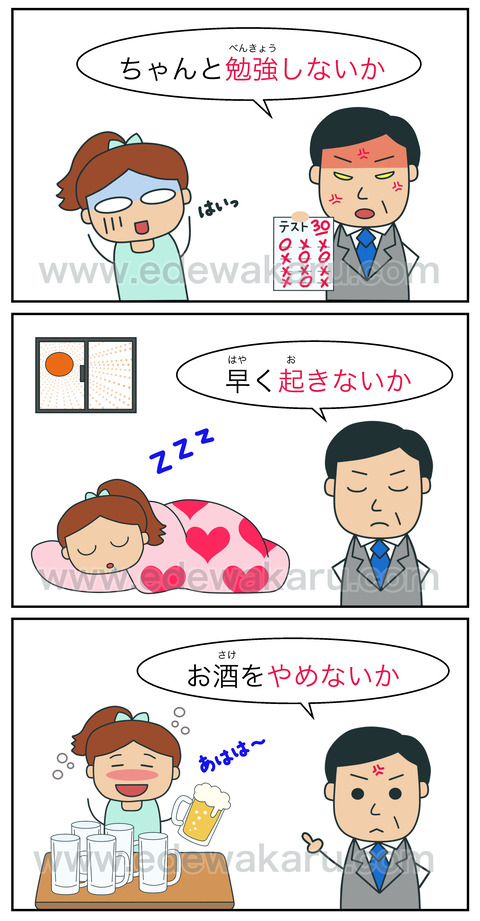
「〜ないか」は「〜しろ」というように、命令を表す文型です。相手がすぐに行動しなかったり、ちゃんとしなかったりする場合に
「早く〜しろ」「ちゃんと〜しろ」という気持ちを込めて使われます
😊
(復習:〜を込めて・〜を込めた)
[例]
食べ
ないか
=食べろ
書か
ないか
=書け
し
ないか
=しろ
来
ないか
=来い
普通の命令形に比べて、少し怒っている気持ちなどを表したい時によく使用されます。
(復習:〜に比べて)
(復習:〜など・〜なんか・〜なんて)
命令の「〜ないか」は文の最後を下げて言うようにしましょう😀上に上げて言うと、勧誘の意味になります。
[例]
お酒をやめないか(
↓)
【命令】
お酒をやめないか(↑)
【勧誘】
この文型は男性が使うものですから、
女性は使わないように気をつけましょう
😉
In context 3 examples
ちゃんと勉強しないか
→ちゃんと勉強しろ早く起きないか
→早く起きろお酒をやめないか
→お酒をやめろ
日本語文型辞典
Meaning
基本情報説明「…ないか」は主として男性が使う。丁寧な言い方の「…ませんか」や「か」を省略した「…ない?」は男女ともに使う。
意志的な行為を表す動詞に付いて、相手に行動を勧めたり、いっしょに行動しようと誘う表現。丁寧形は「V-ませんか」となる。普通、上昇調で発音され、「か」は省略されることもある。
「V-てくれないか/もらえないか」などの形で、相手に対する依頼を表す。「V-てくださいませんか/いただけませんか/いただけませんでしょうか」や、④⑤のように「お/ご…くださいませんか」「お/ご…いただけないでしょうか」などの形にするとさらに丁寧な表現になる。「もらう/いただく」の場合は「V-てもらえないか/いただけないか」のように、可能を表す「もらえる」「いただける」の否定形を使うという点に注意すること。また敬語の「おいでになる」や漢語動詞「来店する」などに「いただく/くださる」が付く場合は「になって」や「して」を省略して「おいでいただけませんか/くださいませんか」「ご来店いただけませんか/くださいませんか」のような形になるのが普通である。上昇調で発音されることが多く、「か」が省略されることもある。丁寧な言い方では、次のように「…願えないか」という表現に言いかえることもできる。
行動を起こさない相手に対して、すぐに行動を起こすように命令する表現。例えば①は「待て」、②は「だまれ」の意味。これらは「待て」「だまれ」という命令形の表現に似ているが、相手がなかなか行動を起こさない状況で用いられるため、話し手のいらだちや怒りが感じられることが多い.下降の詰問調で発音され、丁寧形にはならない。男性が用いる。
話し手の考えが正しいかどうかを聞き手に確認する場合に用いる。「Xじゃないか」などと打ち消しの形を取っているが、確認の内容は「Xである」という肯定のことがらである。聞き手も同意見の場合は「はい/うん、そうだ」、違う意見の場合は、「いいえ/いや、そうではない」のような形で答える。なお、すでに起こったと思われることについて確認する場合は、次のように、タ形をとる。
自分の意見を控えめに主張する場合の表現で、「そうではないかと思う」といった気持ちで、やや疑う余地を残し非断定的に述べるのに用いる。⑤のように、心配・懸念の気持ちを含むことも多い。「(の)ではないか」「(の)ではないだろうか/(の)ではなかろうか/(の)ではあるまいか」や「ないかしら/ないかな」のような推量や疑念を含む表現で言いかえられることが多い。過去のことについて言う場合は次のように「(では)なかったか」の形をとる。
話しことばでは、名詞やナ形容詞につく場合、「じゃないか」になるのが普通。
⇾じゃないか1
⇾じゃないか2
⇾ではないか1
⇾ではないか2
How to use it
V-ない(か)【勧誘】
V-てくれない(か)【依頼】
V-ないか【命令】
…ない(か)【確認】
N/Na ではないか
A-くないか
V-ないか
…ない(か)【控えめな主張】
N/Na ではないか
A-くないか
V-ないか
…じゃないか
…ではないか
In context 28 examples
ちょっと、食べてみない?
今度、いっしょにスキーに行かないか。
そろそろお茶にしませんか。
ちょっと寄っていきません?
お塩、とってくれない?
ちょっと手伝ってくれませんか。
この本、2、3日貸してもらえない?
5時までにおいでくださいませんか。
明日もう一度ご来店いただけないでしょうか。
(例) もう一度ご来店願えないでしょうか。
おい待たないか。
だまらないか。
いい加減でやめないか。
早く起きないか。
さっさと出かけないか。
A:彼が犯人じゃないですか。
B:そうかな。A:子供には無理じゃないですか。
B:大丈夫ですよ。A:君にはちょっと難しくない?
B:ええ、でもやってみます。A:この部屋、変な匂いがしない?
B:うん、なんだかちょっと。A:ちょっと駅から遠すぎませんか。
B:そうですか。歩いて15分ぐらいですけど。彼の様子、ちょっと変だと思いませんか。
(例) A:何か物音がしなかったか。
B:いや、僕には何も聞こえなかったけど。
A:私に電話かかって来ませんでしたか。
B:いいえ。彼が、東大に合格したなんて、何かの間違いではないか。
最近の彼の言動はちょっと変じゃないか。
このスープ、ちょっと、塩味が薄くない?
やめといたほうがよくないか。
そんなに働いたら病気にならないか。
(例) 昨日見かけた人、山田さんの奥さんじゃなかったか。
日本語文型辞典 英語版
Meaning
【ないか】...ないか is used mainly by male speakers. However, ...ない?, which is an abbreviated form of polite expressions such as ...ませんか and か, is used by both male and female speakers.
When combined with verbs expressing a volitional action, the pattern V-ない(か) is used to suggest that an interlocutor take some action or to invite him/her to do something together. The polite form of V-ない(か) is V-ませんか. V-ない(か) forms are usually pronounced with rising intonation, and か can be omitted.
This pattern, used in the forms V-てくれないか and V-てもらえないか, expresses a request from a speaker to an interlocutor. It is more polite when used in forms such as V-てくださいませんか/いただけませんか/いただけませんでしょうか or お/ご...くださいませんか, as in
(4)
, and お/ご...いただけないでしょうか, as in
(5)
.
Note that when this pattern is used with もらう and いただく, the potential forms もらえる and いただける should be negated to create the forms V-てもらえないか/いただけないか. Also, when いただく and くださる are attached to honorific expressions such as おいでになる (to come/to be here) or Sino-Japanese verbs such as 来店する (to come to a shop), になって and して are usually omitted and the forms おいでいただけませんか/くださいませんか and ご来店いただけませんか/くださいませんか are used.
V-てくれないか forms are often pronounced with a rising intonation, and か can be omitted. In polite language, these forms can also be replaced by ...願えないか (lit. “can’t/couldn’t I ask...?”), as shown below.
(例)もう一度ご来店願えないでしょうか。
Could we ask you to come to our shop again?
Used to order an interlocutor to take action immediately when s/he does not seem to be doing so. For instance,
(1)
means “Wait!” and
(2)
“Shut up.”
These expressions are similar to imperatives. However, because they are used in situations where an interlocutor is reluctant to take immediate action, they often convey the sense that the speaker is irritated or upset. V-ないか is pronounced with falling intonation in a demanding tone and does not have a polite form. It is used by male speakers.
B:そうかな。
We’ll see.
B:大丈夫ですよ。
It should be all right.
B:ええ、でもやってみます。
Yes, but I’ll try.
B:うん、なんだかちょっと。
Yeah, a bit....
B:そうですか。歩いて 15 分ぐらいですけど。
Do you think so? But it’s only about a fifteen-minute walk.
Used to ask the listener to confirm whether or not what the speaker is thinking is correct. Even though this pattern takes negative forms such as Xじゃないか (isn’t it X?), what the speaker wants to confirm is a positive state of affairs, Xである (it is X). When the listener agrees with what the speaker says, s/he responds with はい/うん、そうだ, and when the listener disagrees, s/he uses いいえ/いや、そうではない. When the speaker wants to confirm an event that has apparently already taken place, s/he uses the ta-form, as below.
(例)A:何か物音がしなかったか。
Didn’t you hear a noise?
B:いや、僕には何も聞こえなかったけど。
No, I didn’t hear anything.
(例)A:私に電話かかって来ませんでしたか。
Wasn’t there a phone call for me?
B:いいえ。
No, there wasn’t.
Used to make a mild assertion of personal opinion. Conveys the speaker’s feeling that “I think this might be so” and is used to make an inconclusive statement that leaves room for a little doubt. As shown in
(5)
, the use of ...ないか often implies the speaker’s anxiety or concern.
...ないか is often replaced by expressions implying conjecture or doubt, such as (の)ではないか, (の)ではないだろうか/(の)ではなかろうか/(の)ではあるまいか or ないかしら/ないかな. When talking about a past event, (では)なかったか is used, as illustrated below.
(例)昨日見かけた人、山田さんの奥さんじゃなかったか。
Wasn’t the person we saw yesterday Yamada-san’s wife?
In spoken Japanese, when ...ではないか attaches to a noun or a na-adjective it is usually replaced by じゃないか.
【じゃないか1】、
【ではないか1】、
How to use it
1. V-ない(か)〈invitation〉
2. V-てくれない(か)〈request〉
3. V-ないか〈imperative〉
4. ...ない(か)〈confirmation〉[N/Na ではないか][A-くないか][V-ないか]
5. ...ない(か)〈mild assertion〉[N/Na ではないか][A-くないか][V-ないか]
6. ...じゃないか→
7. ...ではないか→
In context 25 examples
ちょっと、食べてみない?
Want to try some of this?
今度、いっしょにスキーに行かないか。
Why don’t we go skiing sometime?
そろそろお茶にしませんか。
How about taking a break for tea pretty soon?
ちょっと寄っていきません?
Would you like to drop by there?
お塩、とってくれない?
Can you pass me the salt?
ちょっと手伝ってくれませんか。
Would you help me for a moment?
この本、2、3日貸してもらえない?
Can I borrow this book for a few days?
5時までにおいでくださいませんか。
Would it be possible for you to be here by five o’clock?
明日もう一度ご来店いただけないでしょうか。
Could you come to our shop again tomorrow?
おい、待たないか。
Hey, can’t you wait?
だまらないか。
Can’t you shut up?
いい加減でやめないか。
It’s about time you stopped.
早く起きないか。
Why don’t you get up now?
さっさと出かけないか。
Why don’t you hurry up and get going?
A:彼が犯人じゃないですか。
Isn’t he guilty?
A:子供には無理じゃないですか。
Isn’t this impossible for a child?
A:君にはちょっと難しくない?
Isn’t this a bit difficult for you?
A:この部屋、変な匂いがしない?
Doesn’t this room smell strange?
A:ちょっと駅から遠すぎませんか。
Isn’t it a little too far from the station?
彼の様子、ちょっと変だと思いませんか。
Don’t you think something about him looks a bit strange?
彼が、東大に合格したなんて何かの間違いではないか。
Wasn’t it some kind of mistake that he passed the entrance exam for Tokyo University?
最近の彼の言動はちょっと変じゃないか。
Don’t you think that lately he’s been behaving a little strangely?
このスープ、ちょっと、塩味が薄くない?
Doesn’t this soup need a little more salt?
やめといたほうがよくないか。
Wouldn’t it be better if you just let it drop?
そんなに働いたら病気にならないか。
Don’t you think that working so hard will make you sick?
AIUEO JLPT Grammar
Meaning
This sentence pattern is used to confirm or inquire whether a certain action or condition will occur. It is used when presenting options or possibilities.
How to use it
動詞辞書形か+動詞ない形か
Explanation · 日本語
この文型は、ある動作や状態が発生するかどうかの確認や、疑問を示すときに使われる表現です。選択肢や可能性を示すときに使用されます。
In context 5 examples
薬が効くか効かないかは人によります。
Whether the medicine works or not depends on the person.
彼が合格するかしないか、試験の結果次第です。
Whether he passes or not depends on the exam results.
言ったか言わなかったか、という問題ではない。
It's not a question of whether or not you said it.
やるかやらないかはあなた次第です。
It's up to you whether you do it or not.
彼が来るか来ないかは、パーティーの雰囲気に影響します。
Whether he comes or not will affect the atmosphere of the party.