AIUEO JLPT Grammar
Meaning
This sentence pattern emphasizes the point at which something ends or stops. It is used to express decisions to quit something or indicate a clear deadline or endpoint.
How to use it
名詞を+限りに
Explanation · 日本語
この文型は、何かをやめたり、終えたりする時点を強調する表現で、何かを決心してやめる、または何かが終わる期限を明示するときに使われます。
In context 5 examples
今日を限りに、タバコをやめることにした。
As of today, I’ve decided to quit smoking.
この試合を限りに、彼は引退する。
He will retire after this match.
今月を限りに、このサービスは終了します。
This service will end at the end of this month.
この機会を限りに、過去を振り返るのはやめよう。
Let’s stop reflecting on the past after this opportunity.
今日を限りに、甘い物を控えようと思う。
Starting today, I will cut back on sweets.
文法
Meaning
〜を最後として、(今まで続いていたこと、続けていたことをやめる)
How to use it
Nを + 限りに
In context 7 examples
今日を限りに、御社との契約は解消することにしました。
今学期を限りに、私はこの学校を辞めます。
今月を限りに、この店は閉店するそうだ。
今回のツアーを限りに、私たちグループは解散します。
次の試合を限りに、私は引退を決意しました。
今日を限りに、お酒とタバコはやめることにしました。
今日を限りに、前の彼女のことはきれいさっぱり忘れよう
Bunpro Grammar Reference
Meaning
As of (the end of), (Starting) from, (No longer) after, By (the), Ending with
How to use it
Noun + を限りに
Noun + 限りで
Nuance
A construction highlighting the end of (A), after which a significant change often happens. To the limit of (A). As of (A).
Explanation
を限りに is a structure that follows nouns in order to express a time for which something that was continuing will finish by. Common interpretations include ‘ending with (A), (B)’, and ‘no longer than (A), (B)’. This grammar pattern makes use of the adverbial particle を, the noun 限り ‘limit’, and the case-marking particle に.
こちらの事情により、明日を限りに店を閉店させていただくことになりました。長年ご利用いただき誠にありがとうございました。
Due to personal reasons, we have decided to close the store as of tomorrow. Thank you very much for your patronage over the years.
今月を限りに、海外に引っ越すことになりました。今までいろいろとお世話になりました。
As of this month, I will be moving abroad. Thank you so much for everything.
来月行われるコンサートを限りにSUM(エスユーエム)41(フォーティーワン)は解散することを決めたそうです。
SUM41 has decided to disband after the concert next month.
を限りに is primarily used for making proclamations or announcements, and is more formal than similar structures like 限りで.
Fun Fact
Although を限りに almost always follows words indicating a specific time or place that is being viewed temporally, there is also the set expression 声を限りに, ‘to the limit of one’s voice’ that breaks this usual rule.
昨日の夜は息子が声を限りに泣いていたから大変だったよ。
It was tough last night because my son was crying to the limit of his voice (crying as loud as he could).
Nuance · 日本語
頻繁に起きる大きな変化が起こった後に(A)が終わったということを強調するために使われる表現。(A)の終わりまで。(A)からは。
Explanation · 日本語
「を限りに」は、名詞の後に付いて、それまで続いていたことが終わる時点を表す表現です。「(A) を最後に (B) を終える」や「(A) までで (B) を終了する」といった意味で使われます。これは副助詞「を」、名詞「限り」、格助詞「に」の組み合わせです。
こちらの事情により、明日を限りに店を閉店させていただくことになりました。長年ご利用いただき誠にありがとうございました。
Due to personal reasons, we have decided to close the store as of tomorrow. Thank you very much for your patronage over the years.
今月を限りに、海外に引っ越すことになりました。今までいろいろとお世話になりました。
As of this month, I will be moving abroad. Thank you so much for everything.
来月行われるコンサートを限りにSUM(エスユーエム)41(フォーティーワン)は解散することを決めたそうです。
SUM41 has decided to disband after the concert next month.
「を限りに」は、主に宣言や告知など、公的な場面で使われます。類似の表現である「限りで」と比べると、より改まった印象があります。
豆知識
「を限りに」は、通常、特定の時間や場所を指す言葉に続き、その時点をもって何かが終わることを示します。ただし、「声を限りに」という例外的な表現もあり、これは時間ではなく、物理的な能力や範囲の限界を意味します。
昨日の夜は息子が声を限りに泣いていたから大変だったよ。
It was tough last night because my son was crying to the limit of his voice (crying as loud as he could).
In context 8 examples
- 来月行われるコンサートを限りにSUM(エスユーエム)41(フォーティーワン)は解散することを決めたそうです。
SUM41 has decided to disband after the concert next month.
- 今月を限りに、海外に引っ越すことになりました。今までいろいろとお世話になりました。
As of this month, I will be moving abroad. Thank you so much for everything.
- こちらの事情により、明日を限りに店を閉店させていただくことになりました。長年ご利用いただき誠にありがとうございました。
Due to personal reasons, we have decided to close the store as of tomorrow. Thank you very much for your patronage over the years.
- 明日を限りに閉店致します。当店は1972年に開業し、49年にわたり現在の場所で営業してまいりました。
We will close as of tomorrow. This store opened in 1972 and has been operating at our current location for 49 years.
- 異動、公務員:「今週限りで、現在の職務から離れることになりました。」
Changes in personnel, civil servant: 'I will be leaving my current position as of this week.'
- 同僚との話:「今月限りで田中さんは退職するつもりって聞いたけど、本当か?」
Conversation between coworkers: 'I heard that Tanaka is planning to resign as of this month, but is that true?'
- 今回を限りに武田先生は人前では演奏しません。
Takeda-sensei will not perform in public as of now.
- 昨日の夜は息子が声を限りに泣いていたから大変だったよ。
It was tough last night because my son was crying to the limit of his voice (crying as loud as he could).
どんなときどう使う 日本語表現文型辞典
Meaning
the last time
How to use it
N+を限りに
Explanation
~を最後として
今まで続いていたことが今後はもう続かなくなるということを言うときに、その最後の期限を表す。
Final time period when something that has continued until now will no longer happen.
In context 3 examples
今日を限りに禁煙することにしました。
今回の取引を限りに、今後A社とはいっさい取引しない。
今年度を限りに土曜日の業務は行わないことになりました。
絵でわかる日本語
Meaning
その時を最後にして〜
〜を最後に〜をやめる
How to use it
名詞[辞書形]+を限りに
Explanation
「〜を限りに」は「〜を最後にして〜」「〜を最後に〜をやめる」という意味を表す文型です。この文型は
「今日」「今回」「今月」
など、時を表す名詞に使って、「その時を最後にして〜」「その時を最後にして〜をやめる」と言いたい時に使います😊
(復習:〜など・〜なんか・〜なんて)
【N1を受ける人へ】
「〜を限りに」には「〜の限度まで〜する」という意味もあります😮「声を限りに〜」はこの文型からつくられましたが、慣用表現ですので、特別に覚えておいてください😉
「声を限りに(こえをかぎりに)」
[意味]
出せる最大限の大声で・できるだけ大きな声で
[例文]
声を限りに
叫んだ
「限る」シリーズもたくさんありますので、区別をして覚えておいてくださいね😀
【「限る」シリーズ】
〜限り(限界)
〜限り
〜限りだ
〜限りで・N限りのN(限定)
〜限りでは(範囲)
限りなく〜に近い
〜とは限らない
〜ない限り
〜に限ったことではない
〜に限らず(〜も)
〜に限る
〜を限りに
In context 4 examples
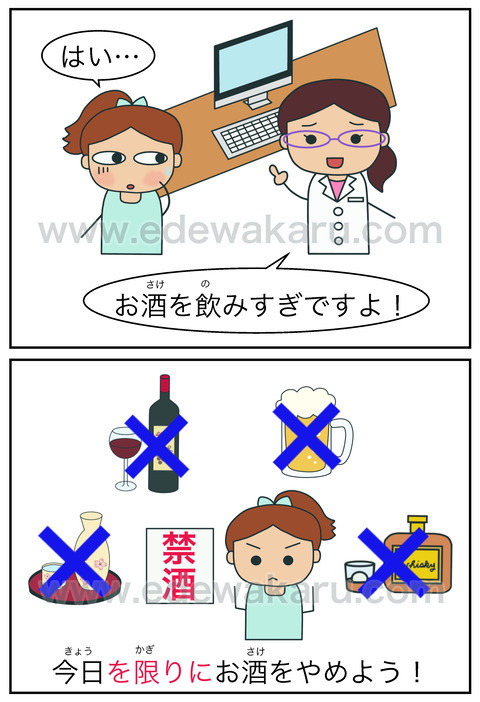
今日を限りにお酒はやめよう!
→今日を最後にお酒をやめよう!あのデパートは今回のセールを限りに閉店するんだって
→あのデパートは今回のセールを最後に閉店するんだって(復習:口語形「〜って(伝聞)」)健康のために、今日を限りにタバコは吸わないぞ
→健康のために、今日を最後にタバコを吸わないぞ今回を限りに二度と遅刻をしません
→今回を最後に、二度と遅刻をしません
くらべてわかる日本語表現文型辞典
Meaning
意味1:Aの時点でBをする。Aという出来事でおしまいになる。
意味2:Aの限度まで目一杯にB。
How to use it
Aを限りにB(Aの限り(に・を)B/Aのを限りにB)
接続1:
[動詞-た形]+の+を限りに
[名詞-∅]を限りに
接続2:
[名詞-∅]を限りに
Explanation
【対比1】
「Aを最後にB」(意味1 P.338)
「Aを限りにB」はAという終わりの時点に焦点を当てて述べている。
「Aを最後にB」は続くべきものが続かなくなるというニュアンス。
○彼とは梅田で別れたのを最後に、連絡が途絶えた。
×彼とは梅田で別れたのを限りに、連絡が途絶えた。
Notes
【注意2】
・「Aを限りにB」は慣用的表現であり、「Aの限り(を)B」の形でよく使われる。
In context 8 examples
今日を限りに店をやめさせていただきます。
今回を限りに、当審議会は解散いたします。
ギャンブルはあの時を限りにやめたんだ。
資金援助を断ったのを限りに、我々の交流事業は終わった。
応援団は声を限りに叫び続けている。
力の限り、戦ったのだから悔いはない。
我々は言葉の限りを尽くして、彼を説得した。
彼は我が子に愛情の限りを注いだ。
日本語NET JLPT文法解説まとめ
Meaning
〜を最後として、(今まで続いていたこと、続けていたことをやめる)
How to use it
Nを + 限りに
In context 7 examples
今日を限りに、御社との契約は解消することにしました。
今学期を限りに、私はこの学校を辞めます。
今月を限りに、この店は閉店するそうだ。
今回のツアーを限りに、私たちグループは解散します。
次の試合を限りに、私は引退を決意しました。
今日を限りに、お酒とタバコはやめることにしました。
今日を限りに、前の彼女のことはきれいさっぱり忘れよう。
毎日のんびり日本語教師
How to use it
名詞+を限りに
名詞+限りで
Explanation
時間を表す名詞に接続して、期限を表します。
特に「~を限りに」は今回、今日、今月、今年、本日などの時間名詞につきます。
その期限を過ぎたら何かを止めるような決意を表したりや、何かが終わって残念がるような場合に使います。
Notes
「限る」シリーズ
In context 16 examples
ダイエットのため、今日を限りに甘いものは食べません。
この試合を限りに引退します。
二人はその日を限りに、二度と会わなかった。
着られなくなった服を今日を限りに捨てることにした。(决定把不能穿的衣服今天扔掉。)
太ってきたので今日を限りに暴飲暴食止めます。
今日を限りにお菓子を食べるの控えます。
この要綱は、令和5年3月31日を限りにその効力を失う。
利用者が減ったことで最後まで残った鉄道も今年9月30日を限りに運行を取り止めた。
今の仕事は今月末限りで辞める予定だ。(现在的工作预计本月末之前辞职。)
当店は今月31日限りで閉店致します。
仕事の人間関係でついに限界が来て、本日限りで退職をしました。
4年に一度の1日限り、たった10秒の試合のために練習をしてきた選手たちに尊敬の念を覚えます。
2000年3月10日、東海道・山陽新幹線の食堂車がこの日限りで廃止された。
もし「もうこの辺でいい」という気持ちが生まれたら、俺はその日限りでサッカーをやめる。
せっかく出会えた人達のことを大切にしたい。その日限りで終わりにはしたくない。
から揚げ弁当が8日、9日限りで50円引きです。
IMABI
Limit
Read this IMABI lesson ↗Explanation
Limit: ~限り, ~を限りに, ~限りでは, ~に限って, ~に限らない, & ~とは限らない
限り is a rather complicated noun. Although it means “limit” and understanding it is no problem for most students, similar looking structures with it cause problems.
限り
~かぎり shows up in a lot of expressions, but what comes before it must be taken into account. Although particles may be a pain to get used to, you should still love them.
1. ~かぎり: This shows a parameter of a certain condition. Before ~かぎり, you may see nouns, adjectives, and verbs.
1. 保証ほしょうの限りではない。
It is not in the warranty.
2. 目の届とどく限り、晴れ渡わたっている。
The sky is clear as far as the eye can see.
3. 可能な限り、薬を飲まないようにしています。
I’m trying as best I can to not take the medicine.
4. できる限りのことをするのも無理なのだ。
Doing as much as possible is also no good.
5. 法律ほうりつの及およぶ限り厳密げんみつに処しょすべきだ。
It should be strictly dealt with to the full extent of the law.
6. 今年も能力の限り、お役に立てるよう働くことを誓ちかいます。
I vow to work to be of benefit [to X] to the best of my ability this year as well.
7. 外は豪雪ごうせつでも、部屋のなかにいるかぎりは真夏日まなつびのようだ。
Even if there is heavy snowfall outside, for as long as you’re inside the room, it’s like a hot summer day.
読み物: A Passage from 心 by 夏目漱石
8. 次の日私は先生の後あとにつづいて海へ飛び込こんだ。そうして先生といっしょの方角ほうがくに泳いで行った。二丁ちょうほど沖おきへ出ると、先生は後ろを振ふり返って私に話し掛かけた。広い蒼あおい海の表面に浮ういているものは、その近所に私ら二人より外ほかになかった。そうして強い太陽の光が、眼めの届く限り水と山とを照らしていた。私は自由と歓喜かんきに充みちた筋肉を動かして海の中で躍おどり狂くるった。先生はまたぱたりと手足の運動を已やめて仰向あおむけになったまま浪なみの上に寝た。私もその真似まねをした。青空の色がぎらぎらと眼を射いるように痛烈つうれつな色を私の顔に投なげ付つけた。「愉快ゆかいですね」と私は大きな声を出した。
漢字 Notes:
1. 蒼い is a very literary spelling for blue. And, you may also encounter 碧い in similar contexts. 蒼い is a rather dull “blue”, and it is often used in contexts where one “is blue in the face”. 碧い is used when “blue” may have anywhere from a light to dark green hue to it.
2. ~掛ける is usually spelled as ~かける in everyday writing.
3. Rather than using 満ちる, 充ちる has the added nuance of inundation. 満ちる is over all the most important spelling due to the fact that 充 does not have the reading み(ちる) listed in the 常用漢字表.
4. 躍る differs from 踊る in the sense that the latter is “dance” in a rhythmic sense whereas the former is just jumping up and down.
5. 已む specifically describes a phenomenon, action, or condition that has continued for some time stopping completely. It is generally replaced with 止む except in literal situations like this when the writer wishes to make this nuance clear.
6. 浪 specifically refers to ripples in water or water rising up.
The next day, I followed Sensei into the ocean. I then swam in the same direction as him. After going over a hundred meters offshore, Sensei turned around to talk to me. It was only us floating atop the surface of the wide, blue sea. The strong sunlight made the water and mountains glow for as far as one could see. I madly danced around in the waves with my muscles full of joy and freedom. Sensei, again, suddenly froze his arms and legs and lay flat on his back asleep on the waves, and so I mimicked him. The blue sky cast a scathing light into my eyes as if to pierce them out. “How pleasant!”, I yelled out.
Questions:
1. Find an example where a Japanese item is naturalized for the English translation.
2. Why might liberties in translation be needed with this passage?
~ない限り, which is an application of above, can be translated as “until” in contexts like below.
9. 君が考えを改あらためないかぎり、うまくいかない。
Until you rethink yourself, things won’t go well.
10. あいつは、あまりにも疲れていないかぎり、夜遅くまでIMABIを編集へんしゅうするそうだ。
That guy seems to edit IMABI up into the night unless he’s too tired.
11. 汚水おすいを飲まないかぎり大丈夫ですよ。
So long as you don’t drink filthy water, you should be fine.
After adjectives at the end of a sentence, ~かぎりだ shows the speaker’s emotions with what is being said not being simply about the nature of things, but the matter at hand doesn’t extend beyond a certain limit.
12. 誰からも連絡がなく、寂さびしいかぎりだ。
It’s just very lonely that I don’t get contact from anyone.
Another thing that this form can do that the two below cannot is be followed with a volitional expression.
13. 生きている限り歌おう。
I’ll sing until I die.
As a suffix after temporal phrases in the form of ~かぎりで, it express deadline.
14. 来月末限りで辞任するつもりだ。
I plan to resign at the end of next month.
2. ~を限りに, when used with time phrases, explicitly states when will be the last time that one does something. With non-temporal phrases, it shows some sort of physical limitation.
15. 彼は声の限りに叫さけんだ。
He screamed to the top of list lungs.
16. 今日を限りに酒は飲みません。
I will not drink alcohol from this day forward!
17. これを限りにお前とは縁えんを切る。
From here on I break my ties with you.
18. 今年の年末を限りに期限が切れる。
The term/period/deadline will expire at the end of this year.
3. ~限りでは: Verbs of cognition such as 知る, 見る, 聞く, 読む, etc. come before, and the following clause deals with a judgment. In totality, this construction means “as far as…”.
19. 知られる限りでは依然行方不明いぜんゆくえふめい。 (Headline)
[X] is/are still missing as far as is known.
20. 私の知っている限りでは、彼はそんなことをする人ではありません。
As far as I know, he is not the kind of person to do something like that.
4. ~に限って: This raises a time, person, or thing to mean “insofar/unless”. This is used a lot with とき.
21. あたしが出かけるときにかぎって、雨が降るのよ。(女性語)
It doesn’t rain unless I go out [somewhere].
22. 我わが社しゃの社員に限って、そのような不正はするはずがない。
Insofar as our company’s workers, we have no reason to do such illegality.
23. 読みたいときに限って、アクセスできない。
I can’t access it insofar as to when I want to read it.
As one would expect, this phrase has a negative form, ~に限らない. This means that something is not yet decided. Of course, in formal/written situations, you can see it as ~に限らず.
24. 怠なまけたがるのは、子供に限ったことじゃない。
Wanting to slack off is not limited to just kids.
25. 対象はアメリカ人に限りません。
Our target is not limited to Americans.
26. 韓国語を勉強している学生は、東アジア専攻に限りません。
Students who study Korean are not limited to East Asian majors.
5. ~とは限らない may resemble ~に限らない, and the best of students mix them up. However, because of the particle と, no part of speech limitations exists. ~とは限らない means “not necessarily”. This phrase is frequently used to speak against stereotypes.
27. 日本人がみんな勉強ばかりしているとは限らない。
It’s not necessarily the case that all Japanese people do nothing but study.
28. アメリカ人は、必ずしも日本人より背が高いとは限らない。
Americans are not necessarily taller than Japanese people.
29. テキサスの人がみんな必ずバーベキューばかり食べるとは限らない。
All Texans don’t necessarily eat just barbecue.
30. 念ねんを入れたからっていい仕上しあがりになるとは限らない。
Because we paid attention to detail, it’s (now) a good finish.
In context 41 examples
~かぎり: This shows a parameter of a certain condition. Before ~かぎり, you may see nouns, adjectives, and verbs.
It is not in the warranty.
保証ほしょうの限りではない。
It is not in the warranty.
目の届とどく限り、晴れ渡わたっている。
The sky is clear as far as the eye can see.
可能な限り、薬を飲まないようにしています。
I’m trying as best I can to not take the medicine.
できる限りのことをするのも無理なのだ。
Doing as much as possible is also no good.
法律ほうりつの及およぶ限り厳密げんみつに処しょすべきだ。
It should be strictly dealt with to the full extent of the law.
今年も能力の限り、お役に立てるよう働くことを誓ちかいます。
I vow to work to be of benefit [to X] to the best of my ability this year as well.
外は豪雪ごうせつでも、部屋のなかにいるかぎりは真夏日まなつびのようだ。
Even if there is heavy snowfall outside, for as long as you’re inside the room, it’s like a hot summer day.
次の日私は先生の後あとにつづいて海へ飛び込こんだ。そうして先生といっしょの方角ほうがくに泳いで行った。二丁ちょうほど沖おきへ出ると、先生は後ろを振ふり返って私に話し掛かけた。広い蒼あおい海の表面に浮ういているものは、その近所に私ら二人より外ほかになかった。そうして強い太陽の光が、眼めの届く限り水と山とを照らしていた。私は自由と歓喜かんきに充みちた筋肉を動かして海の中で躍おどり狂くるった。先生はまたぱたりと手足の運動を已やめて仰向あおむけになったまま浪なみの上に寝た。私もその真似まねをした。青空の色がぎらぎらと眼を射いるように痛烈つうれつな色を私の顔に投なげ付つけた。「愉快ゆかいですね」と私は大きな声を出した。
蒼い is a very literary spelling for blue. And, you may also encounter 碧い in similar contexts. 蒼い is a rather dull “blue”, and it is often used in contexts where one “is blue in the face”. 碧い is used when “blue” may have anywhere from a light to dark green hue to it.
The next day, I followed Sensei into the ocean. I then swam in the same direction as him. After going over a hundred meters offshore, Sensei turned around to talk to me. It was only us floating atop the surface of the wide, blue sea. The strong sunlight made the water and mountains glow for as far as one could see. I madly danced around in the waves with my muscles full of joy and freedom. Sensei, again, suddenly froze his arms and legs and lay flat on his back asleep on the waves, and so I mimicked him. The blue sky cast a scathing light into my eyes as if to pierce them out. “How pleasant!”, I yelled out.
~掛ける is usually spelled as ~かける in everyday writing.
The next day, I followed Sensei into the ocean. I then swam in the same direction as him. After going over a hundred meters offshore, Sensei turned around to talk to me. It was only us floating atop the surface of the wide, blue sea. The strong sunlight made the water and mountains glow for as far as one could see. I madly danced around in the waves with my muscles full of joy and freedom. Sensei, again, suddenly froze his arms and legs and lay flat on his back asleep on the waves, and so I mimicked him. The blue sky cast a scathing light into my eyes as if to pierce them out. “How pleasant!”, I yelled out.
Rather than using 満ちる, 充ちる has the added nuance of inundation. 満ちる is over all the most important spelling due to the fact that 充 does not have the reading み(ちる) listed in the 常用漢字表.
The next day, I followed Sensei into the ocean. I then swam in the same direction as him. After going over a hundred meters offshore, Sensei turned around to talk to me. It was only us floating atop the surface of the wide, blue sea. The strong sunlight made the water and mountains glow for as far as one could see. I madly danced around in the waves with my muscles full of joy and freedom. Sensei, again, suddenly froze his arms and legs and lay flat on his back asleep on the waves, and so I mimicked him. The blue sky cast a scathing light into my eyes as if to pierce them out. “How pleasant!”, I yelled out.
躍る differs from 踊る in the sense that the latter is “dance” in a rhythmic sense whereas the former is just jumping up and down.
The next day, I followed Sensei into the ocean. I then swam in the same direction as him. After going over a hundred meters offshore, Sensei turned around to talk to me. It was only us floating atop the surface of the wide, blue sea. The strong sunlight made the water and mountains glow for as far as one could see. I madly danced around in the waves with my muscles full of joy and freedom. Sensei, again, suddenly froze his arms and legs and lay flat on his back asleep on the waves, and so I mimicked him. The blue sky cast a scathing light into my eyes as if to pierce them out. “How pleasant!”, I yelled out.
已む specifically describes a phenomenon, action, or condition that has continued for some time stopping completely. It is generally replaced with 止む except in literal situations like this when the writer wishes to make this nuance clear.
The next day, I followed Sensei into the ocean. I then swam in the same direction as him. After going over a hundred meters offshore, Sensei turned around to talk to me. It was only us floating atop the surface of the wide, blue sea. The strong sunlight made the water and mountains glow for as far as one could see. I madly danced around in the waves with my muscles full of joy and freedom. Sensei, again, suddenly froze his arms and legs and lay flat on his back asleep on the waves, and so I mimicked him. The blue sky cast a scathing light into my eyes as if to pierce them out. “How pleasant!”, I yelled out.
浪 specifically refers to ripples in water or water rising up.
The next day, I followed Sensei into the ocean. I then swam in the same direction as him. After going over a hundred meters offshore, Sensei turned around to talk to me. It was only us floating atop the surface of the wide, blue sea. The strong sunlight made the water and mountains glow for as far as one could see. I madly danced around in the waves with my muscles full of joy and freedom. Sensei, again, suddenly froze his arms and legs and lay flat on his back asleep on the waves, and so I mimicked him. The blue sky cast a scathing light into my eyes as if to pierce them out. “How pleasant!”, I yelled out.
君が考えを改あらためないかぎり、うまくいかない。
Until you rethink yourself, things won’t go well.
あいつは、あまりにも疲れていないかぎり、夜遅くまでIMABIを編集へんしゅうするそうだ。
That guy seems to edit IMABI up into the night unless he’s too tired.
汚水おすいを飲まないかぎり大丈夫ですよ。
So long as you don’t drink filthy water, you should be fine.
誰からも連絡がなく、寂さびしいかぎりだ。
It’s just very lonely that I don’t get contact from anyone.
生きている限り歌おう。
I’ll sing until I die.
来月末限りで辞任するつもりだ。
I plan to resign at the end of next month.
~を限りに, when used with time phrases, explicitly states when will be the last time that one does something. With non-temporal phrases, it shows some sort of physical limitation.
He screamed to the top of list lungs.
彼は声の限りに叫さけんだ。
He screamed to the top of list lungs.
今日を限りに酒は飲みません。
I will not drink alcohol from this day forward!
これを限りにお前とは縁えんを切る。
From here on I break my ties with you.
今年の年末を限りに期限が切れる。
The term/period/deadline will expire at the end of this year.
~限りでは: Verbs of cognition such as 知る, 見る, 聞く, 読む, etc. come before, and the following clause deals with a judgment. In totality, this construction means “as far as…”.
[X] is/are still missing as far as is known.
知られる限りでは依然行方不明いぜんゆくえふめい。 (Headline)
[X] is/are still missing as far as is known.
私の知っている限りでは、彼はそんなことをする人ではありません。
As far as I know, he is not the kind of person to do something like that.
~に限って: This raises a time, person, or thing to mean “insofar/unless”. This is used a lot with とき.
It doesn’t rain unless I go out [somewhere].
あたしが出かけるときにかぎって、雨が降るのよ。(女性語)
It doesn’t rain unless I go out [somewhere].
我わが社しゃの社員に限って、そのような不正はするはずがない。
Insofar as our company’s workers, we have no reason to do such illegality.
読みたいときに限って、アクセスできない。
I can’t access it insofar as to when I want to read it.
怠なまけたがるのは、子供に限ったことじゃない。
Wanting to slack off is not limited to just kids.
対象はアメリカ人に限りません。
Our target is not limited to Americans.
韓国語を勉強している学生は、東アジア専攻に限りません。
Students who study Korean are not limited to East Asian majors.
~とは限らない may resemble ~に限らない, and the best of students mix them up. However, because of the particle と, no part of speech limitations exists. ~とは限らない means “not necessarily”. This phrase is frequently used to speak against stereotypes.
It’s not necessarily the case that all Japanese people do nothing but study.
日本人がみんな勉強ばかりしているとは限らない。
It’s not necessarily the case that all Japanese people do nothing but study.
アメリカ人は、必ずしも日本人より背が高いとは限らない。
Americans are not necessarily taller than Japanese people.
テキサスの人がみんな必ずバーベキューばかり食べるとは限らない。
All Texans don’t necessarily eat just barbecue.
念ねんを入れたからっていい仕上しあがりになるとは限らない。
Because we paid attention to detail, it’s (now) a good finish.