くらべてわかる日本語表現文型辞典
Meaning
意味1:Aの変化によって、他の変化が引き起こされる。Bという事態になったのは、Aという変化があったからだ。
意味2:命令、指示や規則・規定の通りにする。
How to use it
AにしたがってB(AにしたがいB)
接続1:
[動詞-る形]にしたがって
[名詞-∅]にしたがって
接続2:
[名詞-∅]にしたがって
Explanation
【対比1】
「AにともなってB」(意味1 P.252)
両方ともAの変化はプラス・マイナス、増減など対立するもの。ただし、「AにともなってB」のBは変化でなければならないが「AにしたがってB」のBは変化によって引き起こされた事態でもよい。
○この会社は受注量にしたがって、ボーナスが支払われる。
×この会社は受注量にともなって、ボーナスが支払われる。
「AとともにB」(意味1 P.181)
「AとともにB」の意味1のように、同時性の強いものには「AしたがってB」は使えない。
○二十歳になるとともに責任がのしかかってきた気がする。
×二十歳になるにしたがって責任がのしかかってきた気がする。
「AとともにB」(意味2 P.182)
「AとともにB」の意味2のように、並行的な変化の場合は「AにしたがってB」と置き換えが可能である。
「AにつれてB」(意味1 P.250)
Aの変化が一定方向の場合は、置き換えが可能だが二方向の場合は置き換えができない。
○売上高の増減にしたがって、その年のボーナスも変わってくる。
×売上高の増減につれて、その年のボーナスも変わってくる。
【対比2】
「AにそってB」(意味2 P.243)
In context 8 examples
年を取るにしたがって、頑固さが目立ってきた。
子どもの数が減るにしたがい、小学校の統廃合が増えてきた。
女性の社会進出が進むにしたがい、家庭の介護力が低下した。
子どもの成長にしたがって、家族で出かけることも少なくなった。
ルールにしたがってゲームをする。
お申し込みは画面の指示にしたがって操作してください。
彼は医者の忠告にしたがって酒をやめた。
万一の時は、従業員の誘導にしたがって避難してください。
日本語文型辞典
Meaning
人、規則、指示などを表す名詞を受けて、それに逆らわずに言うなりになって、指示通りに行動して、という意味を表す。
「その動作や作用が進むのにともなって」という意味を表す。後ろには「気圧が下がる」「険しくなる」など、前に述べた動作や作用の進行にともなって変化が生じることがらが続く。
How to use it
Nにしたがって
V-るにしたがって
In context 7 examples
引率者の指示にしたがって行動して下さい。
しきたりに従って式をとり行った。
上司の命令に従って不正を働いた。
矢印に従って進んで下さい。
上昇するにしたがって気圧が下がる。
進むにしたがって道は険しくなる。
この材質は年月を重ねるに従って美しいつやがでて来る。
絵でわかる日本語
Usage 1
Read this source entry ↗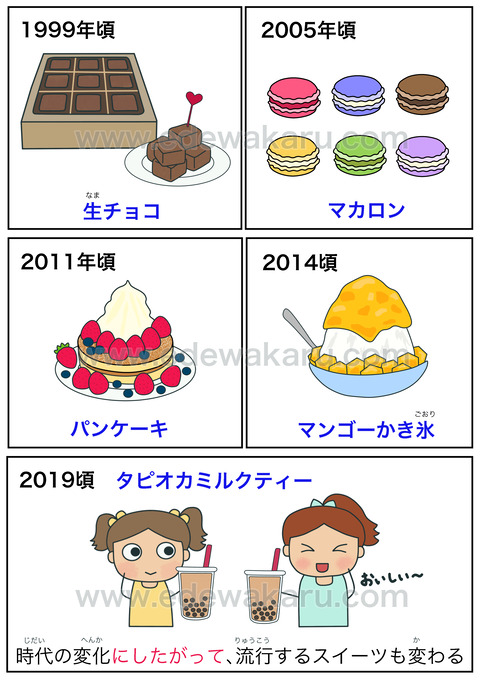
Meaning
〜すると、だんだん〜
〜が変化すると、〜も変化する
How to use it
動詞[辞書形]+にしたがって
名詞[辞書形]+にしたがって
Explanation
「AにしたがってB」は「Aすると、だんだんB」「Aが変化すると、Bも変化する」という意味の文型です。「Aの影響を受けて、Bになる」と言いたい時に使われます。「A」と「B」には、変化を表す言葉が入ります。
「〜にしたがい」は「〜にしたがって」よりもかたい言い方で、チェンジすることができます。
また「〜にしたがって・〜にしたがい」は、漢字で書くと「〜に従って・〜に従い」になります。
[例]
時代の変化
にしたがって、流行するスイーツも変わる
=時代の変化
にしたがい、流行するスイーツも変わる
「〜にしたがって」には「〜の通に」という意味もありますので、一緒に覚えておきましょう😊
【関連文型】
In context 5 examples
時代の変化にしたがって、流行するスイーツも変わる
→時代が変化すると、流行するスイーツも変わる試験の日が近づくにしたがって、緊張してきた
→試験の日が近づくと、だんだん緊張してきた暑くなるにしたがって、熱中症(ねっちゅうしょう)になる人が増える
→暑くなると、だんだん熱中症になる人が増える年をとるにしたがって、疲れやすくなった
→年をとると、だんだん疲れやすくなったこのマンガは、話が進むにしたがっておもしろくなってきた
→話が進むと、だんだんおもしろくなってきた
Usage 2
Read this source entry ↗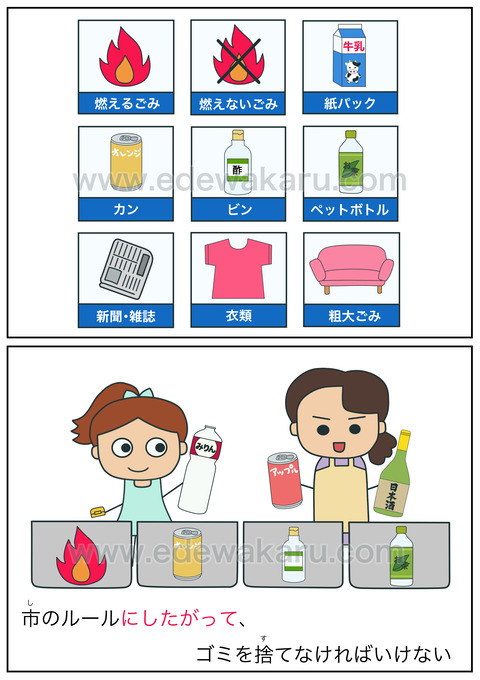
Meaning
〜の通りに〜する
How to use it
名詞[辞書形]+にしたがって
Explanation
「Aにしたがって」は「Aの通りに〜する」という意味の文型です。「A」には[ルール][規則][指示][人]などが入り、「Aの通りに行動する」と言いたい時に使われます。
「〜にしたがって」には[変化]を表す用法もありますので、復習をしておきましょう😊
In context 5 examples
市のルールにしたがってゴミを捨てなければいけない
→市のルールの通りにゴミを捨てなければいけない矢印にしたがって進んでください
→矢印の通りに進んでください上司の命令にしたがって行動する
→上司の命令の通りに行動する地震が起きた場合は、スタッフの指示にしたがって避難してください
→スタッフの指示の通りに避難してくださいマニュアルにしたがって、作業を行うこと
→マニュアルの通りに、作業を行うこと
Usage 3
Read this source entry ↗Meaning
〜の通りに〜する
How to use it
名詞[辞書形]+にしたがって
Explanation
「Aにしたがって」は「Aの通りに〜する」という意味の文型です。「A」には[ルール][規則][指示][人]などが入り、「Aの通りに行動する」と言いたい時に使われます。
「〜にしたがって」には[変化]を表す用法もありますので、復習をしておきましょう😊
In context 5 examples
市のルールにしたがってゴミを捨てなければいけない
→市のルールの通りにゴミを捨てなければいけない矢印にしたがって進んでください
→矢印の通りに進んでください上司の命令にしたがって行動する
→上司の命令の通りに行動する地震が起きた場合は、スタッフの指示にしたがって避難してください
→スタッフの指示の通りに避難してくださいマニュアルにしたがって、作業を行うこと
→マニュアルの通りに、作業を行うこと
Usage 4
Read this source entry ↗Meaning
〜すると、だんだん〜
〜が変化すると、〜も変化する
How to use it
動詞[辞書形]+にしたがって
名詞[辞書形]+にしたがって
Explanation
「AにしたがってB」は「Aすると、だんだんB」「Aが変化すると、Bも変化する」という意味の文型です。「Aの影響を受けて、Bになる」と言いたい時に使われます。「A」と「B」には、変化を表す言葉が入ります。
「〜にしたがい」は「〜にしたがって」よりもかたい言い方で、チェンジすることができます。
また「〜にしたがって・〜にしたがい」は、漢字で書くと「〜に従って・〜に従い」になります。
[例]
時代の変化
にしたがって、流行するスイーツも変わる
=時代の変化
にしたがい、流行するスイーツも変わる
「〜にしたがって」には「〜の通に」という意味もありますので、一緒に覚えておきましょう😊
【関連文型】
In context 5 examples
時代の変化にしたがって、流行するスイーツも変わる
→時代が変化すると、流行するスイーツも変わる試験の日が近づくにしたがって、緊張してきた
→試験の日が近づくと、だんだん緊張してきた暑くなるにしたがって、熱中症(ねっちゅうしょう)になる人が増える
→暑くなると、だんだん熱中症になる人が増える年をとるにしたがって、疲れやすくなった
→年をとると、だんだん疲れやすくなったこのマンガは、話が進むにしたがっておもしろくなってきた
→話が進むと、だんだんおもしろくなってきた
どんなときどう使う 日本語表現文型辞典
Meaning
as; in consequence
How to use it
Vる/する動詞のN+に従ってW
Explanation
~すると、だんだん
1)「~ に従って、…」の形で、「~が変化すると、…の変化も起こってくる」という表現。
2)「~」にも「…」にも変化を表す言葉が来る。
1)Some change will occur as consequence of another.
2)Words expressing change both precede and follow pattern.
In context 3 examples
警察の調べが進むに従って、次々と新しい疑問点が出てきた。
今後、通勤客が増えるに従って、バスの本数を増やしていこうと思っている。
ごみの問題が深刻になるに従い、リサイクル運動への関心が高まってきた。
日本語NET JLPT文法解説まとめ
Meaning
"〜すると、だんだん"
前件の変化に対応して、後件も変化するということを表す。
そのため、変化を表現する言葉が使われる。
How to use it
V(辞書形) + にしたがって
N + にしたがって
Explanation
as, in proportion to
In context 12 examples
このゲームはステージをクリアするにしたがって、難しくなります。
時間が経つにしたがって、足の痛みが引いてきた。
暗くなるにしたがって、だんだん寒くなってきました。
父は年をとるにしたがって、物忘れが多くなってきました。
年をとるにしたがって、病気になりやすくなります。
寒くなるにしたがって、体調を崩して欠席する人が増えてくる。
試験の日が近づくにしたがい、不安と緊張で眠れない日が続く。
スマホの普及にしたがって、私たち生活は便利になった。
冬が近くにしたがって、暗くなるのが早くなってきた。
時間が経つにしたがって、自然と嫌なことも忘れますよ。
山は高く登るにしたがって、気温が低くなります。
パソコンの普及にしたがって、仕事がとてもやりやすくなった。
日本語文型辞典 英語版
Meaning
With a noun expressing a person, an order, or an instruction, expresses the meaning of “being submissive without resisting someone/something” or “acting according to someone’s instructions.”
Expresses the meaning of “as some action or function advances.” Followed by a thing/state/event indicating some change as the action or function of a previously mentioned progress, such as 気圧が下がる(the air pressure goes down) or 険しくなる(become steep).
How to use it
1. Nにしたがって
2. V-るにしたがって
In context 7 examples
引率者の指示にしたがって行動して下さい。
Please act according to the leader’s instructions.
しきたりに従って式をとり行った。
We performed the ceremony following the convention.
上司の命令に従って不正を働いた。
I obeyed my boss’s orders to commit the injustice.
矢印に従って進んで下さい。
Please follow the arrows.
上昇するにしたがって気圧が下がる。
The air pressure goes down as you go up.
進むにしたがって道は険しくなる。
As you proceed, the road becomes steeper.
この材質は年月を重ねるに従って美しいつやがでて来る。
With age, this type of material develops a beautiful sheen.
文法
Meaning
"〜すると、だんだん"
前件の変化に対応して、後件も変化するということを表す。
そのため、変化を表現する言葉が使われる。
How to use it
V(辞書形) + にしたがって
N + にしたがって
In context 12 examples
このゲームはステージをクリアするにしたがって、難しくなります。
時間が経つにしたがって、足の痛みが引いてきた。
暗くなるにしたがって、だんだん寒くなってきました。
父は年をとるにしたがって、物忘れが多くなってきました。
年をとるにしたがって、病気になりやすくなります。
寒くなるにしたがって、体調を崩して欠席する人が増えてくる。
試験の日が近づくにしたがい、不安と緊張で眠れない日が続く。
スマホの普及にしたがって、私たち生活は便利になった。
冬が近くにしたがって、暗くなるのが早くなってきた。
時間が経つにしたがって、自然と嫌なことも忘れますよ。
山は高く登るにしたがって、気温が低くなります。
パソコンの普及にしたがって、仕事がとてもやりやすくなった。
Bunpro Grammar Reference
Meaning
As, Following, As then, According to, In accordance with
How to use it
Verb[る]+ にしたがって(1)
Noun + にしたがって(1)
(1) にしたがい
Nuance
A formal phrase used to say something is done in compliance with (A), or following the lead of (A).
Explanation
By grouping the う-Verb 従う 'to comply' with に, a common pattern meaning 'to comply with (A)', 'in accordance with (A)', or 'following (A)' will be created. This is a fairly strong and formal structure, indicating that (B) is being controlled or heavily influenced by (A). (B) will often express some kind of ongoing or sudden change caused by (A).
に従って may appear after either verbs or nouns in their dictionary forms.
年を取るに従って、目がどんどん悪くなっていってる気がする。
I feel like my eyes are getting worse and worse as I get older.
テレワークの普及が進むに従って、通勤するサラリーマンが減っていっている。
As teleworking becomes more widespread, the number of office workers commuting to work is decreasing.
僕はただ上司の指示に従って仕事を進めていただけです。
I was just following my boss' instructions to get the job done.
この説明書に従って、パソコンの初期設定を行ってください。
Please follow these instructions to perform the initial setup of your computer.
As this expression is quite formal, it is common to see it used in relation to matters that are usually discussed in formal or official situations, such as laws, standards, conventions, or traditions.
Nuance · 日本語
(A)に沿って何かが行われた、又は(A)に続いて何かが行われたということを表す丁寧な表現。
Explanation · 日本語
五段動詞「従う」と「に」を組み合わせると、「(A) に合うように」「(A) を守りながら」「(A) に沿って」のような意味を表します。これは (B) が (A) に強い影響を受けていたり、厳しく管理されていたりすることを表す、かなり硬くて強い言葉です。また、(B) には (A) によって引き起こされた突然の変化や進行中の変化が入ることが多いです。
「に従って」の前には辞書形の動詞や名詞が置かれます。
年を取るに従って、目がどんどん悪くなっていってる気がする。
I feel like my eyes are getting worse and worse as I get older.
テレワークの普及が進むに従って、通勤するサラリーマンが減っていっている。
As teleworking becomes more widespread, the number of office workers commuting to work is decreasing.
僕はただ上司の指示に従って仕事を進めていただけです。
I was just following my boss' instructions to get the job done.
この説明書に従って、パソコンの初期設定を行ってください。
Please follow these instructions to perform the initial setup of your computer.
「に従って」はかなり硬い表現なので、正式・公式な場面で、法律や基準、慣習、伝統などについて述べるときによく使われます。
In context 16 examples
- この原稿に従ってインタビューに答えてください。
Please answer the interview in accordance with this manuscript.
- 年を取るに従って、目がどんどん悪くなっていってる気がする。
I feel like my eyes are getting worse and worse as I get older.
- この説明書に従って、パソコンの初期設定を行ってください。
Please follow these instructions to perform the initial setup of your computer.
- テレワークの普及が進むに従って、通勤するサラリーマンが減っていっている。
As teleworking becomes more widespread, the number of office workers commuting to work is decreasing.
- 僕はただ上司の指示に従って仕事を進めていただけです。
I was just following my boss' instructions to get the job done.
- 憲法に従って、新たな法律が成立する。
In accordance with the constitution, the new law will be established.
- クラスメイトの言うことに従って意地悪をしてはいけません。
You must not act unkindly in accordance with what your classmates say.
- この足跡に従って進めば、きっとみんなに会えるはずです。
If you progress in accordance with these tracks, you will surely be able to see everyone.
- 会社の指示に従ってオートメーション化を進めています。
The change to automation is progressing according to the company's specifications.
- 世界中でのインターネットの広がりに従い、情報へのアクセスは前よりもっと容易になる。
As the internet spreads all over the world, access to information becomes easier than before.
- 歳をとるに従って、だんだんいいアイデアが思い浮かばなくなっているような気がする。
I have a feeling that, as I age, good ideas are gradually stopping coming to mind.
- 有名な育児本に従って子供を育てたからといって、必ずうまくいくとは限らない。
Just because you raise a child in accordance with a famous book on child rearing, it won't necessarily always turn out well.
- 勇ましい先人たちの手本に従って、我々も戦おうではないか!
In accordance with the model of our brave ancestors, let's fight!
- 引力に従って生活するのはもう嫌だ。自由に空を飛びたい。
I hate living in accordance with gravity. I want to fly freely in the sky.
- 指揮者の方針に従って演奏できないというのであれば、このオーケストラから出て行ってもらうしかない。
There is no choice but to have you leave this orchestra if you cannot perform according to the conductor's direction.
- 年が経つに従って、非再生可能資源が枯渇する一方だ。
As years pass by, non-renewable resources continue to run out.
NINJAL 日本語文型データベース
Meaning
~の程度が変化すると、それに比例して他のことも変化すると言いたいときに使います。
How to use it
Vるにしたがって
Nにしたがって
Notes
「~」にも「〜にしたがって」の後の文にも、程度の変化を表す言葉がきます。
「~」は一方向の変化でなくてもいいです。
「〜にしたがって」の後に、話し手の希望・意向を表す文がくることもあります。
「〜」が文の場合、「の」を使って名詞にして接続することもあります。
In context 9 examples
新築だった家も年を経るにしたがって、傷みが目立ってきた。
一人暮らしに慣れるにしたがって、お金の使い方がうまくなった。
標高が高くなるにしたがって、山道に見られる植物の種類が変わっていくのがわかる。
企業のビジョンは、社会のあり方が変わるにしたがって、時代に合ったものに変更していく必要がある。
リフォーム業者「はじめはこの間取りにして、ご家族の構成が変化するに従って、改築していかれたらいかがでしょうか」
子どもたちは成長にしたがって知っている言葉が増え、大人顔負けの文を作るようになった。
高齢者人口の増加にしたがって、医療・介護等の需要が高まる。
日本の所得税は累進課税なので、所得の増減にしたがって、税率が変わる。
児童数が変化するのに従って、自治体の教育関係予算が調整されている。
IMABI
As (change)
Read this IMABI lesson ↗Explanation
As (change): ~につれて, ~に従って, ~に伴って, ~とともに, ~に応じて, & ~に応えて
~につれて, ~に従って, ~に伴って, and ~とともに all have meanings of showing the transition/change of one situation as another transition/change is under way. We will also see how ~に応じて・応えてrelate to them.
~につれて
~につれて is either after a noun or a verb in the 連体形 to express “as one thing changes, another thing changes as well”. These changes are simultaneous. Although it can be after nouns or verbs, it is after verbs more often. ~につれて is often used in situations where there is a proportional relationship with the two events in the respective clauses.
As such, the first clause acts as the trigger, proportionately raising the degree of the change/transition of the latter clause. Common translations include “as”, “together with”, and “in accordance to/with”.
Variant Note: It can be seen in more formal/written language as ~につれ.
Examples
1. 歌は世につれ世は歌につれ。
Song changes by generation, and generations change by song.
2. 昭和から平成へと時代が変わるにつれて軍歌ぐんかは歌われなくなりました。
With the changing of periods from the Showa to the Heisei, military songs became unsung.
3. 時間が経つにつれて忘れっぽくなる。
As time passes, I become forgetful.
4. 都心化(が進む)につれて自分の地域への関心が薄うすれる。
As urbanization progresses, the concern towards one’s region fades.
5. 夜が更ふけるにつれて嵐あらしは激しくなった。
The storm became fierce as the night grew late.
6. 季節の変化につれて気温が変わる。
The temperatures change in accordance to the seasons. 7. 冬になるにつれて、山が白くなってくる。
The mountains become white as winter depends.
8. イナゴは稲に付く害虫なので駆除しなくてはなりません。昔の人はそこからイナゴを食べることを思いつきました。当時は、食べることを前提に捕まえていたので、殺虫剤は使っていませんでした。しかし戦後、 農薬が普及し、それにつれてイナゴは激減してしまいました。現在では、殺虫剤を使ったイナゴの駆除も行われていますが、安全な無農薬栽培やオーガニック栽培をしている農家では一匹ずつ捕まえているそうです。大変な作業ですね。
Locusts are harmful insects which stick to rice plants and have to be exterminated. People in the past thought of eating locusts from this. At the time, they wouldn’t use pesticides with eating them as a premise. However, after the war, agrochemicals spread, and with this locusts were decreased in number. Presently, there is extermination involving pesticides, but at farms which use safe non-agriculture chemical and organic cultivation, locusts are caught by hand one by one. That’s definitely a tough job.
~に従って
~に従って can be used in a hierarchical sense to mean “according to”. As should be expected, ~に従い is more formal and indicative of the written language. Both に従っての and に従った are appropriate attribute forms.
9. 命令に従って、行動しろ。
Act according to the command.
10. 私の合図に従って行動してください。
Please act in according to my signals.
It may also be used like ~につれて. In the first usage above, it attaches to nouns. As for this usage, it attaches primarily to verbs. It, however, simply states that the two actions described in the respective clauses are happening in parallel.
11. 南に行くに従い、気温がどんどん高くなる。(Somewhat literary)
The temperature gets higher as you go south.
12. 人口が増えるにしたがって、住宅問題が起こってくる。
As the population increases, housing problems will come to occur.
13. 人口が増えるにしたがって、犯罪が多発する。
As the population increases, crime will frequently occur.
The contrast in nuance between ~につれて and ~にしたがって can definitely be seen in the following example.
14. スタジアムで場内の歓声が高まる{につれて・にしたがって}。実況アナウンサーの声も大きくなっていった。
As the cheers in the stadium intensified, the commentator’s voice got ever louder.
With ~につれて, the suspense is captured with the first clause being the trigger for the events of the second. With ~にしたがって, the sentence doesn’t become ungrammatical, but it loses the emotive drive and merely states that the two events described in the respective clauses are happening in parallel.
~に伴って
伴う means “to accompany” and ~に伴って means “associated/accompanied with” or “as”. Just like ~につれて, it may show that something is happening together with a change/transition of a certain situation. There is a temporal context of “taking A as the opportunity, therefore…B”. It is also often the case that it infers that the thing in the second clause continues.
What precedes it is either a noun or verb. In the case of a verb, unlike the other options, the particle の may be optionally used after the verb for nominalization. To be clear, this is not required and is not done in the first place for the other options. Lastly, ~に伴って is more literary.
Variant Note: It may also be seen in writing as ~に伴い.
15. 汚染おせんに伴う問題について話しましょう。
Let’s talk about the problems accompanied with pollution.
16. 人口の増加に伴って、たくさんの住宅が建てられる。
Many houses are constructed in association to the increase in population.
Particle Note: 伴う is used with を when used transitively.
~とともに
~とともに also behaves like ~につれて to show that something happens together with a change/transition of a certain situation. However, unlike ~につれて, the entire sentence doesn’t necessarily have to show a state of progress. In other cases it can have meanings equivalent to 同時に and 一緒に. As for its usage similar to ~につれて, it’s also the case that the words it follows must show change in situation. It cannot be words pertaining to action, which ~につれ and ~にしたがって can be.
17. 人口の増加とともに、犯罪が多発する。
Along with the increase in population, crimes will frequently occur.
18. 子供が卒業するとともに、父母会ふぼかいも解散かいさんしました。
The parents’ association also dissolved at the same time the kids graduated.
19. 皆さんとともに快適かいてきな道づくりを進めます。
With everyone we will go forward with a pleasant road construction.
漢字 Note: This pattern may also be written in 漢字 as ~と共に.
~に応じて
~に応じて means “accordingly” or “as to”. The first meaning is important in this lesson as it ties with the other patterns. When it is used with a verb that shows change, it describes the corresponding/dealing with a certain change. In this instance, it is possible to switch it out with ~につれて, ~にしたがって, ~にともなって, and ~とともに.
In its other meaning, it is equivalent to ~に応えて (as to/to satisfy). Although this, too, sounds like it is of the vein of the other phrases, it’s not. Although in such situations it may seem that ~に従って is possible, it would be considerably more negative.
20a. 住民の要求に応じて、説明会を開くことになりました。〇
20b. 住民の要求に従って、説明会を開くことになりました。△
20c. 住民の要求{にともなって・とともに}、説明会を開くことになりました。?
20d. 住民の要求につれて、説明会を開くことになりました。X
In meeting the wants of the citizens, it has been decided that we open an information seminar.
It has the attribute forms ~に応じての and ~に応じた. When に応じて comes before a noun, の is necessary after 応じて. Or, you can use に応じた. The 一段 conjugating verb 応じる either means “reply” or “to comply”.
21. 質問に応じて、彼女は問題の解答を詳くわしく説明しました。
As to answer the question, she explained the answer to the problem well.
22. 命令に応じた服従。
Obedience in accordance to command.
23. 料金が距離きょりと時間に応じて決まります。
The fee is determined according to distance and time.
24. 「うん」と応じる。
To respond with a “yes”.
25. 相手の依頼いらいに応じましたか。
Have you responded to your partner’s request?
26. 車の速さに応じてガソリンの消費量が変わる。
Fuel use will change depending upon the car’s speed.
~に応えて
The 一段 verb 応える may be used to mean “to come through/satisfy/answer” or “to tell/go to one’s heart”. The latter usage shows some sort of burden.
27. 要求に応こたえて、社員の給料が上がりました。
To meet demand, the employee’s salaries went up.
28. 国民に応えて、法律は廃止はいしされました。
The law was repealed in response to the citizens.
29. 期待に応える。
To come through with expectations.
30. 深酒ふかざけは身体に応えるのです。
Hard drinking takes its toll on the body.
31. その当時供給は需要に{応えて・満たして}いなかった。
In those days, the supply didn’t meet the demand.
In context 33 examples
歌は世につれ世は歌につれ。
Song changes by generation, and generations change by song.
昭和から平成へと時代が変わるにつれて軍歌ぐんかは歌われなくなりました。
With the changing of periods from the Showa to the Heisei, military songs became unsung.
時間が経つにつれて忘れっぽくなる。
As time passes, I become forgetful.
都心化(が進む)につれて自分の地域への関心が薄うすれる。
As urbanization progresses, the concern towards one’s region fades.
夜が更ふけるにつれて嵐あらしは激しくなった。
The storm became fierce as the night grew late.
季節の変化につれて気温が変わる。
イナゴは稲に付く害虫なので駆除しなくてはなりません。昔の人はそこからイナゴを食べることを思いつきました。当時は、食べることを前提に捕まえていたので、殺虫剤は使っていませんでした。しかし戦後、 農薬が普及し、それにつれてイナゴは激減してしまいました。現在では、殺虫剤を使ったイナゴの駆除も行われていますが、安全な無農薬栽培やオーガニック栽培をしている農家では一匹ずつ捕まえているそうです。大変な作業ですね。
Locusts are harmful insects which stick to rice plants and have to be exterminated. People in the past thought of eating locusts from this. At the time, they wouldn’t use pesticides with eating them as a premise. However, after the war, agrochemicals spread, and with this locusts were decreased in number. Presently, there is extermination involving pesticides, but at farms which use safe non-agriculture chemical and organic cultivation, locusts are caught by hand one by one. That’s definitely a tough job.
命令に従って、行動しろ。
Act according to the command.
私の合図に従って行動してください。
Please act in according to my signals.
南に行くに従い、気温がどんどん高くなる。(Somewhat literary)
The temperature gets higher as you go south.
人口が増えるにしたがって、住宅問題が起こってくる。
As the population increases, housing problems will come to occur.
人口が増えるにしたがって、犯罪が多発する。
As the population increases, crime will frequently occur.
スタジアムで場内の歓声が高まる{につれて・にしたがって}。実況アナウンサーの声も大きくなっていった。
As the cheers in the stadium intensified, the commentator’s voice got ever louder.
汚染おせんに伴う問題について話しましょう。
Let’s talk about the problems accompanied with pollution.
人口の増加に伴って、たくさんの住宅が建てられる。
Many houses are constructed in association to the increase in population.
人口の増加とともに、犯罪が多発する。
Along with the increase in population, crimes will frequently occur.
子供が卒業するとともに、父母会ふぼかいも解散かいさんしました。
The parents’ association also dissolved at the same time the kids graduated.
皆さんとともに快適かいてきな道づくりを進めます。
With everyone we will go forward with a pleasant road construction.
住民の要求に応じて、説明会を開くことになりました。〇
In meeting the wants of the citizens, it has been decided that we open an information seminar.
住民の要求に従って、説明会を開くことになりました。△
In meeting the wants of the citizens, it has been decided that we open an information seminar.
住民の要求{にともなって・とともに}、説明会を開くことになりました。?
In meeting the wants of the citizens, it has been decided that we open an information seminar.
住民の要求につれて、説明会を開くことになりました。X
In meeting the wants of the citizens, it has been decided that we open an information seminar.
質問に応じて、彼女は問題の解答を詳くわしく説明しました。
As to answer the question, she explained the answer to the problem well.
命令に応じた服従。
Obedience in accordance to command.
料金が距離きょりと時間に応じて決まります。
The fee is determined according to distance and time.
「うん」と応じる。
To respond with a “yes”.
相手の依頼いらいに応じましたか。
Have you responded to your partner’s request?
車の速さに応じてガソリンの消費量が変わる。
Fuel use will change depending upon the car’s speed.
要求に応こたえて、社員の給料が上がりました。
To meet demand, the employee’s salaries went up.
国民に応えて、法律は廃止はいしされました。
The law was repealed in response to the citizens.
期待に応える。
To come through with expectations.
深酒ふかざけは身体に応えるのです。
Hard drinking takes its toll on the body.
その当時供給は需要に{応えて・満たして}いなかった。
In those days, the supply didn’t meet the demand.
DoJG 日本語文法辞典(全集)
Meaning
As, accordingly; in proportion to; in accordance with; following
How to use it
(i) Vinformal nonpast | に{従って/従い} | |
| その本を読むに{従って/従い} | As someone reads the book |
(ii) Noun | に{従って/従い} | |
| 指示に{従って/従い} | In accordance with the instructions |
Explanation
に従って/従い Something spontaneously and gradually occurs in accordance with some change.
In context 9 examples
日本の経済力が強くなるに{従って/従い}、日本語学習者が増えてきた。
As Japan's economic power has become stronger, Japanese language learners have increased, accordingly.
契約に{従って/従い}雇用期間を三年とする。
In accordance with the contract, your tenure shall be three years.
収入が増えるに従って、支出も増える。
As our income increases, our expenditure, too, increases.
年を取るに従い、体力が衰える。
As you grow older, your physical strength declines.
文明が進むに従い、人間のストレスが多くなる。
As civilization progresses, human stresses increase.
日がたつに従って、父の病気は回復してきた。
As the days went by, my father recovered from his illness.
太陽が沈んで行くに従って、温度がどんどん下がった。
As the sun went down, the temperature went down rapidly.
約束に従い、借金を一か月後に返した。
In accordance with the promise I returned the loaned money after a month.
社長の命令に従って、彼はただちにマニラに飛んだ。
In accordance with the president's order, he flew to Manila immediately.