どんなときどう使う 日本語表現文型辞典
Meaning
show signs of; look
How to use it
イAい/ナA+げ(あります+げ の形もある)
Explanation
~そう
1)人の「そのような様子」を表す。人の気持ちの様態を表す場合に使われる。やや古い言い方。
2)目上の人の様子を言うときにはあまり使わない。
3)主にイ形容詞、ナ形容詞に接続し、全体でナ形容詞のように使われる。ほかに「意味ありげ・さびしげ・はずかしげ・不安げ・なつかしげ」など。
4)「いかにも・さも」などの言葉といっしょに使うことが多い。
3)Mainly connects to イ-adjectives, or ナ-adjectives, and used overall like ナ-adjectives. Also seen in expressions: 意味ありげ (meaningful), さびしげ (sadly), はずかしげ (shyly), 不安げ (uneasily), なつかしげ (wistfully), etc.
4) Often used with いかにも, さも, etc.
1)Describes a person's appearance. Shows feelings. Slightly old-fashioned.
2)Not usually used to describe appearance of social superiors.
In context 4 examples
「お母さんはどうしたの」と聞くと、子どもは悲しげな顔をして下を向いた。
高い熱のあるひろしは、わたしと話すのも苦しげだった。
となりの乗客は退屈げに窓の外をながめていた。
会議の後、彼はいかにも不満ありげな顔をしていた。
IMABI
Appearance
Read this IMABI lesson ↗Explanation
Appearance: ~だらけ, ~まみれ, ~ずくめ, ~めく, ~げ, ~みどろ, & ~気味
There are several suffixes in Japanese that represent states of appearance.
~だらけ
~だらけ attaches to nouns to describe how something is riddled with something. ~だらけ may be used with both physical and psychological items. There is an extent to how you can use this though. Things like 混乱こんらんだらけ would be wrong. This is because it should be used with things that are either physical or dealing with (emotional) phenomenon and not a “state”. Rather than 混乱だらけ, consider phrases like すごく狼狽ろうばいしている or とても動揺どうようしている.
1. 彼女は(口を開けば){不平・不満}{ばっかり言ってる・だらけだ}な。
She’s full of complaints isn’t she?
2. パソコンは埃ほこり{かぶっていた・だらけだった}。
The desktop was covered in dust.
3. 後悔こうかいだらけ
Covered in regret
4. 傷きずだらけ
Covered in injuries
5. 血だらけになった殺人犯さつじんはんは逃にげ場ばがなくなって自殺じさつしたそうだ。
They say that since the murderer covered in blood didn’t have a place to run away, he committed suicide.
~塗れ
~まみれ comes from 塗まみれる which means “to be covered with”. Similar to ~だらけ ~まみれ shows how something is completely covered in something. Unlike ~だらけ, ~まみれ is solely used with physical objects. However, there is a trend to use ~まみれ with things that have a “physical persona”. This, though, is metaphoric. Creating metaphors in any language causes rules to become more flexible.
6. 遺体いたいは血塗れだったということです。
It is said that the corpse was completely covered in blood.
7. メキシコ湾わんは{辺り一面}重油じゅうゆ{埋め尽くされました・まみれになりました}。
The Gulf of Mexico became completely covered in heavy oil.
8. 彼はただの挫折塗ざせつまみれのやつだけだ。
He’s just completely covered in failure.
~尽くめ
~ずくめ shows that something is “completely…”. It is normally either attached to nouns of colors or こと. There is, though, a condition that whatever it attaches to that the context is in relation to human intent.
A similar ending is ~ずくし. It means “all sorts of”. Here, the human intent condition is non-existent. In writing, using づ instead of ず is OK. This is just a conflict between Old and New orthographies that has just been left to the individual to decide.
9. 人が黒尽くめでした。
The person was completely black.
10. いい事づくしの人
A person full of good luck
11a. 白づくめで抗議してる人は窃盗罪せっとうざいで訴うったえられた人達だ。
11b. 抗議をしている、白づくめの人達は、窃盗罪で訴うったえられた。
The people protesting dressed in white were accused of theft.
~めく
~めく shows what something looks like or what condition something becomes, and it may follow nouns, adverbs, or the stem of adjectives and verbs. The closest translation for ~めく is “to show signs of”. Although all tenses are possible, ~めく is normally only used in the non-past or past tense. Depending on the verb, there are may be more options. For instance, うごめく can be seen in things like the progressive.
To be astir ざわめく To flash 閃く To be mysterious 謎めく
To glimmer 仄めく To color 色めく To be spring-like 春めく
To wriggle うごめく To flourish 時めく To be autumn-like 秋めく
Grammar Note: When attached to verbs, the new verb is often seen contracted and then written differently. ~めく is most often used with nouns and 形容動詞.
12. 教室は興奮こうふんで騒ざわめいた。
The classroom stirred with excitement.
13. 庭の楓かえでが色めくのは本当に美しいですよね。
The changing in colors of the maple trees in the garden is really beautiful, isn’t it?
14. {うわぁ・ああ}、{もぞもぞ動いてる・蠢うごめいてる}虫(がいる)!
Ah, a wriggling worm!
15. 彼は今を時めく歌手・有名人です。
He is one of the most prosperous singers/famous people of the time.
16. 謎なぞめいた様子ようすをしている。
To have an air of mystery.
17. 謎めいた様相ようそうを呈ていする。
To be in a situation covered in mystery.
18. 冬めいてきた。
It became winter-like.
19. 陽光に川面が煌めく。
The river surface glistens in the sunlight.
20. どよめいて、人々が飛びのく。一人の背中が飛鳥にぶつかった。はね飛ばされて、壁に肩をぶつける。さらにはね返ってよろめき、あやうく転びかけたときだった。
Making a stir, people jumped back. A person’s back hit Asuka. Being sent flying, she hit her shoulder on the wall. In addition, it was when she had bounced back, staggered, and dangerously started to tumble.
From 野生の風 by 村山由佳.
~みどろ
~みどろ is a less common alternative to the suffix ~まみれ to show things being covered in something.
21. 血みどろの遺体
A bloody corpse
22. 汗みどろの労働者
A sweat covered laborer
~気
~げ conjugates as a 形容動詞けいようどうし. Used to show a sense of true appearance, it describes something with intense fervor and emotion. Lastly, ~げ may be attached to the stem of adjectives and to nouns.
23. 悲しげに泣く。
Cry while being sad all over.
24. 均衡予算を黙殺するのは大人げない。
Ignoring the balanced budget proposal is childish.
25. 彼は何か言いたげな顔をしていた。
He had the face of wanting to say something.
26. 「今も新しい戦争が僕らを追っかけて来ているのかもしれないし、僕らのなかの前の戦争が、亡霊のように僕らを追っかけているかもしれないんです。」と修一は憎さげに、「お父さまこそ、あの娘がちょっと変わっているから、ひそかに魅力を感じて、妙な考えをくどくどもってまわってらっしゃる。女がほかの女とどこかちょっとちがっているだけで、男はつかまるのですからね。」
“A new word may have come its way to chase after us even now, but the war of the past within ourselves may be chasing after us like a departed spirit”, and Shuichi continued odiously with “And you, of course, Father inwardly feel a mystique since she’s changed a little, and you’re going about stuttering long-winded, strange thoughts. That’s man is just something that it’s caught up with the small differences one woman has with other women.”
From 山の音 by 川端康成.
27. 菊子は不審げに信吾を見て、そして顔を赤らめた。
Kikuko looked strangely at Shingo and then blushed.
From 山の音 by 川端康成.
Grammar Note: ~げ is almost never used with verbs. ~げ is closest to ~そうだ, but ~そうだ lacks the emotional emphasis. As emotional emphasis is very important, it is used with nouns that we aspire to be and adjectives that express our emotions.
The reading け and ぎ also exist, and they confusingly are used similarly to the げ reading. Luckily, the latter reading is not written as 気. The reading け is seen a lot in phrases like 飾り気 (affectation), 色気 (sex appeal), and 寒気 (feeling chilly). 人気 has two readings. When it is read as にんき, it means “popularity”, and when it is read as ひとけ, it is the antonym of deserted, but it is usually used in this sense in the phrase 人気がない.
The reading ぎ of 気 is rather restricted to nouns that can have perceptually suitable characteristics. Words such as 商売気 (mercenary mind), 男気 (chivalry), and 女気 (woman care) come to mind, and the only other examples are all literary words unlikely to be used in conversation, or at the very least appear rarely in literature. Examples of such words include 謀反気 (rebelling spirit), 芝居気 (theatrical spirit), 芸気 (theatrical spirit), and 回り気 (worrying and doubtful spirit).
28. お前さんも余程回り気の人だね。
You’re quite the worry wort too, aren’t you.
From 深川女房 by 小栗風葉.
Interestingly enough, the most common examples of ぎ and け are replaced with っけ. Examples of this include人っ気, 飾りっ気, and 商売っ気. Even words that typically only use け such as 真っ黒け and 真っ白け may have っ insertion in actual conversation. Even more interesting is the fact that the phrases 真っ赤っ赤 (bright red) and 真っ黄っ黄 (bright yellow) exist. The first one shows up dictionaries and is used widely, but the latter is rather dialectical. The interesting point here is how the forms seem to mimic the use of っけ for emphasis.
29. 彼は仕事を事もなげにやってのけた。
He pulled the job off as if nothing happened.
~気味
~気味ぎみ is seen after either a noun or the 連用形れんようけい of a verb. It shows a visible indication or slight feeling and is often used in a negative context. Common translations include “sign of,” “on the…side,” and “slight.”
30. 彼は疲れ気味だ。
He has the signs of fatigue.
30. 彼は太り気味だ。
He’s a little on the heavy side.
31. 今朝はちょっと風邪気味だ。
I have a slight feeling of a cold this morning.
Word Note: ~味 comes from 気味, which means “sensation” or “tendency.”
In context 33 examples
彼女は(口を開けば){不平・不満}{ばっかり言ってる・だらけだ}な。
She’s full of complaints isn’t she?
パソコンは埃ほこり{かぶっていた・だらけだった}。
The desktop was covered in dust.
後悔こうかいだらけ
Covered in regret
傷きずだらけ
Covered in injuries
血だらけになった殺人犯さつじんはんは逃にげ場ばがなくなって自殺じさつしたそうだ。
They say that since the murderer covered in blood didn’t have a place to run away, he committed suicide.
遺体いたいは血塗れだったということです。
It is said that the corpse was completely covered in blood.
メキシコ湾わんは{辺り一面}重油じゅうゆ{埋め尽くされました・まみれになりました}。
The Gulf of Mexico became completely covered in heavy oil.
彼はただの挫折塗ざせつまみれのやつだけだ。
He’s just completely covered in failure.
人が黒尽くめでした。
The person was completely black.
いい事づくしの人
A person full of good luck
白づくめで抗議してる人は窃盗罪せっとうざいで訴うったえられた人達だ。
The people protesting dressed in white were accused of theft.
抗議をしている、白づくめの人達は、窃盗罪で訴うったえられた。
The people protesting dressed in white were accused of theft.
教室は興奮こうふんで騒ざわめいた。
The classroom stirred with excitement.
庭の楓かえでが色めくのは本当に美しいですよね。
The changing in colors of the maple trees in the garden is really beautiful, isn’t it?
{うわぁ・ああ}、{もぞもぞ動いてる・蠢うごめいてる}虫(がいる)!
Ah, a wriggling worm!
彼は今を時めく歌手・有名人です。
He is one of the most prosperous singers/famous people of the time.
謎なぞめいた様子ようすをしている。
To have an air of mystery.
謎めいた様相ようそうを呈ていする。
To be in a situation covered in mystery.
冬めいてきた。
It became winter-like.
陽光に川面が煌めく。
The river surface glistens in the sunlight.
どよめいて、人々が飛びのく。一人の背中が飛鳥にぶつかった。はね飛ばされて、壁に肩をぶつける。さらにはね返ってよろめき、あやうく転びかけたときだった。
Making a stir, people jumped back. A person’s back hit Asuka. Being sent flying, she hit her shoulder on the wall. In addition, it was when she had bounced back, staggered, and dangerously started to tumble.
血みどろの遺体
A bloody corpse
汗みどろの労働者
A sweat covered laborer
悲しげに泣く。
Cry while being sad all over.
均衡予算を黙殺するのは大人げない。
Ignoring the balanced budget proposal is childish.
彼は何か言いたげな顔をしていた。
He had the face of wanting to say something.
「今も新しい戦争が僕らを追っかけて来ているのかもしれないし、僕らのなかの前の戦争が、亡霊のように僕らを追っかけているかもしれないんです。」と修一は憎さげに、「お父さまこそ、あの娘がちょっと変わっているから、ひそかに魅力を感じて、妙な考えをくどくどもってまわってらっしゃる。女がほかの女とどこかちょっとちがっているだけで、男はつかまるのですからね。」
“A new word may have come its way to chase after us even now, but the war of the past within ourselves may be chasing after us like a departed spirit”, and Shuichi continued odiously with “And you, of course, Father inwardly feel a mystique since she’s changed a little, and you’re going about stuttering long-winded, strange thoughts. That’s man is just something that it’s caught up with the small differences one woman has with other women.”
菊子は不審げに信吾を見て、そして顔を赤らめた。
Kikuko looked strangely at Shingo and then blushed.
お前さんも余程回り気の人だね。
You’re quite the worry wort too, aren’t you.
彼は仕事を事もなげにやってのけた。
He pulled the job off as if nothing happened.
彼は疲れ気味だ。
He has the signs of fatigue.
彼は太り気味だ。
He’s a little on the heavy side.
今朝はちょっと風邪気味だ。
I have a slight feeling of a cold this morning.
AIUEO JLPT Grammar
Meaning
「〜げ」is used to express an appearance or state, especially when guessing or inferring based on outward appearances or vibes.
How to use it
動詞すま形+げ形容詞語幹+げ形容動詞+げ
Explanation · 日本語
「〜げ」は、様子や状態を表す表現で、見た目や雰囲気から推測するときに使われます。
In context 5 examples
彼は寂しげに窓の外を見ていた。
He was looking out the window with a lonely expression.
その子は不安げな顔をしていた。
The child had an anxious look on their face.
その老人は嬉しげに歩いていた。
The old man walked happily.
彼女は何か言いたげだったが、結局黙っていた。
She seemed like she wanted to say something, but remained silent.
彼女は心配げに電話を見つめていた。
She was staring at her phone with a worried look.
文法
Meaning
〜そうだ / 〜そうな様子だ
人の気持ちを表す言葉について、「そのような様子である」と言いたい時に使われる。
目上の人の様子をいう時にはあまり使わない。
How to use it
イAい + げ
ナAだ + げ
名詞や動詞に接続することもあるが、使えるものは限定的。
In context 10 examples
彼の表情は少し、悲しげだった。
彼女は寂しげに、一人で公園のベンチで座っていた。
彼は得意げな顔で、みんなにテストの結果を見せた。
トムさんは国のニュースを見て、少し不安げだった。
彼はいつも自信なさげに答える。
怪しげな人が家の回りをウロウロしている。
彼は何か言いたげな様子だったが、何も言わずに部屋を出て行った。
向こうでみんなが楽しげに、何か話している。
もう、こんな事で腹を立てるなんて、大人げないよ。
会議のあと、彼はいかにも不満ありげな表情を浮かべた。
Bunpro Grammar Reference
Meaning
Seemingly, Giving appearance of, [Expresses emotions or feelings]
How to use it
Verb[stem]+ げ + に(1)
[い]Adjective[い̶]+ げ + に(1)
[な]Adjective + げ + に(1)
(1) な + Noun
Nuance
A short word used to indicate that something seems (A), or is giving off the vibe of (A).
Explanation
げ, sometimes seen in the kanji form 気 is a suffix in Japanese that expresses that something is 'giving off the feeling of (A)', or 'seems like (A)'. げ is frequently used in relation to emotions, feelings, and things that the speaker generally can't be 100% sure of due to them not being directly visible.
げ is primarily seen used after the stem form of い-Adjectives, but may also appear following the stem forms of nouns of な-Adjectives. In all of these cases, the addition of げ creates a new な-Adjective meaning '(A) seeming'. Due to this, げ may then be followed by either な or に, depending on whether it is altering a verb or a noun later in the sentence.
自信ありげに見えたかもしれないけど、実はめちゃくちゃ緊張してて吐きそうだった。
I may have given off the appearance of being confident, but actually, I was super nervous and felt like I was going to throw up.
高校生たちがファストフード店で楽しげに話しているのを見て、自分が高校生の頃を思い出した。
When I saw highschool students seemingly having a good time talking to each other at a fast food restaurant, it reminded me of the time when I was a highschooler.
高橋くんは不安げに手を上げました。
Seemingly nervous, Takahashi-kun raised his hand.
げ is more subjective (based on the speaker's opinion) than そう, and is considered to be very low confidence. This may be considered a byproduct of the original 気, meaning of 'attention', referring to the way that the speaker 'senses (A)', regardless of what is actually true for (A) on the inside.
Nuance · 日本語
あるものが(A)みたい、又は(A)の雰囲気を出しているということを表す短い言葉。
Explanation · 日本語
「げ」は「(A) という様子である」ことを表す接尾語です。主に、気持ちや感覚のような、目に見えないため話し手がそうであるとは100%(パーセント)断言できないようなことに関連して使われます。漢字で「気」と書かれることもあります。
「げ」は主にイ形容詞の語幹に付きますが、ナ形容詞の語幹(名詞の部分)に付くこともあります。このような場合、「げ」は「(A) そうな」を意味する新しいナ形容詞を作ります。そのため、「げ」の後に「な」または「に」を付けて、名詞や動詞を修飾することができます。
自信ありげに見えたかもしれないけど、実はめちゃくちゃ緊張してて吐きそうだった。
I may have given off the appearance of being confident, but actually, I was super nervous and felt like I was going to throw up.
高校生たちがファストフード店で楽しげに話しているのを見て、自分が高校生の頃を思い出した。
When I saw highschool students seemingly having a good time talking to each other at a fast food restaurant, it reminded me of the time when I was a highschooler.
高橋くんは不安げに手を上げました。
Seemingly nervous, Takahashi-kun raised his hand.
「げ」は「そう」よりも話し手の主観が強く、自信の度合いは低めです。これは「気」から生まれた表現だと見なされることもあり、実際に (A) がどうであるかよりも、話し手が「(A) だと感じる」ことを表しています。
In context 15 examples
- 教養がありすぎて可愛気がないのもどうかと思う。
I wonder about things that are too refined and therefore don't give off the appearance of being cute.
- 自信ありげに見えたかもしれないけど、実はめちゃくちゃ緊張してて吐きそうだった。
I may have given off the appearance of being confident, but actually, I was super nervous and felt like I was going to throw up.
- 高校生たちがファストフード店で楽しげに話しているのを見て、自分が高校生の頃を思い出した。
When I saw highschool students seemingly having a good time talking to each other at a fast food restaurant, it reminded me of the time when I was a highschooler.
- 高橋くんは不安げに手を上げました。
Seemingly nervous, Takahashi-kun raised his hand.
- 彼が恥ずかし気に自分の弱点を教えてくれた。
Seemingly embarrassed, he told us about his weak points.
- 涼し気な顔でマラソンを走りきるんだから大したもんだよ。
It was considerable that he finished running the marathon while seemingly undeterred.
- 彼女はとても素直だが、どことなく儚気なのが気になります。
She is very honest, but I am concerned by her somehow fickle appearance.
- 子供たちが羨まし気に見ているから、お菓子を分けてあげた。
Looking at the children they were giving the appearance of being envious, so I divided up the candy and gave it to them.
- 楽し気に遊ぶ子供を見るたびに、私は子供のころを思い出す。そして思わず笑顔になる。
Every time I see children seemingly enjoying themselves, I recall my childhood. And, without thinking, I smile.
- 優勝した選手を見て彼は悔し気な表情をしていた。
Looking at the winning athlete, his facial expressions gave off the appearance of being frustrated.
- 彼女が意味あり気な表情で僕を見つめている。何かあったのかな?
She is staring at me with the facial expression that gives off the appearance of knowing something about me. I wonder if something happened.
- A(エー):「どうしてそんなに満足気なの?」
B(ビー):「日本語能力試験、合格したんだよ!」A: 'Why are you giving off the appearance of being so satisfied?' B: 'I passed the Japanese Language Proficiency Test!'
- 彼女は私の言葉を聞いて悲し気な顔で出かけた。どうしてそんな態度を取ったのか分からない。
She left with a seemingly sad look upon her face after hearing my words. I don't understand the change in her demeanor.
- 誰かに「私の言うとおりにすれば、いつの間にかお金持ちになれるんだ」と言われると、頭の中に赤ランプが点灯して、これはなにか怪し気な儲け話だと思うようになる。このような人には、いつも気を付けなければならない。
When someone says: 'Do as I say, and you will get rich in no time', a warning light in my head turns on and I begin to think that 'this gives off the appearance of a suspicious get-rich-quick scheme'. One must always be wary of people like this.
- 父が懐かし気に自分の子供の頃の話をしてくれた。
My father talked about his childhood while giving off the appearance of nostalgia.
絵でわかる日本語
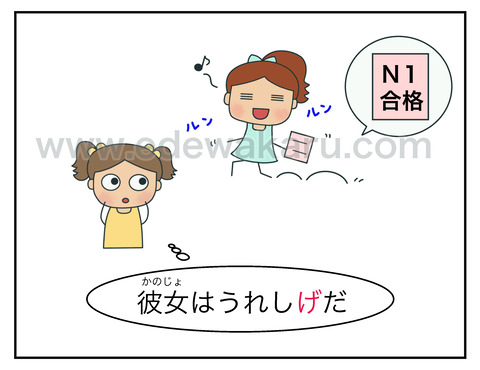
Meaning
〜そうな様子
How to use it
い形容詞[ーい]+げ
な形容詞[ーな]+げ
Explanation
「〜げ」は「〜そうな様子」という意味を表します。みなさんが初級で勉強した推量や様態を表す「〜そう」とチェンジすることができます😊「〜げ」は漢字で書くと「〜気」と書きます。
[例]
うれし
げ
だ→うれし
そう
だ
うれし
げ
な様子→うれし
そう
な顔
不安
げ
だ→不安
そう
だ
不安
げ
な顔→不安
そう
な顔
また、例文④のように「〜たい」につく場合はい形容詞と同じで「たい」の「い」をとって「げ」をつけます😉(「ーたい」+げ)
[例]
言いたい→言いた
げ
→言いた
そう
【
上級レベルの人へ】
この文法はほとんどの場合「い形容詞・な形容詞」に使用されますが、「名詞」「動詞」に使われる場合もあります😮ですが、
使われるものはほとんど決まっていますので単語として覚えることをオススメします
😉
動詞:「ある」→〜ありげ
[使い方]
何か意味
ありげ
な様子→何か意味が
ありそう
な様子
名詞:「大人」→大人げない
(慣用表現:大人らしくない・幼稚という意味)
[使い方]
子供相手に本気になるなんて、本当に
大人げない
ね…→本当に
幼稚だ
ね
「〜げ」は「〜そう」に比べて書き言葉的ですが、会話で使われることもたくさんありますのでがんばって覚えてくださいね😄
In context 4 examples
彼女はうれしげだ
→彼女はうれしそうだそのニュースを聞いて、彼は不安げな顔をした
→そのニュースを聞いて、彼は不安そうな顔をしたこのカフェ(「カフェ」と「コーヒー」の違い)はいつも楽しげな学生たちでいっぱいだ
→このカフェはいつも楽しそうな学生たちでいっぱいだ山田くんは何か言いたげだったが、何も言わずに部屋を出て行った
→山田くんは何か言いたそうだったが、何も言わずに部屋を出て行った
日本語文型辞典
Meaning
基本情報NaげA-げR-げ説明形容詞の語幹や動詞の連用形に付いて、そのような様子、ありさまである、という意味のナ形容詞を作る。例文は「退屈そう」「悲しそう」など「…そう」に言いかえられるが、「…げ」の方が書きことば的。慣用的な表現として④のようなものもある。例文① その人は退屈げに雑誌のページをめくっていた。② 「そうですか」というその声には悲しげな響きがあった。③ 彼女の笑顔にはどこか寂しげなどころがあった。④ 彼のそのいわくありげな様子が私には気になった。
日本語文型辞典 英語版
Meaning
【げ】[Na げ][A-げ][R-げ]
げ is combined with the stem of an i-adjective or verb to create a na-adjective with the meaning “to have a certain look or manner.” The examples above can be paraphrased using ...そう, as in 退屈そう and 悲しそう, but ...げ is more for written language. There are also idiomatic expressions such as the one shown in
(4)
.
In context 4 examples
その人は退屈げに雑誌のページをめくっていた。
That person was leafing through the pages of a magazine in a bored manner.
「そうですか」というその声には悲しげな響きがあった。
The voice saying “Soo desuka (is that so?)” was tinged with sadness.
彼女の笑顔にはどこか寂しげなところがあった。
Her smiling face had something of a look of loneliness.
彼のそのいわくありげな様子が私には気になった。
There was something deliberate in his manner that bothered me.
日本語NET JLPT文法解説まとめ
Meaning
"〜そうだ / 〜そうな様子だ"
人の気持ちを表す言葉について、「そのような様子である」と言いたい時に使われる。
目上の人の様子をいう時にはあまり使わない。
How to use it
イAい + げ
ナAだ + げ
名詞や動詞に接続することもあるが、使えるものは限定的。
Explanation
"seems like"
This expression is used to describe someone's feelings by saying 'it looks like that.'
This is not often used to describe the demeanor of superiors.
In context 10 examples
彼の表情は少し、悲しげだった。
彼女は寂しげに、一人で公園のベンチで座っていた。
彼は得意げな顔で、みんなにテストの結果を見せた。
トムさんは国のニュースを見て、少し不安げだった。
彼はいつも自信なさげに答える。
怪しげな人が家の回りをウロウロしている。
彼は何か言いたげな様子だったが、何も言わずに部屋を出て行った。
向こうでみんなが楽しげに、何か話している。
もう、こんな事で腹を立てるなんて、大人げないよ。
会議のあと、彼はいかにも不満ありげな表情を浮かべた。
毎日のんびり日本語教師
How to use it
動ます形+げ (ありげ)
い形容詞語幹+げ
な形容詞語幹+げ
※なさげ
~げな+名詞
~げに+動詞
Explanation
外から見た表面的様子から、対象の感情、感覚、性格、属性など推測・予想するという意味を持っています。断定を避ける婉曲表現なので、話者の主張を和らげる働きがあります。「~らしい」「~のようだ」等と同じような意味です。
「~げ」は動詞、イ形容詞、ナ形容詞について、それらをナ形容詞化する接尾辞です。
接続できる語は少なく生産性は低い上、ほとんどの語は慣用的に用いられていますが、若者の間では以前よりも頻繁に使われるようになってきており、これまでなかった新たな語が作られることが多くなっています。
~げ
気配や雰囲気から感じられる。主体の主観的な印象による感じを表現する。
助動詞「~そう」
主体が直接知覚できない感情・感覚・属性を予想する。感情・感覚・属性は、様子や文脈から想定されるものでなければならない。
イ形容詞、ナ形容詞を名詞化するものに「【N3文法】~さ」があります。
「彼女は可愛さがない」と「彼女は可愛げがない」では、後者が正しいです。「~さ」は客観的な程度の大小を表すだけで、話者の主観的な意見が含まれる場合に「~さ」は使いにくくなります。
「ありげ」は「ありそう」という意味です。
それとは意味的に逆の表現に「無さげ(なさげ)」(なさそう)があります。これは文法的に破格です。「良さげ(よさげ)」(よさそう)と合わせて若者言葉として使われています。
Notes
関連文法「【N3文法】~さ」
In context 21 examples
彼女はなんだか悲しげな様子だ。(她好像很悲伤的样子。)
彼女は急に黙って何か言いたげにこっちを見てきた。
彼は寂しげに遠くを見ている。
あの頃は可愛げがあったのに、今はもう…。
意味ありげな言葉を残して彼は立ち去って行った。
彼は自信ありげに頷いた。(他自信地点头。)
外で子供たちが楽しげに走り回っている。
怪しげな雰囲気の男が歩いている。(气氛怪异的男人走在路上。)
自信ありげに話すだけで、本当に自信があるように感じられる。
猫が鏡に映った自分を興味ありげに見ている。
この俳句は適当に作りました。意味ありげだけど全くないです。
親しげな口調で話す二人の声を聞いて、私の中の嫉妬が目覚めた。
残暑が続く中、風鈴が涼しげな音色を響かせている。
あの人はぼそぼそと話し頼りなさげだった。
儚げな雰囲気漂う女性は男性に人気が高いと言われています。
彼女の眠たげな表情がかわいい。
話をするときに目をあわせない人は自信無さげで臆病に見える。
欲しい本があるけど、amazonにも無さげで手に入らなさそうだ。
ネットで見ると良さげな物件だったけど、内見してみたら意外と狭かった。
初デートで行く店にしては雰囲気よさげだ。
先輩が文句言いたげな顔で近寄ってきた。