Bunpro Grammar Reference
Meaning
Not willing to, Not make an effort to, To not attempt or try to, Volitional + としない
How to use it
Verb[おう] + としない
Verb[おう] + としません
Nuance
A phrase that highlights that someone does not have the strong will to attempt (A), or will not make an effort.
Explanation
Like ~ようと思う 'I think that I shall do (A)', ~ようとしない is a combination of a verb that has been grouped with the auxiliary verb う (or よう), followed by the case marking particle と, and then another verb. In this case, する. ~ようとしない is often translated as 'shall not (A)', but with emphasis on a lack of effort, or willingness.
彼は怒っているから、誰の話も聞こうとしない。
Since he is angry, he is not willing to listen to what anyone has to say.
家になかなか帰ろうとしない。
He isn't quite trying to go home. (It doesn't seem like he is going to leave anytime soon)
Caution
As ~ようとしない implies a lack of effort, this expression is usually quite negative, and mostly refers to other people, rather than the speaker themselves. If ~ようとしない were used to refer to the speaker, it will come across as 'I shall not do (A)', which would sound very abrupt/potentially rude. If speaking about yourself, ようと思わない may be used instead, meaning 'I don't think I shall do (A)', or 'I think I shan't do (A)'.
自分から買って食べようと思わないけど、誰かに貰ったら食べるかも。
I don't think I would eat it if I had to buy it myself, but I might if someone gave it to me.
私は性格を変えようと思わない。
I think I shan't change my personality.
Nuance · 日本語
誰かが(A)をする強い意志がない、又はやる努力をしないことを強調する表現。
Explanation · 日本語
「〜ようとしない」は、動詞に助動詞「う」や「よう」が付いて、それに格助詞「と」と、動詞「する」の否定形「しない」が続いた表現です。「(A) をする様子が見えない」のような意味で使われて、(A) のやる気や意思が感じられないことを強調します。
彼は怒っているから、誰の話も聞こうとしない。
Since he is angry, he is not willing to listen to what anyone has to say.
家になかなか帰ろうとしない。
He isn't quite trying to go home. (It doesn't seem like he is going to leave anytime soon)
注意点
「〜ようとしない」は、やる気がないことを示す表現なので、たいていの場合、かなり否定的なニュアンスで使われます。また、主に話し手自身ではなく、ほかの人に対して使われます。話し手自身に「〜ようとしない」を使うと、かなり冷たい感じ(かんじ)や失礼な印象を与える可能性があります。自分のことを言うときは「ようと思わない」を使う方が自然でしょう。
自分から買って食べようと思わないけど、誰かに貰ったら食べるかも。
I don't think I would eat it if I had to buy it myself, but I might if someone gave it to me.
私は性格を変えようと思わない。
I think I shan't change my personality.
In context 16 examples
- 彼女は好きな男を諦めようとしない。
She is not willing to give up on the man she likes.
- 家になかなか帰ろうとしない。
He isn't quite trying to go home. (It doesn't seem like he is going to leave anytime soon)
- 彼は怒っているから、誰の話も聞こうとしない。
Since he is angry, he is not willing to listen to what anyone has to say.
- 皆に嫌われているのに、性格を変えようとしないの?
Even though you're disliked by everyone you won't try to change your personality?
- こんなに天気がいいのに、うちの息子は外に出ようとしない。
Although it's nice outside, my son is not willing to go outside.
- これだけ説明しても信じようとしないならもういいよ。
If you are not willing to believe me, even after I took the time to explain things to you, then so be it.
- 彼は現実を見ようとしない。逃げてばかりだ。
He is not willing to face (see) reality. He is just running from it.
- 隠蔽しようとしないで、正直に言ってください。
Do not attempt to conceal anything, just speak honestly.
- 何度失敗しても、彼は望みを捨てようとしない。
He is not willing to throw away his dreams, no matter how many times he fails.
- 彼は怒って、昨日から食事をしようとしない。
He got pissed off and has not been willing to eat since yesterday.
- まだ話し足りないからなのか、車から降りようとしない。
He is not willing to get out of the car, perhaps because he is not yet finished with the conversation.
- 誘っても来ようとしないから、誘われなくなっちゃったんだよ。
You are not being invited, because even if we invite you, you would not make the effort to come.
- 何回言われても復習しようとしないから、全然上達しないんですよ。
You are not making any progress at all! No matter how many times you are told, you are not willing to review.
- 彼は自分が悪いことをしても、決して認めようとしない。
Even if he does something bad, he will not make an effort to admit it.
- 自分から買って食べようと思わないけど、誰かに貰ったら食べるかも。
I don't think I would eat it if I had to buy it myself, but I might if someone gave it to me.
- 私は性格を変えようと思わない。
I think I shan't change my personality.
どんなときどう使う 日本語表現文型辞典
Meaning
doesn't even think about
How to use it
Vよう+としない
Explanation
1人称「わたし」以外の人が、「期待されていることをしない」という強い否定の意志を持っている様子を表す。1人称には使えない。
◆ × わたしはきらいなにんじんは食べようとしません。
Someone other than speaker has strong volition not to do what is expected. Cannot be used in first person.
In context 3 examples
リーさんは病気のときでも、医者に行こうとしません。
あの子はしかられても、決してあやまろうとしない。
シンさんはいつもたばこを吸っている。「たばこは体に悪いから、やめた方がいいよ」と言っても、シンさんはやめようとしない。
絵でわかる日本語
Usage 1
Read this source entry ↗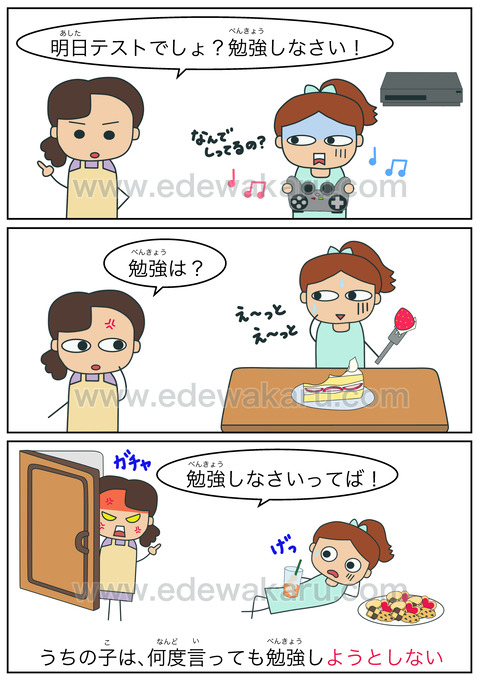
Meaning
全然〜する様子がない
How to use it
動詞[意向形]+としない
動詞[意向形]+ともしない
Explanation
「〜ようとしない」は「まったく〜する様子がない」という意味の文型です。「しなければいけないことや、するつもりだったことを全然しない」と言いたい時に使われます。
「〜ようともしない」は、「〜ようとしない」を強調した言い方です。
[例]
娘は、何度言っても勉強し
ようとしない
→娘は、何度言っても勉強し
ようともしない
「〜ようとする」の復習をしておきましょう😊
【関連記事】
In context 5 examples
うちの娘は、何度言っても勉強しようとしない
→まったく勉強する様子がないA:彼女にちゃんと説明した?B:うん。でも、ぼくの話を聞こうとしないんだ…
→全然ぼくの話を聞かないんだ…母:お父さんを起こしてきてくれる?娘:嫌だよ…だって、起こしても起きようとしないんだもん
→起こしても全然起きないんだもん彼は、昨日何があったのか話そうとしない
→昨日何があったのか、まったく話さない山田くんったら、みんなに迷惑をかけたのに謝ろうとしないのよ
→まったく謝る様子がない
Usage 2
Read this source entry ↗Meaning
全然〜する様子がない
How to use it
動詞[意向形]+としない
動詞[意向形]+ともしない
Explanation
「〜ようとしない」は「まったく〜する様子がない」という意味の文型です。「しなければいけないことや、するつもりだったことを全然しない」と言いたい時に使われます。
「〜ようともしない」は、「〜ようとしない」を強調した言い方です。
[例]
娘は、何度言っても勉強し
ようとしない
→娘は、何度言っても勉強し
ようともしない
「〜ようとする」の復習をしておきましょう😊
【関連記事】
In context 5 examples
うちの娘は、何度言っても勉強しようとしない
→まったく勉強する様子がないA:彼女にちゃんと説明した?B:うん。でも、ぼくの話を聞こうとしないんだ…
→全然ぼくの話を聞かないんだ…母:お父さんを起こしてきてくれる?娘:嫌だよ…だって、起こしても起きようとしないんだもん
→起こしても全然起きないんだもん彼は、昨日何があったのか話そうとしない
→昨日何があったのか、まったく話さない山田くんったら、みんなに迷惑をかけたのに謝ろうとしないのよ
→まったく謝る様子がない