DoJG 日本語文法辞典(全集)
Meaning
When; then
How to use it
Vinformal past | ところ | |
| 使ったところ | When someone used (it) |
Explanation
A dependent noun which is used to express the idea that when someone did something, something took place as the result.
In context 7 examples
先生に相談したところ、ぜひ大学院に行くよう進められた。
When I consulted with my teacher, he strongly advised me to go to graduate school.
部長に頼んでみたところ、喜んで引き受けてくれた。
When I asked my boss (literally: department chief), he was glad to do it.
友達に話したところ、しばらく考えさせて欲しいと言った。
When I told one of my friends (about that), he said he would like to think (literally: would like me to let him think) (about it) for a while.
これまでに書いた論文を本にしたとろこ、意外によく売れた。
When I published a book of the papers that I had written (literally: till this time), it sold unexpectedly well.
人に勧められてヨガを始めたところ、非常に効果があることが分かった。
I started yoga because someone recommended it; then, I realised it had a great effect.
冗談のつもりで言ったところ、思わぬ結果になって驚いている。
I'm surprised that what I said as a joke had unexpected consequences' (literally: that when I said it as a joke, it brought about an unexpected result).
その仕事に興味のある旨、手紙を出したところ、すぐに面接をしたいとの返事があった。
When I wrote to them saying that I was interested in the job, I got a letter immediately saying they wanted to interview me.
日本語文型辞典
Usage 1
Meaning
「今」「げんざい」「この」など「今」を表す名詞に付いて、「現段階、今の時点、最近」といった、現在の時間的状況を表す。
うわさや、ニュースが人に知られる状態になるという意味。「知るところとなる」の形をとるのが普通。書きことば的。
「聞く」「話す」「伝える」などの発言や伝達の動詞を受けて、後に続くことがらが伝聞情報であることを示す。文末には「らしい/そうだ/とのことだ」などを伴うことが多い。ニュース報道などでよく使われる。
欧文の関係代名詞の直訳的表現。日本語では「彼の目指す理想の社会」のように、必ずしもこれを用いる必要はないが、使用した場合は翻訳調に聞こえる。書きことば的。
前後に同じ動詞が用いられ、動作・変化が極限・最終段階に至るという意味を表す。②③のように可能を表す「V-れる」を使った場合は、可能な限りその動作を行うという意味になる。
直接の経験を根拠に話し手が推量を述べる場合に用いる。文末には「らしい/ようだ/にちがいない」などが使われることが多い。「…ところから」や「…ところからみて」という形が用いられることもある。
How to use it
Nのところ
V-るところとなる
V-るところによると/よれば
V-る/V-ているところのN
V-るところまでV
V-ているところをみると
In context 16 examples
今のところ患者は小康状態を保っています。
現在のところ応募者は約100人ほどです。
このところ肌寒い日が続いている。
この政治的スキャンダルは、還からず世界中の人々が知るところとなるだろう。
彼らの別居はたちまち周囲の人の知るところとなった。
聞くところによれば、あの二人は離婚したそうだ。
現地記者の話すところによると、戦況は悪化する一方のようである。
特派員の伝えるところによると、アフリカの飢饉はさらに悪化しているらしい。
私が知るところの限りでは、そのようなことは一切ございません。
彼が目指すところの理想の社会とは、身分差別のないすべての人が平等であるような社会であった。
堕ちるところまで堕ちてしまった。
とにかく、行けるところまで行ってみよう。
時間内にやれるところまでやってみてください。
平気な顔をしているところをみると、まだ事故のことを知らされてないのだろう。
大勢の人が行列しているところを見ると、安くておいしい店のようだ。
(例) 高級車に乗っているところから、相当の金持ちだと思われる。
Usage 2
Meaning
動作を表す動詞のタ形に付いて、後に続くことがらの成立や、発見のきっかけを表す。前後にくることがらには直接的な因果関係はなく「…したら、たまたま/偶然そうであった」という関係である。後に続くことがらは前の動作をきっかけに話し手が発見した事態で、すでに成立している事実の表現が用いられる。④のように「V-たところが」の形で「が」を伴うこともある。その場合は、後件が期待に反する内容であることが多い。
「のに」で言いかえられる逆接的な用法で、結果が予想・期待に反したものであることを表す。上の順援用法と異なり「が」は省略されないのが普通である。
How to use it
V-たところ【順接】
V-たところが【逆接】
In context 7 examples
先生にお願いしたところ、早速承諾のお返事をいただいた。
駅の遺失物係に間い合わせたところ、届いているとのことだ。
ホテルに電話したところ、そのような名前の人は泊まっていないそうだ。
教室に行ってみたところが、学生は一人も来ていなかった。
親切のつもりで言ったところが、かえっで恨まれてしまった。
高いお金を出して買ったところが、すぐ壊れてしまった。
仕事が終わって急いで駆けつけてみたところが、講演はもうほとんど終わってしまっていた。
絵でわかる日本語
Meaning
〜なのに
〜という状況なのに
How to use it
動詞[普通形]+ところ
動詞[ている]+ところ
動詞[ます形]+中のところ
い形容詞[辞書形]+ところ
な形容詞[ーな]+ところ
名詞[辞書形]+のところ
Explanation
「〜ところを」は「〜のに」「〜という状況なのに」という意味を表す文型です。この文型は、相手に迷惑をかけたりする場合などによく使われ、
後ろには【お詫び】【感謝】【依頼】などの文がきます。
この用法の場合は「〜ところを」の「を」を省略することができます。
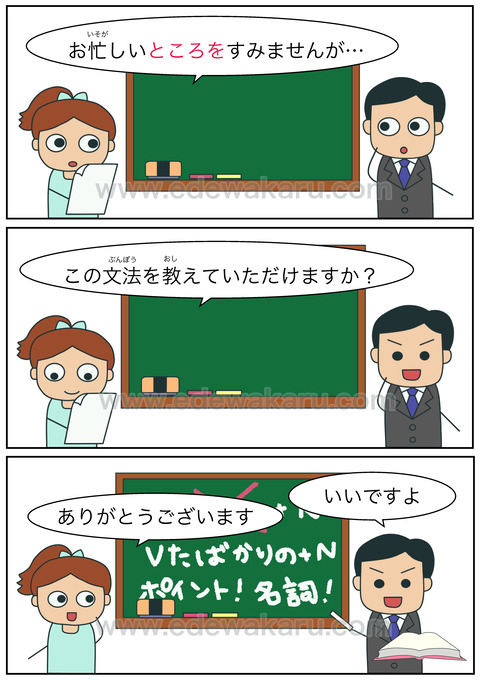
①学生:お忙しい
ところを
すみませんが、この文法を教えていただけますか?
→お忙しいのにすみませんが、この文法を教えていただけますか?
【依頼】
②本日はお忙しい
ところ
来ていただき、ありがとうございました
→お忙しいのに来ていただき、ありがとうございました
【感謝】
③お急ぎの
ところを
電車が遅れてしまい、大変申し訳ございません
→お急ぎなのに電車が遅れてしまい、申し訳ございません
【お詫び】
④お疲れの
ところを
悪いんだけど、これに目を通してくれる?
→疲れているのに悪いんだけど、これに目を通してくれる?
【お詫び】
⑤休憩している
ところを
申し訳ないんだけど、会議の資料がどこにあるか教えてくれる?
→休憩しているのに申し訳無いんだけど、資料がどこにあるか教えてくれる?
【お詫び】
また、
この文型には「〜中のところを」という形もあります😀
[例]
お休み
中のところを
お電話してすみません
お楽しみ
中のところを
申し訳ありませんが、少しお時間をいただけますか?
この「〜ところを」はよく使われる形を覚えておくといいと思います。
[よく使われる形]
・〜ところをありがとうございます
・〜ところを申し訳ありません
・〜ところを悪いんだけど…
・〜ところをありがとうございます
「〜ところを」には「〜ている場面を」という意味もありますので、いっしょに覚えておきましょう。
「ところ」がつく文型はたくさんありますので、復習をしておきましょう😀
In context 5 examples
学生:お忙しいところをすみませんが、この文法を教えていただけますか?先生:いいですよ
本日はお忙しいところ来ていただき、ありがとうございました
お急ぎのところを電車が遅れてしまい、申し訳ございません
お疲れのところを悪いんだけど、これに目を通してくれる?
休憩しているところを申し訳ないんだけど、会議の資料がどこにあるか教えてくれる?
毎日のんびり日本語教師
Usage 1
Read this source entry ↗How to use it
名詞+のところ(を)
イ形容詞基本形+ところ(を)
Explanation
相手に対するお願いや謝罪、挨拶などをする前置きとして用います。
前件には前置き、後件には「申し訳ありません」「ありがとうございます」「お願いいたします」などの感謝、謝罪、依頼を述べます。
相手に何らかの迷惑をかける場合に用いるへりくだった表現です。
「そこのところ(そこんところ)」は前件を指す指示詞として用います。
Notes
「ところ」シリーズ
In context 11 examples
お忙しいところを申し訳ありませんが、よろしくお願いいたします。
お楽しみのところお邪魔しました。(在您高兴的时候打扰了)
お取込み中のところを失礼致します。(在收款时失礼了。)
お休みのところ大変申し訳ございませんが、急ぎですのでこの書類に目を通していただけませんか。
お忙しいところご丁寧にお答えくださり、どうもありがとうございました
お休みのところわざわざお返事をありがとうございます。
お急ぎのところ大変恐縮ですが、最新の配送状況については注文履歴をご確認いただき、今しばらくお待ち下さいますようお願いいたします。
皆さま、本日はご多忙のところ、お集まり頂きまして誠にありがとうございます。
お暑いところ、ご来店ありがとうございました。
お忙しいところ恐れ入ります、お伺いしたいことがあるのですがよろしいですか?
お忙しいところご対応いただき、誠にありがとうございます。
Usage 2
Read this source entry ↗How to use it
名詞+のところ(を)/のところだが
い形容詞+ところ(を)/ところだが
な形容詞語幹+な/である+ところ(を)/ところだが
動普通形+ところ(を)/ところだが
Explanation
普段と比較したとき、現状が特殊であることを表します。
前件には「通常」「普通」「本来」「いつもは」などの語が来やすく、前件と後件を対比させるような文型を取ります。
Notes
「ところ」シリーズ
In context 6 examples
通常は2980円のところを、本日限り980円となっています。
いつもは30分のところを、渋滞で1時間かかった。
普通なら許されないところだが、今回は黙っておいてやる。
全身マッサージ1時間1万円のところ、今なら30分サービスとなっています。
本来なら直接お伺いするところですが、お時間合わず申し訳ありませんでした。
普段は夜10時までのところ、年末年始につき今日限り夜6時までの営業となります。
日本語文型辞典 英語版
Meaning
Attaches to nouns denoting the present, such as 今 (now), げんざい (at present), and この... (this...). Expresses a situation as of the present moment, as in “at the present stage, at this point, recently.”
Means that a rumor or news becomes common knowledge. Usually used in the form 知るところとなる. Has the tone of written language.
Uses verbs that denote the output or transfer of information, like 聞く (hear), 話す (speak), or 伝える (tell), and is followed by a clause that specifies the information that has been relayed. The sentence often ends with expressions such as らしい (seem/appear), そうだ (they say/I hear), or とのことだ (so they say). Often used in news reports.
This expression is a rather direct translation of relative pronouns used in Western languages. In Japanese it is possible to say, for example, 彼の目指す理想の社会 (the ideal society he aspires to), so there is usually no need to use this expression; when it is used, it sounds like a translation. Used mostly in written language.
The same verb is used at the beginning and end of this pattern to express the notion that an action or change reaches its utmost limit or an ultimate stage. When the potential form V-れる is used, as in
(2)
and
(3)
, the meaning is that the action is performed to the greatest extent possible.
Used when the speaker is stating a supposition based on firsthand experience. At the end of the sentence, expressions such as らしい (seem/appear), ようだ (like/as if), or にちがいない (must be/without a doubt) are often used. The forms ...ところから and ...ところからみて may also be used.
(例)高級車に乗っているところから、相当の金持ちだと思われる。
Seeing as he drives a luxury car, we can presume he’s quite wealthy.
ところ is attached to the ta-form of an action verb to express the occurrence of a situation and the triggering of a discovery. The situations that appear before and after this expression are not in a direct cause-effect relationship; rather, their relationship is something like “when I did..., by chance/it so happened that such-and-such was the case.” The situation in the second clause is a discovery on the part of the speaker that was triggered by the action in the first clause, and this discovery is stated using language that denotes a previously-realized fact. Sometimes ところ is followed by the particle が, as in
(4)
, creating the form V-たところが. In this case, the second clause usually expresses a situation contrary to expectation.
This adversative usage can be replaced by のに (even though) and expresses that an outcome is contradictory to anticipation or expectation. In contrast to the resultative usage shown above, が is usually not omitted.
How to use it
1. Nのところ
2. V-るところとなる
3. V-るところに よると/よれば
4. V-る/V-ている ところのN
5. V-るところまでV
6. V-ているところをみると
1. V-たところ〈resultative〉
2. V-たところが〈adversative connective〉
In context 22 examples
今のところ患者は小康状態を保っています。
At present the patient’s condition is stable.
現在のところ応募者は約 100 人ほどです。
We currently have about 100 applicants.
このところ肌寒い日が続いている。
We’re having a spell of chilly weather these days.
この政治的スキャンダルは遠からず世界中の人々が知るところとなるだろう。
It won’t be long before this political scandal becomes known to people all over the world.
彼らの別居はたちまち周囲の人の知るところとなった。
The news of their separation immediately became common knowledge to everyone around them.
聞くところによれば、あの二人は離婚したそうだ。
According to what I hear, apparently those two have divorced.
現地記者の話すところによると、戦況は悪化する一方のようである。
The reporters on location are saying that the war situation is steadily worsening.
特派員の伝えるところによると、アフリカの飢饉はさらに悪化しているらしい。
What we hear from the special correspondents is that the famine in Africa seems to be getting even worse.
私が知るところの限りでは、そのようなことは一切ございません。
As far as I know, that is not the case at all.
彼が目指すところの理想の社会とは、身分差別のないすべての人が平等であるような社会であった。
The ideal society to which he aspired was one in which there is no discrimination according to status but equality among all people.
堕ちるところまで堕ちてしまった。
She sank as low as it was possible for her to sink.
とにかく、行けるところまで行ってみよう。
At any rate, let’s try to go as far as we can.
時間内にやれるところまでやってみてください。
Please try to do as much as you can in the allotted time.
平気な顔をしているところをみると、まだ事故のことを知らせられてないのだろう。
From the calm expression on his face, I would guess that he hasn’t heard about the accident yet.
大勢の人が行列しているところを見ると、安くておいしい店のようだ。
Judging from the long line of people, it looks like a good restaurant with reasonable prices.
先生にお願いしたところ、早速承諾のお返事をいただいた。
On making a request of my teacher, I immediately received a reply of consent.
駅の遺失物係に問い合わせたところ、届いているとのことだ。
Upon contacting the lost and found office at the station, I was told that my article had been turned in.
ホテルに電話したところ、そのような名前の人は泊まっていないそうだ。
When I called the hotel, I was told that there was no one by that name staying there.
教室に行ってみたところが、学生は一人も来ていなかった。
When I went and took a look at the classroom, there wasn't a single student there.
親切のつもりで言ったところがかえって恨まれてしまった。
I spoke with the intention of being kind, and instead I find myself being resented.
高いお金を出して買ったところが、すぐ壊れてしまった。
I spent a lot of money to buy it, and it broke right away.
仕事が終わって急いで駆けつけてみたところが、講演はもうほとんど終わってしまっていた。
After finishing work I rushed to get there as soon as I could, only to find that the performance was already almost over.
AIUEO JLPT Grammar
Meaning
This sentence pattern indicates the time or situation when an action occurs, connecting with the dictionary form of verbs. It highlights the moment when the action is being performed, just before or after it happens. In casual speech, 「ところ」may be simplified to 「とこ」.
How to use it
動詞辞書形+ところ
Explanation · 日本語
この文型は、動作が行われる時点や場面を示す表現で、動詞の辞書形に接続して使います。この表現は、行為が今まさに行われる瞬間や、その直前、直後などの状況を表すために使われます。口語では、「ところ」を「とこ」に簡略化することがよくあります。
In context 5 examples
今、食べるところです。
I’m about to eat now.
会議を始めるところです。
We are about to start the meeting.
今、出発するとこです。
We are about to depart now.
ちょうど買い物に行くところです。
I’m about to go shopping.
あとちょっとで、ぶつかるところだった。
We almost collided.
文法
Meaning
〜のに / 〜という状況なのに相手の状況を配慮した表現。
How to use it
普通形 + ところ(を)
In context 4 examples
先生、お忙しいところすみません。ちょっと教えていただきたいことがあるんですが。
田中くん、休んでいるところ悪いんだけど、この書類、誤字があったから訂正してくれる?
本日はお忙しいところ、お時間を割いていただき、ありがとうございました。
ただ今、人身事故による影響で電車が遅れております。お急ぎのところ申し訳ございません。
Yokubi — The Common Grammar Guide (https://yoku.bi)
Explanation
事 and 物 both mean "thing". 事 is generally used for intangible things like actions or states, and 物 is generally used for tangible things like objects. Grammatically, they are nouns, so just like any other noun they can be modified by verbs and adjectives.
所 is a word that means "place". It is used in similar patterns, including ones about intangible places like moments in time or progress, and aspects of an entity. It is often contracted to とこ.
All three of these generic nouns can turn entire phrases into nouns. This lets Japanese use phrases like things without using embedded clauses. This is basically a special simplified case of the relative clauses we learned about in [Lesson 14](../../Section1/Part1/Lesson14.md).
These generic nouns are the base of common phrases and expressions like the following:
死ぬことはない is literally something like 'there is no “will die” event/moment'.
Another one is \<verb\>たことがある which literally means something like "the action of having done \<verb\> exists" and it means "to have done \<verb\> before":
こと in particular is often used to nominalize verbs. We do a similar thing in English with the ‘ing' construction: "To play soccer" is an action, but "the act of play**ing** soccer" is a(n abstract) thing.
In Japanese we can also use の to achieve a similar result. There are some instances where こと and の cannot replace each other, but for the most part their usage is very similar when nominalizing actions.
の can also be used as a generic noun to replace a more specific word when what we are talking about can be inferred from context. This works with both adjectives and verbs.
In context 2 examples
ちょうどいいところに来ました。
You came just at the right moment. (moment = "place" in time)
こういうところが彼女のいいところだ。
This aspect of her is what is good (about her)
NINJAL 日本語文型データベース
Meaning
〜てみたら、ある結果になった、または、ある結果がわかったと言いたいときに使います。
How to use it
Vたところ
Notes
過去の1回だけの出来事について説明するときに使います。「〜」には、意志的な行為を表す動詞がきます。「〜ところ」の後には「〜」をきっかけに話し手が発見した事実を表す文がきます。
In context 5 examples
新しく買ったパソコンの電源が入らなかったのでサービスセンターに問い合わせたところ、無料で交換してもらえることになった。
長男が生まれるとき、育児休暇の取得について上司に相談したところ、制度はあっても前例がないと言われてしまった。
若手社員のアイデアで新商品を作ってみたところ、予想外の大ヒットとなった。
毎日早起きして30分ジョギングするという生活を続けたところ、3か月で10キロやせた。
一日の睡眠時間について20歳以上の男女に聞いたところ、男性の37.5%、女性の40.6%が6時間未満と答えた。
IMABI
Combination Particles with ところ
Read this IMABI lesson ↗Explanation
Combination Particles with ところ
While learning about the particle ところ, you’ll be introduced to combination particles. We’ve seen many instances where 2(+) particles can be used together, but we haven’t really dealt with instances where one or more used together make a new phrase.
Combination Particles: A particle phrase made up of either more than one particle or a particle(s) with another part of speech.
ところ
The noun 所 means “place”. There are four usages of ところ. These usages can be used in many situations. It can be used to show place, moment of time, situation, or the substance of a matter. More specific things that it can show include the following.
Show a specific space or spot.
Show a particular place, part, or position.
Show a point, address, region, etc.
Shows the current time in phrases like このところ and 今日の所.
Show a particular time.
With a meaning of content/outline.
早いところ = Promptly
When seen after a verb, tense is very important for correct interpretation. With the non-past tense, ところ means “just about to…”. When used with the past tense of a verb, it shows what you “just did”. This can only be used to indicate the time when a certain action has literally just been done. If you want to say that you just recently did something, you should use ~たばかりです.
When used with the progressive, it shows that you are now doing a certain action. The “just” may also be emphasized with adverbs such as ちょうど. This is simply an extension of translation of its usage to show time. The tense just shows the time factor.
1. 帰るところだ。
I’m about to go home.
2. 学校に行くところでした。
I was about to go to school.
3. 事故を起こすところだったよ。
I was about to cause an accident.
4. 忘れるところでした。
I almost forgot.
5. よく晴れるところもあります。
There are also places where it is quite clear.
6. 雨の降るところもありそうです。
There also seems to be places where it’s raining.
7. 陽が沈むところです。
The sun is about to set.
8. 会社を出たところです。
I just left the company.
9. 彼の言ったところが分かりませんでした。
I didn’t understand what he said.
10. この国の議会では、B党の占めるところが大きい。
In this/our country’s parliament, B party is the majority.
11. 彼女の理論は、仲間の調査によるところが大きい。
Her theory mainly relies on the research by his friends.
12. 人は建物を余すところなく建てている。
People are building buildings exhaustively.
13. もう一歩いっぽといったところですが。
You’re just one more step away, but…
14. 私たちは田舎に新築の家をちょうど買ったところです。
We have just bought a new house in the countryside.
Grammar Note: You can also see ところ after speech modals like ~ようとする ~てしまった. It works the same way.
Combination Particles with ところ
The meaning of a combination will reflect that of its individual parts put together. However, for the conjunctive particles that are created with ところ, this may not be that obvious. These combinations below may also not be used as conjunctive particles and can be more literally interpreted in different situations. Don’t let punctuation get the best of you.
Meaning Usage
ところへ Just when Shows coincidence of events after -ている or -た.
ところが But/while Shows unexpected bad outcome.
ところで Even if (X) were to… Poses an undesirable hypothetical situation.
ところを Although usually Shows something unexpected is happening
Grammar Notes:
1. ところ may often be shortened to just とこ.
2. ところへ may also be ところに.
3. The particle ところ either shows a sequence or contradiction depending on context. The last usage is synonymous with ところが. These are conjunction usages of ところ.
Examples
15. 科学の宿題をし始めようとしているところへ、僕の友だちが遊びにきた。
Just when I was about to start doing my science homework, my friends came to play.
16. 俄にわか雨あめがやんだところへ、台風たいふうが町を襲おそった。
Just when the shower quit, a typhoon hit the town.
17. 彼女は僕が好きらしいんだよね。ところが、彼女の方は僕が知ってるなんて全く気がついてないよ。
She (seems) to love me you know. But, she doesn’t realize that I know it at all.
Grammar Note: As you can see, ところが may also be used as a conjunction at the beginning of a sentence to mean “even so/however/but”.
18. 半分したところで、彼はもう済ませたよ。
I’ve finished half, but he’s already finished!
19. いつもなら6時に起きるところを、今朝は寝坊ねぼうして、学校に遅刻してしまった。
Although I always wake up at six, I overslept this morning and became late to school.
In context 22 examples
帰るところだ。
I’m about to go home.
学校に行くところでした。
I was about to go to school.
事故を起こすところだったよ。
I was about to cause an accident.
忘れるところでした。
I almost forgot.
よく晴れるところもあります。
There are also places where it is quite clear.
雨の降るところもありそうです。
There also seems to be places where it’s raining.
陽が沈むところです。
The sun is about to set.
会社を出たところです。
I just left the company.
彼の言ったところが分かりませんでした。
I didn’t understand what he said.
この国の議会では、B党の占めるところが大きい。
In this/our country’s parliament, B party is the majority.
彼女の理論は、仲間の調査によるところが大きい。
Her theory mainly relies on the research by his friends.
人は建物を余すところなく建てている。
People are building buildings exhaustively.
もう一歩いっぽといったところですが。
You’re just one more step away, but…
私たちは田舎に新築の家をちょうど買ったところです。
We have just bought a new house in the countryside.
ところ may often be shortened to just とこ.
Examples
ところへ may also be ところに.
Examples
The particle ところ either shows a sequence or contradiction depending on context. The last usage is synonymous with ところが. These are conjunction usages of ところ.
Examples
科学の宿題をし始めようとしているところへ、僕の友だちが遊びにきた。
Just when I was about to start doing my science homework, my friends came to play.
俄にわか雨あめがやんだところへ、台風たいふうが町を襲おそった。
Just when the shower quit, a typhoon hit the town.
彼女は僕が好きらしいんだよね。ところが、彼女の方は僕が知ってるなんて全く気がついてないよ。
She (seems) to love me you know. But, she doesn’t realize that I know it at all.
半分したところで、彼はもう済ませたよ。
I’ve finished half, but he’s already finished!
いつもなら6時に起きるところを、今朝は寝坊ねぼうして、学校に遅刻してしまった。
Although I always wake up at six, I overslept this morning and became late to school.