文法
Meaning
① 我慢できないくらい~だ
気持ちが強く、抑えることができないことを表す。
② 最高に〜だ
How to use it
V(て形) + しかたがない
イAくて + しかたがない
ナAで + しかたがない
In context 9 examples
大学受験の結果が気になってしかたがない。
ゲーム終了1分前に逆転されてしまい、負けてしまった。本当に悔しくてしかたがない。
第一志望の大学に合格できたので、嬉してしかたがありません。
会社の飲み会が嫌でしかたがない。
海外で一人暮らしを始めたばかりなので、寂しくてしかたがありません。
私の国で大きな地震があったようで、家族と現在連絡がとれません。本当に心配でしかたがありません。
USBをジーンズのポケットに入れたまま洗濯してしまい、残念でしかたがない。
最近はやることがないので、毎日が暇でしかたがない。
昨日のパーティーであった彼女のことが気になってしかたがない。
どんなときどう使う 日本語表現文型辞典
Meaning
extremely
How to use it
Vて/イAくて/ナAで+しかたがない
Explanation
非常に~だ
1)ある感情や体の感覚が起こってその状態が「強くて抑えられない」というときに使う。
2)話者の感情・体の感覚・欲求などを表す言い方であるから、3人称に使うときは文末に「ようだ・らしい・のだ」をつける必要がある。
3) ❹ のように「思える・泣ける」などの自発を表す動詞とともに使える。
4)「てしょうがない」は話し言葉。
2)Necessary to add to end of sentence ようだ, らしい, or のだ for the third person because only describes speaker's feelings, bodily sensations, or demands.
3)Can also be used with reflexive verbs such as 思える, or 泣ける.
4)てしょうがない is spoken form.
1)Speaker cannot repress strong emotions or sensations.
In context 4 examples
いよいよあした帰国できるかと思うと、うれしくてしかたがありません。
毎日会社に行って、人に会うのがいやでしかたがない。
朝から寒気がしてしかたがない。熱が出るのかもしれない。
体の調子が悪いときは、周りの人たちがうるさく思えてしかたがない。
絵でわかる日本語
Meaning
とても〜だ
とても〜で我慢できない
How to use it
動詞・形容詞[て形]+てしかたがない
動詞・形容詞[て形]+てしょうがない
Explanation
「〜てしかたがない」は「とても〜だ」「とても〜で我慢できない」という意味の文型です。強い[感情]や[感覚]を表す文型で、その[感情・感覚]が自分ではコントロールできないという時に使います。「〜てしかたがない」は、「が」を省略して
「〜てしかたない」
と言われることもあります。また、会話では
「〜てしょうがない」
という形がよく使われます。
[例]
お腹が空い
てしかたがない
=お腹が空い
てしかたない
=お腹が空い
てしょうがない
【上級レベルの人へ】
「〜てしかたがない」は、「自分ではコントロールできなくて困った状態だ」と言いたい時にも使われるます。コントロールできない状態に
困ったり、イライラしたりする場合
に使われます。
[例]
①赤ちゃんが泣い
てしかたがない
→赤ちゃんがずっと泣いていてすごく困る
②娘が言うことを聞かなく
てしかたがない
→娘が言うことを聞かなくて、イライラする
③年をとったせいか、忘れっぽくなっ
てしかたがない
→忘れっぽくなって、すごく困る
「〜てしかたがない」に似ている文型はたくさんありますので、復習をしておきましょう。
【関連文型】
In context 6 examples
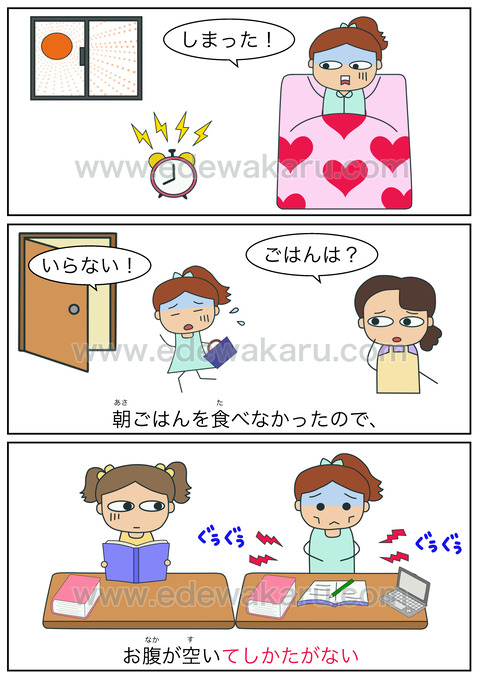
朝ごはんを食べなかったので、お腹が空いてしかたがない
→とてもお腹が空いて、我慢できない試験の結果が気になってしかたがない
→とても気になる(早く結果が知りたくて我慢できない)N1に合格した!うれしくてしかたがない!!
→とてもうれしい昨日はお酒を飲みすぎた…頭が痛くてしかたがない
→とても頭が痛くて我慢できない台風のせいで旅行に行けなくなった。残念でしかたがない
→とても残念だ山田くんに秘密をばらされた!腹が立ってしかたがない
→すごく腹が立って我慢できない
日本語文型辞典
Meaning
基本情報NaでしかたがないA-くてしかたがないV-てしかたがない説明自然に何らかの感情や感覚が起こってきて自分ではコントロールできない状態を表す。押さえようとしても押さえられない状態で、そのためその感情の程度が非常に高いことを表す場合が多い。「…てしかたがない」の前には感情や感覚や欲求を表す言葉が用いられるのが普通で、ものの属性や評価についての言葉を用いると、不自然な文になる。例文① 公園で出会って以来、彼女のことが気になってしかたがない。② この映画はみるたびに、涙が出てしかたがない。③ 何とか仕事に集中しようとしているのだが、気が散ってしかたがない。④ 毎日ひまでしかたがない。⑤ 試験に合格したので、うれしくてしかたがない。⑥ 台風のせいで、あの山に登れなかったのが、今でも残念でしかたがない。⑦ わたしが転職したのは、前の会社で働くのがいやでしかたがなかったからだ。⑧ 田中さんは孫が可愛くて仕方がないらしい。例文(誤) 歌が下手で仕方がない。例文(正) 歌がとても下手だ。説明直接感情や感覚を表さない場合でも、その事態をコントロールできないことから困惑したりいらだったりする状態が生じる場合は用いることができる。例文(例) 最近うちの息子は口答えをしてしかたがないんです。
年のせいか物忘れをしてしかたがない。説明「が」を省略して「…てしかたない」となることもある。また、くだけた話しことばでは「…てしょうがない」とも言う。「てならない」との違いについては【てならない】を参照。
日本語文型辞典 英語版
Meaning
【てしかたがない】[Na でしかたがない][A-くてしかたがない][V-てしかたがない]
Expresses an emotion or feeling arising naturally from a source beyond the control of the speaker. Often used to express an irrepressibly strong emotion. Usually preceded by an expression of emotion, feeling, or desire; use of words denoting an attribute or evaluation leads to awkward constructions.
(×)歌が下手で仕方がない。
Her singing can’t help but be poor.
(○)歌がとても下手だ。
Her singing is really poor.
In addition to directly expressing emotion or feeling, this construction can also be used in cases when a situation lies beyond the control of the speaker and results in problems or annoyance.
(例)最近うちの息子は口答えをしてしかたがないんです。
Recently our son has taken to talking back to us and we don’t know what to do.
(例)年のせいか物忘れをしてしかたがない。
It might just be age, but I’m getting awfully forgetful.
At times が is omitted, resulting in the construction ...てしかたない. In casual conversation, the form ...てしょうがない is also used. For the difference in meaning from てならない, refer to that section.
In context 8 examples
公園で出会って以来、彼女のことが気になってしかたがない。
Ever since I met her in the park, I just can’t get her out of my mind.
この映画はみるたびに、涙が出てしかたがない。
I just can’t help tearing up every time I watch this movie.
何とか仕事に集中しようとしているのだが、気が散ってしかたがない。
No matter how much I try to concentrate on my work, I just can’t keep my mind from wandering.
毎日ひまでしかたがない。
I have too much time on my hands every day.
試験に合格したので、うれしくてしかたがない。
I couldn’t contain myself after passing the examination.
台風のせいで、あの山に登れなかったのが、今でも残念でしかたがない。
I still regret that I couldn’t climb that mountain because of a typhoon.
わたしが転職したのは、前の会社で働くのがいやでしかたがなかったからだ。
The reason I changed jobs was that I just couldn’t stand working at my previous company.
田中さんは孫が可愛くて仕方がないらしい。
Apparently Tanaka-san dotes shamelessly on her grandchild.
日本語NET JLPT文法解説まとめ
Meaning
① 我慢できないくらい~だ
気持ちが強く、抑えることができないことを表す。
② 最高に〜だ
How to use it
V(て形) + しかたがない
イAくて + しかたがない
ナAで + しかたがない
In context 9 examples
大学受験の結果が気になってしかたがない。
ゲーム終了1分前に逆転されてしまい、負けてしまった。本当に悔しくてしかたがない。
第一志望の大学に合格できたので、嬉してしかたがありません。
会社の飲み会が嫌でしかたがない。
海外で一人暮らしを始めたばかりなので、寂しくてしかたがありません。
私の国で大きな地震があったようで、家族と現在連絡がとれません。本当に心配でしかたがありません。
USBをジーンズのポケットに入れたまま洗濯してしまい、残念でしかたがない。
最近はやることがないので、毎日が暇でしかたがない。
昨日のパーティーであった彼女のことが気になってしかたがない。
IMABI
Can’t Help II
Read this IMABI lesson ↗Explanation
Can’t Help II: ~てならない, ~てやまない, ~てしかたがない, ~にたえない, & ~てたまらない
This lesson will continue coverage on phrases regarding “not being able to restrain” one’s emotions or feeling. The phrases here with exception to ~にたえない, which is brought up because of ~てこたらない, all use the て form to attach to verbs/adjectives, but be careful about what kind of words they can semantically be used with.
~てならない
~てならない is found primarily in the written language, though this doesn’t mean you can’t hear it be used in the spoken language, and its purpose is to show that a certain feeling can’t be helped being felt/thought. If the verb, though, does not refer to emotion or something spontaneous, it cannot be used. This pattern, also, does not attach to the negative form.
1. 不思議に思えてならない。
I can’t help but think it’s strange.
2. 悪化するように思えてならない。
I can’t help but think that it’s going to get worse.
3. もう10年も故郷ふるさとに帰っていないので、両親に会いたくてならない。
Since it’s already been 10 years since I haven’t been home at my hometown, I can’t help but want to meet my parents.
漢字 Note: 故郷 may also be read as こきょう.
4. 肘ひじが痛くてならない。
I can’t help but think about my hurting elbow.
5. 退屈たいくつな日本語の授業に出ていると、眠くてならない。
I can’t help but sleep when I’m at my boring Japanese class.
6. 毎日寂さびしくてならない。
I can’t help but be sad every day.
7. 日本語能力試験が心配でならない。
I can’t help but worry about the JLPT.
8. 失敗するような気がしてなりません。
I can’t help but have the feeling that I’m going to fail.
Warning Note: Do not confuse this with the must/must not pattern ~てはならない.
~てやまない
~てやまない is a somewhat 硬かたい phrase that is used to show that one will continue to be holding a strong feeling. You just won’t stop. It is used with verbs concerning emotion, but it is not used with emotional verbs that describe temporary states. The grammatical person is usually first person. Understandably, it is not appropriate to attach this phrase to the negative form.
9. この写真に写うつっているのは私が愛してやまない犬だ。
The thing in this picture is a dog that I shall always love.
10. 親は子供の将来を期待してやまないものだ。
Parents never stop hoping for their children;s future.
11. 愛犬が死んで悲しくてやまない。
I will continue to be sad over my beloved dog dying.
12. 皆さんの幸せを願ってやみません。
I will continue to wish for everyone’s happiness.
13. ご活躍かつやくを願ってやまない。
I can’t stop wishing for you to flourish.
~てしかたがない
~てしかたがない is very similar to ~てならない, but since it originally referred to there not being a way to withstand or conquer, it gives off a feeling that one can’t stand something while thinking at the same time that there is nothing else that could be done. Therefore, it is also very common in the spoken language. This is unlike ~てならない which is often felt to be quite old-fashioned.
~てならない and ~てしかたがない are different when the verb doesn’t express something spontaneous or emotional, in which case you use ~てしかたがない because nothing is predicated in its definition that it must be used with a verb of emotion. However, this does not mean that ~てしかたがない can’t be used with verbs of spontaneity and or emotion because it still can.
Variant Note: ~しようがない and ~てしょうがない are more casual versions with the latter being the most casual.
Examples
14. もう残念でしかたがない。
It’s no use that it’s already regrettable.
15. いくら着込んでも寒くてしょうねーな。
No matter how much I wear, I’m still cold!
16. 彼が言うと、僕を非難しているように聞こえて{ならない・しかたがない}。
Whenever he says (something), I can’t help but hear it that he’s criticizing me.
17. 朝っぱらからくそ犬めが鳴くんで、うるさくしょうがねーよ。(Vulgar)
Since the damn dog barks from early in the morning, it’s annoying as hell.
18.抽選ちゅうせんにもれたなんて、残念でしかたないね。
It can’t be helped that I’m disappointed that I didn’t get drawn.
~にたえる・~にたえない
耐える means ” to endure”. ~に耐える is seen after nouns and verbs of personal attention to show the worth of something. With する verbs, する is dropped. For example, it is used in contexts such as being worth to read, hear, criticize, applaud, value, etc.
~に耐えない, though, has two usages. When used with the 連体形, it means “cannot stand/endure to…”. When used after a noun, it shows a strong emotional reaction in which one can’t hold back such emotions. This may sound very similar to the first usage, but this usage is strictly used with nouns.
Spelling Note: The phrase can also be spelled as に堪えない.
Style/Word Choice Note: It is somewhat of a stiff phrase and used with a limited number of nouns such as 感謝, 感激, 慙愧ざんき(shame), 等.
Examples
19. 感謝に耐えません。
I can’t help but thank you.
20. 見るに耐えないOLだぞ。
She’s a butt-ugly office lady.
21. 慙愧ざんき(の念)に堪えない。
To be deeply ashamed of oneself.
22. お忙しいところを多くの方にお集まりいただき、感激に堪えません。(謙譲語)
I am overwhelmed with emotion from receiving all of you gathering while you are all busy.
23. 気の毒で同情に堪えない。
I am deeply sorry for you and sympathize with you.
24. 誠まことに慨嘆がいたんに堪えない。
It is truly a matter for great regret.
25. 父は聞くに耐えない歌たいぶりをする。
My dad has an awful manner of singing.
26. 鑑賞に耐えるものだ。
It is something worth appreciating.
Word Note: Again, this phrase is used with limited words such as 見る、聞く、批判、鑑賞かんしょう、議論、etc.
~てたまらない
Although usually left in かな, if you do see this pattern written in 漢字, don’t confuse the reading for the one in ~(に)堪えない. They’re not the same, of course. This is a very common phrase in the spoken language, unlike a lot of the phrases in this lesson, and it is a strong speech style meant to show that one can’t resist a certain emotion, sense, or want.
~てたまらない can’t be used with spontaneous verbs. This is contrast with things like ~てならない and ~てしかたがない. On the other hand, if you are using an adjective that shows an objective degree, ~てたまらない can be used but ~てならない・~てしかたがない can’t.
Examples
26. 日本へ帰りたくてたまらない。
I can’t stand but want to go back home to Japan.
27. 隣の車のマフラー音がうるさくて、たまらないよ。
The muffler of the car next to me is annoying, and I can’t stand it.
28. 隣の駐車場の車の音がうるさくて、たまりません。困ってますよ。
The car noise from the parking lot next to me is annoying, and I can’t stand it. I’m at a loss.
29. お兄さんは毎日退屈で堪らないそうです。
I hear that your older brother can’t stand him being bored every day?
In context 30 examples
不思議に思えてならない。
I can’t help but think it’s strange.
悪化するように思えてならない。
I can’t help but think that it’s going to get worse.
もう10年も故郷ふるさとに帰っていないので、両親に会いたくてならない。
Since it’s already been 10 years since I haven’t been home at my hometown, I can’t help but want to meet my parents.
肘ひじが痛くてならない。
I can’t help but think about my hurting elbow.
退屈たいくつな日本語の授業に出ていると、眠くてならない。
I can’t help but sleep when I’m at my boring Japanese class.
毎日寂さびしくてならない。
I can’t help but be sad every day.
日本語能力試験が心配でならない。
I can’t help but worry about the JLPT.
失敗するような気がしてなりません。
I can’t help but have the feeling that I’m going to fail.
この写真に写うつっているのは私が愛してやまない犬だ。
The thing in this picture is a dog that I shall always love.
親は子供の将来を期待してやまないものだ。
Parents never stop hoping for their children;s future.
愛犬が死んで悲しくてやまない。
I will continue to be sad over my beloved dog dying.
皆さんの幸せを願ってやみません。
I will continue to wish for everyone’s happiness.
ご活躍かつやくを願ってやまない。
I can’t stop wishing for you to flourish.
もう残念でしかたがない。
It’s no use that it’s already regrettable.
いくら着込んでも寒くてしょうねーな。
No matter how much I wear, I’m still cold!
彼が言うと、僕を非難しているように聞こえて{ならない・しかたがない}。
Whenever he says (something), I can’t help but hear it that he’s criticizing me.
朝っぱらからくそ犬めが鳴くんで、うるさくしょうがねーよ。(Vulgar)
Since the damn dog barks from early in the morning, it’s annoying as hell.
抽選ちゅうせんにもれたなんて、残念でしかたないね。
It can’t be helped that I’m disappointed that I didn’t get drawn.
感謝に耐えません。
I can’t help but thank you.
見るに耐えないOLだぞ。
She’s a butt-ugly office lady.
慙愧ざんき(の念)に堪えない。
To be deeply ashamed of oneself.
お忙しいところを多くの方にお集まりいただき、感激に堪えません。(謙譲語)
I am overwhelmed with emotion from receiving all of you gathering while you are all busy.
気の毒で同情に堪えない。
I am deeply sorry for you and sympathize with you.
誠まことに慨嘆がいたんに堪えない。
It is truly a matter for great regret.
父は聞くに耐えない歌たいぶりをする。
My dad has an awful manner of singing.
鑑賞に耐えるものだ。
It is something worth appreciating.
日本へ帰りたくてたまらない。
I can’t stand but want to go back home to Japan.
隣の車のマフラー音がうるさくて、たまらないよ。
The muffler of the car next to me is annoying, and I can’t stand it.
隣の駐車場の車の音がうるさくて、たまりません。困ってますよ。
The car noise from the parking lot next to me is annoying, and I can’t stand it. I’m at a loss.
お兄さんは毎日退屈で堪らないそうです。
I hear that your older brother can’t stand him being bored every day?
AIUEO JLPT Grammar
Meaning
This sentence pattern expresses that an emotion or state is so strong that it cannot be controlled.
How to use it
動詞て形+しかたがないorしようがないorしょうがない形容詞て形+しかたがないorしようがないorしょうがない形容動詞で+しかたがないorしようがないorしょうがない
Explanation · 日本語
この文型は、ある感情や状態が非常に強く、それを抑えられないことを表す表現です。
In context 5 examples
昨日から何も食べていないので、お腹が空いてしかたがない。
I haven’t eaten anything since yesterday, so I’m extremely hungry.
彼のことが気になってしょうがなかった。
I couldn't help thinking about him.
試験の結果が心配でしょうがない。
I’m extremely worried about the exam results.
暑くてしかたがないので、冷たい飲み物が欲しい。
It’s unbearably hot, so I want a cold drink.
この映画は退屈でしかたがない。
This movie is unbearably boring.
DoJG 日本語文法辞典(全集)
Meaning
Cannot help ~ing; cannot stop feeling; (so ~ and) cannot control ~; so ~ and ~ cannot bare it; so; unbearably
How to use it
(i) Verb | て仕方がない | |
| 喉が乾いて仕方がない | (I) am so thirsty (and cannot bear it) |
(ii) Adjectiveいstemく | て仕方がない | |
| 悲しくて仕方がない | (I) am so sad (and can hardly control (my) emotion) |
(iii) Adjectiveな | で仕方がない | |
| いやで仕方がない | (I) dislike it so much (and (I)) can hardly control (my) emotion |
Explanation
A phrase that represents emotions the speaker/writer cannot control or sensations/situations he/she cannot bear.
In context 12 examples
会社の理不尽なリストラに腹が立って仕方がない。
I'm so mad at the company's unreasonable restructuring (i.e., laying off workers) (and cannot control my anger).
久しぶりに妻や子供たちに会えるので嬉しくて仕方がない。
Because I get to see my wife and children for the first time in a long while, I am so happy (and can hardly control my emotion).
ここは何もすることがないので退屈で仕方がない。
Because I have nothing to do here, I'm unbearably bored.
アンディーがアメリカに帰ってまだ二日しか経っていないのに、寂しくて仕方がない。
Although it's been only two days since Andy went back to America, I miss him so much (literally: I'm so lonely and can hardly control my emotion).
こんなすばらしい建物が取り壊されるのかと思うと残念で仕方がない
I feel so bad when I think that such a wonderful building is going to be demolished.
ボーイフレンドが一年の日本留学を終えて来週帰ってくる。早く会いたくて仕方がない。
My boyfriend is coming back next week after finishing his year of study in Japan. I'm dying to see him (literally: I want to see him soon so much)!
悪い風邪を引いたらしい。咳が出て仕方がない。
I seem to have a bad cold. I cannot control my coughing.
ここは空港のすぐ近くなので飛行機の音がうるさくて仕方がない。
Because this place is close to an airport, the noise from the airplanes is unbearable.
この参考書は索引が不完全なので使いにくくて仕方がない。
Because this reference book has an incomplete index, it is so hard to use.
私のうちは近くにスーパーもコンビニもないので不便で仕方がない。
Because there is neither a supermarket nor a convenience store near my house, it is unbearably inconvenient.
先週、学会で会った女性が気になって仕方がない。
I cannot stop thinking about the woman I met at the academic conference last week.
母親になった途端に自分の子供がよその子供より可愛く思えて仕方がない。
As soon as I became a mother, I couldn't help thinking that my child was cuter than other children.