DoJG 日本語文法辞典(全集)
Meaning
(in) the same way as; (in) the way; as
How to use it
(i) Noun | の通り(に) | |
| 計画の通り(に) | The same way as the plan |
(ii) Vinformal | 通り(に) | |
| 見た通り(に) | The way someone saw something |
(iii) Demonstrative Adjective | 通り(に) | |
| この通り(に) | The same way as this; this way |
Explanation
通り(に)A dependent noun which expresses the idea that someone does something or something takes place in the same way as something else.
In context 12 examples
説明書の通り(に)やったが、うまくいかなかった。
I did it as the manual shows (literally: in the same way as the manual), but it didn't work.
私の言う通り(に)体を動かして下さい。
Please move your body as I tell you to (literally: in the same way as I tell you).
思った通り彼が一番先に来ていた。
As I expected (literally: thought), he was the first to come.
結果はやはり予想した通りだった。
The result was just as I expected, after all.
この地図の通り(に)行けば間違いなく行けます。
If you go as this map shows (literally: in the same way as this map), you can get there without fail.
私はただ言われた通り(に)やっているだけです。
I'm just doing as I'm told (literally: in the way I'm told).
ここに書いてある通り(に)すれば誰にでも出来ます。
If you follow what is (literally: do it in the way) written here, anyone can do it.
予想した通り誰も宿題をやってこなかった。
As I expected, no one did their homework.
心配していた通りペンキが足りなくなった。
As I feared, I ran out of paint.
内容はこの間説明した通りです。
The content is the same as I explained to you the other day.
これは私が考えていた通りのデザインです。
This is the same design as the one I have thought about.
A:これは何語か分かりますか。B: アラビア語です。A: はい、その通りです。
A: Do you know what language this is? B: It's Arabic. A: That's right (literally: the same as you said).
絵でわかる日本語
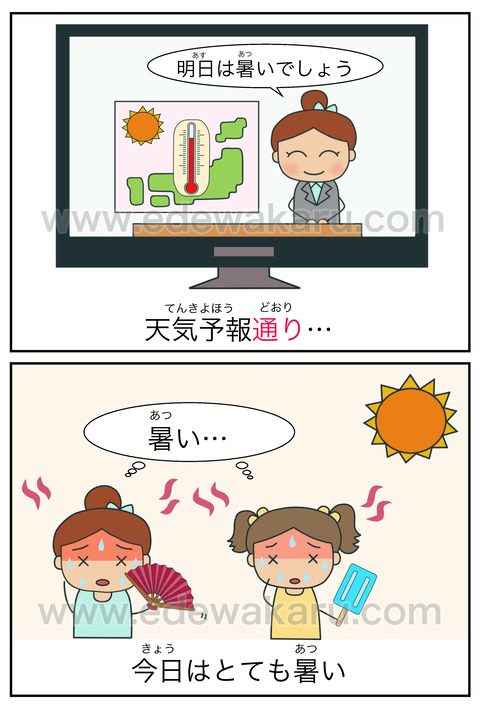
Meaning
〜と同じように
〜そのまま
How to use it
動詞[辞書形]+通り
動詞[た形]+通り
名詞[辞書形]+通り
名詞[辞書形]+の通り
Explanation
「〜通り」は「〜と同じように」という意味を表す文型です。この文型を使用するときに気をつけなければいけないのは読み方です😮動詞の場合は全部「〜とおり」になり、「名詞+どおり」「名詞+のとおり」となります😉
[動詞の場合は「〜とおり」]
私が言う
とおり
に書いてください
私が言った
とおり
に書いてください
[名詞+通りの場合は「〜どおり」]
天気予報
どおり、今日は暑かった
予想
どおり、N1は難しかった
予定
どおり
行います
[名詞+の通りの場合は「〜とおり」]
天気予報の
とおり、今日は暑かった
予想の
とおり、N1は難しかった
よく使われる単語は覚えておきましょう😀
[よく使われるもの]
予定通り・予定の通り
計画通り・計画の通り
命令通り・命令の通り
想像通り・想像の通り
希望通り・希望の通り
指示通り・指示の通り
【余裕がある人へ】
「文字通り」は慣用表現ですので覚えておきましょう。
「文字通り」→文字に書いているのと同じように・誇張せずそのまま
しっかりと覚えて会話で使ってみてくださいね😉
In context 3 examples
天気予報通り、今日はとても暑い
→天気予報(が伝えていたの)と同じように、今日はとても暑い思った通り、N1は難しかった
→思っていたのと同じように、N1は難しかった予定通り、来週から日本に出張します
→予定と同じように、来週から日本に出張します
日本語文型辞典
Meaning
数詞や「何(なん)・幾(いく)」などの疑問詞に付いて、方法や種類の数を表す。
予定・計画・指示・命令などの名詞や「思う・考える」などの思考動詞の連用形に付いて、「それと同様に」「その通りに」「そのままに」といった意味を表す。この用法ではいつも「…どおり」となる。この他の例として「命令どおり・型どおり・見本どおり・文字どおり・想像どおり」などがある。
「言う」「思う」などの発言や思考を表す動詞の辞書形/タ形に付いて、それと同じようであるという意味を表す。
How to use it
数詞/なん/いく とおり
…どおり
Nどおり
R-どおり
V-る/V-た とおり
In context 11 examples
駅からあの建物までには3通りの行き方がある。
やり方は、何とおりもありますがどの方法がよろしいでしょう。
「生」の読み方は、いくとおりあるか知っていますか。
計画はなかなか予定どおりには進まないものだ。
すべて課長の指示どおり手配いたしました。
自分の気持ちを思いどおりに書くことは、簡単そうに見えて難しい。
世の中は自分の考えどおりには動いてはくれないものだ。
おっしゃるとおりです。(=あなたの意見に賛成です。)
私の言うとおりに繰り返して言ってください。
先生の奥さんは私が想像していたとおりの美人でした。
ものごとは自分で考えているとおりにはなかなか進まない場合が多い。
毎日のんびり日本語教師
How to use it
動辞形+通り(とおり)
動た形+通り(とおり)
名詞+の+通り(とおり)
名詞+通り(どおり)
Explanation
「~に従い」「~と同じ」という意味を表します。
予定や計画、命令、指示、想像する、思う、考えるなど特定の単語と結びつきます。
Notes
特になし
In context 8 examples
計画は予定通りに進んでいる。
私の指示通りにやらなかったからこんなことになったんだろう。
書通りに操作してみたが、よく分からなかった。
ここに書いている通りにやれと言われたのでやったのに、なぜ叱られなければならないのか。
人生とは、自分が思い描いた通りに進まないものだ。
あれから事態は悪化する一方で、想像した通りの結果になった。
彼女は噂通りの美人だった。
そちらのおっしゃる通りです。
IMABI
Counters W/ Native Numbers I
Read this IMABI lesson ↗Explanation
Counters W/ Native Numbers I: ~文字・クラス・品・桁・切れ・玉・房・株・袋・箱・棟・組み・皿・束・通り・駅
In this installment on counters, we will learn about 16 counters which utilize native numbers beyond 4 and 7, especially 1-3. First, let’s review the native numbers and the Sino-Japanese numbers for 1-10.
NO.NATIVE NUMBERSINO-JAPANESE NUMBER
1ひとイチ
2ふたニ
3みサン
4よ(ん)シ
5いつゴ
6むロク
7ななシチ
8やハチ
9ここのキュウ・ク
10とおジュウ
?いく1なん
Chart Note: “?” in the charts stands for how to say “how many…”
These native numbers are hardly used equally. As stated, 1-3, also colloquially referred to as ひふみ, are used at a higher rate than 5-6, 8-10. However, counters that are generally used with several native numbers tend to have the ability of being used with most native numbers from 1-10.
Curriculum Note: Just as in prior lessons on counters, because some counter expressions have multiple pronunciations, ON readings will be in Katakana and KUN readings will be in Hiragana. Notes on intonation and variant acceptance are largely in accordance with the 2016 edition of the NHK 日本語発音アクセント新辞典. Preferred readings in the spoken language are noted in bold for visibility.
Chart Note: ※An intonation with this mark becomes unaccented (flat = LHH…) when the expression is used adverbially.
The Counters ~文字・字
The counters ~文字2 and ~字 are both used to count characters as in written symbols, but they are not entirely interchangeable. Whereas ~字 may refer to any symbol, including non-letter symbols such as punctuation marks, ~文字 exclusively counts written symbols with phonetic value.
Due to their similarity in meaning, both are mentioned here, but only ~文字 is seen used with more native numbers, as is demonstrated by the following two charts.
■~字
NO.READING(S)PITCHNO.READING(S)PITCH
1イチジLHL2ニジHL
3サンジHLL4よんジ
よジHLL
HL
5ゴジHL6ロクジLHL
7ななジ
シチジLHL8ハチジLHL
9キュウジHLL10ジュウジHLL
14ジュウよんジ
ジュウよジLHHLL
HL-HL100ヒャクジLHL
1000センジHLL10000イチマンジLHHHH
?なんジHLL
■~文字
NO.READING(S)PITCHNO.READING(S)PITCH
1ひとモジLHLL2ふたモジLHLL
3サンモジHLLL4よんモジHLLL
5ゴモジHLL6ロクモジLHLL
7ななモジLHLL8ハチモジLHLL
9キュウモジHLLL10ジュウモジHLLL
14ジュウよんモジLHHLLL100ヒャクモジLHLL
1000センモジHLLL10000イチマンモジLHHHHH
?なんもじHLLL
1. 字数制限じすうせいげんを1いち万字まんじに拡大かくだいしました。
I/we expanded the character limit to 10,000 letters.
2. その内容ないようを英語えいごの100ひゃく字じで纏まとめてください。
Please summarize the content in 100 characters in English.
3. 英語えいごでは、曜日ようびや月つきを3さん文字もじで省略しょうりゃくして書かくことがあります。
In English, you often abbreviate the days of the week and the months to three letters when writing.
4. 1いっ分ぷんで読よめる300さんびゃく文字もじ
300 letters that can be read in a minute
The Counter ~クラス
The counter ~クラス is used to count classes in a school setting. Despite being a loanword, it is used heavily with the native words for 1-2. However, as is the case with many of the counters showcased in this lesson, it is not actually imperative to use these native numbers with this counter.
NO.READING(S)PITCHNO.READING(S)PITCH
1イチクラス
ひとクラスLHHLL
LHHLL2ニクラス
ふたクラスLHLL
LHHLL
3サンクラスLHHLL4よんクラスLHHLL
5ゴクラスLHLL6ロックラスLHHLL
7ななクラスLHHLL8ハチクラス
ハックラスLHHLL
9キュウクラスLHHLL10ジュックラス
ジックラスLHHLL
?なんクラスLHHLL
5. 皆みなさんのお子こさんが通かよう小学校しょうがっこうは何なんクラスありますか。
How many classes do the elementary schools that everyone’s children go to have?
6. 私わたしは私立高校しりつこうこうですが、15じゅうごクラスあります。
I (go to) a private school, but [there are/I have] fifteen classes.
Counter Note: When referring to individual home rooms, the counter ~学級 may be used instead. There are no sound changes with this counter.
The Counter ~品(ヒン・しな)
The counter ~品(ヒン・しな) is used to count “dishes of food.” The KUN reading is preferred in the restaurant industry, but both sets of readings are utilized. Of these two sets of readings, it is the latter which utilizes native numbers.
■~品(ヒン)
NO.READING(S)PITCHNO.READING(S)PITCH
1イッピンHLLL※2ニヒンHLL
3サンピンHLLL4よんピン
よんヒンHLLL
5ゴヒンHLL6ロッピンHLLL
7ななヒンLHLL8ハッピン
ハチヒンLHLL
9キュウヒンHLLL10ジュッピン
ジッピンHLLL
14ジュウよんピン
ジュウよんヒンLHHLLL100ヒャッピンHLLL
1000センピンHLLL10000イチマンピンLHHHHH
?なんピンHLLL
■~品(しな)
NO.READING(S)PITCHNO.READING(S)PITCH
1ひとしなLHLL2ふたしなLHLL
3みしな
サンしなHLL
HLLL4よんしな
よしなHLLL
HLL
5ゴしな
いつしなHLL
LHLL6ロクしな
むしなLHLL
HLL
7ななしなLHLL8ハチしな
ハッしな
やしなLHLL
HLLL
HLL
9キュウしな
ここのしなHLLL
LHHLL10ジュッしな
ジッしな
としなHLLL
HLL
?なんしなHLLL
~品(しな) is one of a handful of counters with which most speakers are still acutely aware of it traditionally being read with the native numbers 1 through 10.
7. これとこれを二品ふたしな下ください。
Please give me these two.
8. お豆腐料理とうふりょうりを10じゅっ品作つくりました。
I made 10 tofu dishes.
9. 一品料理いっぴんりょうりを注文ちゅうもんしました。
I ordered à la carte.
The Counter ~桁
The counter ~桁 is used to count numerical digits.
NO.READING(S)PITCHNO.READING(S)PITCH
1ひとけたLHLL2ふたけたLHLL
3サンけた
みけたHLLL
HLL4よんけた
よけたHLLL
HLL
5ゴけたHLL6ロッけたHLLL
7ななけたLHLL8ハチけた
ハッけたLHLL
HLLL
9キュウけたHLLL10ジュッけた
ジッけたHLLL
?なんけたHLLL
10. 下しも3桁けたは456しーごーろくです。
The last three digits are 456.
11. 値段ねだんを一桁ひとけた(見み)間違まちがえました。
I mistook the price by one digit.
12. 二桁万円ふたけたまんえんの時計とけいの良よさを実感じっかんしました。
I really felt the merit of a watch in the six-figure range.
Word Note: 万 means “ten thousand,” and 二桁万 refers to 100,000~999,999. This is because of how large numbers in Japanese are based on powers of four as opposed to three like in English. As such, 104 = 1万 and 105 = 10万. Two numbers are to the left of the unit 万, thus the phrasing 二桁万.
The Counter ~切れ
The counter ~切れ is used to count slices.
NO.READING(S)PITCHNO.READING(S)PITCH
1ひときれLHLL2ふたきれLHLL
3みきれ
サンきれHLL
HLLL4よんきれ
よきれHLLL
HLL
5ゴきれHLL6ロッきれHLLL
7ななきれLHLL8ハチきれLHLL
9キュウきれHLLL10ジュッきれ
ジッきれHLLL
?なんきれHLLL
13. サンドイッチにチーズを2ふた切きれ挟はさみます。
(I’ll) put two slices of cheese in the sandwich.
14. 長男ちょうなんにケーキを1ひと切きれ切きり分わけてあげました。
I cut my oldest son a piece of cake.
15. 鮭さけを10じゅっ切きれの切きり身みにして、パック入いりにしました。
I cut the salmon into ten slices and packed them.
The Counter ~玉
The counter ~玉 is used to count spherical food items such as tomatoes (トマト), heads of lettuce (レタス), melons (メロン), watermelons (スイカ), garlic (ニンニク), cabbage (キャベツ), onions (玉葱), portions of noodles such as udon (うどん), etc.
NO.READING(S)PITCHNO.READING(S)PITCH
1ひとたまLHLL2ふたたまLHLL
3サンたま
みたまHLLL
HLL4よんたまHLLL
5ゴたまHLL6ロクたまLHLL
7ななたまLHLL8ハチたまLHLL
9キュウたまHLLL10ジュッたま
ジッたまHLLL
?なんたまHLLL
16. 大おおきめのメロンを1ひと玉たま買かいました。
I bought one large-sized melon.
17. あの象ぞうはスイカを2ふた玉たま丸まるごと食たべましたよ。
That elephant ate two watermelons whole.
18. 生なまうどんを5ご玉たま買かいました。
I bought five servings of fresh udon.
19. ハワイ産さんのパパイヤを3み玉たま売うりました。
I sold three papayas from Hawaii.
The Counter ~房
The counter ~房 is used to count produce that grow in bunches such as grapes (ブドウ) and bananas (バナナ).
NO.READING(S)PITCHNO.READING(S)PITCH
1ひとふさLHLL2ふたふさLHLL
3みふさ
サンふさHLL
HLLL4よんふさHLLL
5ゴふさHLL6ロクふさLHLL
7ななふさLHLL8ハチふさLHLL
9キュウふさHLLL10ジュウふさ
ジュッふさ
ジッふさ
とふさHLLL
HLLL
HLLL
HLL
?なんふさHLLL
20. 店みせに、1ひと房ふさに8はっ本ぽん付ついたバナナを1ひと房ふさ100ひゃく円えんで20にじゅう房ふさ仕入しいれました。
For the store, I procured 20 bunches of bananas for 100 yen per bunch with 8 bananas in each bunch.
21. 器うつわにミカンを2ふた房ふさ入いれました。
I put two bunches of mandarin oranges into the bowl.
22. 青あおいブドウを3み房ふさ冷蔵庫れいぞうこに入いれました。
I put three bunches of green grapes into the refrigerator.
The Counter ~株
The counter ~株 is used to count heads of produce such as cabbage (キャベツ), Chinese cabbage (白菜), broccoli (ブロッコリー), cauliflower (カリフラワー), bok choy (チンゲン菜), spinach (ほうれん草), Japanese mustard spinach (小松菜), etc. connected at the stem. It may even be used to count stocks in the stock exchange (株式市場).
NO.READING(S)PITCHNO.READING(S)PITCH
1ひとかぶLHLL2ふたかぶLHLL
3サンかぶ
みかぶHLLL
HLL4よんかぶHLLL
5ゴかぶHLL6ロッかぶHLLL
7ななかぶLHLL8ハチかぶLHLL
9キュウかぶHLLL10ジュッかぶ
ジッかぶHLLL
?なんかぶHLLL
23. 1ひと株かぶ8はち万円まんえんの株かぶを6ろっ株買かぶかいました。
I bought six stocks at 80,000 yen per stock.
24. 自家製じかせいの担々麺たんたんめんにチンゲン菜さいを2株入れて食たべました。
I added two heads of bok choy into the homemade dandan noodles I ate.
25. ほうれん草そうを3み株かぶ収穫しゅうかくしました。
I harvested three bundles of spinach.
The Counter ~袋(ふくろ・タイ)
The counter ~袋(ふくろ・タイ)is used to count bagfuls and is frequently used with words such as tea (お茶), cement (セメント), wheat flour (小麦粉), etc. that are sold in bagfuls. In business settings, the ON reading is preferred, but in everyday speech, the KUN reading is preferred.
■~袋(ふくろ)
NO.READING(S)PITCHNO.READING(S)PITCH
1ひとふくろLHHLL2ふたふくろLHHLL
3みふくろ
サンふくろLHLL
LHHLL4よんふくろ
よふくろLHHLL
LHLL
5ゴふくろLHLL6ロクふくろLHHLL
7ななふくろLHHLL8ハチふくろLHHLL
9キュウふくろLHHLL10ジュッぷくろ
ジッぷくろLHHLL
14ジュウよんふくろLHHHHLL100ヒャクふくろ
ヒャッぷくろLHHLL
LHHLL
?なんふくろLHHLL
■~袋(タイ)
NO.READING(S)PITCHNO.READING(S)PITCH
1イッタイHLLL2ニタイHLL
3サンタイHLLL4よんタイHLLL
5ゴタイHLL6ロクタイLHLL
7ななタイLHLL8ハチタイ
ハッタイLHLL
HLLL
9キュウタイHLLL10ジュッタイ
ジッタイHLLL
14ジュウよんタイLHHLLL100ヒャクタイLHLL
?なんタイHLLL
26. 炒いため玉葱たまねぎを一袋入ひとふくろいれました。
I put in a bagful of sautéed onions.
27. ポテチを一袋食ひとふくろたべました。
I ate a bag of potato chips.
28. 土どのうを100ひゃく袋くらい貯ためています。
We have about 100 sandbags stored.
The Counter ~箱
The counter ~箱 is used to count boxes. Its readings are noticeably in major flux in modern speech, with speakers still being acutely aware of its traditional use with all native numbers from 1 to 10, but in reality, its relationship with Sino-Japanese numbers now largely mirrors counters of Sino-Japanese origin.
NO.READING(S)PITCHNO.READING(S)PITCH
1ひとはこ
イッぱこLHLL
HLLL2ふたはこ
二はこLHLL
HLL
3みはこ
サンばこ
サンぱこ
サンはこHLL
HLLL
HLLL
HLLL4よんはこ
よはこ
よんぱこHLLL
HLL
HLLL
5ゴはこ
いつはこHLL
LHLL6ロクはこ
ロッぱこ
むはこLHLL
HLLL
HLL
7ななはこLHLL8ハチはこ
ハッぱこ
やはこLHLL
HLLL
HLL
9キュウはこ
ここのはこHLLL
LHHLL10ジュッぱこ
ジッぱこ
とはこHLLL
HLLL
HLL
14ジュウよんはこLHHLLL100ヒャッぱこ
ヒャクはこHLLL
LHLL
?なんばこ
なんぱこHLLL
29. 好すきな本ほんを一箱に詰つめ込こみました。
I crammed the books I liked into one box.
30. 引ひっ越こしで段だんボール箱ばこを10じゅっ箱ぱこくらい発送はっそうしました。
I shipped about ten cardboard boxes in moving.
31. 彼かれは一日いちにちにタバコを{2箱・2パック}吸っている。
He smokes two cartons/packs of cigarettes a day.
Counter Notes: The counter ~パック may also be used to count packs. 1 may be rendered as イチ, イッ, ひと, or even ワン, and 2 may be rendered as ニ, ふた, or even ツー.
The Counter ~棟(むね・トウ)
The counter ~棟 is used to count buildings. Historically, only its KUN reading existed. In modern times, its ON reading is specifically used to count large structures such as high-rises, while the KUN reading is preferred for smaller-sized buildings. In the news, however, the KUN reading is solely used for understandability.
■~棟(むね)
NO.READING(S)PITCHNO.READING(S)PITCH
1ひとむねLHLL2ふたむねLHLL
3サンむね
みむねHLLL
HLL4よんむね
よむねHLLL
HLL
5ゴむねHLL6ロクむねLHLL
7ななむねLHLL8ハチむねLHLL
9キュウむねHLLL10ジュウむね
とむねHLLL
HLL
?なんむねHLLL
■~棟(トウ)
NO.READING(S)PITCHNO.READING(S)PITCH
1イットウLHHL2ニトウLHL
3サントウLHHL4よんトウLHHL
5ゴトウLHL6ロクトウLHHL
7ななトウLHHL8ハットウ
ハチトウLHHL
9キュウトウHLLL10ジュットウ
ジットウLHHH※
?なんトウHLLL
32. 住宅じゅうたく1ひと棟むねが全焼ぜんしょうしました。
One home burned down.
33. マンションが10棟立たち並ならんでいる。
Ten apartment complexes are lined in a row.
34. 菊川きくかわはオフィスビル3さん棟むねを所有しょゆうしている。
Kikukawa owns three office buildings.
The Counter ~組み
The counter ~組み is used to count sets of things as well as what “class” one is in school. In Japan, homerooms are referred to by #組. For this latter meaning, it is spelled without the okurigana み, which is also preferred when it is used to count “groups of people.”
NO.READING(S)PITCHNO.READING(S)PITCH
1ひとくみ
イチくみLHLL
LHLL2ふたくみ
ニくみLHLL
HLL
3サンくみ
みくみHLLL
HLL4よんくみ
よくみHLLL
HLL
5ゴくみHLL6ロッくみHLLL
7ななくみLHLL8ハチくみLHLL
9キュウくみHLLL10ジュッくみ
ジッくみHLLL
?なんくみHLLL
It must be duly noted that the readings イチくみ and ニくみ, サンクミ, and よんくみ must be used when ~組 refers to the number of one’s “class/group” in school. Conversely, for the meaning of “sets” such as items like “socks,” etc., the native numbers ひと (1) and ふた (2) are obligatory.
35. コーヒー茶碗ぢゃわん一組ひとくみを購入こうにゅうしました。
I purchased a coffee cup set.
36. 10じゅっチームを3さん組くみに分わけました。
I split ten teams into three groups.
Counter Note: The counter ~チーム may also be used to count “teams.” 1 may be rendered as イッ or ひと, and 2 may be rendered as ニ or ふた.
37. 私わたしは3さん組くみです。
I’m in Class 3.
The Counter ~皿
The counter ~皿 is used to count plates of food. When plates have no food and have not been served, the counter ~枚 is used instead. This counter also has a notably higher acceptance of its traditional native readings, but some native numbers such as 6(む) have long fallen out of use with it.
NO.READING(S)PITCHNO.READING(S)PITCH
1ひとさらLHLL2ふたさらLHLL
3サンさら
みさらHLLL
HLL4よんさら
よさらHLLL
HLL
5ゴさら
いつさらHLL
LHLL6ロクさらLHLL
7ななさらLHLL8ハチさら
ハッさらLHLL
HLLL
9キュウさらHLLL10ジュッさら
ジッさら
とさらHLLL
HLL
?なんさらHLLL
38. 私わたしは炙あぶりサーモンの握にぎり寿司ずしを16じゅうろく皿食さらたべきりました。
I completely ate 16 plates of seared salmon nigirizushi.
39. きのう、100ひゃく円えんの回転寿司かいてんずしを8はっ皿食さらたべましたよ。
I ate eight plates of 100-yen conveyor belt sushi yesterday.
40. 回転寿司店かいてんずしてんで寿司すしを何皿食なんさらたべることが多おおいですか。
How many plates of sushi do you eat the most at conveyor belt sushi restaurants?
41. お持もち帰かえりの方かたはエビ天巻てんまきを10じゅっ{皿分さらぶん・貫かん}注文ちゅうもんしました。
The person ordering takeout ordered 10 plates worth/pieces of shrimp tempura rolls.
Counter Note: The counter ~貫 is used to count pieces of sushi.
The Counter ~束(たば・ソク)
The counter ~束(たば) is used to count leafy vegetables (葉菜類・葉(物)野菜・菜っ葉) that are in bundles. The ON reading ~ソク tends to be used to indicate quantities of a hundred for vegetables, bamboo (竹), rice plants (稲), firewood (薪), etc. This comes from bundles being treated as units of ten and ~ソク being ten of those bundles.
■~束(たば)
NO.READING(S)PITCHNO.READING(S)PITCH
1ひとたばLHLL2ふたたばLHLL
3サンたば
みたばHLLL
HLL4よんたば
よたばHLLL
HLL
5ゴたばHLL6ロクたばLHLL
7ななたばLHLL8ハチたばLHLL
9キュウたばHLLL10ジュッたば
ジッたばHLLL
?なんたばHLLL
■~束(ソク)
NO.READING(S)PITCHNO.READING(S)PITCH
1イッソクLHHH(L)2ニソクHLL
3サンソクHLLL4よんソクHLLL
5ゴソクHLL6ロクソクLHHH(L)
7ななソクLHLL8ハッソクLHHH(L)
9キュウソクHLLL10ジュッソク
ジッソクLHHH(L)
14ジュウよんソクLHHLLL100ヒャクソクLHLL
?なんソクHLLL
42. このお味噌汁みそしる1いっ杯ぱいで、ほうれん草そう1ひと束分たばぶんの鉄分てつぶんが摂とれます。
You can get the iron content of a bundle of spinach with one cup of this miso soup.
43. 業務用ぎょうむようの味付あじつけ海苔のりを100ひゃく束たば発注はっちゅうしました。
I put in an order for 100 bundles of business use, seasoned nori.
44. 長ながネギ2に本ほんと、水菜みずな1ひと束たば、鍋なべつゆ1ひと袋ふくろ、ポン酢ず少すこしで作つくりました。
I made it with two Japanese leeks, one bundle of potherb mustard, a bag of hot pot soup, and a little ponzu sauce.
45. 下したの写真しゃしんのお浸ひたしで春菊しゅんぎく3み束分たばぶんです!
In the ohitashi in the picture below, there are three bundles worth of edible chrysanthemum!
Culture Note: Ohitashi is boiled greens like spinach, mustard spinach, edible chrysanthemum, etc.
The Counter ~通り
The counter ~通り is used to count “ways/methods” or “sets of things.”
NO.READING(S)PITCHNO.READING(S)PITCH
1ひととおりLHHHH2ふたとおり
ニとおりLHHHH
LHHH
3サンとおり
みとおりLHHHH
LHHH4よんとおりLHHHH
5ゴとおりLHHH6ロクとおりLHHHH
7ななとおりLHHHH8ハチとおり
ハッとおりLHHHH
9キュウとおりLHHHH10ジュッとおり
ジッとおりLHHHH
?なんとおりLHHHH
46. 必要ひつような道具どうぐは一通ひととおり揃そろっています。
There’s a full lineup of needed tools/instruments.
47. 読よみが2ふた通とおりある熟語じゅくごがたくさん存在そんざいします。
There are many compound words that have two readings.
48. 3さん通とおりの男性だんせいの誘さそい方かたを紹介しょうかいしていきます。
I am going to introduce to you three ways to lure men.
49. 組くみ合あわせは何通なんとおりあるか教おしえてください。
Please tell me how many combinations there are.
The phrase 一通り is not only used to mean “one way/method,” but it also means “in general/generally/roughly.”
50. 大学受験だいがくじゅけんが一通ひととおり終おわりました。
I’m generally done with taking my college exams.
The Counter ~駅(えき)
The counter ~駅 is used to count stations. Although the word itself is Sino-Japanese in origin, it has been nativized to take on several native numbers.
NO.READING(S)PITCHNO.READING(S)PITCH
1ひとエキLHLL2ふたエキLHLL
3サンエキHLLL4よんエキHLLL
5ゴエキHLL6ロクエキLHLL
7ななエキLHLL8ハチエキLHLL
9キュウエキHLLL10ジュウエキHLLL
100ヒャクエキLHLL?なんエキHLLL
51. 私は名古屋駅から2駅離れたところに住んでいます。
I live somewhere two stations away from Nagoya Station.
52. JRは今年、3駅を廃止した。
JR went away with three stations this year.
53. 埼玉県の人気の100駅に限定しています。
It’s limited to the 100 stations popular in Saitama Prefecture.
Previous Lesson
Next Lesson
The use of いく(幾) for “how many…” is old-fashioned, if not neo-classical to many speakers, but it is still used in set phrases and older writing. For complete coverage, it is shown in this chart, but it does not appear elsewhere due to it no longer being productive. ↩︎
文字 is etymologically Sino-Japanese, but grammatically speaking, the word has been nativized, which explains its use with native numbers. ↩︎
In context 53 examples
字数制限じすうせいげんを1いち万字まんじに拡大かくだいしました。
I/we expanded the character limit to 10,000 letters.
その内容ないようを英語えいごの100ひゃく字じで纏まとめてください。
Please summarize the content in 100 characters in English.
英語えいごでは、曜日ようびや月つきを3さん文字もじで省略しょうりゃくして書かくことがあります。
In English, you often abbreviate the days of the week and the months to three letters when writing.
1いっ分ぷんで読よめる300さんびゃく文字もじ
300 letters that can be read in a minute
皆みなさんのお子こさんが通かよう小学校しょうがっこうは何なんクラスありますか。
How many classes do the elementary schools that everyone’s children go to have?
私わたしは私立高校しりつこうこうですが、15じゅうごクラスあります。
I (go to) a private school, but [there are/I have] fifteen classes.
これとこれを二品ふたしな下ください。
Please give me these two.
お豆腐料理とうふりょうりを10じゅっ品作つくりました。
I made 10 tofu dishes.
一品料理いっぴんりょうりを注文ちゅうもんしました。
I ordered à la carte.
下しも3桁けたは456しーごーろくです。
The last three digits are 456.
値段ねだんを一桁ひとけた(見み)間違まちがえました。
I mistook the price by one digit.
二桁万円ふたけたまんえんの時計とけいの良よさを実感じっかんしました。
I really felt the merit of a watch in the six-figure range.
サンドイッチにチーズを2ふた切きれ挟はさみます。
(I’ll) put two slices of cheese in the sandwich.
長男ちょうなんにケーキを1ひと切きれ切きり分わけてあげました。
I cut my oldest son a piece of cake.
鮭さけを10じゅっ切きれの切きり身みにして、パック入いりにしました。
I cut the salmon into ten slices and packed them.
大おおきめのメロンを1ひと玉たま買かいました。
I bought one large-sized melon.
あの象ぞうはスイカを2ふた玉たま丸まるごと食たべましたよ。
That elephant ate two watermelons whole.
生なまうどんを5ご玉たま買かいました。
I bought five servings of fresh udon.
ハワイ産さんのパパイヤを3み玉たま売うりました。
I sold three papayas from Hawaii.
店みせに、1ひと房ふさに8はっ本ぽん付ついたバナナを1ひと房ふさ100ひゃく円えんで20にじゅう房ふさ仕入しいれました。
For the store, I procured 20 bunches of bananas for 100 yen per bunch with 8 bananas in each bunch.
器うつわにミカンを2ふた房ふさ入いれました。
I put two bunches of mandarin oranges into the bowl.
青あおいブドウを3み房ふさ冷蔵庫れいぞうこに入いれました。
I put three bunches of green grapes into the refrigerator.
1ひと株かぶ8はち万円まんえんの株かぶを6ろっ株買かぶかいました。
I bought six stocks at 80,000 yen per stock.
自家製じかせいの担々麺たんたんめんにチンゲン菜さいを2株入れて食たべました。
I added two heads of bok choy into the homemade dandan noodles I ate.
ほうれん草そうを3み株かぶ収穫しゅうかくしました。
I harvested three bundles of spinach.
炒いため玉葱たまねぎを一袋入ひとふくろいれました。
I put in a bagful of sautéed onions.
ポテチを一袋食ひとふくろたべました。
I ate a bag of potato chips.
土どのうを100ひゃく袋くらい貯ためています。
We have about 100 sandbags stored.
好すきな本ほんを一箱に詰つめ込こみました。
I crammed the books I liked into one box.
引ひっ越こしで段だんボール箱ばこを10じゅっ箱ぱこくらい発送はっそうしました。
I shipped about ten cardboard boxes in moving.
彼かれは一日いちにちにタバコを{2箱・2パック}吸っている。
He smokes two cartons/packs of cigarettes a day.
住宅じゅうたく1ひと棟むねが全焼ぜんしょうしました。
One home burned down.
マンションが10棟立たち並ならんでいる。
Ten apartment complexes are lined in a row.
菊川きくかわはオフィスビル3さん棟むねを所有しょゆうしている。
Kikukawa owns three office buildings.
コーヒー茶碗ぢゃわん一組ひとくみを購入こうにゅうしました。
I purchased a coffee cup set.
10じゅっチームを3さん組くみに分わけました。
I split ten teams into three groups.
私わたしは3さん組くみです。
I’m in Class 3.
私わたしは炙あぶりサーモンの握にぎり寿司ずしを16じゅうろく皿食さらたべきりました。
I completely ate 16 plates of seared salmon nigirizushi.
きのう、100ひゃく円えんの回転寿司かいてんずしを8はっ皿食さらたべましたよ。
I ate eight plates of 100-yen conveyor belt sushi yesterday.
回転寿司店かいてんずしてんで寿司すしを何皿食なんさらたべることが多おおいですか。
How many plates of sushi do you eat the most at conveyor belt sushi restaurants?
お持もち帰かえりの方かたはエビ天巻てんまきを10じゅっ{皿分さらぶん・貫かん}注文ちゅうもんしました。
The person ordering takeout ordered 10 plates worth/pieces of shrimp tempura rolls.
このお味噌汁みそしる1いっ杯ぱいで、ほうれん草そう1ひと束分たばぶんの鉄分てつぶんが摂とれます。
You can get the iron content of a bundle of spinach with one cup of this miso soup.
業務用ぎょうむようの味付あじつけ海苔のりを100ひゃく束たば発注はっちゅうしました。
I put in an order for 100 bundles of business use, seasoned nori.
長ながネギ2に本ほんと、水菜みずな1ひと束たば、鍋なべつゆ1ひと袋ふくろ、ポン酢ず少すこしで作つくりました。
I made it with two Japanese leeks, one bundle of potherb mustard, a bag of hot pot soup, and a little ponzu sauce.
下したの写真しゃしんのお浸ひたしで春菊しゅんぎく3み束分たばぶんです!
In the ohitashi in the picture below, there are three bundles worth of edible chrysanthemum!
必要ひつような道具どうぐは一通ひととおり揃そろっています。
There’s a full lineup of needed tools/instruments.
読よみが2ふた通とおりある熟語じゅくごがたくさん存在そんざいします。
There are many compound words that have two readings.
3さん通とおりの男性だんせいの誘さそい方かたを紹介しょうかいしていきます。
I am going to introduce to you three ways to lure men.
組くみ合あわせは何通なんとおりあるか教おしえてください。
Please tell me how many combinations there are.
大学受験だいがくじゅけんが一通ひととおり終おわりました。
I’m generally done with taking my college exams.
私は名古屋駅から2駅離れたところに住んでいます。
I live somewhere two stations away from Nagoya Station.
JRは今年、3駅を廃止した。
JR went away with three stations this year.
埼玉県の人気の100駅に限定しています。
It’s limited to the 100 stations popular in Saitama Prefecture.