くらべてわかる日本語表現文型辞典
Meaning
意味1:BをAという表現を使って、例示する。
意味2:Aは例示ではなく、Bの一面を説明している。AはBということを示す。
意味3:AとおりにB。Aと同じにB。
意味4:たぶんAだ。Aだという断定を避ける表現。
意味5:AはBをするための目的・目標となる状態。
意味6:間接的な命令。Aは命令する内容であり、Bは伝達手段。
意味7:「Aようにする」の形で。Aという努力をするという意味を表す。
意味8:「Aようになる」の形で。Aという状態への変化を表す。
How to use it
(Xは)AようにB(Aようだ/AようなB/Aようにする/Aようになる)
接続1,2:
[動詞]ように
[名詞-の]ように
接続3:
[動詞]ように
[イ形-く]ように
[名詞-の]ように
接続4:
[動詞]ように
[名詞-の]ように
接続5:
[動詞-可能]ように
[動詞-自発(わかる・見える・聞こえる)]ように
[自動詞-る形]ように
[自動詞-ない形]ないように
[イ形-くない]ように
[ナ形-な]ように
接続6,7:
[動詞-る形]ように
[動詞-ない形]ないように
接続8:
[動詞-る形]ように
Explanation
【対比2】
「Aかのようだ」(意味2 P.62)
【対比4】
「Aかのようだ」(意味1,2 P.62)
【対比5】
「AためにB」(意味1 P.126)
Bをする目的がAであることは同じだが、「AためにB」のAは他動詞が多く、話し手の意志を表す。
○大学に合格できるように、一生懸命頑張ります。
○大学に合格するために、一生懸命頑張ります。
○洗濯物がよく乾くように外に干しました。
○洗濯物をよく乾かすために外に干しました。
Notes
【注意4】
・「AようなことをB」はさらに断定を避けたいときに使う。
○天気予報では雨が降るようなことを言っていましたよ。
【注意6】
・願いや祈りを表すときは「マス形+ように」となる。
○大学に合格しますように。
○家族が健康でありますように。
【注意8】
・Aの動詞によって、意味が変わる。
○日本語の新聞を読むようになった。(習慣の変化)
○日本語の新聞が読めるようになった。(能力の変化)
・ル形からナイ形への変化は「Aないようになった」ではなく「Aなくなった」という。
○この子は弟ができてから泣かなくなったね。
In context 32 examples
新幹線はレールの上を滑るように走りだした。
今日はまるで春のような陽気ですね。
風の音が泣いているようだ。
一筆で書いたような細長い雲が浮かんでいる。
大学院まで出たような人が、こんな事件を起こすなんて…。
客が呼んでいるのに返事をしないような従業員は失格だ。
観光地を走っているようなタクシーなのに、なぜ道を知らないのか。
あなたのように働いていると、病気にならない?
先生が発音するように発音してください。
手術を受けて、以前のように元気になりたい。
あなたに教えてもらったように作ったけど、おいしくできなかったわ。
ここにはあなたが好きなように絵を書いてくださって結構です。
私はもう彼は帰って来ないように感じました。
会議で課長は確かそうおっしゃったように思います。
その時は、わかったように思ったんですけど…。
あそこに座っている人は、高校の同窓生のような気がする。名前を聞いてこよう。
私はおじいさんによく聞こえるように、大声で話しました。
落とさないように、しっかり持ってください。
首が楽なように枕を低くした。
子どもが寒くないようにセーターをもう1枚着せた。
田中さんに明日ここに来るように言ってください。
試験の時、話をしないように学生に注意しました。
来週、本を持って来るように電話しておきます。
もう二度と、こんなことをしないように。
これから、あまりお酒を飲まないようにするつもりです。
「教室では、日本語で話すようにしてください。」
「はい、日本語で話すようにします。」もっと野菜を食べるようにしないと、体に悪いですよ。
図書館では、大きい声でしゃべらないようにしましょう。
古い眼鏡を新しくしたら、黒板の字が見えるようになりました。
市外の人でも今年からこの図書館を利用できるようになった。
彼は最近、酒を飲むようになった。
郊外に引っ越してから、車を運転するようになった。
日本語文型辞典
Meaning
前後に動詞を伴い、「そのような状態・状況を成立させるために…する/しないように…する」という意味を表す。「に」は省略されることもある。「ように」の前には、「なる」「できる」など人間の意志に関わらない無意志的な行為を表す動詞や可能を表す「V-れる」、あるいは動詞の否定形など、状態的な意味を表す表現が用いられることが多く、後の節には話し手の意志的な行為を表す動詞が続く。前後の主語は①~③のように異なる場合と④のように同じ場合がある。なお、前後の主語が同一で前の動詞も意志蹄な動作を表す場合は、「ために」を用いるのが普通。
聞き手に対する忠告や勧告を表す表現。後半には「しなさい/してください」や、「お願いします」などの動詞が続くが、省略されて「ように」で終わることもある。また、「ように」の「に」は省略が可能だが、⑤⑥のように「ように」で文が終わる場合は省略されないのが普通。「V-ないように」の形で、否定的な内容の忠告・勧告を表すことが多い。
自分や他者にとって、望ましいことを祈ったり希望する表現。「ように」の後には「祈る」「祈念する」「念じる」「望む」「願う」「希望する」「期待する」などの動詞が用いられる。⑤⑥のように、「…よう(に)」で終わることもある。その場合は「…ように」の前に丁寧体の表現が用いられるのが普通。スピーチや手紙の締めくくりなどでよく用いられる。
後半に「言う」「伝える」などの伝達を表す動詞を伴い、要求内容を間接的に引用するのに使う。直接的な引用の場合は、次のように「命令や依頼の表現+と+伝達の動詞」の形をとる。
行為や状況を成立させることを目指して努力する/心掛ける/配慮する、といった意味を表す。④~⑥のように否定形を使った場合は成立させないことを目指して、という意味になる。③や⑥の「…ようにしている」は、そうすることを習慣としているという意味。たいていの場合「ように」の前には動詞が用いられるが、②のように「V-やすい」が来ることもある。この場合は「読みやすくする」とも言える。
動詞の辞書形を受けて、不可能な状態から可能な状態に、あるいは実行されない状態から実行される状態に変化することを表す。①のように可能を表す「V-れる」が使われることが多い。⑤のように否定形に続く場合は、実行しない状態への変化を表す。この場合「言わなくなった」とも言える。
How to use it
V-る/V-ない よう(に)【目的】
V-る/V-ない よう(に)【勧告】
V-る/V-ない よう(に)【祈願】
V-る/V-ない ようくに)いう
V-る/V-ない ようにする
V-る/V-ない ようになる
In context 35 examples
後ろの席の人にも聞こえるように大きな声で話した。
子供にも読めるよう名前にふりがなをつけた。
赤ん坊を起こさないようにそっと布団を出た。
忘れないようにノートにメモしておこう。
(誤) 息子が家で仕事ができるために父親は家を改築した。(異主語・非意志的)
(正) 息子が家で仕事ができるように父親は家を改築した。(異主語・非意志的)
家で仕事をするために家を改築した。(同一主語・意志的)忘れ物をしないようにしてください。
時間内に終了するようお願いします。
風邪をひかないようご注意ください。
私語は慎むようにしなさい。
集合時間は守るように。
授業中はおしゃべりしないように。
息子が大学に合格できるよう神に祈った。
現状がさらに改善されるよう期待している。
≪年賀状≫新しい年が幸い多き年でありますよう祈っております。
≪病気見舞の手紙≫早く全快なさいますよう、祈念いたしております。
どうか合格できますように。
すべてがうまくいきますよう。
あしたは雨が降りませんように。
すぐ家に帰るように言われました。
これからは遅刻しないように注意しておきました。
戻りましたら、家に電話するようお伝えください。
隣の人に、ステレオの音量を下げてもらうように頼んだ。
(例) 「すぐ帰れ」と言った。
「ステレオの音量を下げてください」と頼んだ。私は肉を小さく切って、こどもにも食べられるようにした。
大きな活字を使い、老人にも読みやすいようにする。
できるだけ英会話のテレビを見るようにしている。
彼女の機嫌を損ねることは言わないようにした。
試験日には、目覚まし時計を2台セットして寝坊しないようにしよう。
油ものは食べないようにしている。
日本語が話せるようになりました。
眼鏡をかければ、黒板の字が見えるようになります。
赤ちゃんはずいぶん活発に動くようになりました。
隣の子供は最近きちんとあいさつするようになった。
注意したら文句を言わないようになった。
絵でわかる日本語
Usage 1
Read this source entry ↗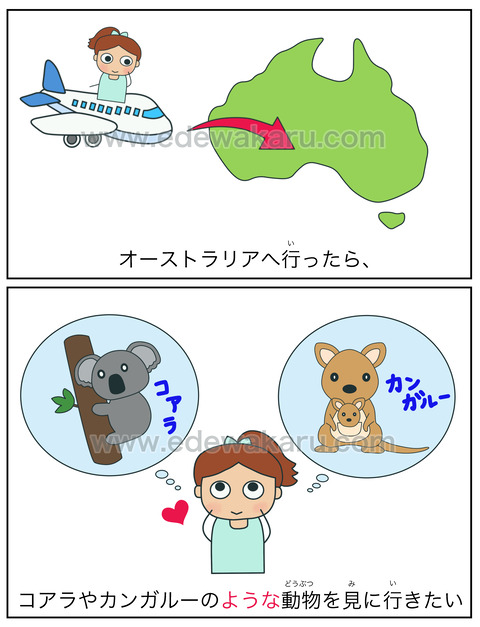
Meaning
例としてあげる
例えば〜など〜
How to use it
名詞[辞書形]+のように
名詞[辞書形]+のような+名詞
Explanation
「〜ように」「〜ような」は「例えば〜など」というように、【例をあげて言う】時に使われる文型です。たくさんある中から、例をあげて言う場合に使われます😊
[例]
①オーストラリアへ行ったら、コアラやカンガルーの
ような
動物を見に行きたい
オーストラリアにはいろんな動物がいるが、例として「コアラ」「カンガルー」をあげている
②ケーキやプリンの
ような
スイーツが好きです
スイーツは色々あるが、例として「ケーキ」と「プリン」をあげている
③彼女の
ように
英語が上手になりたい
英語が上手な人はたくさんいるが、例として「彼女」をあげている
④僕も彼の
ように
イケメンだったらよかったのに…
イケメンはたくさんいるが、例として「彼」をあげている
⑤名前を書くのを忘れる
ような
場合は0点とします
0点になる場合は色々あるが、例として「名前を書くのを忘れた場合」をあげている
「〜ように・〜ような」にはたくさん意味があり、区別するのがとても難しい場合もあります😨
「例えば〜ように・〜ような」と言うことができたら【例をあげて言う「〜ように・〜ような」】だと覚えておくといいと思います
😉
(復習:〜ておく)
(復習:〜ようだ(五感推量))
(復習:「〇〇シリーズ」リスト)
In context 5 examples
オーストラリアへ行ったら、コアラやカンガルーのような動物を見に行きたい
ケーキやプリンのようなスイーツが好きです
彼女のように英語が上手になりたい
僕も彼のようにイケメンだったらよかったのに…(復習:イケメン)
名前を書くのを忘れるような場合は0点とします(復習:〜とする)
Usage 2
Read this source entry ↗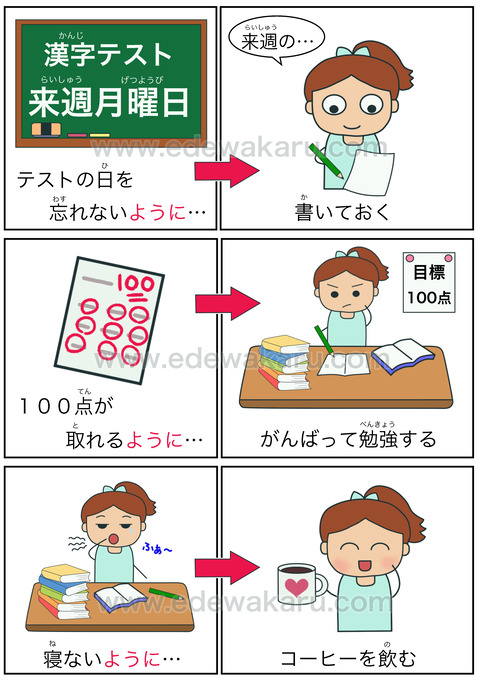
Meaning
目的を表す
How to use it
動詞[辞書形・ない形]+ように
動詞[可能形]+ように
In context 11 examples
テストの日を忘れないように、書いておく
100点が取れるようにがんばって勉強する
寝ないように、コーヒーを飲む
日本語が上手になるように、毎日NHKを見ている(復習:〜ている(繰り返し))
日本語能力試験(にほんごのうりょくしけん)に合格できるように、毎日勉強します【説明】「〜ように」は「目的」を表す文型です。「無意志動詞の辞書形・ない形」「動詞の可能形」に使われます。「できる・わかる・見える・聞こえる」などの状態動詞(じょうたいどうし)によく使われます😮「AようにB」の形で、「A」には【目的】や【目標】が入り、「B」には「目的を達成しよう!」という意志動作が入ります😊[例]
テストの日を忘れないように、書いておく[目的・目標]テストの日を忘れない[意志動作]書いておく
100点が取れるようにがんばって勉強する[目的・目標]100点を取る[意志動作]勉強する
寝ないように、コーヒーを飲む[目的・目標]寝ない[意志動作]コーヒーを飲むまた、目的の「〜ように」は「A(前の文)」と「B(後ろの文)」の主語は同じではなくてもOKです😮 [例]
みんなに見えるように、(私は)大きく書きます【Aの主語】みんな【Bの主語】私
娘がしっかり勉強するように、(私は)いい辞書を買ってあげた【Aの主語】娘【Bの主語】私(お母さん・お父さん)
(私が)ちゃんとわかるように説明してちょうだい!(復習:〜てちょうだい)【Aの主語】私【Bの主語】あなた「〜よう」 を使う文型はとてもたくさんあります😨1つ1つ区別をして覚えておきましょう。また、目的を表す「〜ために」と一緒に覚えておくといいと思います😉(復習:「よう」シリーズ)(復習:〜ために(目的))
どんなときどう使う 日本語表現文型辞典
Usage 1
Meaning
as
How to use it
Nの/〔普通形〕(ナAな・ナAである/Nである)+ように
Explanation
ように〈同様〉
~とだいたい同じに
一致する内容であることを表す。文書などで、「次のように・左記のように」などとはじめに書いておいて、その後で詳しく内容を書くという形式でよく使われる。「とおり(に)」と意味・内容がだいたい同じ。
Matching content. Often used in writing: 次のように (as follows), 左記のように (as written to the left), etc.; followed by details. Pattern とおり(に) is very similar in meaning and content.
In context 6 examples
旅行の日程は次のように決まりました。
世の中が何でもあなたの思うように動くなどとは考えないでください。
この実験では、わたしが期待していたようなデータは得られなかった。
人間に感情があるように、人間以外の動物にも感情があるはずだ。
作家には想像力が必要なように、営業マンには交渉力が必要だ。
わたしもヤンさんのように早く日本語が上手になりたい。
Usage 2
Meaning
in order to; so that
How to use it
Vる・Vない+ように
Explanation
ように〈期待〉
~を期待して
1)「~ように」の形で、「~という目標が実現することを期待して」という意味を表す。
2)「~」には話者の意志を表さない動詞(意志を含まない動詞や可能の意味を表す動詞など)が来る。後には、話者の意志を表す文が来る。
3) ❹ のように、「ように」の前の主語が3人称の場合は、意志を含む動詞も来る。
3)When subject is in the third person, as in sentence ❹ , verbs including volition appear before ように.
1)Expectation of realizing objective.
2)Verbs not expressing speaker's volition (verbs of potentiality or verbs that don't include volition) precede pattern. Clauses following express speaker's volition.
In context 4 examples
風邪が早く治るように注射を打ってもらいました。
黒板の字がよく見えるように前の席に座りましょう。
だれにもわからないようにそっと家を出たのだが、母に見つかってしまった。
たくさんの人がバザーに参加するように、広い会場を用意した。
Usage 3
Meaning
(indirect discourse)says to
How to use it
Vる・Vない+ように(と)
Explanation
ように(と言う)〈間接話法〉
1)間接話法で依頼・指示・忠告などの内容を示す言い方。後ろには「言う・書く・頼む・お願いする・注意する・命令する」などの動詞が来る。
2)本来、命令などの内容を伝える言い方なので、そのままの形では目上の人に対して使わない方がいい。
◆ △わたしは先生にゆっくり話すようにお願いしました。→○わたしは先生にゆっくり話してくださるようにお願いしました。
3) ❺ ❻ のように「祈る」ことの内容を言う場合にも使う。祈りの内容を言う場合、丁寧形もよく使われる。 ❻ のように、後の文が省略されることもある。
1)Indirect requests, instructions, or advice. Verbs following pattern include 言う, 書く, 頼む, お願いする, 注意する, or 命令する.
◆ △わたしは先生にゆっくり話すようにお願いしました。→○わたしは先生にゆっくり話してくださるようにお願いしました。
3)Also used with祈る, as in sentences ❺ and ❻ . Often polite form is used with prayer or wish. Clause following can be omitted, as in sentence ❻ .
2)Best not to use toward social superiors since is originally for conveying commands.
In context 6 examples
先生はタンさんに字をもっときれいに書くように言いました。
父の手紙にはいつも早く国へ帰るようにと書いてあります。
母は姉に会社の帰りに本を買ってくるように頼みました。
お医者さんはタンさんに酒を飲まないようにと注意しました。
お母さんの病気が早く治りますように、と祈りました。
(年賀状)新しい年が平和でありますよう。
日本語NET JLPT文法解説まとめ
Meaning
目標を実現させるために〜する
How to use it
V(辞書形) + ように
V(ナイ形)+ ように
Vは無意志動詞(見える、聞こえる、わかる、なおる、可能動詞など)
Explanation
so that / in order to
In context 15 examples
JLPTに合格できるように、勉強した単語や文法を復習します。
ホワイトボードの字がよく見えるように、前の席に座ります。
日本語を上手に話せるように、毎日シャドーイングをしています。
日本語初級者でもわかるように、やさしい日本語で話します。
来年、海外旅行ができるように、お金を少しずつ貯めています。
友達が日本に留学できるように、祈っています。
子供でも飲めるように、少しコーヒーを甘くしました。
日本語で漫画が読めるように、毎日日本語を勉強しています。
太らないように、甘いものは食べないことにしています。
明日、寝坊しないように、今日は早く寝ます。
誰にも気がつかれないように、こっそりと家を出た。
忘れないように、メモをしておきます。
地震が起きても慌てないように、家族との連絡方法を決めておきます。
明日、遠足でしょ? ちゃんと、起きられるように今夜は早く寝なさい。
おじいちゃんに聞こえるように、大きな声で話します。
毎日のんびり日本語教師
How to use it
動辞形+よう(に)
動ない形+よう(に)
動詞可能形+よう(に)
動ます形+ますように/ませんように
Explanation
意味は3つあります。
①目的、目標を達成するため
無意志動詞の場合は辞書形に、それ以外の場合は可能形やない形に接続します。
無意志動詞とは自分の意志では実現不可能な動詞、「降る」「忘れる」「なる」「できる」などです。
前件には目的や目標、後件にはそれを達成しようとする動作がきます。
前件と後件の主語は同一である必要はありません。
また「に」は省略できます。省略するとやや硬いニュアンスになります。
②アドバイス、注意
他人に対する忠告を表します。
③祈り、祈願、祈祷
何かを願うことを表します。
神様に独り言のように祈る場合は「動ます形+ますように/ませんように」の形を取ることがあります。
Notes
「よう」シリーズ
In context 14 examples
皆さまに楽しんでいただけるように頑張ります。
寝坊しないように早めにおやすみなさい。
この服が似合う人になれるよう痩せなきゃ。
体調を崩さないように皆さん気をつけて下さい。
ちょっとした不注意で怪我しないようにしてください。
お腹冷えないように気をつけてください。
みんなに聞こえるように大きい声で話してください。
可愛くなれるように努力する。(为了变得可爱而努力。)
皆様の支えに少しでもなれるよう頑張ります。(我会为了成为大家的支持而努力。)
忘れ物をしないよう注意してください。
明日のテスト、うまくいきますように。
病気が治りますように。(希望病能治好。)
明日いい天気になりますように。(希望明天会是好天气。)
第一志望の大学に合格できるように神社でお祈りをした。
日本語文型辞典 英語版
Meaning
→
→
Using a verb before and after, this means “do... so as to make such a circumstance or situation occur/do... so as not to....”に is sometimes omitted. Before ように, verbs which show non-volitional actions, such as なる and できる, or verbs which show possibility in the form V-れる are often used, as are the negative forms of verbs and expressions which show the state or condition of a thing. The clause which follows ように is a verb which demonstrates the speaker’s intentional act. The subject may differ before and after, as in examples
(1)
-
(3)
, or it may be the same, as in
(4)
.
Furthermore, in cases where the subject is the same before and after, and where the first verb demonstrates an intentional action, it is usual to use ために.
(×)息子が家で仕事ができるために父親は家を改築した。(異主語・非意志的)
So that his son could work from home, the father renovated the house. (different subject, non-volitional)
(○)息子が家で仕事ができるように父親は家を改築した。(異主語・非意志的)
So that his son could work from home, the father renovated the house. (different subject, non-volitional)
(○)家で仕事をするために家を改築した。(同一主語・意志的)
He renovated the house so he could work from home. (same subject, volitional)
Used to give advice to or to remonstrate with the listener. Verbs such as しなさい/してください and お願いします are used in the latter half but are sometimes omitted, in which case the expression ends with ように. Also, it is possible to omit the に from ように but, where the sentence ends with ように, it is usual not to do so, as in examples
(5)
and
(6)
. Used in the form V-ないように, this often expresses negative advice or recommendations.
Expresses one’s or another’s hopes, prayers and wishes. Verbs such as 祈る(pray), 祈念する(say a prayer), 念じる(pray silently), 望む(desire), 願う(wish), 希望する(hope) and 期待する(expect) are used after ように. As in examples
(5)
and
(6)
, the expression can end with ように. In such cases the polite form is usually used before ように. It is often used to bring a speech or letter to a close.
Using verbs of communication, such as 言う(say) and 伝える(convey) in the latter half, this is used to indirectly quote a request. Direct quotations take the following form: command/request+と+verb of communication.
(例)「すぐ帰れ」と言った。
She said, “Go home at once.”
(例)「ステレオの音量を下げてください」と頼んだ。
I asked, “Please would you turn down the volume of your stereo?”
Means to make efforts with the aim of/to aim to/to see to it that an action or situation occurs. As in examples
(4)
-
(6)
, when the negative form is used, it means to aim for the action or situation not to occur....ようにしている of
(3)
and
(6)
means to do that thing customarily. A verb usually comes before ように but, as in example
(2)
, V-やすい is also used. In this case 読みやすくする could also be used.
Taking the dictionary form of verbs, expresses a change from a situation in which something is not possible to one in which it is, or, from one in which a thing cannot be realized to one in which it can. It is often used to express possibility in the form V-れる, as in example
(1)
. In cases where the negative form is used, as in
(5)
, it expresses a change to a situation in which a thing is not done. In this case 言わなくなった could also be said.
How to use it
1. V-る/V-ない よう(に)〈purpose〉
2. V-る/V-ない よう(に)〈admonition〉
3. V-る/V-ない よう(に)〈prayer〉
4. V-る/V-ない よう(に)いう
5. V-る/V-ない ようにする
6. V-る/V-ない ようになる
In context 36 examples
あの人のように英語がペラペラしゃべれるようになりたい。
I want to be able to speak English as fluently as that person.
私が発音するようにあとについて言って下さい。
Please pronounce it as I do, after me.
こちらのほうがお似合いになるように思われます。
I think this one would suit you better.
心なしか彼の表情が陰ったように思われた。
His expression seemed to darken somewhat.
後ろの席の人にも聞こえるように大きな声で話した。
I said it in a loud enough voice so that even the people in the seats behind could hear it.
子供にも読めるよう名前にふりがなをつけた。
I put my name in furigana so that even children would be able to read it.
赤ん坊を起こさないようにそっと布団を出た。
I got out of the futon softly, so as not to wake the baby.
忘れないようにノートにメモしておこう。
I will make a note of this so I won’t forget.
忘れ物をしないようにしてください。
Don’t leave anything behind.
時間内に終了するようお願いします。
Please finish within the time (allowed).
風邪をひかないようご注意ください。
Please take care not to catch a cold.
私語は慎むようにしなさい。
Please refrain from whispering amongst yourselves.
集合時間は守るように。
Keep to the appointed time.
授業中はおしゃべりしないように。
No chatting during class.
息子が大学に合格できるよう神に祈った。
I prayed to God that my son would pass the university entrance exam.
現状がさらに改善されるよう期待している。
I hope that the present situation will improve again.
《年賀状》新しい年が幸い多き年でありますよう祈っております。
《New Year’s card》Wishing you a joyful new year.
《病気見舞の手紙》早く全快なさいますよう、祈念いたしております。
《get-well card》I am praying for your swift and complete recovery.
どうか合格できますように。
Wishing you success in the (e.g. entrance) exams.
すべてがうまくいきますよう。
Hoping all goes well.
あしたは雨が降りませんように。
Praying that it does not rain tomorrow.
すぐ家に帰るように言われました。
I was told to go home at once.
これからは遅刻しないように注意しておきました。
I warned them not to be late from now on.
戻りましたら、家に電話するようお伝えください。
Please tell him to call me at home when he comes back (to the office).
隣の人に、ステレオの音量を下げてもらうように頼んだ。
I asked my neighbor to turn the volume of her stereo down.
私は肉を小さく切って、こどもにも食べられるようにした。
I cut the meat into small pieces so that even children could eat it.
大きな活字を使い、老人にも読みやすいようにする。
We use large print so that it’s easy for the elderly to read.
できるだけ英会話のテレビを見るようにしている。
I’m watching as much English conversation program on TV as I possibly can.
彼女の機嫌を損ねることは言わないようにした。
I tried not to say things that would hurt her feelings.
試験日には、目覚まし時計を2台セットして寝坊しないようにしよう。
On exams days I set two alarm clocks so that I don’t overlay.
油ものは食べないようにしている。
I try not to eat fried foods.
日本語が話せるようになりました。
I have become able to speak Japanese.
眼鏡をかければ、黒板の字が見えるようになります。
I can see the letters on the blackboard if I wear my glasses.
赤ちゃんはずいぶん活発に動くようになりました。
The baby has started moving very vigorously.
隣の子供は最近きちんとあいさつするようになった。
The neighbor’s child has recently begun to make the proper greetings.
注意したら文句を言わないようになった。
After I had a word, he stopped complaining.
AIUEO JLPT Grammar
Usage 1
Meaning
This sentence pattern expresses taking action toward a specific goal or objective. It is used when acting toward a particular purpose.
How to use it
動詞+ように形容詞+ように形容動詞な+ように名詞の+ように
Explanation · 日本語
この文型は、ある目標や目的を達成するために行動を取ることを表す表現で、特定の目的に向かって行動するときに使います。
In context 5 examples
早く起きるように目覚まし時計をセットした。
I set the alarm clock so that I can wake up early.
風邪を引かないように暖かくしてください。
Please keep warm so that you do not catch a cold.
遅刻しないように早めに家を出ましょう。
Let’s leave home early so that we do not arrive late.
帰りが遅くならないように、時計を持って行こう。
Take your watch with you so you don't get home late.
事故が起こらないように、対策が講じられました。
Measures have been taken to prevent accidents.
Usage 2
Meaning
This sentence pattern expresses wishing or praying for the realization of something, used when hoping or wishing for a goal to be achieved.
How to use it
動詞ます形+ように動詞辞書形+ように動詞ない形+ように
Explanation · 日本語
この文型は、何かが実現することを願う、あるいは祈る表現で、願望や希望が実現することを心から願うときに使います。
In context 5 examples
試験に合格しますように。
I hope to pass the exam.
プロジェクトが成功しますように。
I hope the project succeeds.
皆さんがいい成績を取れますように。
I hope you all get good grades.
計画が順調に進みますように。
I hope the plan proceeds smoothly.
契約が無事に結べますように。
I hope the contract can be signed smoothly.
文法
Meaning
目標を実現させるために〜する
How to use it
V(辞書形) + ように
V(ナイ形)+ ように
Vは無意志動詞(見える、聞こえる、わかる、なおる、可能動詞など)
In context 15 examples
JLPTに合格できるように、勉強した単語や文法を復習します。
ホワイトボードの字がよく見えるように、前の席に座ります。
日本語を上手に話せるように、毎日シャドーイングをしています。
日本語初級者でもわかるように、やさしい日本語で話します。
来年、海外旅行ができるように、お金を少しずつ貯めています。
友達が日本に留学できるように、祈っています。
子供でも飲めるように、少しコーヒーを甘くしました。
日本語で漫画が読めるように、毎日日本語を勉強しています。
太らないように、甘いものは食べないことにしています。
明日、寝坊しないように、今日は早く寝ます。
誰にも気がつかれないように、こっそりと家を出た。
忘れないように、メモをしておきます。
地震が起きても慌てないように、家族との連絡方法を決めておきます。
明日、遠足でしょ? ちゃんと、起きられるように今夜は早く寝なさい。
おじいちゃんに聞こえるように、大きな声で話します。
Bunpro Grammar Reference
Usage 1
Meaning
As・like, Just like
How to use it
Verb + よう + に + Verb(1)
Verb + よう + な + Noun
(1) Adverb、[い]Adjective、[な]Adjective
Nuance
A semi-formal expression used to confidently describe the manner in which something appears.
Explanation
We have seen many cases now where the auxiliary verb ようだ may be modified slightly to show that something is being done 'in a way' that will bring about a specific outcome. In this lesson, we will look at how ような (when used with nouns), or ように (when used with verbs) may be used with almost any noun/verb, to show that they are being done/existing in a particular manner.
彼は亀のように走る。
He runs like a turtle.
バケツをひっくり返したように雨が降っている。
It is raining like a bucket was flipped over. (It's pouring rain)
彼の車は工場のような臭いがする。
His car smells like a factory. (His car has an industrial smell)
キトウ先生は鬼のような怒り方をする。
The way Kito-sensei gets mad is like a demon.
Sometimes, this structure is used purely to express the speaker's uncertainty about whether (B) really is being done/existing in the way of (A). In these cases, ように (or ような) will be translated as 'as if', or 'as though'.
彼は今、人を殺すような目をしている。
Right now, his eyes look as if he is about to kill someone.
Nuance · 日本語
あるものの見た目を自信をもって表現する時に使われる、少し丁寧な表現。
In context 17 examples
- 彼は食べすぎたような顔をしている。
He looks like he ate too much.
- キトウ先生は鬼のような怒り方をする。
The way Kito-sensei gets mad is like a demon.
- 彼は今、人を殺すような目をしている。
Right now, his eyes look as if he is about to kill someone.
- 彼は亀のように走る。
He runs like a turtle.
- バケツをひっくり返したように雨が降っている。
It is raining like a bucket was flipped over. (It's pouring rain)
- 彼の車は工場のような臭いがする。
His car smells like a factory. (His car has an industrial smell)
- あなたが言ったように、事故が起こった。
An accident happened just like you said.
- 十代に戻ったように楽しかった。
It was fun, just like being in my teens again.
- 君が言うように綺麗ですね。
It is beautiful, just like you say.
- 驚くような景色を見た。
I saw mind-blowing-like scenery.
- 誰かを殺すような目をしていた。
He had eyes just like he was going to kill someone.
- 想像できないようなアイディアが沢山ありました。
I had ideas like you couldn't imagine.
- いっぱい宿題があるようなことを言っていたけど、本当は何もなかった。
They were talking like we would have a lot of homework, but we really didn't have any.
- 商品がなくなるような状況だったけど、閉店まで大丈夫でした。
It seemed like we were going to run out of products, but we made it until closing time.
- あの人はまるで筆で書くように、綺麗な字を書けます。
That person is able to write beautiful letters as if (they were) written with a brush.
- まずはウサインボルトが走るように走ってみて。
First, try running just like Usain Bolt.
- 何か腐っているような臭いがするね。
It smells just like something is rotting, don't you think?
Usage 2
Meaning
So that, In order to, In such a way that
How to use it
Verb[る](1) + ように + Phrase
Verb[できる](2) + ように + Phrase
(1) Verb[ない]
(2) Verb[できる][ない]
Nuance
A structure implying that (A) is done in a manner which will enable success.
Explanation
When partnered with verbs in the potential form, or in the negative form, the auxiliary verb ようだ (in its adverbial form ように) implies that the speaker has a lack of direct control over an outcome, and therefore is 'trying to do (B) in the manner of (A)', but cannot guarantee the result. This grammar point is usually translated as 'to do (A) in such a way that will enable (B)', or 'in order to allow (B)'.
To use ように in this way, simply add it to the non-past form of any verb in its negative, potential, or standard conjugation.
お母さんから離れないように手をつなぐ。
I hold my mothers hands so that I won't get separated from her.
泥棒が入れないように家のカギを閉める。
I lock my house, so that burglars can't come in.
マイケルジャクソンみたいに踊れるように毎日ダンスの練習をする。
I practice dancing every day, so that I can dance like Michael Jackson.
日本語をペラペラに話せるように毎日近所の人と日本語で話をしている。
I speak Japanese with my neighbor every day, so that I can speak Japanese fluently.
As mentioned in our lesson about potential verbs, する does not actually have a potential form, and therefore できる will be used instead.
勉強ができるように机の上を掃除した。
I tidied up my desk so that I could study.
平日にスキーが出来るように仕事を休んだ。
I took the day off of work, in order to be able to ski on a weekday.
Nuance · 日本語
(A)が成功するような方法で行われることを表す文法。
In context 19 examples
- 例えば風邪を引かないように、暖かい服装をする。
For example, I wear warm clothes so that I won't catch a cold.
- お母さんから離れないように手をつなぐ。
I hold my mothers hands so that I won't get separated from her.
- 泥棒が入れないように家のカギを閉める。
I lock my house, so that burglars can't come in.
- 日本語をペラペラに話せるように毎日近所の人と日本語で話をしている。
I speak Japanese with my neighbor every day, so that I can speak Japanese fluently.
- 勉強ができるように机の上を掃除した。
I tidied up my desk so that I could study.
- 平日にスキーが出来るように仕事を休んだ。
I took the day off of work, in order to be able to ski on a weekday.
- マイケルジャクソンみたいに踊れるように毎日ダンスの練習をする。
I practice dancing every day, so that I can dance like Michael Jackson.
- 彼が理解出来るように説明しようと思っている。
I plan to explain it in such a way that he will be able to understand.
- 大事なことを忘れないようにいつもメモをしている。
I always take notes so that I won't forget important things.
- 間に合うように数分早く出るつもりだ。
I plan to leave a few minutes earlier so that I will be on time.
- 太陽に目がくらまないように、スキーヤーはゴーグルをかけています。
The skiiers wear goggles so that they won't be blinded (disoriented) by the sun.
- ペラペラに話せるように日本語を勉強します。
I learn Japanese so that I will be able to speak fluently.
- 子供の頃、兄は私が黙っているように、お金をよくくれた。
During my childhood, my brother often gave me money in order to keep my mouth shut.
- 火事の場合に車が燃えないように、消火器を買いました。
I bought a fire extinguisher so that my car won't go up in flames in the case of a fire..
- 子供がナイフなどに近づかないようにキッチンキャビネットを閉める必要がある。
It is necessary to close the kitchen cabinets so that children won't get near knives and the like.
- 独立して暮らせるように働き始めた。
I started working in order to be able to live independently.
- 目が悪いので、字幕が見えるように椅子をテレビに近づけた。
Because I have bad eyes, I moved the chair closer to the TV so that I can see the subtitles.
- 日本語能力試験に合格出来るように、毎日文法を学んだりNHK(エヌエイチケー)ニュースを読んだりしている。
Every day I am doing things like learning grammar and reading NHK news so that I can pass the JLPT.
- 迷子にならないように、外に出る時はいつも子供と手をつないでいる。
I always hold hands with my child when we go outside so that he/she won't get lost.
Yokubi — The Common Grammar Guide (https://yoku.bi)
Explanation
のに is related to ので, but it works in the opposite direction. While ので means "because of X, Y", のに means "despite X, Y". Like ので, this is more "objective" than other adversatives. のに also loves being attached to the end of sentences as an emphasis marker of disappointment or discontentment.
Just like ので, のに needs な after nouns and な adjectives
ように essentially means "so as to", as in "walk so as to keep your back hidden". This treads a fine line between "for the purpose of" and "in such a way as".
If it helps, you can think of ように as a noun (よう = "manner") turned into adverb by に. The clause that qualifies よう becomes "adverbial" to the main verb.
ために literally uses the noun ため "purpose" plus に to make a conjunction.
In many situations, ために and ように are interchangeable with the meaning of "for the purpose of", but not always.
ために can also be used to mean "for the sake of" rather than "for the purpose of". The nuance is different in English but in Japanese it is not always obvious. に can also be dropped.
せい is a noun meaning "fault" used to indicate cause/blame/reason. It usually implies that the effect is undesirable.
The opposite of せいで is おかげで, which implies a thankful feeling.
In context 1 examples
足音を立てないように歩く
Walk in such a way as to not make noise.
NINJAL 日本語文型データベース
Usage 1
Meaning
命令・指示したり頼んだりする内容を引用して、1文の中に入れるときに使います。
How to use it
Vるように/Vないように
Notes
「〜ように」の後には、「言う・頼む・伝える」などの動詞がきます。
少し強制する意味があります。指示できる立場の人が頼む内容を言う場合に使うことが多いです。
In context 5 examples
学校の帰りに本屋で新刊の本を買ってくるように、母に頼まれました。
ピアノの先生に、曲の出だしのテンポに気をつけるように言われた。
「本人が社に戻りましたら、折り返しご連絡するように申し伝えます」
息子がバイクで出かけるたびに、スピードを出さないように注意している。
出張する夫に薬を飲み忘れないように言って、見送った。
Usage 2
Meaning
〜という状態を目指して、何かをすると言いたいときに使います。
How to use it
Notes
「〜」が動詞の文で、その主語が「〜ように」の後の文と同じ場合、「〜」には話し手の意志を表さない動詞(意志的な行為を表さない動詞(「治る・見つかる・間に合う」など)・可能の動詞(「見える・わかる・できる」など))がきます。「〜」の文の主語が「~ように」の後の文と同じではない場合は、どんな動詞の文でもいいです。
In context 13 examples
発表会の曲はとても難しかったので、間違えずに弾けるように、何度も練習した。
スピーチをするときは、遠くの人にも聞こえるように、大きな声で話してください。
より多くの人がイベントに来てくれるように、ポスターを作って宣伝した。
買わなければいけないものは、忘れないようにメモしている。
風邪をひかないように、手洗い、うがいの習慣をつけよう。
マッチやライターは、子どもが触らないように、見えないところにしまっておいたほうがいい。
レタスは、食べやすいように小さくちぎる。
仕事から帰った後で、急いで買い物に行かなくてもいいように、休日にまとめ買いをしている。
割れた食器やガラスなどを捨てるときは、危なくないように、紙に包んで出してください。
下に厚手のセーターを着てもきつくないように、ゆとりのあるサイズのコートを選びました。
学校では、いつ災害が起こっても大丈夫なように、ときどき避難訓練をしている。
イベントの詳細について問い合わせが可能なように、ポスターにメールアドレスを載せた。
この建物の入り口には階段があるが、車椅子などでも不便ではないように、スロープもつけてある。
IMABI
So that
Read this IMABI lesson ↗Explanation
~ように: So That…
In this lesson, we will look at yet another grammatical expression which utilizes the purpose-marking に. This phrase is ~ように, which is composed of the noun 様よう and the particle に. 様 is a Sino-Japanese noun, but unlike the noun 為ため we learned about in the previous two lessons, 様 is not ever used in true isolation as a standalone noun—at least not in Modern Standard Japanese.
Overall, ~ように is used to express an expectation or goal that one wishes to realize or hopes will realize if possible. This is similar to ~ために; however, ~ように oppositely implies no volition on the part of the agent of the clause that precedes it.
Orthography Note: The よう in ~ように is only seldom spelled as 様. When it is, it is usually in very formal writing.
Conjugation Recap
First, let’s have a bit of conjugation review. Despite the ambition ~ように following the same grammar as any other nominal expression which follows a verb, because the expression itself is totally different in terms of part of speech from its English counterpart “so that,” we will look at how to conjugate ~ように with each kind of verb. Note that unlike the simile ~ように, the ambition ~ように is only used with verbs.
/eru/-Ichidan Verb 見える + ように
見えない + ように 見えるように
見えないように So that… can be seen
So that… cannot be seen
/iru/-Ichidan Verb 見る + ように
見ない + ように 見るように
見ないように So that… sees
So that… doesn’t see
/u/-Godan Verb 買う + ように
買わない + ように 買うように
買わないように So that… buys
So that… doesn’t buy
/ku/-Godan Verb 行く + ように
行かない + ように 行くように
行かないように So that… goes
So that… doesn’t go
/gu/-Godan Verb 騒ぐ + ように
騒がない + ように 騒ぐように
騒がないように So that… makes a fuss
So that… doesn’t make a fuss
/su/-Godan Verb 話す + ように
話さない + ように 話すように
話さないように So that… talks
So that… doesn’t talk
/tsu/-Godan Verb 立つ + ように
立たない + ように 立つように
立たないように So that… stands
So that… doesn’t stand
/nu/-Godan Verb 死ぬ + ように
死なない + ように 死ぬように
死なないように So that… dies
So that… doesn’t die
/bu/-Godan Verb 運ぶ + ように
運ばない + ように 運ぶように
運ばないように So that… carries
So that… doesn’t carry
/mu/-Godan Verb 飲む + ように
飲まない + ように 飲むように
飲まないように So that… drinks
So that… doesn’t drink
/ru/-Godan Verb 切る + ように
切らない + ように 切るように
切らないように So that… cuts
So that… doesn’t cut
Aru ある + ように
ない + ように あるように
ないように So that… there is
So that… there isn’t
Suru (Verb) する + ように
しない + ように するように
しないように So that… does
So that… doesn’t do
Kuru くる + ように
こない + ように くるように
こないように So that… comes
So that… doesn’t come
Part of Speech Note: Conjugation-wise, ~ように behaves like a nominal phrase, but the purpose-marking に is adverbial in nature. Thus, as a whole, ~ように can be viewed as an adverbial phrase. This contrasts with “so that,” which is treated as a conjunction in English. Even in Japanese, though, the resultant phrase can also be viewed as an adverbial conjunctive phrase.
The Usages of ~ように
Whereas ~ために must be used with verbs of volition to express realizing a stated objective/goal, ~ように must be used with verbs that don’t express volition. In fact, although ~ように is largely used with intransitive verbs, it can be used with transitive verbs so long as those verbs don’t imply willful control over the action by the agent.
Just as was the case with ~ために, the concept of “agent” is very important to understanding how to use ~ように properly. First, know that the base sentence pattern is “A + ~ように + B.” Both “A” and “B” are verbal expressions. Each verbal expression will have an agent. “A” will always be the expectation/goal, and “B” will either be an effort or an exertion of influence. The nature of “B” is determined by who the agent of “A” is and whether it is the same as the one in “B.”
~ように is not particularly complicated to understand, but these factors do add subtleties to its interpretation. For each usage discussed, we will learn about what the “agent” can be for both the “A” clause and the “B” clause, what kind of verbs “A” and “B” can be, and compare usages with each other if necessary.
Grammar Note: Do not confuse this with the volitional form. The volitional form is created with the auxiliary verb ~よう for only a subset of verbs in Japanese, and conjugating with it does not follow the same rules as ~ように.
Usage 1:(目標+努力)
The words 目標 (goal) and 努力 (effort) are very important words to know in understanding ~ように. For Usage 1 of “A + ~ように + B,” A is a goal that the speaker wishes to make possible by some effort expressed by B. This usage normally involves A being a verb in the potential form, negative form, or the potential-negative form. When not specifically used with a potential verb, the verb in question should be an intransitive verb of non-volition.
Translation Note: This usage is most often translated as “so that.”
1. 来年復活らいねんふっかつできるように頑張がんばりたいと思おもいます。
I want to do my best so that I can make a come-back next year.
2. 韓国かんこくへ行いけるように貯金ちょきんをしています。
I am saving money so that I can go to Korea.
3. (自分じぶんが)自分じぶんであることをいつか誇ほこれるように、今日きょうも明日あすも胸むねを張はるんだ。
I shall be confident today and tomorrow so that I one day can be proud of being myself.
4. 良よい日本語教師にほんごきょうしになれるように、経験けいけんを積つんでいきたいと思おもいます。
I’d like to gain experience so that I may become a good Japanese teacher.
5. 1いち日にち{も・でも}早はやく解決かいけつできるようにやっていきたい。
I’d like (for us) to move forward so that I/we can resolve this as soon as possible.
6. クビにならないよう(に)しっかり仕事しごとを覚おぼえるのが先さきだ。
Properly learning the job comes first (so as) to not getting fired.
Grammar Note: Although the person that would potentially fire the agent of B would not be that said individual, the agent of B is the experiencer of A, and A is still a goal that the agent of B would be trying to make sure of.
Particle Note: Ex. 6 is an example of the agent of A and B being “one,” which is a third-person pronoun and not a first-person pronoun like all the other examples in this section. When this is not used in first person, it is possible to omit the particle に. This omission is commonplace in very formal writing and oration. It is worth noting that when this usage is used in second-person, it brings about Usage 3.
7. よく見みえるように(体からだを)高たかく持もち上あげてもらった。
I had myself lifted up so that I could see well.
Grammar Note: In this example, B involves an effort which has someone do something for the speaker, but the experiencer of A and the causer of B is still the same individual, and B is still an action that person does to achieve goal A.
8. 風邪かぜやインフルエンザなどにならないように、免疫力めんえきりょくをアップさせることを意識いしきして生活せいかつしていきたいと思おもいます。
I want to live while consciously thinking of increasing my immunity so that I don’t get colds or the flu.
Grammar Note: In this sentence, the experiencer of A is the agent of B. Even though the viruses that would cause the speaker to become ill would be the technical agent of A, Japanese does not typically treat non-human things such as this as active agents. Thus, this creates a basis for concluding that if the agent of B is not present in A that A must be the same person as B but as the role of experiencer.
9. 擦すれ違ちがうように君きみに会あいたい。
I want to meet you so that we may pass by each other.
Grammar Note: In this sentence, the experiencer of A includes another individual, but because one of those experiencers is the agent of B, it is still representative of this grammar.
~ようにする
In the examples above, the agent/experiencer of A and B was limited to “I” and “one.” These examples also demonstrated how this grammar point doesn’t limit A to potential verbs. The one stipulation stated was that A would otherwise need to be a non-volitional intransitive verb. However, there are in fact instances when A is a transitive verb or volitional intransitive verb. When this is the case, though, B is limited to する by default, creating the grammatical pattern ~ようにする. This phrase is translated as “to try to…” as in putting effort into making some goal a habitual action.
The thought process behind this is that the volition that would otherwise be wholly expressed by the transitive verb of A is shifted to the verb in B, する. This is the case even when the verb in A also happens to be する.
Particle Note: Ex. 6 presented a case in which the particle に can be omitted after よう, but it is important that you not run with this. This is only true for second-person and third-person in formal writing and speaking and is not applicable to ~ようにする or anything involving ~ように with first person. Although ~ようにする can be used in second-person (in question form) and third-person, ~ようにする is a set phrase in which に is obligatory and should be treated as such.
10. 牛乳ぎゅうにゅうを飲のまないようにしています。
I am trying not to drink milk.
11. 少すこしずつ野菜やさいを摂とるようにしています。
I am trying to have vegetables little by little.
12. 銀行口座ぎんこうこうざはまめにチェックするようにしています。
As for my bank account, I am trying to check it diligently.
Usage 2: (目標+働きかけ)
The word 働はたらきかけ means “pressure/encouragement.” The concept of putting pressure on someone becomes very important when the agents of A and B don’t match. When this is the case, the subject will manifest oneself in B, and B will be an action that puts pressure, encourages, and/or expresses hope/anticipation that goal A is realized. The goal of A could be several things. It could be the agent of A becoming able to do something (with potential verbs), doing some action (with transitive verbs or volitional intransitive verbs), or the experiencer of A becoming a certain state (non-volitional intransitive verbs). Regardless of what the goal of A is, B will always involve the subject of B either hoping or doing some action to get that goal realized.
Translation Note: Potential translations for this usage include “(so) that” and “so as to.”
Grammar Note: In many ways, Usage 2 is no different from Usage 1 except that the agents of A and B don’t match. Putting pressure on someone for A to be fulfilled is in and of itself an effort.
13. 英語えいごの文法ぶんぽうが分わかるように、先生せんせいは絵えを使つかって説明せつめいしてくれました。
The teacher explained using pictures so that (they) could understand English grammar.
Sentence Note: The agent of B is “the teacher” and the agent/experiencer of A (understanding) is the implied “they.”
14. 妻つまが無事出産ぶじしゅっさんできるように、神様かみさまにお願ねがいしています。
I’ve asked God that my wife may deliver safely.
15. スマートに会話かいわを始はじめることができるように、自己紹介じこしょうかいで使つかわれるフレーズをいくつか紹介しょうかいしてみました。
I tried introducing (to them) several phrases used in self-introductions so that (they) could begin to be able to converse skillfully.
16. 左翼思想さよくしそうの人々ひとびとは、再分配さいぶんぱいを強化きょうかするように税制ぜいせいを変かえようと主張しゅちょうしている。
Leftists are insistent about changing the tax system so as to reinforce redistribution.
17. 官庁かんちょうは、道路どうろの建設けんせつに力ちからを入いれ、資本家しほんかや企業きぎょうを保護ほごするように政策せいさくを転換てんかんした。
The authorities changed its policy so as to put effort into road construction and protect capitalists and corporations.
18. 地震等じしんなどの振動しんどうで転倒てんとうしないよう、固定こていする必要ひつようのあるものは必かならず固定こていする。
Always secure things that ought to be secured so that they do not fall down due to vibrations caused by earthquakes and such.
Grammar Note: This example, in contrast with Exs. 16 and 17, shows how に is only omissible when the sentence is interpreted as a directive to someone, which was also the case with Ex. 6. These examples all hint at Usage 3, which we are about to come to shortly.
19. 厚生労働省こうせいろうどうしょうは、インフルエンザと診断しんだんされてから少すくなくとも2ふつ日間かかんは極力きょくりょく1ひと人りにしないよう注意ちゅういするほか、マンションやアパートの場合ばあいは窓まどや玄関げんかんを施錠せじょうし、ベランダに面めんしていない部屋へやで寝ねかせるよう呼よびかけている。また、多おおくの人ひとが早はやめにワクチンを接種せっしゅできるよう、13じゅうさん歳以上さいいじょうの人ひとは原則げんそく、1いっ回かいだけの接種せっしゅにしてほしいと呼よびかけている。
The Ministry of Health, Labour and Welfare is asking that, in addition to being careful not to leave someone diagnosed with influenza alone as much as possible for at least two days, they are also calling that for those in apartment buildings or condominium high-rises have (said individuals) rest in rooms which are not facing verandas. They are also calling for people 13 years or older to limit their vaccination to just once as a rule so that more people can be vaccinated ahead of time.
20. イエレン議長ぎちょうは、自由貿易じゆうぼうえきを損そこなうことがないよう、トランプ政権せいけんを牽制けんせいした。
Chairman Yellen checked the Trump Administration so that they don’t mar free trade.
21. 災害発生時さいがいはっせいじ、勤つとめ先さきや外出中がいしゅつちゅうの家族かぞくの安否確認あんぴかくにんをとるために連絡先れんらくさきをみんながわかるようにしていますか?
Do you have your contact information set up so that you know everyone in order to confirm the safety of family at work or out and about for when a natural disaster occurs?
22. 科学工場かがくこうじょうの火災かさいなので、職場しょくばの仲間なかまにはマスクをしたうえで外そとに出でないよう注意ちゅういをした。
With it being a chemical factory fire, I warned my friends at the workplace not to go outside upon having put on masks.
23. 更さらに努力どりょくしてプレミアムフライデーを定着ていちゃくさせるよう頑張がんばっていきたい。
I want to do my best strive more to have Premium Friday take hold (in society).
Grammar Note: Although A is a causative verb, the agent of A and B is still the main speaker, making it an application of a “goal” being sought for by the effort expressed in B. The causative verb, however, does imply that the goal involves directing people to make it so, thus a grammatical motivation for why に can be omitted here.
24. 子供こどもが触さわらないように、危あぶない物ものは高たかいところに置おくようにしています。
I’m trying to place dangerous objects high up so that (the) children won’t touch them.
Grammar Note: This example as well as Ex. 25 show that it is possible to have more than one ~ように in a sentence. As for the first instance in Ex. 24, its purpose is to indicate the goal of having children not touch dangerous objects which is achieved by the effort of placing them up high, which is an indirect pressure on said children not to get into such trouble. The purpose of ~ようにしている indicates that this is a pressure the speaker is actively exerting and trying to maintain.
25. 母ははに心配しんぱいをかけない{よう・ため}に、毎日まいにち、早はやく家いえに帰かえるようにしている。
I am trying to return home quickly every day [so as/in order] not to worry my mother.
Grammar Note: The difference between ~ように and ~ために is that although both indicate fulfilling a certain goal, only ~ために implies complete confidence of that goal being made so. ~ように puts more emphasis on the hope that the goal will be matched, but hope is not a guarantee.
26. 学生がくせいがフェイクニュースに惑まどわされないようにしようと思おもって、調査ちょうさを始はじめました。
I began an investigation hoping to have students not be misled by fake news.
Grammar Note: This example exemplifies how “effort” and “pressure” are one of the same thing. Do note that the よう in しよう is the auxiliary verb for affirmative volition. Its purpose is to emphasize the will of the speaker to have it so that students aren’t misled.
27. 借金しゃっきんは無なくならないように出来できているものだ。
Debt is made so that it doesn’t go away.
Grammar Note: 出来る, here, means “to be made,” which implicitly suggests an agent who had the goal of making said liability one that wouldn’t go away.
~ようになる
While ~ようになる typically denotes change into a certain state, there are contexts in which the particle に functions as a purpose marker as opposed to a result marker, allowing for ~ようになる to pertain to purposeful rendering by an agent, albeit an implicit one. This dynamic is also the case for Ex. 27 above.
28. その携帯電話けいたいでんわは、しばらく放置ほうちすると電源でんげんが切きれるようになっている。
That cellphone is made so that it turns off when you leave it idle for a while.
Like Ex. 27, the agent that would have programmed the phone had しばらく放置すると電源が切れる as a goal, and that success is embodied in ~ようになっている. The use of ~ている suggests that this success is not instantaneous with the statement but has been so.
Usage 3: Euphemized Command
When ~ように is directed toward someone, it expresses a command that indicates the manner you want the listener (agent) to do in order to achieve goal A. When the verb before ~ように is a transitive verb or volitional intransitive verb, the following effort B doesn’t have to be stated. However, when the verb is a non-volitional intransitive, the effort described by B cannot be omitted as the statement becomes a directive for the state expressed by the verb of A to come true.
Grammar Note: This usage may also be interpreted as an application of the simile ~ように’s use of illustrating an example. In the examples below, ~ように is translated as “so that,” which plays emphasis on the interpretation of goal A being carried by effort B. However, “so that” can easily be paraphrased to “in a way that.” Thus, Usage 3 demonstrates that there is in fact overlap between these two different ~ように.
29. せっかく寝付ねついた赤あかちゃんを起おこさないように、(静しずかにしてよ)。
(Be quiet so that you) don’t wake up the baby who just went to sleep.
Translation Note: When “B” is omitted from this sentence, it can be translated as “Try not to wake up the baby who just went to sleep.”
30. 壊こわさないように運はこんでください。
Please carry it [so that you don’t break/without breaking] it.
31. 普段ふだんから、怪あやしい儲もうけ話ばなしなどの誘惑ゆうわくに乗のらないように行動こうどうするよう心こころがけましょう。
Let’s keep in mind on a routine basis to conduct ourselves so that we are not yielded to temptation by shady get-rich-quick schemes.
Particle Note: Aside from the second よう having に omitted because of it marking a directive to others, another motivation for why に is omitted here is that it gets rid of grammatical awkwardness that would be felt with two too similar instances of ~ように.
The next three examples show how this usage can also be used when the verb preceding ~ように is in polite speech. Thus, both ~ますよう(に)and ~ませんよう(に) are possible. However, the use of the auxiliary ~ます is only acceptable when ~ように is used to create a command or to simply express a hope (Usage 5)
32. 今後こんごともよろしくご指導しどうくださいますように(お願ねがい申もうし上あげます)。
I ask for your continued guidance going forward.
33. ご確認頂かくにんいただきますよう、お願ねがい致いたします。
I ask that you please confirm this.
34. 寒さむい日ひが続つづきますので、お風邪かぜなど召めしませんよう、ご自愛じあいのほどお願ねがい申もうし上げます。
Because cold days continue, please take care of yourself so that you do not catch a cold.
Usage 4: ~ようにと
As an extension of the previous usage of creating euphemized commands regarding manner, ~ように can be optionally followed by the quotation-marking と and then followed by a request verb of some kind. This is largely restricted to transitive verbs or volitional intransitive verbs.
35. 友達ともだちに荷物にもつを運はこぶように(と)頼たのみました。
I asked my friend to carry [the/my] luggage.
36. 学生がくせいたちに授業じゅぎょうを欠席けっせきしないように(と)注意ちゅういしました。
I warned the students not to be absent from class.
37. 私わたしは彼かれに原稿げんこうを書かくように(と)依頼いらいしました。
I requested to him that he write draft/manuscript.
38. 彼かれはみんなに注意ちゅういして運転うんてんするように(と)促うながした。
I urged everyone to be careful driving.
39. 花が咲くように(と思って)毎日水をやっている。
I water the flowers daily so that they may bloom.
Ex. 39 is an example of this being used with a non-volitional verb. When that is the case, と is obligatorily followed by a verb of thought. This puts one’s hope into a mental quotation.
Usage 5: Hope/Prayer
In the same way ~ように can indicate a command to someone so that a goal can be met, when the verb involved is a non-volitional verb and nothing else follows, the resultant phrase solely expresses a hope that that goal is realized. This usage is used extensively when praying and wishing for something to happen.
Typically, this usage is used with the verb preceding ~ように being in polite speech, thus creating ~ますように. If a plain form speech were to be used, then grammar resembling that of Ex. 39 would need to follow. Unsurprisingly, ~ませんように is also possible with this usage.
40. 当あたりますように。
May [I/you] hit (the lottery).
41. 素敵すてきな一年いちねんになりますように。
May this be a wonderful year.
42. ずっと一緒いっしょにいられますように。
May we always be together.
43. どうか怪あやしまれませんように。
May I not be suspected.
44. お疲つかれの出でませんように。
May you not become wary (in your endeavors).
Variation with Negative Auxiliaries
In conclusion, it’s worth noting that ~ない is not the only form that negation takes and that those other forms can all be used in conjunction with ~ように. Aside from ~ませんよう, there is also ~ぬよう(に), seen most frequently in literature and song as a more poetic variant. There is also ~んよう(に) which is merely dialectical, but to many can give off the impression of a man in his 40s or older. Lastly, ~へんよう(に) is possible in Kansai Dialects.
45. 時節柄じせつがら、体調たいちょうを崩くずされませぬようご自愛じあいくださいませ。
The season being what is, please take care of yourself so that you do not upset your health.
46. この想おもいが消きえぬように、流ながれ星ぼしに願ねがうよ。
I wish to a shooting star so that this hope may not die.
47. 同おなじような事故じこが起おきんようにしっかりと頑張がんばってほしいな。
I want for them to work firmly so that similar accidents don’t occur.
In context 47 examples
来年復活らいねんふっかつできるように頑張がんばりたいと思おもいます。
I want to do my best so that I can make a come-back next year.
韓国かんこくへ行いけるように貯金ちょきんをしています。
I am saving money so that I can go to Korea.
(自分じぶんが)自分じぶんであることをいつか誇ほこれるように、今日きょうも明日あすも胸むねを張はるんだ。
I shall be confident today and tomorrow so that I one day can be proud of being myself.
良よい日本語教師にほんごきょうしになれるように、経験けいけんを積つんでいきたいと思おもいます。
I’d like to gain experience so that I may become a good Japanese teacher.
1いち日にち{も・でも}早はやく解決かいけつできるようにやっていきたい。
I’d like (for us) to move forward so that I/we can resolve this as soon as possible.
クビにならないよう(に)しっかり仕事しごとを覚おぼえるのが先さきだ。
Properly learning the job comes first (so as) to not getting fired.
よく見みえるように(体からだを)高たかく持もち上あげてもらった。
I had myself lifted up so that I could see well.
風邪かぜやインフルエンザなどにならないように、免疫力めんえきりょくをアップさせることを意識いしきして生活せいかつしていきたいと思おもいます。
I want to live while consciously thinking of increasing my immunity so that I don’t get colds or the flu.
擦すれ違ちがうように君きみに会あいたい。
I want to meet you so that we may pass by each other.
牛乳ぎゅうにゅうを飲のまないようにしています。
I am trying not to drink milk.
少すこしずつ野菜やさいを摂とるようにしています。
I am trying to have vegetables little by little.
銀行口座ぎんこうこうざはまめにチェックするようにしています。
As for my bank account, I am trying to check it diligently.
英語えいごの文法ぶんぽうが分わかるように、先生せんせいは絵えを使つかって説明せつめいしてくれました。
The teacher explained using pictures so that (they) could understand English grammar.
妻つまが無事出産ぶじしゅっさんできるように、神様かみさまにお願ねがいしています。
I’ve asked God that my wife may deliver safely.
スマートに会話かいわを始はじめることができるように、自己紹介じこしょうかいで使つかわれるフレーズをいくつか紹介しょうかいしてみました。
I tried introducing (to them) several phrases used in self-introductions so that (they) could begin to be able to converse skillfully.
左翼思想さよくしそうの人々ひとびとは、再分配さいぶんぱいを強化きょうかするように税制ぜいせいを変かえようと主張しゅちょうしている。
Leftists are insistent about changing the tax system so as to reinforce redistribution.
官庁かんちょうは、道路どうろの建設けんせつに力ちからを入いれ、資本家しほんかや企業きぎょうを保護ほごするように政策せいさくを転換てんかんした。
The authorities changed its policy so as to put effort into road construction and protect capitalists and corporations.
地震等じしんなどの振動しんどうで転倒てんとうしないよう、固定こていする必要ひつようのあるものは必かならず固定こていする。
Always secure things that ought to be secured so that they do not fall down due to vibrations caused by earthquakes and such.
厚生労働省こうせいろうどうしょうは、インフルエンザと診断しんだんされてから少すくなくとも2ふつ日間かかんは極力きょくりょく1ひと人りにしないよう注意ちゅういするほか、マンションやアパートの場合ばあいは窓まどや玄関げんかんを施錠せじょうし、ベランダに面めんしていない部屋へやで寝ねかせるよう呼よびかけている。また、多おおくの人ひとが早はやめにワクチンを接種せっしゅできるよう、13じゅうさん歳以上さいいじょうの人ひとは原則げんそく、1いっ回かいだけの接種せっしゅにしてほしいと呼よびかけている。
The Ministry of Health, Labour and Welfare is asking that, in addition to being careful not to leave someone diagnosed with influenza alone as much as possible for at least two days, they are also calling that for those in apartment buildings or condominium high-rises have (said individuals) rest in rooms which are not facing verandas. They are also calling for people 13 years or older to limit their vaccination to just once as a rule so that more people can be vaccinated ahead of time.
イエレン議長ぎちょうは、自由貿易じゆうぼうえきを損そこなうことがないよう、トランプ政権せいけんを牽制けんせいした。
Chairman Yellen checked the Trump Administration so that they don’t mar free trade.
災害発生時さいがいはっせいじ、勤つとめ先さきや外出中がいしゅつちゅうの家族かぞくの安否確認あんぴかくにんをとるために連絡先れんらくさきをみんながわかるようにしていますか?
Do you have your contact information set up so that you know everyone in order to confirm the safety of family at work or out and about for when a natural disaster occurs?
科学工場かがくこうじょうの火災かさいなので、職場しょくばの仲間なかまにはマスクをしたうえで外そとに出でないよう注意ちゅういをした。
With it being a chemical factory fire, I warned my friends at the workplace not to go outside upon having put on masks.
更さらに努力どりょくしてプレミアムフライデーを定着ていちゃくさせるよう頑張がんばっていきたい。
I want to do my best strive more to have Premium Friday take hold (in society).
子供こどもが触さわらないように、危あぶない物ものは高たかいところに置おくようにしています。
I’m trying to place dangerous objects high up so that (the) children won’t touch them.
母ははに心配しんぱいをかけない{よう・ため}に、毎日まいにち、早はやく家いえに帰かえるようにしている。
I am trying to return home quickly every day [so as/in order] not to worry my mother.
学生がくせいがフェイクニュースに惑まどわされないようにしようと思おもって、調査ちょうさを始はじめました。
I began an investigation hoping to have students not be misled by fake news.
借金しゃっきんは無なくならないように出来できているものだ。
Debt is made so that it doesn’t go away.
その携帯電話けいたいでんわは、しばらく放置ほうちすると電源でんげんが切きれるようになっている。
That cellphone is made so that it turns off when you leave it idle for a while.
せっかく寝付ねついた赤あかちゃんを起おこさないように、(静しずかにしてよ)。
(Be quiet so that you) don’t wake up the baby who just went to sleep.
壊こわさないように運はこんでください。
Please carry it [so that you don’t break/without breaking] it.
普段ふだんから、怪あやしい儲もうけ話ばなしなどの誘惑ゆうわくに乗のらないように行動こうどうするよう心こころがけましょう。
Let’s keep in mind on a routine basis to conduct ourselves so that we are not yielded to temptation by shady get-rich-quick schemes.
今後こんごともよろしくご指導しどうくださいますように(お願ねがい申もうし上あげます)。
I ask for your continued guidance going forward.
ご確認頂かくにんいただきますよう、お願ねがい致いたします。
I ask that you please confirm this.
寒さむい日ひが続つづきますので、お風邪かぜなど召めしませんよう、ご自愛じあいのほどお願ねがい申もうし上げます。
Because cold days continue, please take care of yourself so that you do not catch a cold.
友達ともだちに荷物にもつを運はこぶように(と)頼たのみました。
I asked my friend to carry [the/my] luggage.
学生がくせいたちに授業じゅぎょうを欠席けっせきしないように(と)注意ちゅういしました。
I warned the students not to be absent from class.
私わたしは彼かれに原稿げんこうを書かくように(と)依頼いらいしました。
I requested to him that he write draft/manuscript.
彼かれはみんなに注意ちゅういして運転うんてんするように(と)促うながした。
I urged everyone to be careful driving.
花が咲くように(と思って)毎日水をやっている。
I water the flowers daily so that they may bloom.
当あたりますように。
May [I/you] hit (the lottery).
素敵すてきな一年いちねんになりますように。
May this be a wonderful year.
ずっと一緒いっしょにいられますように。
May we always be together.
どうか怪あやしまれませんように。
May I not be suspected.
お疲つかれの出でませんように。
May you not become wary (in your endeavors).
時節柄じせつがら、体調たいちょうを崩くずされませぬようご自愛じあいくださいませ。
The season being what is, please take care of yourself so that you do not upset your health.
この想おもいが消きえぬように、流ながれ星ぼしに願ねがうよ。
I wish to a shooting star so that this hope may not die.
同おなじような事故じこが起おきんようにしっかりと頑張がんばってほしいな。
I want for them to work firmly so that similar accidents don’t occur.