AIUEO JLPT Grammar
Meaning
「〜並み」 connects to nouns to indicate that something matches a certain standard or level, or is comparable in degree. It emphasizes equivalence in skills, abilities, or circumstances to the expected or standard level.
How to use it
名詞+並み
Explanation · 日本語
「〜並み」は、名詞に接続して、何かがある基準やレベルに匹敵する、またはそれと同じ程度であることを示すときに使われます。特に、技術や能力、状況などが基準や期待されるものと同じ水準であることを強調します。
In context 5 examples
彼のテニスの腕前はプロ並みだ。
His tennis skills are on par with a professional.
この料理はレストラン並みの美味しさだ。
This food is as delicious as what you’d find in a restaurant.
彼の知識は専門家並みだ。
His knowledge is on the same level as an expert.
彼のギター演奏はアーティスト並みだ。
His guitar playing is at an artist’s level.
彼女のドレスはブランド物並みのクオリティだ。
Her dress is of the same quality as a designer brand.
文法
Meaning
〜程度 / 〜と同じぐらい程度が同じぐらいであることを表す。
How to use it
N + 並み
Notes
慣用表現としても使われることが多い。
月並み:あふれていて新鮮味がないこと。平凡なこと
軒並み:多くの家が並んでいること
お手並み:腕前や力量
In context 5 examples
彼女の歌はプロ並みに上手だ。
彼はまだ小学生なのに、大学生並みの知識がある。
ブラウンさんは日本人並みに日本語が上手だ。
今年の夏も例年並みの暑さとなるでしょう。
転職活動していたら、今の会社の役員並みの給料がもらえる会社を見つけた。
Bunpro Grammar Reference
Meaning
As, On par with, Worthy of
How to use it
Noun + 並み + だ
Noun + 並み + の + Noun
Noun + 並み + に + Phrase
Noun + 並み + です
Noun + 並み + の + Noun
Noun + 並み + に + Phrase
Explanation
並み is the noun form of the classical verb 並む, which has the same meaning as 並ぶ, ‘to line up’, or ‘to be in line’. It will be used following nouns, and may be interpreted as ‘on par with (A)’, ‘worthy of (A)’, or ‘as standard for (A)’. However, the literal translation of ‘in line with (A)’ also works just as well in many cases.
あの子のサーブの仕方はプロ並みだ。
Their serve is on par with pros.
まだ5月なのに8月並みの暑さだ。
Despite it still being May, it is as hot as August.
彼は日本語をネイティブ並みに話せるから、彼がいると安心できる。
He can speak Japanese as well as a native, so I feel at ease when he is around.
Caution
Although 並み may occasionally have the meaning of ‘as standard for (A)’ as a suffix, the ‘average’ or ‘ordinary’ meaning is often reserved for when 並み is used by itself as a noun. In these cases it will usually be written as 並, and be followed by the case-marking particle の, and then a second noun marking what the average is.
あのような家は並の人には高すぎます。
A house like that is too expensive for the average person.
並の大学生がお金を貯めるにはアルバイトだけではなく、節約できるところで節約もしないといけません。
In order for the average college student to save money, not only do they have to work part-time, but they also have to cut expenses where they can.
Caution
並み may only be used in sentences where (A) has a standard or norm that is well recognized, or easily identifiable. In cases where the ‘norm’ would change based on an individual’s opinion, rather than what the actual standard is, it will sound unnatural.
この子供の柔軟さはトカゲ並みのレベルがありそうです。
It seems that this kid’s flexibility is on par with that of a lizard. (Unnatural Japanese, as the flexibility of a lizard is not something that is either easy to imagine, or common knowledge)
Explanation · 日本語
「並み」は、古典的な動詞「並む」の名詞形で、「並ぶ」(主な意味:列になる)と同じ意味を持ちます。名詞の後に付いて、「(A) と同等」「(A) にふさわしい」「(A) を基準とした」などの意味を表します。
あの子のサーブの仕方はプロ並みだ。
Their serve is on par with pros.
まだ5月なのに8月並みの暑さだ。
Despite it still being May, it is as hot as August.
彼は日本語をネイティブ並みに話せるから、彼がいると安心できる。
He can speak Japanese as well as a native, so I feel at ease when he is around.
注意点
「並み」は接尾語として使われるとき、「(A) を基準とした」という意味になることがありますが、単独の名詞として使われる場合は、「普通」や「平均的」という意味になります。この場合は「並」と書かれることが多く、その後に格助詞「の」と「普通」であることを示す名詞が来ます。
あのような家は並の人には高すぎます。
A house like that is too expensive for the average person.
並の大学生がお金を貯めるにはアルバイトだけではなく、節約できるところで節約もしないといけません。
In order for the average college student to save money, not only do they have to work part-time, but they also have to cut expenses where they can.
注意点
「並み」は、(A) が広く知られている基準であったり、多くの人にとって明確な基準である場合に使われます。そのため、その基準が人によって異なる主観的なものである場合は、不自然に聞こえることがあります。
この子供の柔軟さはトカゲ並みのレベルがありそうです。
It seems that this kid’s flexibility is on par with that of a lizard. (Unnatural Japanese, as the flexibility of a lizard is not something that is either easy to imagine, or common knowledge)
In context 12 examples
- 私の妻の歌はプロ並みだ。
My wife's singing is on par with pros.
- あの子のサーブの仕方はプロ並みだ。
Their serve is on par with pros.
- まだ5月なのに8月並みの暑さだ。
Despite it still being May, it is as hot as August.
- 彼は日本語をネイティブ並みに話せるから、彼がいると安心できる。
He can speak Japanese as well as a native, so I feel at ease when he is around.
- アトランタの年間日照時間は、ローマ平均並みである。
Atlanta's annual daylight hours are on par with Rome's average.
- チタンは鋼鉄並みの丈夫さだが、はるかに軽量である。
Titanium is as strong as steel, yet much lighter.
- この映画はアカデミー賞並みの功績でした。
This movie was an achievement on par with the level of an academy award.
- 統計から推測すると、中国の経済は先進国並みになってきている。
Statistics suggest that China's economy has come to be on par with with that of other developed countries.
- 現代人は、20年前のスーパーコンピュータ並みのスマホというデバイスをポケットに入れている。
Modern people carry in their pockets devices known as smartphones, that are on par with supercomputers 20 years ago.
- あのような家は並の人には高すぎます。
A house like that is too expensive for the average person.
- 並の大学生がお金を貯めるにはアルバイトだけではなく、節約できるところで節約もしないといけません。
In order for the average college student to save money, not only do they have to work part-time, but they also have to cut expenses where they can.
- この子供の柔軟さはトカゲ並みのレベルがありそうです。
It seems that this kid’s flexibility is on par with that of a lizard. (Unnatural Japanese, as the flexibility of a lizard is not something that is either easy to imagine, or common knowledge)
DoJG 日本語文法辞典(全集)
Meaning
About the same level as; like; as (much ~) as; to match; to rival; on a par with; equivalent to
How to use it
(i) Noun | 並みだ | |
| 真冬並みだ | Something is about the same as that in mid-winter |
(ii) Noun1 | 並みのNoun2 | |
| 大人並みの力 | Power as strong as an adult’s |
(iii) Noun | 並みに | |
| 人並みに | Like ordinary people |
Explanation
A noun suffix that adds the meaning "to match".
In context 12 examples
マイクさんのゴルフはプロ並みだ。
Mike's golf skills are about the same level as a pro's.
吉田さんは植物については専門家並みの知識を持っている。
Regarding plants, Ms. Yoshida has as much knowledge as a specialist.
日本人も欧米人並みに肉や乳製品を食べるようになった。
Japanese people now eat (literally: have come to eat) as much meat and dairy products as Westerners (literally: Europeans and Americans) do.
今月の降水量は平年並みだそうだ。
It is said that this month's precipitation is about the same as (that of the same month) in an average year.
当社に登録されている通訳の英語力はネイティブ並みです。
The interpreters registered with our company have a native level of English proficiency.
今日はまだ5月だというのに8月並みの暑さだ。
Although it is still May today, it is as hot as August.
ダイエット用品、スポーツ器具、美容雑貨など、アメリカのヒット商品を現地並みの価格でお届けします。
We deliver top-selling (literally: hit) products from America, including diet products, athletic equipment and beauty goods, at U.S. prices.
今日はリハーサルだったが本番並みの緊張感を味わった。
Although today's (performance) was a rehearsal, I felt the same level of tension as if it were the real performance.
やっと仕事も見つかって何とか人並みに暮らしています。
I finally found a job, and somehow am making a go of it, living like other people do.
私はパートなのに、正社員並みに仕事をさせられている。
Despite the fact that I'm only a part-timer, they make me work as much as the regular employees.
電気自動車の価格をガソリン自動車並みに下げるのは極めて難しい。
It is extremely difficult to reduce the price of an electric car so it is on a par with a gasoline car.
ここの寿司屋は回転寿司並みに安い。
This sushi bar is cheap like a conveyer belt sushi bar.
絵でわかる日本語
Meaning
〜と同じ程度
〜と同じくらい〜
How to use it
名詞[辞書形]+並み
名詞[辞書形]+並みの+名詞
Explanation
「〜並み」は「〜と同じくらい〜」というように程度を表します。後ろに名詞がくる場合は「〜並みの+名詞」になります😊「人並み」「世間並み」「十人並み」は同じ意味で使われますので、覚えておくといいと思います😉一番よく使われるのは「人並み」です。
人並み
・
世間並み
・十人並み
意味:普通の人と同じ程度
[例]
英語は
人並み
に話せます
【上級レベルの人へ】
程度を表す意味で使われる場合は色んな単語に使われますが、それ以外の場合は慣用的表現がほとんどですので、1つの単語として覚えておくといいと思います😀
[慣用的表現]
軒並み
・
家並み
意味:①多くの家が並んでいる ②並んでいる家全部
並みならぬ
・
並々ならぬ
意味:普通ではない/大変な
並外れた
意味:普通ではない/すごい
「軒並み」はN1レベルの単語です😮「〜並み」は「〜並」と「み」がない場合もありますので、両方覚えておきましょう😊
In context 3 examples
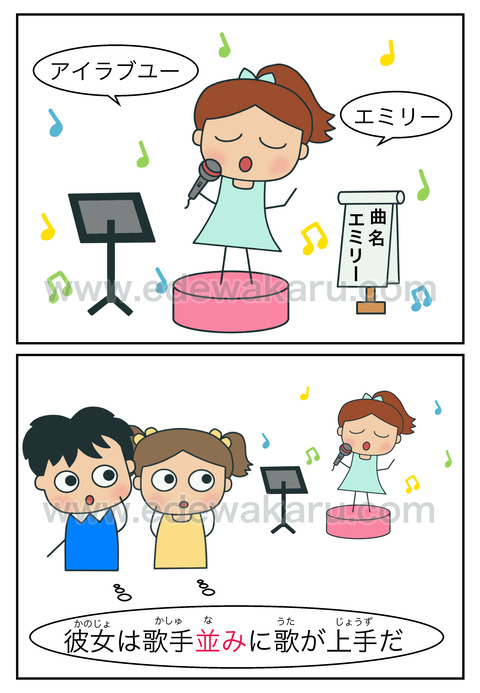
彼女は歌手並みに歌が上手だ
→彼女は歌手と同じくらい歌が上手だあの子は大人並みに漢字をよく知っている
→あの子は大人と同じくらい漢字をよく知っている陳さんは日本人並みに発音がきれいだ
→陳さんは日本人と同じくらい発音がきれいだ