文法
Usage 1
Meaning
~ないだろう
話者の推量を表す。古い言い方で書き言葉的。
推量なので、第3人称も主語として使用可。
How to use it
V(普) + まい
イAく + あるまい
ナAでは + あるまい
Nでは + あるまい
In context 4 examples
熱が徐々に下がり始めたので、心配しすぎる必要はあるまい。
私はさっき幽霊を見たが、誰も信じまい。
末期癌の父に対してできる限りのことをしたが、深刻な状況でこれ以上の回復は見込めまいとのことだ。
散々叱られたんだから、さすがにもう悪さをするまい。
Usage 2
Meaning
~しようと思わない強い否定の意志を表す。そのため、主語は1人称となる。
How to use it
V(普) + まい
In context 6 examples
田中さんを飲み会に誘っても、いつも断られる。もう二度と彼を誘うまい。
タバコの吸いすぎで重い病気になるなんて・・・、もう絶対吸うまい。
信用していた親友が僕の秘密をもらした。絶対に許すまい。
どんなに悲しいことがあっても、人前では泣くまいと決めている。
料金は高いし、サービスは最悪だし、もう二度とあんな店に行くまい。
もうあいつには二度と会うまい。
どんなときどう使う 日本語表現文型辞典
Usage 1
Meaning
probably won't
How to use it
Vる+まい(動詞Ⅱ・Ⅲは「Vない+まい」もある。「する」は「すまい」もある) イAく/ナAでは/Nでは+あるまいW
Explanation
まい〈否定の推量〉
~ないだろう
1)話者の「ある事柄がそうはならないだろう」という推量を表す。現代でも使われている古い言い方。
2)硬い書き言葉的な表現なので、話し言葉で文末に使われることは少ない。 ❺ のように、話し言葉でも、文中の引用文の中には現れることがある。
1)Speaker expresses the conjecture that something probably won't occur. Old form used even today.
2)As old, written expression, rarely used in sentence endings in spoken language. Even in speech, may appear in quotation in middle of sentence, as in sentence ❺ .
In context 5 examples
この事件は複雑だから、そう簡単には解決するまい。
彼は人をだまして町を出て行ったのだから、2度とここへ戻ることはあるまい。
この不況は深刻だから、安易な対策では景気の早期回復は望めまい。
これが唯一の解決策ではあるまい。もっと別の観点から見たらどうか。
父はこの様子では今日は雨は降るまいと言っているけれど、一応雨天の場合の準備もしておこう。
Usage 2
Meaning
I (we) will never…
How to use it
Vる+まい(動詞Ⅱ、Ⅲは「Vない+まい」もある。「する」は「すまい」もある)W
Explanation
まい〈否定の意志〉
~ようとは思わない
強い否定の意志を表す。意志を表すのだから、主語は1人称である。主語が3人称の場合は、「~まい」で終わる文はない。
◆ × 太郎は今年の正月からたばこを吸うまい。
→○太郎は今年の正月からたばこを吸うまいと決心した。 古い硬い言い方。
Strong negative volition. As expression of volition, subject is in the first person. When subject is in the third person, sentence ending cannot take ~まい. Formal, old-fashioned expression.
In context 3 examples
鈴木さんは無責任な人だ。もう2度とあんな人に仕事を頼むまい。
もう決して戦争を起こすまいと、わが国は固く決心したはずです。
考えまい、考えまいとするけれど、やっぱりあしたのことが気になって眠れない。
IMABI
毎~, ~ごとに, & ~おきに
Read this IMABI lesson ↗Explanation
毎~, ~毎に, & ~おきに
In this lesson, we will learn about three grammar points which roughly translate to “every/each…” in the context of repetition.
The Prefix 毎~
The prefix 毎~ denotes an ordinary repetition of time. While it is used in response to common, habitual actions, it is limited to idiomatic expressions and cannot generate new possible combinations:
毎朝まいあさevery morning毎晩every evening
毎日every day毎週every week
毎月まいつきevery month毎年まいとしevery year
毎春まいはるevery spring毎夏まいなつevery summer
毎秋まいあきevery autumn毎冬まいふゆevery winter
毎時(間)every hour毎分every minute
毎秒every second毎回every time
毎度always/often毎期every term
毎学期every semester毎号every issue
1. 毎朝散歩に出かけます。
I go out on a walk every morning.
2. 台風20号は毎時50キロメートルの速度で進んでいる。
Typhoon No. 20 is moving at a speed of 50 kilometers per hour.
3. 家の近くに野良猫が棲んでいて、1年くらい、ほぼ毎晩食事をあげています。
There is a stray cat that lives near my house, and I’ve been feeding it almost every evening for about a year.
4. 人間の意識的な思考速度は毎秒10ビット、一方で感覚器官の情報処理速度は毎秒約1ギガビット(10億ビット)に達することが判明しました。
It has been found that the speed of conscious thought for humans is 10 bits per second, while the processing speed for the sensory organs reaches approximately 1 gigabit (1 billion bits) per second.
5. 日本人は毎日三回食事まいにちさんかいしょくじをするのが普通ふつうだ。
It is typical for Japanese people to eat three meals every day.
6. 日本の首相は毎年のように替わる。
The Japanese prime minister changes practically every year.
7. 毎月のように熱を出すけど、変な病気ではない?
I get a fever like every month, but isn’t this some sort of strange illness?
8. 連載記事を毎号愛読してくださる方におすすめ!
Recommended for those who enjoy reading every issue of our serialized articles!
As is borne out in the chart above, 毎~ is primarily used with one-character words, but examples like 毎学期 (every semester) and 毎学年 (every academic year) are notable exceptions to this norm.
9. 毎学期楽しく過ごせています。
I’ve been able to enjoy every semester.
The most common lengthy utilization of 毎~ happens to be found when expressing “every [day of the week],” which is typically formed by using “毎週+ day of the week,” as opposed to “毎 + day of the week,” which is possible yet rather rare, particularly in the spoken language.
10. 毎週日曜日に教会に通うことにどのような意味があるのでしょうか。
What does it mean to go to church every Sunday.
In formal writing, more expressions utilizing 毎~ may be found, almost all of which relate to non-deictic time expressions. In this environment, it is also possible to find example words mentioned in the previous chart read solely with ON readings to heighten the literary tone.
毎朝まいちょうevery morning毎月まいげつevery month
毎年まいねんevery year毎夕まいゆう1every evening
毎夜まいよ2every night毎春まいしゅんevery spring
毎夏まいかevery summer毎秋まいしゅうevery autumn
毎冬まいとうevery winter毎季every season
In the spoken language, these formal expressions are switched out with their equivalents shown in the previous chart or replaced altogether with help from the next item of discussion in this lesson, ~ごとに.
~ごとに
~ごとに, written in kanji as ~毎に, is the native equivalent of 毎~, translating into English as “every/each…,” but its utility is far more versatile. Its usage can be summarized with the four following environments:
For every constant place, time period, person, etc., something is repeated, translating as “each/every.”
Something differs between instances of a given variable, translating as “from X to X…”
For every constant spatial or temporal interval, something is repeated, translating as “every/per.”
With each passing interval, a change progresses, translating as “with each…”
Each/Every…
Attaching after nouns, ~ごとに may translate as “each/every,” indicating the repetition of some action/event with each/every identified constant.”
11. 祝日ごとに、家族みんなでドライブに出かけることにしてますよ。
The whole family goes out on a drive every holiday.
12. 降りてくる人ごとに「あとどれぐらい?」と尋ねた。
With each person (I passed that was) descending, I would ask, “how much longer is there?”
From X to X…
Attaching after nouns, ~ごとに may translate as “each/from X to X” to indicate that some circumstance differs between each variable.
13. 会社ごとに、それぞれの社是しゃぜと社則しゃそくがあるから、よく注意してください。
[Each company/from company to company, each one] has its own policies and rules. So, please pay close attention.
14. カレーの味は地方ごとに異なります。
The way curry tastes differs from region to region.
15. 相続人ごとに考え方が異なり、「公平感」の違いから争いに発展することがあります。
Each heir has their own way of thinking, and differences in their sense of “fairness” can often lead to disputes.
Every/Each…
Paired with either spatial or temporal nouns, including counter phrases, ~ごとに may translate as “every/each” to indicate some repetition in constant intervals.
16. 4年ごとに閏年うるうどしになって、オリンピックが開かれるということは常識じょうしきだ。
It’s common sense that every four years is a leap year and that the Olympics are held.
17. 一時間ごとに手洗い消毒を行っています。
We disinfect or hands every hour.
18. 土曜日ごとに塾に通います。
I go to cram school every Saturday.
19. 昔は、3月から5月にかけて週末ごとに釣りに行っていました。
I used to go fishing every weekend from March to May back in the day.
20. 長さ100メートルの道に端から端まで5メートルごとに木が植えられています。
The 100 meter-long road has trees planted every 5 meters from one end to the other.
With Each…
At every stated constant interval, some effect becomes more pronounced.
21. 一雨ごとに、もっと暖かくなる。
With each rain, it gets warmer.
22. 年ごとに、地球温暖化が加速しているように思えます。
With each passing year, global warming seems to be accelerating.
For some non-deictic temporal nouns such as 年 and 月, duplicating the noun is a common, more prominent paraphrasing of ~ごとに. Meaning, 年々 = 年ごとに; 月々 = 月ごとに. While it may not be always the case that what is repeated has an accumulated effect (Usage 3), the interchangeability is maintained.
23. 家賃を{月々 ◎・月ごとに 〇}ちゃんと払っています。(Usage 3)
I properly pay my rent every month.
This is not to say that ~ごとに is entirely synonymous with 毎~ as it pertains to cyclical behavior. 毎~ simply denotes repetition, whereas ~ごとに, especially with Usage 4, implies accumulation, which the former can never express.
24. 毎年調査を行っていますが、年々店舗の意識も上がり、ほとんどの店舗できちんとした規制が行われていました。
(We) conduct surveys every year, and with each year, we find that awareness (of the matters at hand) at those stores is improving, with proper regulations being enforced at nearly all stores.
~ごとに = Objective
Expressions made with ~ごとに have a strong objective feel, and there is often a sense that whatever is happening repeats cyclically as the rule. In this light, it may follow verbal predicates, but this is quite rare, being inappropriate when describing personal, emotional anecdotes. However, if the repetition described is just an objective statement of fact, “Verb + ~ごとに” may be used naturally, although this is still quite uncommon and overshadowed by other grammar points.
25. 買い物するごとに、還元ポイントがもらえます。
Every time you shop, you received cash-back points.
In older language, “Verb + ~ごとに” could be seen more broadly to mean “whenever,” and in this greater capacity, it holds on in set phrases such as ことあるごとに (with every little thing/at every turn), albeit with a negative connotation.
26. オレの彼女だが、ことあるごとに浮気を疑ってくる。
My girlfriend suspects that I’m cheating on her at every turn.
Expressing “Every Time”
As you may have noticed, 毎~ may be used with the counters ~回 and ~度, and while it may seem like common sense that both would be synonymous to mean “every time,” they are not as interchangeable as one might expect.
While both 毎回 and 毎度 may translate as “every time/occurrence,” the literal sense of what is meant by “every time” is not nearly as felt with 毎度, allowing it to be used more idiomatically.
27. お客さんは毎回違う。
The patrons/guests are different each time.
28. 毎回このパターンだ・・・
Each time, it’s this same pattern (of behavior)…
29. 毎度ありがとうございます3。(Said often to customers)
Thank you as always.
30. 毎度のことだけれど、どこから手をつけていいか悩むわ。
As always, I’m not sure where to start.
31. 2人分の晩御飯が毎回毎回多すぎなのは知ってる。
I’m aware that dinner enough for two each and every time is too much.
~おきに
~おきに is equivalent to “every other,” and it can be used with temporal or spatial intervals. While it shows repetition within a given interval, the spacing out of said repetition is not the same as ~ごとに. To see how this manifests, compare the following:
32a. 2日おきに (●○○●○○●○○●)
Every other two days
32b. 2日ごとに (●○●○●○●)
Every two days
33a. 3メートルおきに (●○○○●○○○●)
Every other three meters
33b. 3メートルごとに (●○○●○○●)
Every three meters
34. きょうから一日いちにちおきに出勤です!
It’s going into work every other day starting today (for me)!
35. 部屋は5分おきに揺ゆれた。
The room shook every other five minutes.
When the interval of time or space is so small that the gap that ~おきに literally imposes is negligible, it essentially becomes synonymous with ~ごとに. Here are some scenarios to figure out the logic behind this:
Imagine you are planting trees 10 meters away from each other for 100 meters. If you measure so that the 10 meters goes from center to center, you can ensure that each interval is the same regardless of how thick each tree is (think ~ごとに). If, however, each interval of 10 meters begins at the edge of each tree, fewer trees will be planted the thicker the trees are (think ~おきに).
Imagine aftershocks are occurring in intervals of five minutes. Earthquakes typically only last for a few seconds. Here, the difference between ~ごとに and ~おきに is arguably negligible.
Though not heard in the spoken language, 毎夕 is generally read as まいゆう, with the reading まいせき giving off an even stronger literary tone. ↩︎
Though its traditional reading is まいや, it is generally read まいよ in modern speech. However, the word is normally replaced with 毎晩 in everyday speech. ↩︎
The Kansai Dialect iteration of this expression, 毎度大きに, is widely known. ↩︎
In context 37 examples
毎朝散歩に出かけます。
I go out on a walk every morning.
台風20号は毎時50キロメートルの速度で進んでいる。
Typhoon No. 20 is moving at a speed of 50 kilometers per hour.
家の近くに野良猫が棲んでいて、1年くらい、ほぼ毎晩食事をあげています。
There is a stray cat that lives near my house, and I’ve been feeding it almost every evening for about a year.
人間の意識的な思考速度は毎秒10ビット、一方で感覚器官の情報処理速度は毎秒約1ギガビット(10億ビット)に達することが判明しました。
It has been found that the speed of conscious thought for humans is 10 bits per second, while the processing speed for the sensory organs reaches approximately 1 gigabit (1 billion bits) per second.
日本人は毎日三回食事まいにちさんかいしょくじをするのが普通ふつうだ。
It is typical for Japanese people to eat three meals every day.
日本の首相は毎年のように替わる。
The Japanese prime minister changes practically every year.
毎月のように熱を出すけど、変な病気ではない?
I get a fever like every month, but isn’t this some sort of strange illness?
連載記事を毎号愛読してくださる方におすすめ!
Recommended for those who enjoy reading every issue of our serialized articles!
毎学期楽しく過ごせています。
I’ve been able to enjoy every semester.
毎週日曜日に教会に通うことにどのような意味があるのでしょうか。
What does it mean to go to church every Sunday.
祝日ごとに、家族みんなでドライブに出かけることにしてますよ。
The whole family goes out on a drive every holiday.
降りてくる人ごとに「あとどれぐらい?」と尋ねた。
With each person (I passed that was) descending, I would ask, “how much longer is there?”
会社ごとに、それぞれの社是しゃぜと社則しゃそくがあるから、よく注意してください。
[Each company/from company to company, each one] has its own policies and rules. So, please pay close attention.
カレーの味は地方ごとに異なります。
The way curry tastes differs from region to region.
相続人ごとに考え方が異なり、「公平感」の違いから争いに発展することがあります。
Each heir has their own way of thinking, and differences in their sense of “fairness” can often lead to disputes.
4年ごとに閏年うるうどしになって、オリンピックが開かれるということは常識じょうしきだ。
It’s common sense that every four years is a leap year and that the Olympics are held.
一時間ごとに手洗い消毒を行っています。
We disinfect or hands every hour.
土曜日ごとに塾に通います。
I go to cram school every Saturday.
昔は、3月から5月にかけて週末ごとに釣りに行っていました。
I used to go fishing every weekend from March to May back in the day.
長さ100メートルの道に端から端まで5メートルごとに木が植えられています。
The 100 meter-long road has trees planted every 5 meters from one end to the other.
一雨ごとに、もっと暖かくなる。
With each rain, it gets warmer.
年ごとに、地球温暖化が加速しているように思えます。
With each passing year, global warming seems to be accelerating.
家賃を{月々 ◎・月ごとに 〇}ちゃんと払っています。(Usage 3)
I properly pay my rent every month.
毎年調査を行っていますが、年々店舗の意識も上がり、ほとんどの店舗できちんとした規制が行われていました。
(We) conduct surveys every year, and with each year, we find that awareness (of the matters at hand) at those stores is improving, with proper regulations being enforced at nearly all stores.
買い物するごとに、還元ポイントがもらえます。
Every time you shop, you received cash-back points.
オレの彼女だが、ことあるごとに浮気を疑ってくる。
My girlfriend suspects that I’m cheating on her at every turn.
お客さんは毎回違う。
The patrons/guests are different each time.
毎回このパターンだ・・・
Each time, it’s this same pattern (of behavior)…
毎度ありがとうございます3。(Said often to customers)
Thank you as always.
毎度のことだけれど、どこから手をつけていいか悩むわ。
As always, I’m not sure where to start.
2人分の晩御飯が毎回毎回多すぎなのは知ってる。
I’m aware that dinner enough for two each and every time is too much.
2日おきに (●○○●○○●○○●)
Every other two days
2日ごとに (●○●○●○●)
Every two days
3メートルおきに (●○○○●○○○●)
Every other three meters
3メートルごとに (●○○●○○●)
Every three meters
きょうから一日いちにちおきに出勤です!
It’s going into work every other day starting today (for me)!
部屋は5分おきに揺ゆれた。
The room shook every other five minutes.
Negative Volition: ~まい
Read this IMABI lesson ↗Explanation
Negative Volition: ~まい
The auxiliary verb まい is best known as the negative volitional auxiliary. In Modern Japanese, it functions as the opposite of the volitional auxiliary ~(よ)う, but historically it is the antonym of ~べし (=~べきだ).
Although its use in the spoken language has diminished quite a lot, it remains fairly common in the written language, particularly grammatical structures, as well as certain dialects with some unique adaptations.
Conjugating with ~まい
「~まい」の接続
In prescriptive Standard Japanese, the auxiliary verb ~まい follows the 未然形 with 一段 verbs (which includes the passive/causative auxiliary verbs ~(ら)れる ~(さ)せる1, ~しめる), サ変 verbs (する), and カ変 verbs (来る), but it follows the 終止形 with 五段 verbs and the politeness marking auxiliary verb ~ます.
Verb ClassBaseExample
一段動詞∅-未然形食べまい
五段動詞∅-終止形言うまい
サ変動詞shi-未然形しまい
カ変動詞ko-未然形来まい
~ます∅-終止形~ますまい
Although the above chart represents the standardized conjugation norms for this auxiliary, considerable fluctuation has existed for centuries, to the point that some variation has become accepted in modern times.
StandardAcceptedDialectal
上一段
例、見る見まい見るまい見よまい
下一段
例、食べる食べまい食べるまい食べよまい
五段
例、行く行くまい行かまい
行こまい
サ変
例、するしまいするまい
すまい2せまい
カ変
例、来るこまいくるまいくまい
きまい
From the perspective of the 未然形, if ~まい is inherently less modern, then it would only seem logical for it to be paired with the traditional 未然形 for when there is a discrepancy, such as which exists for the サ変 verb する—se– being the traditional 未然形 seen in constructions like せず (=しない). Yet, despite せまい being the historically pure form, its use among modern speakers across dialects is only marginal. Conversely, 来る is regular in this regard for maintaining こまい over きまい, with the latter using き as an alternative 未然形 mirroring し for する in the same capacity but never having gained widespread acceptance. Moreover, 五段 verbs have experienced dialectal acceptance of ~まい attaching to their 未然形.
Having ~まい follow the 終止形 with all classes of verbs has become so prevalent that doing so has become generally accepted and will at some point in the future become standardized. In the cases of するまい vs すまい and 来るまい vs 来(く)まい, this is a matter of whether the traditional 終止形 of these verbs without the final /ru/ is used over the modern 終止形 with the final /ru/.
Conjugating ~まい
「~まい」の活用
~まい, like all other auxiliary verbs, has its own bases. However, much has changed over time, and as a consequence, only its 終止形 and 連体形 remain in use.
終止形 連体形
まいまい
The 連体形 is practically only used with the nominalizers こと and もの.
Negative Volition
打ち消しの意志
The primary usage of ~まい is to show negative volition – “shall not.” This can be roughly reworded as ~ないようにするつもりだ. Although it isn’t that common in the spoken language, it is very succinct and it can be said that is more emphatic as an effect.
1. もう言うまい!
I shall say no more.
2. もう二度とそんな過ちは繰り返すまい。
I shall not make such a mistake again.
3. 債権者もそんな過酷な手段は認めますまい。
Not even the creditor would approve of such a cruel means.
4. 絶対に落第すまい3ぞ!
I will absolutely not fail!
5. じっと女の顔を見た刹那、わたしは男を殺さない限り、此処は去るまいと覚悟しました。
The moment I fixed my glance on the woman’s face, I was determined not to leave until I killed the man.
From 『藪の中』 by 芥川龍之介.
Negative Supposition
打ち消しの推量
The auxiliary verb ~まい may also indicate ‘negative supposition,’ which is parallel to how the auxiliary verb ~(よ)う may indicate ‘affirmative supposition,’ but unlike the latter, ~まい is just as often used to indicate negative volition as it does negative supposition.
Negative supposition indicates what the speaker views as unlikely to occur. In modern language, this would be usually rendered with ~ないだろう. However, ~まい still holds on in this capacity in literature as well as in the speech of older generations, as well as by anyone who wishes to sound more assertive.
Though quite uncommon nowadays, it is also possible to see this usage adapted to polite speech in the form of ~ますまい.
6. 知らなかったわけではあるまい。
It’s not that they didn’t know.
7. 妻の罪はそれだけではない。それだけならばこの闇の中に、今程おれも苦しみはしまい。
The wife’s crime wasn’t just that. If it were, I too wouldn’t be suffering as I am now in this darkness.
From 『藪の中』 by 芥川龍之介.
8. 兎に角わたしはどうしても、死に切る力がなかったのです。小刀を喉に突き立てたり、山の裾の池へ身を投げたり、いろいろな事もして見ましたが、死にきれずにこうしている限り、これも自慢にはなりますまい。
Anyway, in the end, I did not have the strength to really die. I had thrust the knife into my throat, thrown myself into the pond at the foot of the mountain, and all sorts of other things, but insofar I am like this unable to die, this too is surely nothing to boast.
From『藪の中』 by 芥川龍之介.
9. その後の事を申し上げるだけ、無用の口数に過ぎますまい。
Merely speaking of what happened after would be no more than useless words.
From 『藪の中』 by 芥川龍之介.
10. 併し死刑の宣告を受けた人は、処刑の日を前知している代わりには、いよいよ刑に逢うまで、若し赦免になりはすまいか、偶然助かりはすまいか、奇蹟がありはすまいかなんぞと思っているのです。
However, for those who receive a death sentence, mustn’t they be hoping for a pardon, being suddenly saved, or even a miracle up until the moment they meet their punishment instead of knowing their execution date?
From 『死』 by 森鴎外.
11. いくら肉親の妹だって、姉の骨まで見たことはあるまいから、分かるもんか。
Even if it was your own little sister, you’d never understand since you’ve never seen your sister turned to bones.
From 『死体紹介人』 by 川端康成.
12. 「里子ちゃん、いらっしゃい。お雑煮のお餅を焼きましょうね。里子ちゃんも、お手つだいしてちょうだい。」などと言って、菊子は里子を台所へ呼び寄せ、信吾の寝部屋の廊下を走らせまいとするつもりらしいが、里子は聞く風もなく、ぺたぺた廊下を走りつづけた。
Kikuko had said, “Satoko-chan, come here. Let’s make some zoni mochi. Won’t you please help?” to call Satoko to the kitchen, and although it seemed she had intended for her not to run down the hall past Shingo’s bedroom, Satoko paid no heed to this and continued running down loudly through the hall.
From 『山の音』 by 川端康成.
13. 争いが無ければ、かかる嘆きはあるまいものを4。
If there were no war, nay, there would be no such grief as this.
Prohibition
禁止
Similar to the concept of showing negative volition, when used in the second person, ~まい may be used in the same sense as ~てはいけない. In doing so, it is usually followed by the final particle ぞ.
14. 迂闊なことは言うまいぞ。
You mustn’t speak absurdities.
15. 一兵たりとも逃がすまいぞ。
You mustn’t let a single soldier escape.
16. あとわずかだ、油断すまいぞ。
Just a little more; you mustn’t let your guard down.
17. 決して他人には漏らすまいぞ。
You absolutely mustn’t leak this to anyone.
~まいとする
~まいとする is equivalent to ~ないようにする・ないでおこうとする in more modern phrasing, as such it is most prevalent in the written language or when the speaker wishes to sound far more assertive with their intent of non-action. This structure is the antonym of ~ようとする.
18. 笑うまいとしても、つい笑ってしまうだろう。
Even if you try not to laugh, you’ll eventually end up laughing.
19. 瑠璃子は涙を見せまいとしていたが、その瞳は真っ赤になっていた。
Ruriko tried to not let her tears be seen, but her eyes were bright red.
20. 世の中に反逆的に生きることに夢中だった俺は、時間という世間の常識にも縛られまいとしていた。
I have strived not to be bound by the world’s common sense notion of “time,” having devoted myself to living life rebelling against the world.
21. 学生たちは、先生の動作を食い入るように見つめ、少しも見逃すまいとしていたようだった。
It seemed as though the students had intently stared at their sensei’s every move, daring not to miss anything.
22. パニックを起こすまいとしたが、全身の感覚が麻痺していくのがわかった。
I tried not to panic, but I knew that my whole body’s senses were numbing up.
Just as is the case with ~ようとする, ~まいとする may be adapted to utilize other verbs besides する which may be used with the quotative particle と, and it is also possible to use the clause containing ~まい as an adverbial clause without する.
23. 会うまいと決心した。
I decided that I wasn’t going to meet (him).
24. その時までは決して彼に会うまいと心に決めていた。
Until that time (would come to pass), I decided in my heart that I would never meet him.
25. 彼女は眠るまいと決心していたが、結局眠りにつけてしまった。
She was resolute not to sleep, but she finally ended up falling asleep.
26. 武史は、絶対に{逃がさまい △・逃がすまい ◎}と、相手の肩を掴んで、手に力を入れた。
Takeshi, daring not to allow the other person to get away, snags them by the shoulder, and squeezes down.
~でもあるまい & ~こともあるまい
The grammatical patterns ~でもあるまい and ~こともあるまい are both used to indicate a scenario deemed inappropriate by being critical to the point of downplaying the situation altogether, which results in these patterns being rendered in English as “it’s not as if…” When such statements are directed towards oneself, there is a rather strong self-deprecating tone produced.
As for how the two structures differ, they are merely different adaptions based on the kind of predicate involved. For noun-predicates, use Noun + ~でもあるまい, and for verbal predicates, use 連体形 + ~こともあるまい.
27. 本当のことを言われたからと言って、何もそんなに怒ることはあるまい。
There is nothing to be so mad about just for being told the truth.
This use of ~まい does remain prevalent in the spoken language, but when it is used, it is usually accompanied with the particle し, here used like a final particle to tone down the seriousness of the situation the speaker thinks is out of line. Note also that でもあるまい may be rendered as ではあるまい5 or even じゃあるまい, with the latter being colloquial in tone due to the contraction of では to じゃ.
28. 車で15分ほどの所に住む人は泊まりに行くこともあるまいし。
Besides, people who live 15 minutes away by car would not stay (there).
29. 子供じゃあるまいし、自分で買いなさい。
It’s not as if you’re a kid; buy it yourself.
Though somewhat less common these days, this use of ~まい may be seen with the final particle に, which emphasizes the speaker’s displeasure/dissatisfaction.
30. 黙っていれば言うこともあるまいに。
If you’d just stay quiet, you’d have nothing to say.
As you can see, negative supposition and the sense of prohibition are both at play here.
31. 馬鹿じゃあるまいし、そんなことをするな。
It’s not as if you’re an idiot, so don’t do that.
~まいか
As mentioned above, ~まいか may be used to express a request in the same way ~ないか is used in more modern speech. As such, this is rather old-fashioned in Standard Japanese. Or, it may be analogous to ~ないのだろうか to indicate supposition via the negative. The difference is based on intonation: upward intonation = ないか; downward intonation = ~ないのだろうか6.
32. 天気予報は雪だったが、このぶんだと、今日はもう降るまいか。
The weather forecast called for snow, but at this rate, there won’t be any snow today, huh.
33. 寒いから毛布を持ってきてくれまいか。
It’s cold, so could you bring me a blanket?
34. 儂にもその製法を教えてもらえまいか。
Could I have you teach me that formulation, too?
~のではあるまい(か)
Of course, the nominalizer の may be used in conjunction with the auxiliary ~まい. In doing so, ~のではあるまい functions parallel to how ~のではない does in modern speech. Whether ~まい should be interpreted as literally expressing negative supposition or agreeance via a rhetorical, negative tag-question. Unlike its Modern Japanese equivalent ~のではないか, the negative tag-question marker ~まい(か)has a downward intonation7.
As for the exact function of ~のではある (=のだ) in conjunction with ~まい, のである itself indicates the speaker’s confidence in affirming the statement in light of a context at works, but the conviction is not quite 100% due to the suppositional nature of ~まい.
Speech Style Note: のではあるまい may be rendered as のじゃあるまい to reflect the pattern’s use in the speech of older generation.
35. 元々、魚がお好きなのじゃあるまいか。
Haven’t you always liked fish (which is why you like it so much)?
36. 別にわざとしたんじゃあるまいよ。
It’s not like I did it particularly on purpose, you know?
37. よもや戦(いくさ)が恐ろしいのではありますまいな?
Surely war isn’t so terrifying, no?
38. このお酒は儂が最も好きな日本酒のうちのひとつであり、まさかお前がわざわざ買ってくれたのではあるまいか。
This sake is one of my favorite sakes, don’t tell me you were the one who went out of your way to buy it for me?
~あろうことかあるまいことか
Seen as such in なろうことかなるまいことか, ~まい may also indicate what ought not to be so and in a rather condescending light.
39. あろうことかあるまいことか、新しく買った携帯を海に投げるなんて・・・
Of all things, throwing your newly bought phone into the ocean…
40. 自分の思い通りになろうことかなるまいことか、よく考えてみろ。
There is no sense in thinking things will go your way; think about it.
~まじき
Though the 連体形 of ~まい is no longer used much in modern speech, the 連体形8 of its predecessor, まじき, is actually more productive, surviving in the phrase あるまじき (unworthy/improper) and a handful of other phrases. This usage derives from its prohibition nuance.
41. あるまじき行為だ。
It is an improper act.
42. すまじき9ものは宮仕え。(Set Phrase)
It is better to work for oneself than to work for someone else.
~まじき = ~まじい
Occasionally in Early Modern Japanese literature, you may encounter まじい, which is the stage its 連体形・終止形 took before being further reduced to ~まい.
43. 「早くね、早くね。」と、言うなり後向いて走り出したのは噓みたいにあっけなかったが、遠ざかる後姿を見送っていると、なぜまたあの娘はいつもああ真剣な様子なのだろうと、この場にあるまじい不審が島村の心を掠めた。
Her running off as soon as she looked back saying “hurry, hurry!” seemed all too much like a lie, but as Shimamura looked at her retreating figure go farther away, a suspicion unfit for the scene grazed his mind as he thought again about why she was always so serious.
From 『雪国』 by 川端康成。
44. 士官の軍刀と、半玉の守り袋や花簪の鈴とが、足拍子につれて鳴った。兵士にあるまじい、哀傷の歌詞でありながら、二十五前後の青年と十五六の少女との合唱であるために、進軍の歌の響きがあった。
The officer’s saber and the young geisha’s little pouch and bells on her flowery hairpin resounded with the beating of their feet. Though the lyrics were elegiac and unbecoming of a solider, as it was the ensemble of a twenty-five or so year old lad and a fifteen, sixteen or so year old girl, it had the quality of a marching song.
From 『童謡』 by 川端康成.
45. 触れるほど顔を重ねて見るほど、能面にはあるまじい邪道だろう。
It was surely heresy unworthy of the Noh mask to even touch or try to put over one’s face.
From 『山の音』 by 川端康成.
For the short causatives form ~さす and ~す, ~まい is observed following the 終止形, as these shortened forms exhibit 五段 conjugations. ↩︎
Some speakers feel that すまい is more emphatic than しまい, but this perception is likely due to the pervasive use of 終止形+~まい, which affects する as with any other verb, predating the use of し(未然形)+ ~まい over the historical form せまい. ↩︎
Regarding the use of the verb する with this usage of ~まい, some speakers feel that すまい is more effective at expressing one’s intent (lack thereof) than しまい. This may be due to すまい having existed in this capacity for much longer. ↩︎
~ものを is a somewhat old-fashioned compound final particle which expresses lament. ↩︎
The difference between は and も here is a subtle one. Whereas は would downplay the scenario as not being so in light of what it could be, も would soften the tone and in light of not being so. ↩︎
This is the opposite intonation found with the modern ~ないのだろうか. ↩︎
The downward intonation is explained from the culture of giving a “yes” even when there is the potential of a situation “not” being so, which also explains way negative structures are used in “affirmative” tag questions. ↩︎
The auxiliary verb 〜まい derives from the Classical Japanese auxiliary verb 〜まじ, itself a contraction of 〜ましじ, a combination of two moribund auxiliaries: 〜まし (supposition marker) and 〜じ (negative volition marker). 〜まし itself is believed to be an adjectivalized form of the volition auxiliary 〜む, which is the ancestor to the Modern Japanese volitional auixilaries 〜よう・う. ↩︎
Also seen as せまじきものは宮仕え. The form せまい was, in fact, used in Edo Period colloquial speech, and it can be still heard in situations such as authentic kabuki performances. ↩︎
In context 45 examples
もう言うまい!
I shall say no more.
もう二度とそんな過ちは繰り返すまい。
I shall not make such a mistake again.
債権者もそんな過酷な手段は認めますまい。
Not even the creditor would approve of such a cruel means.
絶対に落第すまい3ぞ!
I will absolutely not fail!
じっと女の顔を見た刹那、わたしは男を殺さない限り、此処は去るまいと覚悟しました。
The moment I fixed my glance on the woman’s face, I was determined not to leave until I killed the man.
知らなかったわけではあるまい。
It’s not that they didn’t know.
妻の罪はそれだけではない。それだけならばこの闇の中に、今程おれも苦しみはしまい。
The wife’s crime wasn’t just that. If it were, I too wouldn’t be suffering as I am now in this darkness.
兎に角わたしはどうしても、死に切る力がなかったのです。小刀を喉に突き立てたり、山の裾の池へ身を投げたり、いろいろな事もして見ましたが、死にきれずにこうしている限り、これも自慢にはなりますまい。
Anyway, in the end, I did not have the strength to really die. I had thrust the knife into my throat, thrown myself into the pond at the foot of the mountain, and all sorts of other things, but insofar I am like this unable to die, this too is surely nothing to boast.
その後の事を申し上げるだけ、無用の口数に過ぎますまい。
Merely speaking of what happened after would be no more than useless words.
併し死刑の宣告を受けた人は、処刑の日を前知している代わりには、いよいよ刑に逢うまで、若し赦免になりはすまいか、偶然助かりはすまいか、奇蹟がありはすまいかなんぞと思っているのです。
However, for those who receive a death sentence, mustn’t they be hoping for a pardon, being suddenly saved, or even a miracle up until the moment they meet their punishment instead of knowing their execution date?
いくら肉親の妹だって、姉の骨まで見たことはあるまいから、分かるもんか。
Even if it was your own little sister, you’d never understand since you’ve never seen your sister turned to bones.
「里子ちゃん、いらっしゃい。お雑煮のお餅を焼きましょうね。里子ちゃんも、お手つだいしてちょうだい。」などと言って、菊子は里子を台所へ呼び寄せ、信吾の寝部屋の廊下を走らせまいとするつもりらしいが、里子は聞く風もなく、ぺたぺた廊下を走りつづけた。
Kikuko had said, “Satoko-chan, come here. Let’s make some zoni mochi. Won’t you please help?” to call Satoko to the kitchen, and although it seemed she had intended for her not to run down the hall past Shingo’s bedroom, Satoko paid no heed to this and continued running down loudly through the hall.
争いが無ければ、かかる嘆きはあるまいものを4。
If there were no war, nay, there would be no such grief as this.
迂闊なことは言うまいぞ。
You mustn’t speak absurdities.
一兵たりとも逃がすまいぞ。
You mustn’t let a single soldier escape.
あとわずかだ、油断すまいぞ。
Just a little more; you mustn’t let your guard down.
決して他人には漏らすまいぞ。
You absolutely mustn’t leak this to anyone.
笑うまいとしても、つい笑ってしまうだろう。
Even if you try not to laugh, you’ll eventually end up laughing.
瑠璃子は涙を見せまいとしていたが、その瞳は真っ赤になっていた。
Ruriko tried to not let her tears be seen, but her eyes were bright red.
世の中に反逆的に生きることに夢中だった俺は、時間という世間の常識にも縛られまいとしていた。
I have strived not to be bound by the world’s common sense notion of “time,” having devoted myself to living life rebelling against the world.
学生たちは、先生の動作を食い入るように見つめ、少しも見逃すまいとしていたようだった。
It seemed as though the students had intently stared at their sensei’s every move, daring not to miss anything.
パニックを起こすまいとしたが、全身の感覚が麻痺していくのがわかった。
I tried not to panic, but I knew that my whole body’s senses were numbing up.
会うまいと決心した。
I decided that I wasn’t going to meet (him).
その時までは決して彼に会うまいと心に決めていた。
Until that time (would come to pass), I decided in my heart that I would never meet him.
彼女は眠るまいと決心していたが、結局眠りにつけてしまった。
She was resolute not to sleep, but she finally ended up falling asleep.
武史は、絶対に{逃がさまい △・逃がすまい ◎}と、相手の肩を掴んで、手に力を入れた。
Takeshi, daring not to allow the other person to get away, snags them by the shoulder, and squeezes down.
本当のことを言われたからと言って、何もそんなに怒ることはあるまい。
There is nothing to be so mad about just for being told the truth.
車で15分ほどの所に住む人は泊まりに行くこともあるまいし。
Besides, people who live 15 minutes away by car would not stay (there).
子供じゃあるまいし、自分で買いなさい。
It’s not as if you’re a kid; buy it yourself.
黙っていれば言うこともあるまいに。
If you’d just stay quiet, you’d have nothing to say.
馬鹿じゃあるまいし、そんなことをするな。
It’s not as if you’re an idiot, so don’t do that.
天気予報は雪だったが、このぶんだと、今日はもう降るまいか。
The weather forecast called for snow, but at this rate, there won’t be any snow today, huh.
寒いから毛布を持ってきてくれまいか。
It’s cold, so could you bring me a blanket?
儂にもその製法を教えてもらえまいか。
Could I have you teach me that formulation, too?
元々、魚がお好きなのじゃあるまいか。
Haven’t you always liked fish (which is why you like it so much)?
別にわざとしたんじゃあるまいよ。
It’s not like I did it particularly on purpose, you know?
よもや戦(いくさ)が恐ろしいのではありますまいな?
Surely war isn’t so terrifying, no?
このお酒は儂が最も好きな日本酒のうちのひとつであり、まさかお前がわざわざ買ってくれたのではあるまいか。
This sake is one of my favorite sakes, don’t tell me you were the one who went out of your way to buy it for me?
あろうことかあるまいことか、新しく買った携帯を海に投げるなんて・・・
Of all things, throwing your newly bought phone into the ocean…
自分の思い通りになろうことかなるまいことか、よく考えてみろ。
There is no sense in thinking things will go your way; think about it.
あるまじき行為だ。
It is an improper act.
すまじき9ものは宮仕え。(Set Phrase)
It is better to work for oneself than to work for someone else.
「早くね、早くね。」と、言うなり後向いて走り出したのは噓みたいにあっけなかったが、遠ざかる後姿を見送っていると、なぜまたあの娘はいつもああ真剣な様子なのだろうと、この場にあるまじい不審が島村の心を掠めた。
Her running off as soon as she looked back saying “hurry, hurry!” seemed all too much like a lie, but as Shimamura looked at her retreating figure go farther away, a suspicion unfit for the scene grazed his mind as he thought again about why she was always so serious.
士官の軍刀と、半玉の守り袋や花簪の鈴とが、足拍子につれて鳴った。兵士にあるまじい、哀傷の歌詞でありながら、二十五前後の青年と十五六の少女との合唱であるために、進軍の歌の響きがあった。
The officer’s saber and the young geisha’s little pouch and bells on her flowery hairpin resounded with the beating of their feet. Though the lyrics were elegiac and unbecoming of a solider, as it was the ensemble of a twenty-five or so year old lad and a fifteen, sixteen or so year old girl, it had the quality of a marching song.
触れるほど顔を重ねて見るほど、能面にはあるまじい邪道だろう。
It was surely heresy unworthy of the Noh mask to even touch or try to put over one’s face.
くらべてわかる日本語表現文型辞典
Meaning
意味1:否定の推量を表す。Aないだろう。
意味2:「ぜったいにAないぞ」という話し手自身の強い否定の意志を表す。
How to use it
Aまい(Aでは(じゃ)あるまいか)
[動詞-る形]まい
[動詞-ない形]まい(一段動詞(2グループ)、する・来る(3グループ)のみ)
Explanation
【対比2】
「Aものか」(意味1 P.304)
「Aまい」は否定の意志や決定を自分に言い聞かせている表現である。
「Aものか」は感情を前面に出し相手に訴えているニュアンスがあり、動詞以外にも使える。
○今朝はひどい二日酔いだ。二度と酒は飲むまい。
○彼は酒癖が悪い。あんな奴と二度と酒を飲むものか。
Notes
【注意1】
・「Aではあるまいか」はAではないだろうかの意味。
In context 8 examples
こんなにきれいな青空が広がっているんだから、雨は降るまい。
これほどのご馳走を、とても一人では食べきれまい。
昨日あれほど注意したから、今日は遅れてくるまい。
こ、これはダイヤモンドの原石ではあるまいか!
今日はひどい二日酔いだ。もう二度と酒は飲むまい。
子どもは大切なおもちゃを放すまいと、強く握りしめていた。
人の悪口はもう言うまい。
あんな男の言うことなんか、二度と信じるまい。
DoJG 日本語文法辞典(全集)
Meaning
Will not; will probably not; be probably not
How to use it
(i) Vinformal nonpast | まい | |
| 行くまい | (I) will not go; probably won’t go |
| 教えるまい | (I) will not teach; probably won’t teach |
(ii) Adjective い stem | くはあるまい | |
| 高くはあるまい | Something is probably not expensive |
(iii) {Adjective な stem/Noun} | ではあるまい | |
| 静かではあるまい | Something is probably not quiet |
| 先生ではあるまい | Someone is probably not a teacher |
Explanation
An auxiliary which expresses the speaker's negative volition or conjecture.
In context 11 examples
もう橋本には何も頼むまい。
I will not ask any more favours of Hashimoto.
これは恐らく誰も気が付くまい。
Probably no one will notice this.
参加者はそれほど多くはあるまい。
There probably won't be many participants.
この教え方はあまり効果的ではあるまい。
This teaching method is probably not very effective.
これは何かの間違いではあるまいか。
I have a feeling that this is some kind of mistake. (literally: Is this not some kind of mistake?)
清のパーティーにはもう行くまい。
I will not go to Kiyoshi's parties any more.
日本へ行こうか行くまいか迷った。
I couldn't decide whether I should go to Japan or not.
彼は多分誰の言うことも聞くまい。
He probably won't listen to anyone.
それは今我々には必要ではあるまい。
It is probably not necessary for us now.
この問題はこの学校の学生にはそれほど難しくはあるまい。
This problem is probably not very difficult for these students.
ジョージが真相を知っているのではあるまいか。
I have a feeling that George knows the truth.
日本語文型辞典
Meaning
基本情報説明五段動詞は辞書形、一段動詞は連用形か辞書形に付く(例:行くまい、話すまい、見まい、見るまい)。「来る」と「する」にはそれぞれ、「くるまい/こまい」「するまい/すまい」という二つの形があるが、辞書形に付く「くるまい」「するまい」の形のほうが一般的である。動詞以外については、「ない」は「あるまい」となり、「Nではない」「Naではない」「A-くない」はそれぞれ「Nではあるまい」「Naではあるまい」「A-くあるまい」になる。また、「ます」に付いて「ますまい」となることもある。
a. V-まい【意志】
「…しない」という話し手の否定的な意志を表す。話しことばでは、「V-ないようにしよう」「V-ないつもりだ」が使われる。また⑤のように「…まいと決心する/思う/考える」などの形で他者の「…しない」という意志について述べるのに使う。⑥は、「母を悲しませたくないと思って…」の意味。書きことば的なかたい表現。
b. V-まいとする
「…ないでおこうとする」という意味。書きことば的なかたい表現。「…まいとして」の場合は「して」を省くこともある。
「…ないだろう」という意味。話し手の推量を表す。⑦のように、話しことばで使われることはまれで、「言わないだろう」「言わないでしょう」を使うのが普通。⑤のように「と思って/と考えて」など引用文中にくるときは話しことばでも用いられる。書きことば的なかたい表現。
a. Nでもあるまい
不適切、不適当であるという判断を表す。「いまさら/いまごろ、…でもあるまい」の形で使われることが多く、時期が遅すぎて不適当であるということを述べる場合に使う。
b. Nでもあるまいし
「Nではないのだから」「Nではないはずだから」という意味。後に「…しなさい」「…してはいけない」など、禁止や命令の形が使われて、忠告したり、批判したりする場合に使われることが多い。「では/じゃあるまいし」の形もある。
c. V-ることもあるまい
その行動が不適当であるという批判的な判断や、その行動が不必要であるという判断を述べる場合に使う。書きことば的なかたい表現で、話しことばでは「V-ることもないだろう」の方がよく使われる。
a. …ではあるまいか
「…ではないだろうか」という意味。「Xではあるまいか」は、話し手が「たぶんXだ」と考えていることを表す推量の表現。
名詞、ナ形容詞に付く場合には、「N/Naではあるまいか」と「N/Naなのではあるまいか」の二つの形がある。
③~⑥のように、問題提起の部分に使われたり、結論を述べる部分で、聞き手に問いかける形をとりながら、話し手の主張を述べる場合に使うことが多い。主に書きことばで使われるかたい表現。
b. V-てくれまいか
依頼を表す。男性的なかたい表現で、話しことばでは「V-てくれ/もらえないだろうか」が使われるのが普通。①のように、「…と頼まれた/言われた」の形で引用文中に使われることが多い。
⇾よう24c
⇾よう26c
How to use it
…まい
…まい【推量】
…でもあるまい
まいか
N/Na(なの)ではあるまいか
A/V のではあるまいか
V-てもらえまいか
V-ようがV-まいが
V-ようとV-まいと
In context 34 examples
酒はもう二度と飲むまい。
あいつにはもう二度と会うまい。
A:佐々木とけんかしたんだって?
B:そうなんだよ。人が親切で言ってるのに聞こうともしないんだ。あいつにはもう何も言うまいと思っているんだ。二日酔いの間はもう二度と飲みすぎるまいと思うが、ついまた飲み過ぎてしまう。
その時、広子は、二度と田中には会うまいと固く決心した。
母を悲しませまいと思ってそのことは知らせずにおいた。
銃を奪われまいとして争いになった。
夏子は泣くまいとして歯を食いしばった。
家族の者を心配させまいとする気持ちから、会社をやめたことは言わずにおいた。
(例) 銃を奪われまいと争いになった。
このうれしさは他人にはわかるまい。
税金を減らすのに反対する人はまずあるまい。
山田氏の当選はまず間違いあるまい。
年老いた両親も亡くなって、ふるさとにはもうだれもいなくなってしまった。もう二度と訪れることもあるまい。
こんな話をしてもだれも信じてはくれまいと思って、今まで黙っていたのです。
顔を見るだけで他人の過去を当てるなんて妙な話だが、これだけ証人がいるのならまんざら嘘でもあるまい。
他ならぬ松下さんの御依頼ですから、父もまさかいやとは言いますまい。
子供が初めて下宿した時には、かぜをひいてはいまいか、一人でさびしがっていはしまいかと心配でならなかった。
仕事を紹介して下さる人もあるが、私ももう70だ。この歳になって、いまさら会社勤めでもあるまい。
自分から家を出ておきながら、今ごろになって、同居でもあるまい。
子供でもあるまいし、自分のことは自分でしなさい。
学生でもあるまいし、アルパイトはやめて、きちんと勤めなさい。
17や18の小娘でもあるまいし、男に振られたぐらいで、いつまでもくよくよするのはやめなさい。
あんなにひどい言い方をすることもあるまいに。
あの程度のことで、大の大人が泣くこともあるまい。
電話か手紙で用は足りるのだから、わざわざ行くほどのこともあるまい。
彼は若くみえるが、本当はかなりの年輩なのではあるまいか。
佐藤さんは知らないふりをしているが、全部わかっているのではあるまいか。
児童の自殺があいついだのには、現在の教育制度に、何か問題があるのではあるまいか。
他人への無関心が、このような事件を引き起こす一因となったのではあるまいか。
知識のみを偏重してきたことは、現在の入試制度の大きな欠陥ではあるまいか。
会社や組織のためにのみ働き続ける生活は、誰よりも本人が一番苦しいのではあるまいか。
忙しいからと一度は断わったのだが、なんとかやってもらえまいかと何度も頼まれてしかたなく引き受けた。
A:例のニューヨーク支店の件だが、支店長として、まず君に行ってもらえまいか。
B:かしこまりました。
絵でわかる日本語
Usage 1
Read this source entry ↗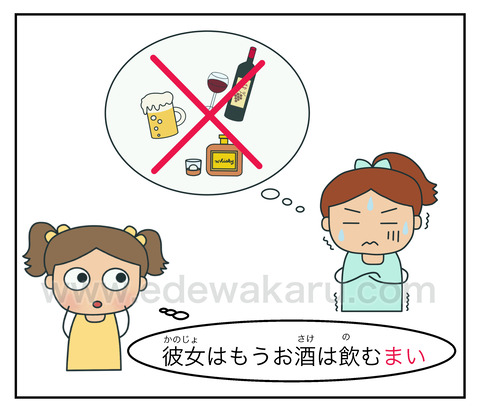
Meaning
〜ないだろう
How to use it
動詞Ⅰ[辞書形]+まい
動詞Ⅱ[辞書形・ます形]+まい
する→するまい・すまい
来る→来るまい・来まい
Explanation
「〜まい」は
「〜ないだろう」という意味の文型です。これは【否定推量(ひていすいりょう)】を表すもので、3人称に使用することもできます😉古くてかたい言い方ですので、書き言葉として使われます。動詞Ⅱの場合は「辞書形+まい」「ます形+まい」の両方を使うことができます。
[例]
おばけを見たと言っても、誰も
信じるまい
=おばけを見たと言っても、誰も
信じまい
「〜まい」には【否定意志】を表すものもありますので、一緒に覚えておきましょう😀
In context 5 examples
彼女はもうお酒は飲むまい
→彼女はもうお酒は飲まないだろう私の気持ちは誰にもわかるまい
→私の気持ちは誰にもわからないだろう薬を飲んだから、もう心配する必要はあるまい
→薬を飲んだから、もう心配する必要はないだろう社長に言われたら、嫌だとは言うまい
→社長に言われたら、嫌だとは言わないだろうおばけを見たと言っても、誰も信じるまい
→おばけを見たと言っても、誰も信じないだろう
Usage 2
Read this source entry ↗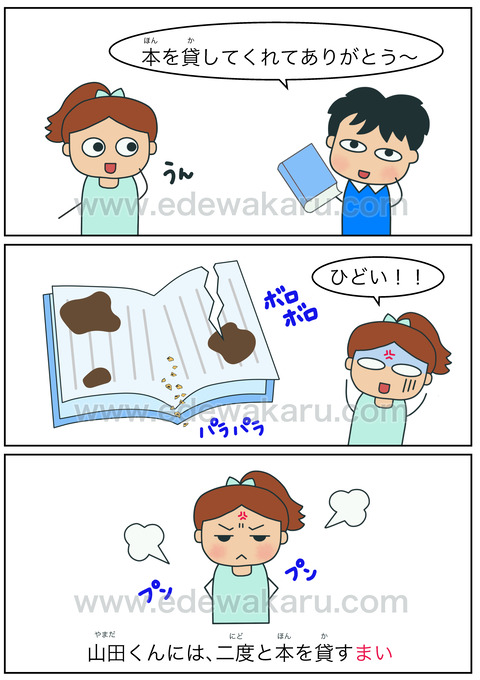
Meaning
絶対に〜しないつもりだ
How to use it
動詞Ⅰ[辞書形]+まい
動詞Ⅱ[辞書形・ます形]+まい
する→するまい・すまい
来る→来るまい・来まい
Explanation
「〜まい」は「絶対に〜しない」という意味を表す文型です。これは、
話者の強い意志
を表す場合に使われます。よく一緒に使われる表現をいくつか覚えておきましょう。
[よく一緒に使われるもの]
・
もう
+〜まい
・
二度と
+〜まい
・
決して
+〜まい
「〜まい」には【否定推量(ひていすいりょう)】を表す用法もありますので、復習をしておきましょう😀
In context 5 examples
山田くんには、二度と本を貸すまい
→山田くんには、二度と本を貸さないつもりだもうお酒は飲むまい
→もう絶対にお酒は飲まないつもりだあんなにまずくて高い店になんて二度と行くまい
→あんなまずくて高い店になんて二度と行かないつもりだ今日は眠くてかなわない…もうオールなどするまい
→もうオールなどしないつもりだ秘密をばらされた…もう決して彼には秘密を言うまい
→もう決して彼には秘密を言わないつもりだ
日本語NET JLPT文法解説まとめ
Meaning
~しようと思わない
強い否定の意志を表す。そのため、主語は1人称となる。
How to use it
V(普) + まい
In context 10 examples
田中さんを飲み会に誘っても、いつも断られる。もう二度と彼を誘うまい。
タバコの吸いすぎで重い病気になるなんて・・・、もう絶対吸うまい。
信用していた親友が僕の秘密をもらした。絶対に許すまい。
どんなに悲しいことがあっても、人前では泣くまいと決めている。
料金は高いし、サービスは最悪だし、もう二度とあんな店に行くまい。
もうあいつには二度と会うまい。
熱が徐々に下がり始めたので、心配しすぎる必要はあるまい。
私はさっき幽霊を見たが、誰も信じまい。
末期癌の父に対してできる限りのことをしたが、深刻な状況でこれ以上の回復は見込めまいとのことだ。
散々叱られたんだから、さすがにもう悪さをするまい。
毎日のんびり日本語教師
How to use it
五段動詞辞書形+まい (書くまい)
一段動詞辞書形+まい (見るまい)
一段動詞ます形+まい (見まい)
する → するまい/しまい/すまい
来る → 来るまい(くるまい)/来まい(こまい)/来まい(くまい)
ない→あるまい
(動ます形+ますまい)
Explanation
2つの意味があります。
①否定意志
「~ないつもりだ」「~ないようにしよう」と同義です。
②否定推量
「~ないだろう」と同義です。
書き言葉で用いることが多い硬い表現です。
Notes
「まい」シリーズ
In context 8 examples
これ以上は何も言うまい。
もう二度とこんな店に来るまい。
タバコ辞めるぞもう吸うまいと思いながらいつも手離せないでいる。
もう彼には会うまい。(我再也不会见他了。)
釣れまいと思うところに常に魚あり。
事の重大性を理解していた人は半数もおるまい。
運命が決まっていようといまいと、そんなことは別にどうでもいい。
この気持ちお前には分かるまい。
日本語文型辞典 英語版
Meaning
【まい】Structurally, まい is placed after a Group 1 verb in dictionary form, or a Group 2 verb in either verb stem or dictionary form. As for the Group 3 verbs 来る and する, there are two possibilities each of くるまい/こまい and するまい/すまい, respectively. Of the two, くるまい and するまい are more common in both verbs.
When used with non-verbs, ない becomes あるまい, Nではない becomes Nではあるまい, Naではない becomes Na ではあるまい, and A-くない becomes A-くあるまい.
Can also be attached to ます to form ますまい.
B:そうなんだよ。人が親切で言ってるのに聞こうともしないんだ。あいつにはもう何も言うまいと思っているんだ。
Yes. He wouldn’t listen to me when I was advising him out of kindness. I have made up my mind that I won’t say anything to him anymore.
Expresses the speaker’s intention of not doing something. In spoken language, V-ないようにしよう and V-ないつもりだ are commonly used. To express someone else’s intention, as in the case of example
(5)
, ...まいと決心する/思う/考える are used. Example
(6)
is in a formal style often found in written language, and it means that the speaker does not want to make his mother upset.
b. V-まいとする
Means “trying not to do something.” A formal expression often found in writing. When it is used in the form of ...まいとして, して is sometimes omitted.
(例)銃を奪われまいと争いになった。
It developed into a fight as both sides tried to keep the gun from being taken by the other.
Means that someone will likely not do something. Expresses the speaker’s conjecture. Rarely used in spoken language, as in the case of example
(7)
. 言わないだろう or 言わないでしょう is more common. However, it may be used in spoken language when it is used in quotations accompanying と思って or と考えて, as in example
(5)
.
Indicates that something or an action is not appropriate or befitting the situation. Often used in the form of いまさら/いまごろ、...でもあるまい, indicating that time has passed and it is no longer appropriate for a certain event to take place or to take a certain action.
b. Nでもあるまいし
Means “because something/someone is not N” or “because something/someone is not supposed to be N.” Often used in conjunction with a prohibitive or imperative form and is often used in scolding or criticizing someone. The form では/じゃあるまいし is also found.
c. V-ることもあるまい
Used in order to convey the opinion that a certain action is inappropriate or unnecessary. A formal expression often used in written language. In spoken language, V-ることもないだろう is used more often.
Indicates the speaker’s conjecture ...ではないだろうか (I wonder if it isn’t a case of ...).
When used in conjunction with a noun or na-adjective, takes either of the two forms: N/Naではあるまいか or N/Naなのではあるまいか.
As in the cases
(3)
through
(6)
, often used in introducing the discussion point or in presenting the speaker’s assertion by taking the form of a question to the listener. A formal expression used mainly in written language.
b. V-てくれまいかV-てもらえまいか
B:かしこまりました。
Yes, I will.
Indicates a request. A masculine, formal expression. In spoken language, either V-てくれ or V-てもらえないだろうか is more common. As in
(1)
, often used for quoting another person with the forms ...と頼まれた/言われた.
【よう2】4c
【よう2】6c
How to use it
1. ...まいa. V-まい〈volition〉
2. ...まい〈supposition, conjecture〉
3. ...でもあるまいa. Nでもあるまい
4. まいかa. ...ではあるまいか[N/Na (なの)ではあるまいか][A/V のではあるまいか]
5. V-ようがV-まいが→
6. V-ようとV-まいと→
In context 33 examples
酒はもう二度と飲むまい。
I shall not drink sake ever again.
あいつにはもう二度と会うまい。
I shall not see her ever again.
A:佐々木とけんかしたんだって?
Is it true that you quarreled with Sasaki?
二日酔いの間はもう二度と飲みすぎるまいと思うが、ついまた飲み過ぎてしまう。
When I have a hangover I always think that I won’t drink too much ever again, but then I can’t help indulging myself in drinking again.
その時、広子は、二度と田中には会うまいと固く決心した。
Just then, Hiroko firmly made up her mind that she would not see Tanaka ever again.
母を悲しませまいと思ってそのことは知らせずにおいた。
I kept it secret from my mother so as not to upset her.
銃を奪われまいとして争いになった。
It developed into a fight as both sides tried to keep the gun from being taken by the other.
夏子は泣くまいとして歯を食いしばった。
Natsuko clenched her teeth to keep herself from crying.
家族の者を心配させまいとする気持ちから、会社をやめたことは言わずにおいた。
From my desire not to worry my family, I said nothing about the fact that I had left my company.
このうれしさは他人にはわかるまい。
I don’t suppose anyone else could understand how happy I feel now.
税金を減らすのに反対する人はまずあるまい。
I don’t suppose there is anyone who opposes a decrease in taxation.
山田氏の当選はまず間違いあるまい。
There’s no mistaking that Yamada-shi (Mr. Yamada) will win the election.
年老いた両親も亡くなって、ふるさとにはもうだれもいなくなってしまった。もう二度と訪れることもあるまい。
Now that both my elderly parents have died, there is nobody waiting for me in my hometown. I don’t think I will be visiting it again.
こんな話をしてもだれも信じてはくれまいと思って、今まで黙っていたのです。
Because I thought no one would believe me even if I tried to explain, I haven’t told anyone about this until now.
顔を見るだけで他人の過去を当てるなんて妙な話だが、これだけ証人がいるのならまんざら嘘でもあるまい。
Though it is very strange that anyone can tell someone else’s past by just looking at his or her face, with so many attesting to this fact, there could be some truth to it.
他ならぬ松下さんの御依頼ですから、父もまさかいやとは言いますまい。
Since it is a request from none other than Matsushita-san, I would never have thought that my father would refuse it.
子供が初めて下宿した時には、かぜをひいてはいまいか、一人でさびしがっていはしまいかと心配でならなかった。
When my child first started living in a boarding house, I was so worried over whether she might catch a cold or feel lonely.
仕事を紹介して下さる人もあるが、私ももう 70 だ。この歳になって、いまさら会社勤めでもあるまい。
Some people want to find work for me, but I am already seventy. At this age, I can’t see starting to work for a company.
自分から家を出ておきながら、今ごろになって、同居でもあるまい。
He left home on his own a long time ago, so at this point we can hardly expect him to live with his family again.
子供でもあるまいし、自分のことは自分でしなさい。
You are no longer a child, so take charge of your own things yourself.
学生でもあるまいし、アルバイトはやめて、きちんと勤めなさい。
You are not a student, so stop working part-time and get a real job.
17 や 18 の小娘でもあるまいし、男に振られたぐらいで、いつまでもくよくよするのはやめなさい。
You are no longer a girl of seventeen or eighteen, so stop moping on and on just for being dumped by a guy.
あんなにひどい言い方をすることもあるまいに。
There wasn’t any need for saying it so harshly, was there?
あの程度のことで、大の大人が泣くこともあるまい。
There is no need for a fully grown adult to cry over something so trivial as that.
電話か手紙で用は足りるのだから、わざわざ行くほどのこともあるまい。
Since the matter can be dealt with by telephone or letter, there is hardly any need for anyone to go there in person.
彼は若くみえるが、本当はかなりの年輩なのではあるまいか。
Though he looks young, I wonder if he is in fact quite old.
佐藤さんは知らないふりをしているが、全部わかっているのではあるまいか。
Though Sato-san is pretending not to know anything, she may in fact know everything.
児童の自殺があいついだのには、現在の教育制度に、何か問題があるのではあるまいか。
I wonder if there aren’t some problems in the current system of education that have caused this outbreak of children’s suicides.
他人への無関心が、このような事件を引き起こす一因となったのではあるまいか。
Indifference towards other people may have been one of the factors that caused this incident.
知識のみを偏重してきたことは、現在の入試制度の大きな欠陥ではあるまいか。
Putting too much emphasis on book-learning alone may be considered as a major defect in the current entrance examination system.
会社や組織のためにのみ働き続ける生活は、誰よりも本人が一番苦しいのではあるまいか。
For a life that is spent working continuously for a company or organization, it is the person him/herself who probably suffers more than anyone else.
忙しいからと一度は断わったのだが、なんとかやってもらえまいかと何度も頼まれてしかたなく引き受けた。
I had refused to do it once by saying that I was too busy, but then I gave in and agreed to do it since I was begged so many times.
A:例のニューヨーク支店の件だが、支店長として、まず君に行ってもらえまいか。
About the New York store... I wonder if you would go there first of all as the store manager.
AIUEO JLPT Grammar
Meaning
This sentence pattern emphasizes the intention not to do something or expresses a prediction that something will not happen. It is often used in written language.
How to use it
動詞辞書形+まい (+か)
Explanation · 日本語
この文型は、何かをしないつもりであることを強調したり、何かが起こらないだろうという推測を表す表現です。書き言葉で使われることが多いです。
In context 5 examples
こんな失敗は二度とするまい。
I will never make such a mistake again.
もう絶対にお酒は飲むまい。
I will never drink alcohol again.
そんなことは到底ありはしまい。
There is no way that could happen.
この計画はあまりにも無謀だ。成功しまい。
This plan is too reckless. It probably won’t succeed.
この問題はそう簡単には解決できまい。
This problem is unlikely to be solved so easily.
Bunpro Grammar Reference
Meaning
Won't, Intend not to, Probably not
How to use it
Verb + まい
Verb[stem]+ まい
Verb (Polite) + まい
Nuance
A strong formal way to determine that someone does not have the will to do (A), or intends not to.
Explanation
The auxiliary verb まい is used in Japanese to express negative volition. This means that in many ways, it is the opposite of う and よう, which are the auxiliary verbs that express positive volition. まい connects to the base form of verbs, and is considered slightly formal.
まい may be translated as 'won't (A)', 'to intend not to (A)', or 'probably not (A)'. It can be considered as a condensed way of expressing ~ないだろう.
あんな接客が雑なレストランにはもう行くまい。
I probably won't go back to that restaurant with such poor customer service.
あのアパートの家賃は高いので、あそこには住むまい。
The rent for that apartment is expensive, so I probably won't live there.
Caution
When appearing with する or 来る, it is also common to see まい connected to the conjunctive form as しまい, すまい, きまい and こまい. However, the standard するまい and 来るまい are also quite common structures.
田中くんはとてもいい人なので、そんなひどい事はしまい。
Since Tanaka-kun is a nice person, he probably wouldn't do such a terrible thing.
台風の警報が出ているので、今日中に届くはずだった荷物はこまい。
Since there was a warning announced for the typhoon, I probably won't get the package that I was expecting today.
Nuance · 日本語
(A)をする意思がない、またはするつもりではないということを強く丁寧に表現する時に使われる表現。
Explanation · 日本語
「まい」は否定の意思を表す助動詞で、肯定の意思を表す助動詞である「う」や「よう」とは反対の役割を果たします。「まい」は動詞の原形に付いて使われます。また、これは少し硬い表現とされています。
「まい」は、「(A) しないつもりだ」や「恐らく (A) ではない」のような意味で使われます。これは「〜ないだろう」をより短くした表現だとも考えられます。
あんな接客が雑なレストランにはもう行くまい。
I probably won't go back to that restaurant with such poor customer service.
あのアパートの家賃は高いので、あそこには住むまい。
The rent for that apartment is expensive, so I probably won't live there.
注意点
「まい」が「する」や「来る」と一緒に使われる場合、「しまい」「すまい」「きまい」「こまい」のように、「まい」が動詞の連用形に繋がることがよくあります。ただし、「するまい」や「来るまい」のような形もよく使われています。
田中くんはとてもいい人なので、そんなひどい事はしまい。
Since Tanaka-kun is a nice person, he probably wouldn't do such a terrible thing.
台風の警報が出ているので、今日中に届くはずだった荷物はこまい。
Since there was a warning announced for the typhoon, I probably won't get the package that I was expecting today.
In context 16 examples
- あの店は行列がすごすぎる。もう行くまい。
The line at that shop is too crazy. I probably won't go again.
- あんな接客が雑なレストランにはもう行くまい。
I probably won't go back to that restaurant with such poor customer service.
- あのアパートの家賃は高いので、あそこには住むまい。
The rent for that apartment is expensive, so I probably won't live there.
- 税金が高いから、この町には住むまい。
I don't intend to live in this town because the taxes are high.
- 私のせいでものすごい苦情だ。もう失敗するまい。
I caused the terrible grievances. I intend not to fail again.
- あの人の話は下品だ。二度と聞くまい。
That person's stories are vulgar. I probably won't listen to them a second time.
- 昨日飲みすぎてしまったので、二度と酒は飲むまい。
Because I drank too much last night, I don't intend to drink ever again.
- 今日は火曜日だから、あのダンスクラブにはお客さんがおるまい。
Because it is Tuesday, there probably won't be many people at that dance club.
- この車の見た目からすると安くはあるまい。
Judging from the appearance of this car, it is probably not cheap.
- 血圧が高くて調子が悪い。しばらく注文は取るまい。
My blood pressure is high and I don't feel well. I probably won't be taking orders for a while.
- 彼は人の話を聞かないらしい。それならもう何も言うまい。
Apparently he doesn't listen to what people have to say. If that is the case, I probably won't say anything more.
- 会社公式の発言だから、嘘ということはあるまい。
Since it is an official company announcement, it probably won't be fake.
- 僕がこっそり高級な香水をつけているなんて誰も知るまい。
Probably no one will know that I am secretly wearing expensive cologne.
- 1950年代、学者達は、コンピューターを使って天気を予報することはそう難しくはあるまいと考えていたが、14日以上先の予報は不可能である事がすぐに明らかになった。
During the 1950s, it was thought by scholars that it probably would not be hard to predict the weather using computers, but it soon became clear that forecasting more than 14 days in advance was not possible.
- 田中くんはとてもいい人なので、そんなひどい事はしまい。
Since Tanaka-kun is a nice person, he probably wouldn't do such a terrible thing.
- 台風の警報が出ているので、今日中に届くはずだった荷物はこまい。
Since there was a warning announced for the typhoon, I probably won't get the package that I was expecting today.