DoJG 日本語文法辞典(全集)
Meaning
How much; how
How to use it
(i) いくら | {Vて/Adjectiveいstemくて/Adjectiveなstemで}も | |
| いくら飲んでも | No matter how much someone drinks |
| いくら難しくても | No matter how hard something is |
| いくら奇麗でも | No matter how beautiful something/someone is |
(ii) いくらでも | {Adjective(い/な)/V} | |
| いくらでもいい | Any amount of something is fine |
| いくらでも結構だ | Any amount of fine |
| お金はいくらでもある | There is an enormous amount of money |
(iii) いくらも | Vnegativeない | |
| いくらも買わない | Someone doesn’t buy much |
| いくらも食べない | Someone doesn’t eat much |
Explanation
A Wh-word that asks about the amount of something.
In context 16 examples
東京の3DKのマンションはいくらぐらいですか。
Approximately how much is a 3DK (3 rooms with a dining room / kitchen) apartment in Tokyo?
いくら働いてもお金が貯まらない。
No matter how much I work I can't save money.
夏休みだから時間はいくらでもある。
It's summer vacation, so I have tons of time.
ミルクはもういくらも残っていない。
There is barely any milk left.
今日はいくらか気分がいい。
I feel somewhat better today.
その車はいくらでしたか。
How much was the car?
A:寄付はいくらぐらいすればいいでしょうか。 B:いくらでも結構です。
A: About how much money should I donate? B: Any amount would be fine.
いくら時間とお金をかけてもそのプロジェクトは終わるまい。
No matter how much time and money we spend on this project, it probably won't end.
会議はいくら長くても一時間ぐらいだろう。
The meeting should last for an hour at the most (literally: no matter how long it may last).
いくら頭脳明晰でもよき指導者になれるとは限らない。
No matter how bright someone is they won't necessarily become a good leader.
お酒はいくらでもありますから、どうぞたくさん飲んで下さい。
There is really plenty of sake, so please drink as much as you like.
私はまだ経験が浅いので報酬はいくらでもいいです。
I don't have much experience, so any amount of compensation is fine.
寄付はいくらでも大丈夫です。
As for donations, any amount will be fine.
僕みたいに毎日泳いでいる人間はいくらもいない。
Very few people swim every day like I do.
我々のように、いくらも休みがない人間だと、どんなに山登りをしたくても時間がないのである。
People like us who don't have many days off can't afford the time to climb mountains, no matter how much we'd like to.
いくらか日本語の面白さが分かってきた。
I have (now) come to appreciate some of the fascinating aspects of the Japanese language.
絵でわかる日本語
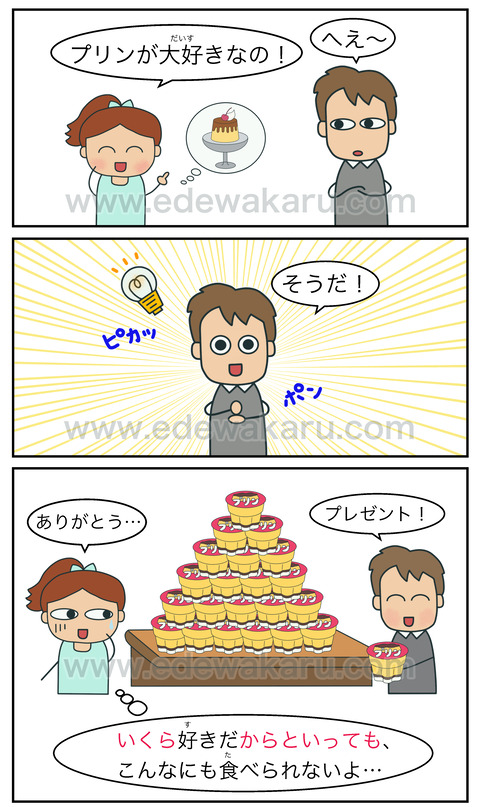
Meaning
(「いくらAからといってもB」の形で)
どんなにAでも、しかし〜
AだけれどもBになるというのはおかしい
Aという理由でBになるというのはおかしい
Explanation
「いくらAからといっても」は「どんなにAでも、Bというのはおかしい」という意味を表す文型です。
意味はいくつかありますが、【「A」なのは確かだが「B」という結論になるのはおかしい】と言いたい時によく使用します😊また
「いくら」は「どんなに」と同じで、量や程度が多いという意味を表します
😀
[例]
いくら
プリンが好きだ
からといっても、こんなには食べられないよ
→プリンが好きだ
というのは確かだ。しかし、
たくさんありすぎて食べられない
→
どんなに
プリンが好き
でも、こんなにたくさんは食べられない
この文型は会話でもよく使われますので、しっかりと覚えておいてください😉
日本語文型辞典
Meaning
a. いくら【質問】
値段が不明であることを表し、値段を聞くのに用いる。
b. いくら【不定】
値段や数量が不定であることを表し、はっきりその数値が言えないときや言う必要のないときに用いる。
限りがない様子を表す。「望めば望んだだけ」という意味。
数量がとても少ないという意味を表す。
a. いくらV-ても
「どんなにたくさん/何度も/一生懸命…しても」の意味。程度を強調するのに用いる。
b. いくら…といっても
「…であるということは認めるが、それでも」の意味。後の部分を強調して主張する。
c. いくら…からといって(も)
「いくらXからといって(も)Y」で、「XだからYという結論になると思っているのだろうが、それはおかしい」という軽い非難の気持ちを表す。後にYに対する反論を伴う。たとえば①「X:淋しい」だから「Y:夜中に友達に電話する」のは「非常識だ」。
d. いくら…からといっても
4cと似ているが「XだからY」のYの部分が表れない形。「Xでも(Yという結論にはならず)Zだ」という意味で、Yに対する反論を述べる。たとえば①「X:ピアノの才能がない」でも「Y:ピアノがひけない」ことはなく「Z:簡単な伴奏はできるはずだ」。
e. いくらなんでも
副詞的な慣用句。「…すぎる」と共に用いられることが多い。「いろいろな事情を考慮に入れてみてもやはりおかしい/ふつうではない/常識の範囲を越えている」というような非難の気持ちを表す。
後ろに「同じだ/仕方がない/無駄だ」などの語が来て、「どんなに一生懸命…しても、その状態は変わらない」「一生懸命そういうことをするのは無駄だ」という意味を表す。4aの「いくら…ても」と似ているが、こちらはその行為の結果が無意味なのはすでにわかっているというあきらめの気持ちを伴う。「だからやめたほうがいい」というアドバイスに用いる。
How to use it
いくら
いくらでも
いくらも…ない
いくら…ても
いくらNaだといっても
いくらA-いといっても
いくらV-たところで
In context 34 examples
この本はいくらですか。
東京まで片道いくらですか。
この絵はいくらぐらいかなあ。
いくらなら案内してもらってもいいとこちらから先に提示した。
フリーマーケットに出す品物は、それぞれいくらで売るということを決めてこの書類に金額を書き込んでください。
いくら持ってきてくれという形で注文しないと、後でまた頼まなければならなくなったりするから、個数を確認してください。
ビールならまだいくらでもあるから、安心して飲んでください。
これだけ暇ならいくらでも好きなことができる。
あの人の代わりならいくらでもいるから、やめられても全然困らない。
いくらでもいたいだけここにいてくれてかまわないよ。
もうワインはいくらも残っていない。
バスがでるまで時間はもういくらもない。
駅までは歩いていくらもかからなかった。
収入はいくらにもならないが、やることに意味がある。
いくら練習してもうまくならない。
いくら食べても太らない。
彼はいくら誘っても一度もパーティーに顔を出してくれない。
私がいくら「お祝いにはバラの花束をあげよう」と言っても、誰も賛成してくれなかった。
いくら給料がいいと言っても、残業がそんなに多いのでは就職するのはいやだ。
いくら甘いものが好きだと言っても、一度におまんじゅうを3つは食べられない。
いくらここの食べ物がまずいと言っても、生協食堂よりはましだろう。
いくら淋しいからと言って、夜中の3時に友達に電話するなんて非常識だ。
いくら体にいいからと言っても、毎日そればかり食べ続けていては病気になってしまう。
いくら新しいのを買うからと言っても、何も古いのをすぐに捨ててしまうことはないんじゃないか。
いくら才能がないからと言っても、10年もピアノをやっていれば簡単な伴奏ぐらいはできるだろう。
いくら不器用だからと言っても、それだけきれいにセーターが編めれば上出来だ。
いくら私が料理がうまいからと言っても、プロとは違うんだからそういうこったものは作れませんよ。
そういう言い方はいくらなんでもひどすぎるよ。
いくらなんでも、その服はお母さんには派手すぎないか。
この料理はいくらなんでも辛すぎてとても食べられない。
いくらがんばってみたところで結果的には同じことだ。
いくら隠してみたところで、もうみんなにはばれているんだから仕方がないよ。
いくらいいドレスを買ったところで、どうせ着ていくところがないんだから無駄になるだけだ。
いくら話し合ったところで、彼らは自分の意見を変える気はないんだから、話し合うだけ無駄だ。
日本語文型辞典 英語版
Meaning
いくら expresses that a price is unknown. It is used for asking the price.
b. いくら〈indefinite〉
In these cases, いくら indicates an indefinite price or amount. It is used when one is not able to say or it is not necessary to say an exact amount.
Expresses that something is unlimited and means “as much as one wishes.”
Expresses that the amount is very small.
Means “no matter how many/how many times/how hard one does something.” Used for emphasizing degree or extent.
b. いくら...といっても[いくらNaだといっても][いくらA-いといっても]
Means “I acknowledge that..., but still” and is used to emphasize an assertion that follows.
c. いくら...からといって(も)
Takes the pattern いくらXからといって(も)Y and means “you might think that X leads to the conclusion Y, but that is strange.” Implies a slight criticism and is followed by an objection against Y. In
(1)
, for example, it is “not common sense” to do Y (calling a friend in the middle of the night) just because of X (being lonely).
d. いくら...からといっても
Similar to Usage 4c above, with the difference that Y is not explicit. Means something likes “even if X, what follows is (not Y) but Z” and expresses the speaker’s refutation of Y. In
(1)
, for example, the speaker is saying that even if X (“he has no talent for playing the piano”) is true, it doesn’t follow that “he can’t play the piano” (Y), but that “he should be able to play a simple accompaniment” (Z).
e. いくらなんでも
An adverbial idiom often used with ...すぎる. Expresses a feeling of criticism, as in “even if I take various circumstances into consideration, it’s still wrong/unusual/beyond common sense.”
When いくらV-たところで is followed by phrases like同じだ, 仕方がない, or 無駄だ, it means “no matter how hard one tries to do something, the situation doesn’t change” or “it’s a waste to work so hard.” This is similar to いくら...ても in Usage 4a, but Usage 5 includes a feeling of resignation because the result of the action will be meaningless. This is used to give advice that “you should not do something because....”
How to use it
1. いくらa. いくら〈question〉
2. いくらでも
3. いくらも...ない
4. いくら...てもa. いくらV-ても
5. いくらV-たところで
In context 34 examples
この本はいくらですか。
How much is this book?
東京まで片道いくらですか。
How much is a one-way ticket to Tokyo?
この絵はいくらぐらいかなあ。
I wonder how much this picture is.
いくらなら案内してもらってもいいとこちらから先に提示した。
I told them beforehand how much I was prepared to pay for a guided tour.
フリーマーケットに出す品物は、それぞれいくらで売るということを決めてこの書類に金額を書き込んでください。
Please decide how much you want to charge for each item that you bring to the flea market, and fill in the amounts on this form.
いくら持ってきてくれという形で注文しないと、後でまた頼まなければならなくなったりするから、個数を確認してください。
If you don’t specify in your order how many items you want delivered, you may have to order more later on, so please confirm the number.
ビールならまだいくらでもあるから、安心して飲んでください。
We still have plenty of beer, so please feel free to drink it.
これだけ暇ならいくらでも好きなことができる。
If I have this much free time, I can do whatever I’d like.
あの人の代わりならいくらでもいるから、やめられても全然困らない。
It’s no problem whatsoever for me if that person quits, because I can find any number of people to take his/her place.
いくらでもいたいだけここにいてくれてかまわないよ。
I don’t mind if you stay here as long as you want.
もうワインはいくらも残っていない。
There is not much wine left.
バスがでるまで時間はもういくらもない。
There is not much time left until the bus leaves.
駅までは歩いていくらもかからなかった。
It didn’t take very much time to get to the station on foot.
収入はいくらにもならないが、やることに意味がある。
Though I don’t get paid much for this, it is a worthwhile thing to do.
いくら練習してもうまくならない。
I don’t get better however hard I practice.
いくら食べても太らない。
No matter how much I eat, I don’t put on weight.
彼はいくら誘っても一度もパーティーに顔を出してくれない。
He never shows up at a party no matter how many times I invite him.
私がいくら「お祝いにはバラの花束をあげよう」と言っても、誰も賛成してくれなかった。
No matter how many times I said we should give her a bouquet of roses to celebrate the occasion, no one would agree with me.
いくら給料がいいと言っても、残業がそんなに多いのでは就職するのはいやだ。
However high the salary is, I don’t want to take the job if there is that much overtime work.
いくら甘いものが好きだと言っても、一度におまんじゅうを3つは食べられない。
However much I like sweets, I can’t eat three manjuu(bean-jam buns) at a sitting.
いくらここの食べ物がまずいと言っても、生協食堂よりはましだろう。
However bad the food here is, it would be better than a co-op restaurant.
いくら淋しいからと言って、夜中の3時に友達に電話するなんて非常識だ。
Even if he feels lonely, calling a friend at three o’clock in the morning shows a lack of common sense.
いくら体にいいからと言っても、毎日そればかり食べ続けていては病気になってしまう。
No matter how good it is for your health, you will get sick eating the same thing every day.
いくら新しいのを買うからと言っても、何も古いのをすぐに捨ててしまうことはないんじゃないか。
Even though you’re buying a new one, there isn’t any need to throw away the old one straight away, is there?
いくら才能がないからと言っても、10 年もピアノをやっていれば簡単な伴奏ぐらいはできるだろう。
Although you say that he has no talent at all, if he has been playing the piano for ten years, he should at least be able to play a simple accompaniment.
いくら不器用だからと言っても、それだけきれいにセーターが編めれば上出来だ。
However clumsy you may say you are, knitting that beautiful sweater shows you are pretty good after all.
いくら私が料理がうまいからと言っても、プロとは違うんだからそういうこったものは作れませんよ。
Even though I may be pretty good at cooking, I am not a professional, so I can’t make something as elaborate as that.
そういう言い方はいくらなんでもひどすぎるよ。
There’s no excuse for such a harsh statement.
いくらなんでも、その服はお母さんには派手すぎないか。
Be that as it may, don’t you think that outfit is too flashy for our mother?
この料理はいくらなんでも辛すぎてとても食べられない。
I don’t care what you think, for me this food is so spicy that there’s no way I can eat it.
いくらがんばってみたところで結果的には同じことだ。
No matter how hard you try, you’ll get the same result.
いくら隠してみたところで、もうみんなにはばれているんだから仕方がないよ。
Even if you try to hide the fact, there’s nothing you can do since everyone already knows about it.
いくらいいドレスを買ったところで、どうせ着ていくところがないんだから無駄になるだけだ。
There’s no point in buying such a great dress, since you have no place to wear it.
いくら話し合ったところで、彼らは自分の意見を変える気はないんだから、話し合うだけ無駄だ。
No matter how many times we discuss it, it’s a waste of time because they have no intention of changing their opinion.
IMABI
Interrogatives II: The Question “How”
Read this IMABI lesson ↗Explanation
Interrogatives II: The Question “How”
Following our coverage of the non-question how with ~かた, we’ll now cover the many phrases for how to make a question “how” in Japanese.
どう & Related Words
どう and どのように are used to mean “how” as in regards to action. However, the two words are not the same when it comes to politeness. どう is typically more casual, and when it is used in polite speech, it still has a somewhat casual feel to it. どのように, on the other hand, is more formal and is expected in more polite contexts as well as in written documents.
1. この状況じょうきょうをどのように覆くつがえすことができるのでしょうか。
How can be we overturn this condition?
2. どのように新しい世界を開拓かいたくされてきたのか、お聞きしました。 (Humble speech)
I asked how (they) had come to pioneer a new world.
3. その印象はどのように感じられますか。
How do you feel about the impression?
どう may also simply describe an uncertain state. A politer form would be いかが. For instance, ~はどうですか meaning “how is…?” is more politely as ~はいかがですか. To further make it more polite, you can replace ~ですか with ~でしょうか as です is often too abrupt for truly polite/honorific utterances. Of course, when the situation does not call for such measures, ~でしょうか would be taken the opposite way.
4. 「仕事はどうですか」「私は自営業じえいぎょうです」
How is your work?” I am self-employed”
5. お天気はどうですか。
How is the weather?
6. 日本をどう思いますか。
What do you think about Japan?
7. 広東語かんとんごのクラスはどうですか。
How is your Cantonese class?
8. 皆様いかがお過ごしですか。(Honorific)
How is everyone fairing?
どうか
ど うか, the combination of どう and the particle か, either means どうぞ (which is ultimately also a combination of どう with the particle ぞ) in the sense of pleading or なんとか. Do not confuse this with かどうか. In かどうか, the か is used to mark the end of a question clause inside a larger sentence.
9. そのことはどうかしなければなりません。
We have to do something about it.
10. この頃彼女はどうかしてるね。
Something’s been wrong with her lately.
11. どうか許してください。
Please forgive me.
12. 頭がどうかなってしまいそうだ。
My head feels like it’s going crazy.
どんな風に・どういう風に
どんな風ふうに and どういう風ふうに are similar words meaning “how”. Both are used to describe how things are done in regards to manner/style. The first is more casual while the latter is more polite/formal. 風 is read as ふう when used to mean method; manner; way; style; appearance etc.
13. いまびはどういう風に作られているんですか。
How is IMABI being made?
14. どんな風に生きれば幸せになれるんだろう。
I wonder how one could live happily.
15. どんな風に天国に導かれるのでしょう?
How is one led to heaven?
16. 日本語は外国人にどんな風に聞こえているのでしょうか。
How does Japanese sound to foreigners?
どうやって
どうやって is another word for “how” often used in asking how something is done. This makes it especially useful in asking for directions and how things work. Even so, どう and どのように may also be used in the same way.
17. ここからどうやって駅に行けばいいのか全く分からないんですよ。
I have no idea how to get to the train station from here.
18. どうやって応募おうぼしたらいいですか?
How should I apply?
19. どうやって英語を勉強すればいいの? (Casual)
How should I study English?
20. 信頼しんらいはどのように作りますか。
How does one build trust?
How Much
“How” as in “how much” in degree is expressed with either どれくらい, どれぐらい, どのくらい, or どのぐらい. There is almost no difference in meaning or nuance. However, the variants are listed from most to least common. This is not to insinuate any one of them is not used a lot because they all are.
21. 日本にどれくらい滞在するつもりですか。
How long do you plan to reside in Japan?
22. どれくらいの頻度ひんどで運動したら効果こうかを期待できるのでしょうか。
How often should one exercise and expect to see effects?
23. 宇宙はどのくらい広いの?
How wide is the universe?
24. 理想の彼氏の身長しんちょうってどれくらい? (Casual)
How tall is your ideal boyfriend?
25. どれくらいの頻度でトイレに行くの? (Casual)
How often do you go to the bathroom?
26. 愛ちゃんの耳がどのくらい赤くなっているのかが気がかりだ。
How red Ai-chan’s ears have gotten is a big worry.
いくら
“How much” as in money or quantity is expressed with いくら. It is also seen in the phrases いくらか, いくらも, and いくらでも.
いくらか: Equivalent to 幾分か and 少し. It may also be used in the same sense as 多少 when used as an adverb. Whereas いくらか can be used for degree and quantity, いくぶんか must only be used for quantity.
いくらも: Shows a very large degree. With the negative, it is equivalent to ほとんど.
いくらでも: This may be equivalent to どれほどでも and can be used to exaggerate the amount of something. Whereas いくらでも works for quantity and price, どれほどでも only works for degree. With ない, it’s just like いくらも showing that the degree/amount is not as large as one thought. With いい, it means “any amount is fine”.
Spelling Note: いくら may be spelled as 幾ら.
27. 出来れば、アメリカ人に、いくら払うとかどんな場所でチップを期待されているのかについて、聞いたほうがい いですよ。
If you can, it would be best to ask an American on how much and in what places it is expected of you to tip.
28. 体重たいじゅうはいくらですか。
What is your weight?
29. 氷こおりの温度おんどはいくらですか。
How hot is the ice?
31. お金がいくらでも使える。
I can use as much money as I want.
32a. 立派な品をどれほどでも買おう!
32b. 立派な品をいくらでも買おう!
I’ll buy splendid items no matter how much (there are).
Sentence Note: 32a can only refer to quantity of what is being bought. 32b would usually be interpreted as referring to price, but it is ambiguous enough to refer to quantity as well.
33. インドの人口はいくらでしょうか。
What is the population of India?
34. 値段はいくらでもいいから、売ってくれ。(Vulgar)
The price is no problem, so sell it (to me)!
35. 提示ていじする額がくはいくらですか?
How much is your offering price?
36. 在庫ざいこはいくらも残のこっていない。
Almost nothing remains in the stockpile.
37. 「今日きょう一いちドルは何円なんえんですか」「為替かわせレートはいくらか分かりません」
“How many yen is one dollar today?” “I don’t know how much the exchange rate is.”
38. 「日本からアメリカまでいくらぐらいかかりますか」「旅行費りょこうひはいくらか分かりません」
“About how much is it from Japan to America? ” “I don’t know how much the travel costs are.”
何ぼ
何ぼ can be used for not only price but also quantity in general. This is used in 関西弁 and other parts of Japan.
39. これ、ちょっと何ぼ?
How much is this?
40. このリンゴ何ぼ?
How much is this apple/are these apples?
いくつ
“How many” as in age or counting things is いくつ. However, this is a generic word. So, for counter phrases, you must use the pattern 何+counter. 幾‐ is sometimes seen instead of 何‐ in native phrases in literary contexts.
いくつか means “a few”. It may be used as a noun or adverb. Regardless of its syntactic role, it is always in reference to 数. いくつも is on either end of the spectrum, being able to express large and hardly any amount depending on whether the sentence is positive or negative.
41. おいくつですか。
How old are you?
42. 虹にじには色いろがいくつありますか。
How many colors does a rainbow have?
43. あのクラスには何人いますか。
How many people do you have in this class?
44. 共通点きょうつうてんがいくつかある。
To have some points in common.
45. 選択肢はいくつも残っていない。
There’s absolutely no option to be had.
46. 指サイズはいくつですか?
What’s your finger size?
Literally: How much is your finger size?
Word Note: いくら, although it means “how much”, is not used here because “finger size” is not deemed as something of quantity. If you akin finger size to age, the logic behind this may be clearer.
In context 46 examples
この状況じょうきょうをどのように覆くつがえすことができるのでしょうか。
How can be we overturn this condition?
どのように新しい世界を開拓かいたくされてきたのか、お聞きしました。 (Humble speech)
I asked how (they) had come to pioneer a new world.
その印象はどのように感じられますか。
How do you feel about the impression?
「仕事はどうですか」「私は自営業じえいぎょうです」
How is your work?” I am self-employed”
お天気はどうですか。
How is the weather?
日本をどう思いますか。
What do you think about Japan?
広東語かんとんごのクラスはどうですか。
How is your Cantonese class?
皆様いかがお過ごしですか。(Honorific)
How is everyone fairing?
そのことはどうかしなければなりません。
We have to do something about it.
この頃彼女はどうかしてるね。
Something’s been wrong with her lately.
どうか許してください。
Please forgive me.
頭がどうかなってしまいそうだ。
My head feels like it’s going crazy.
いまびはどういう風に作られているんですか。
How is IMABI being made?
どんな風に生きれば幸せになれるんだろう。
I wonder how one could live happily.
どんな風に天国に導かれるのでしょう?
How is one led to heaven?
日本語は外国人にどんな風に聞こえているのでしょうか。
How does Japanese sound to foreigners?
ここからどうやって駅に行けばいいのか全く分からないんですよ。
I have no idea how to get to the train station from here.
どうやって応募おうぼしたらいいですか?
How should I apply?
どうやって英語を勉強すればいいの? (Casual)
How should I study English?
信頼しんらいはどのように作りますか。
How does one build trust?
日本にどれくらい滞在するつもりですか。
How long do you plan to reside in Japan?
どれくらいの頻度ひんどで運動したら効果こうかを期待できるのでしょうか。
How often should one exercise and expect to see effects?
宇宙はどのくらい広いの?
How wide is the universe?
理想の彼氏の身長しんちょうってどれくらい? (Casual)
How tall is your ideal boyfriend?
どれくらいの頻度でトイレに行くの? (Casual)
How often do you go to the bathroom?
愛ちゃんの耳がどのくらい赤くなっているのかが気がかりだ。
How red Ai-chan’s ears have gotten is a big worry.
出来れば、アメリカ人に、いくら払うとかどんな場所でチップを期待されているのかについて、聞いたほうがい いですよ。
If you can, it would be best to ask an American on how much and in what places it is expected of you to tip.
体重たいじゅうはいくらですか。
What is your weight?
氷こおりの温度おんどはいくらですか。
How hot is the ice?
お金がいくらでも使える。
I can use as much money as I want.
立派な品をどれほどでも買おう!
I’ll buy splendid items no matter how much (there are).
立派な品をいくらでも買おう!
I’ll buy splendid items no matter how much (there are).
インドの人口はいくらでしょうか。
What is the population of India?
値段はいくらでもいいから、売ってくれ。(Vulgar)
The price is no problem, so sell it (to me)!
提示ていじする額がくはいくらですか?
How much is your offering price?
在庫ざいこはいくらも残のこっていない。
Almost nothing remains in the stockpile.
「今日きょう一いちドルは何円なんえんですか」「為替かわせレートはいくらか分かりません」
“How many yen is one dollar today?” “I don’t know how much the exchange rate is.”
「日本からアメリカまでいくらぐらいかかりますか」「旅行費りょこうひはいくらか分かりません」
“About how much is it from Japan to America? ” “I don’t know how much the travel costs are.”
これ、ちょっと何ぼ?
How much is this?
このリンゴ何ぼ?
How much is this apple/are these apples?
おいくつですか。
How old are you?
虹にじには色いろがいくつありますか。
How many colors does a rainbow have?
あのクラスには何人いますか。
How many people do you have in this class?
共通点きょうつうてんがいくつかある。
To have some points in common.
選択肢はいくつも残っていない。
There’s absolutely no option to be had.
指サイズはいくつですか?
What’s your finger size?
No Matter If: たとえ・いくら・どれだけ・どんなに
Read this IMABI lesson ↗Explanation
No Matter If: たとえ・いくら・どれだけ・どんなに
The adverb たとえ derives from the verb 例える meaning “to compare/liken/use a metaphor,” and as an adverb, it emphasizes a condition (Situation A) which is deemed a worst-case scenario by the speaker. In the various contrastive conditional patterns that it appears in, it generally translates as “even if/no matter (what).”
This lesson will investigate its use by studying the patterns it appears in as setting the template for its use, and in doing so, we will also investigate synonymous adverbs such as いくら, どれだけ, and どんなに.
Orthography Note: When written kanji, たとえ may be seen as 仮令 or 縦令.
たとえ Situation A + ~ても Situation B
When たとえ is paired with a dependent clause (Situation A) that ends in ~ても—in which all predicate types are possible—the speaker has little to no control over whether Situation A occurs. Yet, “even if” it happens, the speaker intends on carrying out Situation B.
品詞(たとえ+・・・) Example
Verb 連用形+ ても・でもたとえ失敗しても
(Even if you fail)
たとえ死んでも
(Even if you die)
Adjective 連用形(く) + てもたとえ苦しくても
(Even if it’s tough)
Adj. Noun語幹 + でも
であってもたとえ大変で(あっ)ても
(No matter if it’s difficult/challenging)
Noun語幹 + でも
語幹 + であってもたとえ難題で(あっ)ても
(Even if it’s a tough problem)
1. たとえ雨が降っても出かけるぞ。
I’m heading out no matter if it rains.
2. たとえ仕事が忙しくても、毎日サイトの編集をしています。
No matter if I’m busy with work, I am editing the website every day.
3. たとえ面倒でも3か月ごとに健康診断を受けるようにしています。
No matter how much of a pain it is, I make sure to get a health exam every 3 months.
4. 法定労働時間を超える労働は、厳密にはたとえ1分でも割増賃金の支払いを要する。
Work that exceeds statutory working hours, strictly speaking, even if it’s just 1 minute, you are obligated to pay (the employee for that work) at the overtime rate.
5. たとえ殺されても信念は曲げられない。
Even if I were to be killed, my conviction wouldn’t be bent.
6. たとえ相手が無傷であっても、殺人未遂罪が成立するのだ。
No matter if your opponent is unscathed, the crime of attempted murder still holds.
7. たとえ象が踏んでも、 この画面は割れません。
No matter if an elephant steps on it, this screen won’t break.
たとえ Situation A + ~(よ)う[と(も)・が] …
Previously, we learned about the pattern Predicate1 ~まい{が・と} or Predicate2 ~(よ)う{が・と}, in which the dual volitional/suppositional endings ~(う)よう and ~まい are used to create contrastive conditions in the vein of “whether/no matter… or…” With this pattern, the situation stated in the main clause is unperturbed by the contrastive conditions stated.
One particle variation that we have none gone over is ~と vs. ~とも. With the addition of the emphasizer も, the contrastive conditions shown sound more hypothetical in nature, but that still does not deter from the situation of the main clause from holding true.
7. たとえ死のうが輪廻する限り人はまた苦しむ。
No matter if they die, people will suffer once more for as long as they are reincarnated.
8. たとえコロナの第10波が来ようとも、我々は乗り越えて元通りの生活には必ず戻るんだ!
No matter if the tenth wave of COVID strikes, we will overcome it and will positively return to our normal lives!
9. たとえ原発が必要であろうが、必要でなかろうが、とにかく何が何でも動かす。
No matter if nuclear power is necessary or not, they’re going to run (the plants) at any rate regardless.
10. たとえ何をしようとも支持しよう。
I will support you no matter what it is that you do.
11. たとえ何があろうとやります。
I’ll do it no matter what the case might be.
12. たとえ反対されようが、人が離れていこうが、自分が納得できるまで突き進んでいきたい。
No matter how much I’m opposed or how people separate themselves from me, I want to push myself on until I’m satisfied.
たとえ Situation A + ~たとしても Situation B
Even if the speaker supposes that Situation A may possibly occur, the outcome of said situation realizing has no effect on Situation B. This pattern essentially plays the devil’s advocate.
Unlike the other patterns showcased thus far, this pattern is restricted to verbal predicates; however, the copula verb counts in this case, allowing for it to be adapted to nominal and adjectival noun predicates by proxy. Situation A may be stated in the affirmative or negative, but as far as aspect marking, the use of the non-past vs. ~た, the time frame of Situation A envisioned by the speaker is what determines which is used. In practice, however, ~たとしても is far more common.
13. 両者の間には、たとえあったとしてもごく僅わずかしか相違はありません。
Even if there were differences between the two parties, there would hardly be any at whatsoever.
14. たとえあいつと会ったのが1回だけだとしても、とても許せない。
Even if you were to only have met that guy only once, I cannot possibly forgive you for it.
15. たとえ被害者に何等かの落ち度があったとしても、いじめの責任のすべては加害者にある!
No matter if there were any sort of lapse by the victim, full responsible for bullying lies with the offender.
16. たとえ志望校に入学できたとしても、卒業後一番大事な「社会」に出たときに苦労することになる。
No matter if you’re able to get into your dream school, once you enter “society,” the most important thing, after graduating, you will struggle.
17. たとえ世界が滅んだとしても君が死ぬのは一度きり。
No matter if the world were to end, you would only die once.
It is also possible to ~としても used with the the auxiliaries ~(よ)う and ~まい. However, these auxiliaries must be used in their volitional capacities, and thus must be paired with volitional verbs. As such, an agent must be present. Incidentally, personified subjects may count as agents (Ex. 18).
18. たとえ明日世界が終ろうとしても、必ず君を守るから。
No matter if the world were to end tomorrow, I will always protect you.
たとえ Situation A ~に[しろ/せよ] Situation B
~にしろ—also ~にせよ in formal, written language—with たとえ X indicates that regardless if Situation A is true (which there is admission on the part of the speaker that it may be), Situation B is also unequivocally true. In other words, although Situation A is so (as harsh as it may be), Situation B is just as true and often meant to be an important life lesson to the listener.
Situation A may be rendered with any predicate type, attaching to the non-past and past tenses with aspect dynamics being no different than other dependent clause. The only oddity worth noting is that copula ellipsis is limited, in practice, to nominal predicates1.
Predicate Type接続
Adjectival Nouns語幹 + である + に[しろ・せよ]
Nominal語幹 (+ である) + に[しろ・せよ]
19. たとえ冗談(である)にしろ、傷つけるようなことはいうべきではない。
Even if it’s just a joke, you should not say hurtful things.
20. たとえ才能があるにせよ、努力しなければ上手に話せるようにならない。
No matter how much talent you may have, if you do not put in the effort, you will not become able to speak it well.
In the event that more than one contrastive situation is stated, ~に[しろ・せよ] implies that any and all such circumstances do not affect the event of the main clause. In practice, ~にしろ and ~にせよ represent different registers, so it is important to maintain one form if multiple contrasts need to be shown.
21. 明日はたとえ豪雨にしろ吹雪にしろ会社は休めない。
Whether tomorrow is extreme rain or a blizzard, I can’t take the day off from the company.
Related Adverbs
In actuality, たとえ is not obligatory in the contrastive conditional clauses that it emphasizes, as it is its presence that highlights the extreme nature to the situation.
If you see such contrastive clauses without たとえ, Situation A might just not be that extreme or there might be a more fitting adverb – factors such as agency, volition of the agent (≈speaker), etc.
In the case of たとえ, even if the subject manages to accomplish Situation A, you may have noticed that Situation A along with Situation B are beyond the agent’s control. If control is an explicit factor (Ex. 24) or an implicit factor (Ex. 25), another adverb will need to be used for the same emphatic effect.
21. 文法的に主語が必須でなかろうと、主語を補った方が論理的であるのなら補えば良い。
Even if it weren’t grammatically necessary for there to be a subject, if it is more logical to supplement a subject, then it is fine to do so.
22. 独り暮らしをしないにしろ、自分で簡単な料理くらいできたほうがいい。
No matter whether you’re not living alone, it’s best to at least know how to many simple things by yourself.
23. 何度こっちがLINEを終わらせようとしても、向こうがずっと終わらせない。No matter how many times I try ending our LINE, the other person will always not let it end.
24. いくら待っても彼女は来ない。
She won’t come no matter how long I wait.
25. どれだけ社会で成功しようがしまいが、たとえ2億円もの高級マンションにて息を引き取ろうが、道端で野垂れ死にしようが、実際には、何の違いもないことさえ知れば、随分と生きやすくなる。
No matter how much you do or don’t succeed in society, whether you take your last breath in a 200 million-yen luxury apartment or die on the side of the road, once you realize that there is actually no difference at the end of the day, you’ll live far more easily.
いくら・どんなに・どれだけ
The commonality among たとえ, いくら, どんなに, and どれだけ is that “no matter” what Situation X is, there is no change or effect had on Situation Y. It is the nature of the action or state of Situation X that determines which adverb is most natural. There are many times that either of them may be natural, but there will always be a difference in nuance.
使い分け
たとえ Situation A is an extreme supposition. The speaker or another entity may have some level of volition over the situation, but regardless, it is a worst-case scenario that ultimately does not affect Situation B. It is also not certain whether Situation A will even happen or not. In actuality, it most likely won’t.
いくら Situation B does not change no matter how frequent or to what degree Situation A occurs. It best translates as “no matter how much.” In the speaker’s mind, however, there is some level of supposition as to how far in degree Situation A will go.
どんなにThe degree to which Situation A might occur as well as the nature of the situation is up in the air, but even so, Situation B remains unchanged. Other things might come up which could in theory change things, but in your mind, that still won’t happen.
どれだけSynonymous with どんなに多く, no matter how many alternations of Situation A that are experienced, Situation B does not change. In casual speech, it may be heard as どんだけ.
26. この携帯は、いくら落としても画面が割れません。
The screen on this phone won’t crack no matter how many times you drop it.
27. いくら美味しくても、ラーメンを毎日は食べられない。
No matter how delicious it might be, I can’t eat ramen every day.
28. どんなに苦しくてもいつでも支えてくれる人がいるから私は生きていけます。
No matter how tough it might be, I am able to live on because there are always people there to support me.
29. どんなにお酒を飲んでも吐いたことがありません。
No matter how much I drink, I’ve never thrown up.
30.どれだけ世界が変わろうとも、生き抜ける!
No matter how much the world changes, I can live through it!
31. どんな苦しみを味わおうが、自分が決めたことは変えたくない。
No matter the suffering I suffer, I won’t want to change what I’ve decided.
32. どんなに反対されようが、消費税の引き上げが施行される。
No matter how much it’s protested against, the consumer tax hike will be enforced.
In fact, you can actually see たとえ used with these other adverbs. When this happens, たとえ marks extremity and the following adverb describes the nature of Situation X in its own light. However, because of the overlap that exists, many speakers will find it redundant unless there is true reason to be purposefully so emphatic to the point of exaggeration.
33. たとえどんなに願っても君は戻れない。
No matter how much I wish, you can’t come back (to me).
In Ex. 33, no amount or means of hoping will change the situation. By using たとえ, the speaker is also implying that it is pointless to even try.
仮に
The adverb 仮に has two main meanings, one of which overlaps with たとえ.
“Supposing (if)…”
“Temporarily”
The first meaning is only plausible when it is paired with a contrastive conditional phrase. While it may seem to overlap with たとえ in this environment, the layer of nuance it provides is positing the conditional as a suggestion of what might happen, but even so, Situation B would not be changed by it.
34. 仮にその日が満室だった場合、キャンセルのご連絡を事前にいただければ他のお客様をご案内することもできますが・・・
Suppose that on that day we were fully booked, in that case if we were able to receive notification of cancellation prior, we would be able to invite other guests, but…
35. 仮に森が消滅せずに残っていたとしても、80億人もの人口を賄える農耕地を維持できない。
Even if you suppose that the the forests didn’t disappear and were left (in tact), you wouldn’t be able to support enough arable land to maintain a population of 8 billion people.
36. 仮に恐竜の時代に人類が生きていたとしても、生物の覇権を握っていたと思いますか?
Suppose that mankind had been alive during the time of the dinosaurs, do you think that (we) would have still held dominion over living things?
37. 仮に一千ドルあるとしたら何に使うの?
Suppose that you had 1,000 dollars, what would you use it on?
38. 仮にテントを張ったとしましょう。
Let’s suppose that you temporarily made set up a tent.
たとい
たとい is a classical variation of たとえ that can still be seen in literature.
39. たといこの身が滅ぼうとも約束は守る。
Even if I shall perish, I will protect my promise.
40. たとい神が私のそばを通り過ぎても私には見えない。
Even if God were to walk past me, I would not be able to see Him.
よしんば
In older language, you may also encounter the synonymous phrase 縦しんば, which combines the classical adverb よし2, which you may readily recognize as meaning “good,” and ~んば, which denoted a contrastive conditional for certain predicate types, put together. It may also be seen as 縦しや.
While よしんば is more or less equivalent to たとえ, it had its own layer of nuance. With it, Situation A is a condition that the speaker is letting “pass,” but that even upon letting Situation A come to pass, that choice does not affect Situation B.
41. よしんば命を落としたとしても自身の名に恥じるような事はしない。
Even if I were to lose my life, I would never do anything that would tarnish my name.
42. 縦しんば失敗したとしても後悔はせぬ。
Even if I were to end in failure, I shall have no regrets.
43. よしや切ない思いをしても、その思いを我が胸一つに疊んでおこうと決心した。
No matter how painful it might be, I have determined to keep that matter to myself.
From 『諦念』 by 森鷗外.
In our discussion on copula ellipsis, we briefly touched on how ellipsis is less likely in the written language, and given the propensity of both ~にしろ and ~にせよ to be used more often in the written language, that would greatly affect the unlikeliness of copula ellipsis. Furthermore, copula ellipsis hardly ever occurs when the copula manifests as である. This, too, is a feature of its distinct high yet rigid declarative tone, in other words, its modality. ↩︎
The adverb よし does ultimately derive from the adjective 良し, making it a rare instance of a single word form used as both an adjective and an adverb without any marked morphology for the latter. ↩︎
In context 45 examples
たとえ雨が降っても出かけるぞ。
I’m heading out no matter if it rains.
たとえ仕事が忙しくても、毎日サイトの編集をしています。
No matter if I’m busy with work, I am editing the website every day.
たとえ面倒でも3か月ごとに健康診断を受けるようにしています。
No matter how much of a pain it is, I make sure to get a health exam every 3 months.
法定労働時間を超える労働は、厳密にはたとえ1分でも割増賃金の支払いを要する。
Work that exceeds statutory working hours, strictly speaking, even if it’s just 1 minute, you are obligated to pay (the employee for that work) at the overtime rate.
たとえ殺されても信念は曲げられない。
Even if I were to be killed, my conviction wouldn’t be bent.
たとえ相手が無傷であっても、殺人未遂罪が成立するのだ。
No matter if your opponent is unscathed, the crime of attempted murder still holds.
たとえ象が踏んでも、 この画面は割れません。
No matter if an elephant steps on it, this screen won’t break.
たとえ死のうが輪廻する限り人はまた苦しむ。
No matter if they die, people will suffer once more for as long as they are reincarnated.
たとえコロナの第10波が来ようとも、我々は乗り越えて元通りの生活には必ず戻るんだ!
No matter if the tenth wave of COVID strikes, we will overcome it and will positively return to our normal lives!
たとえ原発が必要であろうが、必要でなかろうが、とにかく何が何でも動かす。
No matter if nuclear power is necessary or not, they’re going to run (the plants) at any rate regardless.
たとえ何をしようとも支持しよう。
I will support you no matter what it is that you do.
たとえ何があろうとやります。
I’ll do it no matter what the case might be.
たとえ反対されようが、人が離れていこうが、自分が納得できるまで突き進んでいきたい。
No matter how much I’m opposed or how people separate themselves from me, I want to push myself on until I’m satisfied.
両者の間には、たとえあったとしてもごく僅わずかしか相違はありません。
Even if there were differences between the two parties, there would hardly be any at whatsoever.
たとえあいつと会ったのが1回だけだとしても、とても許せない。
Even if you were to only have met that guy only once, I cannot possibly forgive you for it.
たとえ被害者に何等かの落ち度があったとしても、いじめの責任のすべては加害者にある!
No matter if there were any sort of lapse by the victim, full responsible for bullying lies with the offender.
たとえ志望校に入学できたとしても、卒業後一番大事な「社会」に出たときに苦労することになる。
No matter if you’re able to get into your dream school, once you enter “society,” the most important thing, after graduating, you will struggle.
たとえ世界が滅んだとしても君が死ぬのは一度きり。
No matter if the world were to end, you would only die once.
たとえ明日世界が終ろうとしても、必ず君を守るから。
No matter if the world were to end tomorrow, I will always protect you.
たとえ冗談(である)にしろ、傷つけるようなことはいうべきではない。
Even if it’s just a joke, you should not say hurtful things.
たとえ才能があるにせよ、努力しなければ上手に話せるようにならない。
No matter how much talent you may have, if you do not put in the effort, you will not become able to speak it well.
明日はたとえ豪雨にしろ吹雪にしろ会社は休めない。
Whether tomorrow is extreme rain or a blizzard, I can’t take the day off from the company.
文法的に主語が必須でなかろうと、主語を補った方が論理的であるのなら補えば良い。
Even if it weren’t grammatically necessary for there to be a subject, if it is more logical to supplement a subject, then it is fine to do so.
独り暮らしをしないにしろ、自分で簡単な料理くらいできたほうがいい。
No matter whether you’re not living alone, it’s best to at least know how to many simple things by yourself.
何度こっちがLINEを終わらせようとしても、向こうがずっと終わらせない。No matter how many times I try ending our LINE, the other person will always not let it end.
She won’t come no matter how long I wait.
いくら待っても彼女は来ない。
She won’t come no matter how long I wait.
どれだけ社会で成功しようがしまいが、たとえ2億円もの高級マンションにて息を引き取ろうが、道端で野垂れ死にしようが、実際には、何の違いもないことさえ知れば、随分と生きやすくなる。
No matter how much you do or don’t succeed in society, whether you take your last breath in a 200 million-yen luxury apartment or die on the side of the road, once you realize that there is actually no difference at the end of the day, you’ll live far more easily.
この携帯は、いくら落としても画面が割れません。
The screen on this phone won’t crack no matter how many times you drop it.
いくら美味しくても、ラーメンを毎日は食べられない。
No matter how delicious it might be, I can’t eat ramen every day.
どんなに苦しくてもいつでも支えてくれる人がいるから私は生きていけます。
No matter how tough it might be, I am able to live on because there are always people there to support me.
どんなにお酒を飲んでも吐いたことがありません。
No matter how much I drink, I’ve never thrown up.
どれだけ世界が変わろうとも、生き抜ける!
No matter how much the world changes, I can live through it!
どんな苦しみを味わおうが、自分が決めたことは変えたくない。
No matter the suffering I suffer, I won’t want to change what I’ve decided.
どんなに反対されようが、消費税の引き上げが施行される。
No matter how much it’s protested against, the consumer tax hike will be enforced.
たとえどんなに願っても君は戻れない。
No matter how much I wish, you can’t come back (to me).
仮にその日が満室だった場合、キャンセルのご連絡を事前にいただければ他のお客様をご案内することもできますが・・・
Suppose that on that day we were fully booked, in that case if we were able to receive notification of cancellation prior, we would be able to invite other guests, but…
仮に森が消滅せずに残っていたとしても、80億人もの人口を賄える農耕地を維持できない。
Even if you suppose that the the forests didn’t disappear and were left (in tact), you wouldn’t be able to support enough arable land to maintain a population of 8 billion people.
仮に恐竜の時代に人類が生きていたとしても、生物の覇権を握っていたと思いますか?
Suppose that mankind had been alive during the time of the dinosaurs, do you think that (we) would have still held dominion over living things?
仮に一千ドルあるとしたら何に使うの?
Suppose that you had 1,000 dollars, what would you use it on?
仮にテントを張ったとしましょう。
Let’s suppose that you temporarily made set up a tent.
たといこの身が滅ぼうとも約束は守る。
Even if I shall perish, I will protect my promise.
たとい神が私のそばを通り過ぎても私には見えない。
Even if God were to walk past me, I would not be able to see Him.
よしんば命を落としたとしても自身の名に恥じるような事はしない。
Even if I were to lose my life, I would never do anything that would tarnish my name.
縦しんば失敗したとしても後悔はせぬ。
Even if I were to end in failure, I shall have no regrets.
よしや切ない思いをしても、その思いを我が胸一つに疊んでおこうと決心した。
No matter how painful it might be, I have determined to keep that matter to myself.
文法
Meaning
数量や程度がどのようになっても、影響しないことを表す。
How to use it
V(テ形)+ も
イAくて + も
ナAで + も
Nで + も
In context 9 examples
いくら頼まれてもお金は貸しませんよ。
彼にいくら注意しても、言うことを聞かないので困っている。
先生、いくら考えてもこの問題の答えがわからないんです。教えていただけませんか。
いくら待っても彼女は来なかった。
僕はいくら食べても太らない体質なんです。
いくら勉強しても日本語が上手にならないんですが、どうすればいいでしょうか。
最近、いくら寝ても眠いんだけど、どうしてだろう。
どんなに謝られても、あなたのやったことは許しません。
どんなに辛くても、僕は泣かないよ!
Bunpro Grammar Reference
Meaning
No matter how (much)
How to use it
いくら + Verb[ても]
いくら + [い]Adjective[ても]
いくら + Noun + でも
いくら + [な]Adjective + でも
Nuance
A phrase that highlights that no matter what number of (A), the result will not change.
Explanation
In a similar way to どんなに~ても, いくら~でも is regularly translated to 'no matter how (A), (B)'. However, unlike どんな (which is an abbreviation of どのような), いくら is a noun that comes from the kanji 幾ら, meaning 'how much'. When partnered with ても (with verbs and い-Adjectives), or でも (with nouns and な-Adjectives), the literal meaning means 'however much (A), (B)'.
With いくら~でも, the (B) part of the phrase will usually highlight something that is being negated, giving the phrase it's 'no matter how much' nuance.
あの人にいくら言っても、何も変わらないよ。
No matter how much you tell him, he won't change.
いくら新しくても落としたら壊れるに決まってるじゃん。
No matter how new it is, of course it is going to break if you drop it!
あの人のことがいくら嫌いでも、そんな事言ったら可哀そうだよ。
No matter how much you dislike them, that is a hurtful thing to say.
いくら俺でもそんな重いものは持てないよ。
No matter if it is me, I can't lift something that heavy. (Even if it is me, who is strong, I cant lift something that heavy)
Despite this trend of being used in sentences that contain ない or ありません, いくら~でも may also be seen in positive sentences. In these cases, despite not being negative, the (B) phrase will still be something that is surprising/unexpected in some way (due to its extent or amount).
相談ならいくらでも聞いてあげるよ。
I'll listen to you vent however much you need.
お菓子ならいくらでもあるから、好きなだけ持っていきな!
As for snacks, I have plenty, so take all you want!
Fun Fact
幾ら places more emphasis on the 'amount' of something, while どんなに places more emphasis on the 'type', or 'style'. Due to this, いくら will be a better choice when the 'volume' of something is being highlighted, while どんなに will sound more natural when the 'state' is being discussed.
お金はいくら払ってもいいのでその靴を私に下さい。
I will pay however much for those shoes, so please let me have them! (Amount only)
お金はどんなに払ってもいいのでその靴を私に下さい。
I will pay whatever sort of money for those shoes, so please let me have them! (Possible amount or type. Dollar, yen, euro, etc)
Despite this small difference, いくら and どんなに are used fairly interchangeably in most situations.
Nuance · 日本語
(A)の数に関わらず、結果は変わらないということを強調する文法。
Explanation · 日本語
「いくら~でも」は、「どんなに〜ても」と似ている表現で、「(A) の数や程度がどれくらいでも、(B) の結果は変わらない」という意味を表します。この「いくら」は、漢字で書くと「幾ら」(意味:どのくらいか)になります。この表現を、イ形容詞や動詞と使うときは「ても」、名詞やナ形容詞と使うときは「でも」を使います。
「いくら〜でも」の文の (B) には、否定文が来ることが多いです。
あの人にいくら言っても、何も変わらないよ。
No matter how much you tell him, he won't change.
いくら新しくても落としたら壊れるに決まってるじゃん。
No matter how new it is, of course it is going to break if you drop it!
あの人のことがいくら嫌いでも、そんな事言ったら可哀そうだよ。
No matter how much you dislike them, that is a hurtful thing to say.
いくら俺でもそんな重いものは持てないよ。
No matter if it is me, I can't lift something that heavy. (Even if it is me, who is strong, I cant lift something that heavy)
「いくら〜でも」は、「ない」や「ありません」のような否定文に使われることが多いですが、肯定文に使われることもあります。この場合、(B) には否定的な内容ではなくても、(A) の量や程度を考えると、意外・予想外だと感じられる内容が入ります。
相談ならいくらでも聞いてあげるよ。
I'll listen to you vent however much you need.
お菓子ならいくらでもあるから、好きなだけ持っていきな!
As for snacks, I have plenty, so take all you want!
豆知識
「幾ら」は、物事の「数」や「量」に焦点を当てていますが、「どんなに」は、「種類」や「状態」に焦点を当てています。そのため、量については「いくら」、状態や様子については「どんなに」を使う方がより自然に聞こえることが多いでしょう。
お金はいくら払ってもいいのでその靴を私に下さい。
I will pay however much for those shoes, so please let me have them! (Amount only)
お金はどんなに払ってもいいのでその靴を私に下さい。
I will pay whatever sort of money for those shoes, so please let me have them! (Possible amount or type. Dollar, yen, euro, etc)
こうした小さな違いはありますが、実際にはどちらもほとんど同じような場面で使われます。
In context 20 examples
- いくら急いでも土曜日までには終わらない。
No matter how quickly I do it, I won't finish before Saturday.
- あの人のことがいくら嫌いでも、そんな事言ったら可哀そうだよ。
No matter how much you dislike them, that is a hurtful thing to say.
- あの人にいくら言っても、何も変わらないよ。
No matter how much you tell him, he won't change.
- いくら新しくても落としたら壊れるに決まってるじゃん。
No matter how new it is, of course it is going to break if you drop it!
- 相談ならいくらでも聞いてあげるよ。
I'll listen to you vent however much you need.
- お菓子ならいくらでもあるから、好きなだけ持っていきな!
As for snacks, I have plenty, so take all you want!
- いくら俺でもそんな重いものは持てないよ。
No matter if it is me, I can't lift something that heavy. (Even if it is me, who is strong, I cant lift something that heavy)
- いくら泣いても、泣き止まない。
No matter how much they cry, they won't cry themselves out.
- 文プロを見つけるまでいくら文法を勉強しても、理解ができなかった。
Before finding Bunpro, no matter how much I studied grammar I couldn't understand it.
- いくらお金があっても、愛は買えない。
No matter how much money you have, you can't buy love.
- いくらご飯を食べても、あの人は全然お腹いっぱいにならない。
No matter how much he (she) eats, he (she) doesn't get full at all.
- いくら頑張っても、彼にはかなわない。
No matter how hard I try, I can't compete with him.
- いくら稼いでも、妻がすぐに使ってしまうから困っている。
I am having trouble because no matter how much I earn, my wife spends it all.
- いくら親切にしても、あの人は全然感謝しない人だ。
No matter how nice I am to him (her), he (she) is a completely ungrateful person.
- いくら社長でも、あんな言い方をしてはいけません。
No matter how much of a boss you are, you cannot speak in that manner.
- いくら可愛くても、孫になんでも買ってあげるのは良くないですよ。
No matter how cute your grandchildren are, it's not good to buy them whatever they want.
- いくら優秀でも、性格が悪い人とは一緒に仕事をしたくありません。
I don't want to work with someone who is mean, no matter how amazing they may be.
- いくら忠告しても、彼は考えを変える気がないらしい。
No matter how much advice you give him, he doesn't seem to want to change his mind.
- お金はいくら払ってもいいのでその靴を私に下さい。
I will pay however much for those shoes, so please let me have them! (Amount only)
- お金はどんなに払ってもいいのでその靴を私に下さい。
I will pay whatever sort of money for those shoes, so please let me have them! (Possible amount or type. Dollar, yen, euro, etc)
日本語NET JLPT文法解説まとめ
Meaning
数量や程度がどのようになっても、影響しないことを表す。
How to use it
V(テ形)+ も
イAくて + も
ナAで + も
Nで + も
In context 9 examples
いくら頼まれてもお金は貸しませんよ。
彼にいくら注意しても、言うことを聞かないので困っている。
先生、いくら考えてもこの問題の答えがわからないんです。教えていただけませんか。
いくら待っても彼女は来なかった。
僕はいくら食べても太らない体質なんです。
いくら勉強しても日本語が上手にならないんですが、どうすればいいでしょうか。
最近、いくら寝ても眠いんだけど、どうしてだろう。
どんなに謝られても、あなたのやったことは許しません。
どんなに辛くても、僕は泣かないよ!