日本語文型辞典
Usage 1
Meaning
Used to add a further quantity, and so on. For example, ④ means, “I have some money, and if I have an additional hundred yen, I can buy a ticket.” It can often be rephrased with あと, as in あと5分 (“five more minutes”). However, あと carries the implication that this is the final remainder, while もう does not carry that implication in particular. When referring to the number of times, if it is difficult to say that it will be the last time, もう is used instead of あと. For example, みんなが来てからあと一回先生に電話してみた (“After everyone came, I tried calling the teacher one more time”) sounds somewhat unnatural.
a. もうすこし/もうちょっと [quantity]
Indicates that a small increase, decrease, or change will occur from the current state. あとすこし is also used. Also, もうちょっと is a more casual expression than もうすこし and is generally used in everyday conversation and the like. It cannot be used when the quantity is large.
b. もうすこし/もうちょっと [degree]
Used with expressions of attributes or states to indicate a degree slightly higher than the current state.
c. もうすこしで V-そうだった
Means “came to just short of a situation occurring.” It can often be rephrased as もう少しで…ところだ. もうちょっとで is also used in casual conversation and the like.
d. もうすこしで V-るところだった
An emphatic way of saying V-るところだった.
⇾ところだ 2b
How to use it
もう + quantity word
もうすこし
In context 27 examples
すみません、もう5分ここにいてください。
Excuse me, please stay here for another five minutes.
もう一時間待って、彼が来なかったら先に行く。
I'll wait another hour, and if he hasn't come, I'll go on ahead.
もう一人紹介したい人がいる。
There's one more person I'd like to introduce.
もう百円あれば、切符が買える。
If I had another hundred yen, I could buy a ticket.
もう10ページ読めば、この本は読み終えられる。
If I read ten more pages, I can finish this book.
もう一回だけテストしてみよう。
Let's try the test just one more time.
もう一度だけ会ってください。
Please meet me just one more time.
みんなが来てから、もう一回先生に電話してみた。
After everyone arrived, I tried calling the teacher one more time.
もう少し、ミルクをください。
Please give me a little more milk.
もう少しここで過ごしたい。
I want to spend a little more time here.
もう少し待てば、順番が回ってくる。
If we wait a little longer, it will be our turn.
ゴールまで、もうちょっとだ。
It's just a little farther to the goal.
(誤) もうたくさんほしい。
(Incorrect) I want much more.
(正) もっとたくさんほしい。
(Correct) I want a lot more.
もう少しいい車を買いたい。
I want to buy a slightly better car.
温度はもう少し低くした方がいい。
It would be better to lower the temperature a little more.
もう少し大きな声で話したほうがいい。
You should speak a little louder.
かれなら、もう少しむずかしい問題もできるだろう。
He could probably solve slightly more difficult problems.
もうちょっと安いものはありませんか。
Do you have anything a little cheaper?
もう少しでうまくいきそうだったのに、邪魔が入ってしまった。
It looked like it was just about to go well, but then we were interrupted.
もう少しで会社に遅れそうになったが、ぎりぎりで間にあった。
I almost arrived late at work, but I just made it in time.
もう少しで本当のことを言いそうになったが、何とか我慢した。
I almost told the truth, but somehow managed to hold back.
二人はもう少しでけんかしそうになったが、わたしが何とか止めた。
The two were just about to get into a fight, but I managed to stop them.
もう少しでけがするところだった。
I almost got hurt.
ぽんやり歩いていて、もう少しで車にひかれるところだった。
I was walking absentmindedly and nearly got hit by a car.
赤ちゃんはもう少しで寝るところだったのに、電話の音で目をさましてしまった。
The baby was just about to fall asleep, but woke up at the sound of the phone.
実験はまた失敗したが、本当はもう少しで成功するところだったのだ。
The experiment failed again, but it really was just about to succeed.
Read the original source text
Meaning
量などをさらに付け加えるのに使う。たとえば、④は、「お金がいくらかあるが、これに加えて百円あれば、切符が買える」という意味。「あと5分」のように「あと」で言いかえられることが多い。ただし、「あと」の方は、「これが最後の残り」という含みがあるが、「もう」には特にそういう含みがない。回数などについては、それで最後とは言いにくい場合は「あと」ではなく「もう」を使う。たとえば、「みんなが来てからあと一回先生に電話してみた」はやや不自然。
a. もうすこし/もうちょっと【量】
現在の状態から少量の増減か変化があることを表す。「あとすこし」ともいう。また、「もうちょっと」は、「もうすこし」よりくだけた表現で、日常の会話などで使うのが普通。量が多い場合は使えない。
b. もうすこし/もうちょっと【程度】
属性や状態を表す表現とともに使って、現在の状態よりわずかに程度が高いことを表す。
c. もうすこしでV-そうだった
「ある事態が起こる寸前まで行った」という意味。「もう少しで…ところだ」と言いかえられることが多い。くだけた会話などでは「もうちょっとで」も使う。
d. もうすこしでV-るところだった
「V-るところだった」を強める言い方。
⇾ところだ2b
How to use it
もう+数量詞
もうすこし
Usage 2
Meaning
Used with a verb sentence to show that an action, event, and so on has been completed by a certain point in time. もう is also used in questions asking whether something has been completed. When the completed state has not been reached, まだ…ない is used in both declarative and interrogative sentences.
Used with expressions of time or age to show that a sufficiently advanced point has already been reached. As in ① and ②, it can convey the feeling that this point has been reached sooner than expected.
Used with expressions such as 一杯だ (“full”) and 十分だ (“enough”) to mean that a sufficiently satisfying state has been reached. もういい basically means “it is in a sufficiently suitable state” and is used in various situations. Depending on the context, it can mean “the preparations are complete,” “it has been resolved,” and so on. For the negative use of もういい, see もう 5b.
Indicates that a certain point, etc., is the limit, and that there is nothing after that or nothing beyond it.
a. もう + negative expression
Used with a predicate with a negative meaning, such as 無理だ (“impossible”) or いやだ (“unwilling”), to mean that a state can no longer be continued. もうたくさんだ means “I've reached my limit, so I don't want any more,” and is often used when someone is quite emotional. It is also used, as in ⑦, to prohibit further action.
b. もういい
Basically means “this is enough, so I don't need any more.” Used in various situations. ③ is an expression used when declining something. Also, ④ and ⑤ mean “this is the limit; I can't accept any more,” expressing the speaker's refusal. Often used when someone has had enough or is fed up. As in ⑥ and ⑦, it is also used to express giving up something one had been attached to until then. For the affirmative use of もういい, see もう 3.
Inserted at the beginning or middle of a sentence to show reproach toward the other person. Used only in casual conversation. Often used by women. It is often used with ったら or たら, which conveys a reproachful feeling.
How to use it
もう [completion]
もう + time / + age
もう Naだ / もういい
もう…ない
5 もう [negative attitude]
もう [reproach]
In context 48 examples
今日の仕事はもう全部終わった。
Today's work is all finished now.
A:今評判になっているあの映画、もう見ましたか。
B:ええ、この前の日曜日に見ました。A: Have you seen that movie everyone is talking about now? B: Yes, I saw it last Sunday.
食事はもうできている。
The meal is ready now.
その問題なら、もう解決している。
That problem has already been resolved.
彼の娘はもう大学を卒業したそうだ。
I hear his daughter has already graduated from university.
手紙はもう投函したので、取り返せないんです。
I've already mailed the letter, so I can't get it back.
A:すみません、今日はもう閉店ですか。
B:いいえ、まだ開いています。A: Excuse me, are you closed for the day already? B: No, we're still open.
A:この本はもう出ましたか。
B:いいえ、まだ出ていません。予定は来週です。A: Has this book come out yet? B: No, it hasn't been published yet. It's scheduled for next week.
おしゃべりに夢中になっていたら、もう5時だ。
I got caught up chatting, and before I knew it, it was already five o'clock.
気がついたらもう朝だった。
When I came to, it was already morning.
この子はもう10才だから、十分事故の証人になれる。
This child is already ten, so they're old enough to be a witness to the accident.
こよみの上ではもう春なのに、まだ雪が降っている三れ
Although it's already spring according to the calendar, snow is still falling. (Source text ends with stray: 三れ)
もう夜が明けるのに彼らはまだ話し続けている。
It's already nearly dawn, but they're still talking.
もう8時ですよ。起きなさい、学校に遅れますよ。
It's already eight o'clock. Get up or you'll be late for school.
もうおなかが一杯だ。
I'm already full.
今日はもう十分に楽しんだ。
I've already had quite enough fun today.
A:お湯はわいていますか。
B:ええ、もういいですよ。A: Is the water boiling? B: Yes, it's ready now.
A:機械、直ったんですか。
B:ええ、これでもういいはずです。A: Is the machine fixed? B: Yes, it should be all right now.
A:ちょっと目を閉じて。1、2、3。
B:もういい?
A:いいよ。はい、目を開けて。A: Close your eyes for a moment. One, two, three. B: Is it okay now? A: Yes. All right, open your eyes.
山田さんはもうここにはいません。
Mr. Yamada is no longer here.
この喫茶店はもう営業していない。
This coffee shop is no longer in business.
疲れて、もう何も考えられなくなった。
I was so tired that I couldn't think about anything anymore.
交渉のあと、だれももう文句を言わなかった。
After the negotiations, nobody complained anymore.
かれとは、もうこれ以上話したくない。
I don't want to talk to him any more than this.
わたしは、18才、もう子供ではない。
I'm eighteen; I'm not a child anymore.
もう二度とあの人には会わないだろう。
I probably won't ever see that person again.
もう誰も信じられないと言って、彼女は泣いていた。
Saying she couldn't trust anyone anymore, she was crying.
こんな待遇の悪い職場にはもうがまんができない。
I can't put up with a workplace with such poor conditions any longer.
さいふの中にはもう100円しか残っていなかったので、家へ帰るのにバスにも乗れなかった。
There was only 100 yen left in my wallet, so I couldn't even take the bus home.
10万円の値段がついたので、もうこれ以上は上がらないだろうと思った。
It had reached a price of 100,000 yen, so I thought it probably wouldn't go any higher.
こんな退屈な仕事はもうやめたい。
I want to quit this boring job already.
もうあの人の愚痴を聞くのはいやだ。
I'm tired of listening to that person complain.
これ以上歩き続けるのは体力的にもう無理です。
Continuing to walk any farther is physically impossible for me now.
あの人をかばい続けられるのももう限界だ。
I've reached my limit for continuing to defend that person.
戦争をするのは、もうたくさんだ。
I've had enough of war.
こんなまずいものを食べるのはもうたくさんだ。
I've had enough of eating such awful food.
もういいかげんに妹をいじめるのはやめなさい。
Stop picking on your little sister already.
A:ほかに出す書類がありますか。
B:これでもういいです。A: Are there any other documents to submit? B: This is all that's needed.
A:チョコレート買いましょうか。
B:いや、これだけ食料があれば、もういいです。A: Shall we buy some chocolate? B: No, with this much food, we're fine.
A:もう一杯いかがですか。
B:いや、もういいです。A: Would you like another drink? B: No, I'm fine.
A:急なアルバイトさえなかったら、来られたんだけど。
B:言い訳はもういいよ。A: If I hadn't had that sudden part-time job, I could have come. B: Enough with the excuses.
A:お母さんの気持ちも考えてみなさい。
B:もういいよ。お読教は聞き飽きたよ。A: Think about how your mother feels, too. B: I've heard enough. I'm tired of hearing your lectures.
A:頑張っていたのに、うまく行かなくて残念だったね。
B:もういいんです。何か、ほかの事を考えます。A: You worked hard, but it's too bad it didn't go well. B: It's all right now. I'll think about something else.
A:もう一回探しなおせば、みつかるかもしれません。
B:もういいよ。あきらめよう。A: If we search one more time, we might find it. B: It's all right. Let's give up.
お母さんたら、もう。わたしの友達の悪口を言うのはやめてよ。
Mom, honestly! Stop badmouthing my friends.
もう、あなたったら、こんなやさしい計算もできないの。
Honestly, you can't even do such an easy calculation?
山田さんたら、もう、また『お茶入れて』ですって。自分でやればいいのに。
Mr. Yamada, honestly—he's at it again, saying, 'Make me some tea.' He should do it himself.
A:あ、また、汚した。
B:もう。A: Oh, you got it dirty again. B: Oh, honestly!
Read the original source text
Meaning
動詞文とともに使って、行為、できごとなどがある時点までに完了したことを示す。完了かどうかを問う疑問文でも「もう」を用いる。完了状態に到っていないときは、平叙文でも、疑問文でも「まだ…ない」を用いる。
時間や年齢を表す表現と共に用いて、すでに十分な時点に至っているということを示す。①②のように思ったより早くその時点に到達してしまったという気持ちが含まれることがある。
「一杯だ」「十分だ」などと共に用いて、十分満足すべき状態になっているという意味を表す。「もういい」は基本的に「十分に適当な状態になっている」という意味で、いろいろな状況で用いる。文脈によって、「準備ができた」「解決した」などの意味になる。「もういい」の否定的な用法については、もう5b参照。
ある時点などを限界として、それ以後はない、これ以上はないという意味を表す。
a. もう+否定的表現
「無理だ」「いやだ」など否定的意味の述語を用いて、これ以上ある状態を続けることができないという意味を表す。「もうたくさんだ」は「限界に達したので、これ以上はいやだ」の意味で、かなり感情的になった時に使うことが多い。また、以後の行動を禁止する⑦のような場合にも使う。
b. もういい
基本的に「これで十分だから、これ以上はいらない」という意味。いろいろな状況で使う。③は断るときの表現。また、④⑤は、「これが限度で、これ以上は受け入れられない」の意味で、話し手の拒否の態度を表す。いやになったり、うんざりした場合などによく使う。⑥⑦のように、それまで執着していたことをあきらめるという気持ちの表現としても用いる。「もういい」の肯定的な用法は、もう3参照。
文ぶん頭や文中に挿入して、相手に対する非難の気持ちを示す。くだけた会話でのみ用いる。女性が使うことが多い。非舞の気持ちをこめた「(っ)たら」とともに使うことがおおい。
How to use it
もう【完了】
もう+時間/+年齢
もうNaだ/もういい
もう…ない
5もう【否定的態度】
もう【非難】
絵でわかる日本語
Usage 1
Read this source entry ↗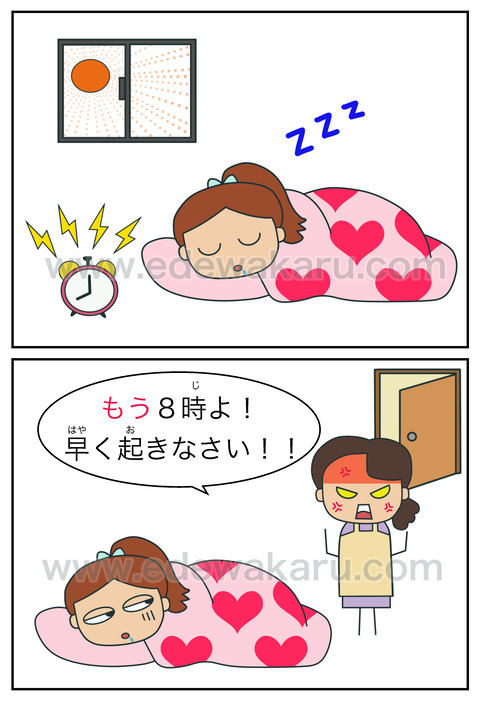
Meaning
Already ~.
How to use it
もう + a word expressing time
もう + age
Explanation
“もう〜” is a sentence pattern used with a [word expressing time] or [age] and means “already ~.”
It is used when you want to say “already old enough to ~” or “already the right time to ~,” or when you feel that “that time or age came earlier than I expected” 😊
[Examples]
もう9時だ!早く帰らなきゃ
It’s already 9 o’clock! I have to get home quickly.
→Time passed faster than I thought; before I knew it, it was 9 o’clock.
もう20歳だから、お酒を飲んでもOKだ
I’m already 20, so it’s okay for me to drink alcohol.
→I’m already 20, so I’m old enough to drink alcohol.
“もう〜” has many meanings 😨 It is also used very often in conversation, so make sure to learn it 😉
(Review: もう + counter/quantity word)
In context 1 examples
娘がもう1歳になった…時間が経つのは早いものだ
→娘がすでに1歳になった…時間が経つのは早いものだ(復習:〜ものだ(感慨))My daughter is already one year old… Time really does pass quickly (Review: 〜ものだ [expressing a feeling of wonder]).
Read the original source text
Meaning
すでに〜
How to use it
もう+時を表す語
もう+年齢
Explanation
「もう〜」は【時を表す語】や【年齢】と一緒に使われ、「すでに〜」という意味の文型です。
「すでに〜するのに十分な年齢だ」「すでに〜するのに十分な時期だ」
と言いたい時や、
「思ったよりも早くその時や年齢になった」
と感じた時に使います😊
[例]
もう
9時だ!早く帰らなきゃ
→思ってたよりも早く時間が過ぎてしまって、気付いたら9時になっていた
もう
20歳だから、お酒を飲んでもOKだ
→すでに20歳だから、お酒を飲むのに十分な年齢だ
「もう〜」にはたくさん意味があります😨また会話でもとてもよく使いますので、しっかりと覚えておきましょう😉
(復習:もう+数量詞)
Usage 2
Read this source entry ↗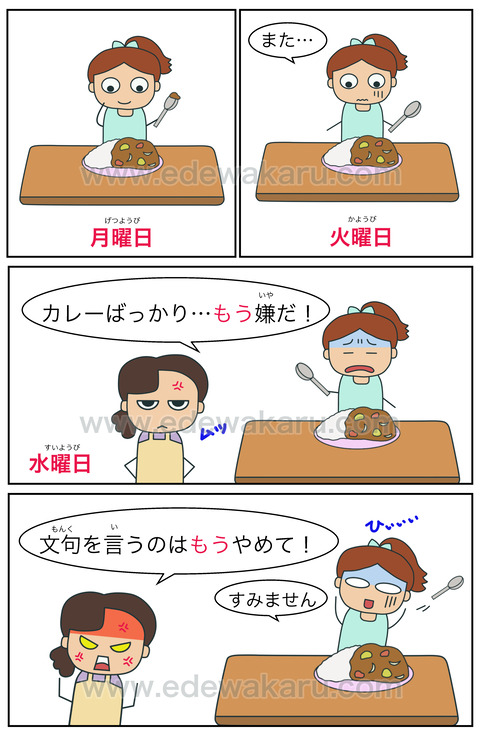
Meaning
It would be ~ to do any more.
How to use it
もう + negative expression
Explanation
“もう + negative expression” is a sentence pattern meaning “it would be ~ to do any more.”
It is used when you want to say “I can’t continue in this state any longer.” Negative expressions such as “嫌だ” (I don’t want to) and “無理だ” (It’s impossible) follow it 😊
[Commonly used negative expressions]
・嫌だ (I don’t want to)
・やめて (Stop it)
・やめたい (I want to quit)
・やめなさい(・やめろ) (Stop it! / Quit it!)
・無理だ (It’s impossible)
・限界だ (I’m at my limit)
・たえられない (I can’t stand it)
・我慢できない (I can’t put up with it), etc.
[For advanced learners]
One expression in the “もう + negative expression” group is “もうたくさんだ.” It means “I can’t put up with any more” 😮
[Example]
文句ばっかり…もうたくさん!
Nothing but complaints… I’ve had enough!
→You’re always complaining… I can’t put up with it anymore!
“もうたくさん” is used when you are irritated or angry at someone’s behavior, about as strongly as “いいかげんにしろ!” (“That’s enough!”), so be careful when using it 😀
“もう + negative expression” is often used in conversation, so you will probably hear it frequently in dramas and anime 😉
In context 5 examples
カレーばっかり…もう嫌だよ!
→これ以上カレーばっかり食べるのは、嫌だ(復習:〜ばっかり・〜ばっか)Nothing but curry… I’m sick of it! →I don’t want to eat nothing but curry anymore (Review: 〜ばっかり・〜ばっか [nothing but ~]).
文句を言うのはもうやめてちょうだい!
→これ以上文句を言うのはやめてちょうだい(復習:〜てちょうだい)Please stop complaining already! →Please stop complaining any more (Review: 〜てちょうだい [please do ~]).
このアルバイトはもうやめたいな…
→これ以上このアルバイトをするのは嫌だからやめたいな…I want to quit this part-time job already… →I want to quit because I don’t want to keep doing this part-time job any longer…
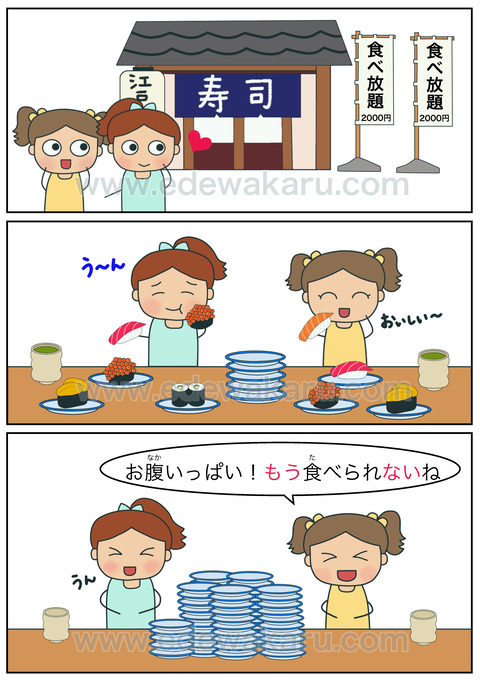
ラーメンを5杯も食べた。これ以上食べるのはもう無理だ
→これ以上食べるのは無理だ(復習:〜も(数量詞+も))I ate as many as five bowls of ramen. I can’t eat any more. →It’s impossible for me to eat any more (Review: 〜も [as many/much as]).
ここのところ休みがない…もう限界だ
→ここのところ休みがない…これ以上働くのは限界だ(復習:〜ところ(Nのところ))I haven’t had a day off lately… I’m at my limit. →I haven’t had a day off lately… I’m at my limit for working any more (Review: 〜ところ (Nのところ) [lately/at this point]).
Read the original source text
Meaning
これ以上〜するのは〜だ
How to use it
もう+否定的表現
Explanation
「もう+否定的表現(ひていてきひょうげん)」は「これ以上〜するのは〜だ」という意味を表す文型です。
これは
「これ以上〜の状態を続けることはできない」
と言いたい時に使用します。後ろには「嫌だ」「無理だ」などの否定的表現を使います😊
[よく使われる否定表現]
・嫌だ
・やめて
・やめたい
・やめなさい(・やめろ)
・無理だ
・限界だ
・たえられない
・我慢できない など
【上級レベルの人へ】
「もう+否定表現」の1つとして、
「もうたくさんだ」
という表現があります。これは
「これ以上我慢できない」
という意味で使われます😮
[例]
文句ばっかり…
もうたくさん!
→文句ばっかり言うわね…
もう我慢できない
わ!
「もうたくさん」は「いいかげんにしろ!」と同じくらい、相手の行動に対してイライラしたり、怒ったりしている時に使いますので、使用するときは気をつけましょう
😀
「もう+否定表現」は会話でもよく使いますので、ドラマやアニメなどでも聞く機会が多いと思います😉
Usage 4
Read this source entry ↗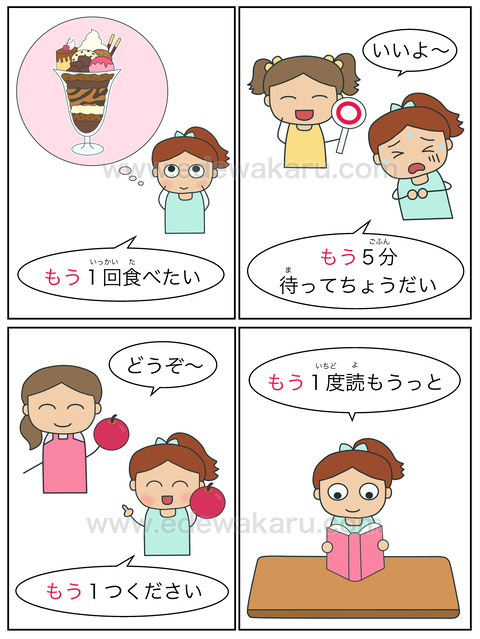
Meaning
Further ~.
In addition to ~, also ~.
How to use it
もう + quantity word
Explanation
“もう + quantity word” is a sentence pattern meaning “another ~ more (of the same thing)” or “add ~ more (of the same thing).” It is used to say “add more of the same thing to the current amount” or “add one more of the same thing to what you have now” 😮
[Examples]
①もう1度あのケーキが食べたい
I want to eat that cake one more time.
→I want to eat the same cake again.
②もう1つあのケーキが食べたい
I want one more piece of that cake.
→I want to eat one more of the same cake.
③もう100円あったら、あのケーキが食べられるのに…
If only I had another 100 yen, I could eat that cake…
→If I added 100 yen to the money I have now, I could eat that cake…
When you want to drink or eat the same thing again at a restaurant or izakaya, there are many opportunities to say things like “もう1杯ください” (One more glass, please) or “もう1つください” (One more, please). Try using these in conversation too 😉
Read the original source text
Meaning
さらに〜
〜に加えて、また〜
How to use it
もう+数量詞
Explanation
「もう+数量詞」は「(同じものを)さらにまた〜」「(同じものを)付け加えて〜」という意味を表す文型です。「
今の状態に、さらに同じものを〜」「今の状態に、同じものをプラスして〜」と言いたい時に使います
😮
[例]
①
もう
1度あのケーキが食べたい
→同じケーキを
また
食べたい
②
もう
1つあのケーキが食べたい
→同じケーキを
さらに
1つ食べたい
③
もう
100円あったら、あのケーキが食べられるのに…
→
今持っているお金にプラス
100円あったら、あのケーキが食べられるのに…
レストランや居酒屋で同じものをまた飲んだり食べたりしたい時に
「もう1杯ください」「もう1つください」
など、使う機会がたくさんあると思います。みなさんも会話で使ってみてくださいね😉
日本語文型辞典 英語版
Meaning
This is used to add further quantities to something. For example,
(4)
means “You have some money but if you could add 100 yen to it, you would be able to buy a ticket.”
Often used as another way of saying あと, as in あと5分. However, あと also includes the meaning “This is the last of what remains,” but もう does not particularly carry that meaning. In situations where it is difficult to say this is the last (time), もう is used rather than あと. For example,みんなが来てからあと一回先生に電話してみた is somewhat unnatural.
Expresses a small fluctuation or change in the current situation. あとすこし is also used. Moreover, asもうちょっと is less formal than もうすこし, it is more commonly used in daily conversation. This cannot be used in cases where the quantity is large.
(×)もうたくさんほしい。
I want more.
(○)もっとたくさんほしい。
I want more.
b. もうすこし/もうちょっと〈degree〉
Used with expressions which show an attribute or condition, this demonstrates a slightly higher degree than the present condition.
c. もうすこしでV-そうだった
Means “a certain situation is on the verge of occurring.” もう少しで...ところだ is often used instead. In casual conversation もうちょっとで is also used.
d. もうすこしでV-るところだった
This is a way of intensifying V-るところだった.
→
【ところだ】2b
B:ええ、この前の日曜日に見ました。
Yes, I watched it last Sunday.
B:いいえ、まだ開いています。
No, we’re still open.
B:いいえ、まだ出ていません。予定は来週です。
No, not yet. It is scheduled (to be out) next week.
When used with a verb phrase, this indicates the completion of a deed or event by a certain point in time. It is also used in interrogative sentences asking whether or not something has been completed. When the point of completion has not yet been reached, まだ...ない is used in both declarative and interrogative sentences.
Used with expressions which show time or age, it shows that a point which is rather late has been reached. As in examples
(1)
and
(2)
, it includes the feeling that a certain point in time has been reached sooner than was thought.
B:ええ、もういいですよ。
Yes, it’s ready.
B:ええ、これでもういいはずです。
Yes, it should be fine now.
B:もういい?
Okay now?
A:いいよ。はい、目を開けて。
Okay, open your eyes.
Used with phrases such as 一杯だ and 十分だ, this means “(it) ought to be enough/satisfactory.” もういい, basically meaning “a satisfactory situation or state has been reached,” is used in various circumstances. Depending on the context, it can mean “to have done enough,” or “to have resolved (it).” For the negative usage rules for もういい, please see Usage 5b of もう.
This means, with something like a certain point in time as the limit, there is nothing further or nothing after that.
Using predicates with a negative meaning such as 無理だ and いやだ, this means the situation cannot be tolerated any further. Meaning “the limit has been reached and so I can’t take anymore,” もうたくさんだ is often used when the speaker is feeling quite emotional. It can also be used in cases, such as example
(7)
, which prohibit further such behavior.
b. もういい
B:これでもういいです。
That’s all.
B:いや、これだけ食料があれば、もういいです。
No, this should be enough food.
B:いや、もういいです。
No, I’ve had enough.
B:言い訳はもういいよ。
That’s enough of your excuses.
B:もういいよ。お説教は聞き飽きたよ。
Enough! I’m tired of your preaching!
B:もういいんです。何か、ほかの事を考えます。
Oh, it’s okay. I will think of something else.
B:もういいよ。あきらめよう。
I’ve had enough! Let’s give it up.
Fundamentally this means “because this is enough, more than this is not necessary.” It is used in various circumstances. In example
(3)
it is used to decline something. Also, in
(4)
and
(5)
, meaning “this is the limit, I can’t accept more than this,” it conveys the speaker’s attitude of refusal. It is often used in cases in which something has become disagreeable or tedious. As in
(6)
and
(7)
, it is also used as an expression which conveys the feeling of being sick of or giving up on something which had been adhered to until that point. For the affirmative usage rules of もういい, see Usage 3 of もう.
B:もう。
Already again!
At the start or in the middle of a sentence, this expresses a feeling of criticism towards the other person. Only used in casual conversation and is often used by women. Frequently used with the highly critical (っ)たら.
How to use it
1. もう+数量詞
2. もうすこしa. もうすこし/もうちょっと〈quantity〉
1. もう〈completion〉
2. もう +時間/+年齢
3. もうNa だ/もういい
4. もう...ない
5. もう〈negative attitude〉a. もう+否定的表現
6. もう〈criticism〉
In context 74 examples
すみません、もう5分ここにいてください。
Excuse me, please wait here another five minutes.
もう一時間待って、彼が来なかったら先に行く。
I’ll wait another hour and then, if he doesn’t come, I’ll go on ahead.
もう一人紹介したい人がいる。
There’s one more person I’d like to introduce.
もう百円あれば、切符が買える。
If you had 100 yen more, you could buy a ticket.
もう 10 ページ読めば、この本は読み終えられる。
If you read another ten pages, you can finish this book.
もう一回だけテストしてみよう。
Let’s try the test just once more.
もう一度だけ会ってください。
Please meet him just one more time.
みんなが来てから、もう一回先生に電話してみた。
After everyone had arrived, I tried to call the teacher one more time.
もう少し、ミルクをください。
Could I have a little more milk, please.
もう少しここで過ごしたい。
I want to stay here a little longer.
もう少し待てば、順番が回ってくる。
If you wait a little longer, your turn will come.
ゴールまで、もうちょっとだ。
It’s just a little bit more to the goal.
もう少しいい車を買いたい。
I want to buy a slightly better car.
温度はもう少し低くした方がいい。
You’d better bring the temperature down a little.
もう少し大きな声で話したほうがいい。
You ought to speak a little more loudly.
かれなら、もう少しむずかしい問題もできるだろう。
As for him, I think he could handle slightly more difficult problems.
もうちょっと安いものはありませんか。
Don’t you have anything a little cheaper?
もう少しでうまくいきそうだったのに、邪魔が入ってしまった。
Everything was just about to work out well when a wrench was thrown into the works.
もう少しで会社に遅れそうになったが、ぎりぎりで間にあった。
It seemed I was going to be late for work, but I made it just in time.
もう少しで本当のことを言いそうになったが、何とか我慢した。
I was so close to telling the true story, but somehow managed to keep my self-control.
二人はもう少しでけんかしそうになったが、わたしが何とか止めた。
The two of them seemed close to getting into a fight, but somehow I stopped them.
もう少しでけがするところだった。
I was almost injured.
ぼんやり歩いていて、もう少しで車にひかれるところだった。
I was walking along absentmindedly and almost got hit by a car.
赤ちゃんはもう少しで寝るところだったのに、電話の音で目をさましてしまった。
The baby was just about to fall asleep, but the phone rang and she opened her eyes.
実験はまた失敗したが、本当はもう少しで成功するところだったのだ。
The experiment failed again, but the truth is that we were close to succeeding.
今日の仕事はもう全部終わった。
Today’s work is all done.
A:今評判になっているあの映画、もう見ましたか。
Have you seen that film that everyone’s talking about now?
食事はもうできている。
Dinner is ready.
その問題なら、もう解決している。
That problem? It’s been resolved already.
彼の娘はもう大学を卒業したそうだ。
I heard that his daughter has already graduated from college.
駅についたときにもう特急は出てしまっていた。
When I got to the station, the limited express had already left.
手紙はもう投函したので、取り返せないんです。
I have already mailed the letter, so I can’t get it back.
A:すみません、今日はもう閉店ですか。
Excuse me, are you already closed for today?
A:この本はもう出ましたか。
Is this book out yet?
おしゃべりに夢中になっていたら、もう5時だ。
We got lost in conversation and it’s already five o’clock.
気がついたらもう朝だった。
Before we knew it, it was already morning.
この子はもう 10 才だから、十分事故の証人になれる。
This child is already ten years old, so she can serve as a witness to an accident.
こよみの上ではもう春なのに、まだ雪が降っている。
Although the calendar says it is spring, it is still snowing.
もう夜が明けるのに彼らはまだ話し続けている。
They kept on talking even though dawn was breaking.
もう8時ですよ。起きなさい、学校に遅れますよ。
It’s already eight o’clock. Get up, or you’ll be late for school.
もうおなかが一杯だ。
I’m already full.
今日はもう十分に楽しんだ。
I’ve already had a lot of fun today.
A:お湯はわいていますか。
Is the water boiling yet?
A:機械、直ったんですか。
Is the machine fixed?
A:ちょっと目を閉じて。1、2、3。
Just shut your eyes. One, two, three.
山田さんはもうここにはいません。
Yamada-san is no longer here.
この喫茶店はもう営業していない。
This coffee shop is no longer in business.
疲れて、もう何も考えられなくなった。
I was so tired I couldn’t think anymore.
交渉のあと、だれももう文句を言わなかった。
After the negotiations, nobody had any more complaints.
かれとは、もうこれ以上話したくない。
I don’t want to say anything more to him.
わたしは、18 才、もう子供ではない。
I’m eighteen. I’m not a child anymore.
もう二度とあの人には会わないだろう。
I don’t suppose I’ll ever meet her again.
もう誰も信じられないと言って、彼女は泣いていた。
She was crying and said, “I can’t trust anyone anymore.”
こんな待遇の悪い職場にはもうがまんができない。
I can’t take it anymore in a workplace like this with such terrible conditions.
さいふの中にはもう 100 円しか残っていなかったので、家へ帰るのにバスにも乗れなかった。
Since I only had 100 yen left in my wallet, I couldn’t even catch the bus home.
10 万円の値段がついたので、もうこれ以上は上がらないだろうと思った。
Because it was already priced at 100,000 yen, I didn’t think the price could go any higher.
こんな退屈な仕事はもうやめたい。
I want to quit this kind of boring work.
もうあの人の愚痴を聞くのはいやだ。
I’m sick of hearing that person’s complaints.
これ以上歩き続けるのは体力的にもう無理です。
It’s physically impossible for me to walk any further.
あの人をかばい続けられるのももう限界だ。
I can’t carry on sticking up for that man.
戦争をするのは、もうたくさんだ。
I’ve had it with the war.
こんなまずいものを食べるのはもうたくさんだ。
I can’t eat any more of such disgusting stuff.
もういいかげんに妹をいじめるのはやめなさい。
Stop picking on your younger sister.
A:ほかに出す書類がありますか。
Do you have any other documents to hand in?
A:チョコレート買いましょうか。
Shall we buy some chocolate?
A:もう一杯いかがですか。
How about one more (glass/cup)?
A:急なアルバイトさえなかったら、来られたんだけど。
If I just hadn’t had that sudden part-time work, I could have come.
A:お母さんの気持ちも考えてみなさい。
Try to think about your mother’s feelings, too.
A:頑張っていたのに、うまく行かなくて残念だったね。
It’s such a shame that it didn’t go well even though you did your best.
A:もう一回探しなおせば、みつかるかもしれません。
If we have another look, we may be able to find it.
お母さんたら、もう。わたしの友達の悪口を言うのはやめてよ。
Mom, enough! Stop badmouthing my friends.
もう、あなたったら、こんなやさしい計算もできないの。
Oh, come on, dear. Can’t you even do a simple calculation like this?
山田さんたら、もう、また「お茶入れて」ですって。自分でやればいいのに。
That Yamada-san telling me again, “Make some tea.” He should make it himself.
A:あ、また、汚した。
Oh, it’s dirty again.
AIUEO JLPT Grammar
Meaning
「もう」is an adverb indicating that an action or state has already been completed, typically used with the past tense of verbs. Similar to "already” in English.
How to use it
もう + past tense
In context 5 examples
もう宿題を終えたよ。
I have already finished my homework.
もう新しいバージョンがリリースされました。
The new version has already been released.
もうお薬を飲みましたか?
Have you already taken your medicine?
もう晩ご飯を食べたの?
Have you already eaten dinner?
もう準備はできましたか?
Are you already prepared?
Read the original source text
Meaning
「もう」is an adverb indicating that an action or state has already been completed, typically used with the past tense of verbs. Similar to "already” in English.
How to use it
もう+過去形
Explanation · 日本語
「もう」は、ある行動や状態がすでに完了したことを示す副詞で、動詞の過去形とともに使用されます。
Bunpro Grammar Reference
Meaning
Already, Anymore
How to use it
もう + (Past) Phrase
もう + (Negative) Phrase
Nuance
A word that is used to highlight something that is expected to be continuing, but is not.
Explanation
In English, もう is regularly translated to 'already', or 'anymore', depending on if it is used in a positive-past (already), or negative (anymore) sentence. The reason that Japanese only requires one word for both of these nuances is due to もう literally meaning 'something has unexpectedly ended'.
朝ごはんはもう食べた。
I already ate breakfast. (Although you probably didn't expect it, I have already eaten breakfast)
もうお金がない。
I don't have money anymore. (Although you probably didn't expect it, I have no money)
From these sentences we can see that もう can be translated in each case as the following.
(Past) - Although expected to not be done, it is. 'Already', in English.
(Negative) - Although expected to still be going, it isn't. 'Anymore', in English.
This is the opposite of まだ, which means 'something is unexpectedly still going'.
もう may also be used to ask questions. This is when the speaker thinks that something 'might' have ended, but wants to confirm.
もうデザートを食べた?
Did you already eat dessert?
Fun Fact
もう is often used simply as an expression of exasperation (giving up on arguing), to show that someone has already reached the point of not wanting to continue.
あ~もう無理。
Ugh, that's enough. (I've had enough, I'm done arguing/continuing)
In context 16 examples
- もう学校に行きましたか。
Did you already go to school?
- もうデザートを食べた?
Did you already eat dessert?
- 朝ごはんはもう食べた。
I already ate breakfast. (Although you probably didn't expect it, I have already eaten breakfast)
- もうお金がない。
I don't have money anymore. (Although you probably didn't expect it, I have no money)
- もうその本を読んだ。
I have already read that book.
- もうコーヒーを作りました。
I already made coffee.
- もうしました。
I already did it.
- もう帰った。
They already went home.
- そのケーキは、もう食べた。
I already ate that cake.
- 犬の散歩もうしました。
I already took the dog for a walk.
- それはもうよくない。
That is already not good. (Not good anymore)
- お母さんは晩ごはんをもう作りました。
My mother already made dinner.
- もう写真撮った。
I already took a picture.
- もうパーティーに行った。
I already went to the party.
- もう始まった。
It already started.
- あ~もう無理。
Ugh, that's enough. (I've had enough, I'm done arguing/continuing)
Yokubi — The Common Grammar Guide (https://yoku.bi)
Explanation
With positive statements, もう expresses "already". With negative statements, it works together with the negation to express "not anymore".
Basically, もう means that there's a change of state from the statement being false or irrelevant to the statement being true: "already" and "not anymore".
もう can also appear as an emphatic expression of frustration
In statements about the near future, もう can mean "soon" instead. This usually goes along with an adverb expressing soonness, but sometimes it's just implied.
Another use of もう expresses "more" of an amount.
まだ expresses the idea of "still" or "yet" and it is the opposite of もう. It's used when a state stays the same.
まだまだ is an adverb and set expression that also works as a more emphatic まだ
もう is used for "yet" in positive questions, since もう highlights a change.
また expresses the idea of "again".
In context 10 examples
もうこんな時間だ
It's this late! (lit. It's already this time)
もう食べたよ
I already ate
もう食べないの?
You won't eat anymore?
もういいよ
I've had enough (lit. it's already at a sufficient level)
もう!
(angry frustrated noises)
どうやらもう来るみたい
Well it seems like he'll arrive soon
もう一杯!
One more drink!
もうちょっと
A bit more
もう書きましたか?
Did you write it yet?
もう眠いの?
Are you already sleepy?
文法
Meaning
Expresses the completion of an action or event.
How to use it
V(肯定形 + 過去形)
Notes
When replying to the question “もう〜ましたか?” (“Have you already ~?”) to say that something has not yet been completed, answer with “いいえ、まだです” (“No, not yet”) or “いいえ、まだ〜ていません” (“No, I haven't ~ yet”).
In context 8 examples
A:もう昼ごはんを食べましたか。
B:はい、食べました。A: Have you eaten lunch yet? B: Yes, I have.
A:もう宿題をしましたか。
B:いいえ、まだです。A: Have you done your homework yet? B: No, not yet.
A:みなさん、もう京都には行きましたか?
B:はい、行きました。A: Has everyone been to Kyoto yet? B: Yes, we have.
A:もうレポートを出しましたか。
B:はい、さっき出しました。A: Have you handed in the report yet? B: Yes, I handed it in a little while ago.
A:もう映画始まった?
B:ううん、まだだよ。A: Has the movie started yet? B: Nope, not yet.
もうディズニーランドへは行きましたか。
Have you been to Disneyland yet?
え、トムさんもうテスト終わったの?
Huh, Tom, have you already finished the test?
旅行の準備はもう終わった?
Have you finished getting ready for the trip yet?
Read the original source text
Meaning
動作や出来事の完了を表す。
How to use it
V(肯定形 + 過去形)
Notes
「もう〜ましたか?」の質問にまだ完了していないことを述べる場合は「いいえ、まだです」や「いいえ、まだ〜ていません」の形で答える。
日本語NET JLPT文法解説まとめ
Meaning
Expresses the completion of an action or event.
How to use it
V(肯定形 + 過去形)
Explanation
"already done"
Indicates the completion of an action or event.
When answering the question 「もう〜ましたか?」 and saying that something has not been completed yet, answer with 「いいえ、まだです」 or 「いいえ、まだ〜ていません」.
In context 8 examples
A:もう昼ごはんを食べましたか。
A: Have you eaten lunch yet?
A:もう宿題をしましたか。
A: Have you done your homework yet?
A:みなさん、もう京都には行きましたか?
A: Has everyone been to Kyoto yet?
A:もうレポートを出しましたか。
A: Have you turned in the report yet?
A:もう映画始まった?
A: Has the movie started yet?
もうディズニーランドへは行きましたか。
Have you been to Disneyland yet?
え、トムさんもうテスト終わったの?
Huh, Tom, have you already finished the test?
旅行の準備はもう終わった?
Have you finished getting ready for the trip yet?
Read the original source text
Meaning
動作や出来事の完了を表す。
How to use it
V(肯定形 + 過去形)
Explanation
"already done"
Indicates the completion of an action or event.
「もう〜ましたか?」の質問にまだ完了していないことを述べる場合は「いいえ、まだです」や「いいえ、まだ〜ていません」の形で答える。