日本語文型辞典
Usage 1
Meaning
量などをさらに付け加えるのに使う。たとえば、④は、「お金がいくらかあるが、これに加えて百円あれば、切符が買える」という意味。「あと5分」のように「あと」で言いかえられることが多い。ただし、「あと」の方は、「これが最後の残り」という含みがあるが、「もう」には特にそういう含みがない。回数などについては、それで最後とは言いにくい場合は「あと」ではなく「もう」を使う。たとえば、「みんなが来てからあと一回先生に電話してみた」はやや不自然。
a. もうすこし/もうちょっと【量】
現在の状態から少量の増減か変化があることを表す。「あとすこし」ともいう。また、「もうちょっと」は、「もうすこし」よりくだけた表現で、日常の会話などで使うのが普通。量が多い場合は使えない。
b. もうすこし/もうちょっと【程度】
属性や状態を表す表現とともに使って、現在の状態よりわずかに程度が高いことを表す。
c. もうすこしでV-そうだった
「ある事態が起こる寸前まで行った」という意味。「もう少しで…ところだ」と言いかえられることが多い。くだけた会話などでは「もうちょっとで」も使う。
d. もうすこしでV-るところだった
「V-るところだった」を強める言い方。
⇾ところだ2b
How to use it
もう+数量詞
もうすこし
In context 27 examples
すみません、もう5分ここにいてください。
もう一時間待って、彼が来なかったら先に行く。
もう一人紹介したい人がいる。
もう百円あれば、切符が買える。
もう10ページ読めば、この本は読み終えられる。
もう一回だけテストしてみよう。
もう一度だけ会ってください。
みんなが来てから、もう一回先生に電話してみた。
もう少し、ミルクをください。
もう少しここで過ごしたい。
もう少し待てば、順番が回ってくる。
ゴールまで、もうちょっとだ。
(誤) もうたくさんほしい。
(正) もっとたくさんほしい。
もう少しいい車を買いたい。
温度はもう少し低くした方がいい。
もう少し大きな声で話したほうがいい。
かれなら、もう少しむずかしい問題もできるだろう。
もうちょっと安いものはありませんか。
もう少しでうまくいきそうだったのに、邪魔が入ってしまった。
もう少しで会社に遅れそうになったが、ぎりぎりで間にあった。
もう少しで本当のことを言いそうになったが、何とか我慢した。
二人はもう少しでけんかしそうになったが、わたしが何とか止めた。
もう少しでけがするところだった。
ぽんやり歩いていて、もう少しで車にひかれるところだった。
赤ちゃんはもう少しで寝るところだったのに、電話の音で目をさましてしまった。
実験はまた失敗したが、本当はもう少しで成功するところだったのだ。
Usage 2
Meaning
動詞文とともに使って、行為、できごとなどがある時点までに完了したことを示す。完了かどうかを問う疑問文でも「もう」を用いる。完了状態に到っていないときは、平叙文でも、疑問文でも「まだ…ない」を用いる。
時間や年齢を表す表現と共に用いて、すでに十分な時点に至っているということを示す。①②のように思ったより早くその時点に到達してしまったという気持ちが含まれることがある。
「一杯だ」「十分だ」などと共に用いて、十分満足すべき状態になっているという意味を表す。「もういい」は基本的に「十分に適当な状態になっている」という意味で、いろいろな状況で用いる。文脈によって、「準備ができた」「解決した」などの意味になる。「もういい」の否定的な用法については、もう5b参照。
ある時点などを限界として、それ以後はない、これ以上はないという意味を表す。
a. もう+否定的表現
「無理だ」「いやだ」など否定的意味の述語を用いて、これ以上ある状態を続けることができないという意味を表す。「もうたくさんだ」は「限界に達したので、これ以上はいやだ」の意味で、かなり感情的になった時に使うことが多い。また、以後の行動を禁止する⑦のような場合にも使う。
b. もういい
基本的に「これで十分だから、これ以上はいらない」という意味。いろいろな状況で使う。③は断るときの表現。また、④⑤は、「これが限度で、これ以上は受け入れられない」の意味で、話し手の拒否の態度を表す。いやになったり、うんざりした場合などによく使う。⑥⑦のように、それまで執着していたことをあきらめるという気持ちの表現としても用いる。「もういい」の肯定的な用法は、もう3参照。
文ぶん頭や文中に挿入して、相手に対する非難の気持ちを示す。くだけた会話でのみ用いる。女性が使うことが多い。非舞の気持ちをこめた「(っ)たら」とともに使うことがおおい。
How to use it
もう【完了】
もう+時間/+年齢
もうNaだ/もういい
もう…ない
5もう【否定的態度】
もう【非難】
In context 48 examples
今日の仕事はもう全部終わった。
A:今評判になっているあの映画、もう見ましたか。
B:ええ、この前の日曜日に見ました。食事はもうできている。
その問題なら、もう解決している。
彼の娘はもう大学を卒業したそうだ。
手紙はもう投函したので、取り返せないんです。
A:すみません、今日はもう閉店ですか。
B:いいえ、まだ開いています。A:この本はもう出ましたか。
B:いいえ、まだ出ていません。予定は来週です。おしゃべりに夢中になっていたら、もう5時だ。
気がついたらもう朝だった。
この子はもう10才だから、十分事故の証人になれる。
こよみの上ではもう春なのに、まだ雪が降っている三れ
もう夜が明けるのに彼らはまだ話し続けている。
もう8時ですよ。起きなさい、学校に遅れますよ。
もうおなかが一杯だ。
今日はもう十分に楽しんだ。
A:お湯はわいていますか。
B:ええ、もういいですよ。A:機械、直ったんですか。
B:ええ、これでもういいはずです。A:ちょっと目を閉じて。1、2、3。
B:もういい?
A:いいよ。はい、目を開けて。山田さんはもうここにはいません。
この喫茶店はもう営業していない。
疲れて、もう何も考えられなくなった。
交渉のあと、だれももう文句を言わなかった。
かれとは、もうこれ以上話したくない。
わたしは、18才、もう子供ではない。
もう二度とあの人には会わないだろう。
もう誰も信じられないと言って、彼女は泣いていた。
こんな待遇の悪い職場にはもうがまんができない。
さいふの中にはもう100円しか残っていなかったので、家へ帰るのにバスにも乗れなかった。
10万円の値段がついたので、もうこれ以上は上がらないだろうと思った。
こんな退屈な仕事はもうやめたい。
もうあの人の愚痴を聞くのはいやだ。
これ以上歩き続けるのは体力的にもう無理です。
あの人をかばい続けられるのももう限界だ。
戦争をするのは、もうたくさんだ。
こんなまずいものを食べるのはもうたくさんだ。
もういいかげんに妹をいじめるのはやめなさい。
A:ほかに出す書類がありますか。
B:これでもういいです。A:チョコレート買いましょうか。
B:いや、これだけ食料があれば、もういいです。A:もう一杯いかがですか。
B:いや、もういいです。A:急なアルバイトさえなかったら、来られたんだけど。
B:言い訳はもういいよ。A:お母さんの気持ちも考えてみなさい。
B:もういいよ。お読教は聞き飽きたよ。A:頑張っていたのに、うまく行かなくて残念だったね。
B:もういいんです。何か、ほかの事を考えます。A:もう一回探しなおせば、みつかるかもしれません。
B:もういいよ。あきらめよう。お母さんたら、もう。わたしの友達の悪口を言うのはやめてよ。
もう、あなたったら、こんなやさしい計算もできないの。
山田さんたら、もう、また『お茶入れて』ですって。自分でやればいいのに。
A:あ、また、汚した。
B:もう。
絵でわかる日本語
Usage 1
Read this source entry ↗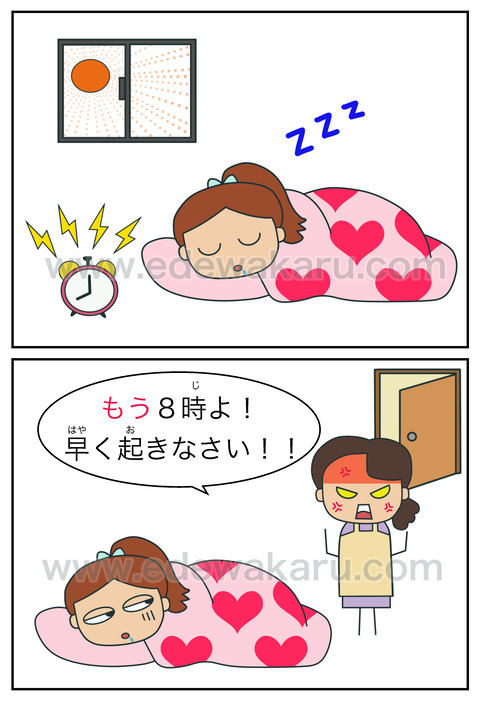
Meaning
すでに〜
How to use it
もう+時を表す語
もう+年齢
Explanation
「もう〜」は【時を表す語】や【年齢】と一緒に使われ、「すでに〜」という意味の文型です。
「すでに〜するのに十分な年齢だ」「すでに〜するのに十分な時期だ」
と言いたい時や、
「思ったよりも早くその時や年齢になった」
と感じた時に使います😊
[例]
もう
9時だ!早く帰らなきゃ
→思ってたよりも早く時間が過ぎてしまって、気付いたら9時になっていた
もう
20歳だから、お酒を飲んでもOKだ
→すでに20歳だから、お酒を飲むのに十分な年齢だ
「もう〜」にはたくさん意味があります😨また会話でもとてもよく使いますので、しっかりと覚えておきましょう😉
(復習:もう+数量詞)
In context 1 examples
娘がもう1歳になった…時間が経つのは早いものだ
→娘がすでに1歳になった…時間が経つのは早いものだ(復習:〜ものだ(感慨))
Usage 2
Read this source entry ↗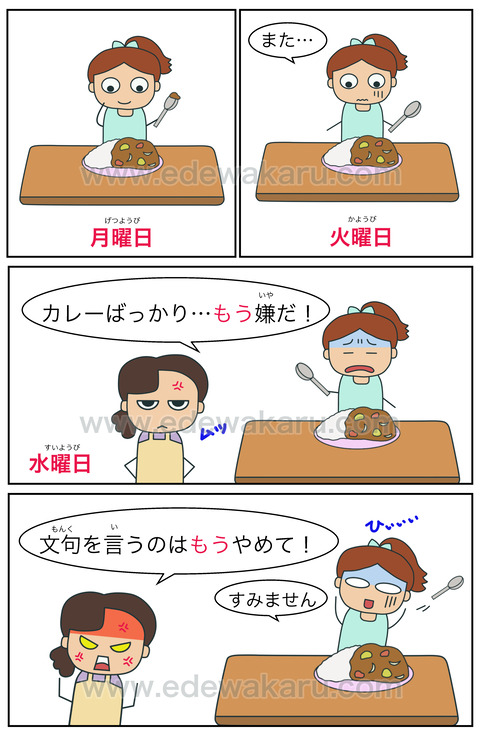
Meaning
これ以上〜するのは〜だ
How to use it
もう+否定的表現
Explanation
「もう+否定的表現(ひていてきひょうげん)」は「これ以上〜するのは〜だ」という意味を表す文型です。
これは
「これ以上〜の状態を続けることはできない」
と言いたい時に使用します。後ろには「嫌だ」「無理だ」などの否定的表現を使います😊
[よく使われる否定表現]
・嫌だ
・やめて
・やめたい
・やめなさい(・やめろ)
・無理だ
・限界だ
・たえられない
・我慢できない など
【上級レベルの人へ】
「もう+否定表現」の1つとして、
「もうたくさんだ」
という表現があります。これは
「これ以上我慢できない」
という意味で使われます😮
[例]
文句ばっかり…
もうたくさん!
→文句ばっかり言うわね…
もう我慢できない
わ!
「もうたくさん」は「いいかげんにしろ!」と同じくらい、相手の行動に対してイライラしたり、怒ったりしている時に使いますので、使用するときは気をつけましょう
😀
「もう+否定表現」は会話でもよく使いますので、ドラマやアニメなどでも聞く機会が多いと思います😉
In context 5 examples
カレーばっかり…もう嫌だよ!
→これ以上カレーばっかり食べるのは、嫌だ(復習:〜ばっかり・〜ばっか)文句を言うのはもうやめてちょうだい!
→これ以上文句を言うのはやめてちょうだい(復習:〜てちょうだい)このアルバイトはもうやめたいな…
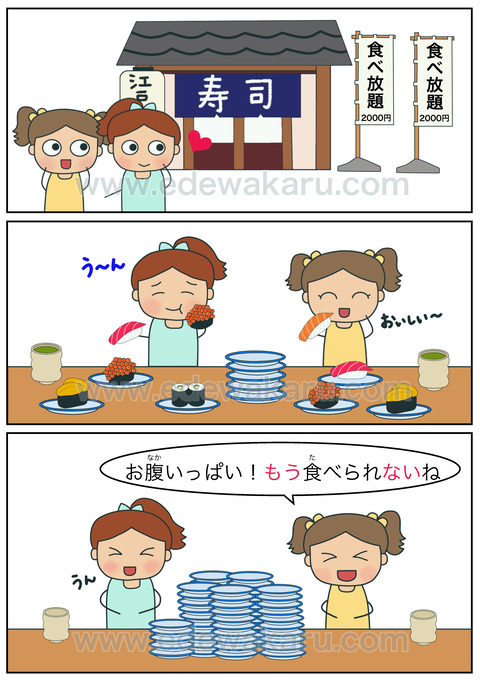
→これ以上このアルバイトをするのは嫌だからやめたいな…ラーメンを5杯も食べた。これ以上食べるのはもう無理だ
→これ以上食べるのは無理だ(復習:〜も(数量詞+も))ここのところ休みがない…もう限界だ
→ここのところ休みがない…これ以上働くのは限界だ(復習:〜ところ(Nのところ))
Usage 4
Read this source entry ↗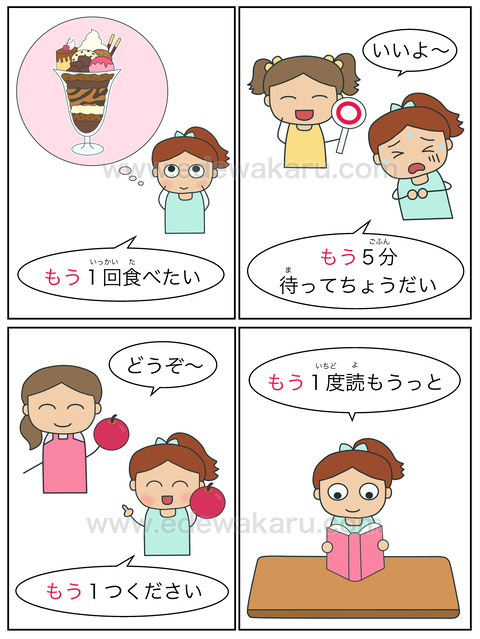
Meaning
さらに〜
〜に加えて、また〜
How to use it
もう+数量詞
Explanation
「もう+数量詞」は「(同じものを)さらにまた〜」「(同じものを)付け加えて〜」という意味を表す文型です。「
今の状態に、さらに同じものを〜」「今の状態に、同じものをプラスして〜」と言いたい時に使います
😮
[例]
①
もう
1度あのケーキが食べたい
→同じケーキを
また
食べたい
②
もう
1つあのケーキが食べたい
→同じケーキを
さらに
1つ食べたい
③
もう
100円あったら、あのケーキが食べられるのに…
→
今持っているお金にプラス
100円あったら、あのケーキが食べられるのに…
レストランや居酒屋で同じものをまた飲んだり食べたりしたい時に
「もう1杯ください」「もう1つください」
など、使う機会がたくさんあると思います。みなさんも会話で使ってみてくださいね😉
日本語文型辞典 英語版
Meaning
This is used to add further quantities to something. For example,
(4)
means “You have some money but if you could add 100 yen to it, you would be able to buy a ticket.”
Often used as another way of saying あと, as in あと5分. However, あと also includes the meaning “This is the last of what remains,” but もう does not particularly carry that meaning. In situations where it is difficult to say this is the last (time), もう is used rather than あと. For example,みんなが来てからあと一回先生に電話してみた is somewhat unnatural.
Expresses a small fluctuation or change in the current situation. あとすこし is also used. Moreover, asもうちょっと is less formal than もうすこし, it is more commonly used in daily conversation. This cannot be used in cases where the quantity is large.
(×)もうたくさんほしい。
I want more.
(○)もっとたくさんほしい。
I want more.
b. もうすこし/もうちょっと〈degree〉
Used with expressions which show an attribute or condition, this demonstrates a slightly higher degree than the present condition.
c. もうすこしでV-そうだった
Means “a certain situation is on the verge of occurring.” もう少しで...ところだ is often used instead. In casual conversation もうちょっとで is also used.
d. もうすこしでV-るところだった
This is a way of intensifying V-るところだった.
→
【ところだ】2b
B:ええ、この前の日曜日に見ました。
Yes, I watched it last Sunday.
B:いいえ、まだ開いています。
No, we’re still open.
B:いいえ、まだ出ていません。予定は来週です。
No, not yet. It is scheduled (to be out) next week.
When used with a verb phrase, this indicates the completion of a deed or event by a certain point in time. It is also used in interrogative sentences asking whether or not something has been completed. When the point of completion has not yet been reached, まだ...ない is used in both declarative and interrogative sentences.
Used with expressions which show time or age, it shows that a point which is rather late has been reached. As in examples
(1)
and
(2)
, it includes the feeling that a certain point in time has been reached sooner than was thought.
B:ええ、もういいですよ。
Yes, it’s ready.
B:ええ、これでもういいはずです。
Yes, it should be fine now.
B:もういい?
Okay now?
A:いいよ。はい、目を開けて。
Okay, open your eyes.
Used with phrases such as 一杯だ and 十分だ, this means “(it) ought to be enough/satisfactory.” もういい, basically meaning “a satisfactory situation or state has been reached,” is used in various circumstances. Depending on the context, it can mean “to have done enough,” or “to have resolved (it).” For the negative usage rules for もういい, please see Usage 5b of もう.
This means, with something like a certain point in time as the limit, there is nothing further or nothing after that.
Using predicates with a negative meaning such as 無理だ and いやだ, this means the situation cannot be tolerated any further. Meaning “the limit has been reached and so I can’t take anymore,” もうたくさんだ is often used when the speaker is feeling quite emotional. It can also be used in cases, such as example
(7)
, which prohibit further such behavior.
b. もういい
B:これでもういいです。
That’s all.
B:いや、これだけ食料があれば、もういいです。
No, this should be enough food.
B:いや、もういいです。
No, I’ve had enough.
B:言い訳はもういいよ。
That’s enough of your excuses.
B:もういいよ。お説教は聞き飽きたよ。
Enough! I’m tired of your preaching!
B:もういいんです。何か、ほかの事を考えます。
Oh, it’s okay. I will think of something else.
B:もういいよ。あきらめよう。
I’ve had enough! Let’s give it up.
Fundamentally this means “because this is enough, more than this is not necessary.” It is used in various circumstances. In example
(3)
it is used to decline something. Also, in
(4)
and
(5)
, meaning “this is the limit, I can’t accept more than this,” it conveys the speaker’s attitude of refusal. It is often used in cases in which something has become disagreeable or tedious. As in
(6)
and
(7)
, it is also used as an expression which conveys the feeling of being sick of or giving up on something which had been adhered to until that point. For the affirmative usage rules of もういい, see Usage 3 of もう.
B:もう。
Already again!
At the start or in the middle of a sentence, this expresses a feeling of criticism towards the other person. Only used in casual conversation and is often used by women. Frequently used with the highly critical (っ)たら.
How to use it
1. もう+数量詞
2. もうすこしa. もうすこし/もうちょっと〈quantity〉
1. もう〈completion〉
2. もう +時間/+年齢
3. もうNa だ/もういい
4. もう...ない
5. もう〈negative attitude〉a. もう+否定的表現
6. もう〈criticism〉
In context 74 examples
すみません、もう5分ここにいてください。
Excuse me, please wait here another five minutes.
もう一時間待って、彼が来なかったら先に行く。
I’ll wait another hour and then, if he doesn’t come, I’ll go on ahead.
もう一人紹介したい人がいる。
There’s one more person I’d like to introduce.
もう百円あれば、切符が買える。
If you had 100 yen more, you could buy a ticket.
もう 10 ページ読めば、この本は読み終えられる。
If you read another ten pages, you can finish this book.
もう一回だけテストしてみよう。
Let’s try the test just once more.
もう一度だけ会ってください。
Please meet him just one more time.
みんなが来てから、もう一回先生に電話してみた。
After everyone had arrived, I tried to call the teacher one more time.
もう少し、ミルクをください。
Could I have a little more milk, please.
もう少しここで過ごしたい。
I want to stay here a little longer.
もう少し待てば、順番が回ってくる。
If you wait a little longer, your turn will come.
ゴールまで、もうちょっとだ。
It’s just a little bit more to the goal.
もう少しいい車を買いたい。
I want to buy a slightly better car.
温度はもう少し低くした方がいい。
You’d better bring the temperature down a little.
もう少し大きな声で話したほうがいい。
You ought to speak a little more loudly.
かれなら、もう少しむずかしい問題もできるだろう。
As for him, I think he could handle slightly more difficult problems.
もうちょっと安いものはありませんか。
Don’t you have anything a little cheaper?
もう少しでうまくいきそうだったのに、邪魔が入ってしまった。
Everything was just about to work out well when a wrench was thrown into the works.
もう少しで会社に遅れそうになったが、ぎりぎりで間にあった。
It seemed I was going to be late for work, but I made it just in time.
もう少しで本当のことを言いそうになったが、何とか我慢した。
I was so close to telling the true story, but somehow managed to keep my self-control.
二人はもう少しでけんかしそうになったが、わたしが何とか止めた。
The two of them seemed close to getting into a fight, but somehow I stopped them.
もう少しでけがするところだった。
I was almost injured.
ぼんやり歩いていて、もう少しで車にひかれるところだった。
I was walking along absentmindedly and almost got hit by a car.
赤ちゃんはもう少しで寝るところだったのに、電話の音で目をさましてしまった。
The baby was just about to fall asleep, but the phone rang and she opened her eyes.
実験はまた失敗したが、本当はもう少しで成功するところだったのだ。
The experiment failed again, but the truth is that we were close to succeeding.
今日の仕事はもう全部終わった。
Today’s work is all done.
A:今評判になっているあの映画、もう見ましたか。
Have you seen that film that everyone’s talking about now?
食事はもうできている。
Dinner is ready.
その問題なら、もう解決している。
That problem? It’s been resolved already.
彼の娘はもう大学を卒業したそうだ。
I heard that his daughter has already graduated from college.
駅についたときにもう特急は出てしまっていた。
When I got to the station, the limited express had already left.
手紙はもう投函したので、取り返せないんです。
I have already mailed the letter, so I can’t get it back.
A:すみません、今日はもう閉店ですか。
Excuse me, are you already closed for today?
A:この本はもう出ましたか。
Is this book out yet?
おしゃべりに夢中になっていたら、もう5時だ。
We got lost in conversation and it’s already five o’clock.
気がついたらもう朝だった。
Before we knew it, it was already morning.
この子はもう 10 才だから、十分事故の証人になれる。
This child is already ten years old, so she can serve as a witness to an accident.
こよみの上ではもう春なのに、まだ雪が降っている。
Although the calendar says it is spring, it is still snowing.
もう夜が明けるのに彼らはまだ話し続けている。
They kept on talking even though dawn was breaking.
もう8時ですよ。起きなさい、学校に遅れますよ。
It’s already eight o’clock. Get up, or you’ll be late for school.
もうおなかが一杯だ。
I’m already full.
今日はもう十分に楽しんだ。
I’ve already had a lot of fun today.
A:お湯はわいていますか。
Is the water boiling yet?
A:機械、直ったんですか。
Is the machine fixed?
A:ちょっと目を閉じて。1、2、3。
Just shut your eyes. One, two, three.
山田さんはもうここにはいません。
Yamada-san is no longer here.
この喫茶店はもう営業していない。
This coffee shop is no longer in business.
疲れて、もう何も考えられなくなった。
I was so tired I couldn’t think anymore.
交渉のあと、だれももう文句を言わなかった。
After the negotiations, nobody had any more complaints.
かれとは、もうこれ以上話したくない。
I don’t want to say anything more to him.
わたしは、18 才、もう子供ではない。
I’m eighteen. I’m not a child anymore.
もう二度とあの人には会わないだろう。
I don’t suppose I’ll ever meet her again.
もう誰も信じられないと言って、彼女は泣いていた。
She was crying and said, “I can’t trust anyone anymore.”
こんな待遇の悪い職場にはもうがまんができない。
I can’t take it anymore in a workplace like this with such terrible conditions.
さいふの中にはもう 100 円しか残っていなかったので、家へ帰るのにバスにも乗れなかった。
Since I only had 100 yen left in my wallet, I couldn’t even catch the bus home.
10 万円の値段がついたので、もうこれ以上は上がらないだろうと思った。
Because it was already priced at 100,000 yen, I didn’t think the price could go any higher.
こんな退屈な仕事はもうやめたい。
I want to quit this kind of boring work.
もうあの人の愚痴を聞くのはいやだ。
I’m sick of hearing that person’s complaints.
これ以上歩き続けるのは体力的にもう無理です。
It’s physically impossible for me to walk any further.
あの人をかばい続けられるのももう限界だ。
I can’t carry on sticking up for that man.
戦争をするのは、もうたくさんだ。
I’ve had it with the war.
こんなまずいものを食べるのはもうたくさんだ。
I can’t eat any more of such disgusting stuff.
もういいかげんに妹をいじめるのはやめなさい。
Stop picking on your younger sister.
A:ほかに出す書類がありますか。
Do you have any other documents to hand in?
A:チョコレート買いましょうか。
Shall we buy some chocolate?
A:もう一杯いかがですか。
How about one more (glass/cup)?
A:急なアルバイトさえなかったら、来られたんだけど。
If I just hadn’t had that sudden part-time work, I could have come.
A:お母さんの気持ちも考えてみなさい。
Try to think about your mother’s feelings, too.
A:頑張っていたのに、うまく行かなくて残念だったね。
It’s such a shame that it didn’t go well even though you did your best.
A:もう一回探しなおせば、みつかるかもしれません。
If we have another look, we may be able to find it.
お母さんたら、もう。わたしの友達の悪口を言うのはやめてよ。
Mom, enough! Stop badmouthing my friends.
もう、あなたったら、こんなやさしい計算もできないの。
Oh, come on, dear. Can’t you even do a simple calculation like this?
山田さんたら、もう、また「お茶入れて」ですって。自分でやればいいのに。
That Yamada-san telling me again, “Make some tea.” He should make it himself.
A:あ、また、汚した。
Oh, it’s dirty again.
AIUEO JLPT Grammar
Meaning
「もう」is an adverb indicating that an action or state has already been completed, typically used with the past tense of verbs. Similar to "already” in English.
How to use it
もう+過去形
Explanation · 日本語
「もう」は、ある行動や状態がすでに完了したことを示す副詞で、動詞の過去形とともに使用されます。
In context 5 examples
もう宿題を終えたよ。
I have already finished my homework.
もう新しいバージョンがリリースされました。
The new version has already been released.
もうお薬を飲みましたか?
Have you already taken your medicine?
もう晩ご飯を食べたの?
Have you already eaten dinner?
もう準備はできましたか?
Are you already prepared?
Bunpro Grammar Reference
Meaning
Already, Anymore
How to use it
もう + (Past) Phrase
もう + (Negative) Phrase
Nuance
A word that is used to highlight something that is expected to be continuing, but is not.
Explanation
In English, もう is regularly translated to 'already', or 'anymore', depending on if it is used in a positive-past (already), or negative (anymore) sentence. The reason that Japanese only requires one word for both of these nuances is due to もう literally meaning 'something has unexpectedly ended'.
朝ごはんはもう食べた。
I already ate breakfast. (Although you probably didn't expect it, I have already eaten breakfast)
もうお金がない。
I don't have money anymore. (Although you probably didn't expect it, I have no money)
From these sentences we can see that もう can be translated in each case as the following.
(Past) - Although expected to not be done, it is. 'Already', in English.
(Negative) - Although expected to still be going, it isn't. 'Anymore', in English.
This is the opposite of まだ, which means 'something is unexpectedly still going'.
もう may also be used to ask questions. This is when the speaker thinks that something 'might' have ended, but wants to confirm.
もうデザートを食べた?
Did you already eat dessert?
Fun Fact
もう is often used simply as an expression of exasperation (giving up on arguing), to show that someone has already reached the point of not wanting to continue.
あ~もう無理。
Ugh, that's enough. (I've had enough, I'm done arguing/continuing)
Nuance · 日本語
継続しているはずのことが継続していないということを表すときに使う言葉。
In context 16 examples
- もう学校に行きましたか。
Did you already go to school?
- もうデザートを食べた?
Did you already eat dessert?
- 朝ごはんはもう食べた。
I already ate breakfast. (Although you probably didn't expect it, I have already eaten breakfast)
- もうお金がない。
I don't have money anymore. (Although you probably didn't expect it, I have no money)
- もうその本を読んだ。
I have already read that book.
- もうコーヒーを作りました。
I already made coffee.
- もうしました。
I already did it.
- もう帰った。
They already went home.
- そのケーキは、もう食べた。
I already ate that cake.
- 犬の散歩もうしました。
I already took the dog for a walk.
- それはもうよくない。
That is already not good. (Not good anymore)
- お母さんは晩ごはんをもう作りました。
My mother already made dinner.
- もう写真撮った。
I already took a picture.
- もうパーティーに行った。
I already went to the party.
- もう始まった。
It already started.
- あ~もう無理。
Ugh, that's enough. (I've had enough, I'm done arguing/continuing)
Yokubi — The Common Grammar Guide (https://yoku.bi)
Explanation
With positive statements, もう expresses "already". With negative statements, it works together with the negation to express "not anymore".
Basically, もう means that there's a change of state from the statement being false or irrelevant to the statement being true: "already" and "not anymore".
もう can also appear as an emphatic expression of frustration
In statements about the near future, もう can mean "soon" instead. This usually goes along with an adverb expressing soonness, but sometimes it's just implied.
Another use of もう expresses "more" of an amount.
まだ expresses the idea of "still" or "yet" and it is the opposite of もう. It's used when a state stays the same.
まだまだ is an adverb and set expression that also works as a more emphatic まだ
もう is used for "yet" in positive questions, since もう highlights a change.
また expresses the idea of "again".
In context 10 examples
もうこんな時間だ
It's this late! (lit. It's already this time)
もう食べたよ
I already ate
もう食べないの?
You won't eat anymore?
もういいよ
I've had enough (lit. it's already at a sufficient level)
もう!
(angry frustrated noises)
どうやらもう来るみたい
Well it seems like he'll arrive soon
もう一杯!
One more drink!
もうちょっと
A bit more
もう書きましたか?
Did you write it yet?
もう眠いの?
Are you already sleepy?
文法
Meaning
動作や出来事の完了を表す。
How to use it
V(肯定形 + 過去形)
Notes
「もう〜ましたか?」の質問にまだ完了していないことを述べる場合は「いいえ、まだです」や「いいえ、まだ〜ていません」の形で答える。
In context 8 examples
A:もう昼ごはんを食べましたか。
B:はい、食べました。A:もう宿題をしましたか。
B:いいえ、まだです。A:みなさん、もう京都には行きましたか?
B:はい、行きました。A:もうレポートを出しましたか。
B:はい、さっき出しました。A:もう映画始まった?
B:ううん、まだだよ。もうディズニーランドへは行きましたか。
え、トムさんもうテスト終わったの?
旅行の準備はもう終わった?
日本語NET JLPT文法解説まとめ
Meaning
動作や出来事の完了を表す。
How to use it
V(肯定形 + 過去形)
Explanation
"already done"
Indicates the completion of an action or event.
「もう〜ましたか?」の質問にまだ完了していないことを述べる場合は「いいえ、まだです」や「いいえ、まだ〜ていません」の形で答える。
In context 8 examples
A:もう昼ごはんを食べましたか。
A:もう宿題をしましたか。
A:みなさん、もう京都には行きましたか?
A:もうレポートを出しましたか。
A:もう映画始まった?
もうディズニーランドへは行きましたか。
え、トムさんもうテスト終わったの?
旅行の準備はもう終わった?