絵でわかる日本語
Meaning
Reason (the reason that …)
Explanation
This “(〜という)わけ” is used to mean [reason] 😊
It is an expression often used when stating the reason why something happened. It’s easier than the other uses of “わけ,” so I think it should be easy to remember 😉 Also remember that “わけ” is written with the kanji “訳.”
There are many patterns in the “わけ” series, so be sure to distinguish this one as the “わけ” used as a notional noun and remember it 😀
[The “わけ” series]
〜ないわけにはいかない
〜わけがない
〜わけがわからない (notional noun)
〜わけだ (realization)
〜わけではない
〜わけない (notional noun)
〜わけにはいかない
In context 5 examples
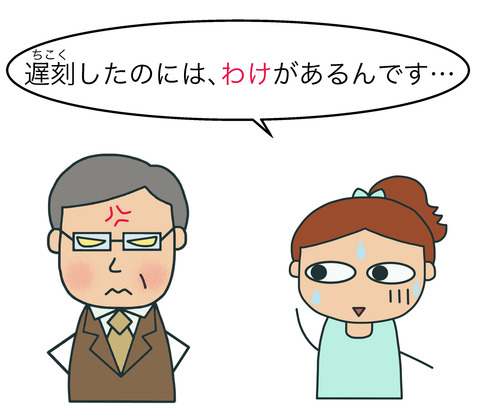
遅刻したのには、わけがあるんです→遅刻したのには、理由があるんです
There’s a reason I was late. → There’s a reason I was late.
会社を休んだわけを聞く→会社を休んだ理由を聞く
Ask why they took the day off work. → Ask the reason they took the day off work.
A:どうしてパーティーに来なかったの?B:妹が病気になって、病院に連れて行っていたというわけさ
→妹が病気になって、病院に連れて行っていたからさA: Why didn’t you come to the party? B: My little sister got sick, so I was taking her to the hospital—that’s why. →Because my little sister got sick, and I was taking her to the hospital.
A:どうしたの?元気がないねB:色々なことがあってね…わけは聞かないで…
→色々なことがあってね…理由は聞かないで…A: What’s wrong? You seem down. B: A lot has happened… Don’t ask me why… →A lot has happened… Don’t ask me the reason…
なぜミスをしたのか、わけを話してもらおう→なぜミスをしたのか、理由を話してもらおう
Let’s hear why you made the mistake. → Let’s hear the reason you made the mistake.
Read the original source text
Meaning
(〜という)理由
Explanation
この「(〜という)わけ」は【理由】という意味で使用されます😊
なぜそうなったかという理由などを言う時によく使われる表現
ですね。他の「わけ」に比べて簡単ですので、覚えやすいと思います😉「わけ」は漢字で書くと「訳」と書くということも覚えておいてください。
「わけ」シリーズはたくさんありますので、今回のは「実質名詞のわけ」だと、しっかり区別して覚えておきましょう😀
【「わけ」シリーズ】
〜ないわけにはいかない
〜わけがない
〜わけがわからない(実質名詞)
〜わけだ(納得)
〜わけではない
〜わけない(実質名詞)
〜わけにはいかない
毎日のんびり日本語教師
How to use it
Verb plain form + (という)わけ
い-adjective plain form + (という)わけ
な-adjective stem + な/である/という + わけ
Noun + な/である/という + わけ
Explanation
There are four uses.
① Reason
② Stating a conclusion or fact emphatically
③ Rephrasing or summarizing
④ Acceptance or understanding
When used for ③ rephrasing, the preceding clause may be paired with つまり or 要するに (“in other words,” “to sum up”), etc.
When used for ④ acceptance or understanding, the preceding clause may be paired with どうりで (“no wonder”), だから (“that’s why”), それで (“and so”), なるほど (“I see”), etc.
Notes
The わけ series
In context 14 examples
今日は子どもの誕生日なんです。そういうわけだから私先に帰らせてください。
Today is my child’s birthday. That’s why, please let me leave early.
双子は生まれる前からずっと一緒にいたわけだから、心が通じ合っているのも当然だ。
Since the twins have been together ever since before they were born, it’s only natural that they understand each other.
この映画は、人々が主人公に共感できるから人気になったわけだ。
This movie became popular because people can relate to the main character.
人間は視覚から得る情報量が最も多いわけだから、身だしなみを整えることで第一印象を良くすることができる。
Since people get the most information through sight, they can make a good first impression by dressing neatly.
数年ぶりに地元へ帰って来たわけだが、昔のまま何一つ変わっていなかった。
I came back to my hometown for the first time in several years, but not a single thing had changed from how it used to be.
大学4年生になったわけだが単位足りなくて卒業できなさそう。
I’m now a fourth-year university student, but I don’t have enough credits, so it looks like I won’t be able to graduate.
明日から夏休みなわけだけど何か予定とかあるの?
So, summer vacation starts tomorrow. Do you have any plans?
別れは出会いの始まり。終わりは始まりなわけである。
Parting is the beginning of a new meeting. An ending is a beginning.
距離が近くなるほど、長く一緒にいるほど素が出てくる。つまりそれが本性なわけだ。
The closer you become and the longer you spend together, the more people show their true selves. In other words, that’s their true nature.
人は潜在意識に支配されている。つまり人の動機は潜在意識にあるわけだ。
People are governed by their subconscious. In other words, people’s motives lie in their subconscious.
窓を開けて寝ていた。どうりで寒いわけだ。
I slept with the window open. No wonder it’s cold.
彼とは趣味が同じだった。なるほど、だから気も合うし話も合うわけだ。
He and I had the same hobbies. I see—that’s why we get along and have so much to talk about.
人は後悔することができる。だから悩むわけだ。(人可以后悔。 所以才烦恼。)
People are capable of regret. That’s why they worry.
内通者がいたから、それでこちらの情報が向こうに筒抜けだったわけか。
So there was an informant, and that’s why all our information was getting straight through to the other side?
Read the original source text
How to use it
動詞普通形+(という)わけ
い形容詞普通形+(という)わけ
な形容詞語幹+な/である/という+わけ
名詞+な/である/という+わけ
Explanation
4つの用法があります。
①理由
②結論・事実を強調して述べる
③言い換え、要約
④納得・理解
③言い換えの時は、前件に「つまり」「要するに」等が呼応することがあります。
④納得・理解の時は、前件に「どうりで」「だから」「それで」「なるほど」等が呼応することがあります。
Notes
「わけ」シリーズ
Yokubi — The Common Grammar Guide (https://yoku.bi)
Explanation
わけ is a noun meaning "reason" (as in "why"). It can be used in many different set expressions. It is not possible to list all of them here but just a few common ones.
At the core わけ(だ) states a reason, explanation, fact, logical restatement, or conclusion. This usage can occasionally be replaced with のだ.
わけがない means "there is no way" and implies that something is not even remotely thinkable by the speaker
わけじゃない on the other hand is a roundabout way to negate a situation, circumstance, or logical conclusion.
わけにはいかない means that something is not possible according to general knowledge or social expectations.
Since わけ is a very strong statement, it is often paired with という in the form of というわけ to soften the impact of the expression.
はず expresses that the speaker expects something to factually be true or come true. It can be similar to the English "should" but it does not cover the entire same range of situations. はず also implies that the expectation is based on reasoning and is not pure conjecture.
べき states that the speaker expects a certain behaviour or state to be upheld, because not doing so would be bad, irresponsible, etc.
There are however some situations where using べき isn't always so heavy, especially in questions when asking for someone's wisdom or advice.
When in the past tense like べきだった, it says that an action or state "was" or "would have been" right, usually the latter.
べし is an archaic version of べき. Just be aware it exists.
ものだ can also express "should" with the nuance that it's a general "should" that applies to a lot of people, not just a specific person or a group. It is often used to state the nature of "how things are".
かもしれない is a compound sentence-ender. It attaches the same way as か alone does. It expresses that the speaker thinks the statement is a possibility. Sometimes people attach this to things they know are true for politeness's sake.
かもしれない is often shortened to just かも in casual conversation.
In context 5 examples
なるほど、そういう可能性もあるわけだ。
I see, so that possibility also exists.
それならいくら探しても見つからないわけだ。
If that's the case, no matter how hard they search, she won't be found.
そんな馬鹿なことがあるわけがない。
There's no way such a ridiculous thing would exist.
可能性がないわけじゃない。
It's not like there's no chance.
このチャンスを逃すわけにはいかない。
I cannot possibly let this chance go.