絵でわかる日本語
Meaning
(〜という)理由
Explanation
この「(〜という)わけ」は【理由】という意味で使用されます😊
なぜそうなったかという理由などを言う時によく使われる表現
ですね。他の「わけ」に比べて簡単ですので、覚えやすいと思います😉「わけ」は漢字で書くと「訳」と書くということも覚えておいてください。
「わけ」シリーズはたくさんありますので、今回のは「実質名詞のわけ」だと、しっかり区別して覚えておきましょう😀
【「わけ」シリーズ】
〜ないわけにはいかない
〜わけがない
〜わけがわからない(実質名詞)
〜わけだ(納得)
〜わけではない
〜わけない(実質名詞)
〜わけにはいかない
In context 5 examples
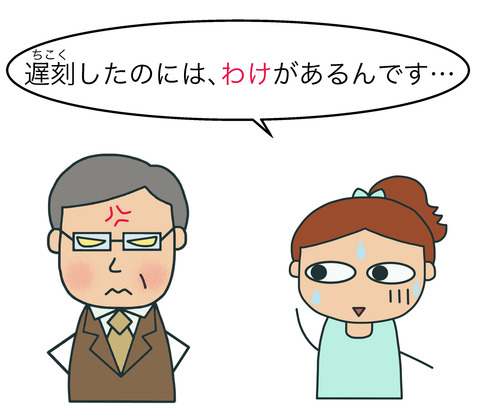
遅刻したのには、わけがあるんです→遅刻したのには、理由があるんです
会社を休んだわけを聞く→会社を休んだ理由を聞く
A:どうしてパーティーに来なかったの?B:妹が病気になって、病院に連れて行っていたというわけさ
→妹が病気になって、病院に連れて行っていたからさA:どうしたの?元気がないねB:色々なことがあってね…わけは聞かないで…
→色々なことがあってね…理由は聞かないで…なぜミスをしたのか、わけを話してもらおう→なぜミスをしたのか、理由を話してもらおう
毎日のんびり日本語教師
How to use it
動詞普通形+(という)わけ
い形容詞普通形+(という)わけ
な形容詞語幹+な/である/という+わけ
名詞+な/である/という+わけ
Explanation
4つの用法があります。
①理由
②結論・事実を強調して述べる
③言い換え、要約
④納得・理解
③言い換えの時は、前件に「つまり」「要するに」等が呼応することがあります。
④納得・理解の時は、前件に「どうりで」「だから」「それで」「なるほど」等が呼応することがあります。
Notes
「わけ」シリーズ
In context 14 examples
今日は子どもの誕生日なんです。そういうわけだから私先に帰らせてください。
双子は生まれる前からずっと一緒にいたわけだから、心が通じ合っているのも当然だ。
この映画は、人々が主人公に共感できるから人気になったわけだ。
人間は視覚から得る情報量が最も多いわけだから、身だしなみを整えることで第一印象を良くすることができる。
数年ぶりに地元へ帰って来たわけだが、昔のまま何一つ変わっていなかった。
大学4年生になったわけだが単位足りなくて卒業できなさそう。
明日から夏休みなわけだけど何か予定とかあるの?
別れは出会いの始まり。終わりは始まりなわけである。
距離が近くなるほど、長く一緒にいるほど素が出てくる。つまりそれが本性なわけだ。
人は潜在意識に支配されている。つまり人の動機は潜在意識にあるわけだ。
窓を開けて寝ていた。どうりで寒いわけだ。
彼とは趣味が同じだった。なるほど、だから気も合うし話も合うわけだ。
人は後悔することができる。だから悩むわけだ。(人可以后悔。 所以才烦恼。)
内通者がいたから、それでこちらの情報が向こうに筒抜けだったわけか。
Yokubi — The Common Grammar Guide (https://yoku.bi)
Explanation
わけ is a noun meaning "reason" (as in "why"). It can be used in many different set expressions. It is not possible to list all of them here but just a few common ones.
At the core わけ(だ) states a reason, explanation, fact, logical restatement, or conclusion. This usage can occasionally be replaced with のだ.
わけがない means "there is no way" and implies that something is not even remotely thinkable by the speaker
わけじゃない on the other hand is a roundabout way to negate a situation, circumstance, or logical conclusion.
わけにはいかない means that something is not possible according to general knowledge or social expectations.
Since わけ is a very strong statement, it is often paired with という in the form of というわけ to soften the impact of the expression.
はず expresses that the speaker expects something to factually be true or come true. It can be similar to the English "should" but it does not cover the entire same range of situations. はず also implies that the expectation is based on reasoning and is not pure conjecture.
べき states that the speaker expects a certain behaviour or state to be upheld, because not doing so would be bad, irresponsible, etc.
There are however some situations where using べき isn't always so heavy, especially in questions when asking for someone's wisdom or advice.
When in the past tense like べきだった, it says that an action or state "was" or "would have been" right, usually the latter.
べし is an archaic version of べき. Just be aware it exists.
ものだ can also express "should" with the nuance that it's a general "should" that applies to a lot of people, not just a specific person or a group. It is often used to state the nature of "how things are".
かもしれない is a compound sentence-ender. It attaches the same way as か alone does. It expresses that the speaker thinks the statement is a possibility. Sometimes people attach this to things they know are true for politeness's sake.
かもしれない is often shortened to just かも in casual conversation.
In context 5 examples
なるほど、そういう可能性もあるわけだ。
I see, so that possibility also exists.
それならいくら探しても見つからないわけだ。
If that's the case, no matter how hard they search, she won't be found.
そんな馬鹿なことがあるわけがない。
There's no way such a ridiculous thing would exist.
可能性がないわけじゃない。
It's not like there's no chance.
このチャンスを逃すわけにはいかない。
I cannot possibly let this chance go.