絵でわかる日本語
日本語文型辞典
Meaning
「まるで-ようだ/みたいだ」、「まるで…かのように/かのごとく」という形で使う。ある状態を他の例にたとえたり、二つを比べて「実際には違うが、たいへん近い」ことを表す表現。「らしい」といっしょに使うことは出来ない。
否定形や否定的な意味を表す表現を伴って、「ぜんぜん…ない」「まったく…ない」という意味を表す。④は「ぜんぜんだめだ」という意味。
How to use it
まるで
まるで…ない
In context 12 examples
今日は風が強くて、まるで台風みたいだ。
あんなつまらないことで怒りだすなんて、まるで子供みたいだ。
彼は、入学試験を受ける友人のことを、まるで自分のことのように心配している。
きのうあんなに大きな事件があったのに、街はまるで何事もなかったかのように平静を取り戻していた。
大事件にもかかわらず、人々はまるで何事もなかったかのごとく振舞っている。
(誤) あの人は、まるで女らしい人です。
(正) あの人は{たいへん/とても}女らしい人です。
私は外国語はまるでだめなんです。
うちの兄弟はまるで似ていない。
いくら仕事ができても、自分の身の回りのことがまるでできないようでは、一人前のおとなとは言えない。
あいつのやり方はまるでなってない。
みんなの講では、ずいぶん嫌な男のように思えたが、実際に会ってみると、聞いていたのとはまるで違っていた。
日本語文型辞典 英語版
Meaning
Used in the forms まるで...ようだ/みたいだ and まるで...かのように/かのごとく. Figuratively compares another example with an existing condition or state and demonstrates that although in reality the two are different, they are very close. It cannot be used together with らしい.
(×)あの人は、まるで女らしい人です。
That person is just as if she were very ladylike.
(○)あの人は{たいへん/とても}女らしい人です。
That person is (very) ladylike.
When accompanied by a negative form or an expression with negative meaning, this conveys the meaning “completely not” or “absolutely not.” In example
(4)
the meaning is “completely hopeless,” “no good at all.”
How to use it
1. まるで
2. まるで...ない
In context 10 examples
今日は風が強くて、まるで台風みたいだ。
Today the wind is strong. It seems just like a typhoon.
あんなつまらないことで怒りだすなんて、まるで子供みたいだ。
When you lose your temper over a little thing like that you seem just like a child.
彼は、入学試験を受ける友人のことを、まるで自分のことのように心配している。
He worries about his friend taking the entrance examination as if it were he himself taking it.
きのうあんなに大きな事件があったのに、街はまるで何事もなかったかのように平静を取り戻していた。
Despite that big incident yesterday, the town has regained its calm again just as if nothing had happened.
大事件にもかかわらず、人々はまるで何事もなかったかのごとく振舞っている。
In spite of the major incident, people are behaving as if nothing has happened.
私は外国語はまるでだめなんです。
I am absolutely hopeless at foreign languages.
うちの兄弟はまるで似ていない。
My siblings look completely different.
いくら仕事ができても、自分の身の回りのことがまるでできないようでは、一人前のおとなとは言えない。
However professional you may be, you can’t say you are properly an adult if you can’t take care of your own personal needs.
あいつのやり方はまるでなってない。
That guy’s way of doing things just doesn’t work.
みんなの話では、ずいぶん嫌な男のように思えたが、実際に会ってみると、聞いていたのとはまるで違っていた。
According to what everyone said, I’d had the impression he was a truly horrible man, but when I actually met him he was completely different from what I had heard.
AIUEO JLPT Grammar
Meaning
This sentence pattern is a metaphorical expression used to show that something is very similar to something else in terms of characteristics or appearance.
How to use it
まるで+名詞の+よう
Explanation · 日本語
この文型は、ある物や状態が別の物や状態と非常によく似ていることを表す比喩表現です。
In context 5 examples
この景色はまるで夢のようだ。
This scenery is just like a dream.
彼女はまるで天使のように優しい。
She is as kind as an angel.
彼はまるで子供のように無邪気だ。
He is as innocent as a child.
その技術はまるで魔法のように見える。
That technology looks just like magic.
その話はまるで嘘のようで信じられない。
This story is as unbelievable as if it were a lie.
文法
Meaning
他の物に例える表現(比喩)。
How to use it
まるで + N + のようだ
まるで + N1 + のような + N2
まるで + N + のように + V / イA
Notes
「まるで」は省略して使うこともできる。
「まるで〜みたい」と言うこともできるが、こちらは口語的。
In context 14 examples
ジェームスさんはまるで日本人のように日本語を話す。
トムさんとのデートはまるで夢のような時間だった。
うちの夫は一人で何もできないし、まるで赤ちゃんのようだ。
ジェシカさんは背が高くて、スタイルもいいし、まるでモデルのようだ。
先生はちょっと間違えただけで怒るし、まるで鬼のようだ。
明日から夏休みなので、山のような宿題が出た。
彼女が買いた犬の絵は本当に素晴らしい。まるで生きているようだ。
ジェームスさんは歌がすごく上手だし、歌手のようだ。
ひどい風。まるで嵐のようですね。
娘は天使のように可愛い。
彼は魚のように泳ぐのが上手だ
彼はビールを水のようにガブガブと飲んだ。
母は怒ると鬼のように怖い。
まだまだ仕事が山のように残っている。
Bunpro Grammar Reference
Meaning
It is entirely as if, It is just as though
How to use it
まるで + Verb + みたい(1) + だ
まるで + [い]Adjective + みたい(1) + だ
まるで + [な]Adjective + みたい(2) + だ
まるで + Noun + みたい(3) + だ
(1) よう
(2) なよう
(3) のよう
まるで + Verb + みたい(1) + です
まるで + [い]Adjective + みたい(1) + です
まるで + [な]Adjective + みたい(2) + です
まるで + Noun + みたい(3) + です
(1) よう
(2) なよう
(3) のよう
Nuance
A structure that expresses something as being completely the manner of (A).
Explanation
まるで~ようだ is an expression in Japanese that combines the adverb まるで (sometimes written as 丸で), and combines it with a description of (A) followed by the auxiliary verb よう (with or without either だ or です after it). 丸で can be translated as 'entirely', or 'completely', while the whole expression may be understood as 'it seems entirely as though (A)'.
まるで will be used at the beginning of a sentence, before the description of what (A) seems to be like.
このゲームはものすごくリアルだ。まるで映画を見ているようだ。
This game is very realistic. It is as if I am watching a movie.
あの人は私の母親と同じ年だけど運動神経がいい。まるで20代のようだ。
That person is the same age as my mother, but is very athletic. It is as though she's in her twenties.
Instead of ようだ, other expressions of conjecture may also be used, such as みたい.
あの人の仕事の仕方はまるで楽みたいだ。
How that person works looks as if it is super easy.
彼は弟にそっくりだ。まるで兄弟みたいだ。
He looks very similar to my younger brother. It is as if they are siblings.
Caution
The 'as if' or 'as though' nuance of まるで~ようだ comes primarily from either ようだ, or みたいだ, with まるで simply meaning 'entirely', or 'completely' in almost all situations.
お客さんと話すときにはちゃんと目を見て話せ!目を見ていないとまるでお客さんの話を聞いていないみたいじゃないか。
Look at the customers eyes when you talk to them! If you don't make eye contact, it is as though you are not listening to what they are saying.
なんだそのフォームは?まるでなってないぞ!
What is that form? That is completely unacceptable. (Natural, but different meaning)
Nuance · 日本語
何かが完全に(A)みたいになっているということを表す文法。
Explanation · 日本語
「まるで〜ようだ」は、副詞の「まるで」(漢字では「丸で」)に、助動詞の「よう」を合わせた表現です。「よう」のあとには、「だ」や「です」が付くこともあります。この表現は、「(実際は違うけど)(A) は (B) のように見える」という意味で使われます。
「まるで」は、文の始まりに置かれます。そのあとに、(A) がどのように見えるのかについて、説明が続きます。
このゲームはものすごくリアルだ。まるで映画を見ているようだ。
This game is very realistic. It is as if I am watching a movie.
あの人は私の母親と同じ年だけど運動神経がいい。まるで20代のようだ。
That person is the same age as my mother, but is very athletic. It is as though she's in her twenties.
「ようだ」は、「みたい」などの表現に変わることもあります。
注意点
「まるで〜ようだ」では、「まるで」が「全く」や「すっかり」という意味を表して、「ようだ」や「みたいだ」が「〜のように見える」という意味を表しています。
お客さんと話すときにはちゃんと目を見て話せ!目を見ていないとまるでお客さんの話を聞いていないみたいじゃないか。
Look at the customers eyes when you talk to them! If you don't make eye contact, it is as though you are not listening to what they are saying.
なんだそのフォームは?まるでなってないぞ!
What is that form? That is completely unacceptable. (Natural, but different meaning)
In context 18 examples
- あなたの顔はまるで幽霊を見たようだ。
Your face totally looks as though you saw a ghost.
- 彼は弟にそっくりだ。まるで兄弟みたいだ。
He looks very similar to my younger brother. It is as if they are siblings.
- このゲームはものすごくリアルだ。まるで映画を見ているようだ。
This game is very realistic. It is as if I am watching a movie.
- あの人は私の母親と同じ年だけど運動神経がいい。まるで20代のようだ。
That person is the same age as my mother, but is very athletic. It is as though she's in her twenties.
- あの人の仕事の仕方はまるで楽みたいだ。
How that person works looks as if it is super easy.
- 全部の家事をしてくれたの?まるで天使のようだ!
You did all the housework? You are just like an angel.
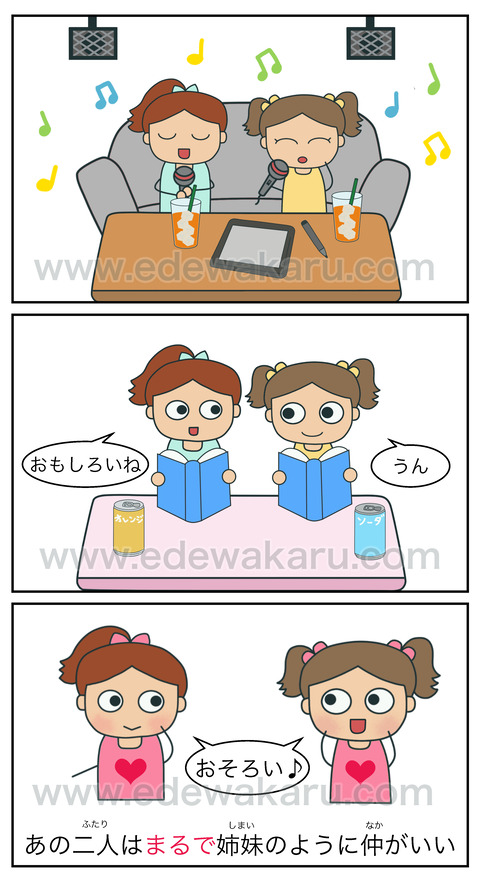
- あの二人は仲がいい。まるで兄弟のようだ。
Those two really get along well. It is just as though they are siblings. (entirely)
- 彼は、まるで山のように積まれた本を見て驚いた。
He was surprised to see books stacked just as if they were a mountain. (entirely)
- こんな日がくるなんて、まるで夢のようだ。
To think such a day would come, It is just as though I am in a dream. (entirely)
- 今日の風はまるで台風のようだ。
The wind today is entirely as if there is a typhoon. (totally)
- 彼女の瞳はまるで 夜空の星のように煌めいていた。
Her eyes sparkled just as if they were stars in the night sky. (completely)
- あいつ!あたしの家、まるでホテルみたいに扱うのよ。彼を追い出したい、どうすればいいかな?
That son of a gun! He treats my house just as though it is a hotel! I want to kick him out, but how? (entirely)
- この問題はまるで東京大学の入学試験のようだ。
This question is entirely as if it were from the Tokyo university entrance exam.
- 冬なのにこんなに暖かくて、蝶々まで飛んでいる。まるで春がきたみたいだ!
Although it is winter, it is so warm that even butterflies are flying. It is entirely as if spring has come. (completely)
- あの家には子供が4人いるので、まるで動物園のようだ。
Since there are four kids living in that house, it is entirely as if it were a zoo.
- ひとみはほんの高校生だけど、まるで経験豊富な大人のように演説した。
私ばかりでなく彼女のご両親を含めてみんな彼女の能力にびっくりした。Although Hitomi is just a high school student, she talked just as though she was a person with a lot of experience. (entirely) Not just me, but everyone, including her parents, were surprised at her ability.
- お客さんと話すときにはちゃんと目を見て話せ!目を見ていないとまるでお客さんの話を聞いていないみたいじゃないか。
Look at the customers eyes when you talk to them! If you don't make eye contact, it is as though you are not listening to what they are saying.
- なんだそのフォームは?まるでなってないぞ!
What is that form? That is completely unacceptable. (Natural, but different meaning)
日本語NET JLPT文法解説まとめ
Meaning
他の物に例える表現(比喩)。
How to use it
まるで + N + のようだ
まるで + N1 + のような + N2
まるで + N + のように + V / イA
Explanation
as if it were like / as if it were similar to
Used to like one thing to something else.
「まるで」は省略して使うこともできる。
「まるで〜みたい」と言うこともできるが、こちらは口語的。
In context 14 examples
ジェームスさんはまるで日本人のように日本語を話す。
トムさんとのデートはまるで夢のような時間だった。
うちの夫は一人で何もできないし、まるで赤ちゃんのようだ。
ジェシカさんは背が高くて、スタイルもいいし、まるでモデルのようだ。
先生はちょっと間違えただけで怒るし、まるで鬼のようだ。
明日から夏休みなので、山のような宿題が出た。
彼女が買いた犬の絵は本当に素晴らしい。まるで生きているようだ。
ジェームスさんは歌がすごく上手だし、歌手のようだ。
ひどい風。まるで嵐のようですね。
娘は天使のように可愛い。
彼は魚のように泳ぐのが上手だ。
彼はビールを水のようにガブガブと飲んだ。
母は怒ると鬼のように怖い。
まだまだ仕事が山のように残っている。